Get a Customized Website SEO Audit and Online Marketing Strategy and Action Plan in San Diego
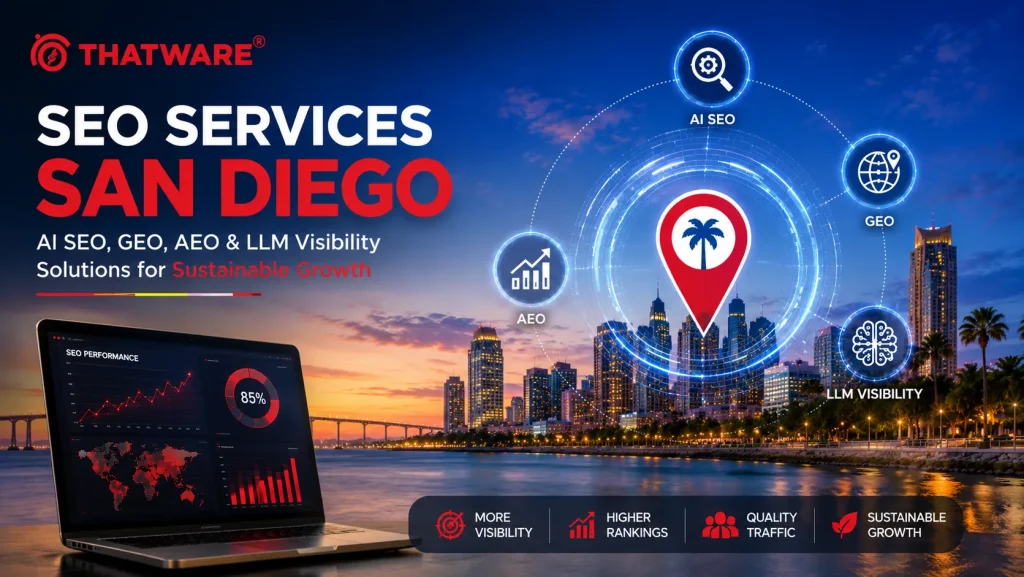
San Diego has evolved into a highly competitive digital marketplace where businesses across technology, healthcare, real estate, ecommerce, professional services, hospitality, and local industries compete for attention across search engines and emerging AI platforms. Simply having a website is no longer enough. Businesses need to be discoverable when customers search on Google, ask questions through conversational platforms, compare providers through AI systems, and look for trusted recommendations before making a decision. This is where a modern San Diego SEO Company needs to go beyond traditional optimization and build visibility across the entire search ecosystem.
1. San Diego’s Competitive Digital Marketplace
For businesses operating in San Diego, Organic SEO Services San Diego can influence nearly every stage of the customer journey—from initial discovery and research to comparison, evaluation, and conversion. Local customers may search for a service nearby, while B2B buyers may research multiple providers before contacting a company. At the same time, consumers are increasingly using AI-powered platforms to summarize options, identify businesses, compare solutions, and answer specific questions.
This creates a more complex search environment. Ranking for a handful of keywords is no longer sufficient when potential customers can discover a business through traditional search results, map listings, featured answers, AI-generated responses, knowledge panels, and conversational recommendations.
A modern SEO Agency San Diego therefore needs to understand not only how search engines rank pages, but also how information is interpreted, connected, retrieved, and presented across different search environments.
2. Why Businesses Need More Than Conventional Rankings
Traditional SEO has historically focused on keywords, backlinks, rankings, and organic traffic. These remain important, but search behavior has changed significantly.
Search engines increasingly evaluate:
- Search intent
- Context and relevance
- Entities and relationships
- Topical authority
- Website architecture
- Structured data
- User experience
- Content quality
- Brand authority
- Local relevance
- Semantic relationships
Meanwhile, AI-powered search introduces another layer of visibility. A customer might never click through ten traditional search results. Instead, they may ask an AI system:
“What is the best SEO company for a growing business in San Diego?”
The answer may contain a shortlist of companies, explanations, citations, or recommendations generated from information retrieved from multiple sources.
That means businesses must optimize for visibility, understanding, retrieval, and recommendation—not rankings alone.
This is why modern Search Engine Optimization San Diego strategies need to combine conventional SEO with semantic optimization, entity optimization, AI search visibility, AEO, GEO, and LLM-oriented content engineering.
3. ThatWare’s SEO, AI SEO, Semantic SEO and Search-Engineering Approach
ThatWare approaches SEO as a broader search-engineering discipline rather than a collection of isolated ranking tactics.
The strategy combines technical SEO, semantic SEO, entity optimization, content engineering, AI SEO, AEO, GEO, and LLM visibility to create a stronger digital presence across both conventional and emerging search systems.
The approach can include:
- Technical website analysis and optimization
- Search-intent modeling
- Semantic topic mapping
- Entity relationship optimization
- Topical authority development
- Structured data implementation
- Internal-link architecture
- Local search optimization
- Content optimization
- AI search optimization
- Generative Engine Optimization
- Answer Engine Optimization
- LLM visibility optimization
- Knowledge graph-oriented optimization
- Retrieval-friendly content structures
The objective is to make a business easier for both people and intelligent search systems to understand.
This philosophy also connects traditional SEO with newer disciplines such as AI SEO Services Belgium, Technical SEO Services Belgium, and Ecommerce SEO Services Belgium—service frameworks that demonstrate how search optimization can extend beyond conventional keyword rankings into technical infrastructure, AI discovery, semantic relationships, and transactional search.
4. Positioning as a San Diego SEO Company and SEO Agency
As a San Diego SEO Company, ThatWare focuses on developing search strategies around the actual business, audience, market, and competitive landscape rather than applying a generic checklist.
Every business has different search opportunities. A healthcare organization may need strong local authority and informational visibility. An ecommerce brand may require product and category optimization. A SaaS company may need extensive topical authority and comparison content. A professional services company may need to establish expertise and trust across both local and informational searches.
The role of an advanced SEO Agency San Diego is therefore to connect business objectives with search behavior.
That means asking:
- Who is searching?
- What are they trying to accomplish?
- Which entities are associated with the business?
- What topics demonstrate expertise?
- Which competitors dominate the search landscape?
- Where are the content and technical gaps?
- How can the website become easier to crawl, understand, and retrieve?
- How can the brand become more visible in AI-generated answers?
This approach transforms SEO from a ranking exercise into a long-term digital growth system.
5. Traditional Search + AI-Powered Discovery
The future of search is not necessarily a replacement of traditional search with AI. Instead, businesses increasingly need to operate across both environments simultaneously.
Traditional search continues to provide visibility through:
Organic Results → Maps → Featured Snippets → Images → Videos → Shopping → Local Results
AI-powered discovery adds another layer:
Conversational Queries → AI Answers → Citations → Recommendations → Knowledge Retrieval → Generative Search
A successful search strategy must therefore account for both.
For example, a San Diego business could appear in a traditional Google result for a commercial query while also being referenced when a user asks an AI platform to recommend businesses within the same category. These two experiences may rely on overlapping but not identical signals.
That is why modern SEO increasingly incorporates AEO, GEO, LLM SEO, entity optimization, semantic SEO, structured data, and AI visibility alongside conventional technical and content optimization.
The goal is simple: make the business discoverable wherever the modern customer searches.
Whether the user searches directly, asks a conversational question, explores a local recommendation, or uses an AI assistant to compare providers, the strongest brands will be those with a consistent, authoritative, structured, and easily retrievable digital presence.
The Evolution of Search and Why Traditional SEO Is No Longer Enough
Search has moved far beyond the traditional model of “type a keyword → view ten blue links → click a website.” Modern search increasingly understands context, intent, entities, relationships, location, user behavior, and the underlying meaning of a query. At the same time, AI-powered platforms are changing how people discover information, businesses, products, and services.
For businesses competing in San Diego, this means SEO can no longer be limited to improving rankings for a predefined list of keywords. A strong search strategy must help a business become discoverable, understandable, authoritative, and retrievable across multiple search environments.
Search Is No Longer Just About Keywords
Keywords remain an important component of SEO, but modern search systems increasingly attempt to understand what the searcher actually means.
Consider a query such as:
“Best SEO company for a technology startup in San Diego.”
The search engine does not only need to identify pages containing the phrase SEO company. It needs to understand concepts such as:
- SEO services
- San Diego
- Technology startups
- SEO agencies
- Business growth
- Local relevance
- Expertise
- Service providers
- Commercial intent
This represents the movement from keyword matching toward semantic understanding.
For businesses, this creates an important shift. Instead of producing multiple pages that target slightly different keyword variations, an effective SEO strategy should establish relationships between topics, services, entities, locations, questions, and user intent.
This is where semantic SEO becomes increasingly important.
A strong semantic strategy can help search engines establish:
Business → Services → Industry → Location → Expertise → Supporting Topics → User Intent
The result is a website that communicates not only what it wants to rank for, but also what the business is, what it offers, whom it serves, and why it is relevant.
From Search Results to Search Experiences
The search experience itself has also changed.
Earlier search behavior was heavily centered around navigating from search results to websites. Today, users can receive information directly through:
- Featured snippets
- Local packs
- Knowledge panels
- People Also Ask
- Video results
- Shopping results
- AI Overviews
- Conversational AI platforms
- Generative search experiences
This means a customer may interact with a brand without following the traditional path of:
Query → Ranking → Website → Click
Instead, the journey can look like:
Query → Search interpretation → AI-generated answer → Brand recommendation → Website
Or:
Question → AI retrieval → Multiple sources → Comparison → Decision
Consequently, the definition of search visibility is expanding.
A business should not measure success only by asking, “Where do we rank?”
It should also ask:
“Can search systems understand our business?”
“Are we visible for relevant questions?”
“Are our services connected to the right entities and topics?”
“Can AI systems retrieve accurate information about our brand?”
“Are we being considered when customers ask for recommendations?”
These questions are becoming increasingly important for modern Search Engine Optimization San Diego strategies.
AI Search Is Reshaping Online Discovery
Generative AI has introduced another major change in the search ecosystem.
Users can now ask conversational questions instead of constructing short keyword queries. Rather than searching for:
“SEO agency San Diego”
a potential customer might ask:
“Which SEO agencies in San Diego are experienced with technical SEO, ecommerce and AI search optimization?”
The second query contains considerably more context.
AI-powered systems can interpret this context, retrieve relevant information, compare entities, and produce a synthesized response. This changes the opportunity for businesses.
Visibility is no longer restricted to appearing on a search results page. Businesses increasingly need to become sources of information that intelligent systems can understand and retrieve.
This has led to emerging disciplines including:
- AI SEO
- Generative Engine Optimization (GEO)
- Answer Engine Optimization (AEO)
- LLM SEO
- Entity SEO
- Semantic SEO
- Knowledge graph optimization
- Retrieval-oriented content optimization
Together, these disciplines extend traditional SEO into a much broader search ecosystem.
Customer Journeys Are Becoming More Complex
The modern customer journey rarely consists of a single search.
A potential customer may begin with an informational query, move into comparison searches, ask an AI assistant for recommendations, visit several websites, check reviews, explore local listings, and then return through a branded search before converting.
A typical journey can therefore look like:
Awareness → Research → Education → Comparison → AI Discovery → Validation → Conversion
Each stage can involve different search behaviors.
Awareness
The customer identifies a problem and searches for information.
Research
The customer investigates solutions, services, products, or providers.
Comparison
The customer evaluates alternatives based on features, expertise, pricing, reputation, or relevance.
AI Discovery
The customer asks an AI platform to summarize options or recommend providers.
Validation
The customer verifies reviews, credentials, case studies, expertise, and other trust signals.
Conversion
The customer contacts the company, requests a quote, schedules an appointment, makes a purchase, or starts a conversation.
A modern SEO Company San Diego must therefore optimize for the complete journey rather than a single ranking position.
Why Traditional Ranking Metrics Are No Longer Enough
Rankings, impressions, clicks, and organic traffic remain valuable performance indicators. However, they do not necessarily capture every way a brand can be discovered.
For example, a business could gain visibility through an AI-generated answer without receiving a traditional organic click. Its information may also influence a customer’s decision before the customer performs a branded search.
This creates a broader definition of SEO performance:
Visibility + Relevance + Authority + Retrieval + Recommendation + Conversion
ThatWare’s approach therefore combines conventional SEO foundations with AI-oriented search optimization.
Technical infrastructure helps search systems access the website.
Semantic optimization helps them understand relationships between concepts.
Entity optimization helps establish what the business represents.
Content architecture provides comprehensive information around important topics.
Structured data provides machine-readable context.
AEO helps address conversational questions.
GEO focuses on visibility within generative search experiences.
LLM-oriented optimization helps make information more accessible and meaningful within AI retrieval environments.
The New Role of an SEO Agency
The role of an SEO agency is consequently evolving.
A traditional agency may focus primarily on:
Keywords → Content → Backlinks → Rankings
A modern search-engineering approach expands this model:
Business Understanding → Search Intent → Technical Infrastructure → Semantic Relationships → Entities → Content → Authority → AI Retrieval → Search Visibility → Conversion
This does not make traditional SEO irrelevant. Instead, it makes traditional SEO one component of a larger search strategy.
Technical SEO still matters.
Content still matters.
Links and authority still matter.
Local search still matters.
But these components now need to work together within a broader ecosystem of search engines, AI systems, knowledge graphs, conversational interfaces, and generative discovery.
For San Diego businesses, this is particularly important because local competition can extend across both traditional search and AI-driven discovery.
The businesses that prepare for this evolution can build visibility that is not dependent on a single search format, algorithm, or platform.
And that is the foundation of a future-ready SEO strategy: not simply optimizing a website to rank, but building a digital presence that search engines and AI systems can understand, trust, retrieve, and recommend.
AI Discovery & LLM Visibility Services for San Diego Businesses
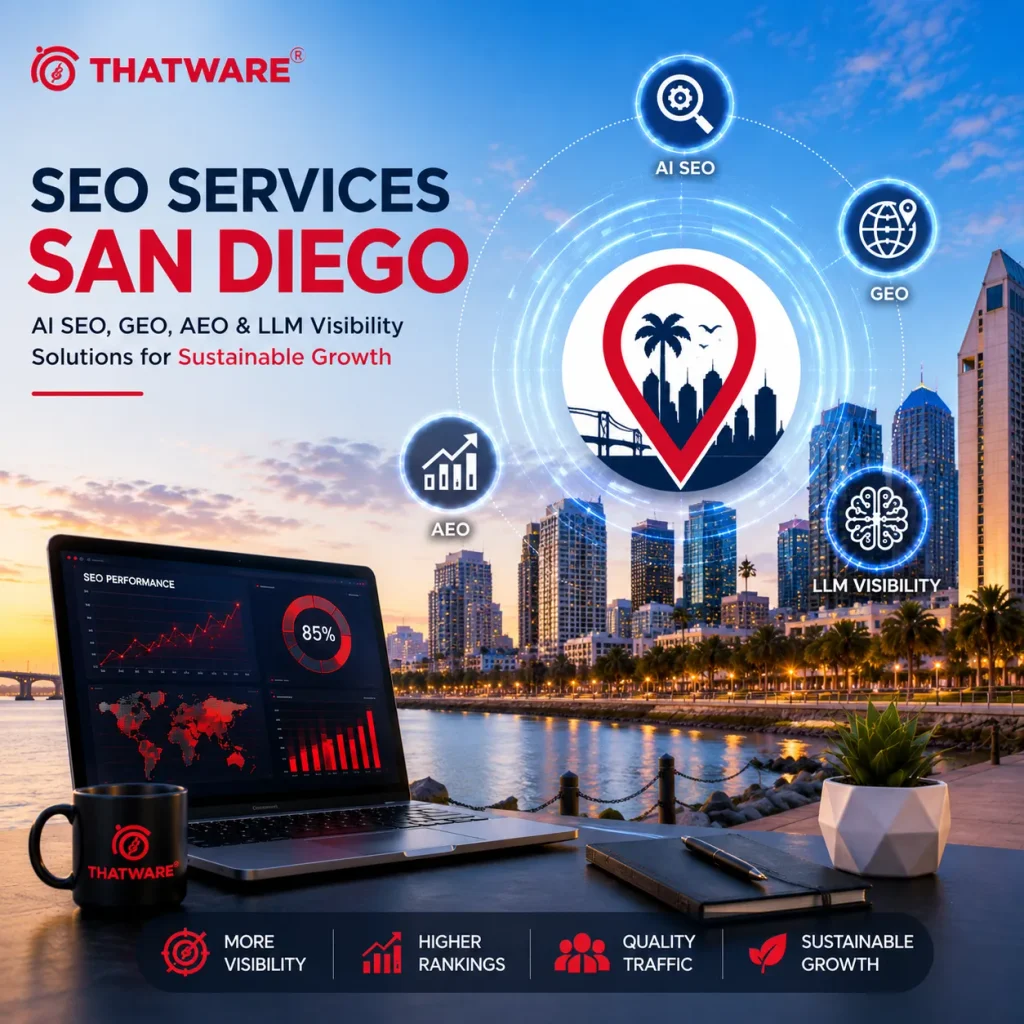
The way customers discover businesses is changing rapidly. Search is no longer limited to Google’s traditional organic results. Users can now ask ChatGPT, Gemini, Perplexity, Claude, Google AI Overviews, and other AI-powered systems to research businesses, compare services, identify experts, and recommend solutions.
For San Diego businesses, this creates a new visibility layer: AI discovery.
A company may have strong conventional rankings but still have limited visibility when potential customers ask AI systems questions about its industry, services, products, or location. Conversely, a business with strong entity signals, authoritative content, structured information, and clear topical relationships can become easier for AI systems to understand and potentially reference.
ThatWare’s AI SEO approach is designed around this emerging search environment, combining traditional search optimization with semantic SEO, entity optimization, structured data, content engineering, and LLM visibility strategies.
What Is AI Discovery?
AI discovery refers to the process through which users find businesses, products, services, information, and recommendations through AI-powered search and conversational systems.
Instead of searching:
“best SEO agency San Diego”
a user might ask:
“What are the best SEO agencies in San Diego for a business that wants technical SEO, local search and AI visibility?”
The AI system must interpret the intent behind the question, identify relevant entities, retrieve information from available sources, assess relevance and authority, and formulate an answer.
This creates a fundamentally different optimization opportunity.
The objective is no longer simply to place a keyword on a webpage. The objective is to build a coherent digital knowledge environment around the business.
That environment can include:
Brand Entity → Services → Location → Industry → Expertise → Content → Reviews → Citations → Structured Data → External Authority
When these relationships are clear and consistent, search and AI systems have more context with which to understand the business.
What Is LLM Visibility?
LLM visibility refers to how readily a business, brand, product, service, or organization can be recognized and surfaced within responses generated by large language models and AI search systems.
LLMs process enormous quantities of information and attempt to understand relationships between concepts and entities. Businesses therefore need more than isolated promotional pages. They need a consistent body of information demonstrating:
- Who the business is
- What it offers
- Where it operates
- Which industries it serves
- What topics it specializes in
- What expertise it demonstrates
- How its services relate to customer needs
- Why the business is relevant to particular search queries
This is where LLM SEO intersects with semantic SEO and entity SEO.
Rather than optimizing only individual pages, the strategy focuses on making the overall digital presence clear, connected, authoritative, and machine-understandable.
Building an AI-Ready Entity
A major component of AI visibility is establishing a recognizable business entity.
For a San Diego business, that entity can be connected across multiple dimensions:
Business Name → San Diego → Service Category → Specific Services → Industry → Expertise → People → Locations → Content → Reviews → External References
For example, an SEO company should not simply publish a page saying that it provides SEO.
Its broader digital ecosystem can communicate relationships between:
- SEO services
- Technical SEO
- Local SEO
- Ecommerce SEO
- AI SEO
- Semantic SEO
- GEO
- AEO
- LLM SEO
- San Diego
- Specific industries
- Case studies
- Expertise
- Supporting educational content
This creates greater semantic depth around the core business entity.
Our AI Discovery Framework
ThatWare approaches AI discovery through multiple interconnected optimization layers.
1. Entity Optimization
We identify the important entities associated with a business and strengthen the relationships between the brand, services, people, locations, industries, and topics.
2. Semantic Optimization
Content is structured around concepts and relationships rather than isolated keywords. This helps establish topical depth and contextual relevance.
3. Knowledge Graph Signals
Relevant information is organized so that relationships between entities are easier for search systems to interpret.
4. Structured Data
Schema markup and structured information can provide additional machine-readable context about organizations, services, products, locations, articles, FAQs, and other important entities.
5. Content Engineering
Content is developed around customer questions, search intent, related concepts, supporting topics, and information gaps.
6. Authority Development
The strategy considers the broader ecosystem of citations, mentions, references, reviews, publications, and other signals that can contribute to a business’s perceived authority.
7. Retrieval-Oriented Optimization
Information is organized into clear, logically connected sections so that important facts and answers are easier to locate and interpret.
8. AI Visibility Monitoring
AI-generated search experiences can change quickly. Monitoring helps identify how a business is represented, which queries produce visibility, and where additional optimization opportunities exist.
Optimizing for Conversational Search
AI search has also changed how people formulate queries.
Traditional search might involve:
“SEO company San Diego”
Conversational search could be:
“Which SEO company in San Diego is best for a growing ecommerce business?”
Or:
“What should I look for when choosing an SEO agency in San Diego?”
Or:
“Which San Diego SEO agencies specialize in technical SEO and AI search?”
These longer queries contain more context and often indicate stronger intent.
Our strategy therefore considers:
- Question-based searches
- Long-tail queries
- Natural-language questions
- Comparison searches
- Recommendation queries
- Local queries
- Transactional questions
- Informational questions
- Follow-up questions
This connects AI discovery with Answer Engine Optimization (AEO) and conversational search optimization.
AI Visibility Across Multiple Platforms
Modern AI discovery is distributed across multiple systems rather than controlled by a single search interface.
The optimization framework can account for environments such as:
- ChatGPT
- Google AI Overviews
- Gemini
- Perplexity
- Claude
- Generative search experiences
- Conversational assistants
- AI-powered recommendation systems
Each platform may process information differently, so there is no single tactic that guarantees visibility everywhere.
Instead, the focus is on strengthening the underlying signals that make a business relevant, understandable, authoritative, and retrievable.
AI SEO + Traditional SEO
AI optimization should not replace traditional SEO.
It should build upon it.
A technically weak website cannot become a strong AI-search asset simply by adding AI-focused content. Likewise, a website with extensive content but poor information architecture may struggle to communicate its expertise effectively.
That is why our approach connects:
Technical SEO + Content SEO + Semantic SEO + Entity SEO + Local SEO + AEO + GEO + LLM SEO
Technical foundations make information accessible.
Semantic architecture establishes relationships.
Entity optimization clarifies what the business represents.
Content demonstrates expertise.
Local optimization establishes geographic relevance.
AEO addresses questions.
GEO expands visibility within generative search.
LLM SEO focuses on AI-oriented discovery and retrieval.
Together, these components create a more comprehensive search presence.
Why AI Discovery Matters for San Diego Businesses
San Diego businesses operate in a diverse and competitive market where customers may search locally, nationally, or globally depending on the industry.
A local customer could ask an AI assistant to recommend a nearby service provider. A technology buyer could use AI to compare SaaS companies. An ecommerce customer could request product recommendations. A business executive could ask for vendors or consultants.
In each case, the customer is delegating part of the discovery process to an intelligent system.
This makes AI visibility an increasingly important component of digital strategy.
The businesses best positioned for this environment will not necessarily be those that simply publish the most content. They will be those that create clear, consistent, authoritative and interconnected information ecosystems that search engines and AI systems can interpret.
ThatWare combines this AI-first perspective with its broader search-engineering methodology to help San Diego businesses prepare for a search environment where being ranked is only one part of being discovered.
Generative Engine Optimization (GEO) for San Diego Businesses
Generative Engine Optimization (GEO) is the practice of optimizing a business’s digital presence so that it can be more effectively discovered, interpreted, referenced, and represented within AI-powered search and generative answer systems. As customers increasingly use conversational platforms to research companies, compare services, and ask for recommendations, businesses need to optimize for more than traditional search-engine rankings.
For San Diego businesses, GEO creates an additional layer of search visibility beyond conventional organic results. A customer may search Google for a service provider, but they may also ask an AI system to identify the best companies, compare providers, explain available solutions, or recommend businesses within San Diego. GEO focuses on strengthening the information and authority signals that can influence these emerging discovery experiences.
What Is GEO?
Traditional SEO primarily focuses on helping webpages achieve visibility within search-engine results. GEO expands this objective toward generative search experiences, where AI systems interpret information from multiple sources and produce synthesized responses.
Instead of optimizing only for a query such as:
“SEO agency San Diego”
GEO considers more complex conversational questions such as:
“Which SEO agencies in San Diego specialize in technical SEO, ecommerce and AI search optimization?”
The objective is to ensure that the business has a strong and understandable digital footprint around the topics, services, entities, locations, and expertise relevant to those questions.
GEO therefore connects several areas of optimization:
SEO → Semantic SEO → Entity SEO → Content Authority → Structured Data → AEO → AI Search → LLM Visibility
Why GEO Matters for San Diego Businesses
San Diego has businesses competing across highly diverse industries, including technology, healthcare, real estate, professional services, ecommerce, hospitality, education, and B2B services.
Their potential customers may use AI systems at different stages of the buying journey.
They may ask:
- Which companies provide this service?
- What are the best providers in San Diego?
- Which company specializes in a particular industry?
- What should I consider before choosing a provider?
- Which products or services are most suitable for my needs?
- How do different companies compare?
- What local businesses offer this solution?
These questions create opportunities for businesses to establish visibility beyond traditional rankings.
A strong GEO strategy helps develop the contextual authority necessary for a brand to be understood within its relevant subject areas.
Our GEO Framework for San Diego Businesses
ThatWare’s GEO methodology combines technical, semantic, content, entity, and AI-search optimization.
1. Entity Optimization
We identify the core entities associated with a business and establish meaningful relationships between the company, its services, location, industries, products, people, and areas of expertise.
For a San Diego business, geographic relevance can become an important part of this entity structure:
Business → San Diego → Service → Industry → Expertise → Relevant Topics
This provides a clearer contextual representation of the organization.
2. Semantic Content Optimization
GEO requires content that covers topics comprehensively rather than relying on repetitive keyword placement.
Content can be organized around:
- Core topics
- Related concepts
- Customer questions
- Industry terminology
- Services
- Comparisons
- Use cases
- Supporting information
- Local relevance
This creates a deeper semantic relationship between the business and the subjects it wants to be associated with.
3. Knowledge Graph Optimization
Search and AI systems increasingly rely on relationships between entities and information.
ThatWare focuses on strengthening connections between relevant entities through consistent business information, structured content, schema implementation, authoritative references, and interconnected website architecture.
The objective is to make relationships easier to understand:
Brand ↔ Service ↔ Location ↔ Industry ↔ Expertise ↔ Content
4. Structured Data Implementation
Structured data provides machine-readable information that can help search systems interpret important aspects of a website.
Depending on the business, this may include relevant structured information for:
- Organization
- Local business
- Services
- Products
- Articles
- FAQs
- Reviews
- Locations
- Events
Structured data forms one component of a broader GEO strategy rather than serving as a standalone solution.
5. Retrieval-Friendly Content
AI systems need to retrieve useful information before they can incorporate it into an answer.
Content should therefore be organized around clear questions, direct explanations, logical headings, concise definitions, supporting evidence, and strong contextual relationships.
Instead of creating content exclusively for search-engine crawlers, the goal is to make important information easy for both humans and information-retrieval systems to understand.
6. Authority and Citation Signals
Generative search systems can rely on information from multiple sources when constructing answers.
That makes broader digital authority important.
A GEO strategy can therefore consider:
- Industry publications
- Relevant directories
- Business profiles
- Reviews
- Expert content
- Brand mentions
- Authoritative references
- Digital PR
- Third-party citations
The objective is to establish a consistent and credible information footprint around the business.
GEO and Local Search
For San Diego businesses, GEO also intersects with local search.
A customer may ask an AI system:
“What are the best local SEO companies in San Diego?”
For a business to be considered relevant, its digital presence needs to communicate both what it does and where it operates.
This makes geographic entity signals particularly important.
The strategy can connect:
Business Name + San Diego + Services + Neighborhoods/Areas + Industry + Expertise
This works alongside Local SEO Services San Diego, Google Business Profile optimization, local content, citations, reviews, location pages, and conventional local-search signals.
GEO and AEO Work Together
GEO and Answer Engine Optimization (AEO) are closely connected but serve different aspects of modern search.
AEO focuses heavily on providing direct answers to questions.
GEO focuses more broadly on visibility within generative and AI-powered search experiences.
For example, AEO can help a business provide a strong answer to:
“What does technical SEO involve?”
GEO extends this by helping establish the business as a relevant entity associated with technical SEO, its broader services, expertise, location, and supporting topics.
Together, they create a stronger foundation for AI-powered discovery.
GEO + LLM SEO
GEO also overlaps with LLM SEO because both consider how AI systems process and retrieve information.
A modern strategy therefore considers:
Entity Recognition → Semantic Relationships → Content Retrieval → Context → Authority → AI Representation
The objective is not to attempt to control what an AI system says. No legitimate optimization methodology can guarantee a specific AI-generated response.
Instead, the objective is to build a digital presence with strong, consistent, authoritative information that makes the business more relevant and understandable within AI-driven discovery environments.
GEO for Different San Diego Business Models
GEO can be adapted according to business type.
Local service businesses can focus on geographic relevance, services, customer questions, reviews, and local entities.
Ecommerce businesses can optimize product entities, categories, attributes, use cases, product information, and transactional content.
SaaS companies can build topical authority around software categories, use cases, integrations, comparisons, and customer problems.
Professional service firms can strengthen expertise around their practice areas, industries, locations, and client questions.
Enterprise organizations can develop broader entity ecosystems connecting brands, products, locations, business units, executives, publications, and industry expertise.
Measuring GEO Performance
GEO requires a broader measurement framework than traditional ranking reports.
Important areas can include:
- AI search visibility
- Brand mentions
- AI citations
- Entity recognition
- Relevant query visibility
- Competitive AI presence
- Referral traffic
- Organic visibility
- Branded search growth
- Local visibility
- Conversion performance
The goal is to understand whether the brand is becoming more visible and authoritative across the expanding search ecosystem.
The Future of GEO
Generative search is still evolving, and the specific mechanisms used by AI platforms will continue to change. That makes short-term tactics less valuable than building durable fundamentals.
Businesses should focus on creating:
Accurate Information + Strong Entities + Semantic Depth + Technical Accessibility + Topical Authority + Structured Data + Consistent Brand Signals
That foundation can support visibility across both today’s search engines and tomorrow’s AI-powered discovery systems.
For San Diego businesses, GEO is therefore not simply another SEO tactic. It represents a broader shift from ranking webpages to establishing digital entities that search engines and AI systems can understand, retrieve, and associate with relevant customer needs.
Answer Engine Optimization (AEO) for San Diego Businesses
Answer Engine Optimization (AEO) is the practice of structuring and optimizing digital content so that search engines, answer engines, and AI-powered systems can more easily understand and deliver information in response to user questions. As search behavior becomes increasingly conversational, customers are moving from short keyword searches toward complete questions, comparisons, and specific requests.
For San Diego businesses, this creates an opportunity to become visible not only in conventional organic results but also in direct answers, featured snippets, People Also Ask results, voice search, AI-generated responses, and conversational search experiences.
A modern AEO strategy focuses on answering the questions customers actually ask while establishing the business as a relevant, authoritative source within its industry and location.
What Is Answer Engine Optimization?
Traditional SEO often focuses on ranking a webpage for a particular keyword. AEO takes a more question-oriented approach.
Instead of optimizing only for:
“SEO company San Diego”
an AEO strategy considers questions such as:
- What is the best SEO company in San Diego?
- How much do SEO services cost in San Diego?
- What does an SEO agency do?
- How long does SEO take?
- What is the difference between local SEO and technical SEO?
- How can a San Diego business improve its Google rankings?
- Which SEO services are best for ecommerce businesses?
The objective is to provide clear, accurate, contextually relevant answers while connecting those answers to the business’s broader expertise.
AEO therefore sits at the intersection of:
Search Intent + Question Optimization + Structured Content + Semantic SEO + Entity SEO + Technical SEO + AI Search
Why AEO Matters for San Diego Businesses
Customers increasingly want immediate answers rather than having to browse through numerous websites.
Someone searching for a healthcare provider may ask an AI assistant which local providers offer a particular service. A property buyer may ask which San Diego neighborhoods are suitable for a particular type of investment. An ecommerce customer may ask which product is best for a specific use case.
These searches are highly contextual.
For businesses, appearing as a useful answer can create visibility before a customer ever visits a website.
AEO can help businesses target different stages of the customer journey:
Question → Answer → Education → Evaluation → Comparison → Conversion
This makes answer optimization particularly valuable for businesses that depend on expertise, trust, local relevance, and detailed customer education.
Optimizing Content Around Search Intent
Effective AEO begins with understanding why someone is asking a question.
Search questions can generally fall into several intent categories.
Informational Intent
The user wants to understand something.
Examples:
- What is technical SEO?
- How does local SEO work?
- What is GEO?
- What is AI SEO?
Content should provide concise explanations followed by sufficient supporting context.
Commercial Investigation
The user is evaluating possible solutions.
Examples:
- What should I look for in an SEO agency?
- Which SEO services does a growing business need?
- How much does professional SEO cost?
These searches require useful comparisons, criteria, explanations, and evidence.
Transactional Intent
The user is ready to take action.
Examples:
- Hire an SEO consultant San Diego
- SEO services San Diego
- Ecommerce SEO agency San Diego
These pages should combine relevant information with clear conversion pathways.
Local Intent
The user wants a geographically relevant business or service.
Examples:
- SEO company near me
- Best SEO agency in San Diego
- Local SEO services San Diego
Local intent requires strong connections between the business, its services, and geographic entities.
Question-Based Content Architecture
AEO works best when questions are integrated into a broader content architecture rather than added as an isolated FAQ section.
A strong structure might look like:
Core Service → Related Questions → Detailed Answers → Supporting Topics → Examples → FAQs → Conversion Path
For example:
Technical SEO
→ What is technical SEO?
→ Why does technical SEO matter?
→ What does a technical SEO audit include?
→ How does technical SEO affect crawling?
→ How does technical SEO affect indexing?
→ How can technical SEO improve website performance?
This approach creates topical depth while addressing the questions users are actually asking.
Featured Snippet Optimization
Featured snippets remain an important answer-oriented search opportunity.
Content can be structured to provide direct responses using:
- Concise definitions
- Numbered steps
- Bullet lists
- Comparison tables
- Short explanatory paragraphs
- Clearly structured headings
- Question-and-answer sections
However, optimization should not be reduced to formatting alone.
The underlying content still needs to demonstrate relevance, accuracy, authority, and contextual depth.
AEO and Structured Data
Structured data can provide search engines with additional machine-readable information about a webpage and its content.
Depending on the business and page type, relevant structured information may include:
- Organization
- LocalBusiness
- Service
- Product
- Article
- FAQ
- Breadcrumb
- Review
- Event
Structured data is not a guarantee that a page will appear as an answer or rich result. Instead, it forms part of a broader technical and semantic framework that helps search systems interpret website information.
AEO for Voice Search
Conversational search has also increased the importance of natural-language questions.
Voice searches tend to be more conversational than traditional typed queries.
Instead of:
“SEO services San Diego”
a user might ask:
“Who provides SEO services for small businesses in San Diego?”
This creates opportunities for businesses to develop content around natural questions, long-tail queries, conversational language, and locally relevant answers.
AEO therefore supports both traditional search and conversational discovery.
AEO and Local SEO
For San Diego businesses, AEO and local SEO can work together particularly effectively.
A customer may ask:
“Where can I find a reliable SEO consultant in San Diego?”
To establish local relevance, the business’s digital presence should consistently communicate:
Business → Service → San Diego → Industry → Expertise
Local landing pages, business information, reviews, relevant citations, structured data, and locally focused content can all contribute to this broader ecosystem.
This makes AEO an important extension of Local SEO Services San Diego, rather than a replacement for local search optimization.
AEO and AI Search
The emergence of generative AI has expanded the role of answer optimization.
AI systems can interpret complex questions and generate responses that synthesize information from multiple sources. As a result, businesses need content that is not only optimized for search engines but also clear enough to be interpreted and retrieved within AI-powered environments.
This creates an overlap between:
AEO + GEO + LLM SEO + Semantic SEO + Entity SEO
AEO focuses on answering questions.
GEO focuses on generative search visibility.
LLM SEO focuses on AI-oriented retrieval and visibility.
Semantic SEO establishes contextual relationships.
Entity SEO strengthens the identity and relationships surrounding the business.
Together, these disciplines create a more comprehensive approach to modern search.
Our AEO Framework for San Diego Businesses
ThatWare’s AEO strategy can include:
1. Question Research
Identifying questions customers ask across informational, commercial, transactional, and local search.
2. Search Intent Classification
Mapping each question to the underlying customer intent.
3. Answer Development
Creating direct, useful responses supported by deeper contextual information.
4. Semantic Expansion
Connecting questions with related concepts, entities, services, and topics.
5. Content Architecture
Organizing answers into logical topic clusters and information hierarchies.
6. Technical Optimization
Ensuring content can be crawled, rendered, indexed, and understood effectively.
7. Structured Data
Implementing appropriate schema where relevant.
8. AI Search Optimization
Extending answer-oriented content toward generative and conversational search environments.
9. Performance Monitoring
Evaluating organic visibility, featured-result opportunities, qualified traffic, conversions, and broader AI-search visibility.
AEO for Different San Diego Industries
Different industries require different answer strategies.
Healthcare:
Questions about symptoms, treatments, procedures, providers, and services require particularly clear and trustworthy informational content.
Real Estate:
Customers may ask about neighborhoods, property types, buying processes, investment considerations, and market terminology.
SaaS:
Users often search for comparisons, integrations, features, use cases, alternatives, and implementation guidance.
Ecommerce:
Questions can revolve around product features, compatibility, use cases, comparisons, sizing, materials, and purchasing decisions.
Professional Services:
Potential clients may ask about costs, processes, qualifications, timelines, legal or financial considerations, and how to select a provider.
Measuring AEO Success
AEO performance should not be evaluated solely through conventional keyword rankings.
Relevant indicators can include:
- Featured snippet visibility
- Answer-oriented search impressions
- People Also Ask visibility
- Organic traffic
- Question-query growth
- Long-tail visibility
- Local search visibility
- Brand searches
- Qualified leads
- Conversion rates
- AI-generated visibility
- Citation and mention opportunities
The most meaningful measurement remains business impact.
An answer that generates visibility but does not attract relevant prospects has limited commercial value. A strong AEO strategy therefore connects answer visibility with customer intent and conversion opportunities.
The Future of Answer Engine Optimization
Search is increasingly becoming conversational, contextual, and answer-oriented.
Customers want direct responses, useful recommendations, and explanations that help them make decisions faster. Search engines and AI systems are adapting to this behavior.
For San Diego businesses, the opportunity is to become a reliable source of answers within their specific markets.
That means creating content that does more than target keywords. It should answer real questions, demonstrate expertise, establish topical authority, communicate local relevance, and provide structured information that modern search systems can understand.
AEO is therefore not simply about winning a featured snippet. It is about building a digital knowledge base around a business that can support visibility across Google search, conversational search, voice search, AI Overviews, generative engines, and emerging answer-driven discovery experiences.
LLM SEO for San Diego Businesses
LLM SEO, or Large Language Model Optimization, focuses on improving how a business is understood, retrieved, interpreted, and represented by AI systems powered by large language models. As customers increasingly use conversational platforms to research companies, services, products, and local providers, businesses need to think beyond conventional search rankings and consider how their information is processed within AI-driven discovery environments.
For San Diego businesses, LLM SEO creates an opportunity to build visibility around the brand, services, expertise, location, industry, and topical authority that AI systems may use when responding to user questions.
A traditional search strategy might target a query such as:
“SEO company San Diego”
An LLM-oriented strategy considers much more contextual questions, such as:
“Which SEO companies in San Diego specialize in AI SEO and technical optimization?”
“What should a San Diego ecommerce business look for in an SEO agency?”
“Which SEO consultant in San Diego has experience with AI-powered search?”
These queries require an AI system to understand relationships between businesses, services, locations, industries, expertise, and user intent. LLM SEO is designed around strengthening those relationships.
What Is LLM SEO?
LLM SEO is an extension of modern search optimization that considers how large language models and AI-powered search systems discover and interpret information.
Rather than focusing exclusively on:
Keyword → Webpage → Ranking
LLM SEO considers:
Entity → Context → Relationships → Content → Authority → Retrieval → AI Response
This means a business needs a digital presence that clearly communicates:
- Who the organization is
- What services it provides
- Where it operates
- Which industries it serves
- What topics it specializes in
- What problems it solves
- What expertise it demonstrates
- Which entities and concepts it is associated with
- What authoritative information exists about the business
This broader approach makes LLM SEO closely connected with semantic SEO, entity SEO, AEO, GEO, technical SEO, and content engineering.
Why LLM SEO Matters for San Diego Businesses
AI-powered discovery is changing how potential customers research businesses.
Instead of opening multiple search results and manually comparing companies, users can ask an AI system to perform part of the research for them.
For example:
“Find reputable SEO companies in San Diego that can help a SaaS company improve organic traffic and AI search visibility.”
The system needs to interpret several concepts simultaneously:
Location + Service + Industry + Expertise + Business Need + Reputation
A business with a clear and authoritative digital footprint has a stronger foundation for being understood within this type of search environment.
This is particularly relevant for San Diego’s technology, healthcare, ecommerce, real estate, professional services, hospitality, and B2B sectors, where customers often conduct extensive research before making a decision.
Entity Optimization for LLMs
One of the central components of LLM SEO is entity optimization.
AI systems need to distinguish between entities and understand how those entities relate to one another.
For a business, this can involve establishing relationships such as:
Brand → San Diego → SEO Company → SEO Services → Technical SEO → Local SEO → AI SEO → GEO → AEO → LLM SEO
Additional relationships can connect the company to:
Industries → Clients → Case Studies → Experts → Publications → Reviews → Locations → Topics
The more consistently these relationships are represented across the digital ecosystem, the clearer the business’s overall entity becomes.
Semantic SEO and LLM Visibility
LLMs are designed to process language and meaning rather than simply matching exact keyword strings.
This makes semantic SEO an important component of LLM optimization.
Instead of repeatedly using the same keyword, content can establish relationships between:
- Core topics
- Related concepts
- Services
- Questions
- Entities
- Industry terminology
- Search intent
- Use cases
- Locations
For example, a page about Technical SEO Services San Diego could naturally address crawling, indexing, JavaScript rendering, site architecture, Core Web Vitals, structured data, internal linking, canonicalization, and website performance.
These concepts collectively communicate what technical SEO means within the business’s broader service ecosystem.
Content Designed for AI Retrieval
LLM SEO also places emphasis on how information is structured.
Important information should be easy to identify and understand.
That means using:
- Descriptive headings
- Clear definitions
- Direct answers
- Logical sections
- Concise explanations
- Supporting evidence
- Contextual internal links
- Consistent terminology
- Structured information
- Comprehensive topic coverage
A well-structured page can make it easier for both humans and information-retrieval systems to locate relevant information.
This does not mean writing robotic content for machines. The strongest approach remains human-first content supported by machine-understandable structure.
LLM SEO and Knowledge Graphs
Knowledge graphs represent relationships between entities and information.
For businesses, knowledge-oriented optimization can help establish relationships between:
Organization ↔ Services ↔ Products ↔ People ↔ Locations ↔ Industries ↔ Topics
ThatWare’s approach considers these relationships as part of a broader entity and semantic SEO framework.
Consistent organization information, structured data, authoritative references, relevant content, and external mentions can all contribute to a more coherent digital representation of the business.
LLM SEO and Structured Data
Structured data can provide machine-readable information about important website elements.
Depending on the business, this may include:
- Organization information
- Local business information
- Services
- Products
- Articles
- FAQs
- Reviews
- Locations
- Events
- Breadcrumbs
Structured data does not guarantee inclusion in an AI-generated response. However, it can contribute to a clearer technical representation of website information and support broader search-engine understanding.
LLM SEO for Conversational Queries
LLM-driven search is inherently conversational.
Users can ask detailed questions containing multiple requirements.
For example:
“What is the best SEO strategy for a San Diego ecommerce business competing with national brands?”
This is substantially different from:
“ecommerce SEO San Diego.”
The conversational query contains:
- Location
- Business model
- Competitive environment
- Search intent
- Industry context
- Desired outcome
LLM SEO therefore considers natural-language query patterns, long-tail questions, comparisons, recommendations, problem-based searches, and follow-up questions.
LLM SEO and Local Search
For San Diego businesses, geographic context is particularly important.
A business needs to communicate its geographic relevance consistently across its website and broader digital presence.
This can connect:
Business → San Diego → Service → Neighborhood/Area → Industry → Customer Need
This complements conventional Local SEO Services San Diego by extending geographic relevance into conversational and AI-oriented discovery.
A business that clearly communicates where it operates, what it provides, and whom it serves has a stronger contextual foundation for local AI queries.
LLM SEO for Ecommerce
Ecommerce businesses have additional opportunities because AI systems can interpret detailed product requirements.
Customers may ask:
“What are the best products for [specific use case]?”
or:
“Compare these products based on price, features, compatibility and customer requirements.”
An LLM-ready ecommerce architecture can therefore include clear product information, attributes, categories, use cases, comparisons, FAQs, specifications, reviews, and supporting educational content.
This complements Ecommerce SEO Services San Diego by making product and category information more structured and contextually meaningful.
LLM SEO for Different Industries
Healthcare businesses can develop authoritative informational resources around services, procedures, patient questions, and provider expertise.
Real estate companies can create comprehensive content around properties, locations, market concepts, buying processes, and investment considerations.
SaaS companies can build topical authority around software categories, use cases, integrations, features, comparisons, and customer problems.
Professional service firms can establish expertise around practice areas, industries, processes, and frequently asked questions.
Ecommerce brands can strengthen product entities through detailed specifications, categories, use cases, comparisons, and transactional content.
Our LLM SEO Framework
ThatWare’s LLM SEO approach can be organized into several interconnected layers:
1. Entity Discovery
Identify the important business, service, product, location, industry, and topic entities.
2. Entity Relationship Mapping
Establish meaningful relationships between those entities.
3. Search Intent Analysis
Identify informational, commercial, transactional, local, and conversational intent.
4. Semantic Content Architecture
Build topic clusters and supporting content around important subjects.
5. Technical Optimization
Improve crawlability, indexability, rendering, architecture, performance, and structured data.
6. Retrieval-Friendly Content
Present important information through clear, logically structured content.
7. Authority Development
Strengthen the broader ecosystem of relevant references, citations, mentions, reviews, and expert content.
8. AI Visibility Analysis
Evaluate how the brand appears across relevant AI-powered search experiences and identify areas for improvement.
LLM SEO vs Traditional SEO
Traditional SEO remains foundational, but LLM SEO expands the optimization framework.
| Traditional SEO | LLM SEO |
| Keyword rankings | Contextual visibility |
| Search queries | Conversational queries |
| Webpage relevance | Entity relevance |
| Keywords | Concepts and relationships |
| Organic results | AI-generated responses |
| SERP visibility | AI discovery visibility |
| Backlinks | Broader authority signals |
| Content optimization | Retrieval-oriented content |
| Search intent | Search + conversational intent |
| Technical SEO | Technical + machine understanding |
The two approaches should not be treated as competing strategies.
LLM SEO builds on strong conventional SEO foundations.
Technical accessibility, quality content, authoritative references, strong architecture, structured information, and relevant search intent remain important. LLM SEO adds another layer focused on how information can be interpreted and retrieved within AI-driven environments.
Measuring LLM SEO Performance
LLM SEO requires a broader measurement framework than conventional rankings alone.
Potential indicators include:
- AI search visibility
- Brand mentions
- Citation frequency
- Relevant query presence
- Entity recognition
- Competitor visibility
- Branded search growth
- Organic traffic
- Referral traffic
- Qualified leads
- Conversion performance
The objective is not simply to generate more AI mentions. The objective is to increase relevant visibility that contributes to brand discovery, trust, engagement, and business outcomes.
Building a Future-Ready LLM Presence
LLM platforms and AI search interfaces will continue to evolve. Specific ranking or retrieval mechanisms may change, which makes short-term manipulation tactics unreliable.
A more sustainable approach is to build strong fundamentals:
Clear Entities + Semantic Depth + Authoritative Content + Technical Accessibility + Structured Information + Consistent Brand Signals
For San Diego businesses, this means preparing for a search environment where customers can discover companies through traditional search engines and AI systems simultaneously.
LLM SEO is therefore not about trying to “hack” an AI model. It is about building a clear, credible, interconnected digital knowledge base that helps modern search systems understand what a business does, where it operates, what it knows, and why it is relevant.
That is the foundation for becoming more discoverable across the next generation of search.
ChatGPT Optimization for San Diego Businesses
ChatGPT has become an important part of the modern discovery journey, allowing users to ask detailed questions, compare businesses, research services, and explore solutions through natural-language conversations. For San Diego businesses, this creates a new opportunity to strengthen visibility beyond conventional search results.
ChatGPT optimization focuses on making a business’s digital presence easier to understand within an AI-driven information environment. Rather than attempting to manipulate ChatGPT or guarantee a particular response, the objective is to establish the entity authority, contextual relevance, semantic depth, and information consistency that support broader AI discoverability.
Entity Authority
A strong business entity should have a clear and consistent identity across its digital ecosystem.
ThatWare can strengthen relationships between:
Business → Services → San Diego → Industry → Expertise → Topics → Supporting Content
Consistent business information, service descriptions, authoritative content, structured information, and relevant external references can help create a stronger entity footprint.
Brand Recognition
AI-driven discovery requires more than keyword visibility. The business needs to be clearly associated with the products, services, industries, and locations it serves.
A San Diego company should consistently communicate:
- Brand identity
- Primary services
- Geographic coverage
- Industry expertise
- Areas of specialization
- Supporting knowledge
- Business credentials
- Relevant customer use cases
This creates stronger contextual associations around the brand.
Knowledge Graph Presence
Knowledge graphs help represent relationships between entities and concepts.
For a business, relevant relationships may include:
Brand ↔ Service ↔ Location ↔ Industry ↔ Expertise ↔ People ↔ Content
ThatWare’s approach considers these relationships through entity optimization, structured information, semantic content, consistent business data, and authoritative references.
Citation Readiness
AI systems may use information from different sources when generating responses. Businesses therefore benefit from having accurate, accessible, and authoritative information available across their digital ecosystem.
Citation readiness can involve:
- Authoritative website content
- Expert resources
- Industry publications
- Relevant business profiles
- Digital PR
- Third-party references
- Reviews
- Structured business information
The objective is to build a credible information footprint rather than manufacture citations.
Semantic Search Signals
Semantic optimization helps establish relationships between related concepts.
For example, a San Diego SEO business can develop contextual relevance around:
SEO → Technical SEO → Local SEO → Ecommerce SEO → AI SEO → AEO → GEO → LLM SEO
Supporting topics can further demonstrate expertise and topical depth.
Structured Data
Structured data can provide search systems with machine-readable information about organizations, services, products, articles, FAQs, locations, and other entities.
Schema implementation can therefore support the broader effort to communicate:
What the business is → What it provides → Where it operates → What information it publishes
Structured data should be treated as one component of a comprehensive optimization strategy rather than a guarantee of ChatGPT visibility.
Contextual Relevance
ChatGPT users frequently ask questions containing multiple contextual requirements.
For example:
“Which SEO company in San Diego specializes in ecommerce businesses and AI search optimization?”
A business needs to establish relationships between its location, services, industry expertise, and specialization rather than simply target individual keywords.
Contextual relevance is therefore central to modern AI SEO.
Topical Authority
A business can strengthen its topical authority by developing comprehensive content around its areas of expertise.
This may include:
- Service pages
- Educational resources
- Industry guides
- Comparisons
- FAQs
- Case studies
- Research
- Expert insights
- Supporting topic clusters
The goal is to demonstrate genuine depth around the subjects the brand wants to be associated with.
Gemini Optimization for San Diego Businesses
Gemini represents another important environment within the evolving AI and search ecosystem. Businesses need to ensure that their digital information is organized clearly enough to establish relevance across search contexts, entities, topics, and geographic relationships.
Gemini optimization should therefore be approached as part of a broader AI SEO Services San Diego strategy rather than as a standalone ranking tactic.
Entity Relevance
A business should have a consistent identity across its website and wider digital presence.
Important relationships can include:
Business → Service → Location → Industry → Expertise
This helps establish what the organization represents and the subjects with which it should be associated.
Semantic Authority
Semantic authority comes from demonstrating comprehensive knowledge around a subject.
Instead of creating pages around isolated keywords, content can connect:
- Primary topics
- Related concepts
- Services
- Customer questions
- Industry terminology
- Use cases
- Supporting subjects
This creates greater contextual depth.
AI Discoverability
AI discoverability refers to how easily a business can be identified and understood within AI-powered search and discovery environments.
A strong foundation includes:
Technical Accessibility + Quality Content + Entity Clarity + Semantic Relevance + Authority
Search-Context Understanding
Modern queries often include multiple requirements.
For example:
“Find a San Diego SEO agency experienced in technical SEO for healthcare companies.”
This combines:
Location + Service + Expertise + Industry
Optimization should therefore address these relationships rather than relying exclusively on exact-match keyword targeting.
Knowledge Graph Connections
Relevant entities can be connected through consistent information, structured data, authoritative content, internal linking, and external references.
This can help communicate relationships between the organization and its:
- Services
- Locations
- Industries
- Products
- Topics
- Experts
- Content
Structured Information
Clear information architecture makes important business information easier to identify.
This includes:
- Clear service descriptions
- Organization information
- Location information
- Product details
- Author information
- FAQs
- Supporting content
- Structured data
Topical Relevance
Topical relevance is strengthened when a business consistently publishes useful information around its core expertise.
A San Diego SEO business, for example, can build topical depth around technical SEO, local SEO, ecommerce SEO, AI SEO, semantic search, GEO, AEO, and LLM SEO.
Perplexity Optimization for San Diego Businesses
Perplexity has helped popularize a search experience where users can ask questions and receive synthesized answers accompanied by source references. This makes source accessibility, content credibility, and citation readiness particularly relevant to businesses seeking visibility within AI-powered research.
Perplexity optimization should focus on making authoritative information available and easy to understand rather than attempting to force inclusion in generated answers.
Citation Acquisition Opportunities
Businesses can increase their potential citation footprint by developing genuinely useful information that other sources can reference.
Potential opportunities include:
- Original research
- Expert insights
- Industry resources
- Detailed guides
- Data-driven content
- Case studies
- Authoritative service information
- Digital PR
The goal is to build content worth referencing.
Authority Building
Authority extends beyond backlinks.
A strong authority ecosystem can include:
Expertise + Quality Content + Relevant References + Brand Mentions + Reviews + Industry Recognition
This broader footprint can reinforce the credibility of the business.
Source Accessibility
Important information should be accessible to search systems and users.
This means maintaining:
- Crawlable pages
- Clear site architecture
- Descriptive headings
- Accessible content
- Logical internal linking
- Strong technical foundations
- Consistent business information
Structured Information
Important facts should be clearly communicated rather than buried inside complex page structures.
Businesses can structure information around:
- Services
- Products
- Locations
- Expertise
- FAQs
- Pricing information where appropriate
- Processes
- Use cases
- Customer questions
Entity Relationships
Perplexity-style research queries can involve several entities simultaneously.
For example:
Business ↔ Service ↔ San Diego ↔ Industry ↔ Customer Need
Building these relationships throughout the website creates stronger contextual relevance.
Content Credibility
AI-powered research places significant value on useful information.
Credibility can be supported through:
- Expert authorship
- Evidence
- Original research
- References
- Case studies
- Transparent business information
- Accurate claims
- Updated content
Topical Expertise
A business should demonstrate depth within its core subject areas rather than publishing disconnected content solely to capture search traffic.
Topical clusters, comprehensive guides, supporting articles, FAQs, and expert resources can help establish a recognizable area of expertise.
Claude Optimization for San Diego Businesses
Claude is another conversational AI environment where users can conduct research, analyze information, and explore complex topics through natural language.
For San Diego businesses, optimization should focus on building a clear, coherent information ecosystem that communicates who the business is, what it does, where it operates, and what expertise it possesses.
Contextual Relevance
AI systems interpret information within context.
A page about SEO becomes more meaningful when its relationship to:
San Diego + SEO Services + Business Growth + Industry + Expertise
is clearly established.
This is why contextual optimization is more valuable than repetitive keyword placement.
Entity Relationships
A business entity can be connected with:
- Services
- Products
- Locations
- Industries
- People
- Topics
- Publications
- Case studies
These relationships create a broader semantic representation of the organization.
Semantic Authority
Semantic authority comes from demonstrating depth and relevance across connected topics.
A business should provide comprehensive information rather than fragmented pages that target isolated keyword variations.
Brand Consistency
Information about the business should remain consistent across its:
- Website
- Business profiles
- Publications
- Social presence
- Industry listings
- Press coverage
- Third-party references
Consistency reduces ambiguity and strengthens the overall brand entity.
Information Clarity
Clear information architecture is essential.
Important business information should be presented through:
- Descriptive headings
- Concise definitions
- Logical sections
- Clear service descriptions
- FAQs
- Supporting evidence
- Relevant internal links
This makes information easier for people and machines to interpret.
Trust Signals
Trust can be reinforced through:
- Expert authorship
- Reviews
- Case studies
- Credentials
- Client outcomes
- Authoritative references
- Transparent business information
- High-quality content
AI-Readable Content
AI-readable content does not mean content written unnaturally for machines.
The strongest approach combines human-first writing with clear machine-readable structure.
Content should be:
Clear + Specific + Contextual + Structured + Authoritative
This supports both conventional search and AI-oriented discovery.
Google AI Overviews Optimization for San Diego Businesses
Google AI Overviews have expanded the search experience by providing AI-generated summaries directly within search results for certain queries. This means businesses increasingly need to consider how their content can contribute to broader search understanding rather than focusing exclusively on traditional blue-link rankings.
Optimization should therefore combine strong SEO foundations with semantic relevance, entity clarity, structured information, topical authority, and trustworthy content.
AI-Generated Search Experiences
AI-generated search experiences can synthesize information from multiple sources to help users answer complex queries.
A San Diego business should therefore develop content that clearly addresses:
- What it provides
- Who it serves
- Where it operates
- What problems it solves
- What expertise it possesses
- Why its information is useful
Entity Recognition
Clear organization information and consistent references can help establish the business as a distinct entity.
Relevant relationships include:
Brand → Services → San Diego → Industry → Expertise
These relationships should remain consistent throughout the website and broader digital ecosystem.
Semantic Relevance
Semantic relevance goes beyond exact keyword matching.
For example, a page targeting Technical SEO Services San Diego can naturally establish relevance through related concepts such as:
- Crawling
- Indexing
- Site architecture
- Structured data
- JavaScript rendering
- Core Web Vitals
- Internal linking
- Canonicalization
- Website performance
Together, these concepts provide stronger topical context.
Knowledge Graph Authority
Knowledge-oriented optimization focuses on establishing meaningful relationships between entities.
For a business, these can include:
Organization ↔ Services ↔ Locations ↔ People ↔ Products ↔ Industries ↔ Topics
Consistent information, structured data, authoritative references, and comprehensive content can contribute to this broader entity ecosystem.
Structured Data
Structured data can help communicate information about relevant entities and page types in a machine-readable format.
Depending on the website, this can include:
- Organization
- LocalBusiness
- Service
- Product
- Article
- Breadcrumb
- FAQ
- Review
- Event
Structured data should complement—not replace—high-quality content and strong technical SEO.
Citation Opportunities
AI-generated search experiences may draw upon information from multiple sources. Creating authoritative, useful, and well-supported content can therefore create opportunities for the business’s information to become part of the wider search information ecosystem.
Relevant assets can include:
- Original research
- Expert guides
- Case studies
- Industry resources
- Data-driven articles
- Service documentation
- Authoritative educational content
Topical Authority
Topical authority becomes increasingly important as search engines move toward understanding subjects rather than simply matching individual phrases.
A business can develop authority through interconnected content covering:
Core Service → Related Services → Customer Questions → Industry Topics → Use Cases → Comparisons → Supporting Resources
This approach helps create a deeper information ecosystem around the business.
Trust Signals
AI-powered search does not eliminate the importance of trust.
Businesses should continue strengthening:
- Expertise
- Accurate information
- Reviews
- Case studies
- Author credentials
- Relevant references
- Transparent business details
- Technical quality
- User experience
The objective is to create a digital presence that is useful to users and understandable to modern search systems.
Building One Unified AI Search Strategy
Although ChatGPT, Gemini, Perplexity, Claude, and Google AI Overviews provide different search experiences, businesses should avoid creating five completely separate SEO strategies.
The stronger approach is to build a unified foundation:
Technical SEO
↓
Semantic SEO
↓
Entity Optimization
↓
Topical Authority
↓
Structured Information
↓
AEO
↓
GEO
↓
LLM Visibility
This creates a scalable AI SEO framework where the same high-quality business information can support visibility across multiple search environments.
For San Diego businesses, the ultimate objective is not to optimize for one AI platform. It is to establish a strong, consistent, authoritative digital entity that can be discovered and understood wherever customers search—whether through Google, ChatGPT, Gemini, Perplexity, Claude, or the next generation of AI-powered search experiences.
Why Businesses in San Diego Choose ThatWare
Choosing an SEO partner is no longer simply about finding an agency that can improve keyword rankings. San Diego businesses need an SEO partner that understands technical infrastructure, search intent, semantic relationships, local visibility, AI-powered discovery, and the changing behavior of search engines.
ThatWare combines these disciplines into an integrated search-engineering framework designed to build visibility, relevance, authority, and measurable business growth.
AI-Driven SEO Framework
ThatWare uses an AI-driven approach to identify search opportunities and develop strategies around how customers actually search.
Data-Driven Analysis
SEO decisions are supported by analysis of search behavior, website performance, competitors, content gaps, technical signals, and market opportunities. This creates a strategy based on measurable evidence rather than assumptions.
Search-Intent Modeling
Different searches represent different stages of the customer journey. We analyze informational, commercial, transactional, local, and conversational intent to understand what users are trying to accomplish.
This allows content and landing pages to be aligned with the purpose behind the search, not simply the keyword itself.
Competitive Intelligence
Understanding competitors is essential in a competitive market such as San Diego. Competitive analysis can reveal:
- Keyword opportunities
- Content gaps
- Topical gaps
- Technical weaknesses
- Backlink opportunities
- Local-search opportunities
- Entity gaps
- AI visibility opportunities
These insights help identify areas where a business can establish differentiated search visibility.
Content Planning
Content is developed around search intent, topical relationships, customer questions, services, industries, and business objectives.
Instead of producing disconnected articles, the strategy can create interconnected content ecosystems that support topical authority.
Opportunity Identification
AI-assisted analysis can help identify emerging topics, underserved queries, content gaps, competitor weaknesses, and opportunities across conventional and AI-powered search.
Semantic SEO Expertise
Modern search increasingly relies on meaning and relationships between concepts.
ThatWare’s semantic SEO Expert San Diego approach focuses on establishing meaningful connections between topics, entities, services, locations, and user intent.
Topic Relationships
Content is structured around relationships between primary and secondary topics.
For example:
SEO → Technical SEO → Crawling → Indexing → Site Architecture → Structured Data → Performance
These relationships create greater topical depth.
Context
Individual keywords are interpreted within a broader context.
A San Diego SEO page should communicate not only the term “SEO,” but also its relationship to:
- San Diego
- Businesses
- Digital marketing
- Local search
- Technical optimization
- AI search
- Lead generation
- Organic growth
Search Intent
Semantic optimization is connected to understanding why someone searches.
The same topic can have informational, commercial, transactional, or local intent, requiring different content experiences.
Topical Depth
Topical authority is developed by covering a subject comprehensively rather than repeatedly targeting variations of the same keyword.
Entity Connections
Relevant entities are connected throughout the website and broader digital presence:
Brand → Service → Location → Industry → Expertise → Topic
This creates a more coherent representation of the business.
Entity-Based Optimization
Search engines and AI systems increasingly need to understand entities and their relationships, not just strings of keywords.
ThatWare develops entity-focused strategies around:
Brand Entities
Establishing consistent information about the organization, its identity, expertise, services, and positioning.
Service Entities
Clearly defining individual services and their relationships with customer problems, industries, and outcomes.
Product Entities
For ecommerce and product-based businesses, establishing clear relationships between products, categories, attributes, applications, and customer needs.
Location Entities
Connecting the business with San Diego and relevant geographic areas to strengthen local relevance.
Industry Relationships
Establishing connections between the business and the industries it serves.
This can create a broader entity ecosystem:
Brand ↔ Service ↔ Product ↔ Location ↔ Industry ↔ Expertise
Advanced Technical SEO
Strong search visibility requires a technically accessible website.
ThatWare’s technical SEO approach addresses the infrastructure that allows search engines to crawl, understand, index, and evaluate a website.
Key areas include:
- Crawlability
- Indexation
- Site architecture
- Core Web Vitals
- Structured data
- Mobile optimization
- Internal linking
- JavaScript rendering
- Canonicalization
- XML sitemaps
- Page performance
- Technical errors
Technical optimization creates the foundation upon which content, semantic SEO, local SEO, and AI search strategies can operate effectively.
GEO Services for AI Search
Search is expanding into generative experiences, making Generative Engine Optimization (GEO) an increasingly important part of modern search strategy.
ThatWare’s GEO approach focuses on:
Generative Search
Preparing content and entities for AI-powered search experiences and conversational discovery.
AI Visibility
Evaluating how a business may be represented across emerging AI search environments and identifying visibility opportunities.
Citation Opportunities
Developing authoritative content, research, resources, and digital references that can strengthen the business’s broader information footprint.
Entity Optimization
Strengthening relationships between the brand, services, products, locations, industries, and areas of expertise.
The goal is not to manipulate AI-generated responses. It is to establish a credible, structured, and authoritative digital presence that modern search systems can understand.
Comprehensive SEO Services in San Diego
ThatWare provides a broad SEO framework designed to address the different ways customers discover businesses online. From technical infrastructure and local search to ecommerce and enterprise optimization, each service can be integrated into a larger search-growth strategy.
Technical SEO Services San Diego
Technical SEO ensures that a website has the infrastructure required for effective crawling, indexing, rendering, and search visibility.
Our Technical SEO Services San Diego approach can include:
Technical Audits
A comprehensive assessment of technical issues affecting website accessibility, performance, architecture, crawling, and indexing.
Crawl Analysis
Analyzing how search-engine crawlers navigate the website and identifying unnecessary barriers, inefficient crawling patterns, and inaccessible resources.
Site Architecture
Developing logical website structures that make relationships between pages, topics, services, and categories easier to understand.
Core Web Vitals
Optimizing important page-experience and performance factors that contribute to website usability.
Schema
Implementing appropriate structured data to provide machine-readable context where relevant.
XML Sitemaps
Maintaining accurate sitemap structures that help search engines discover important URLs.
Mobile Optimization
Ensuring that websites provide a strong experience across mobile devices.
Page Speed
Identifying performance bottlenecks and improving loading efficiency.
Indexation
Resolving issues that prevent important pages from being appropriately indexed.
Internal Linking
Creating strategic connections between related pages to improve navigation, contextual relationships, and the distribution of internal authority.
Local SEO Services San Diego
Local search is essential for businesses that depend on customers within San Diego and surrounding areas.
Our Local SEO Services San Diego approach can include:
- Google Business Profile optimization
- Local citations
- Review strategy
- Local landing pages
- NAP consistency
- Geographic relevance
- Local authority development
- San Diego-area search visibility
- Local keyword targeting
- Location-based content
- Local entity optimization
The objective is to establish a strong connection between:
Business + Service + San Diego + Customer Intent
Local SEO is particularly valuable when customers search for businesses using phrases such as:
“SEO company near me”
“SEO agency San Diego”
“SEO services San Diego”
“local SEO company San Diego”
These searches demonstrate strong geographic and commercial intent.
Ecommerce SEO Services San Diego
Ecommerce businesses require an SEO strategy that connects product discovery with category architecture, search intent, technical performance, and conversion.
Our Ecommerce SEO Services San Diego approach can include:
Product Optimization
Optimizing product information, descriptions, attributes, specifications, and supporting content around customer search behavior.
Category Optimization
Developing category pages that establish strong relevance for broader commercial searches.
Product Schema
Implementing relevant structured information for products and ecommerce entities.
Internal Linking
Connecting products, categories, supporting resources, and related content to strengthen site architecture.
Faceted Navigation
Managing filters and navigation structures to reduce duplication and crawling problems while preserving useful search opportunities.
Conversion-Focused SEO
Aligning organic visibility with user experience, product discovery, trust, and purchasing behavior.
Transactional Search
Targeting searches where users demonstrate strong purchase or commercial intent.
Product Discoverability
Making products easier to discover through search engines and broader digital search experiences.
Enterprise SEO Services San Diego
Enterprise websites require scalable strategies that can operate across thousands or even millions of pages, multiple locations, product categories, business units, and content systems.
Enterprise SEO can include:
- Large-scale website optimization
- Multi-location SEO
- International SEO
- SEO governance
- Scalable content architecture
- Enterprise entity optimization
- Automation
- Reporting
- Technical monitoring
- Template-level optimization
- Internal-link architecture
- Content governance
The objective is to create an SEO framework that can scale without sacrificing technical quality, topical relevance, or organizational consistency.
How AI-Powered SEO Delivers Better Business Results
Modern SEO should ultimately contribute to business performance rather than exist as a standalone traffic-generation activity.
ThatWare connects search visibility with meaningful commercial outcomes.
Higher Quality Traffic
Ranking for more keywords does not automatically mean attracting better customers.
AI-powered search analysis can help align content with:
- Search intent
- Customer needs
- Commercial relevance
- Qualified visitors
- Conversion opportunities
The objective is to attract users who are genuinely relevant to the business.
Search-Intent Alignment
Pages are developed around what users actually want to accomplish.
Qualified Visitors
Better alignment can reduce irrelevant traffic and improve the quality of organic visitors.
Commercial Discovery
Commercially relevant content helps customers discover products, services, and businesses when they are actively evaluating solutions.
Improved Lead Generation
SEO can support multiple conversion paths, including:
- Inquiries
- Consultations
- Purchases
- Phone calls
- Demo bookings
- Quote requests
- Contact-form submissions
The strategy therefore connects search visibility with conversion architecture.
Increased Brand Authority
Consistent search visibility can contribute to stronger brand recognition.
This includes:
- Search visibility
- AI visibility
- Repeated brand exposure
- Trust
- Expertise
- Industry recognition
When a business repeatedly appears during relevant customer journeys, it can become more familiar before the customer reaches the conversion stage.
Long-Term Growth
Unlike channels that stop producing traffic when spending stops, successful organic search can create compounding visibility.
This can support:
- Organic traffic growth
- Sustainable acquisition
- Lower dependence on paid traffic
- Greater brand discoverability
- Long-term customer acquisition
Industries We Help Grow Through SEO Services in San Diego
San Diego’s diverse business environment requires industry-specific SEO strategies. ThatWare adapts search optimization around the unique search behavior, competition, regulations, buying cycles, and customer journeys associated with different sectors.
Healthcare SEO
Healthcare organizations require strong informational authority and clear service visibility.
We can support:
- Clinics
- Medical providers
- Dental practices
- Specialists
- Diagnostic providers
Strategies can focus on service pages, educational resources, local discovery, provider information, patient questions, and trust-oriented content.
Real Estate SEO
Real estate businesses compete across both highly local and highly competitive searches.
SEO strategies can support:
- Realtors
- Property developers
- Commercial real estate
- Residential properties
- Investment properties
Content can cover locations, property types, buying processes, market concepts, investment topics, and customer questions.
SaaS & Technology SEO
Technology companies often need to educate users before conversion.
SEO can support:
- SaaS companies
- Technology companies
- Software products
- Product-led businesses
Strategies may focus on use cases, integrations, comparisons, product education, technical topics, alternatives, and industry-specific search intent.
Ecommerce SEO
Ecommerce SEO connects product discovery with commercial intent.
We support:
- Online retailers
- DTC brands
- Product businesses
- Local ecommerce companies
Optimization can span product pages, categories, informational content, product entities, structured data, and transactional searches.
Professional Services SEO
Professional service organizations often depend on expertise and trust.
This includes:
- Law firms
- Financial services
- Consulting
- Agencies
- B2B services
Content can establish expertise through educational resources, service pages, case studies, FAQs, and industry-specific insights.
Hospitality & Tourism SEO
San Diego’s hospitality and tourism businesses compete heavily for local and destination-based discovery.
SEO can support:
- Hotels
- Travel businesses
- Restaurants
- Tourism companies
- Local experiences
Strategies can target destination searches, local intent, experiences, services, attractions, and customer questions.
Manufacturing & Industrial SEO
B2B industrial businesses often have complex products and longer buying cycles.
SEO can help manufacturers, engineering companies, industrial suppliers, and B2B organizations build visibility around:
- Products
- Applications
- Specifications
- Industries
- Use cases
- Technical questions
- Commercial searches
Education SEO
Educational organizations can build visibility around programs, courses, admissions, subjects, career opportunities, and student questions.
Relevant businesses include:
- Schools
- Universities
- Training providers
- EdTech companies
AI SEO for San Diego Businesses
AI SEO extends traditional optimization into the growing ecosystem of AI-powered search, conversational discovery, and generative answers.
ThatWare’s AI SEO Services San Diego framework can incorporate:
- AI search optimization
- Customer-intent modeling
- AI query mapping
- Semantic content expansion
- Competitor entity gap analysis
- Structured data
- Content freshness
- AI answer monitoring
- Topic authority
- Knowledge graph optimization
- Entity recognition
- AI citation opportunities
- Predictive search trends
AI Search Optimization
We analyze how customers may discover information through AI-powered search experiences and identify opportunities to strengthen the business’s digital presence.
Customer-Intent Modeling
AI-assisted analysis can identify patterns across informational, commercial, transactional, local, and conversational searches.
AI Query Mapping
Traditional keyword lists can be expanded into natural-language questions, comparisons, recommendations, and longer conversational queries.
Semantic Content Expansion
Existing content can be expanded around related entities, concepts, questions, and supporting topics.
Competitor Entity Gap Analysis
We can identify important entities, relationships, topics, and authority areas associated with competitors that may represent opportunities for the business.
Structured Data
Machine-readable information can provide additional context around relevant business entities and content.
Content Freshness
Important content can be reviewed and updated as industries, customer questions, products, and search behavior evolve.
AI Answer Monitoring
AI-search visibility can be monitored to understand how brands and competitors appear across relevant queries and identify potential gaps.
Topic Authority
Comprehensive content ecosystems can establish depth around strategically important subjects.
Knowledge Graph Optimization
Relevant entities and relationships can be strengthened through structured information, semantic content, and consistent digital references.
Entity Recognition
Clear business, service, product, industry, and location information can help establish a stronger entity footprint.
AI Citation Opportunities
Authoritative resources, original research, expert content, and useful information can create opportunities for broader AI-search references.
Predictive Search Trends
Emerging customer questions and changing search behavior can be analyzed to identify future content and visibility opportunities.
Generative Engine Optimization (GEO): The Next Evolution of Search Visibility
What Is GEO?
Generative Engine Optimization focuses on improving a business’s visibility and contextual representation within generative search and AI-powered answer environments.
It extends traditional SEO from:
Ranking Pages
toward:
Establishing Discoverable Entities and Authoritative Information
Why GEO Matters
Customers increasingly use AI systems to research products, services, companies, and solutions.
For a San Diego business, this creates opportunities to become part of AI-assisted discovery when users ask for:
- Recommendations
- Comparisons
- Explanations
- Local businesses
- Industry experts
- Service providers
- Product suggestions
GEO therefore complements traditional SEO rather than replacing it.
How ThatWare Implements GEO
Our GEO approach combines:
Entity Optimization + Semantic SEO + Content Authority + Structured Data + AEO + LLM SEO + Technical SEO
The objective is to build a coherent information ecosystem that modern search systems can understand and retrieve.
Semantic SEO: Building True Topical Authority
Why Semantic SEO Matters
Modern search engines increasingly evaluate the meaning and context behind content.
A page that discusses a subject comprehensively can provide stronger contextual signals than one that simply repeats a target keyword.
Semantic SEO helps businesses build meaningful relationships between their services, topics, industries, locations, and customer questions.
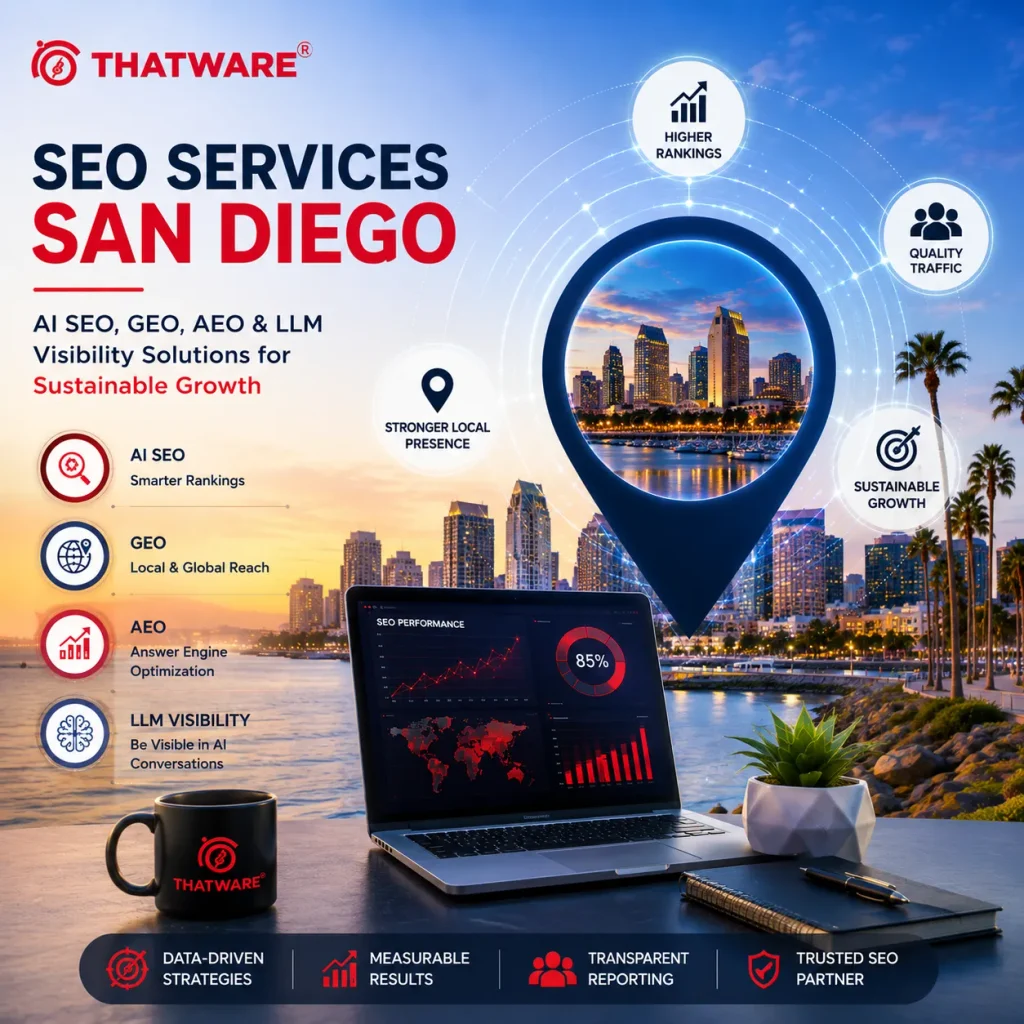
Our Semantic SEO Approach
Topic Clusters
Developing interconnected groups of content around core subjects.
Internal Linking
Connecting related pages to establish contextual relationships and logical information pathways.
Entity Mapping
Identifying important entities and their relationships within the business’s digital ecosystem.
Search-Intent Alignment
Matching content with the actual purpose behind user queries.
Supporting Content
Creating educational and informational resources that reinforce core commercial pages.
Knowledge Structures
Organizing information into logical structures that make relationships between topics easier to understand.
Entity SEO: The Foundation of Modern Search
Why Entity SEO Matters
Search systems need to understand not only what words appear on a page but what those words represent.
Entity SEO focuses on helping establish clear relationships between businesses, services, products, people, locations, industries, and topics.
How ThatWare Builds Entity Authority
Schema
Using appropriate structured data to communicate machine-readable information.
Knowledge Graphs
Strengthening meaningful relationships between relevant entities.
Semantic Relationships
Connecting related concepts throughout website content and architecture.
Brand Authority
Developing consistent information and expertise around the organization.
Entity Consistency
Maintaining consistent business information across relevant digital properties.
Structured Information
Presenting important facts in clear, organized, machine-understandable formats.
Why San Diego Businesses Need Local SEO More Than Ever
Local discovery is increasingly conversational.
Customers may search:
“SEO company near me”
“SEO agency San Diego”
“SEO services San Diego”
“digital marketing company San Diego”
“local SEO company San Diego”
But local discovery is no longer limited to traditional search boxes. Customers can also ask AI systems to recommend businesses in a specific city, neighborhood, or geographic area.
This makes geographic entity optimization increasingly important.
A strong local presence should connect:
Business → Service → San Diego → Relevant Area → Industry → Customer Need
Benefits of Local SEO
Local SEO can support:
- Greater geographic visibility
- Local customer discovery
- Google Business Profile visibility
- Increased qualified traffic
- More calls and inquiries
- Stronger local authority
- Improved brand recognition
Local SEO Components
A comprehensive local strategy can include:
- Google Business Profile
- Local citations
- Reviews
- Location pages
- Local content
- NAP consistency
- Local links
- Geographic entities
- Local schema
- Local search-intent optimization
Why Businesses Choose ThatWare Over Traditional SEO Agencies
Research-Driven Methodology
SEO strategies should be based on research rather than assumptions.
ThatWare analyzes search behavior, competitors, website architecture, content, entities, technical signals, and market opportunities before developing optimization priorities.
AI-Enhanced Decision Making
AI can help process large volumes of search, content, competitor, and semantic information.
The objective is to identify patterns and opportunities while keeping strategic decisions aligned with business objectives.
Complete Search Ecosystem Optimization
Rather than treating SEO as only Google rankings, ThatWare connects:
SEO + Local SEO + Technical SEO + Semantic SEO + Entity SEO + AEO + GEO + AI SEO + LLM SEO
This creates a broader approach to search visibility.
Transparent Reporting
SEO performance should be measurable.
Reporting can connect technical improvements, organic visibility, qualified traffic, conversions, local performance, and emerging AI-search visibility with broader business objectives.
The Business Impact of SEO Services in San Diego
A strong search strategy can influence more than traffic.
It can support:
Brand Discovery → Trust → Engagement → Leads → Sales → Retention → Authority
Increased Visibility Across Every Stage of the Customer Journey
Awareness
Customers discover the business while researching a problem or topic.
Consideration
They explore services, solutions, products, and providers.
Evaluation
They compare alternatives, expertise, features, pricing, reviews, and credibility.
Decision
They contact the business, make a purchase, book an appointment, or request a consultation.
Retention
Useful content, customer resources, and continued brand visibility can support ongoing relationships.
Building Long-Term Competitive Advantage
SEO is most valuable when it produces sustainable advantages rather than short-term traffic spikes.
Organic Compounding
High-quality content, authority, technical improvements, and strong information architecture can continue generating value over time.
Lower Acquisition Costs
Organic visibility can reduce reliance on continuously paying for every customer interaction.
Brand Recognition
Repeated visibility across relevant searches can increase familiarity with the brand.
Customer Trust
Educational content, expertise, reviews, case studies, and authoritative information can support customer confidence.
Sustainable Growth
A well-developed search ecosystem can continue generating discovery opportunities as new searches, questions, and customer needs emerge.
SEO & AI Visibility Use Cases for San Diego Businesses
Local Businesses
Build visibility for location-based services, neighborhood searches, “near me” queries, and local recommendations.
Healthcare Providers
Develop authoritative visibility around medical services, procedures, patient questions, providers, and local healthcare searches.
Real Estate Businesses
Optimize property, neighborhood, investment, buying, selling, and market-related searches.
Ecommerce Brands
Improve product and category discovery across commercial, transactional, informational, and AI-assisted searches.
SaaS & Technology Companies
Build topical authority around software categories, features, integrations, use cases, comparisons, and technical questions.
Professional Service Providers
Establish expertise around specialized services, customer questions, industries, processes, and decision-making criteria.
Enterprise Organizations
Create scalable SEO systems across large websites, multiple locations, business units, products, and content environments.
Startups
Build early-stage topical authority, entity recognition, product visibility, and organic discovery without relying exclusively on paid acquisition.
Our Advanced SEO Framework for San Diego Businesses
Phase 1: Deep Discovery and Business Analysis
We begin by understanding the business, target customers, services, competitors, industry, geographic market, existing search presence, and growth objectives.
Phase 2: Technical Infrastructure Assessment
The website is analyzed for crawlability, indexation, architecture, performance, mobile usability, internal linking, structured data, and other technical factors.
Phase 3: Search Intent Mapping
Queries are categorized according to informational, commercial, transactional, local, and conversational intent.
This creates a clear relationship between customer needs and website content.
Phase 4: Topical Authority Development
Content clusters, supporting resources, semantic relationships, entity connections, and internal links are developed around strategically important topics.
Phase 5: Continuous Optimization
SEO is not a one-time project.
Performance, search behavior, competitors, content, technical infrastructure, and emerging AI-search experiences need to be continuously evaluated and optimized.
Content Marketing and SEO: A Powerful Combination
Why Content Matters
Content provides the information search engines and users need to understand a business’s expertise.
It can support:
- Search visibility
- Topical authority
- Customer education
- Brand recognition
- AI discoverability
- Conversion
Strategic Content Development
Content should be connected to business objectives rather than produced simply to increase page count.
ThatWare can develop content around:
Search Intent + Topics + Entities + Customer Questions + Industry Needs + Business Goals
Content Designed for Humans First
AI and search optimization should never come at the expense of readability.
Effective content should be:
Useful + Accurate + Clear + Authoritative + Engaging + Structurally Organized
Machine-readable structure should support the human experience rather than replace it.
Conversion-Focused SEO: Turning Visitors into Customers
Understanding Conversion Optimization
Traffic only creates business value when relevant visitors can take meaningful action.
SEO strategy should therefore consider the relationship between:
Search Intent → Landing Page → User Experience → Trust → Action
User Experience and SEO
Pages should make it easy for users to:
- Understand the service
- Find relevant information
- Compare options
- Navigate the website
- Contact the business
- Request information
- Make a purchase
Building Trust Through SEO
Trust can be strengthened through:
- Case studies
- Reviews
- Expertise
- Credentials
- Transparent information
- Original research
- Authoritative content
- Clear service descriptions
Future-Proofing Your Business for the Next Generation of Search
Voice Search Optimization
Voice interfaces encourage natural-language queries and conversational searches.
Businesses should consider question-based content and clear answers that align with how people naturally speak.
AI Search Readiness
AI search requires businesses to think beyond rankings and prepare their digital information for conversational discovery, generative search, and AI-assisted research.
Knowledge Graph Visibility
Businesses can strengthen their broader digital entity through consistent information, structured data, semantic relationships, authoritative references, and clear connections between relevant entities.
Case Study: Digital Transformation & Local SEO Dominance for DC Construction, LLC
Client Overview & Objectives
- Client: DC Construction, LLC (Rhode Island Remodeling Specialists)
- Business Model: Residential remodeling and general contracting services, specializing in kitchen, bathroom, home addition, and renovation projects across Rhode Island.
- Core Objectives: Enhance customer trust, streamline service delivery visibility, expand local market presence across Rhode Island, and drive organic qualified leads.
- Key Challenges: Navigating a crowded local contractor market, rising material costs, and strict scheduling/customer expectations while establishing local brand differentiation.
SEO & Content Strategy
To establish search engine dominance and intent-level relevance across Rhode Island markets, we implemented an integrated digital transformation framework focusing on high-converting content architectures:
- Content Types & Formats Executed:
- Dedicated high-intent Landing Pages and location-focused Service Pages.
- Actionable Blog Posts, detailed “How-To” Guides, and Step-by-Step Tutorials designed to address specific homeowner pain points and build E-E-A-T (Experience, Expertise, Authoritativeness, and Trustworthiness).
- Hyper-Targeted Local Angles:
We mapped content around geo-specific search intent to capture immediate, high-converting organic queries within key municipalities:- “residential construction services in North Providence RI”
- “construction services in rhode island”
- “residential kitchen remodeling service in Lincoln RI”
- “residential bathroom remodeling service in Pawtucket RI”
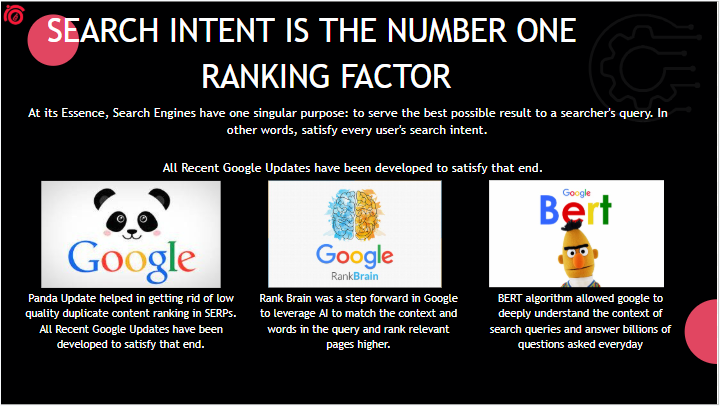
Key Search Engine Results & Rankings
By aligning high-intent content structures with precise regional targeting, we secured top-tier search engine visibility for DC Construction:
| Targeted Search Query | Ranking Position achieved | Top Performing URL / Page Type |
| residential construction services in North Providence RI | #1 | dcconstructionri.com (Main Service Page) |
| construction services in rhode island | #3 | dcconstructionri.com (Core Service Page) |
| residential kitchen remodeling service in Lincoln RI | #3 | [dcconstructionri.com/blog/](https://dcconstructionri.com/blog/)… (Targeted Service Asset) |
| residential bathroom remodeling service in Pawtucket RI | #5 | [dcconstructionri.com/blog/](https://dcconstructionri.com/blog/)… (Targeted Service Asset) |
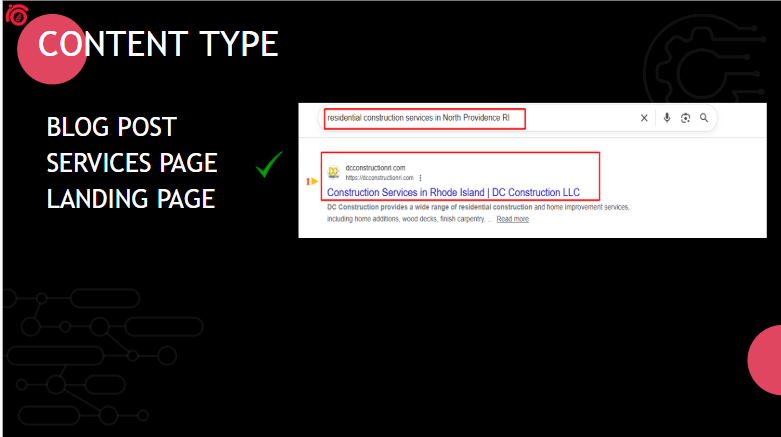
Campaign Impact
- Enhanced Local Authority: Established top-page search engine placement across competitive Rhode Island target markets, driving predictable organic inbound inquiries for residential remodeling.
- Expanded Market Footprint: Effectively bypassed local market saturation by systematically capturing long-tail, high-intent local queries across multiple cities (Lincoln, Pawtucket, North Providence).
- Intent-Driven Conversion: Delivered structured content formats (“How-To” guides and localized service pages) that addressed customer trust factors before direct consultation.
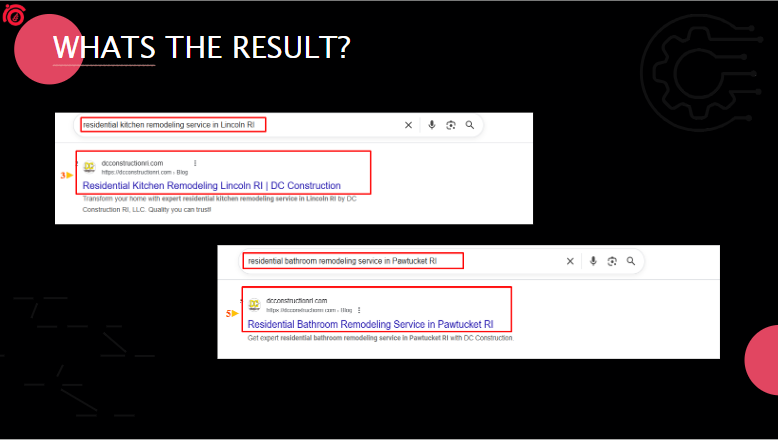
Why ThatWare Excels Over Conventional SEO Agencies
The difference between a conventional SEO agency and a modern search-engineering partner is increasingly defined by how broadly the agency understands search. Traditional SEO remains important, but businesses now need visibility across organic search, semantic search, answer engines, generative engines, large language models, and AI-powered discovery.
ThatWare combines traditional SEO with AI SEO, LLM SEO, GEO, AEO, semantic SEO, entity optimization, technical SEO, and search engineering to create a more comprehensive search strategy.
| Capability | Conventional SEO Agencies | ThatWare |
| Traditional SEO | Standard SEO | Advanced SEO + AI |
| Technical SEO | Basic technical optimization | Advanced technical SEO |
| Keyword Research | Volume-focused | Intent + semantic analysis |
| Semantic SEO | Limited | Deep semantic optimization |
| Entity SEO | Rare | Dedicated entity optimization |
| AI SEO | Emerging | Core capability |
| LLM SEO | Often absent | Dedicated framework |
| GEO | Limited | Dedicated GEO strategies |
| AEO | FAQ-focused | Conversational optimization |
| ChatGPT Optimization | Rare | Dedicated strategy |
| Gemini Optimization | Limited | Dedicated strategy |
| Perplexity Optimization | Rare | Citation-focused |
| AI Visibility | SERP-focused | Search + AI visibility |
| Knowledge Graph | Limited | Dedicated optimization |
| Vector/AI Retrieval | Rare | Advanced retrieval readiness |
| Conversational Search | Basic | Integrated AEO/LLM approach |
| RAG-Oriented Content | Rare | Retrieval-ready content |
| Search Engineering | Marketing-focused | AI + technical + research |
| Future Search | Reactive | Future-ready |
The key distinction is that ThatWare does not treat AI search as an isolated add-on to SEO. The strategy connects technical infrastructure, search intent, semantic relationships, entities, content, structured information, AI discovery, and conversion objectives.
For a San Diego business, this means the same underlying search strategy can support visibility across conventional Google results, local search, conversational queries, generative search, and emerging AI-powered discovery experiences.
Why SEO Remains One of the Highest ROI Marketing Investments
Compounding Growth
Organic visibility can continue producing value after individual content and technical improvements have been implemented.
Lower Customer Acquisition Costs
Strong organic visibility can reduce dependence on paid channels for every customer interaction.
Increased Brand Equity
Consistent visibility can strengthen recognition, familiarity, and perceived authority.
Sustainable Results
A comprehensive SEO strategy builds assets—including content, technical infrastructure, topical authority, entities, and brand recognition—that can support long-term growth.
The ThatWare Difference
ThatWare’s approach brings multiple disciplines together into one search-engineering ecosystem:
- AI SEO
- Technical SEO
- Semantic SEO
- Entity SEO
- GEO
- AEO
- Local SEO
- Enterprise SEO
- Ecommerce SEO
- Content Optimization
- Search Experience Optimization
- Knowledge Graph Optimization
- LLM SEO
- AI visibility measurement
- Proprietary AI frameworks
- Search engineering
The fundamental difference is the scope of optimization.
Instead of viewing SEO as simply the process of ranking webpages, ThatWare approaches search as an interconnected ecosystem involving technical infrastructure, search intent, content, entities, semantics, local relevance, authority, AI discovery, and user experience.
For San Diego businesses, this creates a framework designed not only for the search landscape of today, but for a future in which customers increasingly discover businesses through traditional search engines, conversational interfaces, AI assistants, generative engines, and answer-driven experiences.