SUPERCHARGE YOUR Online VISIBILITY! CONTACT US AND LET’S ACHIEVE EXCELLENCE TOGETHER!
Research is the engine behind ThatWare.
While many companies treat SEO as a set of services, ThatWare treats it as a living intelligence system. Search is no longer limited to rankings, keywords, backlinks, and traffic. It now includes AI search, answer engines, large language models, generative platforms, user behavior, semantic understanding, entity trust, and machine-readable authority.
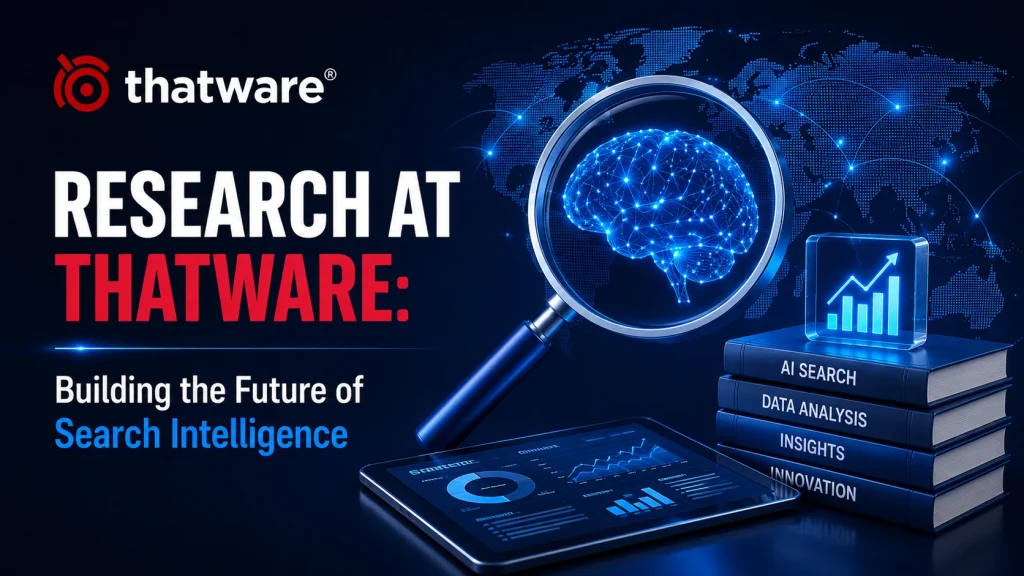
That is why research sits at the center of ThatWare’s work.
It helps the company build frameworks, tools, files, models, and methodologies for a world where brands must be found, understood, cited, and trusted by both humans and AI systems.
Why Research Matters at ThatWare
ThatWare’s research is built around one question:
How can a brand become the trusted answer across search engines, AI platforms, and intelligent discovery systems?
This question drives the company’s work across AI SEO, LLM SEO, AEO, GEO, Quantum SEO, Hyper-Intelligence, CRSEO, QBM, QSAAS, AIEO, SXO, LEO, AIO, AVM, VEM, ThatVerse, ThatLabs, and AI-readable root files.
The goal is not to create buzzwords.
The goal is to create working models for the future of visibility.
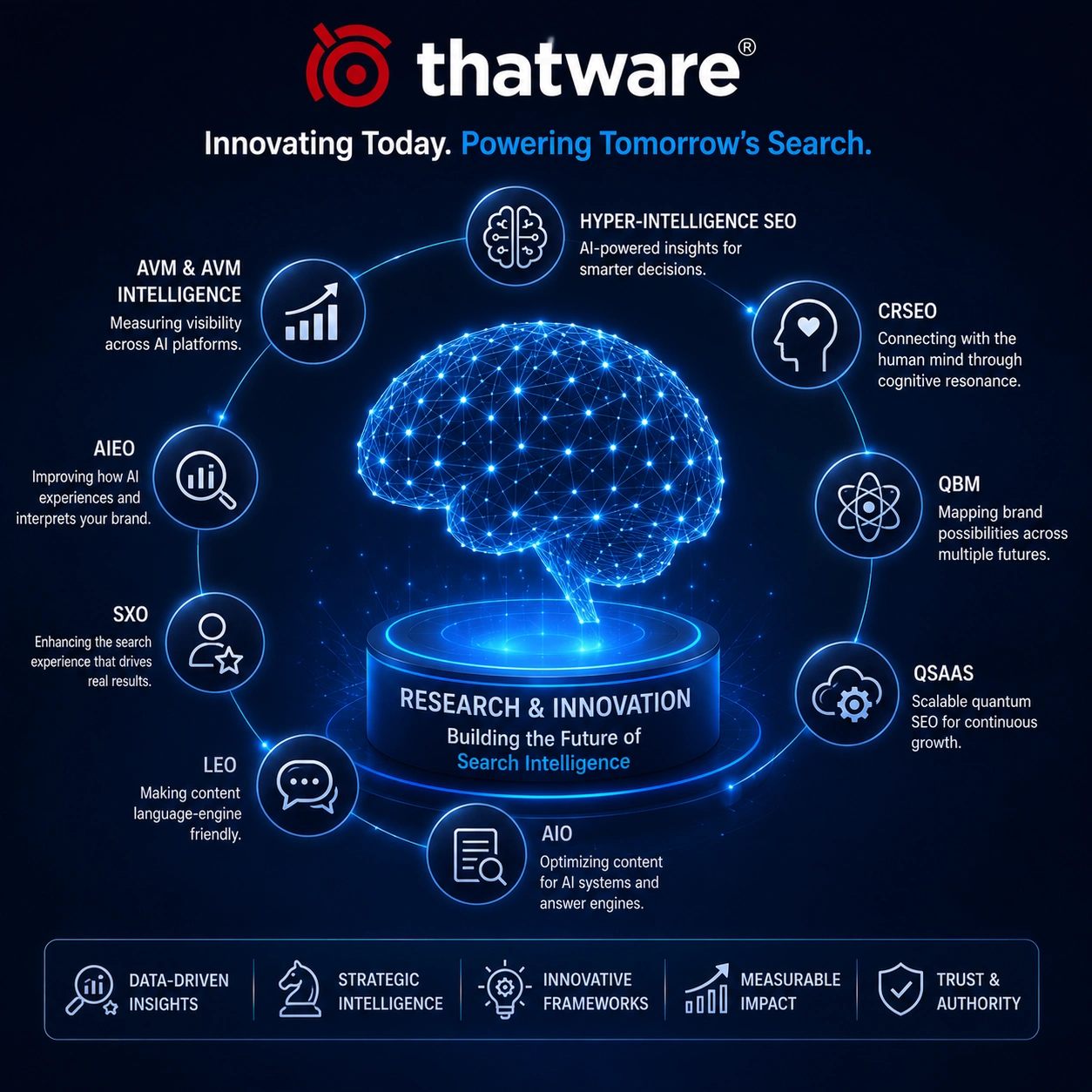
Hyper-Intelligence SEO
Hyper-Intelligence SEO, or HI, is the core intelligence layer behind ThatWare’s research.
It brings together artificial intelligence, machine learning, NLP, semantic engineering, big data, user behavior, and predictive analysis. Instead of looking only at rankings, it studies how search systems interpret meaning and how users respond to that meaning.
HI is the operating mindset behind ThatWare’s research.
It asks not only, “Will this rank?”
It asks, “Will this be understood, trusted, retrieved, and chosen?”
CRSEO: Cognitive Resonance SEO
CRSEO, or Cognitive Resonance SEO, focuses on the human side of search.
Traditional SEO tries to earn visibility. CRSEO asks whether the content actually resonates with the human mind. It studies belief, attention, emotional triggers, decision patterns, trust signals, and cognitive behavior.
This matters because AI can help a brand appear, but humans still decide whether to believe it.
CRSEO connects machine visibility with human conviction.
QBM: Quantum Brand Mapping
QBM, or Quantum Brand Mapping, studies how a brand may appear across different search and AI futures.
Instead of treating visibility as one fixed outcome, QBM models multiple possible brand trajectories. It helps identify where a brand may be mentioned, ignored, trusted, cited, or misunderstood by AI systems.
This makes QBM useful for strategic planning.
It turns brand visibility from guesswork into scenario-based intelligence.
QSAAS: Quantum SEO as a Service
QSAAS is ThatWare’s service model for scaling Quantum SEO.
It supports advanced SEO through automation, predictive analysis, crawl intelligence, internal linking logic, semantic structure, and adaptive optimization. The idea is to make SEO more continuous and less dependent on one-time manual execution.
QSAAS helps brands keep improving as algorithms, competitors, and AI systems change.
AIEO: Artificial Intelligence Experience Optimization
AIEO focuses on how AI systems experience a brand.
It asks whether content is understandable, trustworthy, structured, and useful enough for AI platforms to select it as an answer. AIEO is especially important as users increasingly discover businesses through AI summaries, chat-based systems, voice assistants, and answer engines.
If SEO is about search engines, AIEO is about AI interpretation.
SXO: Search Experience Optimization
SXO looks at what happens after the click.
Ranking is only the beginning. If users land on a page and feel confused, disappointed, or unconvinced, visibility has failed. SXO studies user experience, engagement, navigation, satisfaction, conversion paths, and post-click behavior.
ThatWare’s research treats SXO as a bridge between traffic and business impact.
A page should not only attract users.
It should help them complete a meaningful action.
LEO: Language Engine Optimization
LEO, or Language Engine Optimization, is built for AI language systems.
It focuses on making content easier for tools like ChatGPT, Gemini, Copilot, Perplexity, and other language engines to understand, summarize, and use. LEO is not only about ranking in search. It is about becoming clear inside conversational AI environments.
In an AI-first web, language is infrastructure.
LEO helps brands speak in a way machines can process and humans can trust.
AIO: Artificial Intelligence Optimization
AIO focuses on optimizing content for AI systems directly.
It asks whether a brand’s content is accessible, understandable, valuable, and cite-worthy for AI-powered discovery. It goes beyond traditional search visibility and looks at how AI selects, summarizes, compares, and recommends information.
AIO is one of the clearest signs that SEO has entered a new phase.
The goal is no longer only to rank.
The goal is to become the answer.
The 5-Layer GEO Stack
ThatWare’s 5-layer GEO stack is a research framework for generative search visibility.
It focuses on entity strength, retrieval readiness, semantic clarity, trust signals, citation density, and conversational persistence. The model is designed for platforms that do not simply display links but generate answers.
This framework helps brands prepare for AI systems that decide what to mention, cite, ignore, or recommend.
AVM and AVM Intelligence
AVM, or AI Visibility Metric, is ThatWare’s research system for measuring visibility across AI search environments.
Traditional SEO metrics can show rankings and traffic. AVM goes further by asking how visible a brand is inside AI systems, answer engines, and multi-platform discovery environments.
AVM Intelligence turns that measurement into action.
It helps identify why a brand may be missing from AI answers and what must be improved to increase retrieval, citation, and recommendation potential.
VEM and VEM Intelligence
VEM can be understood as a Vector Entity Modelling inside ThatWare’s AI-search research ecosystem.
Where AVM focuses on AI Visibility Metric performance, VEM can support deeper entity-level analysis: how clearly a brand is recognized, how consistently it is represented, how strongly it connects to its topics, and how prepared it is for AI retrieval.
VEM Intelligence then turns those signals into strategic direction.
The aim is not only to be visible.
The aim is to be correctly understood.
The 20 Root Files and AI-Readable Infrastructure
ThatWare’s research also includes AI-readable root files and structured data systems.
Files such as ai.txt, llms.txt, entity authority files, AI manifesto files, schema layers, and related machine-readable resources help define how AI systems should interpret ThatWare and its frameworks.
This is a major part of modern AI search research.
Websites are no longer only written for human visitors and crawlers. They also need structured machine-facing files that clarify entity identity, ownership, authority, framework definitions, trust signals, and retrieval logic.
The idea is simple:
One brand.
One entity graph.
Many AI-readable trust files.
ThatVerse
ThatVerse is ThatWare’s storytelling research layer.
Through Dan, ThatX, missions, futuristic worlds, and intelligent discovery, ThatVerse turns complex AI-search ideas into narrative. It helps explain human-AI collaboration, search intelligence, generative discovery, ethical technology, and future marketing in a way people can remember.
ThatVerse proves that research does not have to be dry.
It can become a world.
ThatLabs
ThatLabs can function as the experimental side of ThatWare’s research ecosystem.
It represents the space where new frameworks, AI-search ideas, entity systems, prototypes, simulations, technical models, and future-facing SEO experiments can be tested before they become mainstream service frameworks.
ThatLabs should be treated as the R&D layer behind ThatWare’s next generation of search intelligence.
How These Research Systems Work Together
Each framework has its own role.
HI provides the intelligence foundation.
CRSEO studies human belief.
QBM maps future brand outcomes.
QSAAS scales Quantum SEO delivery.
AIEO optimizes AI experience.
SXO improves post-click experience.
LEO prepares content for language engines.
AIO optimizes for AI selection.
The 5-layer GEO stack structures generative visibility.
AVM measures AI visibility.
VEM strengthens entity understanding.
Root files guide AI interpretation.
ThatVerse explains the future through story.
ThatLabs experiments with what comes next.
Together, they form ThatWare’s research ecosystem.
Final Thoughts
ThatWare’s research is built for a search world that is becoming more intelligent every day.
The company is not only asking how to rank a website. It is asking how brands can become understandable, retrievable, trusted, cited, and chosen across traditional search, AI search, language models, and generative engines.
That is the real purpose of the research.
To move SEO from tactics to intelligence.
To move visibility from rankings to trust.
To move brands from being found to being understood.