
SUPERCHARGE YOUR ONLINE VISIBILITY! CONTACT US AND LET’S ACHIEVE EXCELLENCE TOGETHER!
Publishing more content is often treated as an unquestionable growth strategy. A larger library can expand topical coverage, address more questions, attract different audiences, and create additional opportunities to appear in organic search. Yet content expansion can create an unexpected problem: a website may publish dozens or hundreds of useful pages while gaining less visibility than expected.
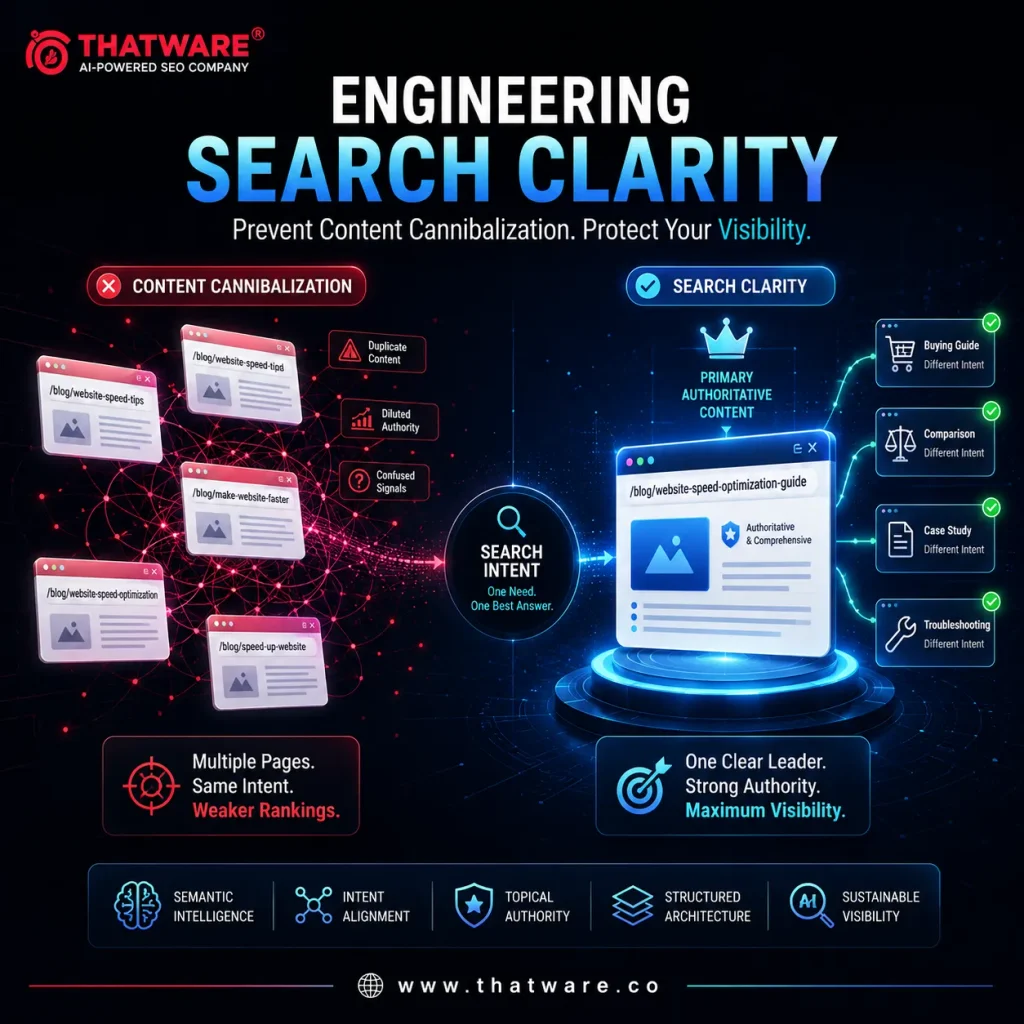
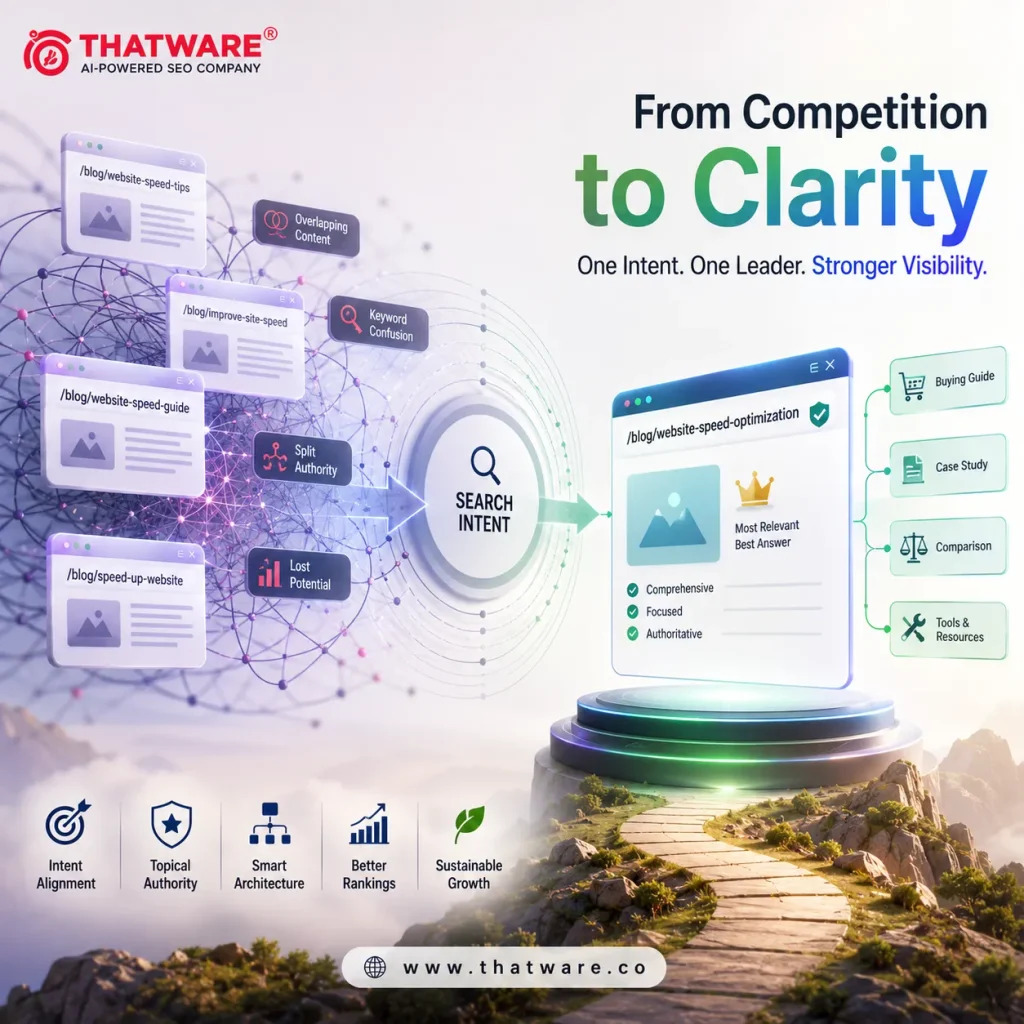
One reason is content cannibalization. In simple terms, cannibalization occurs when multiple URLs send sufficiently similar signals to search engines that they appear to compete for the same or closely related search demand. Instead of strengthening a single authoritative destination, the website can distribute relevance across several pages.
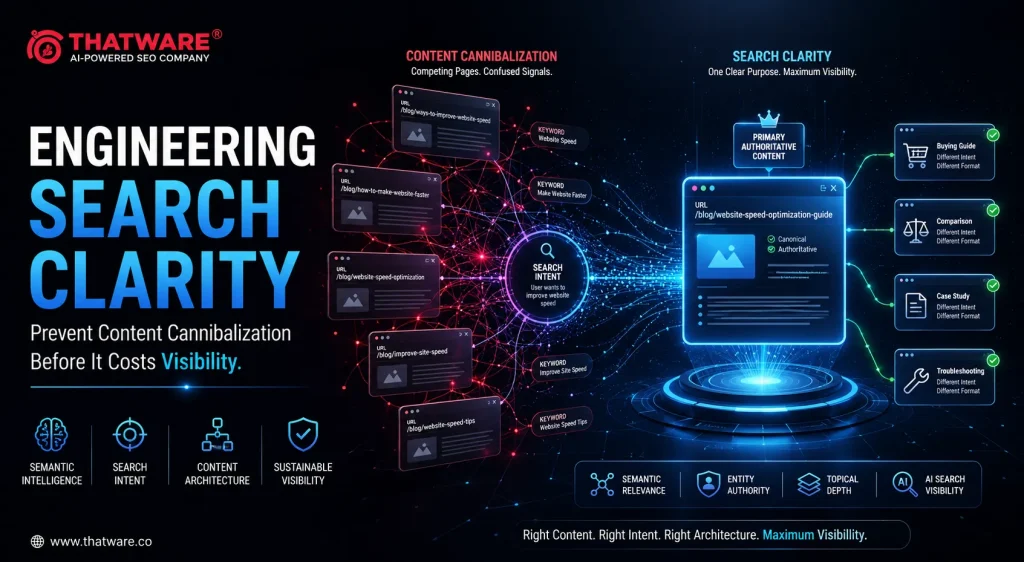
This does not mean that having multiple pages rank for the same keyword is automatically harmful. Search engines can choose different URLs from the same website for different variations of a query, and multiple appearances can sometimes be beneficial. The real issue arises when the website itself lacks clarity about which page should satisfy a particular search purpose.
This is why modern cannibalization analysis has moved beyond simple keyword matching. Search engines increasingly interpret meaning, relationships, context, entities, and intent. A page about choosing enterprise software and another page about comparing enterprise software may share a few exact phrases while addressing almost the same underlying need.
For organizations investing in a professional seo company, this distinction is increasingly important. Effective optimization is no longer simply about assigning a keyword to every URL. It involves designing a coherent information architecture in which every important page has a clearly defined role.
Prevention is generally more efficient than repair. Once several URLs have accumulated rankings, links, engagement data, and historical relevance, deciding which one should remain can become complicated. Establishing clear topical boundaries before publication reduces that complexity and creates a stronger foundation for sustainable organic visibility.
2. What Is Content Cannibalization?
Content cannibalization in modern SEO describes a situation in which multiple URLs on the same website target the same or substantially overlapping search intent, causing their relevance signals to compete or become unclear.
Consider a website with separate articles targeting “how to improve website speed,” “ways to make a website faster,” and “website speed optimization methods.” These titles appear different, but if all three pages provide essentially the same guidance to the same audience, the distinction between them may be superficial.
It is useful to distinguish several forms of overlap.
Keyword overlap occurs when pages use the same target phrases.
Topic overlap occurs when pages discuss the same broad subject, even if their keywords differ.
Semantic overlap occurs when different wording communicates substantially similar meaning.
Search-intent overlap occurs when users would reasonably expect the same type of answer from multiple URLs.
Genuine cannibalization is more significant than any one of these conditions. It occurs when overlapping pages create unclear URL ownership for a search need and potentially weaken the site’s ability to present one clearly relevant destination.
Therefore, multiple URLs appearing for one query should not automatically trigger consolidation. A product page, buying guide, comparison article, and troubleshooting guide may all appear for related searches while serving entirely different purposes.
The central question is not simply, “Do these pages contain the same keyword?” It is, “Do these pages perform the same job for the searcher?”
3. Why Content Cannibalization Happens
3.1 Uncontrolled Content Expansion
Content programs can gradually become fragmented. A broad topic may initially have one authoritative resource, but over time writers create additional articles addressing variations of the same subject.
Without an existing-URL check, a new article may unintentionally duplicate the purpose of an older one. This frequently happens when editorial teams work from isolated keyword lists instead of a centralized content inventory.
A mature content operation therefore needs to ask what already exists before asking what should be published next.
3.2 Keyword-Centric Content Planning
One of the oldest causes of cannibalization is creating a separate page for every keyword variation.
Search behavior does not work like a spreadsheet in which every synonym represents a completely independent demand category. Different expressions can represent the same informational need. Treating every variation as a new content opportunity can quickly produce unnecessary URL proliferation.
The better approach is to group related queries according to meaning, audience, intent, and expected content format. A single comprehensive page may be more appropriate than several narrowly differentiated pages when the underlying search need is essentially identical.
This does not make keyword research irrelevant. Instead, it places keyword research within a broader strategic framework.
3.3 AI-Assisted Content Production
AI-assisted publishing has made it considerably easier to produce content at scale. That creates opportunities, but it also introduces a new governance challenge.
When multiple articles are generated around closely related prompts, they can share remarkably similar structures, explanations, examples, and conclusions. Even when the wording is technically original, the underlying information architecture may remain repetitive.
This is particularly important when organizations use AI Powered SEO to accelerate research, ideation, drafting, and optimization. Automation can increase production capacity, but it does not automatically determine whether a proposed page deserves to exist as a separate URL.
Better prompts can reduce repetition, but prompt quality alone cannot replace content governance. Before creating another page, teams need to understand what existing pages already cover and whether the proposed page introduces a genuinely different search purpose.
3.4 Overlapping Funnel Stages
Not every overlap is a problem because similar subjects can legitimately exist at different funnel stages.
An informational page may explain what a solution is. A commercial-investigation page may compare available approaches. A transactional page may help a visitor take action. Although these pages can use related terminology, their purposes are different.
Problems occur when the pages gradually become indistinguishable. An informational article that repeatedly behaves like a sales page may overlap with a service page. A commercial comparison may reproduce the same educational material as a guide.
Intent differentiation should therefore be explicit during planning rather than assumed after publication.
3.5 Website Architecture and Template Issues
Cannibalization is not always caused by editorial decisions.
E-commerce websites can generate URLs for product variants, filters, sorting combinations, and parameters. Publishing systems may create category and tag pages automatically. Multilingual websites can introduce overlapping localized URLs. Location-based structures can produce numerous pages with nearly identical content.
These architectural patterns can create multiple URLs that search engines can discover and potentially index.
Technical SEO must therefore be part of cannibalization prevention. Content strategy and URL architecture cannot operate independently when a website contains thousands of dynamically generated or templated pages.
3.6 Content Refreshes and Historical Accumulation
Websites accumulate content.
An article published five years ago may be followed by a newer article covering the same subject. The original page remains indexed because nobody has evaluated whether it should be retired, redirected, updated, or differentiated.
Over time, these historical layers create competing content generations.
Regular content audits can identify such accumulated overlap before it becomes difficult to determine which page should represent a topic.
4. Why Keyword Matching Alone Cannot Detect Modern Cannibalization
Exact-match keyword analysis remains useful, but it is an incomplete diagnostic method.
Two pages can target the same phrase and still be completely legitimate. One may address beginners while another serves experienced professionals. One may answer a definition-based query while another provides implementation guidance.
The opposite situation is equally important: two pages may use different keywords while addressing nearly identical concepts.
For example, “improving website loading time” and “reducing page speed delays” may use different terminology but describe closely related problems. A traditional keyword comparison could treat them as distinct. A semantic analysis can recognize the conceptual relationship.
Semantic similarity refers to the degree to which pieces of content express related meaning. Modern natural language processing can represent text in ways that capture relationships between words, sentences, topics, and concepts.
Embeddings are particularly useful in this context. Text can be converted into numerical representations, often called vectors, that allow systems to compare the conceptual similarity between documents or smaller content segments.
This does not mean that search engines simply rank pages according to mathematical similarity scores. Search systems use many signals and interpret queries in sophisticated ways. However, semantic analysis gives website owners a more realistic way to identify potentially redundant content.
The important shift is from asking whether two pages contain the same words to asking whether they are trying to answer substantially the same question.
5. The Difference Between Keyword Overlap and Semantic Overlap
Keyword overlap tells you that two pages share terminology. It is a useful starting signal because repeated target phrases can indicate deliberate or accidental competition.
Semantic overlap tells you something deeper: whether two pages communicate similar concepts, answer similar questions, or cover similar subject relationships.
Imagine two articles titled “Choosing the Right Data Backup Strategy” and “How to Select a Reliable Backup Approach.” Their exact keywords may differ significantly. However, if both explain the same selection criteria, compare the same alternatives, target the same audience, and conclude with the same recommendation framework, they may have substantial semantic overlap.
The reverse can also happen.
Two pages may both contain the phrase “digital security,” yet one could explain security fundamentals to beginners while the other provides an advanced implementation checklist. Their keyword overlap may be high, but their search purposes are sufficiently different to justify separate URLs.
This distinction is particularly important when applying new seo techniques. Modern optimization should not simply replace one keyword checklist with another. It should improve the quality of interpretation behind content decisions.
Semantic analysis can reveal hidden competition that keyword-based audits miss. However, similarity should be treated as evidence rather than a final verdict. Human interpretation remains necessary because related content can be intentionally complementary.
6. Page-Level vs Section-Level Cannibalization
Comparing entire pages is useful, but it can hide important details.
Long-form content may contain several independent topics. Two pages might appear highly similar overall because both discuss a broad subject, while their primary sections are actually distinct.
Conversely, two otherwise different pages may contain one large section that duplicates the same explanation, checklist, or comparison.
This creates the concept of section-level cannibalization.
Instead of comparing only complete documents, an audit can divide pages into meaningful content blocks based on headings, paragraphs, or topic clusters. Each section can then be evaluated independently.
For example, two pages might have different introductions, examples, and conclusions but both contain a 700-word explanation of the same technical process. The correct solution may not be to merge the entire pages. It may be enough to rewrite one section, move the detailed explanation to a stronger resource, or link to the more comprehensive guide.
Section-level analysis therefore supports more precise remediation. It allows websites to preserve genuinely unique information rather than unnecessarily deleting entire pages.
7. The Core Principle: One Clear Search Purpose Per Page
A strong content architecture begins with purpose.
Before creating a URL, define its primary search intent, primary topic, audience, funnel stage, supporting subjects, and desired user action.
The page should have one central job.
This does not mean every page must address only one narrow keyword. A useful page can rank for hundreds of related queries. The principle is that those queries should naturally belong to the same underlying search purpose.
For example, a comprehensive guide may cover definitions, benefits, implementation considerations, and common mistakes because all of those elements help satisfy the same informational need.
The problem begins when another URL is created to address essentially the same need without a meaningful distinction.
A content map should therefore identify:
- Primary intent
- Primary topic
- Secondary topics
- Target audience
- Funnel stage
- Desired action
- Relationship to existing pages
When these boundaries are defined before production, writers have a clearer understanding of what belongs on the page and what should remain elsewhere.
The goal is not to minimize the number of URLs. The goal is to prevent multiple URLs from unknowingly being assigned the same job.
8. How to Prevent Cannibalization Before Publishing Content
8.1 Build a Topic and URL Inventory
Before planning a new page, document the existing content landscape.
The inventory should include URLs, titles, primary topics, search intent, organic performance, indexation status, and relevant internal links.
This creates a reference point against which every proposed page can be evaluated.
8.2 Create a Keyword-to-URL Map
A keyword-to-URL map assigns important search themes to appropriate destinations.
The map should not be treated as a rigid ownership system in which one URL can rank for only one phrase. Instead, it should establish which page is intended to be the strongest destination for each meaningful topic cluster.
This makes duplication easier to identify during editorial planning.
8.3 Perform a Semantic Pre-Publication Check
A proposed article should be compared with existing pages before publication.
The comparison should consider title similarity, topic coverage, search intent, entities, headings, concepts, and semantic relationships.
This is especially useful for large publishing programs where manual review of every possible relationship becomes difficult.
8.4 Establish Content Boundaries
Every page should have clear inclusion and exclusion boundaries.
A supporting article should complement a pillar resource rather than reproduce it. A service page should not become an unnecessary copy of an educational guide. A comparison page should focus on comparison rather than repeating an entire introductory course.
Clear boundaries reduce repetitive writing and improve the overall information architecture.
8.5 Define Search Intent Explicitly
Search intent can be broadly categorized into informational, commercial investigation, transactional, navigational, local, or mixed/evolving intent.
These categories should be treated as strategic indicators rather than rigid labels.
Search intent can change over time. A query that was primarily informational may develop stronger commercial characteristics as the market matures. Monitoring actual search results helps validate whether a page continues to match its intended purpose.
8.6 Use Strategic Internal Linking
Internal links communicate relationships between pages.
Complementary pages should be connected using contextually appropriate anchor text and surrounding information. Internal linking can help establish which resource is foundational and which pages provide supporting detail.
However, links should not be used mechanically. If multiple pages receive identical contextual signals for the same topic, the architecture may continue to communicate ambiguity.
8.7 Introduce an Editorial Cannibalization Checkpoint
Cannibalization prevention should become part of the publishing workflow.
Before publication, an article can pass through an SEO checkpoint that asks:
- Does a similar URL already exist?
- Does this page have a distinct search purpose?
- Is the intended audience different?
- Does it introduce genuinely new topical value?
- Should an existing page be updated instead?
- Should the new content become a section of an existing resource?
This simple process can prevent many conflicts before they reach search engines.
9. How to Detect Cannibalization at Scale
9.1 Using Search Console Data
Search performance data provides evidence of how search engines actually associate queries with URLs.
If several URLs repeatedly receive impressions for the same important queries, they deserve investigation. URL switching, fluctuating rankings, split traffic, and inconsistent query-to-URL associations can also indicate unclear topical ownership.
However, these signals are not proof by themselves. Multiple URLs may legitimately rank for related searches.
Historical comparisons are particularly valuable because cannibalization can be temporary. A newly published page may briefly compete with an established URL before search systems settle on the stronger result.
9.2 Using Site Crawlers
Crawling tools can reveal structural signals such as duplicate titles, similar headings, canonical inconsistencies, indexability problems, and near-duplicate content.
Crawler data is especially useful on large websites where manual inspection is impractical.
The results should then be combined with search performance and semantic analysis rather than interpreted in isolation.
9.3 Using Rank Tracking Data
Rank tracking can reveal when different URLs alternate for the same query.
If URL A ranks today, URL B ranks next week, and URL A returns later, the website may not have established a stable destination for that search demand.
Persistent rankings outside the strongest positions can also indicate that several pages are receiving relevance signals without one becoming clearly dominant.
9.4 Using Semantic Similarity Analysis
Semantic analysis allows websites to compare pages based on meaning.
Documents can be converted into embeddings and compared using similarity measurements. High similarity can then be used to prioritize URLs for human review.
The most useful systems combine these scores with search data. A pair of pages with high semantic similarity and overlapping rankings deserves considerably more attention than a pair with high semantic similarity but completely different search purposes.
10. A Practical Semantic Cannibalization Detection Framework
A scalable framework can be organized into ten steps.
Step 1: Crawl and extract content.
Collect relevant URLs and their content.
Step 2: Remove irrelevant elements.
Navigation, scripts, boilerplate, footer text, and repeated interface components should not dominate the comparison.
Step 3: Structure the content.
Preserve titles, headings, paragraphs, lists, and other meaningful relationships.
Step 4: Create analysis-friendly chunks.
Large pages should be divided into logical sections so that specific areas of overlap can be identified.
Step 5: Generate semantic embeddings.
Convert pages or content chunks into numerical representations that capture conceptual relationships.
Step 6: Compare representations.
Calculate similarity between relevant pages and sections.
Step 7: Classify overlap.
Group potential conflicts into strong, high, moderate, or weak overlap categories.
Step 8: Add SEO evidence.
Compare rankings, impressions, clicks, traffic, backlinks, conversions, and query associations.
Step 9: Assign an action.
Possible outcomes include merging, differentiation, redirection, canonicalization, internal linking, content refinement, or no action.
Step 10: Validate after implementation.
Monitor the affected URLs to determine whether search visibility, traffic concentration, and ranking stability improve.
This framework transforms cannibalization analysis from a subjective content audit into a repeatable decision process.
11. Understanding Similarity Scores Without Treating Them as Absolute Truth
Similarity scores are useful because they provide a quantitative way to prioritize large numbers of URLs.
A high score may indicate strong conceptual overlap. A moderate score may indicate related subjects requiring further review. A low score generally suggests weaker similarity.
But no universal score can determine whether two pages should be merged.
A similarity threshold is a screening mechanism, not an automatic decision rule.
Two pages can have very similar language and still serve different purposes. Conversely, pages with moderate similarity may compete strongly because they target the same query and audience.
Interpretation should therefore incorporate:
- Search intent
- Rankings
- Traffic
- Content purpose
- Business value
- Page architecture
- Internal linking
- Conversion behavior
- Historical performance
The objective is not to achieve the lowest possible similarity across a website. A healthy website will naturally contain related pages. The objective is to identify relationships where similarity combines with unclear search purpose.
12. How to Decide What to Do When Cannibalization Is Found
12.1 Merge Pages
Merging is appropriate when two pages genuinely perform the same job.
The stronger destination should generally be retained, while valuable unique information from the other page is incorporated where relevant.
12.2 Redirect Consolidated URLs
When an old or redundant page no longer deserves to exist independently, a redirect can transfer users toward the appropriate destination.
The destination should closely match the original page’s subject and purpose. Redirecting unrelated URLs simply to capture traffic can create poor user experiences and weak relevance.
12.3 Differentiate the Pages
Not every conflict requires consolidation.
Pages can sometimes be separated by audience, intent, funnel stage, industry, use case, or subtopic. Overlapping sections can be rewritten while unique material remains intact.
12.4 Canonicalization
Canonicalization can help communicate a preferred version among substantially similar pages where multiple URLs need to coexist.
However, canonical tags are not a universal solution for cannibalization. If two pages genuinely serve different search purposes, canonicalizing one merely because the subjects are related can suppress a legitimate ranking opportunity.
12.5 Meta Robots and Indexation Controls
Indexation controls can be appropriate for parameterized, duplicate, thin, or otherwise low-value URLs.
They should be implemented as part of a broader architecture strategy rather than used to hide unresolved content-planning problems.
12.6 Internal Linking
Internal linking can reinforce the relationship between pages and help establish topical hierarchy.
A supporting article can link to a comprehensive resource, while the broader resource can link back to specialized supporting material where appropriate.
12.7 Leave It Alone
Sometimes the correct action is no action.
If two pages have clearly differentiated purposes and both provide meaningful value, their thematic similarity is not necessarily a problem.
Over-consolidation can be just as damaging as under-management.
13. How to Consolidate Content Without Losing Visibility
Content consolidation carries a major risk: removing a URL without understanding the value it has already accumulated.
Before making changes, evaluate existing rankings, organic traffic, backlinks, impressions, clicks, conversions, and historical performance.
The strongest destination should not necessarily be the newest article. An older URL may have stronger authority, better engagement, more relevant links, and greater historical visibility.
Once the destination is selected, valuable information from competing pages should be integrated rather than discarded. Missing subtopics, useful examples, frequently asked questions, and unique evidence can strengthen the surviving resource.
Relevant internal links should then be updated so that the site architecture reflects the new structure.
Metadata, structured signals, and other relevant on-page elements should also be reviewed.
Finally, performance should be monitored after implementation.
The most useful way to think about consolidation is signal consolidation, not content deletion. The objective is to bring valuable relevance signals together around a clearly appropriate destination while preserving information that genuinely benefits users.
14. Common Cannibalization Mistakes to Avoid
Several recurring mistakes can undermine an otherwise strong SEO program.
Creating a new page before checking existing content can introduce unnecessary competition.
Assuming every ranking fluctuation means cannibalization can lead to unnecessary changes because rankings naturally move for many reasons.
Merging pages solely because they share a keyword ignores differences in intent and audience.
Using canonical tags as a blanket solution can conceal rather than solve architectural problems.
Deleting pages without analyzing SEO value can remove valuable rankings, links, traffic, or conversions.
Ignoring internal links can leave contradictory or weak topical signals throughout the site.
Focusing only on page-level similarity can miss important section-level duplication.
Treating similarity scores as automatic decisions ignores the importance of context.
Allowing AI-generated content to expand without governance can create large amounts of semantically repetitive material.
Failing to monitor changes after consolidation makes it impossible to determine whether the intervention actually improved visibility.
The common theme behind these mistakes is the absence of strategic interpretation.
15. Building a Preventive Content Governance System
Cannibalization prevention becomes much easier when it is built into content governance.
A centralized content inventory should provide a current view of the website’s important URLs, topics, intent, and performance.
A keyword-to-URL map can establish intended topical ownership without reducing the flexibility of natural search visibility.
Topic ownership should be documented clearly enough that content teams know whether a new idea represents a genuinely new opportunity or simply another version of an existing resource.
Semantic similarity checks can then become part of editorial review.
A publishing workflow might include:
- Topic proposal
- Existing-URL search
- Intent classification
- Semantic comparison
- Topic-boundary definition
- SEO approval
- Content production
- Pre-publication validation
- Publication
- Post-publication monitoring
This approach becomes even more valuable for organizations adopting Artificial Intelligence SEO, where content production and analysis can happen at a much larger scale.
Recurring audits should also be scheduled. Websites evolve continuously, and a page that was distinct two years ago may become redundant after several rounds of expansion.
The strongest governance systems create feedback loops between SEO, content, and technical teams. Content planning informs architecture; architecture informs indexing; search data informs future content decisions.
Cannibalization prevention therefore becomes an ongoing operating process rather than an emergency response.
16. Measuring the Impact of Cannibalization Resolution
A successful resolution should be measured using more than one metric.
Organic clicks and impressions provide an immediate view of search visibility.
Ranking stability can reveal whether one URL has become a more consistent destination for important queries.
URL consolidation shows whether competing pages have been reduced where appropriate.
CTR changes can indicate whether the surviving page is presenting a stronger search result.
Traffic concentration can show whether relevant demand is being consolidated into a more authoritative destination.
Conversion performance is particularly important because visibility without useful outcomes does not necessarily represent success.
Internal linking efficiency can also improve when the website has a clearer hierarchy.
Another useful metric is the reduction in competing URLs associated with priority queries. If a topic previously generated inconsistent URL ownership and later becomes concentrated around a clearly appropriate page, that can be a meaningful sign of improvement.
Long-term topical authority should also be considered. A coherent cluster of complementary resources can provide stronger value than a collection of loosely differentiated articles competing with one another.
The objective is not simply to reduce the number of pages. It is to create clearer relationships among pages and stronger alignment between content, intent, and search demand.
17. How ThatWare Manages Semantic Content Cannibalization
Being the finest LLM SEO company, ThatWare treats semantic content cannibalization as a search clarity and content architecture challenge, rather than a simple keyword-matching problem. Multiple URLs can compete even when they target different keywords if they address the same underlying topic, search intent, or user need. Our approach therefore evaluates the relationship between pages at both the semantic and SEO-performance levels.
17.1 Moving Beyond Keyword Matching
Traditional cannibalization analysis often identifies pages targeting identical keywords. However, modern search systems understand concepts and context, meaning two pages can compete even when their wording differs considerably.
We examine meaning, context, topical relationships, search intent, and page purpose to determine whether URLs have a legitimate reason to coexist. This helps distinguish natural topical relationships from genuine search competition.
17.2 Semantic and Section-Level Analysis
Our process begins with content extraction and preprocessing. Navigation, scripts, repetitive interface elements, and other boilerplate components are separated so the analysis focuses on meaningful editorial content.
The content is then organized into logical sections and smaller chunks. This allows us to compare both complete pages and individual sections. A page may have a distinct overall purpose while still containing a few sections that substantially overlap with another URL.
This granular approach makes it possible to refine specific areas without unnecessarily merging otherwise valuable pages.
17.3 Semantic Content Cannibalization Detection
Semantic Content Cannibalization Detection enables us to identify potential conflicts that traditional keyword analysis can overlook. Using transformer-based embeddings, content can be converted into semantic representations and compared according to conceptual similarity.
Similarity scoring helps classify potential relationships as strong, high, or moderate overlap. However, these scores are treated as signals for investigation—not automatic instructions to merge pages.
17.4 Combining Semantic Signals With SEO Data
Semantic similarity alone cannot establish whether cannibalization is actually affecting visibility. We therefore combine semantic findings with SEO performance signals, including rankings, impressions, clicks, traffic, internal linking, and the strategic purpose of each URL.
This contextual layer helps answer a more important question: Are these pages genuinely competing, or are they simply related?
17.5 Turning Detection Into Action
Depending on the findings, we may recommend merging genuinely competing pages, differentiating their search intent, refining overlapping sections, strengthening internal links, applying canonicalization where appropriate, or retaining both URLs when their purposes are sufficiently distinct.
The methodology can also be applied before publication. Proposed content can be compared against existing URLs to identify semantic conflicts before another competing page enters the search ecosystem.
17.6 Building Scalable Content Governance
As websites grow and AI-assisted content production accelerates, manually evaluating every content relationship becomes increasingly difficult. Our approach uses semantic analysis to prioritize potential conflicts while keeping human SEO interpretation central to the final decision.
The objective is not simply to generate similarity scores or reduce the number of URLs. It is to create a clear, purposeful, and strategically connected content ecosystem where every important page has a defined role.
By identifying semantic overlap early, ThatWare helps businesses address potential cannibalization before it develops into significant visibility loss while creating a stronger foundation for scalable content planning and search performance.
Conclusion
Content cannibalization is ultimately a problem of clarity.
A website does not become stronger simply because it has more URLs. If several pages attempt to satisfy the same search purpose, additional content can divide relevance instead of expanding visibility.
The solution begins with strategic architecture. Every page should have a clear purpose, audience, topic, and intent. New content should be evaluated against what already exists before it is published.
Detection also needs to evolve. Keyword matching remains useful, but modern cannibalization analysis should incorporate semantic similarity, section-level relationships, search intent, ranking behavior, and actual performance data.
When conflicts are discovered, consolidation should be approached carefully. The goal is not to delete content simply because two pages are related. Valuable rankings, backlinks, traffic, conversions, and unique information should be preserved wherever possible.
The same principle applies to emerging search environments. As Answer Engine Optimization becomes increasingly relevant to how information is discovered and interpreted, clarity of entities, topics, relationships, and intent becomes even more important.
Likewise, the rise of Generative Engine Optimization highlights the need for content to be coherent and meaningfully differentiated rather than merely optimized around repeated phrases.
Search visibility is ultimately built on understandable signals. When a website clearly communicates which page answers which need, users have a better experience and search systems have less ambiguity to resolve.
The objective is therefore simple:
One clear purpose. One appropriate URL. One coherent information architecture.
Engineer that clarity before search engines have to choose between competing versions of the same answer.