SUPERCHARGE YOUR ONLINE VISIBILITY! CONTACT US AND LET’S ACHIEVE EXCELLENCE TOGETHER!
Choosing an SEO agency used to be relatively straightforward.
Businesses looked for an agency that could:
- Improve Google rankings
- Increase organic traffic
- Build backlinks
- Fix technical SEO issues
- Create optimized content
- Generate more leads
Those capabilities still matter.
But the search environment has changed.
Customers are no longer discovering businesses through Google alone. They are also using ChatGPT, Gemini, Perplexity, Copilot, Google AI Overviews, and other AI-powered discovery systems to research companies, compare providers, evaluate products, and make buying decisions.
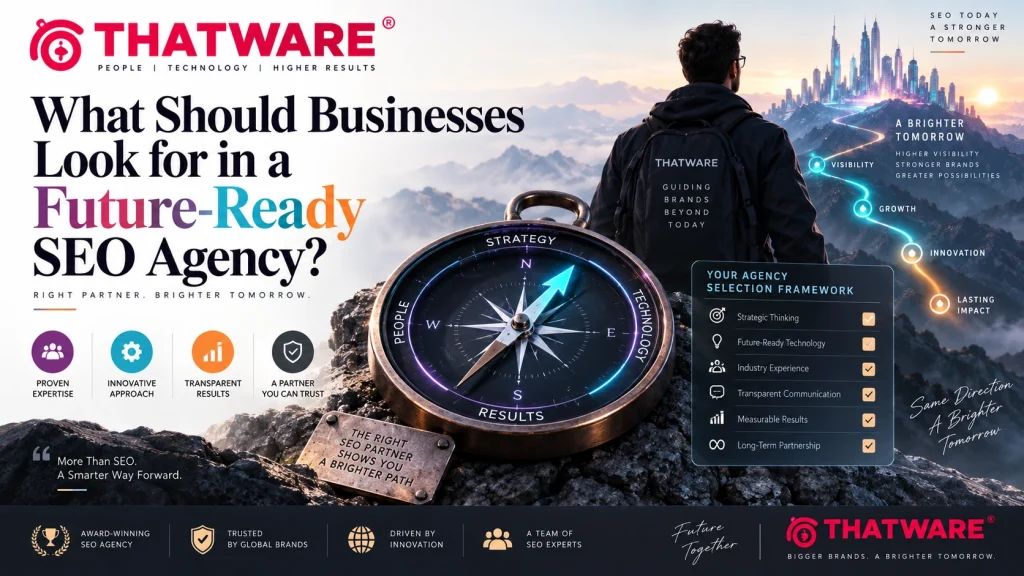
Search is becoming more conversational, more entity-driven, more answer-focused, and increasingly influenced by generative AI.
That means the agency businesses choose today needs to be capable of supporting the search environment of tomorrow.
A future ready SEO agency should not simply optimize webpages for rankings.
It should understand how to build visibility across:
- Traditional search
- AI search
- Answer engines
- Generative search
- Large language models
- Entity-based discovery
- Citation-driven search
- Multi-platform customer journeys
The right SEO partner should combine technical expertise, search intelligence, strategic planning, AI visibility, content authority, and measurable business outcomes.
So what exactly should businesses look for?
What Is a Future-Ready SEO Agency?
A future ready SEO agency is an SEO partner capable of adapting strategies as search behavior, platforms, technologies, and ranking environments evolve.
It should understand traditional SEO fundamentals while also being capable of working with:
- AI SEO
- AEO
- GEO
- LLM SEO
- Entity optimization
- Knowledge graphs
- AI citations
- Search intelligence
- Structured data
- Digital PR
- Prompt monitoring
- Generative visibility
The objective is not to abandon conventional SEO.
The objective is to extend it.
A future-ready agency should help a business remain discoverable even as the interfaces people use to search continue changing.
Expert Insight:
“A future-ready SEO agency should not chase every new platform. It should understand which changes matter and how to connect them with proven SEO fundamentals.”
Why Traditional SEO Capability Is Still Essential
Businesses should not choose an agency simply because it uses AI terminology.
Strong SEO fundamentals remain essential.
An agency still needs deep expertise in:
- Crawlability
- Indexation
- Site architecture
- Canonicals
- XML sitemaps
- Internal linking
- JavaScript rendering
- Structured data
- Page performance
- Keyword strategy
- Search intent
- Backlinks
A technically weak website will struggle regardless of how advanced its AI search strategy sounds.
The strongest advanced SEO agency should therefore combine proven SEO expertise with emerging search capabilities.
1. Look for Strategic Thinking, Not Task Execution
Many SEO providers operate from monthly checklists.
They may:
- Publish blogs
- Build links
- Update metadata
- Send ranking reports
These activities can be useful, but they do not automatically create a strategy.
A strategic SEO agency should ask deeper questions.
For example:
- Where is search demand moving?
- Which topics should the business own?
- Which competitors are gaining visibility?
- How is AI changing the buyer journey?
- Which pages actually influence revenue?
- What new search channels matter?
- What should the business stop doing?
Strategy is about prioritization.
A good agency should know not only what can be done, but what should be done first.
Quick Question: How Can I Tell if an Agency Is Strategic?
Ask what it would prioritize first and why. A strategic agency should connect SEO activity to demand, competition, revenue, AI search behavior, and long-term growth rather than simply list monthly deliverables.
2. Evaluate Its AI SEO Capabilities
AI search should now be part of the evaluation process.
A credible AI SEO agency should understand how AI-powered search affects:
- Brand discovery
- Citation visibility
- Entity recognition
- Generative recommendations
- Conversational queries
- Search intent
- Content architecture
Ask how the agency approaches visibility across:
- ChatGPT
- Gemini
- Google AI Overviews
- Perplexity
- Copilot
- Other generative search environments
If its answer is simply “we use AI to write content faster,” its strategy may not be mature enough.
Strategic Insight:
“Using AI to produce content faster is not the same as understanding how AI is changing search.”
3. Ask What Makes It the Best AI SEO Agency for Your Business
The best AI SEO agency is not necessarily the provider with the most aggressive marketing.
The right choice depends on your business.
Ask whether the agency has experience with:
- Your market
- Your website size
- Your technical complexity
- Your customer journey
- Your search competition
- Your AI visibility challenges
A strong agency should customize the strategy rather than provide the same package to every business.
4. Look for Search Intelligence Capability
Modern SEO creates enormous amounts of data.
The challenge is turning that data into decisions.
A strong search intelligence company should be able to combine:
- Keyword data
- SERP trends
- Competitor analysis
- AI visibility
- Content gaps
- Entity relationships
- Backlink intelligence
- User intent
- Market trends
Search intelligence helps answer:
“What opportunity matters most?”
That is more valuable than receiving another spreadsheet containing hundreds of keywords.
5. Evaluate Technical SEO Depth
Technical SEO remains one of the best indicators of agency quality.
Ask whether the agency can evaluate:
- Crawl budget
- JavaScript rendering
- Indexation
- Duplicate content
- International SEO
- Core templates
- Canonicalization
- Structured data
- Internal architecture
- Large-scale redirects
- Site migrations
A capable advanced SEO company should be able to handle complex technical environments rather than relying only on content and backlinks.
6. Check Whether the Agency Understands Entity SEO
AI systems increasingly depend on entities.
Your brand is an entity.
Your founder is an entity.
Your products, services, locations, and industries are entities.
The agency should understand how to strengthen relationships such as:
Brand → offers → service
Brand → founded by → person
Brand → operates in → market
Brand → specializes in → topic
Entity clarity helps search and AI systems interpret businesses accurately.
Case Study: Fixing Brand Confusion
Consider a company whose website presents it as a technology consultancy while directories and media profiles describe it mainly as a digital agency. A strong SEO partner could align these signals, clarify services and founder relationships, and improve how search engines and AI systems interpret the brand.
7. Ask About AI Search Optimization
A modern agency should understand more than Google rankings.
A capable AI search optimization agency should be able to explain how it improves:
- AI mentions
- Generative citations
- Brand recommendations
- Entity understanding
- Prompt coverage
- AI share of voice
- Platform visibility
It should also explain what can realistically be influenced and what cannot.
No legitimate agency should promise guaranteed placement in ChatGPT or another generative platform.
8. Look for AEO Capability
Answer Engine Optimization is becoming more important as search platforms provide direct answers.
A future-ready agency should know how to optimize for:
- Natural-language questions
- Featured answers
- FAQs
- Direct definitions
- Conversational queries
- Structured answer blocks
- Semantic question coverage
This can strengthen visibility across both search engines and AI-driven experiences.
9. Look for GEO Capability
Generative Engine Optimization focuses on increasing visibility in generative AI responses.
A capable agency should understand:
- AI citations
- External authority
- Brand mentions
- Digital PR
- Original research
- Entity optimization
- Generative visibility measurement
GEO should not be treated as simple keyword optimization.
10. Evaluate LLM SEO Expertise
Large language models do not operate exactly like conventional search engines.
Agencies should understand concepts such as:
- Entity relationships
- Semantic relevance
- Structured information
- Knowledge graphs
- Retrieval
- Citation authority
- Machine-readable context
A next generation SEO agency should be able to integrate these ideas into broader search strategy.
11. Ask How the Agency Measures AI Visibility
Traditional reporting usually includes:
- Rankings
- Traffic
- Impressions
- Backlinks
- Conversions
Modern reporting should also consider:
- AI brand mentions
- Citation frequency
- Recommendation share
- Prompt coverage
- Competitor AI visibility
- AI sentiment
- Entity accuracy
A credible AI powered SEO agency should have a framework for measuring these newer signals.
Quick Question: Are Google Rankings Enough to Measure an AI SEO Agency?
No. Rankings still matter, but modern reporting should also include AI mentions, citations, prompt coverage, recommendation share, competitor visibility, sentiment, and entity accuracy.
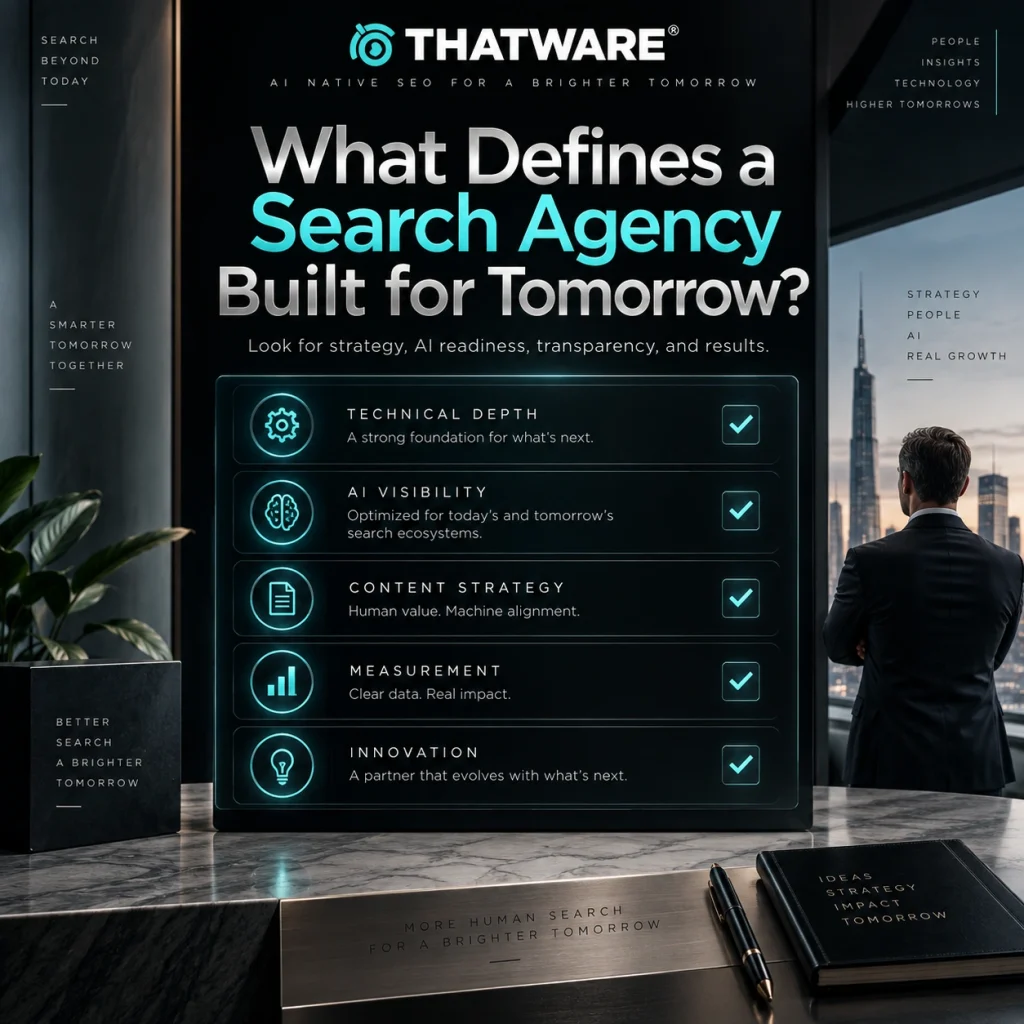
12. Look for Strong Competitor Intelligence
SEO is competitive.
A strong agency should understand not just your website, but your market.
Competitive analysis should examine:
- Ranking competitors
- Content competitors
- Commercial competitors
- AI search competitors
- Backlink competitors
- Entity authority
- Citation sources
The goal is to identify where competitors are winning and where they remain vulnerable.
13. Assess Content Strategy Quality
Future-ready SEO should not be built around publishing as much content as possible.
The agency should prioritize:
- Search intent
- Original expertise
- Topical depth
- Commercial relevance
- Clear answers
- Research
- Useful comparisons
- Citation value
Generic content is becoming easier to create.
Differentiated expertise is becoming more valuable.
Content Principle:
“The best content strategy is not the one that publishes the most. It is the one that creates the strongest authority, relevance, and business value.”
14. Look for Original Research Capability
Original research can strengthen:
- Backlinks
- Digital PR
- AI citations
- Search authority
- Brand credibility
Examples include:
- Industry surveys
- Benchmark studies
- Proprietary datasets
- Search research
- AI visibility studies
- Market analysis
A modern SEO agency should understand the strategic value of publishing information competitors cannot simply recreate.
Case Study: Building a Citation Asset
Imagine an SEO agency helping an enterprise brand publish an annual benchmark on AI search visibility in its industry. That single research asset could support backlinks, digital PR, AI citations, media coverage, and stronger brand authority.
15. Evaluate Digital PR Capability
Digital PR is increasingly connected to search visibility.
Why?
Because external sources help validate what a company claims about itself.
Digital PR can create:
- Brand mentions
- Founder authority
- Expert citations
- Research references
- Industry coverage
- High-quality links
This supports both traditional SEO and AI search.
16. Ask About Structured Data
Structured data helps machines understand website information.
Relevant schema can include:
- Organization
- Person
- Product
- Service
- Article
- FAQPage
- Review
- LocalBusiness
- BreadcrumbList
The agency should understand how schema supports entity clarity and search interpretation.
17. Evaluate Internal Linking Strategy
Internal linking is more than a technical task.
It communicates relationships.
For example:
AI SEO
→ AEO
→ GEO
→ LLM SEO
→ AI citations
→ Search intelligence
A strong internal architecture supports:
- Crawlability
- Topical authority
- Semantic understanding
- User navigation
18. Look for an Enterprise SEO Capability if You Operate at Scale
Large websites have different challenges.
An enterprise SEO agency should be capable of managing:
- Thousands or millions of URLs
- Multiple markets
- International SEO
- Large content ecosystems
- Complex CMS systems
- Technical governance
- Multiple stakeholders
- AI search visibility across product lines
Enterprise SEO requires scalable systems, not just more people.
19. Evaluate the Agency’s Consulting Capability
Some businesses already have internal SEO teams.
In these cases, the best partner may not need to execute everything.
A strong SEO consulting company can provide:
- Strategic direction
- Technical guidance
- Competitive analysis
- Content architecture
- AI search planning
- Governance
- Measurement frameworks
Good consulting helps internal teams make better decisions.
20. Look for AI SEO Consulting Expertise
An AI SEO consulting company should be able to help organizations understand:
- Which AI platforms matter
- How current SEO should evolve
- Where entity gaps exist
- How citations influence visibility
- What prompts should be tracked
- How AI visibility should be measured
This is especially valuable for businesses that already have mature SEO programs.
21. Evaluate AI Search Integration
An agency should not create completely isolated strategies for Google, ChatGPT, and AI search.
These channels should reinforce each other.
For example, one strong research asset could:
- Rank organically
- Earn backlinks
- Generate PR
- Strengthen entity authority
- Become an AI citation source
- Support commercial pages
This creates compounding value.
Quick Question: Should Google SEO and AI SEO Be Separate Campaigns?
Not completely. The strongest strategies allow technical SEO, content, PR, entity signals, research, and citations to support both traditional search and AI discovery at the same time.
22. Look for SEO Transformation Capability
Some organizations do not need another SEO campaign.
They need transformation.
A SEO transformation agency should help businesses move from:
- Keyword-centric SEO to intent-driven strategy
- Content volume to content quality
- Link volume to authority development
- Page rankings to multi-platform visibility
- Manual reporting to integrated analytics
- Google-only thinking to AI-aware search strategy
Transformation requires operational change, not just recommendations.
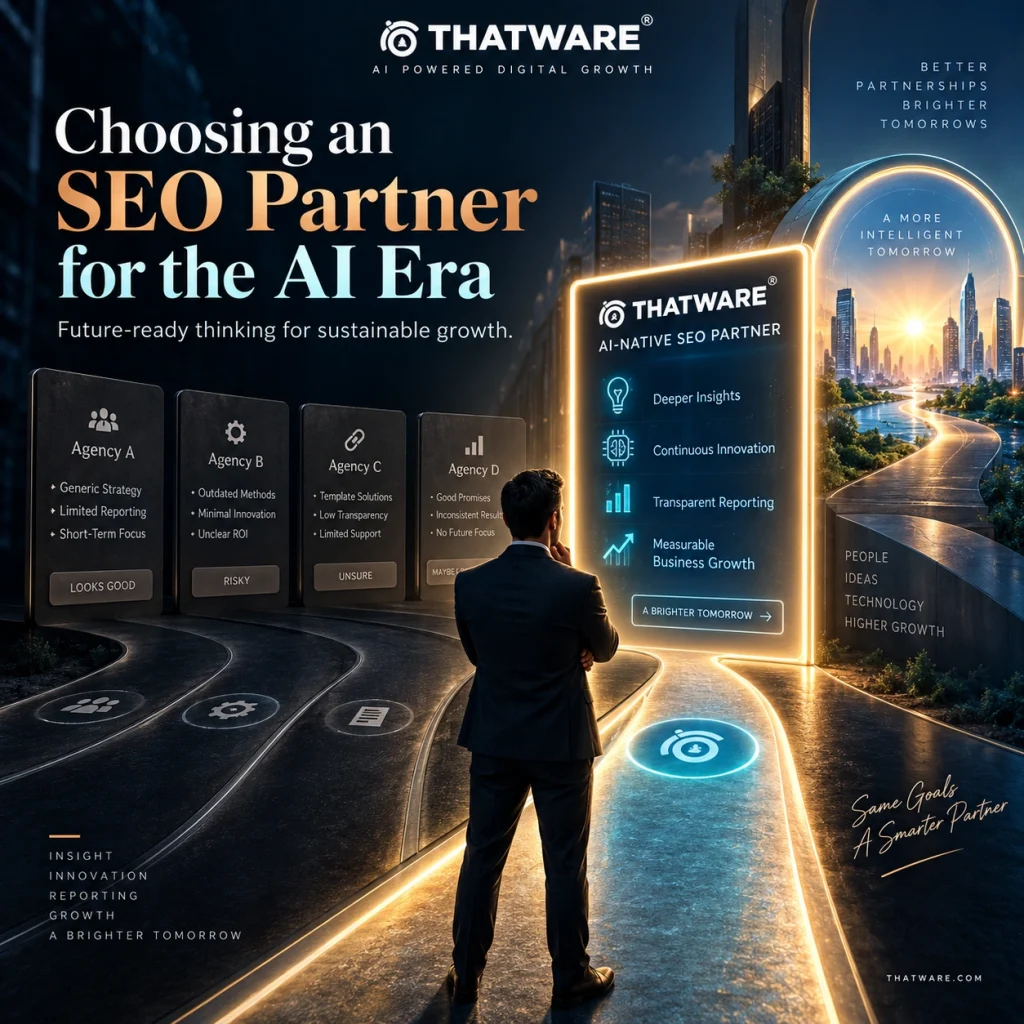
23. Ask How the Agency Approaches Search Innovation
Innovation should solve real problems.
A future-ready agency may use new methods for:
- Search forecasting
- Entity mapping
- Prompt analysis
- AI visibility tracking
- Content intelligence
- Competitive monitoring
- Technical detection
Technology should improve decision-making rather than exist only for marketing.
24. Review How the Agency Uses AI
Ask a potential provider:
“How does AI change your SEO process?”
A weak answer may focus entirely on automated content.
A stronger answer may include:
- Data analysis
- Query clustering
- Technical diagnostics
- Search forecasting
- Entity analysis
- Content intelligence
- Competitor monitoring
- AI search measurement
This is a key distinction when evaluating an AI powered SEO agency.
25. Ask About Commercial Search Strategy
Traffic alone does not guarantee growth.
A strategic agency should understand:
- Informational intent
- Commercial investigation
- Transactional intent
- Recommendation queries
- Comparison queries
- Decision-stage content
The SEO program should support the entire funnel.
26. Evaluate Conversion Thinking
A business does not benefit simply because traffic increases.
The agency should also consider:
- CTA strategy
- Service page quality
- Landing page intent
- Trust signals
- Case studies
- Conversion pathways
SEO should ultimately support business outcomes.
27. Look for Clear Measurement
Ask how success will be measured before signing a contract.
Possible KPIs include:
- Organic visibility
- Revenue-producing keywords
- Qualified traffic
- Leads
- Conversions
- AI mentions
- Citations
- Prompt coverage
- Competitor share of voice
- Brand authority
Metrics should align with business objectives.
28. Demand Transparency
A credible agency should explain:
- What it is doing
- Why it is doing it
- What it expects to improve
- What has not worked
- What will change next
Avoid agencies that hide behind vague reports.
Transparency is particularly important in emerging areas such as AI SEO.
Buyer Principle:
“A good SEO agency should be able to explain what it is doing, why it matters, and what it will change when the data says the strategy is not working.”
29. Avoid Guaranteed Rankings
No credible agency can guarantee first place rankings.
The same applies to generative AI.
No AI SEO agency can guarantee that ChatGPT will recommend a brand in every response.
Search systems change.
AI outputs vary.
A good agency improves the underlying probability of visibility without making unrealistic promises.
30. Avoid Agencies That Sell AI SEO as Content Automation
Generating hundreds of articles with AI is not an AI search strategy.
Mass content production may create:
- Redundancy
- Weak differentiation
- Quality problems
- Authority dilution
A future-ready agency should use AI as an intelligence tool, not simply a publishing shortcut.
31. Avoid Agencies That Ignore Brand Authority
Search and brand are increasingly connected.
A business may have excellent on-page SEO but weak external credibility.
A capable agency should consider:
- PR
- Brand mentions
- Founder authority
- Research
- Industry recognition
- External citations
These signals strengthen overall search authority.
32. Avoid Agencies That Only Track Google
Google remains extremely important.
But businesses should increasingly understand their visibility across AI-powered discovery environments too.
A modern SEO agency should not necessarily optimize equally for every platform, but it should know which platforms matter to your audience and how to measure them.
33. Look for a Clear Roadmap
A strong agency should be able to organize its work into phases.
Phase 1: Discovery
Understand the business, audience, market, and competitors.
Phase 2: Audit
Evaluate technical SEO, content, entities, authority, and AI visibility.
Phase 3: Strategy
Prioritize high-value opportunities.
Phase 4: Implementation
Improve technical, content, authority, and AI search signals.
Phase 5: Measurement
Track traditional and AI visibility.
Phase 6: Iteration
Use performance data to refine the strategy.
This demonstrates strategic maturity.
34. Compare Agencies Using a Practical Scorecard
When comparing providers, score them across:
| Capability | What to Look For |
| Technical SEO | Strong audit and implementation capability |
| Content Strategy | Intent, authority and commercial focus |
| AI SEO | Understanding of AI-powered search |
| AEO | Direct-answer optimization |
| GEO | Generative visibility and citations |
| LLM SEO | Entity and model understanding |
| Digital PR | External authority development |
| Search Intelligence | Data-led opportunity discovery |
| Enterprise Capability | Scale, governance and complexity |
| Reporting | Search and AI visibility metrics |
| Strategy | Clear prioritization and roadmap |
The highest-quality agency should demonstrate depth across several of these areas.
35. What Makes the Best AI SEO Agency?
The best AI SEO agency should not be selected simply because it calls itself innovative.
Look for evidence of:
- Technical expertise
- Search intelligence
- AI visibility measurement
- Entity optimization
- AEO and GEO expertise
- LLM understanding
- Content strategy
- Digital PR
- Business-focused reporting
The agency should connect all of these capabilities into one search strategy.
36. Why Search Intelligence Matters More Than Ever
Search data is becoming more complex.
Businesses must understand:
- What customers search
- What they ask AI
- What competitors rank for
- Which brands AI recommends
- Which sources are cited
- Which topics are emerging
A search intelligence company should help businesses convert these signals into actionable growth decisions.
37. Modern SEO Requires Cross-Functional Thinking
SEO is increasingly connected to:
- PR
- Brand
- Product
- Analytics
- Content
- Development
- Customer experience
A next generation SEO agency should be capable of working across these disciplines.
This is particularly important for enterprise organizations.
38. What Businesses Should Ask Before Hiring an SEO Agency
Before choosing a provider, ask:
- How do you measure business impact from SEO?
- How do you approach AI search?
- Do you offer AEO, GEO, and LLM SEO?
- How do you measure AI visibility?
- What does your technical SEO process include?
- How do you analyze competitors?
- How do you develop search strategy?
- How do you build external authority?
- How do you work with enterprise websites?
- How do you adapt when search behavior changes?
The quality of the answers often reveals more than a sales presentation.
How ThatWare Approaches Future-Ready SEO
At ThatWare, future-ready search optimization can be approached as a search intelligence challenge rather than a collection of isolated SEO tasks.
That can include:
- Traditional SEO
- Advanced technical SEO
- AI SEO
- AEO
- GEO
- LLM SEO
- Entity optimization
- Knowledge graph enhancement
- Structured data
- Digital PR
- AI citation strategy
- Search intelligence
- Prompt monitoring
- Competitive analysis
- AI visibility measurement
- Enterprise search strategy
Businesses looking for a future ready SEO agency, advanced SEO agency, AI search optimization agency, enterprise SEO agency, or SEO consulting company should look for a partner capable of integrating these disciplines into one strategic framework.
ThatWare’s approach is designed around that broader search ecosystem.
Final Thoughts
Choosing an SEO agency today requires a different evaluation process than it did several years ago.
Traditional SEO expertise remains essential.
But businesses should increasingly look for capabilities in:
- AI SEO
- AEO
- GEO
- LLM SEO
- Entity intelligence
- Search intelligence
- Digital PR
- AI visibility
- Enterprise search
- Strategic consulting
A future ready SEO agency should help your business compete not only for today’s rankings, but also for tomorrow’s discovery environments.
The strongest advanced SEO company will understand that search is no longer simply about keywords and links.
It is about building a business that search engines and AI systems can understand, trust, retrieve, cite, and recommend.
That is what separates a conventional provider from a truly next generation SEO agency.