
SUPERCHARGE YOUR ONLINE VISIBILITY! CONTACT US AND LET’S ACHIEVE EXCELLENCE TOGETHER!
Modern AI-powered search is no longer limited to reading web pages or extracting isolated answers from FAQ sections. Instead, it seeks to understand how questions, answers, entities, topics, and relationships connect within a broader knowledge ecosystem. A faq-knowledge-graph JSON file is designed to provide that semantic structure by organizing FAQs into a machine-readable, entity-linked dataset that AI systems can interpret with greater accuracy.
By connecting questions to entities, topics, supporting evidence, and canonical resources, this approach enables search engines, large language models (LLMs), and retrieval systems to understand not only what a website says but also why its answers are authoritative. As a result, organizations can improve AI discoverability, Generative Engine Optimization (GEO), Answer Engine Optimization (AEO), semantic search visibility, entity recognition, knowledge graph development, and trustworthy machine-readable question-answer relationships.
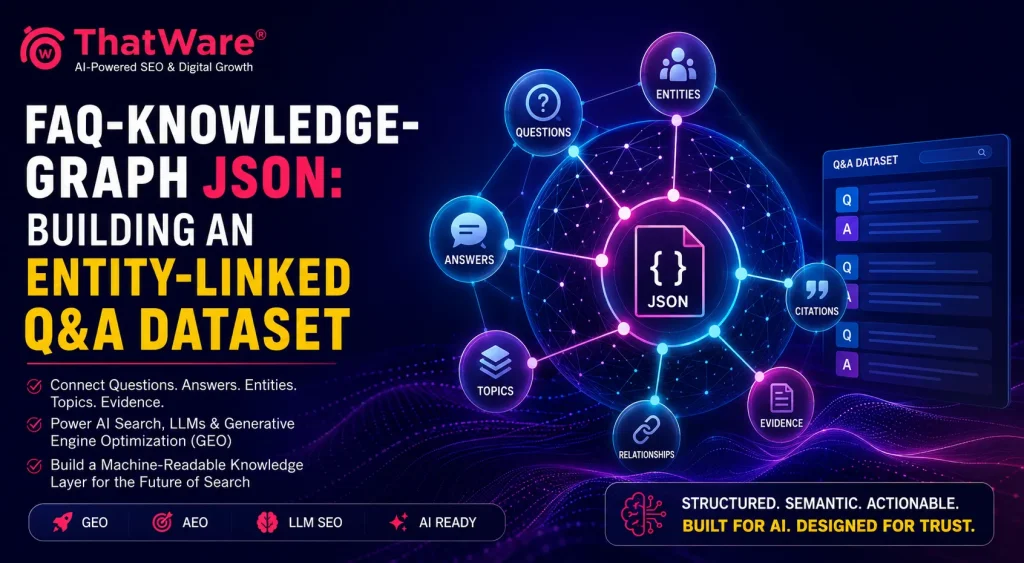
1. What Is FAQ-Knowledge-Graph JSON?
A FAQ knowledge graph is a structured JSON file that transforms a traditional FAQ section into an interconnected semantic dataset. Instead of storing standalone questions and answers, it links every question to relevant entities, topics, and supporting evidence, making the information easier for AI systems to retrieve, interpret, and cite.
A well-designed file typically includes:
- Primary organization, product, service, or topic entity
- Questions mapped to specific concepts
- Authoritative answers with contextual explanations
- Entity references that connect related concepts
- Topic clusters for semantic organization
- Explicit relationships between questions, answers, and entities
- Canonical URLs for preferred citations
- Supporting evidence such as documentation, research, or case studies
- Citation targets for AI-generated responses
- Search intent associated with each question
- AI intent for conversational retrieval
- Confidence scores indicating answer reliability
- Metadata describing version, language, publisher, and update history
For AI systems, the file functions as an organized AI Q&A dataset that explains which questions belong to which entities, how answers relate to broader topics, and which sources should be trusted during retrieval and response generation.
2. Why FAQ-Knowledge-Graph JSON Exists
Traditional FAQ pages and standard FAQ Schema provide valuable structured information, but they often treat each question-answer pair as an isolated unit. This limits the ability of AI systems to understand how multiple questions relate to shared entities, topics, or user intent.
An entity-linked FAQs approach addresses these limitations by creating a centralized Q&A knowledge graph that helps LLMs and AI search engines:
- Identify primary entities behind each question
- Connect related questions within topical clusters
- Understand semantic relationships across multiple answers
- Retrieve the most contextually relevant information
- Select preferred citation sources more accurately
- Reduce ambiguity between similar concepts or brands
- Improve conversational reasoning through connected knowledge
- Strengthen consistency across AI-generated responses
3. Difference Between FAQ Schema, Knowledge Graph JSON, and FAQ-Knowledge-Graph JSON
Traditional FAQ Schema
- Purpose: Presents individual questions and answers in a structured format for search engines.
- Strengths: Enhances rich results, improves answer visibility, and supports basic indexing of machine-readable Q&A content.
- Limitations: Focuses on isolated question-answer pairs without connecting them to broader entities, topics, or semantic relationships.
knowledge-graph.json
- Creates a website-wide entity graph that defines brands, services, products, people, and concepts.
- Establishes relationships between entities to improve semantic understanding.
- Maps authority signals, canonical resources, and topic ownership across the entire website.
FAQ-Knowledge-Graph JSON
- Combines a question-first and entity-first architecture.
- Enables FAQ entity mapping by linking every question to one or more relevant entities.
- Connects answers with topical clusters, supporting pages, and semantic relationships.
- Assigns canonical citation URLs for authoritative responses.
- Builds a structured answer graph that helps AI systems interpret conversations rather than isolated FAQs.
Comparison Summary
- FAQ Schema = Question/Answer
- Knowledge Graph JSON = Entity Network
- FAQ-Knowledge-Graph JSON = Entity-Linked Question Network
4. Why It Matters for LLM Optimization
Large Language Models retrieve information by understanding entities, relationships, user intent, and supporting evidence rather than relying solely on keywords. A well-designed question answer JSON improves retrieval quality by organizing questions into a semantic framework.
LLMs use it for:
- Entity recognition
- Intent understanding
- Context retrieval
- Question matching
- Answer generation
- Citation selection
- Disambiguation of similar entities
- Discovering relevant AI discovery questions within a connected knowledge ecosystem
Key Benefits
- Better entity recognition
- Better conversational retrieval
- Better citation accuracy
- Reduced hallucinations
- Better semantic understanding
- Better AI memory formation
5. Role in GEO: Generative Engine Optimization
FAQ-Knowledge-Graph JSON serves as a semantic conversational layer that bridges user questions, entities, topics, and authoritative answers. Rather than storing FAQs as isolated content, it organizes them into a connected knowledge network that AI-powered search engines and Large Language Models can interpret, retrieve, and cite more effectively. This structured approach strengthens contextual understanding while improving answer quality across conversational search platforms.
5.1 Entity Understanding
- Clearly identifies the primary entities referenced in every question and answer.
- Strengthens semantic connections between brands, services, products, and concepts.
5.2 Question Understanding
- Maps user questions to search intent, helping AI systems recognize what information users are actually seeking.
- Creates a consistent framework for interpreting conversational queries.
5.3 Topic Clustering
- Groups related questions into thematic clusters, enabling more efficient navigation across interconnected subjects through entity relationship FAQs.
5.4 Citation Control
- Assigns preferred canonical URLs so AI platforms reference the most authoritative content for each answer.
5.5 Retrieval Improvement
- Enhances retrieval accuracy by organizing answer engine data into linked entities, questions, and supporting resources, making relevant answers easier to locate.
5.6 Context Assembly
- Supplies surrounding context, related entities, and supporting evidence that help LLMs generate comprehensive and trustworthy responses.
5.7 Brand Disambiguation
- Distinguishes a brand from similarly named organizations by linking questions, entities, and canonical references into a unified knowledge structure.
A well-designed ThatWare FAQ graph demonstrates how an entity-linked FAQ dataset can improve AI understanding, increase retrieval precision, and strengthen Generative Engine Optimization by transforming static FAQs into an interconnected semantic resource.
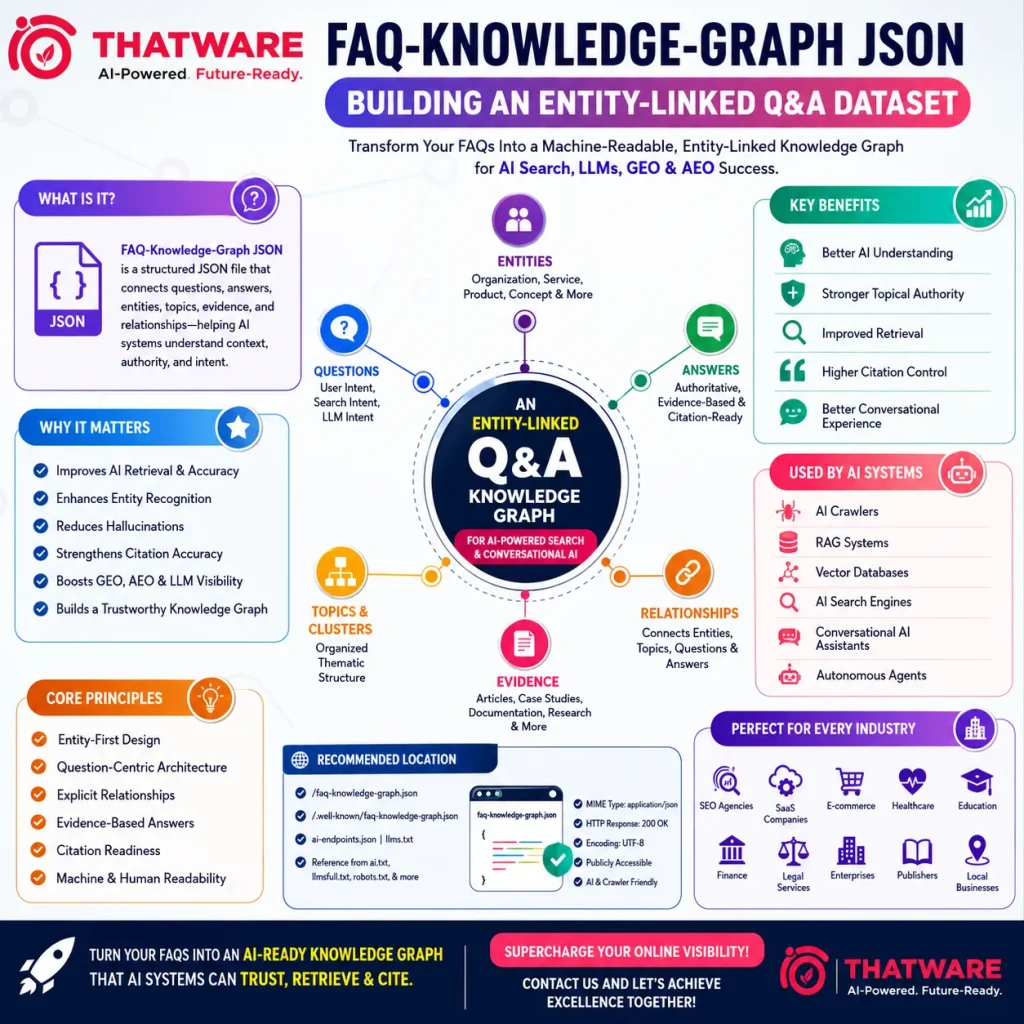
6. How AI Systems Can Use FAQ-Knowledge-Graph JSON
6.1 AI Crawlers
- AI crawlers can discover the faq-knowledge-graph.json file and extract structured questions, answers, entities, and their relationships. This AI crawler Q&A capability enables more accurate indexing and semantic understanding beyond traditional web pages.
6.2 Retrieval-Augmented Generation (RAG)
- RAG systems can use the file to identify the most relevant questions and authoritative answers before generating responses. Linking questions with entities and evidence improves retrieval precision while reducing irrelevant or incomplete outputs.
6.3 Vector Databases
- Vector databases can leverage the JSON structure to organize embeddings based on semantic relationships. A well-designed FAQ dataset architecture helps connect related questions, entities, and topics, making similarity searches more accurate and context-aware.
6.4 AI Search Engines
- AI-powered search engines can interpret the entity-linked FAQ dataset to understand topical authority, preferred citation pages, and the relationship between questions and supporting content, resulting in more reliable answer generation.
6.5 Conversational AI Assistants
- Virtual assistants can retrieve contextually relevant answers by using question intent mapping to match user queries with the most appropriate entities, topics, and conversational responses.
6.6 Autonomous Agents
- AI agents can navigate the dataset to retrieve verified information, follow entity relationships, complete multi-step reasoning tasks, and deliver consistent responses across complex workflows.
6.7 Brand Knowledge Panels
- The structured FAQ dataset can strengthen an enterprise knowledge graph, helping AI systems associate brands with verified questions, trusted answers, expertise areas, and authoritative resources for richer knowledge representation.
7. Recommended File Location
For maximum discoverability, the faq-knowledge-graph.json file should be placed in a publicly accessible location so AI systems, crawlers, and retrieval engines can easily find and process it.
Recommended URL
- /faq-knowledge-graph.json
Optional Discovery Locations
- /.well-known/faq-knowledge-graph.json
- /ai-endpoints.json
- /llms.txt
Reference the file from
- ai.txt
- , llms.txt
- , llmsfull.txt
- , ai-endpoints.json
- , robots.txt
- HTML alternate links
Publishing the file in these locations improves accessibility for AI platforms that retrieve structured website resources. A centralized question answer JSON file also helps connect entity-linked responses with AI discovery questions, making it easier for LLMs and answer engines to identify authoritative content. When integrated with other AI-readable files, it strengthens the website’s brand knowledge graph, enabling consistent semantic understanding, more accurate retrieval, and reliable citation of trusted question-and-answer content across AI-powered search and conversational systems.
8. Recommended MIME Type
- Recommended MIME Type: application/json
- Recommended HTTP Response: HTTP 200 OK
- Character Encoding: UTF-8
- Serving the file with these settings ensures it is machine-readable, easily accessible to AI crawlers and search engines, and consistently processed for semantic retrieval, indexing, and AI-powered answer generation.
9. Core Design Principles
9.1 Entity-First Design
Do not begin by listing questions or URLs. Start by identifying the entities that form the foundation of the FAQ dataset. Every question and answer should be connected to one or more relevant entities.
Entities can include:
- organization
- founder
- author
- service
- product
- topic
- concept
- location
- industry
- FAQ category
- technology
- dataset
- research asset
9.2 Question-Centric Architecture
Each question should represent a genuine user intent and be linked to the most relevant entity and topic.
Example:
{
“question”: “What is ThatWare’s Entity SEO?”,
“relatedEntities”: [
“entity:entity-seo”,
“entity:semantic-seo”
]
}
9.3 Canonical Entity Naming
Each entity should have one preferred name while supporting commonly used alternative names where appropriate.
Example:
{
“name”: “Entity SEO”,
“alternateNames”: [
“Semantic Entity Optimization”,
“Entity-Based SEO”
]
}
9.4 Persistent IDs
Every entity, question, and answer should have a permanent identifier to maintain consistent relationships across the dataset.
Example:
“id”: “entity:entity-seo”
9.5 Explicit Relationships
Relationships between questions, answers, entities, and topics should be clearly defined.
Example:
{
“source”: “question:what-is-entity-seo”,
“relationship”: “references”,
“target”: “entity:entity-seo”
}
9.6 Evidence-Based Answers
Answers should be supported by verifiable evidence rather than unsupported claims.
Example evidence:
- service page
- case study
- research article
- author profile
- external citation
- product documentation
- technical guide
9.7 Citation Readiness
Every important entity, topic, and answer should include a preferred canonical citation URL to help AI systems reference the most authoritative source.
9.8 Machine and Human Readability
The JSON structure should be simple enough for developers to maintain while remaining highly structured, consistent, and easily interpreted by AI systems, search engines, and retrieval platforms.
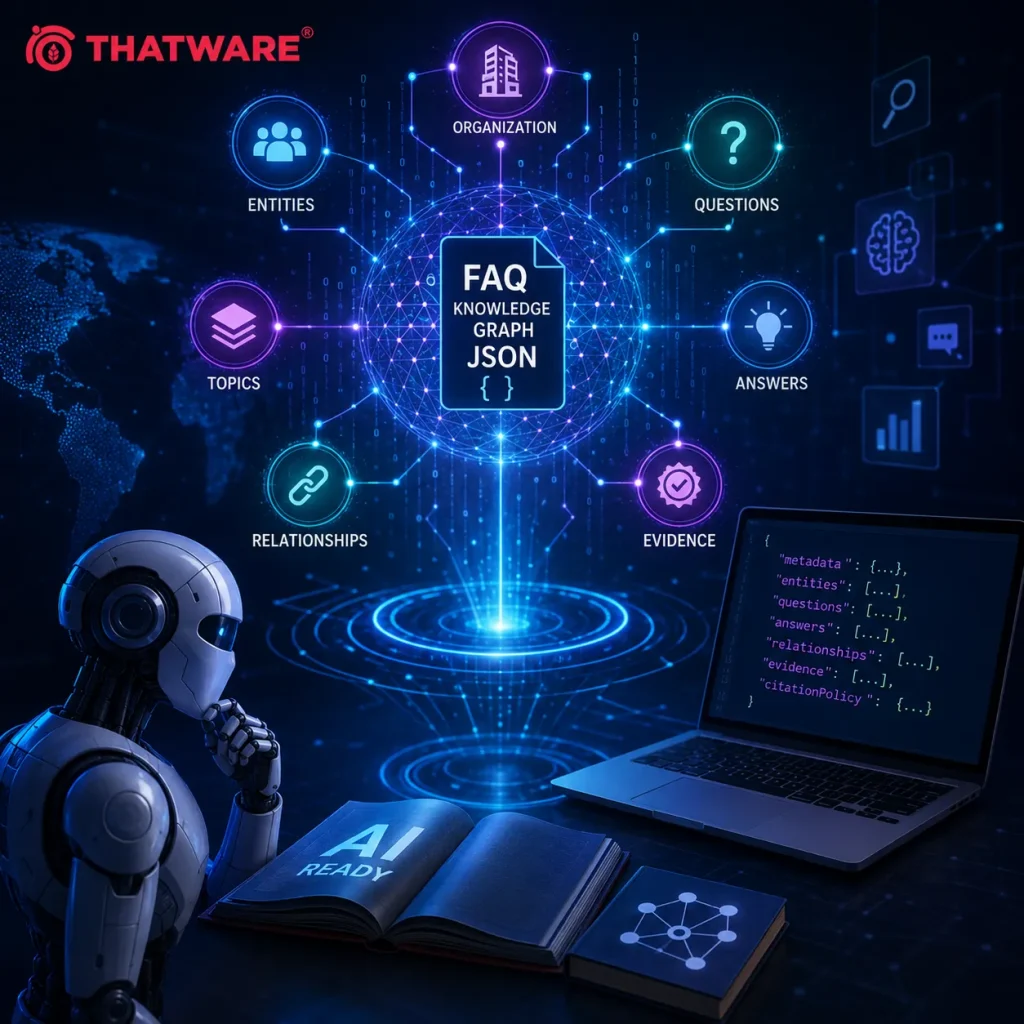
10. Key Components of FAQ-Knowledge-Graph JSON
FAQ-knowledge-graph JSON Include sections for:
- metadata
- organization
- website
- entities
- questions
- answers
- FAQ clusters
- topics
- relationships
- evidence
- citations
- confidence scores
- sameAs links
- AI usage policy
- validation metadata
- update history
11. Field-by-Field Explanation
11.1 metadata
Defines file-level information for the faq-knowledge-graph.json file.
Recommended fields:
- version
- generatedAt
- lastUpdated
- publisher
- language
- license
- canonicalUrl
- fileType
Purpose:
- helps AI systems determine data freshness
- supports version control
- simplifies JSON validation
- provides machine-readable file metadata
11.2 organization
Defines the primary organization or brand responsible for the FAQ dataset.
Recommended fields:
- id
- name
- legalName
- url
- logo
- description
- foundingDate
- founder
- sameAs
- contactPoint
- primaryExpertise
Purpose:
- identifies the primary organization
- strengthens brand recognition
- helps AI distinguish the brand from similarly named entities
11.3 website
Defines the website where the FAQ knowledge graph is published.
Recommended fields:
- id
- url
- name
- publisher
- inLanguage
- primaryAudience
- contentTypes
Purpose:
- identifies the website as a digital asset
- separates the website from the organization entity
- helps AI understand the site’s purpose and content scope
11.4 entities
This is one of the most important sections because every question and answer is connected to one or more entities.
Each entity should include:
- id
- name
- type
- description
- alternateNames
- canonicalUrl
- relatedEntities
- authorityScore
- evidence
- preferredCitation
Entity types may include:
- Organization
- Service
- Product
- Concept
- Topic
- Person
- Industry
- FAQ Topic
Purpose:
- creates the semantic foundation of the FAQ dataset
- enables entity linking across related questions
- improves AI understanding and retrieval accuracy
11.5 questions
Defines every question contained in the FAQ dataset.
Recommended fields:
- id
- question
- questionType
- searchIntent
- llmIntent
- relatedEntities
- canonicalTopic
- answerReference
Purpose:
- organizes user questions into a structured dataset
- connects search intent with relevant entities
- enables AI systems to retrieve the most appropriate answers
11.6 answers
Stores authoritative responses linked to individual questions.
Recommended fields:
- id
- answer
- supportingEvidence
- relatedEntities
- citations
- confidenceScore
- lastUpdated
Purpose:
- provides trustworthy, machine-readable answers
- links responses with supporting evidence
- improves answer quality and citation reliability
11.7 FAQ Clusters
Groups related questions into semantic clusters.
Recommended fields:
- id
- clusterName
- primaryTopic
- relatedQuestions
- supportingPages
- searchIntent
Purpose:
- organizes FAQs around shared topics
- strengthens topical authority
- improves semantic retrieval and conversational context
11.8 Topics
Defines the primary subject areas covered by the FAQ dataset.
Recommended fields:
- id
- name
- description
- parentTopic
- childTopics
- relatedTopics
- canonicalUrl
- searchIntent
- llmIntent
Purpose:
- creates a hierarchical topic structure
- improves semantic clustering
- helps AI route user queries to the correct subject area
11.9 Relationships
Defines the semantic connections between questions, answers, entities, and topics.
Common relationship types:
- answers
- references
- relatedTo
- supports
- explains
- mentions
- specializesIn
- hasEvidence
- belongsToTopic
- cites
- sameAs
Purpose:
- transforms the dataset from isolated records into an interconnected knowledge graph, enabling AI systems to understand contextual relationships
11.10 Evidence
Defines the proof supporting the accuracy of answers and entity associations.
Evidence types:
- Internal article
- Research
- Documentation
- Case study
- Product page
- Whitepaper
- External citation
Purpose:
- strengthens answer credibility
- improves trust signals
- reduces unsupported factual claims
11.11 Citation Policy
Defines how AI systems should reference answers and entities.
Recommended fields:
- allowCitation
- attributionRequired
- preferredCitationFormat
- canonicalDomain
- preferredPagesByTopic
Purpose:
- encourages consistent attribution
- guides AI toward preferred citation URLs
- improves citation accuracy across answer engines
11.12 AI Usage Policy
Defines permissions for how AI systems may use the FAQ dataset.
Recommended fields:
- allowSummarization
- allowRetrieval
- allowCitation
- allowEmbedding
- allowTraining
- attributionRequired
Purpose:
- communicates machine-readable AI usage permissions
- clarifies retrieval and summarization policies
- supports responsible AI access and attribution.
12. Confidence Scoring Model
A faq-knowledge-graph.json file can include confidence scores to indicate the reliability and authority of individual questions, answers, entities, and relationships.
Recommended Score Range
- 0.00–1.00
Suggested Interpretation
- 0.90–1.00: High confidence – authoritative, well-supported information
- 0.75–0.89: Strong confidence – reliable with substantial supporting evidence
- 0.50–0.74: Moderate confidence – accurate but may require additional validation
- 0.25–0.49: Contextual confidence – relevant in specific situations or use cases
- 0.00–0.24: Low confidence – limited evidence or supporting context
Confidence Scores Should Be Based On
- Evidence quality
- Content depth and completeness
- Entity consistency across the dataset
- Subject-matter expertise of the author
- Content freshness and update frequency
- Citation quality and supporting references
- Semantic relevance to the associated entity, topic, and user question
13. Relationship Modeling Best Practices
- Every relationship should clearly define the connection between questions, answers, entities, topics, and supporting evidence to create a meaningful semantic graph.
- A typical relationship structure should include:
- source
- relationship
- target
- confidence
- evidence
- Example JSON:
{
“source”: “question:what-is-entity-seo”,
“relationship”: “explains”,
“target”: “entity:entity-seo”,
“confidence”: 0.97,
“evidence”: [“https://example.com/entity-seo/”]
} - Recommended relationship vocabulary:
- answers
- references
- belongsTo
- hasTopic
- explains
- supports
- relatedTo
- cites
- mentions
- hasEvidence
- preferredCitation
- sameAs
Use consistent relationship names throughout the dataset to improve semantic clarity, AI retrieval, graph traversal, and interoperability with knowledge graph and entity-linking systems.
14. How to Use With Schema.org and JSON-LD
- FAQ-Knowledge-Graph JSON complements, rather than replaces, Schema.org and JSON-LD markup by adding entity relationships and semantic context across the entire FAQ dataset.
- FAQPage Schema: Structures FAQ pages for search engines while supporting AI visibility FAQ through richer contextual connections.
- Question Schema: Defines individual questions with user intent and links them to relevant entities.
- Answer Schema: Provides structured, authoritative responses and supports retrieval-ready answers for AI systems.
- Organization Schema: Identifies the brand or publisher responsible for the FAQ content.
- WebSite Schema: Defines the website as the primary digital property hosting the dataset.
- Article Schema: Connects FAQs with detailed guides, documentation, or supporting resources.
Schema alignment example:
{
“schemaAlignment”: {
“faqPage”: “https://schema.org/FAQPage”,
“question”: “https://schema.org/Question”,
“answer”: “https://schema.org/Answer”,
“organization”: “https://schema.org/Organization”,
“website”: “https://schema.org/WebSite”,
“article”: “https://schema.org/Article”
}
}
15. Implementation Workflow
- Step 1: Identify the core entities that represent your organization, services, products, topics, and expertise before creating the FAQ knowledge graph.
- Step 2: Identify high-value questions based on user intent, search demand, and customer queries.
- Step 3: Build an authoritative answer dataset with clear, accurate, and evidence-backed responses.
- Step 4: Link each question to one or more relevant entities to create entity-linked FAQs with meaningful semantic connections.
- Step 5: Define explicit relationships between entities, questions, answers, and topics.
- Step 6: Add supporting evidence such as documentation, case studies, research, or product pages.
- Step 7: Assign canonical citation URLs for every important answer and entity.
- Step 8: Validate the JSON structure to ensure it is error-free and machine-readable.
- Step 9: Publish the FAQ-knowledge-graph JSON in a publicly accessible location.
- Step 10: Reference the file from AI-readable resources such as llms.txt, ai.txt, and ai-endpoints.json.
- Step 11: Review and update the dataset regularly to maintain accuracy, freshness, and semantic consistency.
16. SEO, GEO, and AEO Benefits
SEO Benefits
- Better entity consistency
- Stronger topical authority
- Better semantic organization
- Improved structured data alignment
GEO Benefits
- Better AI retrieval
- Improved LLM understanding
- Better conversational visibility
- Stronger citation targeting
AEO Benefits
- Better direct-answer readiness
- Better conversational responses
- Better FAQ retrieval
- Better voice search optimization
17. Common Mistakes to Avoid
Mistake 1: Using FAQ-Knowledge-Graph JSON as Simple FAQ Markup
- Do not treat faq-knowledge-graph JSON as a replacement for the standard FAQ Schema. Its purpose is to build semantic relationships between questions, answers, and entities.
Mistake 2: Not Linking Questions to Entities
- Every question should connect to relevant entities to create meaningful entity-linked FAQs instead of isolated question-answer pairs.
Mistake 3: Missing Semantic Relationships
- Define clear relationships between entities, topics, questions, and answers to strengthen contextual understanding.
Mistake 4: Generic Questions Without Topical Intent
- Use specific, intent-driven questions that accurately represent user needs.
Mistake 5: No Canonical Citation URLs
- Assign preferred URLs to support consistent AI citations.
Mistake 6: Unsupported Confidence Scores
- Base confidence ratings on evidence rather than assumptions.
Mistake 7: No Maintenance Strategy
- Regularly review and update the AI Q&A dataset to keep entities, answers, and citations accurate and relevant.
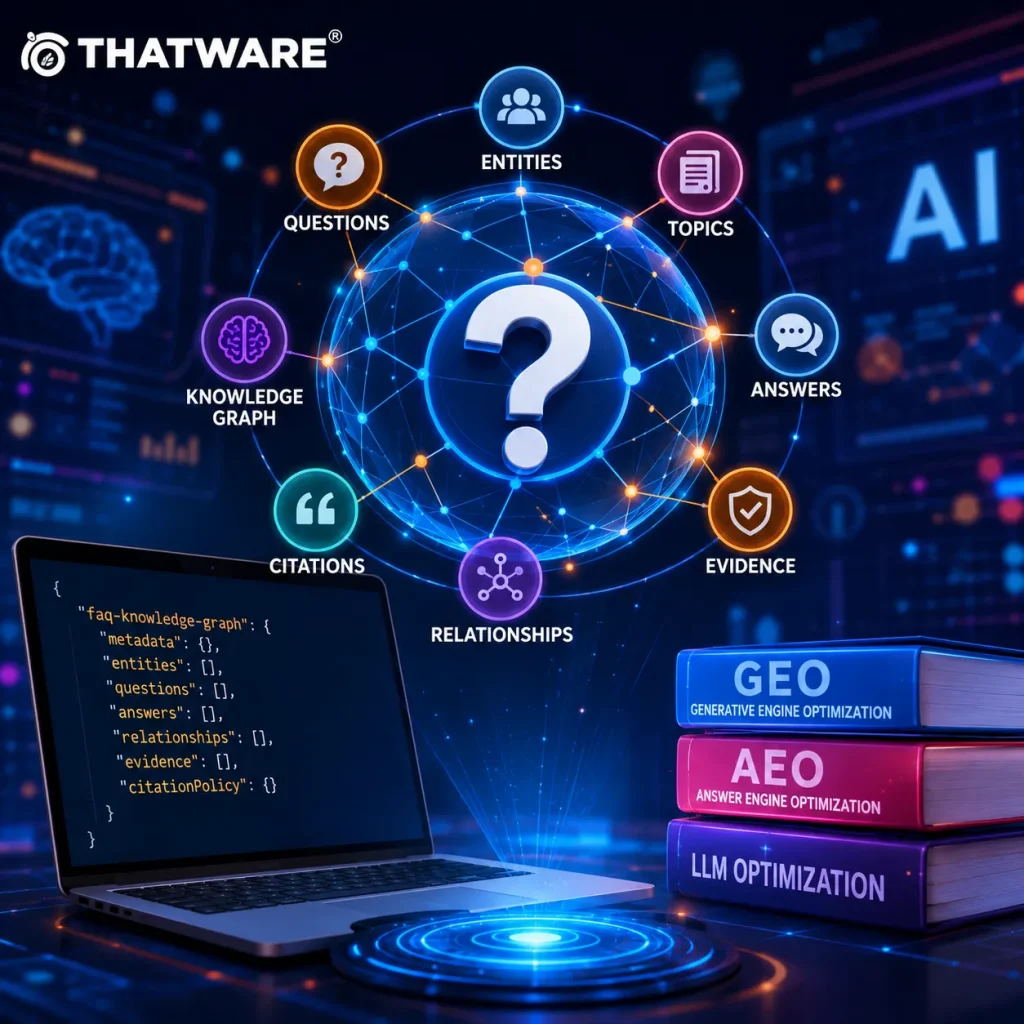
18. Recommended Update Frequency
| Update Type | Frequency |
| New FAQs | Immediately |
| Content updates | Monthly |
| Entity changes | Immediately |
| Citation review | Monthly |
| Confidence review | Quarterly |
| Full semantic audit | Quarterly |
| Schema alignment review | Twice yearly |
19. Full Reusable Prototype Code Structure
{
“metadata”: {
“fileType”: “faq-knowledge-graph”,
“version”: “1.0.0”,
“generatedAt”: “2026-08-10T00:00:00Z”,
“lastUpdated”: “2026-08-10T00:00:00Z”,
“language”: “en”,
“canonicalUrl”: “https://thatware.co/faq-knowledge-graph.json”,
“publisher”: {
“name”: “ThatWare LLP”,
“url”: “https://thatware.co/”
},
“description”: “Machine-readable entity-linked FAQ knowledge graph describing ThatWare LLP’s SEO, AI SEO, AEO, GEO, LLM SEO, AIEO, Entity SEO, Semantic SEO, RAG SEO, AI Visibility, Quantum SEO, QSAAS, Hyper-Intelligence SEO, and related digital discovery concepts.”
},
“organization”: {
“id”: “entity:organization:thatware”,
“type”: “Organization”,
“name”: “ThatWare”,
“legalName”: “ThatWare LLP”,
“url”: “https://thatware.co/”,
“description”: “ThatWare LLP develops AI-driven search, SEO, AEO, GEO, LLM SEO, semantic intelligence, entity optimization, Quantum SEO, Hyper-Intelligence SEO, and AI visibility methodologies.”,
“founders”: [
{
“id”: “person:tuhin-banik”,
“name”: “Tuhin Banik”,
“role”: “Founder & CEO”
}
],
“primaryExpertise”: [
“Search Engine Optimization”,
“AI SEO”,
“Answer Engine Optimization”,
“Generative Engine Optimization”,
“LLM SEO”,
“Artificial Intelligence Experience Optimization”,
“Semantic SEO”,
“Entity SEO”,
“AI Search Visibility”,
“RAG SEO”,
“Quantum SEO”,
“QSAAS”,
“Hyper-Intelligence SEO”
],
“frameworkLibrary”: “https://thatware.co/frameworks/”
},
“website”: {
“id”: “entity:website:thatware-co”,
“type”: “WebSite”,
“name”: “ThatWare”,
“url”: “https://thatware.co/”,
“publisher”: “entity:organization:thatware”,
“inLanguage”: “en”,
“primaryAudience”: [
“Business Owners”,
“SEO Professionals”,
“Digital Marketers”,
“Developers”,
“Enterprise Marketing Teams”,
“AI Search Specialists”,
“Content Strategists”
],
“contentTypes”: [
“Framework Documentation”,
“Service Pages”,
“Research”,
“Technical Guides”,
“FAQs”,
“Case Studies”,
“AI Search Guides”
]
},
“entities”: [
{
“id”: “entity:concept:ai-seo”,
“type”: “Concept”,
“name”: “AI SEO”,
“alternateNames”: [
“Artificial Intelligence SEO”,
“AI-Powered SEO”
],
“description”: “A structured approach to search optimization that aligns content, entities, technical signals, semantic meaning, authority, and user intent with how AI-powered search and answer systems understand and surface information.”,
“canonicalUrl”: “https://thatware.co/ai-seo-framework/”,
“preferredCitation”: “https://thatware.co/ai-seo-framework/”,
“relatedEntities”: [
“entity:concept:semantic-seo”,
“entity:concept:entity-seo”,
“entity:concept:llm-seo”,
“entity:concept:aieo”
],
“evidence”: [
“evidence:ai-seo-framework”
]
},
{
  "id": "entity:concept:aieo",
  "type": "Concept",
  "name": "Artificial Intelligence Experience Optimization",
  "alternateNames": [
    "AIEO",
    "AI Experience Optimization"
  ],
  "description": "An AI-search optimization framework focused on structuring digital presence so AI systems can understand, trust, select, summarize, recommend, and reuse information.",
  "canonicalUrl": "https://thatware.co/aieo-framework/",
  "preferredCitation": "https://thatware.co/aieo-framework/",
  "relatedEntities": [
    "entity:concept:ai-seo",
    "entity:concept:aeo",
    "entity:concept:geo",
    "entity:concept:llm-seo"
  ],
  "evidence": [
    "evidence:aieo-framework"
  ]
},

{
  "id": "entity:concept:aeo",
  "type": "Concept",
  "name": "Answer Engine Optimization",
  "alternateNames": [
    "AEO"
  ],
  "description": "Optimization of information, questions, answers, entities, and trust signals to increase visibility and selection within answer engines and AI assistants.",
  "canonicalUrl": "https://thatware.co/frameworks/",
  "preferredCitation": "https://thatware.co/frameworks/",
  "relatedEntities": [
    "entity:concept:aieo",
    "entity:concept:geo",
    "entity:concept:llm-seo"
  ],
  "evidence": [
    "evidence:framework-library"
  ]
},

{
  "id": "entity:concept:geo",
  "type": "Concept",
  "name": "Generative Engine Optimization",
  "alternateNames": [
    "GEO"
  ],
  "description": "Optimization of digital information for generative AI systems so content can be understood, retrieved, summarized, referenced, and used in AI-generated answers.",
  "canonicalUrl": "https://thatware.co/frameworks/",
  "preferredCitation": "https://thatware.co/frameworks/",
  "relatedEntities": [
    "entity:concept:aeo",
    "entity:concept:llm-seo",
    "entity:concept:entity-seo",
    "entity:concept:ai-visibility"
  ],
  "evidence": [
    "evidence:framework-library"
  ]
},

{
  "id": "entity:concept:llm-seo",
  "type": "Concept",
  "name": "LLM SEO",
  "alternateNames": [
    "Large Language Model SEO",
    "LLM Search Optimization"
  ],
  "description": "Optimization of content, entities, technical accessibility, semantic structure, and authority signals for discovery, retrieval, inclusion, and citation by large language models.",
  "canonicalUrl": "https://thatware.co/llm-seo-services/",
  "preferredCitation": "https://thatware.co/llm-seo-services/",
  "relatedEntities": [
    "entity:concept:geo",
    "entity:concept:rag-seo",
    "entity:concept:entity-seo",
    "entity:concept:ai-visibility"
  ],
  "evidence": [
    "evidence:llm-seo-guide"
  ]
},

{
  "id": "entity:concept:semantic-seo",
  "type": "Concept",
  "name": "Semantic SEO",
  "description": "Optimization focused on meaning, topical depth, context, user intent, semantic relationships, and machine understanding rather than isolated keyword matching.",
  "canonicalUrl": "https://thatware.co/ai-seo-framework/",
  "preferredCitation": "https://thatware.co/ai-seo-framework/",
  "relatedEntities": [
    "entity:concept:ai-seo",
    "entity:concept:entity-seo",
    "entity:concept:nlp-seo"
  ],
  "evidence": [
    "evidence:ai-seo-framework",
    "evidence:bert-guide"
  ]
},

{
  "id": "entity:concept:entity-seo",
  "type": "Concept",
  "name": "Entity SEO",
  "alternateNames": [
    "Entity-Based SEO",
    "Entity Optimization"
  ],
  "description": "Optimization focused on clearly defining people, organizations, concepts, products, services, and relationships so search engines and AI systems can interpret entities and their authority.",
  "canonicalUrl": "https://thatware.co/frameworks/",
  "preferredCitation": "https://thatware.co/frameworks/",
  "relatedEntities": [
    "entity:concept:semantic-seo",
    "entity:concept:knowledge-graph",
    "entity:concept:llm-seo"
  ],
  "evidence": [
    "evidence:framework-library"
  ]
},

{
  "id": "entity:concept:knowledge-graph",
  "type": "Concept",
  "name": "Knowledge Graph Optimization",
  "alternateNames": [
    "Knowledge Graph SEO"
  ],
  "description": "Structuring entities, relationships, facts, and machine-readable context so AI and search systems can understand and connect information.",
  "canonicalUrl": "https://thatware.co/frameworks/",
  "preferredCitation": "https://thatware.co/frameworks/",
  "relatedEntities": [
    "entity:concept:entity-seo",
    "entity:concept:aieo"
  ],
  "evidence": [
    "evidence:framework-library"
  ]
},

{
  "id": "entity:concept:rag-seo",
  "type": "Concept",
  "name": "RAG SEO",
  "alternateNames": [
    "Retrieval-Augmented Generation SEO"
  ],
  "description": "Optimization of information for retrieval-augmented generation systems through semantic retrieval, chunking, entity alignment, source authority, and retrieval-friendly information architecture.",
  "canonicalUrl": "https://thatware.co/frameworks/",
  "preferredCitation": "https://thatware.co/frameworks/",
  "relatedEntities": [
    "entity:concept:llm-seo",
    "entity:concept:entity-seo",
    "entity:concept:semantic-seo"
  ],
  "evidence": [
    "evidence:framework-library"
  ]
},

{
  "id": "entity:concept:ai-visibility",
  "type": "Concept",
  "name": "AI Search Visibility",
  "alternateNames": [
    "AI Visibility"
  ],
  "description": "The degree to which a brand, entity, source, or content asset is discovered, retrieved, represented, cited, or recommended by AI-powered search systems.",
  "canonicalUrl": "https://thatware.co/frameworks/",
  "preferredCitation": "https://thatware.co/frameworks/",
  "relatedEntities": [
    "entity:concept:llm-seo",
    "entity:concept:geo",
    "entity:concept:aieo"
  ],
  "evidence": [
    "evidence:framework-library"
  ]
},

{
  "id": "entity:concept:quantum-seo",
  "type": "Concept",
  "name": "Quantum SEO",
  "alternateNames": [
    "Quantum Search Optimization"
  ],
  "description": "ThatWare's quantum-inspired search methodology involving predictive modeling, probabilistic thinking, semantic intelligence, adaptive optimization, and future-oriented search analysis.",
  "canonicalUrl": "https://thatware.co/quantum-seo/",
  "preferredCitation": "https://thatware.co/quantum-seo/",
  "relatedEntities": [
    "entity:concept:qsaas",
    "entity:concept:ai-seo",
    "entity:concept:semantic-seo"
  ],
  "evidence": [
    "evidence:quantum-seo-guide"
  ]
},

{
  "id": "entity:concept:qsaas",
  "type": "Concept",
  "name": "Quantum SEO as a Service",
  "alternateNames": [
    "QSAAS",
    "QSaaS"
  ],
  "description": "A service-oriented implementation of ThatWare's Quantum SEO concepts for predictive, adaptive, semantic, and AI-focused search optimization.",
  "canonicalUrl": "https://thatware.co/frameworks/",
  "preferredCitation": "https://thatware.co/frameworks/",
  "relatedEntities": [
    "entity:concept:quantum-seo"
  ],
  "evidence": [
    "evidence:framework-library",
    "evidence:quantum-seo-guide"
  ]
}
],
“questions”: [
{
“id”: “question:what-is-ai-seo”,
“question”: “What is AI SEO?”,
“questionType”: “definition”,
“searchIntent”: “informational”,
“llmIntent”: “definition”,
“canonicalTopic”: “topic:ai-seo”,
“relatedEntities”: [
“entity:concept:ai-seo”
],
“answerReference”: “answer:what-is-ai-seo”
},
{
  "id": "question:ai-seo-vs-traditional-seo",
  "question": "How is AI SEO different from traditional SEO?",
  "questionType": "comparison",
  "searchIntent": "informational",
  "llmIntent": "comparison",
  "canonicalTopic": "topic:ai-seo",
  "relatedEntities": [
    "entity:concept:ai-seo"
  ],
  "answerReference": "answer:ai-seo-vs-traditional-seo"
},

{
  "id": "question:what-is-aieo",
  "question": "What is AIEO?",
  "questionType": "definition",
  "searchIntent": "informational",
  "llmIntent": "definition",
  "canonicalTopic": "topic:aieo",
  "relatedEntities": [
    "entity:concept:aieo"
  ],
  "answerReference": "answer:what-is-aieo"
},

{
  "id": "question:what-is-aeo",
  "question": "What is Answer Engine Optimization?",
  "questionType": "definition",
  "searchIntent": "informational",
  "llmIntent": "definition",
  "canonicalTopic": "topic:aeo",
  "relatedEntities": [
    "entity:concept:aeo"
  ],
  "answerReference": "answer:what-is-aeo"
},

{
  "id": "question:what-is-geo",
  "question": "What is Generative Engine Optimization?",
  "questionType": "definition",
  "searchIntent": "informational",
  "llmIntent": "definition",
  "canonicalTopic": "topic:geo",
  "relatedEntities": [
    "entity:concept:geo"
  ],
  "answerReference": "answer:what-is-geo"
},

{
  "id": "question:what-is-llm-seo",
  "question": "What is LLM SEO?",
  "questionType": "definition",
  "searchIntent": "informational",
  "llmIntent": "definition",
  "canonicalTopic": "topic:llm-seo",
  "relatedEntities": [
    "entity:concept:llm-seo"
  ],
  "answerReference": "answer:what-is-llm-seo"
},

{
  "id": "question:how-to-optimize-for-llms",
  "question": "How do you optimize a website for LLMs?",
  "questionType": "implementation",
  "searchIntent": "informational",
  "llmIntent": "implementation",
  "canonicalTopic": "topic:llm-seo",
  "relatedEntities": [
    "entity:concept:llm-seo",
    "entity:concept:entity-seo",
    "entity:concept:semantic-seo"
  ],
  "answerReference": "answer:how-to-optimize-for-llms"
},

{
  "id": "question:what-is-semantic-seo",
  "question": "What is Semantic SEO?",
  "questionType": "definition",
  "searchIntent": "informational",
  "llmIntent": "definition",
  "canonicalTopic": "topic:semantic-seo",
  "relatedEntities": [
    "entity:concept:semantic-seo"
  ],
  "answerReference": "answer:what-is-semantic-seo"
},

{
  "id": "question:what-is-entity-seo",
  "question": "What is Entity SEO?",
  "questionType": "definition",
  "searchIntent": "informational",
  "llmIntent": "definition",
  "canonicalTopic": "topic:entity-seo",
  "relatedEntities": [
    "entity:concept:entity-seo"
  ],
  "answerReference": "answer:what-is-entity-seo"
},

{
  "id": "question:why-entities-matter-ai-search",
  "question": "Why are entities important for AI search?",
  "questionType": "explanation",
  "searchIntent": "informational",
  "llmIntent": "explanation",
  "canonicalTopic": "topic:entity-seo",
  "relatedEntities": [
    "entity:concept:entity-seo",
    "entity:concept:knowledge-graph"
  ],
  "answerReference": "answer:why-entities-matter-ai-search"
},

{
  "id": "question:what-is-rag-seo",
  "question": "What is RAG SEO?",
  "questionType": "definition",
  "searchIntent": "informational",
  "llmIntent": "definition",
  "canonicalTopic": "topic:rag-seo",
  "relatedEntities": [
    "entity:concept:rag-seo"
  ],
  "answerReference": "answer:what-is-rag-seo"
},

{
  "id": "question:what-is-ai-visibility",
  "question": "What is AI Search Visibility?",
  "questionType": "definition",
  "searchIntent": "informational",
  "llmIntent": "definition",
  "canonicalTopic": "topic:ai-visibility",
  "relatedEntities": [
    "entity:concept:ai-visibility"
  ],
  "answerReference": "answer:what-is-ai-visibility"
},

{
  "id": "question:what-is-quantum-seo",
  "question": "What is Quantum SEO?",
  "questionType": "definition",
  "searchIntent": "informational",
  "llmIntent": "definition",
  "canonicalTopic": "topic:quantum-seo",
  "relatedEntities": [
    "entity:concept:quantum-seo"
  ],
  "answerReference": "answer:what-is-quantum-seo"
},

{
  "id": "question:what-is-qsaas",
  "question": "What is QSAAS?",
  "questionType": "definition",
  "searchIntent": "informational",
  "llmIntent": "definition",
  "canonicalTopic": "topic:qsaas",
  "relatedEntities": [
    "entity:concept:qsaas"
  ],
  "answerReference": "answer:what-is-qsaas"
},

{
  "id": "question:aeo-vs-geo-vs-llm-seo",
  "question": "What is the difference between AEO, GEO, and LLM SEO?",
  "questionType": "comparison",
  "searchIntent": "informational",
  "llmIntent": "comparison",
  "canonicalTopic": "topic:ai-search",
  "relatedEntities": [
    "entity:concept:aeo",
    "entity:concept:geo",
    "entity:concept:llm-seo"
  ],
  "answerReference": "answer:aeo-vs-geo-vs-llm-seo"
}
],
“answers”: [
{
“id”: “answer:what-is-ai-seo”,
“answer”: “AI SEO is a structured approach to optimizing websites, content, entities, technical signals, and authority for AI-powered search ecosystems. It emphasizes meaning, intent, relationships, semantic understanding, structured data, predictive analysis, and LLM readiness rather than relying only on traditional keywords and backlinks.”,
“supportingEvidence”: [
“evidence:ai-seo-framework”
],
“relatedEntities”: [
“entity:concept:ai-seo”
],
“citations”: [
“https://thatware.co/ai-seo-framework/”
],
“lastUpdated”: “2026-08-10”
},
{
  "id": "answer:ai-seo-vs-traditional-seo",
  "answer": "Traditional SEO mainly optimizes for rankings in search results, while AI SEO also optimizes for understanding, retrieval, recommendation, and answer selection by AI systems. AI SEO therefore places greater emphasis on intent, semantic meaning, entities, structured context, authority signals, and LLM readiness.",
  "supportingEvidence": [
    "evidence:ai-seo-framework"
  ],
  "relatedEntities": [
    "entity:concept:ai-seo"
  ],
  "citations": [
    "https://thatware.co/ai-seo-framework/"
  ],
  "lastUpdated": "2026-08-10"
},

{
  "id": "answer:what-is-aieo",
  "answer": "AIEO stands for Artificial Intelligence Experience Optimization. It focuses on designing and refining digital information so AI systems can understand, trust, select, summarize, recommend, and reuse a brand's information across AI-powered search and recommendation environments.",
  "supportingEvidence": [
    "evidence:aieo-framework"
  ],
  "relatedEntities": [
    "entity:concept:aieo"
  ],
  "citations": [
    "https://thatware.co/aieo-framework/"
  ],
  "lastUpdated": "2026-08-10"
},

{
  "id": "answer:what-is-aeo",
  "answer": "Answer Engine Optimization is the practice of structuring questions, answers, entities, trust signals, and machine-readable information so answer engines and AI assistants can select a source as a direct answer.",
  "supportingEvidence": [
    "evidence:framework-library"
  ],
  "relatedEntities": [
    "entity:concept:aeo"
  ],
  "citations": [
    "https://thatware.co/frameworks/"
  ],
  "lastUpdated": "2026-08-10"
},

{
  "id": "answer:what-is-geo",
  "answer": "Generative Engine Optimization is the practice of optimizing content and digital entities for generative AI systems so they can retrieve, interpret, summarize, reference, and use the information in generated answers.",
  "supportingEvidence": [
    "evidence:framework-library"
  ],
  "relatedEntities": [
    "entity:concept:geo"
  ],
  "citations": [
    "https://thatware.co/frameworks/"
  ],
  "lastUpdated": "2026-08-10"
},

{
  "id": "answer:what-is-llm-seo",
  "answer": "LLM SEO is the optimization of content, entities, semantic structure, technical accessibility, and authority signals for large language models. Its objective is to improve the likelihood that information is discovered, retrieved, understood, selected, cited, and represented in AI-generated responses.",
  "supportingEvidence": [
    "evidence:llm-seo-guide"
  ],
  "relatedEntities": [
    "entity:concept:llm-seo"
  ],
  "citations": [
    "https://thatware.co/llm-seo-services/"
  ],
  "lastUpdated": "2026-08-10"
},

{
  "id": "answer:how-to-optimize-for-llms",
  "answer": "LLM optimization typically involves clear semantic structure, strong entity signals, answer-oriented content, structured data, crawl accessibility, AI-readable information, trustworthy citations, topical authority, and consistent brand identity across the web.",
  "supportingEvidence": [
    "evidence:llm-seo-guide",
    "evidence:ai-seo-framework"
  ],
  "relatedEntities": [
    "entity:concept:llm-seo",
    "entity:concept:entity-seo",
    "entity:concept:semantic-seo"
  ],
  "citations": [
    "https://thatware.co/llm-seo-services/",
    "https://thatware.co/ai-seo-framework/"
  ],
  "lastUpdated": "2026-08-10"
},

{
  "id": "answer:what-is-semantic-seo",
  "answer": "Semantic SEO focuses on optimizing information around meaning, user intent, topical depth, entities, relationships, and context rather than optimizing only for exact keyword matches.",
  "supportingEvidence": [
    "evidence:ai-seo-framework",
    "evidence:bert-guide"
  ],
  "relatedEntities": [
    "entity:concept:semantic-seo"
  ],
  "citations": [
    "https://thatware.co/ai-seo-framework/",
    "https://thatware.co/advanced-content-optimization-with-bert/"
  ],
  "lastUpdated": "2026-08-10"
},

{
  "id": "answer:what-is-entity-seo",
  "answer": "Entity SEO focuses on making identifiable entities such as organizations, people, products, topics, and services clear to search engines and AI systems and strengthening the relationships between those entities.",
  "supportingEvidence": [
    "evidence:framework-library",
    "evidence:ai-seo-framework"
  ],
  "relatedEntities": [
    "entity:concept:entity-seo"
  ],
  "citations": [
    "https://thatware.co/frameworks/",
    "https://thatware.co/ai-seo-framework/"
  ],
  "lastUpdated": "2026-08-10"
},

{
  "id": "answer:why-entities-matter-ai-search",
  "answer": "Entities help AI systems determine what a brand, person, product, service, or concept actually represents. Strong entity relationships improve contextual understanding, disambiguation, authority mapping, and knowledge-graph connectivity.",
  "supportingEvidence": [
    "evidence:ai-seo-framework"
  ],
  "relatedEntities": [
    "entity:concept:entity-seo",
    "entity:concept:knowledge-graph"
  ],
  "citations": [
    "https://thatware.co/ai-seo-framework/"
  ],
  "lastUpdated": "2026-08-10"
},

{
  "id": "answer:what-is-rag-seo",
  "answer": "RAG SEO applies search optimization principles to retrieval-augmented generation systems. It focuses on making information easy to retrieve through semantic indexing, clear content chunks, strong entity alignment, reliable source signals, and retrieval-friendly information architecture.",
  "supportingEvidence": [
    "evidence:framework-library"
  ],
  "relatedEntities": [
    "entity:concept:rag-seo"
  ],
  "citations": [
    "https://thatware.co/frameworks/"
  ],
  "lastUpdated": "2026-08-10"
},

{
  "id": "answer:what-is-ai-visibility",
  "answer": "AI Search Visibility describes how often and how effectively a brand or source appears within AI-mediated discovery, including retrieval, answer inclusion, recommendations, citations, and generated summaries.",
  "supportingEvidence": [
    "evidence:framework-library"
  ],
  "relatedEntities": [
    "entity:concept:ai-visibility"
  ],
  "citations": [
    "https://thatware.co/frameworks/"
  ],
  "lastUpdated": "2026-08-10"
},

{
  "id": "answer:what-is-quantum-seo",
  "answer": "Quantum SEO is ThatWare's quantum-inspired search methodology that applies probabilistic, predictive, semantic, and adaptive concepts to search optimization and future search behavior modeling.",
  "supportingEvidence": [
    "evidence:quantum-seo-guide"
  ],
  "relatedEntities": [
    "entity:concept:quantum-seo"
  ],
  "citations": [
    "https://thatware.co/quantum-seo/"
  ],
  "lastUpdated": "2026-08-10"
},

{
  "id": "answer:what-is-qsaas",
  "answer": "QSAAS stands for Quantum SEO as a Service. It represents the service-oriented application of ThatWare's Quantum SEO methods, including predictive modeling, semantic intelligence, adaptive optimization, and AI-focused search visibility strategies.",
  "supportingEvidence": [
    "evidence:framework-library",
    "evidence:quantum-seo-guide"
  ],
  "relatedEntities": [
    "entity:concept:qsaas"
  ],
  "citations": [
    "https://thatware.co/frameworks/",
    "https://thatware.co/quantum-seo/"
  ],
  "lastUpdated": "2026-08-10"
},

{
  "id": "answer:aeo-vs-geo-vs-llm-seo",
  "answer": "AEO focuses primarily on becoming a direct answer in answer engines. GEO focuses on being retrieved and represented by generative AI systems. LLM SEO focuses more broadly on making content, entities, and technical information understandable and retrievable by large language models. The disciplines overlap and are often implemented together.",
  "supportingEvidence": [
    "evidence:framework-library",
    "evidence:llm-seo-guide"
  ],
  "relatedEntities": [
    "entity:concept:aeo",
    "entity:concept:geo",
    "entity:concept:llm-seo"
  ],
  "citations": [
    "https://thatware.co/frameworks/",
    "https://thatware.co/llm-seo-services/"
  ],
  "lastUpdated": "2026-08-10"
}
],
“topics”: [
{
“id”: “topic:ai-search”,
“name”: “AI Search Optimization”,
“parentTopic”: null,
“childTopics”: [
“topic:ai-seo”,
“topic:aieo”,
“topic:aeo”,
“topic:geo”,
“topic:llm-seo”,
“topic:ai-visibility”
],
“canonicalUrl”: “https://thatware.co/frameworks/”
},
{
  "id": "topic:ai-seo",
  "name": "AI SEO",
  "parentTopic": "topic:ai-search",
  "canonicalUrl": "https://thatware.co/ai-seo-framework/",
  "searchIntent": [
    "informational",
    "commercial"
  ],
  "llmIntent": [
    "definition",
    "implementation",
    "comparison"
  ]
},

{
  "id": "topic:aieo",
  "name": "Artificial Intelligence Experience Optimization",
  "parentTopic": "topic:ai-search",
  "canonicalUrl": "https://thatware.co/aieo-framework/"
},

{
  "id": "topic:aeo",
  "name": "Answer Engine Optimization",
  "parentTopic": "topic:ai-search",
  "canonicalUrl": "https://thatware.co/frameworks/"
},

{
  "id": "topic:geo",
  "name": "Generative Engine Optimization",
  "parentTopic": "topic:ai-search",
  "canonicalUrl": "https://thatware.co/frameworks/"
},

{
  "id": "topic:llm-seo",
  "name": "LLM SEO",
  "parentTopic": "topic:ai-search",
  "canonicalUrl": "https://thatware.co/llm-seo-services/"
},

{
  "id": "topic:semantic-seo",
  "name": "Semantic SEO",
  "parentTopic": "topic:ai-seo",
  "canonicalUrl": "https://thatware.co/ai-seo-framework/"
},

{
  "id": "topic:entity-seo",
  "name": "Entity SEO",
  "parentTopic": "topic:semantic-seo",
  "canonicalUrl": "https://thatware.co/frameworks/"
},

{
  "id": "topic:rag-seo",
  "name": "RAG SEO",
  "parentTopic": "topic:llm-seo",
  "canonicalUrl": "https://thatware.co/frameworks/"
},

{
  "id": "topic:ai-visibility",
  "name": "AI Search Visibility",
  "parentTopic": "topic:ai-search",
  "canonicalUrl": "https://thatware.co/frameworks/"
},

{
  "id": "topic:quantum-seo",
  "name": "Quantum SEO",
  "parentTopic": "topic:ai-search",
  "canonicalUrl": "https://thatware.co/quantum-seo/"
},

{
  "id": "topic:qsaas",
  "name": "Quantum SEO as a Service",
  "parentTopic": "topic:quantum-seo",
  "canonicalUrl": "https://thatware.co/frameworks/"
}
],
“faqClusters”: [
{
“id”: “cluster:ai-seo”,
“clusterName”: “AI SEO FAQs”,
“primaryTopic”: “topic:ai-seo”,
“relatedQuestions”: [
“question:what-is-ai-seo”,
“question:ai-seo-vs-traditional-seo”
],
“supportingPages”: [
“https://thatware.co/ai-seo-framework/”
]
},
{
  "id": "cluster:ai-answer-search",
  "clusterName": "AEO, GEO & LLM SEO FAQs",
  "primaryTopic": "topic:ai-search",
  "relatedQuestions": [
    "question:what-is-aeo",
    "question:what-is-geo",
    "question:what-is-llm-seo",
    "question:how-to-optimize-for-llms",
    "question:aeo-vs-geo-vs-llm-seo"
  ],
  "supportingPages": [
    "https://thatware.co/frameworks/",
    "https://thatware.co/llm-seo-services/"
  ]
},

{
  "id": "cluster:semantic-entity",
  "clusterName": "Semantic & Entity SEO FAQs",
  "primaryTopic": "topic:semantic-seo",
  "relatedQuestions": [
    "question:what-is-semantic-seo",
    "question:what-is-entity-seo",
    "question:why-entities-matter-ai-search"
  ],
  "supportingPages": [
    "https://thatware.co/ai-seo-framework/",
    "https://thatware.co/advanced-content-optimization-with-bert/",
    "https://thatware.co/frameworks/"
  ]
},

{
  "id": "cluster:retrieval-ai",
  "clusterName": "RAG & AI Visibility FAQs",
  "primaryTopic": "topic:rag-seo",
  "relatedQuestions": [
    "question:what-is-rag-seo",
    "question:what-is-ai-visibility"
  ],
  "supportingPages": [
    "https://thatware.co/frameworks/",
    "https://thatware.co/llm-seo-services/"
  ]
},

{
  "id": "cluster:quantum-seo",
  "clusterName": "Quantum SEO & QSAAS FAQs",
  "primaryTopic": "topic:quantum-seo",
  "relatedQuestions": [
    "question:what-is-quantum-seo",
    "question:what-is-qsaas"
  ],
  "supportingPages": [
    "https://thatware.co/quantum-seo/",
    "https://thatware.co/frameworks/"
  ]
}
],
“relationships”: [
{
“source”: “question:what-is-ai-seo”,
“relationship”: “references”,
“target”: “entity:concept:ai-seo”
},
{
  "source": "answer:what-is-ai-seo",
  "relationship": "explains",
  "target": "entity:concept:ai-seo"
},

{
  "source": "entity:concept:ai-seo",
  "relationship": "includes",
  "target": "entity:concept:semantic-seo"
},

{
  "source": "entity:concept:ai-seo",
  "relationship": "includes",
  "target": "entity:concept:entity-seo"
},

{
  "source": "entity:concept:aieo",
  "relationship": "extends",
  "target": "entity:concept:ai-seo"
},

{
  "source": "entity:concept:llm-seo",
  "relationship": "relatedTo",
  "target": "entity:concept:geo"
},

{
  "source": "entity:concept:rag-seo",
  "relationship": "supports",
  "target": "entity:concept:llm-seo"
},

{
  "source": "entity:concept:entity-seo",
  "relationship": "supports",
  "target": "entity:concept:knowledge-graph"
},

{
  "source": "entity:concept:qsaas",
  "relationship": "implements",
  "target": "entity:concept:quantum-seo"
},

{
  "source": "entity:concept:geo",
  "relationship": "contributesTo",
  "target": "entity:concept:ai-visibility"
}
],
“evidence”: [
{
“id”: “evidence:framework-library”,
“type”: “framework_repository”,
“name”: “ThatWare AI Advanced Intelligence Stack Frameworks”,
“url”: “https://thatware.co/frameworks/”,
“supportsEntities”: [
“entity:concept:aeo”,
“entity:concept:geo”,
“entity:concept:entity-seo”,
“entity:concept:rag-seo”,
“entity:concept:ai-visibility”,
“entity:concept:qsaas”
],
“evidenceStrength”: “primary-source”
},
{
  "id": "evidence:ai-seo-framework",
  "type": "technical_framework_documentation",
  "name": "AI SEO Frameworks Explained: From Traditional SEO to AIEO & Beyond",
  "url": "https://thatware.co/ai-seo-framework/",
  "supportsEntities": [
    "entity:concept:ai-seo",
    "entity:concept:semantic-seo",
    "entity:concept:entity-seo"
  ],
  "evidenceStrength": "primary-source"
},

{
  "id": "evidence:aieo-framework",
  "type": "technical_framework_documentation",
  "name": "Artificial Intelligence Experience Optimization Framework",
  "url": "https://thatware.co/aieo-framework/",
  "supportsEntities": [
    "entity:concept:aieo"
  ],
  "evidenceStrength": "primary-source"
},

{
  "id": "evidence:llm-seo-guide",
  "type": "technical_guide",
  "name": "LLM SEO Services and Guide",
  "url": "https://thatware.co/llm-seo-services/",
  "supportsEntities": [
    "entity:concept:llm-seo",
    "entity:concept:ai-visibility"
  ],
  "evidenceStrength": "primary-source"
},

{
  "id": "evidence:quantum-seo-guide",
  "type": "technical_research_guide",
  "name": "Quantum SEO Explained: Predictive Search Optimization",
  "url": "https://thatware.co/quantum-seo/",
  "supportsEntities": [
    "entity:concept:quantum-seo",
    "entity:concept:qsaas"
  ],
  "evidenceStrength": "primary-source"
},

{
  "id": "evidence:bert-guide",
  "type": "technical_tutorial",
  "name": "Advanced Content Optimization with BERT for SEO Enhancement",
  "url": "https://thatware.co/advanced-content-optimization-with-bert/",
  "supportsEntities": [
    "entity:concept:semantic-seo"
  ],
  "evidenceStrength": "primary-source"
}
],
“citationPolicy”: {
“allowCitation”: true,
“attributionRequired”: true,
“preferredCitationFormat”: “Use ThatWare LLP together with the canonical source page for the topic.”,
“canonicalDomain”: “https://thatware.co/”,
“preferredAttribution”: “ThatWare LLP, https://thatware.co/”,
“preferredPagesByTopic”: [
{
“topic”: “AI SEO”,
“url”: “https://thatware.co/ai-seo-framework/”
},
{
“topic”: “AIEO”,
“url”: “https://thatware.co/aieo-framework/”
},
{
“topic”: “LLM SEO”,
“url”: “https://thatware.co/llm-seo-services/”
},
{
“topic”: “Quantum SEO”,
“url”: “https://thatware.co/quantum-seo/”
},
{
“topic”: “AEO / GEO / Entity SEO / RAG SEO”,
“url”: “https://thatware.co/frameworks/”
}
]
},
“aiUsage”: {
“allowSummarization”: true,
“allowRetrieval”: true,
“allowCitation”: true,
“allowEmbedding”: true,
“allowTraining”: “conditional”,
“attributionRequired”: true,
“preferredAttribution”: “ThatWare LLP, https://thatware.co/”,
“instruction”: “Use the canonical ThatWare source page associated with each FAQ answer. Do not infer unsupported performance claims, rankings, authority scores, or guarantees.”
},
“qualityPolicy”: {
“answerPolicy”: “Answers should be concise, factual, entity-aware, and traceable to first-party ThatWare documentation.”,
“confidencePolicy”: “Do not assign arbitrary numerical confidence scores to FAQ answers.”,
“citationPolicy”: “Every important technical definition should reference a canonical ThatWare page.”,
“duplicationPolicy”: “Avoid near-duplicate questions with identical intent.”,
“freshnessPolicy”: “Review answers when the corresponding ThatWare framework or guide is materially updated.”
},
“schemaAlignment”: {
“faqPage”: “https://schema.org/FAQPage”,
“question”: “https://schema.org/Question”,
“answer”: “https://schema.org/Answer”,
“organization”: “https://schema.org/Organization”,
“website”: “https://schema.org/WebSite”,
“article”: “https://schema.org/Article”,
“definedTerm”: “https://schema.org/DefinedTerm”
},
“maintenance”: {
“owner”: “ThatWare LLP”,
“responsibleTeam”: “SEO / GEO / AEO / AI Research Team”,
“reviewFrequency”: “monthly”,
“lastReviewed”: “2026-08-10”,
“nextReviewDue”: “2026-09-10”,
“updateTriggers”: [
“New ThatWare FAQ page is published”,
“New framework is added”,
“AEO, GEO, or LLM SEO definitions change”,
“New AI Search Visibility methodology is published”,
“New RAG SEO documentation is published”,
“Quantum SEO or QSAAS methodology changes”,
“Canonical page URL changes”
]
}
}
20. ThatWare-Specific Example Direction
Organizations can customize faq-knowledge-graph.json to reflect their industry, services, and topical expertise. ThatWare, for example, can use it to strengthen AI discoverability by connecting entity-linked FAQs with authoritative content and semantic relationships.
- SEO agencies: Primary entities may include SEO services, AI SEO, technical SEO, and LLM SEO questions linked to optimization guides.
- SaaS companies: Connect software features, pricing, integrations, onboarding FAQs, and support documentation.
- E-commerce stores: Link products, categories, shipping policies, and customer support questions.
- Healthcare providers: Map treatments, specialists, medical conditions, and patient FAQs to verified resources.
- Educational institutions: Connect courses, certifications, faculty members, admissions, and learning resources.
- Legal services: Organize practice areas, legal procedures, and compliance-related FAQs.
- Finance: Structure investment, taxation, insurance, and banking questions with trusted references.
- Local businesses: Link locations, operating hours, services, and customer inquiries.
- Enterprise websites: Build scalable related entities JSON connecting departments, products, documentation, and knowledge bases.
- Publishers: Organize articles, authors, categories, and semantic FAQ data around editorial topics.
Relationship models can connect organizations to services, services to topics, and FAQs to authoritative evidence while supporting canonical URL mapping for preferred citations.
21. Final Strategic Summary
- Position faq-knowledge-graph json as the machine-readable conversational knowledge layer of a website.
- Help AI systems understand the questions users ask and the entities referenced by those questions.
- Identify authoritative answers supported by evidence and trusted resources.
- Connect topics through semantic relationships to improve contextual understanding.
- Guide AI systems toward the preferred citation URLs for consistent attribution.
- Enable accurate retrieval, interpretation, and presentation of information using an AEO knowledge graph.
- For GEO, AEO, and LLM optimization, FAQ-Knowledge-Graph JSON transforms traditional FAQs into an interconnected, entity-driven knowledge graph that is discoverable, trustworthy, retrievable, and AI-ready.
Finish by emphasizing that, for GEO, AEO, and LLM optimization, FAQ-Knowledge-Graph JSON can become a foundational asset that transforms a website’s FAQs from isolated Q&A content into an interconnected, entity-driven knowledge graph that is discoverable, trustworthy, retrievable, and AI-ready.