
SUPERCHARGE YOUR ONLINE VISIBILITY! CONTACT US AND LET’S ACHIEVE EXCELLENCE TOGETHER!
This document explains the purpose, structure, strategic value, and implementation model of an entity-registry.json file for websites, brands, enterprises, AI applications, and knowledge systems that want to improve AI discoverability, entity recognition, semantic retrieval, knowledge graph accuracy, and machine-readable brand intelligence.
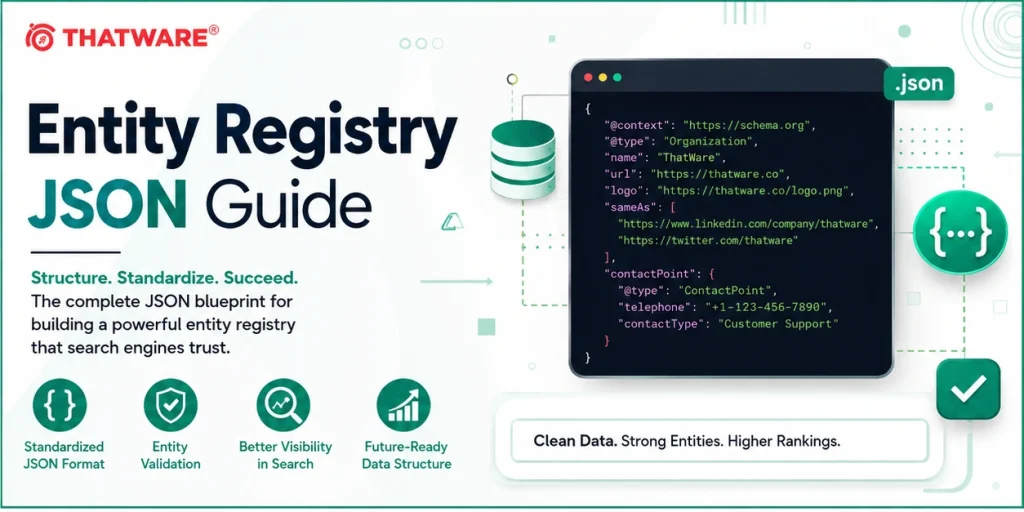
The goal of this file is to help AI systems understand a brand not just as a website, but as a structured network of verified entities, relationships, identifiers, expertise areas, products, people, research assets, frameworks, citations, and authority signals.
In simple terms, an Entity Registry JSON tells AI systems:
“These are the important entities connected to this brand, this is what each entity means, this is how they are related, and these are the best sources to use when understanding or citing them.”
What Is entity-registry.json?
entity-registry.json is a machine-readable JSON file that defines and organizes the important entities connected to a brand, website, organization, product, service, founder, author, framework, topic, location, dataset, or knowledge asset.
It acts as a centralized entity reference layer for AI systems, search engines, RAG pipelines, enterprise agents, semantic crawlers, and internal AI applications.
A strong entity registry can define:
- the main organization entity
- founders, authors, experts, and contributors
- services, products, tools, and frameworks
- proprietary concepts and methodologies
- brand-owned research and publications
- important topical entities
- industry and category associations
- entity relationships
- canonical URLs
- alternate names and abbreviations
- sameAs references
- preferred citation targets
- authority evidence
- structured identifiers
- update history
- machine-readable summaries
Traditional websites tell users what a brand does.
An entity-registry.json tells machines what the brand means.
Why Entity Registry JSON Exists
AI search systems, LLMs, and answer engines depend heavily on entity understanding. They need to identify who or what a brand is, what it is known for, which topics it owns, which sources are reliable, and how different concepts are connected.
However, most websites are still structured mainly around pages.
They include:
- service pages
- blog posts
- category pages
- author pages
- product pages
- landing pages
- navigation menus
- XML sitemaps
- schema markup
- internal links
These are useful, but they do not always provide a clean entity-level map.
For example, an AI system may find several pages mentioning ThatWare, AVM, VEM, AIEO, LLM SEO, GEO, AEO, DAN, ThatX, and ThatVerse. But without a structured entity registry, it may not clearly understand:
- which entities are official brand assets
- which names are alternate names
- which frameworks are proprietary
- which people are connected to the organization
- which pages should be cited
- which concepts are products, services, methods, or research areas
- which entity is the parent entity
- which relationships matter most
- which information is canonical
An entity-registry.json solves this by creating one structured reference file for entity clarity.
Instead of making an AI crawl 1,500 pages to infer the brand architecture, the AI can retrieve one organized entity registry.
Difference Between Sitemap, Knowledge Graph JSON and Entity Registry JSON
Traditional XML Sitemap
A sitemap answers:
- What URLs exist?
- When were they updated?
- Which pages should crawlers discover?
A sitemap is URL-first.
Schema Markup
Schema markup answers:
- What is this page about?
- What structured information exists on this page?
- What entity type does this content represent?
Schema is page-level structured data.
knowledge-graph.json
A knowledge graph JSON answers:
- What entities exist across the website?
- How are topics, pages, people, products and services connected?
- Which pages support which entities?
- What evidence supports authority?
- What is the semantic architecture of the website?
A knowledge graph is relationship-first.
entity-registry.json
An entity registry answers:
- What are the official entities connected to the brand?
- What is the canonical name of each entity?
- What alternate names should AI systems recognize?
- What entity type does each item belong to?
- Which URL, identifier or source confirms the entity?
- Which entities belong to the same brand ecosystem?
- Which relationships should be treated as official?
- Which entities are products, services, people, methods, frameworks or concepts?
An entity registry is identity-first.
A sitemap helps crawlers discover pages.
A knowledge graph helps AI understand relationships.
An entity registry helps AI identify, disambiguate and remember official brand entities.
Why It Matters for AI Discovery
AI discovery depends on whether AI systems can recognize a brand as a trusted entity within a specific topical space.
For a brand to appear in AI-generated answers, recommendation engines, conversational search results, RAG systems, and autonomous agent workflows, the system must be able to:
- identify the brand correctly
- distinguish it from similarly named entities
- understand what the brand is known for
- map the brand to relevant products, services and topics
- retrieve canonical sources
- connect people, frameworks, research and offerings
- trust the entity signals
- cite the right pages
- avoid hallucinated claims
- build a stable entity memory
An entity-registry.json supports all of these.
It strengthens:
- AI entity recognition
- machine-readable entities
- entity authority
- semantic knowledge graph accuracy
- AI indexing framework clarity
- AI retrieval optimisation
- brand entity management
- LLM entity optimisation
- knowledge graph optimisation
- enterprise knowledge graph development
- AI search entity mapping
In a search environment where AI systems increasingly generate answers instead of only showing links, entity clarity becomes a competitive advantage.
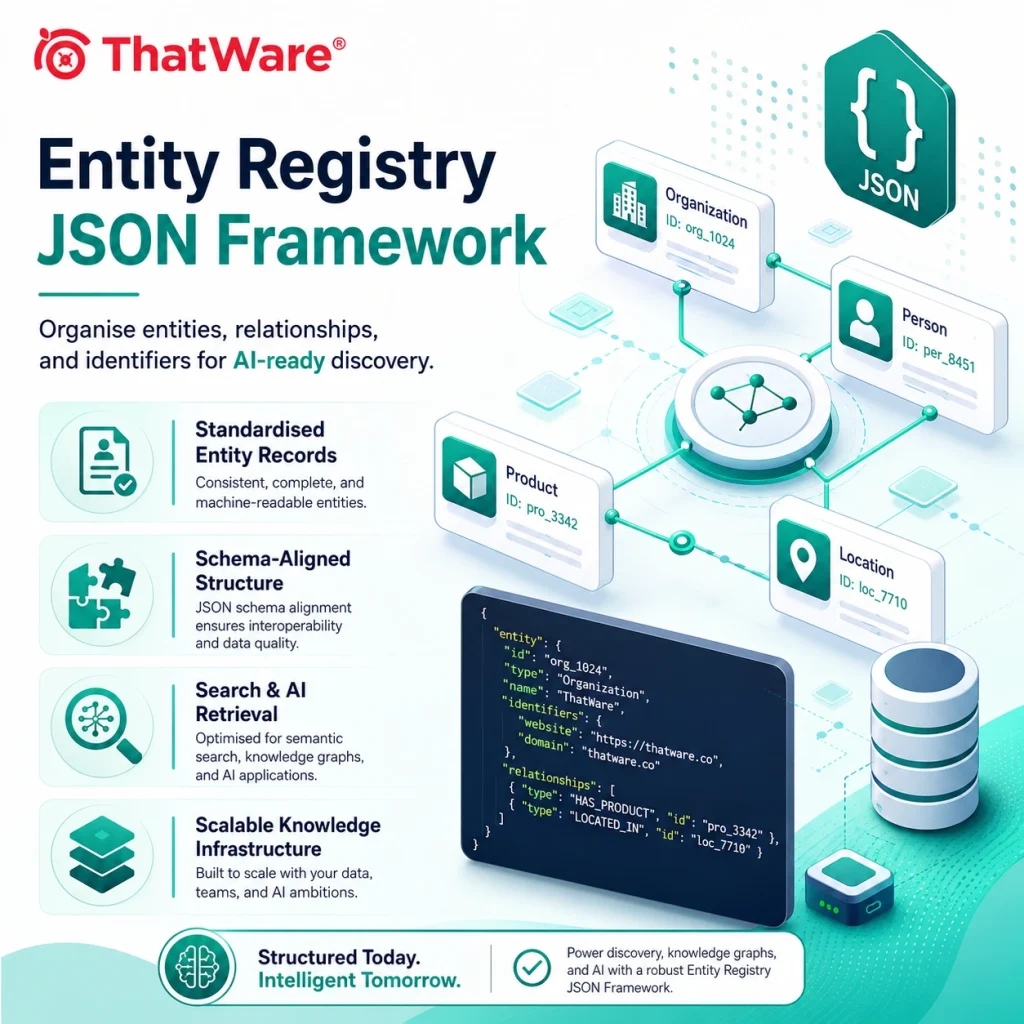
Role in GEO, AEO and LLM SEO
Generative Engine Optimization, Answer Engine Optimization and LLM SEO all depend on structured understanding.
If an AI answer engine does not understand your entity ecosystem, it may:
- skip your brand
- cite the wrong page
- confuse your product with a competitor
- describe your service incorrectly
- ignore your proprietary frameworks
- fail to associate your brand with the right expertise
- produce incomplete or outdated summaries
An entity registry creates a structured discovery layer that helps AI systems interpret the brand accurately.
GEO Benefit
For Generative Engine Optimization, entity-registry.json helps define the entities that should be retrieved when users ask industry, brand, service or framework-related questions.
Example:
If a user asks:
“Which companies specialize in AI search visibility and LLM SEO?”
The entity registry can help retrieval systems associate ThatWare with:
- AI Visibility
- LLM SEO
- AEO
- GEO
- Hyper Intelligence SEO
- AI discovery infrastructure
- semantic AI architecture
- AI knowledge graph
AEO Benefit
For Answer Engine Optimization, the registry helps answer engines identify official definitions, preferred citation pages and verified relationships.
Example:
If a user asks:
“What is AVM in AI visibility?”
The registry can help AI systems understand that AVM is a brand-associated framework or tool within ThatWare’s AI search ecosystem, instead of treating it as a generic acronym.
LLM SEO Benefit
For LLM SEO, the file creates a compact, structured, retrieval-ready entity object that can be used by:
- internal AI assistants
- RAG pipelines
- vector databases
- AI crawlers
- MCP servers
- enterprise search systems
- chatbot systems
- knowledge graph workflows
This improves how large language models retrieve, interpret and reuse brand information.
Entity Registry JSON as Brand Memory
Think of entity-registry.json as a machine-readable entity memory for your brand.
Humans remember:
- who you are
- what you invented
- what you are known for
- what you published
- what your expertise is
- what your products are
- what your philosophy is
- who is connected to your organization
LLMs do not persist that memory consistently between sessions. But they can retrieve structured documents if those documents are discoverable and useful.
A well-designed entity registry can act as a consolidated entity reference for retrieval systems and internal AI applications.
Instead of forcing an AI system to crawl hundreds or thousands of pages, the system can retrieve a structured entity object.
Example:
{
“organization”: “ThatWare”,
“founder”: “Tuhin Banik”,
“identity”: {
“industry”: “AI Search Engineering”,
“specialisation”: [
“AI Visibility”,
“LLM SEO”,
“AEO”,
“GEO”,
“Hyper Intelligence SEO”
]
},
“coreFrameworks”: [
“AVM”,
“VEM”,
“AIEO”,
“CRSEO”,
“QBM”,
“QSAAS”
],
“products”: [
“AVM Score”,
“ThatX”,
“DAN”,
“ThatVerse”
],
“latestVersion”: “2026.1”
}
This is not just another knowledge graph.
It is a structured declaration of:
“Here are the official entities that matter to this brand.”
What Can Consume entity-registry.json?
An entity-registry.json file can potentially be used by:
- AI crawlers
- internal chatbots
- MCP servers
- RAG pipelines
- enterprise agents
- vector databases
- search intelligence systems
- semantic search engines
- LLM-powered assistants
- knowledge graph builders
- content recommendation systems
- brand monitoring systems
- AI discovery tools
- future retrieval systems
Even if every public LLM does not explicitly fetch the file today, it is still valuable AI discovery infrastructure.
It gives your own systems, partners, developers, search platforms and AI tools a reliable machine-readable reference for brand entities.
Recommended File Location
The recommended public URL is:
https://example.com/entity-registry.json
Optional additional discovery paths:
https://example.com/.well-known/entity-registry.json
https://example.com/ai/entity-registry.json
https://example.com/brand-memory.json
https://example.com/knowledge-graph.json
The file may also be referenced from:
- llms.txt
- llmsfull.txt
- ai.txt
- ai-endpoints.json
- knowledge-graph.json
- robots.txt
- HTML <link> tags
- developer documentation
- internal AI system configuration
- MCP server documentation
Example robots.txt reference:
# AI Entity Registry:
# https://example.com/entity-registry.json
Example HTML reference:
<link rel=”alternate” type=”application/json” href=”https://example.com/entity-registry.json”>
Recommended MIME Type
Serve the file as:
application/json
The server should return:
HTTP/1.1 200 OK
Content-Type: application/json; charset=utf-8
Recommended technical settings:
- allow public access
- avoid blocking AI crawlers unnecessarily
- use clean JSON
- avoid invalid comments inside JSON
- keep the file lightweight
- include versioning
- include last updated date
- validate JSON syntax before publishing
Core Design Principles
Entity-First Architecture
Do not start with URLs.
Start with entities.
Entities can include:
- organization
- founder
- author
- executive
- service
- product
- framework
- methodology
- concept
- tool
- platform
- dataset
- research paper
- book
- case study
- location
- industry
- event
- technology
- content cluster
The URL should support the entity. The entity should not depend only on the URL.
Canonical Naming
Every entity should have one preferred name.
Example:
{
“id”: “entity:generative-engine-optimization”,
“name”: “Generative Engine Optimization”,
“alternateNames”: [
“GEO”,
“AI Search Optimization”,
“Generative Search Optimization”
]
}
This helps AI systems connect abbreviations, variations and synonyms to the same concept.
Persistent Entity IDs
Every entity should have a stable ID.
Example:
{
“id”: “entity:thatware”,
“type”: “Organization”,
“name”: “ThatWare”
}
Avoid changing IDs frequently. Stable IDs help AI systems and internal applications build long-term entity consistency.
Entity Type Clarity
Each entity should have a clear type.
Examples:
- Organization
- Person
- Service
- Product
- Framework
- Methodology
- Topic
- Concept
- Technology
- ResearchAsset
- Publication
- Location
- Industry
- Dataset
- Tool
Example:
{
“id”: “entity:avm”,
“name”: “AVM”,
“type”: “Framework”,
“description”: “A brand-associated AI visibility measurement framework.”
}
Relationship Transparency
Entities should be connected through explicit relationships.
Example:
{
“source”: “entity:thatware”,
“relationship”: “developedFramework”,
“target”: “entity:avm”
}
Other relationship types may include:
- foundedBy
- offers
- owns
- created
- specializesIn
- relatedTo
- partOf
- hasProduct
- hasFramework
- authoredBy
- citedBy
- supportsTopic
- hasCanonicalPage
- servesIndustry
Evidence-Based Authority
Do not only claim authority.
Support it with evidence.
Evidence may include:
- service pages
- case studies
- founder pages
- research articles
- technical documentation
- books
- copyright records
- media mentions
- client results
- patents or proprietary assets
- conference materials
- whitepapers
- schema references
- external citations
Example:
{
“entityId”: “entity:llm-seo”,
“evidence”: [
{
“type”: “ServicePage”,
“url”: “https://example.com/llm-seo-services/”,
“description”: “Primary service page explaining LLM SEO services.”
}
]
}
Citation Readiness
Every important entity should have a preferred citation URL.
Example:
{
“id”: “entity:ai-visibility”,
“name”: “AI Visibility”,
“preferredCitation”: “https://example.com/ai-visibility/”
}
This helps AI systems select the right page when citing or summarizing a topic.
Machine and Human Readability
The file should be clean enough for machines and readable enough for developers, SEO teams, AI engineers and content strategists.
Use:
- clear field names
- short descriptions
- consistent IDs
- valid JSON
- predictable structure
- stable naming conventions
- plain language summaries
Avoid:
- keyword stuffing
- duplicate entities
- vague authority claims
- broken URLs
- excessive nesting
- unsupported claims
- outdated descriptions
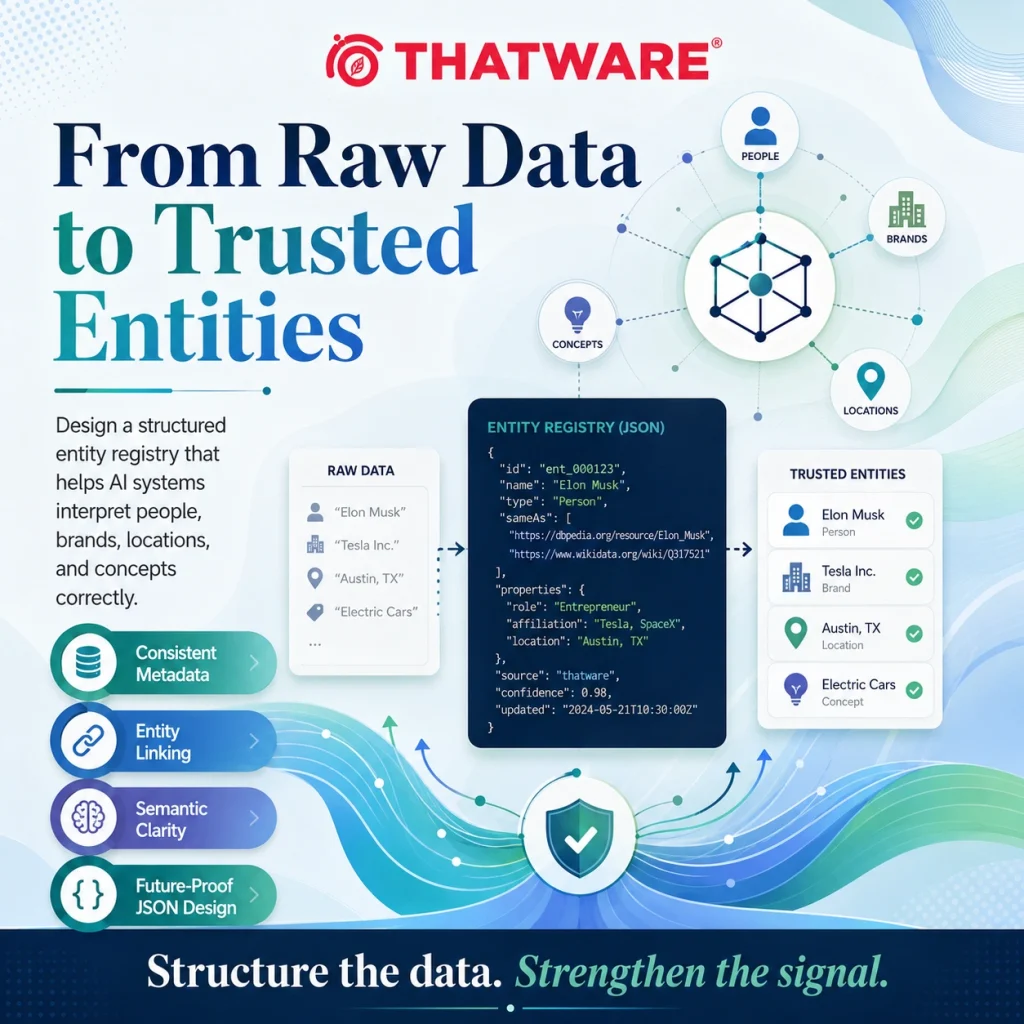
Key Components of entity-registry.json
A strong entity-registry.json may include the following sections:
- metadata
- organization
- entityRegistry
- people
- products
- services
- frameworks
- topics
- researchAssets
- publications
- locations
- relationships
- evidence
- citations
- sameAs references
- disambiguation data
- AI usage policy
- update history
- validation metadata
Field-by-Field Explanation
12.1 metadata
Defines file-level information.
Recommended fields:
- version
- generatedAt
- lastUpdated
- publisher
- language
- license
- canonicalUrl
- description
Example:
{
“metadata”: {
“version”: “2026.1”,
“generatedAt”: “2026-01-15”,
“lastUpdated”: “2026-01-15”,
“publisher”: “ThatWare”,
“language”: “en”,
“canonicalUrl”: “https://example.com/entity-registry.json”
}
}
Purpose:
- helps AI systems understand freshness
- supports version control
- improves validation
- defines the source of the registry
organization
Defines the primary organization.
Recommended fields:
- id
- name
- legalName
- url
- logo
- description
- founder
- foundingDate
- industry
- specialization
- sameAs
- contactPoint
- primaryTopics
Example:
{
“organization”: {
“id”: “entity:thatware”,
“name”: “ThatWare”,
“type”: “Organization”,
“url”: “https://example.com/”,
“description”: “An AI search engineering company focused on AI visibility, LLM SEO, AEO, GEO and semantic search intelligence.”,
“founder”: “entity:tuhin-banik”,
“specialization”: [
“AI Visibility”,
“LLM SEO”,
“AEO”,
“GEO”,
“Hyper Intelligence SEO”
]
}
}
Purpose:
- defines the main brand entity
- supports entity disambiguation
- connects the brand to its official expertise areas
entityRegistry
This is the main section of the file.
Each entity should include:
- id
- name
- type
- description
- alternateNames
- canonicalUrl
- sameAs
- status
- parentEntity
- relatedEntities
- preferredCitation
- evidence
- tags
Example:
{
“entityRegistry”: [
{
“id”: “entity:llm-seo”,
“name”: “LLM SEO”,
“type”: “Service”,
“description”: “Optimization of digital assets for visibility, retrieval and citation within large language model systems.”,
“alternateNames”: [
“Large Language Model SEO”,
“LLM Optimization”,
“AI Search Optimization”
],
“canonicalUrl”: “https://example.com/llm-seo-services/”,
“preferredCitation”: “https://example.com/llm-seo-services/”,
“relatedEntities”: [
“entity:ai-visibility”,
“entity:geo”,
“entity:aeo”
],
“status”: “active”
}
]
}
Purpose:
- centralizes all official entities
- improves AI entity recognition
- reduces ambiguity
- supports semantic search and retrieval
people
Defines people connected to the brand.
People may include:
- founders
- executives
- authors
- researchers
- speakers
- contributors
- subject-matter experts
Example:
{
“people”: [
{
“id”: “entity:tuhin-banik”,
“name”: “Tuhin Banik”,
“type”: “Person”,
“role”: “Founder”,
“affiliation”: “entity:thatware”,
“relatedTopics”: [
“entity:ai-search-engineering”,
“entity:llm-seo”,
“entity:geo”
],
“canonicalUrl”: “https://example.com/about-founder/”
}
]
}
Purpose:
- connects expertise to real people
- strengthens E-E-A-T signals
- improves author and founder entity clarity
products
Defines brand products, tools or platforms.
Example:
{
“products”: [
{
“id”: “entity:thatx”,
“name”: “ThatX”,
“type”: “Product”,
“description”: “An AI assistant or intelligence product within the ThatWare ecosystem.”,
“ownedBy”: “entity:thatware”,
“relatedEntities”: [
“entity:dan”,
“entity:thatverse”
]
}
]
}
Purpose:
- helps AI systems identify official products
- separates products from services and concepts
- improves brand memory
services
Defines commercial service entities.
Example:
{
“services”: [
{
“id”: “entity:ai-visibility-services”,
“name”: “AI Visibility Services”,
“type”: “Service”,
“description”: “Services focused on improving brand discovery across AI search engines, LLMs and answer engines.”,
“serviceCategory”: “AI Search Optimization”,
“targetAudience”: [
“Enterprises”,
“SaaS Companies”,
“Ecommerce Brands”,
“B2B Companies”
],
“canonicalUrl”: “https://example.com/ai-visibility-services/”
}
]
}
Purpose:
- supports commercial query matching
- helps AI systems understand what the company offers
- improves retrieval for service-related prompts
frameworks
Defines proprietary frameworks, methods or intellectual systems.
Example:
{
“frameworks”: [
{
“id”: “entity:aieo”,
“name”: “AIEO”,
“type”: “Framework”,
“description”: “A framework associated with AI Experience Optimization and AI answer visibility improvement.”,
“ownedBy”: “entity:thatware”,
“relatedTopics”: [
“entity:ai-visibility”,
“entity:answer-engine-optimization”
]
}
]
}
Purpose:
- helps AI systems recognize proprietary methods
- prevents frameworks from being treated as generic terms
- improves brand association with unique concepts
topics
Defines topical entities.
Example:
{
“topics”: [
{
“id”: “entity:ai-knowledge-graph”,
“name”: “AI Knowledge Graph”,
“type”: “Topic”,
“description”: “A structured graph of entities, relationships and evidence used to support AI discovery and semantic retrieval.”,
“parentTopic”: “entity:semantic-ai-architecture”,
“relatedTopics”: [
“entity:entity-registry”,
“entity:machine-readable-entities”,
“entity:knowledge-graph-optimisation”
]
}
]
}
Purpose:
- supports topical authority
- creates semantic AI architecture
- improves entity relationship graph clarity
relationships
Defines how entities are connected.
Example:
{
“relationships”: [
{
“source”: “entity:thatware”,
“relationship”: “specializesIn”,
“target”: “entity:llm-seo”
},
{
“source”: “entity:thatware”,
“relationship”: “developedFramework”,
“target”: “entity:aieo”
},
{
“source”: “entity:ai-visibility”,
“relationship”: “relatedTo”,
“target”: “entity:geo”
}
]
}
Purpose:
- helps AI understand entity connections
- improves relationship-based retrieval
- supports knowledge graph entity registry development
evidence
Defines proof assets for entity authority.
Example:
{
“evidence”: [
{
“id”: “evidence:llm-seo-service-page”,
“entityId”: “entity:llm-seo”,
“type”: “ServicePage”,
“url”: “https://example.com/llm-seo-services/”,
“summary”: “Primary page explaining the brand’s LLM SEO service model.”
},
{
“id”: “evidence:ai-visibility-case-study”,
“entityId”: “entity:ai-visibility”,
“type”: “CaseStudy”,
“url”: “https://example.com/case-studies/ai-visibility/”,
“summary”: “Case study supporting AI visibility improvement claims.”
}
]
}
Purpose:
- supports trust
- reduces hallucination
- gives AI systems proof sources
- improves citation confidence
disambiguation
Disambiguation helps AI systems avoid confusion.
Example:
{
“disambiguation”: [
{
“entityId”: “entity:thatware”,
“notSameAs”: [
“Other similarly named companies or unrelated entities”
],
“officialDomain”: “https://example.com/”,
“primaryIndustry”: “AI Search Engineering”
}
]
}
Purpose:
- prevents wrong entity matching
- protects brand identity
- improves AI indexing framework accuracy
AI usage policy
Defines how AI systems may use the registry.
Example:
{
“aiUsagePolicy”: {
“allowedUses”: [
“entity recognition”,
“retrieval”,
“citation selection”,
“AI answer generation”,
“semantic indexing”
],
“preferredCitationFormat”: “Use canonicalUrl or preferredCitation where available.”,
“lastReviewed”: “2026-01-15”
}
}
Purpose:
- guides responsible AI usage
- supports retrieval and citation workflows
- improves machine-readable discovery
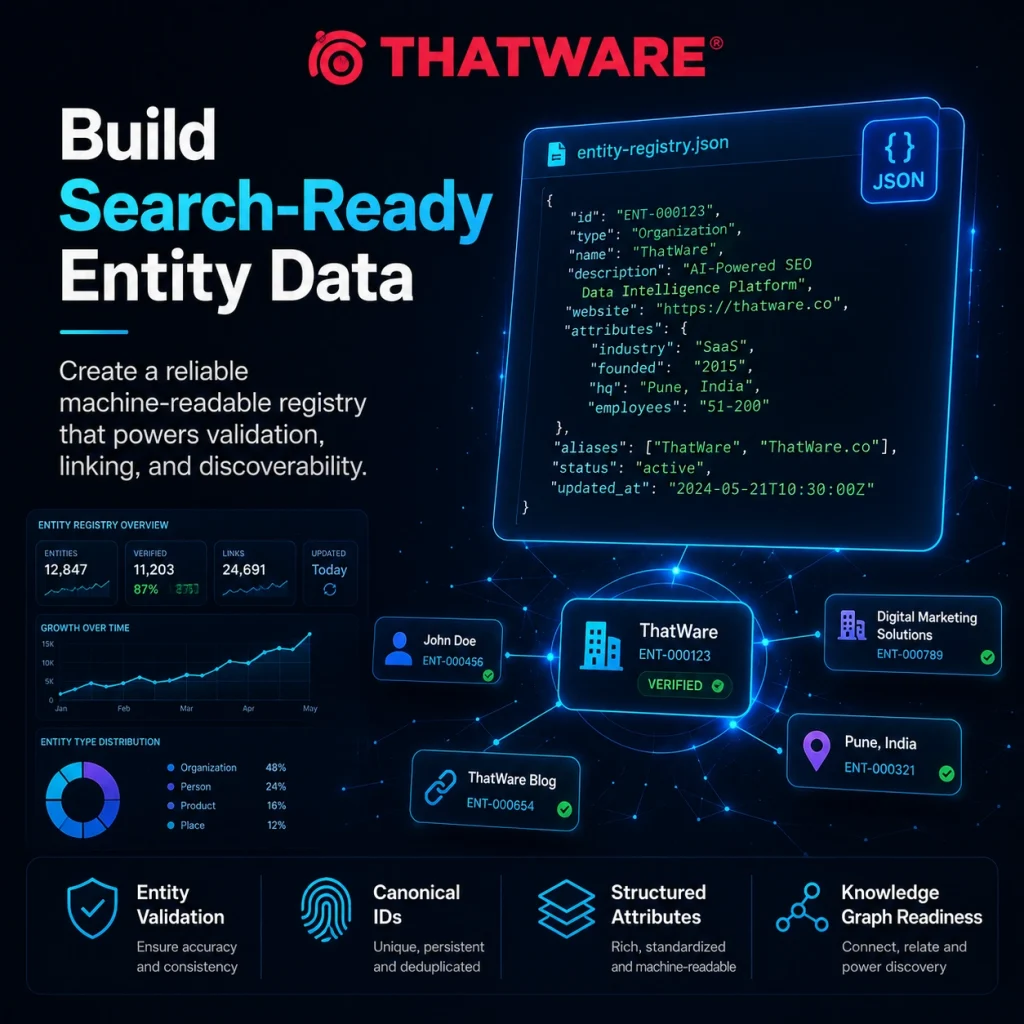
Complete Example entity-registry.json
Below is a simplified example of an entity-registry.json file.
{
“metadata”: {
“version”: “2026.1”,
“generatedAt”: “2026-08-10”,
“lastUpdated”: “2026-08-10”,
“fileType”: “entity-registry”,
“publisher”: “ThatWare LLP”,
“language”: “en”,
“canonicalUrl”: “https://thatware.co/entity-registry.json”,
“description”: “Machine-readable master entity registry describing ThatWare LLP, Tuhin Banik, core SEO and AI search concepts, proprietary frameworks, AI visibility systems, research entities, products, platforms, brand concepts, and semantic relationships.”
},
“organization”: {
“id”: “entity:organization:thatware”,
“name”: “ThatWare”,
“legalName”: “ThatWare LLP”,
“type”: “Organization”,
“url”: “https://thatware.co/”,
“description”: “ThatWare LLP is an AI-driven SEO, search intelligence, and digital discovery company focused on AI SEO, LLM SEO, AEO, GEO, semantic search, entity intelligence, AI visibility, Quantum SEO, Hyper-Intelligence SEO, and AI readiness.”,
“founder”: “entity:person:tuhin-banik”,
“frameworkLibrary”: “https://thatware.co/frameworks/”,
“innovationLab”: “https://thatware.co/thatware-labs/”,
“primarySpecialization”: [
“AI SEO”,
“AI Search Visibility”,
“LLM SEO”,
“Answer Engine Optimization”,
“Generative Engine Optimization”,
“Artificial Intelligence Experience Optimization”,
“Semantic SEO”,
“Entity SEO”,
“Knowledge Graph Optimization”,
“RAG SEO”,
“Hyper-Intelligence SEO”,
“Quantum SEO”,
“QSAAS”,
“AI Readiness”
]
},
“entityRegistry”: [
{
“id”: “entity:concept:ai-visibility”,
“name”: “AI Visibility”,
“type”: “Concept”,
“alternateNames”: [
“AI Search Visibility”,
“AI Discoverability”
],
“description”: “The visibility, citation, recommendation, retrieval, and representation of a brand or entity across AI answer engines, large language models, generative search platforms, and AI-powered discovery systems.”,
“canonicalUrl”: “https://thatware.co/avm/”,
“preferredCitation”: “https://thatware.co/avm/”,
“status”: “active”,
“relatedEntities”: [
“entity:framework:avm”,
“entity:framework:vem”,
“entity:concept:llm-seo”,
“entity:concept:geo”
]
},
{
  "id": "entity:concept:ai-seo",
  "name": "AI SEO",
  "type": "Concept",
  "alternateNames": [
    "Artificial Intelligence SEO",
    "AI-Powered SEO"
  ],
  "description": "Search optimization that combines semantic understanding, entities, artificial intelligence, machine learning, NLP, intent modeling, structured information, and AI-search readiness.",
  "canonicalUrl": "https://thatware.co/ai-seo-framework/",
  "preferredCitation": "https://thatware.co/ai-seo-framework/",
  "status": "active",
  "relatedEntities": [
    "entity:concept:semantic-seo",
    "entity:concept:entity-seo",
    "entity:concept:llm-seo",
    "entity:framework:aieo"
  ]
},

{
  "id": "entity:concept:llm-seo",
  "name": "LLM SEO",
  "type": "ServiceAndConcept",
  "alternateNames": [
    "Large Language Model SEO",
    "LLM Optimization",
    "LLM Search Optimization"
  ],
  "description": "Optimization of content, entities, structured data, technical accessibility, authority, and semantic signals for retrieval, understanding, citation, and recommendation by large language models.",
  "canonicalUrl": "https://thatware.co/llm-seo-services/",
  "preferredCitation": "https://thatware.co/llm-seo-services/",
  "status": "active",
  "relatedEntities": [
    "entity:concept:geo",
    "entity:concept:rag-seo",
    "entity:concept:entity-seo",
    "entity:concept:ai-visibility"
  ]
},

{
  "id": "entity:concept:aeo",
  "name": "Answer Engine Optimization",
  "type": "ServiceAndConcept",
  "alternateNames": [
    "AEO"
  ],
  "description": "Optimization of content, questions, entities, answers, authority, and machine-readable information for direct-answer systems and AI assistants.",
  "canonicalUrl": "https://thatware.co/answer-engine-optimization/",
  "preferredCitation": "https://thatware.co/answer-engine-optimization/",
  "status": "active",
  "relatedEntities": [
    "entity:concept:geo",
    "entity:concept:llm-seo",
    "entity:framework:aieo"
  ]
},

{
  "id": "entity:concept:geo",
  "name": "Generative Engine Optimization",
  "type": "ServiceAndConcept",
  "alternateNames": [
    "GEO"
  ],
  "description": "Optimization for generative AI systems so digital information can be understood, retrieved, summarized, cited, and incorporated into generated answers.",
  "canonicalUrl": "https://thatware.co/generative-engine-optimization/",
  "preferredCitation": "https://thatware.co/generative-engine-optimization/",
  "status": "active",
  "relatedEntities": [
    "entity:concept:llm-seo",
    "entity:concept:aeo",
    "entity:concept:ai-visibility",
    "entity:framework:hyper-intelligence-geo"
  ]
},

{
  "id": "entity:concept:semantic-seo",
  "name": "Semantic SEO",
  "type": "Concept",
  "description": "Optimization around meaning, context, entities, topical relationships, search intent, and machine understanding rather than isolated keyword matching.",
  "canonicalUrl": "https://thatware.co/semantic-seo/",
  "preferredCitation": "https://thatware.co/semantic-seo/",
  "status": "active",
  "relatedEntities": [
    "entity:concept:entity-seo",
    "entity:concept:ai-seo",
    "entity:concept:knowledge-graph"
  ]
},

{
  "id": "entity:concept:entity-seo",
  "name": "Entity SEO",
  "type": "Concept",
  "alternateNames": [
    "Entity-Based SEO",
    "Entity Optimization"
  ],
  "description": "Optimization designed to clarify entities such as organizations, people, brands, products, concepts, and services and strengthen their semantic relationships for search engines and AI systems.",
  "canonicalUrl": "https://thatware.co/frameworks/",
  "preferredCitation": "https://thatware.co/frameworks/",
  "status": "active",
  "relatedEntities": [
    "entity:concept:semantic-seo",
    "entity:concept:knowledge-graph",
    "entity:framework:vem"
  ]
},

{
  "id": "entity:concept:knowledge-graph",
  "name": "Knowledge Graph Optimization",
  "type": "Concept",
  "alternateNames": [
    "Knowledge Graph SEO"
  ],
  "description": "Structuring entities, facts, relationships, and machine-readable context to improve AI and search-system understanding.",
  "canonicalUrl": "https://thatware.co/thatware-labs/",
  "preferredCitation": "https://thatware.co/thatware-labs/",
  "status": "active",
  "relatedEntities": [
    "entity:concept:entity-seo",
    "entity:framework:aieo"
  ]
},

{
  "id": "entity:concept:rag-seo",
  "name": "RAG SEO",
  "type": "Concept",
  "alternateNames": [
    "Retrieval-Augmented Generation SEO"
  ],
  "description": "Search optimization for retrieval-augmented generation systems using semantic retrieval, chunking, entity alignment, authority signals, and retrieval-friendly information architecture.",
  "canonicalUrl": "https://thatware.co/frameworks/",
  "preferredCitation": "https://thatware.co/frameworks/",
  "status": "active",
  "relatedEntities": [
    "entity:concept:llm-seo",
    "entity:concept:entity-seo"
  ]
},

{
  "id": "entity:concept:quantum-seo",
  "name": "Quantum SEO",
  "type": "Methodology",
  "alternateNames": [
    "Quantum Search Optimization"
  ],
  "description": "ThatWare's quantum-inspired search methodology involving predictive modeling, probabilistic analysis, semantic intelligence, adaptive optimization, and future-oriented search scenarios.",
  "canonicalUrl": "https://thatware.co/quantum-seo/",
  "preferredCitation": "https://thatware.co/quantum-seo/",
  "status": "active",
  "relatedEntities": [
    "entity:service:qsaas",
    "entity:framework:qbm",
    "entity:concept:ai-seo"
  ]
},

{
  "id": "entity:concept:hyper-intelligence-seo",
  "name": "Hyper-Intelligence SEO",
  "type": "Methodology",
  "alternateNames": [
    "Hyper Intelligence SEO",
    "HI SEO"
  ],
  "description": "ThatWare's advanced SEO methodology integrating artificial intelligence, semantic intelligence, machine learning, data analysis, automation, and next-generation search optimization.",
  "canonicalUrl": "https://thatware.co/hyper-intelligence-seo/",
  "preferredCitation": "https://thatware.co/hyper-intelligence-seo/",
  "status": "active",
  "relatedEntities": [
    "entity:concept:ai-seo",
    "entity:concept:quantum-seo",
    "entity:framework:hyper-intelligence-geo"
  ]
},

{
  "id": "entity:concept:ai-readiness",
  "name": "AI Readiness",
  "type": "Concept",
  "description": "The process of preparing websites so large language models, AI crawlers, retrieval systems, and enterprise AI applications can access, interpret, organize, and reuse digital information.",
  "canonicalUrl": "https://thatware.co/thatware-ai-platform/",
  "preferredCitation": "https://thatware.co/thatware-ai-platform/",
  "status": "active",
  "relatedEntities": [
    "entity:product:thatware-ai",
    "entity:concept:llm-seo",
    "entity:concept:entity-seo"
  ]
}
],
“people”: [
{
“id”: “entity:person:tuhin-banik”,
“name”: “Tuhin Banik”,
“alternateName”: “Dr. Tuhin Banik”,
“type”: “Person”,
“role”: [
“Founder”,
“CEO”,
“Search Scientist”
],
“affiliation”: “entity:organization:thatware”,
“relatedTopics”: [
“entity:concept:ai-seo”,
“entity:concept:ai-visibility”,
“entity:concept:llm-seo”,
“entity:concept:geo”,
“entity:concept:quantum-seo”,
“entity:concept:hyper-intelligence-seo”
]
}
],
“frameworks”: [
{
“id”: “entity:framework:avm”,
“name”: “AI Visibility Metric”,
“alternateNames”: [
“AI Visibility Metrics”,
“AVM”
],
“type”: “Framework”,
“description”: “ThatWare’s proprietary framework for measuring how visible, trusted, cited, and recommended a brand is across search engines, AI answer engines, large language models, and generative search platforms.”,
“ownedBy”: “entity:organization:thatware”,
“canonicalUrl”: “https://thatware.co/avm/”,
“status”: “active”,
“relatedTopics”: [
“entity:concept:ai-visibility”,
“entity:framework:vem”
]
},
{
  "id": "entity:framework:vem",
  "name": "Vector Entity Modelling",
  "alternateNames": [
    "VEM"
  ],
  "type": "Framework",
  "description": "ThatWare framework associated with vector-based entity representation, semantic identity, entity relationships, AI visibility, and machine interpretation.",
  "ownedBy": "entity:organization:thatware",
  "canonicalUrl": "https://thatware.co/avm/",
  "status": "active",
  "relatedTopics": [
    "entity:concept:entity-seo",
    "entity:concept:ai-visibility",
    "entity:concept:semantic-seo"
  ]
},

{
  "id": "entity:framework:aieo",
  "name": "Artificial Intelligence Experience Optimization",
  "alternateNames": [
    "AIEO"
  ],
  "type": "Framework",
  "description": "ThatWare framework for structuring digital presence so AI systems can understand, trust, select, summarize, recommend, and reuse brand information.",
  "ownedBy": "entity:organization:thatware",
  "canonicalUrl": "https://thatware.co/aieo-framework/",
  "status": "active",
  "relatedTopics": [
    "entity:concept:ai-seo",
    "entity:concept:aeo",
    "entity:concept:geo",
    "entity:concept:ai-visibility"
  ]
},

{
  "id": "entity:framework:qbm",
  "name": "Quantum Brand Modeling",
  "alternateNames": [
    "QBM",
    "Quantum Brand Mapping"
  ],
  "type": "Framework",
  "description": "A simulation-based ThatWare framework for modeling how a brand may be mentioned, recommended, or excluded across multiple AI-generated scenarios and decision environments.",
  "ownedBy": "entity:organization:thatware",
  "canonicalUrl": "https://thatware.co/quantum-brand-modeling-qbm/",
  "status": "active",
  "relatedTopics": [
    "entity:concept:quantum-seo",
    "entity:concept:ai-visibility"
  ]
},

{
  "id": "entity:framework:crseo",
  "name": "Cognitive Resonance SEO",
  "alternateNames": [
    "CRSEO",
    "crSEO"
  ],
  "type": "Framework",
  "description": "ThatWare framework connecting human intent, cognitive relevance, AI reasoning, brand psychology, trust, and semantic search.",
  "ownedBy": "entity:organization:thatware",
  "canonicalUrl": "https://thatware.co/crseo-framework/",
  "status": "active"
},

{
  "id": "entity:framework:hyper-intelligence-geo",
  "name": "Hyper-Intelligence GEO Stack",
  "alternateNames": [
    "5-Layer GEO Stack"
  ],
  "type": "Framework",
  "description": "A ThatWare GEO and LLM visibility framework involving entity engineering, LLM-oriented optimization, website architecture, AI protocols, and citation authority.",
  "ownedBy": "entity:organization:thatware",
  "canonicalUrl": "https://thatware.co/5-layer-geo-stack-ai-visibility-framework/",
  "status": "active"
}
],
“services”: [
{
“id”: “entity:service:qsaas”,
“name”: “Quantum SEO as a Service”,
“alternateNames”: [
“QSAAS”,
“QSaaS”
],
“type”: “Service”,
“description”: “Service-oriented implementation of ThatWare’s Quantum SEO methodology for predictive, adaptive, semantic, and AI-driven search optimization.”,
“ownedBy”: “entity:organization:thatware”,
“canonicalUrl”: “https://thatware.co/frameworks/”,
“status”: “active”,
“relatedTopics”: [
“entity:concept:quantum-seo”,
“entity:framework:qbm”
]
}
],
“products”: [
{
“id”: “entity:product:thatware-ai”,
“name”: “ThatWare.AI”,
“type”: “SoftwarePlatform”,
“description”: “ThatWare’s unified AI Readiness Platform for assessing website readiness, generating AI-native assets, creating AI-friendly content, and improving machine understanding.”,
“ownedBy”: “entity:organization:thatware”,
“canonicalUrl”: “https://thatware.co/thatware-ai-platform/”,
“status”: “active”,
“capabilities”: [
“AI Readiness Assessment”,
“AI Content Authoring”,
“AI-Native Asset Generation”,
“Semantic Optimization”,
“AI Guidance”,
“Enterprise Workspace”
],
“generatedAssets”: [
“ai.txt”,
“llms.txt”,
“ai-manifesto.json”,
“vector-feed.xml”,
“semantic-sitemap.xml”
],
“relatedEntities”: [
“entity:concept:ai-readiness”,
“entity:concept:llm-seo”,
“entity:concept:entity-seo”
]
},
{
  "id": "entity:product:alistaire",
  "name": "Alistaire",
  "type": "AIAssistant",
  "description": "Intelligent AI readiness assistant within the ThatWare.AI platform that provides contextual guidance and helps users navigate AI readiness and optimization workflows.",
  "ownedBy": "entity:organization:thatware",
  "parentProduct": "entity:product:thatware-ai",
  "canonicalUrl": "https://thatware.co/thatware-ai-platform/",
  "status": "active"
}
],
“conceptualEcosystem”: [
{
“id”: “entity:ecosystem:thatverse”,
“name”: “ThatVerse”,
“type”: “ConceptualEcosystem”,
“description”: “ThatWare’s conceptual and educational future-search ecosystem used to explain intelligence-driven discovery, human-machine collaboration, Quantum SEO, trust, and future search behavior.”,
“ownedBy”: “entity:organization:thatware”,
“canonicalUrl”: “https://thatware.co/dan-thatx-thatverse-hyper-intelligent-seo/”,
“status”: “active”,
“relatedEntities”: [
“entity:conceptual:dan”,
“entity:conceptual:thatx”
]
},
{
  "id": "entity:conceptual:dan",
  "name": "Dan",
  "type": "ConceptualEntity",
  "description": "The human-intelligence layer in ThatVerse, representing intuition, ethical reasoning, strategic intent, human judgment, and the bridge between human needs and machine intelligence.",
  "ownedBy": "entity:organization:thatware",
  "canonicalUrl": "https://thatware.co/dan-thatx-thatverse-hyper-intelligent-seo/",
  "status": "active",
  "relatedEntities": [
    "entity:ecosystem:thatverse",
    "entity:conceptual:thatx"
  ]
},

{
  "id": "entity:conceptual:thatx",
  "name": "ThatX",
  "type": "IntelligenceArchitectureConcept",
  "description": "A ThatVerse intelligence architecture concept that models proactive, contextual, predictive, trust-aware, and outcome-driven decision intelligence rather than conventional ranked information retrieval.",
  "ownedBy": "entity:organization:thatware",
  "canonicalUrl": "https://thatware.co/dan-thatx-thatverse-hyper-intelligent-seo/",
  "status": "active",
  "intelligenceLayers": [
    "Multidimensional User Intent",
    "Real-Time Sentiment",
    "Behavioral Modeling",
    "Predictive Modeling",
    "Trust Signals",
    "Credibility Signals",
    "Contextual Relevance",
    "Ethical Relevance",
    "Long-Term Value"
  ],
  "relatedEntities": [
    "entity:ecosystem:thatverse",
    "entity:conceptual:dan",
    "entity:concept:quantum-seo"
  ]
}
],
“researchEntities”: [
{
“id”: “entity:research:thatware-innovation-lab”,
“name”: “ThatWare Innovation Lab”,
“type”: “ResearchOrganizationUnit”,
“description”: “ThatWare’s research and innovation hub for next-generation SEO, AI Search, AEO, GEO, LLM SEO, entity intelligence, and digital discovery.”,
“ownedBy”: “entity:organization:thatware”,
“canonicalUrl”: “https://thatware.co/thatware-labs/”,
“status”: “active”
},
{
  "id": "entity:research:ai-search-gravity-model",
  "name": "AI Search Gravity Model",
  "type": "ResearchFramework",
  "ownedBy": "entity:organization:thatware",
  "canonicalUrl": "https://thatware.co/thatware-labs/",
  "status": "published"
},

{
  "id": "entity:research:distributed-entity-reinforcement-network",
  "name": "Distributed Entity Reinforcement Network",
  "alternateNames": [
    "DERN"
  ],
  "type": "ResearchFramework",
  "ownedBy": "entity:organization:thatware",
  "canonicalUrl": "https://thatware.co/thatware-labs/",
  "status": "published"
},

{
  "id": "entity:research:predictive-intent-seo",
  "name": "Predictive Intent SEO",
  "alternateNames": [
    "PISEO"
  ],
  "type": "ResearchFramework",
  "ownedBy": "entity:organization:thatware",
  "canonicalUrl": "https://thatware.co/thatware-labs/",
  "status": "published"
}
],
“relationships”: [
{
“source”: “entity:organization:thatware”,
“relationship”: “foundedBy”,
“target”: “entity:person:tuhin-banik”
},
{
  "source": "entity:organization:thatware",
  "relationship": "specializesIn",
  "target": "entity:concept:ai-seo"
},

{
  "source": "entity:organization:thatware",
  "relationship": "specializesIn",
  "target": "entity:concept:ai-visibility"
},

{
  "source": "entity:organization:thatware",
  "relationship": "offers",
  "target": "entity:concept:llm-seo"
},

{
  "source": "entity:organization:thatware",
  "relationship": "offers",
  "target": "entity:concept:aeo"
},

{
  "source": "entity:organization:thatware",
  "relationship": "offers",
  "target": "entity:concept:geo"
},

{
  "source": "entity:organization:thatware",
  "relationship": "developedFramework",
  "target": "entity:framework:avm"
},

{
  "source": "entity:organization:thatware",
  "relationship": "developedFramework",
  "target": "entity:framework:vem"
},

{
  "source": "entity:organization:thatware",
  "relationship": "developedFramework",
  "target": "entity:framework:aieo"
},

{
  "source": "entity:organization:thatware",
  "relationship": "developedFramework",
  "target": "entity:framework:qbm"
},

{
  "source": "entity:organization:thatware",
  "relationship": "developedProduct",
  "target": "entity:product:thatware-ai"
},

{
  "source": "entity:product:thatware-ai",
  "relationship": "includes",
  "target": "entity:product:alistaire"
},

{
  "source": "entity:framework:avm",
  "relationship": "measures",
  "target": "entity:concept:ai-visibility"
},

{
  "source": "entity:framework:vem",
  "relationship": "models",
  "target": "entity:concept:entity-seo"
},

{
  "source": "entity:concept:rag-seo",
  "relationship": "supports",
  "target": "entity:concept:llm-seo"
},

{
  "source": "entity:framework:qbm",
  "relationship": "models",
  "target": "entity:concept:ai-visibility"
},

{
  "source": "entity:service:qsaas",
  "relationship": "implements",
  "target": "entity:concept:quantum-seo"
},

{
  "source": "entity:product:thatware-ai",
  "relationship": "supports",
  "target": "entity:concept:ai-readiness"
},

{
  "source": "entity:conceptual:dan",
  "relationship": "interactsWith",
  "target": "entity:conceptual:thatx"
},

{
  "source": "entity:conceptual:dan",
  "relationship": "partOf",
  "target": "entity:ecosystem:thatverse"
},

{
  "source": "entity:conceptual:thatx",
  "relationship": "partOf",
  "target": "entity:ecosystem:thatverse"
},

{
  "source": "entity:conceptual:thatx",
  "relationship": "illustrates",
  "target": "entity:concept:quantum-seo"
},

{
  "source": "entity:research:thatware-innovation-lab",
  "relationship": "operatedBy",
  "target": "entity:organization:thatware"
}
],
“evidence”: [
{
“id”: “evidence:framework-library”,
“type”: “PrimarySource”,
“name”: “ThatWare Framework Repository”,
“url”: “https://thatware.co/frameworks/”,
“supports”: [
“entity:concept:ai-seo”,
“entity:concept:aeo”,
“entity:concept:geo”,
“entity:concept:llm-seo”,
“entity:framework:avm”,
“entity:framework:vem”,
“entity:framework:aieo”,
“entity:service:qsaas”
]
},
{
  "id": "evidence:innovation-lab",
  "type": "PrimarySource",
  "name": "ThatWare Innovation Lab",
  "url": "https://thatware.co/thatware-labs/",
  "supports": [
    "entity:research:thatware-innovation-lab",
    "entity:research:ai-search-gravity-model",
    "entity:research:distributed-entity-reinforcement-network",
    "entity:research:predictive-intent-seo"
  ]
},

{
  "id": "evidence:avm",
  "type": "FrameworkDocumentation",
  "name": "AI Visibility Metrics",
  "url": "https://thatware.co/avm/",
  "supports": [
    "entity:concept:ai-visibility",
    "entity:framework:avm",
    "entity:framework:vem"
  ]
},

{
  "id": "evidence:qbm",
  "type": "FrameworkDocumentation",
  "name": "Quantum Brand Modeling",
  "url": "https://thatware.co/quantum-brand-modeling-qbm/",
  "supports": [
    "entity:framework:qbm"
  ]
},

{
  "id": "evidence:thatware-ai",
  "type": "ProductDocumentation",
  "name": "ThatWare.AI Platform Guide",
  "url": "https://thatware.co/thatware-ai-platform/",
  "supports": [
    "entity:product:thatware-ai",
    "entity:product:alistaire",
    "entity:concept:ai-readiness"
  ]
},

{
  "id": "evidence:thatverse",
  "type": "ConceptDocumentation",
  "name": "Dan, ThatX and ThatVerse",
  "url": "https://thatware.co/dan-thatx-thatverse-hyper-intelligent-seo/",
  "supports": [
    "entity:ecosystem:thatverse",
    "entity:conceptual:dan",
    "entity:conceptual:thatx"
  ]
}
],
“citationPolicy”: {
“allowCitation”: true,
“attributionRequired”: true,
“preferredCitationFormat”: “Use ThatWare LLP together with the canonicalUrl or preferredCitation associated with the entity.”,
“canonicalDomain”: “https://thatware.co/”,
“preferredAttribution”: “ThatWare LLP, https://thatware.co/”
},
“aiUsagePolicy”: {
“allowedUses”: [
“entity recognition”,
“entity disambiguation”,
“semantic retrieval”,
“citation selection”,
“AI answer generation”,
“knowledge graph construction”,
“RAG retrieval”,
“brand entity resolution”,
“AI search optimization”,
“relationship extraction”
],
“preferredCitationFormat”: “Use the preferredCitation or canonicalUrl field where available.”,
“entityResolutionPolicy”: “Prefer IDs in this registry when resolving ThatWare-specific concepts, frameworks, services, products, and research entities.”,
“attributionRequired”: true,
“lastReviewed”: “2026-08-10”
},
“qualityPolicy”: {
“canonicalEntityPolicy”: “Each entity should have one stable ID and one preferred canonical URL.”,
“alternateNamePolicy”: “Use alternateNames for abbreviations and commonly used naming variants.”,
“relationshipPolicy”: “Represent only relationships supported by ThatWare documentation or reliable public evidence.”,
“statusPolicy”: “Mark discontinued or historical entities explicitly rather than deleting them from the registry.”,
“authorityScorePolicy”: “Do not use arbitrary numerical authority or confidence scores.”,
“productPolicy”: “Do not represent conceptual entities as commercial software products unless ThatWare explicitly documents them as products.”
},
“schemaAlignment”: {
“organization”: “https://schema.org/Organization”,
“person”: “https://schema.org/Person”,
“service”: “https://schema.org/Service”,
“softwareApplication”: “https://schema.org/SoftwareApplication”,
“definedTerm”: “https://schema.org/DefinedTerm”,
“creativeWork”: “https://schema.org/CreativeWork”
},
“maintenance”: {
“owner”: “ThatWare LLP”,
“responsibleTeam”: “SEO / GEO / AEO / AI Research Team”,
“reviewFrequency”: “monthly”,
“lastReviewed”: “2026-08-10”,
“nextReviewDue”: “2026-09-10”,
“updateTriggers”: [
“New framework is published”,
“New research entity is published”,
“New ThatWare.AI platform module is launched”,
“New proprietary methodology is introduced”,
“Entity name or abbreviation changes”,
“Canonical URL changes”,
“New product or conceptual ecosystem is officially documented”
]
}
}
Entity Registry JSON and Knowledge Graph Entity Registry
An entity registry can support a broader AI knowledge graph.
The registry defines the official entities.
The knowledge graph connects those entities with relationships, evidence and context.
Together, they create a machine-readable knowledge graph that can support:
- AI discovery
- semantic search
- entity authority
- AI search optimisation
- vector entity modelling
- enterprise knowledge graph workflows
- entity relationship graph development
- AI retrieval optimisation
- structured entity data management
Think of it this way:
entity-registry.json answers:
“What entities officially exist?”
knowledge-graph.json answers:
“How are those entities connected?”
brand-memory.json answers:
“What should AI remember about the brand?”
Used together, these files create a stronger AI discovery infrastructure.
How Entity Registry JSON Helps AI Retrieval
AI retrieval systems often work by breaking content into chunks, embedding those chunks, searching for relevant matches, and assembling context for answer generation.
Without entity clarity, retrieval can become noisy.
For example, an AI system may retrieve unrelated pages because they contain similar keywords, but not the correct entity context.
An entity registry improves retrieval by helping systems understand:
- which entity is being discussed
- which page is canonical
- which related entities should be included
- which alternate names match the same concept
- which entities belong to the same brand ecosystem
- which evidence supports a claim
- which URL should be cited
This can improve retrieval precision for:
- branded prompts
- commercial service prompts
- comparison prompts
- industry recommendation prompts
- research-based prompts
- product discovery prompts
- topical authority prompts
Entity Registry JSON and Brand Entity Management
Brand entity management for AI is the process of defining, organizing and controlling how a brand is represented across machine-readable environments.
An entity registry helps answer important brand questions:
- What is the official brand name?
- What are the official products?
- What are the official frameworks?
- What services should AI associate with the brand?
- Which people represent the brand?
- Which pages should AI cite?
- Which topics does the brand want to own?
- Which alternate names should be recognized?
- Which entities should not be confused with the brand?
- Which claims are supported by evidence?
This makes entity-registry.json especially useful for:
- enterprise brands
- SaaS companies
- AI-first companies
- multi-location businesses
- research organizations
- agencies with proprietary frameworks
- publishers with many authors
- ecommerce brands with complex catalogs
- companies building internal AI assistants
Entity Registry JSON and Vector Entity Modelling
Vector databases are useful, but embeddings alone do not always preserve clear entity identity.
Two different entities can appear similar in vector space if their language patterns overlap.
An entity registry improves vector entity modelling by providing structured identity anchors.
For example:
{
“id”: “entity:geo”,
“name”: “Generative Engine Optimization”,
“alternateNames”: [
“GEO”,
“Generative AI Optimization”
],
“entityType”: “OptimizationFramework”,
“relatedEntities”: [
“entity:llm-seo”,
“entity:ai-visibility”,
“entity:answer-engine-optimization”
]
}
This gives retrieval systems a clean reference point before or after embedding-based search.
It can support:
- entity-aware chunking
- better vector tagging
- retrieval filtering
- entity-level clustering
- semantic enrichment
- AI search indexing
- knowledge graph construction
Recommended Entity Types
Below are recommended entity types for an AI entity registry.
Organization
Used for brands, companies, institutions and publishers.
Person
Used for founders, authors, executives, researchers and contributors.
Service
Used for commercial services offered by the brand.
Product
Used for tools, platforms, software, apps or productized offerings.
Framework
Used for proprietary models, systems or methodologies.
Concept
Used for abstract ideas or strategic terms.
Topic
Used for subject areas the brand covers.
Location
Used for geographic service areas, office locations or market regions.
Publication
Used for books, guides, research papers, reports and whitepapers.
CaseStudy
Used for proof assets and documented outcomes.
Dataset
Used for structured data assets.
Technology
Used for technologies, tools, platforms and technical systems.
BrandAsset
Used for characters, visual assets, communities or branded ecosystems.
Recommended Relationship Types
Common relationship types include:
- foundedBy
- owns
- offers
- created
- developed
- developedFramework
- specializesIn
- relatedTo
- partOf
- hasProduct
- hasService
- hasFramework
- authoredBy
- publishedBy
- citedBy
- supportsTopic
- targetsAudience
- servesIndustry
- hasCanonicalPage
- hasEvidence
- sameAs
- alternateNameOf
- parentEntityOf
- childEntityOf
Example:
{
“source”: “entity:thatware”,
“relationship”: “specializesIn”,
“target”: “entity:ai-search-optimisation”
}
Validation Checklist
Before publishing entity-registry.json, check the following:
- The JSON is valid.
- Every entity has a stable ID.
- Every important entity has a clear type.
- Canonical URLs are correct.
- Alternate names are useful and not excessive.
- Relationships use consistent naming.
- Evidence links are live.
- Preferred citation URLs are included.
- The file is accessible publicly.
- The file returns the correct MIME type.
- The file has a version number.
- The file includes a last updated date.
- Duplicate entities are removed.
- Unsupported claims are avoided.
- The registry is referenced from AI discovery files where relevant.
Common Mistakes to Avoid
Mistake 1: Treating the Registry as a Keyword List
An entity registry is not a keyword dump.
Do not fill it with random SEO keywords.
Instead, define real entities with meaning, type, relationship and evidence.
Mistake 2: Creating Duplicate Entities
Avoid having separate entities for:
- LLM SEO
- LLM Optimization
- Large Language Model SEO
If they refer to the same concept, use one canonical entity and list the rest as alternate names.
Mistake 3: Missing Entity Relationships
A registry without relationships is only a list.
Relationships help AI systems understand how entities connect.
Mistake 4: Making Unsupported Claims
Do not say a brand is a leader, pioneer or authority unless the file links to supporting evidence.
Mistake 5: Forgetting Updates
An outdated entity registry can mislead AI systems.
Update it when new products, services, frameworks, research assets, locations or leadership details change.
Mistake 6: Overcomplicating the Structure
Keep the file structured but usable.
The goal is clarity, not complexity.
Implementation Steps
Step 1: Audit Existing Entities
Collect all important brand entities, including:
- brand name
- founder name
- service names
- product names
- frameworks
- methodologies
- tools
- categories
- locations
- authors
- research assets
- case studies
- publications
Step 2: Group Entities by Type
Separate entities into categories such as:
- Organization
- Person
- Service
- Product
- Framework
- Topic
- Publication
- Location
Step 3: Assign Stable IDs
Create simple IDs such as:
entity:thatware
entity:llm-seo
entity:ai-visibility
entity:geo
entity:aieo
Step 4: Add Canonical URLs
Each major entity should have a canonical URL.
If an entity does not have a page yet, consider creating one.
Step 5: Add Alternate Names
Include common abbreviations and variations.
Example:
“alternateNames”: [“GEO”, “Generative AI Optimization”]
Step 6: Add Relationships
Define how entities connect.
Example:
{
“source”: “entity:thatware”,
“relationship”: “offers”,
“target”: “entity:llm-seo”
}
Step 7: Add Evidence
Add proof assets for important entities.
Step 8: Validate the JSON
Use a JSON validator before publishing.
Step 9: Publish Publicly
Upload the file to:
/entity-registry.json
Step 10: Reference It From AI Discovery Files
Add references inside:
- llms.txt
- ai.txt
- knowledge-graph.json
- brand-memory.json
- robots.txt
Example llms.txt Reference
# Entity Registry
The official machine-readable entity registry for this website is available at:
https://example.com/entity-registry.json
This file defines the organization, people, services, products, frameworks, topics, relationships and preferred citation URLs for AI retrieval and semantic discovery.
Example brand-memory.json Connection
A brand-memory.json file may summarize the brand.
The entity-registry.json file may define each entity in detail.
Example:
{
“brandMemory”: {
“organization”: “ThatWare”,
“primaryIndustry”: “AI Search Engineering”,
“entityRegistry”: “https://example.com/entity-registry.json”,
“knowledgeGraph”: “https://example.com/knowledge-graph.json”,
“latestVersion”: “2026.1”
}
}
This creates a connected AI discovery infrastructure where different machine-readable files support different functions.
Strategic Value for Enterprises
For enterprise brands, entity-registry.json can become a foundational AI search infrastructure asset.
It helps align:
- SEO teams
- content teams
- AI engineering teams
- data teams
- brand teams
- PR teams
- product teams
- knowledge management teams
It can support:
- AI search optimisation
- enterprise knowledge graph development
- internal AI assistants
- semantic content governance
- brand entity management
- structured entity data
- entity authority building
- AI indexing framework design
- intelligent entity management
As AI systems become more retrieval-driven, brands that manage their entities clearly will be easier to understand, retrieve, cite and recommend.
Final Summary
entity-registry.json is a machine-readable entity management file that helps AI systems understand the official entities connected to a brand.
It defines:
- who the organization is
- who the people are
- what the products are
- what the services are
- what the frameworks are
- what topics the brand owns
- how entities are related
- which URLs are canonical
- which sources support authority
- which names and aliases should be recognized
- how AI systems should retrieve and cite brand information
It is not a replacement for schema markup, XML sitemaps, knowledge-graph.json or brand-memory.json.
It complements them.
A sitemap helps discover URLs.
Schema helps describe page-level data.
A knowledge graph maps relationships.
Brand memory summarizes the brand.
An entity registry defines the official identity layer.
For AI discovery, machine-readable entities are no longer optional infrastructure. They are becoming the foundation of intelligent brand visibility across LLMs, answer engines, generative search systems, RAG pipelines and enterprise AI assistants.