SUPERCHARGE YOUR Online VISIBILITY! CONTACT US AND LET’S ACHIEVE EXCELLENCE TOGETHER!
At ThatWare, data is not collected for decoration.
It is used to understand how brands are found, interpreted, trusted, and chosen across search engines, AI systems, answer engines, and generative platforms.
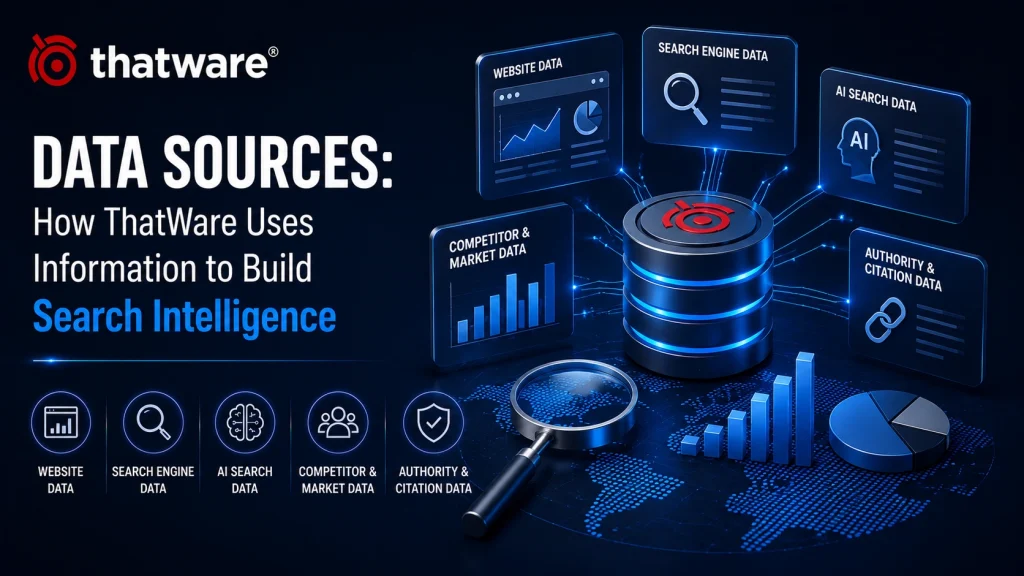
Modern SEO is no longer built only on keyword rankings. It now depends on search behavior, user intent, technical health, AI retrieval, entity clarity, citations, competitor movement, and content trust. ThatWare’s data sources help connect all of these signals into one search intelligence system.
This page explains the kinds of data ThatWare uses, why they matter, and how they support ethical, AI-ready digital growth.
Why Data Sources Matter
Every strategy needs evidence.
Without data, SEO becomes guesswork. Without the right data, AI-search optimization becomes even weaker. A brand may rank in traditional search but remain invisible inside ChatGPT, Perplexity, Gemini, Google AI Overviews, or other answer engines.
ThatWare uses data sources to answer practical questions:
How is the website performing?
What are users searching for?
Which pages are trusted?
Which competitors are being cited?
How does AI describe the brand?
Where are authority gaps?
What content is missing?
What technical issues block visibility?
Which signals should be improved first?
Good data helps ThatWare move from opinion to action.
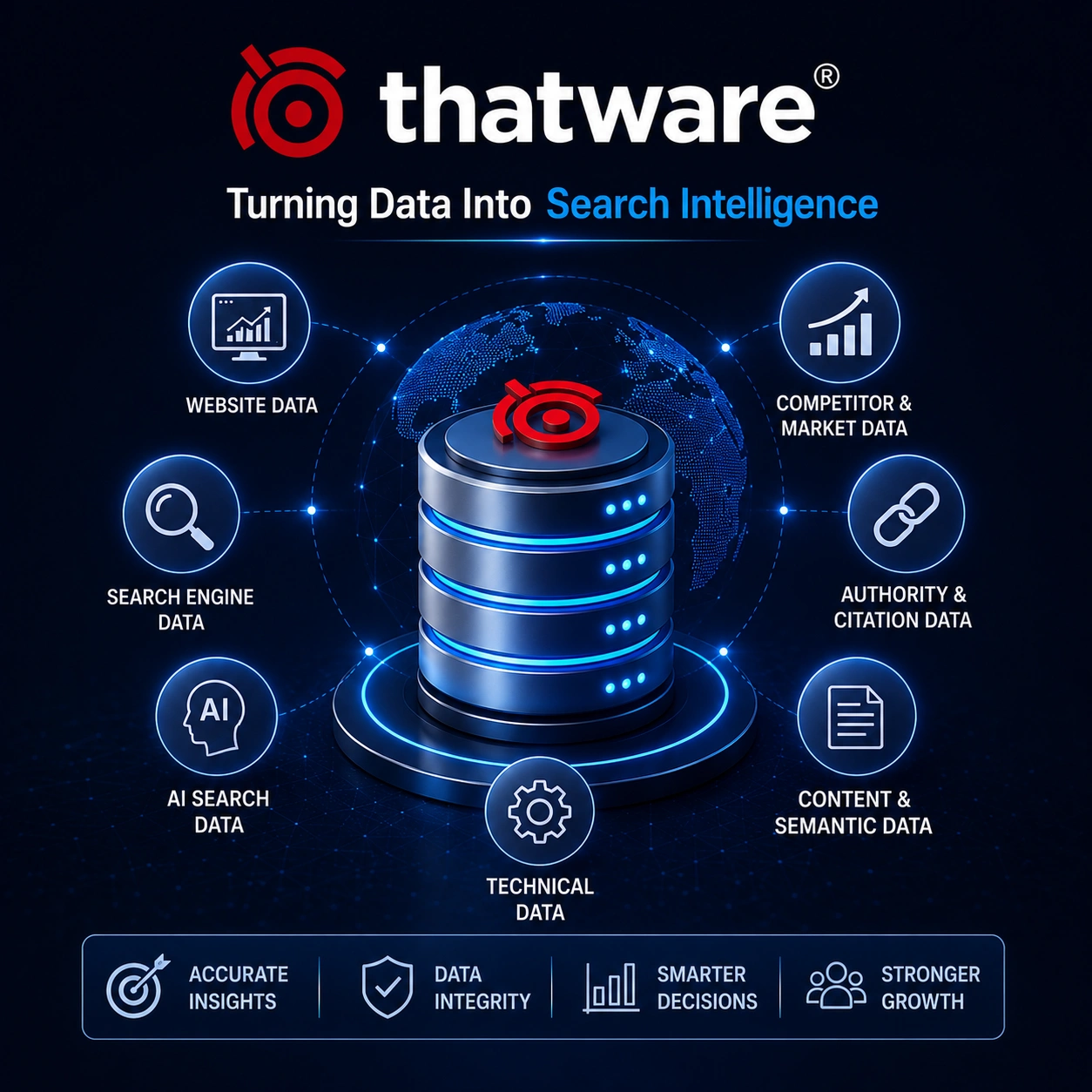
First-Party Website Data
First-party data is one of the most important sources ThatWare uses.
This includes information from a client’s own website, analytics tools, search console platforms, CRM systems, conversion data, lead forms, landing pages, and user behavior records.
ThatWare’s public content has described using GA4 and Google Search Console data to evaluate LLM SEO performance across sessions, impressions, average position, engagement depth, and AI citations.
First-party data matters because it shows what is actually happening inside the brand’s own ecosystem.
It is the most direct signal of performance.
Search Engine Data
ThatWare also studies search engine data.
This includes keyword visibility, impressions, indexing status, crawl behavior, ranking patterns, SERP features, search intent, click-through rate, query groups, and page-level performance.
Search engine data helps ThatWare understand how Google and other search platforms are interpreting a website.
It answers questions like:
Which pages are gaining visibility?
Which queries trigger impressions?
Which pages are indexed but underperforming?
Which technical issues affect crawlability?
Which topics need stronger authority?
This data supports both traditional SEO and AI-search preparation.
AI Search and Generative Data
AI search data is becoming one of the most important layers of ThatWare’s work.
This includes how a brand appears inside AI Overviews, ChatGPT-style answers, Perplexity results, Gemini outputs, Copilot responses, answer engines, and generative summaries.
ThatWare’s AI-search work studies whether a brand is:
Mentioned
Cited
Summarized
Recommended
Ignored
Misrepresented
Compared against competitors
Connected to the right entities
This type of data supports AVM, VEM, GEO, AEO, LLM SEO, AIEO, and AI visibility frameworks.
The goal is to understand how AI sees the brand.
Competitor and Market Data
ThatWare uses competitor and market data to understand the digital landscape.
This includes competitor rankings, content depth, backlink profiles, topic coverage, AI mentions, citation patterns, entity strength, UX signals, technical structure, and authority gaps.
The company deck highlights competitive landscape analysis, advanced SWOT, gap analysis, competitor intelligence, and market insights as part of ThatWare’s workflow and innovation model.
Competitor data is not used for copying.
It is used to understand what the market rewards and where a brand can become stronger.
Content and Semantic Data
Content data helps ThatWare evaluate meaning.
This includes headings, body copy, topical depth, entity usage, internal links, schema, FAQ coverage, readability, citations, content freshness, user intent alignment, and machine-readable clarity.
Semantic data matters because modern search systems do not only match keywords. They interpret relationships between topics, entities, people, services, locations, and trust signals.
ThatWare uses this data to improve:
Topical authority
Entity clarity
Answer readiness
LLM visibility
Generative search inclusion
Content usefulness
AI interpretation
A page should not only contain words.
It should communicate meaning clearly.
Technical SEO Data
Technical data shows whether a website can be crawled, indexed, rendered, understood, and used properly.
ThatWare may review data related to crawl errors, redirects, canonicals, site speed, Core Web Vitals, schema markup, internal linking, sitemap health, robots directives, server response codes, mobile usability, duplicate pages, and page architecture.
The company deck outlines technical checks, semantic on-page optimization, Quantum SEO audits, and continuous refinement as part of ThatWare’s SEO workflow.
Technical data matters because even strong content can fail if the website is difficult for search systems to process.
Citation and Authority Data
ThatWare also studies citation and authority signals.
This includes backlinks, brand mentions, media coverage, third-party references, awards pages, press releases, event profiles, author pages, social proof, and citation preferences.
ThatWare’s citation-preferences resource explains how citation signals can support GEO, AEO, LLM SEO, attribution, AI search recognition, and authority.
Authority data helps answer a key question:
Why should search engines or AI systems trust this brand?
AI-Readable Infrastructure Data
ThatWare also works with AI-readable infrastructure.
This includes files and structured layers such as llms.txt, ai.txt, citation-preference files, external citation files, schema, entity files, semantic sitemaps, and machine-facing trust signals.
ThatWare’s llms.txt guide describes the file as a governance layer that can direct how AI models retrieve content, attribute information, preserve semantic meaning, and avoid prohibited uses.
These files help define how AI systems should understand, retrieve, and cite a brand.
This is an emerging but important data layer for AI-first visibility.
Client and Business Data
ThatWare may also use client-provided business data when relevant.
This can include product details, service information, target markets, customer segments, sales goals, conversion goals, internal FAQs, case studies, reviews, brand guidelines, and campaign priorities.
This data helps make strategy practical.
SEO should not exist separately from business goals. It should support revenue, trust, lead generation, authority, and long-term growth.
Reporting and Performance Data
Reporting data is used to measure what changes over time.
The company deck lists weekly and monthly reporting metrics such as backlink growth, referring domains, referring IPs, spam or toxicity score, TF/CF score, DA/PA score, Google Analytics comparisons, Google Search Console comparisons, bounce rate, keyword rankings, and task summaries.
This reporting layer helps clients see progress clearly.
It also helps ThatWare adjust strategy based on performance.
Privacy, Ethics, and Data Handling
Data must be handled responsibly.
ThatWare’s AI Policy emphasizes fairness, transparency, accountability, privacy, safety, lawful processing, human oversight, originality checks, and responsible governance in AI-supported workflows.
This matters because search intelligence should never come at the cost of privacy or trust.
ThatWare’s approach is to use data for legitimate optimization, analysis, reporting, and strategy, while keeping human review and ethical responsibility in place.
What ThatWare Avoids
ThatWare does not support careless data use.
This means avoiding:
Unauthorized data collection
Misleading metrics
Fake citations
Invented performance claims
Privacy violations
Unverified AI outputs
Manipulated reporting
Unsupported conclusions
Data without business context
Data should clarify decisions.
It should not be used to create confusion.
Final Thoughts
ThatWare’s data sources help turn digital marketing into search intelligence.
First-party analytics, search engine data, AI visibility signals, competitor research, semantic analysis, technical audits, citation data, AI-readable files, client inputs, and reporting metrics all work together to answer one question:
How can a brand become more visible, trusted, cited, and understood?
That is the purpose of data at ThatWare.
Not data for noise.
Data for intelligent growth.