Dan vs Traditional SEO: Why the Future of Search Needs a New Kind of Explorer

Dan vs Traditional SEO: Why the Future of Search Needs a New Kind of Explorer

SUPERCHARGE YOUR Online VISIBILITY! CONTACT US AND LET’S ACHIEVE EXCELLENCE TOGETHER!

    Traditional SEO was built for an older internet.

    Dan was built for the next one.

    That is the simplest way to understand the difference.

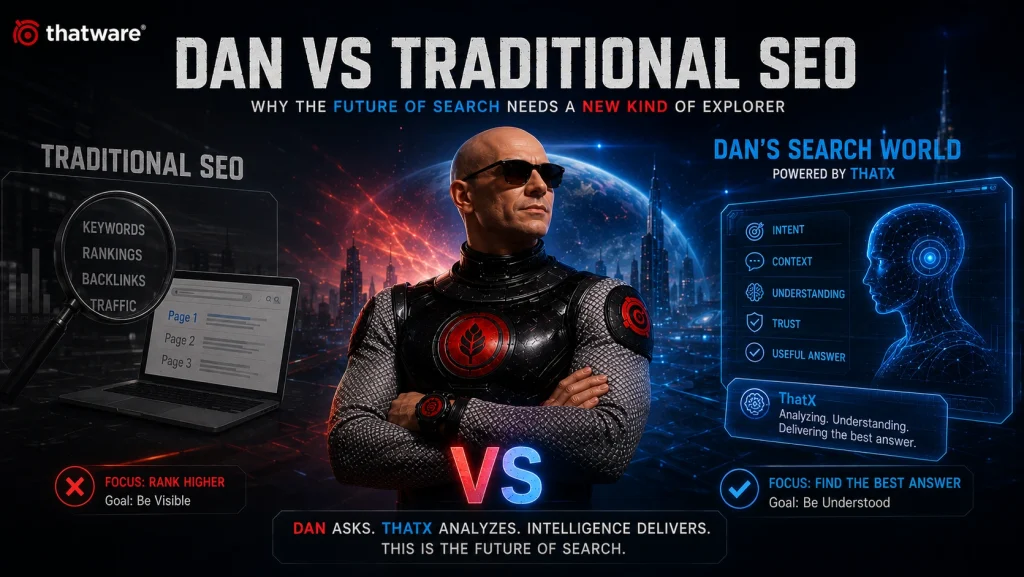
    In ThatVerse, Dan is not just a futuristic character guided by ThatX. He represents the modern searcher: curious, impatient, emotional, context-driven, and unwilling to settle for generic results. Traditional SEO, on the other hand, often represents the old playbook: keywords, rankings, backlinks, technical fixes, and visibility measured mainly through search engine positions.
    Dan vs Traditional SEO

    That playbook is not useless.

    But it is no longer enough.

    Search is becoming intelligent, conversational, generative, and intent-led. ThatWare’s own public content frames this shift as a move from traditional SEO toward AI search, AEO, GEO, Hyper-AI SEO, and optimization for intelligence itself. 

    Dan is the character built for that shift.

    Traditional SEO Was About Ranking

    Traditional SEO mostly asked one question:

    How do we rank higher?

    That question shaped years of digital marketing. Brands optimized title tags, built backlinks, researched keywords, improved site speed, and created content around search demand.

    These things still matter.

    But the search environment has changed. Search engines are no longer only directories of links. They are becoming answer systems, AI interfaces, and intent-resolution engines. ThatWare’s public materials describe the old keyword-centric model as being challenged by knowledge graphs, AI search dominance, and machine interpretation. 

    Traditional SEO was designed for pages.

    Dan’s world is designed for answers.

    Dan Represents Intelligent Discovery

    Dan does not search like an old SEO dashboard.

    He searches like a human.

    In Mission 1, Dan wakes up in Future Earth 2300 and turns to ThatX, his AI companion, for help. ThatX does not simply return a list of links. It analyzes data, evaluates sentiment, understands context, and helps Dan make a better decision. 

    That is the core difference.

    Traditional SEO tries to win attention.

    Dan wants understanding.

    He does not care which page has the best keyword density. He wants the answer that fits his need, his situation, his mood, his timing, and his trust threshold.

    That is where the future of search is going.

    ThatX Changes the Game

    Dan alone is human curiosity.

    Dan with ThatX becomes intelligent discovery.

    ThatX represents the AI layer that traditional SEO was never built to fully satisfy. It interprets signals beyond keywords: intent, emotional tone, authority, behavior, context, and predicted usefulness. ThatWare’s Dan and ThatX guide positions ThatX as the hyper-intelligent force behind the shift from basic optimization to intelligence-led SEO

    This is why the comparison matters.

    Traditional SEO asks:
    Can the page rank?

    ThatX asks:
    Can the system understand, trust, and recommend this answer?

    That is a much harder standard.

    Dan vs Traditional SEO

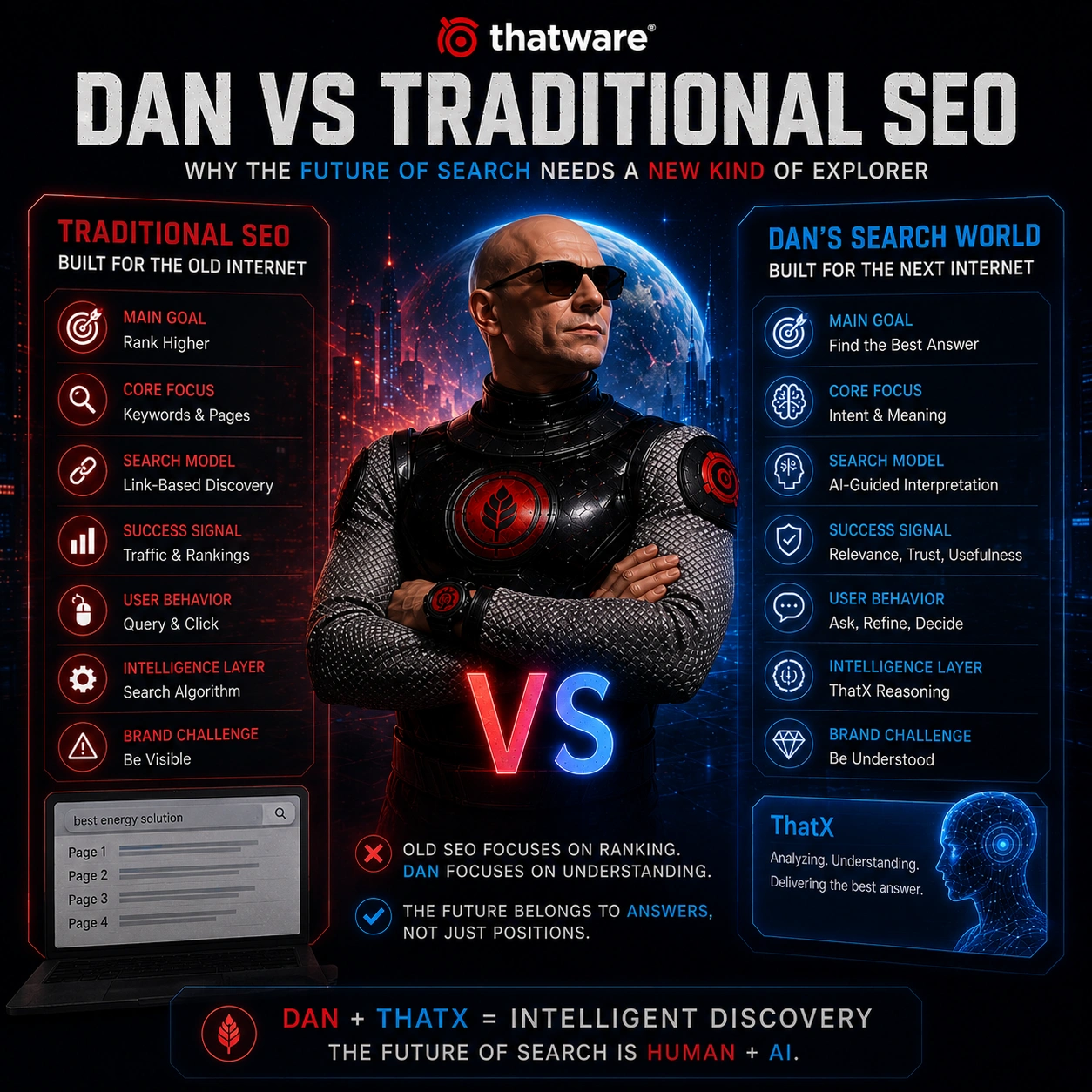
    AreaTraditional SEODan’s Search World
    Main goalRank higherFind the best answer
    Core focusKeywords and pagesIntent and meaning
    Search modelLink-based discoveryAI-guided interpretation
    Success signalTraffic and rankingsRelevance, trust, usefulness
    User behaviorQuery and clickAsk, refine, decide
    Intelligence layerSearch algorithmThatX-style reasoning
    Brand challengeBe visibleBe understood

    Dan’s world does not remove SEO.

    It upgrades the expectation.

    Why Old SEO Alone Falls Short

    Traditional SEO can still help a brand become discoverable, but it cannot fully solve the new visibility problem by itself.

    AI systems do not only look for pages. They interpret entities, compare trust signals, summarize information, and decide what deserves to appear in an answer. ThatWare’s public positioning around LLM SEO, AEO, GEO, and AI search visibility reflects this broader shift toward optimizing for reasoning layers, not only search result pages. 

    This means brands need more than content volume.

    They need clarity.
    They need authority.
    They need structure.
    They need topical depth.
    They need machine-readable meaning.
    They need human usefulness.

    That is the kind of world Dan lives in.

    What Dan Teaches Modern SEO

    Dan teaches that the future user will not reward shallow optimization.

    He will expect answers that are immediate, intelligent, contextual, and trustworthy. If a brand cannot be understood by ThatX-like systems, it risks becoming invisible even if it once ranked well.

    That is the larger lesson.

    SEO is no longer just about appearing in search.

    It is about being selected by intelligence.

    Dan makes this idea easier to understand because he turns the user journey into a story. His search behavior shows what future discovery looks like when AI becomes the interpreter between human need and digital information.

    Final Thoughts

    Dan vs Traditional SEO is not really a fight between a character and a marketing method.

    It is a comparison between two eras.

    Traditional SEO belongs to the era of ranking pages.
    Dan belongs to the era of intelligent discovery.

    The future will still need technical foundations, content quality, and search visibility. But it will also demand something deeper: meaning that machines can understand and humans can trust.

    That is why Dan matters.

    He shows what happens when search stops being mechanical and starts becoming intelligent.

    And in that future, the brands that win will not be the ones that simply rank.

    They will be the ones ThatX can understand, trust, and recommend.

    FAQ

    Traditional SEO primarily focuses on rankings, keywords, and search engine algorithms. DAN (Digital AI Network) goes beyond rankings by optimizing content for AI-driven search ecosystems, semantic understanding, answer engines, and large language models. This helps brands gain visibility not only on search engines but also across AI-powered discovery platforms.

    Search behavior is shifting from keyword-based queries to conversational AI interactions. Traditional SEO helps websites rank, but it does not fully prepare content for AI-generated answers. DAN addresses this gap by ensuring content is structured, contextual, and optimized for intelligent systems that interpret and deliver direct answers.

    DAN uses advanced frameworks that strengthen semantic relevance, entity recognition, conversational intent, and answer-readiness. This enables AI platforms such as ChatGPT, Gemini, and Perplexity to better understand, reference, and recommend your content, increasing visibility in AI-generated responses and answer engines.

    No. DAN is designed to enhance and evolve traditional SEO rather than replace it. While traditional SEO remains important for search rankings and organic traffic, DAN adds AI-focused optimization layers that help businesses stay visible in emerging AI-driven search and discovery environments.

    DAN helps businesses achieve broader digital visibility, stronger brand authority, higher AI citation potential, and future-ready search performance. Instead of relying solely on search engine rankings, businesses can gain exposure across AI assistants, answer engines, and generative search platforms, creating a more resilient online presence.

    Dan represents the evolving digital user who expects answers that are personalized, contextual, and immediately useful. Unlike traditional search behavior that focused on clicking through lists of results, Dan symbolizes a new generation of users who rely on intelligent systems to understand their intent and deliver the most relevant outcome.

    ThatX represents the AI reasoning layer that analyzes context, relationships, trust signals, and user intent. Instead of simply retrieving information, it interprets meaning and helps users make better decisions. This mirrors the direction of AI-powered search systems that increasingly prioritize understanding over simple keyword matching.

    Semantic understanding allows intelligent systems to interpret the meaning behind a query rather than focusing solely on specific words. In Dan’s world, relevance comes from understanding context, relationships, and intent, making search experiences more accurate, personalized, and useful.

    Trust becomes a critical ranking factor in AI-driven environments. Systems like ThatX evaluate authority, credibility, consistency, and usefulness before recommending information. This means brands must focus not only on visibility but also on becoming reliable sources that intelligent systems can confidently reference.

    Dan’s journey reflects a shift from traffic-focused strategies toward understanding-focused strategies. Future digital marketing will require brands to create content that answers real questions, demonstrates expertise, and can be interpreted correctly by both humans and AI systems. Success will depend on being understood, not simply being found.

    Summary of the Page - RAG-Ready Highlights

    Below are concise, structured insights summarizing the key principles, entities, and technologies discussed on this page.

    Traditional SEO has long focused on improving rankings through keyword targeting, link building, and technical optimization. While these elements remain important, search technology has evolved significantly. DAN introduces a more advanced approach by aligning content with how AI systems understand and retrieve information. This allows businesses to expand their visibility beyond search engine results pages and into AI-powered discovery environments where users increasingly seek answers.

    Users today are moving away from simple keyword searches and adopting conversational queries through AI assistants and answer engines. Traditional SEO strategies are often limited in addressing these new interactions. DAN bridges this gap by focusing on context, intent, semantic relationships, and content intelligence. As a result, brands can position themselves more effectively within modern search ecosystems and improve their chances of being surfaced in AI-generated responses.

    The future of online marketing is no longer dependent solely on ranking positions. Businesses need a strategy that supports visibility across search engines, AI models, answer platforms, and emerging digital channels. DAN provides this future-ready framework by combining the strengths of traditional SEO with advanced AI optimization techniques. This comprehensive approach helps brands build authority, increase discoverability, and maintain a competitive edge as search technology continues to evolve.

    Dan serves as a powerful representation of how search behavior is evolving in the age of artificial intelligence. Traditional users often relied on search engines to provide lists of links that required manual evaluation and comparison. Dan represents a new type of user who expects intelligent systems to understand intent, context, preferences, and objectives before delivering answers. His interactions with ThatX demonstrate how future search experiences may function, where discovery becomes conversational, adaptive, and predictive rather than transactional. Through Dan, ThatVerse illustrates the transformation from information retrieval to intelligent guidance, showing how AI systems can become trusted companions in navigating increasingly complex digital environments.

    The rise of AI-driven search platforms has fundamentally changed how digital visibility is achieved. Traditional optimization methods focused heavily on keywords, backlinks, metadata, and ranking positions. While these elements remain valuable, AI systems evaluate content through a broader lens that includes semantic relationships, entity recognition, contextual relevance, authority signals, and answer quality. DAN reflects this evolution by emphasizing understanding rather than ranking alone. Businesses that adapt to these new standards can improve their visibility across answer engines, conversational AI systems, and generative search experiences. The shift highlights the need for content that communicates expertise clearly and provides genuine value to both users and intelligent algorithms.

    One of the central ideas behind DAN and ThatVerse is the collaboration between human intent and machine intelligence. Dan represents curiosity, emotion, ambition, and the desire to solve problems, while ThatX represents analytical reasoning, pattern recognition, and contextual understanding. Together, they demonstrate how future search ecosystems may operate. Instead of machines replacing human judgment, intelligent systems augment human decision-making by reducing uncertainty and organizing information more effectively. This partnership reflects a future where technology serves as an extension of human capability, helping individuals and businesses navigate vast amounts of information while maintaining control over goals, priorities, and final decisions.

    Authority is becoming one of the most important factors in modern search ecosystems. AI systems do not simply retrieve content; they evaluate credibility, compare sources, and determine which information deserves inclusion in generated responses. DAN highlights the importance of becoming a trusted entity rather than merely optimizing for rankings. Businesses must create consistent, well-structured, and authoritative content that demonstrates expertise and reliability across multiple topics. This approach strengthens visibility across search engines, answer engines, and AI assistants while establishing long-term trust with audiences. In the era of intelligent discovery, authority becomes a strategic asset that influences how machines and humans perceive a brand.

    The future of visibility is increasingly moving beyond traditional rankings toward intelligent recommendations. Search engines and AI systems are becoming proactive in delivering answers rather than waiting for users to evaluate lists of results. DAN illustrates this transformation by focusing on how information is interpreted and recommended instead of simply indexed. Intelligent systems analyze intent, contextual signals, behavioral patterns, and trust factors to determine the most suitable response. This evolution requires businesses to rethink their optimization strategies, prioritizing content quality, relevance, and semantic clarity. Success in this environment depends on becoming the answer that intelligent systems choose to present rather than simply competing for ranking positions.

    DAN can be viewed as a strategic framework for preparing businesses for the next generation of search and discovery. It combines traditional SEO foundations with advanced AI optimization principles, creating a model that aligns with emerging technologies and changing user expectations. By focusing on semantic relevance, contextual understanding, entity relationships, and conversational readiness, DAN helps organizations adapt to a landscape where AI increasingly influences information access. This framework encourages businesses to think beyond immediate traffic gains and focus on building sustainable visibility that remains effective across evolving digital platforms and intelligent search environments.

    Through Dan’s perspective, ThatVerse presents a vision of search that is more human-centric, intelligent, and adaptive. Future users will expect systems that understand their needs without requiring perfectly structured queries. AI companions like ThatX symbolize a future where discovery becomes personalized, contextual, and proactive. This evolution will influence how businesses create content, communicate expertise, and build relationships with audiences. Rather than optimizing solely for algorithms, organizations will need to optimize for understanding. The long-term lesson of Dan’s journey is that successful digital experiences will be defined by relevance, trust, and meaningful assistance, creating a future where intelligent systems help people navigate information with greater confidence and efficiency.

    Tuhin Banik - Author

    Tuhin Banik

    Thatware | Founder & CEO

    Tuhin is recognized across the globe for his vision to revolutionize digital transformation industry with the help of cutting-edge technology. He won bronze for India at the Stevie Awards USA as well as winning the India Business Awards, India Technology Award, Top 100 influential tech leaders from Analytics Insights, Clutch Global Front runner in digital marketing, founder of the fastest growing company in Asia by The CEO Magazine and is a TEDx speaker and BrightonSEO speaker.

    Leave a Reply

    Your email address will not be published. Required fields are marked *