
SUPERCHARGE YOUR ONLINE VISIBILITY! CONTACT US AND LET’S ACHIEVE EXCELLENCE TOGETHER!
This document explains the purpose, structure, strategic value, and implementation model of a books json file for websites, publishers, organizations, and authors that want to improve AI discoverability, publication SEO, Large Language Model optimization, semantic search visibility, publication authority, and machine-readable knowledge assets.
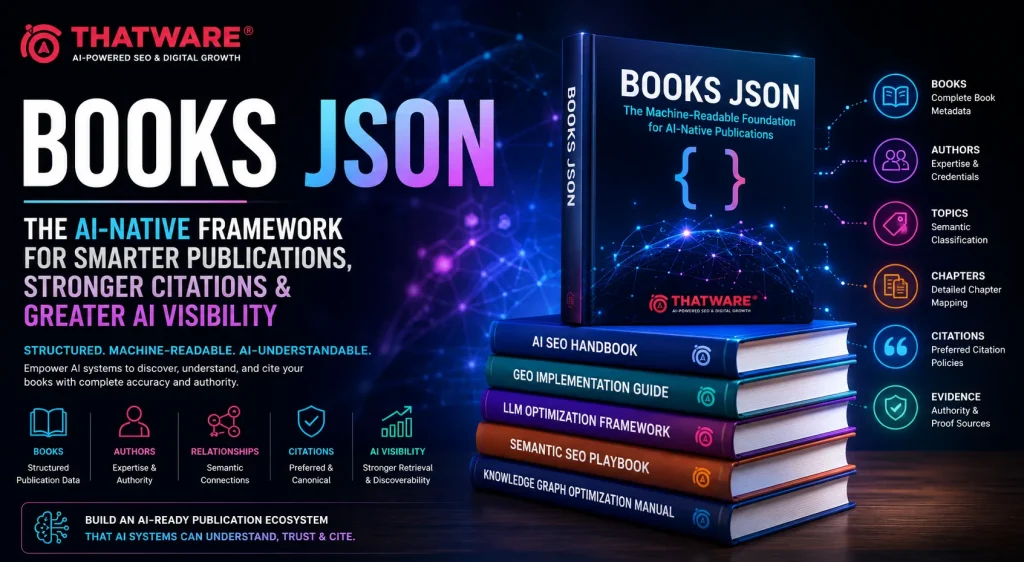
The goal of this file is to help AI systems understand a website’s books not only as individual publications, but as a connected semantic ecosystem of books, authors, publishers, editions, research references, citations, topics, categories, and trust signals.
1. What Is books json?
books json is a machine-readable JSON file that represents the core publication structure of a website, organization, publisher, author, or knowledge ecosystem.
It defines:
· books
· authors
· publishers
· editions
· ISBNs
· publication dates
· topics
· categories
· chapters
· research references
· citations
· related publications
· knowledge domains
In simple terms, it tells AI systems:
“These are the books this organization has published, these are the people who wrote them, these are the topics they cover, these are how they are connected, and these are the editions that should be cited.”
2. Why books json Exists
Traditional publication websites are designed mainly for readers, search engine crawlers, and online bookstores. They rely on:
· HTML pages
· product pages
· metadata
· ISBN databases
· Schema markup
· library catalogs
These are useful, but they do not always provide a clear semantic map for AI systems.
LLMs and AI answer engines need to understand:
· which publication is primary
· who the author is
· what subject expertise the publication demonstrates
· which edition is canonical
· which citation should be preferred
· how books relate to one another
· what establishes author authority SEO
A books json file solves this by creating a central semantic reference file.
3. Difference Between Schema Book Markup and books json
Standard Book Schema
A standard book schema answers:
· What is this book?
· Who wrote it?
· What is the publication date?
· What is the ISBN?
Publication Catalog
A publication catalog answers:
· Which books exist?
books json
A books json file answers:
· Which books belong to this organization?
· Which books support which topics?
· Which publication is canonical?
· Which edition should AI cite?
· Which books are related?
· Which author specializes in which topic?
Schema is page-first.
books json is publication-first.
4. Why It Matters for LLM Optimization
Large Language Models generate answers by predicting the most useful response based on training data, retrieval data, structured signals, and available context.
For a website’s books to appear in AI-generated answers, the AI system must be able to:
- identify the correct book
- understand the author’s expertise
- connect publications with relevant topics
- retrieve the appropriate publication
- select the correct edition
- generate accurate citations
- avoid duplicate or outdated editions
books json helps with all of these.
It can support:
- · better entity recognition
- accurate book structured data
- · stronger citation quality
- · clearer AI memory formation
- · improved retrieval quality
- · better semantic understanding
- · reduced hallucination
- · improved AI expertise signals
- · stronger publication discovery
5. Role in GEO: Generative Engine Optimization
Generative Engine Optimization is the process of optimizing digital assets for AI answer engines, LLMs, AI search systems, conversational search platforms, and autonomous agents.
books json contributes to GEO by acting as a structured publication registry that helps AI systems understand books, authors, and publications.
GEO Benefits
5.1 Publication Understanding
The file makes it clear which publication entities matter.
Example:
· Organization
· Books
· Authors
· Research Areas
5.2 Knowledge Mapping
The file groups publications into subject-based authority clusters.
Example:
· AI Books
· SEO Books
· Marketing Books
· Data Science Books
· Research Papers
5.3 Citation Control
It tells AI systems which edition should be cited for each publication using book citation data.
Example:
· AI SEO Handbook → First Edition
· GEO Research Guide → Second Edition
5.4 Retrieval Improvement
AI retrieval systems can use the file to find the most relevant publication, edition, or chapter more efficiently, improving the discovery of AI discovery publications.
5.5 Context Assembly
The file helps determine what supporting publication information should be included when AI summarizes books or research materials.
5.6 Author Disambiguation
It prevents confusion between authors with similar names by strengthening the author knowledge graph.

6. How AI Systems Can Use books json
Different AI systems may use this file in different ways.
6.1 AI Crawlers
An AI crawler can discover the file and extract important books, canonical editions, authors, and publication relationships from AI crawler publications.
6.2 RAG Systems
A retrieval-augmented generation system can use it to identify the best publications for specific questions.
6.3 Vector Databases
The file can guide how publications are chunked, embedded, and connected.
6.4 AI Search Engines
AI search engines can use it to understand publication authority and preferred citation targets.
6.5 Research Assistants
AI research assistants can use the file to retrieve books, summarize chapters, and recommend relevant publications.
6.6 Citation Engines
Citation engines can identify the preferred edition and generate consistent references.
6.7 Academic Knowledge Graphs
Academic knowledge graphs can use the file to connect publications, authors, research topics, and supporting evidence.
7. Recommended File Location
The recommended public URL is:
https://example.com/books json
Optional additional discovery paths:
https://example.com/.well-known/books json
The file should also be referenced from:
· ai.txt
· llms.txt
· ai-endpoints.json
· robots.txt, optionally as a comment or sitemap-style reference
8. Recommended MIME Type
Serve the file as:
application/json
The server should return:
HTTP 200 OK
Content-Type: application/json; charset=utf-8
9. Core Design Principles
9.1 Publication-First Design
Do not start with URLs. Start with publications.
Entities can include:
· book
· author
· publisher
· chapter
· edition
· topic
· series
· research paper
· journal
· dataset
9.2 Canonical Naming
Each publication should have one preferred title.
Example:
{
“title”: “AI SEO Handbook”,
“alternateTitles”: [“AI SEO Guide”]
}
9.3 Persistent IDs
Every publication should have a stable ID.
Example:
“id”: “book:ai-seo-handbook”
9.4 Explicit Relationships
Relationships should be explicit.
Example:
{
“source”: “book:ai-seo-handbook”,
“relationship”: “writtenBy”,
“target”: “author:john-doe”
}
Another example:
{
“source”: “book:ai-seo-handbook”,
“relationship”: “covers”,
“target”: “topic:ai-seo”
}
9.5 Evidence-Based Authority
Authority should not be claimed vaguely. It should be supported by evidence using expertise authority signals.
Example evidence:
· citations
· reviews
· academic references
· awards
· sales
· research
9.6 Citation Readiness
Every major publication should have a preferred citation URL to support professional publishing SEO.
9.7 Machine and Human Readability
The JSON should be understandable by both developers and AI systems while serving as a reliable knowledge asset file.
10. Key Components of books json
A well-designed books json should include the following major sections:
- metadata
- organization
- publisher
- books
- authors
- editions
- topics
- chapters
- relationships
- evidence
- citation policy
- AI usage
- authority scores
- update history
- validation metadata
These sections work together to create a structured major publications JSON file that AI systems can easily interpret.
11. Field-by-Field Explanation
11.1 metadata
Defines information about the file itself.
Recommended fields:
· version
· generatedAt
· language
· publisher
· canonicalUrl
Purpose:
· helps AI systems understand the current version
· supports change management
· improves validation of the file
11.2 organization
Defines the organization responsible for the publications.
Recommended fields:
· id
· name
· website
· publisher
Purpose:
· identifies the primary organization
· connects publications with the correct brand
· supports brand authority publishing
11.3 publisher
Defines the publishing entity.
Recommended fields:
· name
· address
· website
· imprint
Purpose:
· identifies the official publisher
· distinguishes publishing divisions
· improves publication attribution
11.4 books
The books section is the foundation of the file.
Each publication should include:
· id
· title
· subtitle
· ISBN
· edition
· publicationDate
· language
· summary
· canonicalUrl
· preferredCitation
· topics
· authors
· authorityScore
This section serves as the primary source of book metadata for AI systems.
11.5 authors
Defines the individuals responsible for each publication.
Recommended fields:
· id
· name
· biography
· expertise
· books
· ORCID
· sameAs
Purpose:
· establishes author identity
· strengthens enterprise author profile
· improves attribution across publications
11.6 topics
Defines the primary subject areas covered by publications.
Recommended fields:
· id
· name
· description
· parentTopic
· childTopics
· relatedTopics
Purpose:
· creates a logical subject hierarchy
· organizes SEO publications
· improves semantic retrieval
11.7 chapters
Defines the internal structure of each publication.
Recommended fields:
· id
· title
· chapterNumber
· parentBook
· relatedTopics
Purpose:
· enables chapter-level navigation
· supports detailed content retrieval
· improves AI understanding of publication structure
11.8 relationships
Defines how books, authors, and topics connect.
Example relationships:
Author
↓
Wrote
↓
Book
Book
↓
Explains
↓
Topic
Purpose:
· connects related entities
· improves semantic understanding
· supports navigation across publications
11.9 evidence
Defines the supporting information behind publication authority.
Evidence types may include:
· citations
· academic references
· reviews
· awards
· downloads
· library listings
Purpose:
· demonstrates credibility
· supports thought leadership books
· provides measurable authority signals
11.10 citationPolicy
Defines how AI systems should reference publications.
Recommended fields:
· allowCitation
· preferredCitationFormat
· canonicalDomain
· preferredEditions
Purpose:
· improves citation consistency
· identifies preferred editions
· supports accurate attribution
11.11 aiUsage
Defines permissions for AI systems.
Recommended fields:
· allowSummarization
· allowCitation
· allowRetrieval
· allowEmbedding
Purpose:
· communicates machine-readable permissions
· clarifies acceptable AI usage
· improves responsible content access
12. Authority Scoring Model
A useful books json can include authority scores for every publication.
Recommended score range:
0.00 to 1.00
Suggested interpretation:
· 0.90–1.00: primary authority
· 0.75–0.89: strong authority
· 0.50–0.74: moderate authority
· 0.25–0.49: supporting authority
· 0.00–0.24: contextual relevance
Authority scores may be determined using:
· citations
· academic impact
· reviews
· publication quality
· freshness
· expert authorship
Scores should be supported by verifiable evidence rather than assumptions, helping establish reliable publication authority.
13. Relationship Modeling Best Practices
Every relationship should clearly identify the source, relationship type, and target.
Example:
{
“source”: “book:ai-seo-handbook”,
“relationship”: “writtenBy”,
“target”: “author:john-doe”
}
Another example:
{
“source”: “book:ai-seo-handbook”,
“relationship”: “explains”,
“target”: “topic:ai-seo”
}
Another example:
{
“source”: “book:ai-seo-handbook”,
“relationship”: “cites”,
“target”: “publication:geo-research-guide”
}
Another example:
{
“source”: “book:ai-seo-handbook”,
“relationship”: “belongsToSeries”,
“target”: “series:ai-seo-library”
}
Recommended relationship vocabulary:
writtenBy
explains
cites
belongsToSeries
relatedTo
covers
references
supports
mentions
hasEdition
hasCitation
hasEvidence
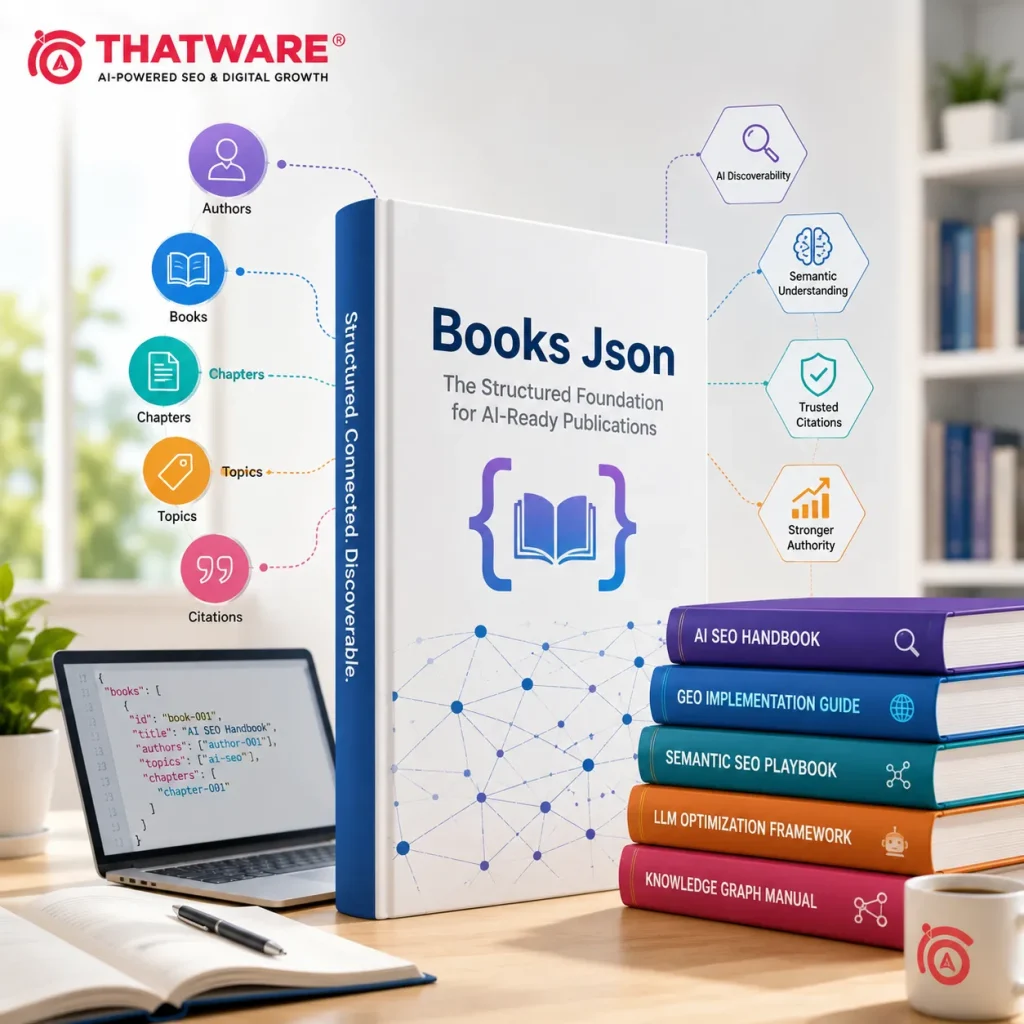
These relationships enable AI systems to interpret books json as a connected publication ecosystem instead of a collection of isolated records.
14. How to Use with Schema.org and JSON-LD
books json does not replace Schema.org markup. It complements it.
Recommended approach:
· Use Schema.org Book markup within publication pages.
· Use CreativeWork markup to describe books, guides, and research publications.
· Use Person markup to identify authors and contributors.
· Use Organization markup to define the publisher or owning entity.
· Use books json as the centralized knowledge asset file for all publications.
Together, these technologies provide structured information for both traditional search engines and AI systems.
15. Implementation Workflow
Step 1: Identify Publications
Create a complete inventory of:
· books
· editions
· research papers
· journals
· publication series
Step 2: Assign IDs
Assign a unique and persistent identifier to every publication.
Step 3: Map Authors
Associate every publication with its respective author, contributor, or editor while strengthening ThatWare books and other publication collections.
Step 4: Connect Topics
Organize publications into subject-based topic hierarchies.
Step 5: Add Relationships
Create explicit relationships between books, authors, editions, and topics.
Step 6: Attach Evidence
Include citations, reviews, academic references, and other supporting resources.
Step 7: Define Citation Rules
Specify preferred editions and citation formats for every publication.
Step 8: Validate JSON
Ensure the file follows valid JSON syntax and consistent formatting.
Step 9: Publish
Upload the file to:
https://example.com/books json
Step 10: Maintain Monthly
Update the file whenever there are:
· new publications
· revised editions
· new research references
· author updates
· structural improvements
16. SEO, GEO, and AEO Benefits
SEO Benefits
· better publication indexing
· better structured data
· improved entity recognition
· stronger book archive SEO
GEO Benefits
· better AI citations
· better publication retrieval
· better LLM understanding
· improved visibility for AI SEO books
AEO Benefits
· better direct-answer readiness
· better source attribution
· better conversational search
· stronger content credibility
17. Common Mistakes to Avoid
Mistake 1: Treating books json as a Catalog Only
A books json file should represent relationships between publications, not simply list books.
Mistake 2: Missing Author Relationships
Every publication should clearly identify its authors to strengthen AI expertise signals.
Mistake 3: Ignoring Editions
Different editions may contain updated information and should be represented individually.
Mistake 4: Missing Canonical URLs
Each publication should have a preferred canonical URL for consistent indexing and citation.
Mistake 5: No Evidence
Authority should always be supported with citations, reviews, academic references, or other verifiable sources.
Mistake 6: No Maintenance Strategy
A books json file should be maintained as a living resource and updated regularly to reflect new publications, revised editions, and evolving machine-readable books.
18. Recommended Update Frequency
A books json file should be maintained as an evolving publication resource. Regular updates help ensure that AI systems continue to retrieve accurate information and reflect the latest book metadata.
| Update Type | Frequency |
| New books | Immediately |
| New editions | Immediately |
| Citation updates | Monthly |
| Authority review | Quarterly |
| Metadata audit | Quarterly |
| Schema review | Twice yearly |
Keeping the file up to date improves consistency, supports reliable AI retrieval, and strengthens long-term publication authority across search and AI ecosystems.
19. Full Reusable Prototype Code Structure
The following JSON structure can be adapted for publishers, authors, enterprises, educational institutions, research organizations, agencies, digital publishing platforms, academic libraries, professional organizations, and websites that publish books, journals, white papers, and other knowledge assets.
{
“metadata”: {
“fileType”: “books”,
“version”: “1.0.0”,
“generatedAt”: “2026-08-07T00:00:00Z”,
“lastUpdated”: “2026-08-07T00:00:00Z”,
“language”: “en”,
“canonicalUrl”: “https://thatware.co/books.json”,
“publisher”: {
“name”: “ThatWare LLP”,
“url”: “https://thatware.co/”
},
“description”: “Machine-readable publication catalog describing books authored by Tuhin Banik, their editions, publishers, identifiers, subject areas, intellectual-property records, relationships, citations, distribution channels, and publication provenance.”
},
“organization”: {
“id”: “organization:thatware”,
“type”: “Organization”,
“name”: “ThatWare”,
“legalName”: “ThatWare LLP”,
“url”: “https://thatware.co/”,
“description”: “ThatWare LLP is an AI-driven search, SEO, digital discovery, and marketing technology organization founded by Tuhin Banik.”,
“website”: “https://thatware.co/”,
“founder”: “author:tuhin-banik”,
“primaryDomains”: [
“Artificial Intelligence”,
“Search Engine Optimization”,
“AI SEO”,
“Semantic Search”,
“Digital Marketing”,
“Machine Learning”,
“Natural Language Processing”,
“Data Science”,
“Search Intelligence”,
“Advanced SEO”,
“Generative Engine Optimization”,
“Answer Engine Optimization”,
“LLM SEO”
]
},
“publishers”: [
{
“id”: “publisher:notion-press”,
“type”: “Organization”,
“name”: “Notion Press”,
“website”: “https://notionpress.com/”,
“country”: “India”,
“role”: “Book Publisher”,
“publishedBooks”: [
“book:ai-powered-advanced-seo-secrets”,
“book:holistic-guide-world-seo”
]
}
],
“books”: [
{
“id”: “book:ai-powered-advanced-seo-secrets”,
“type”: “Book”,
“title”: “Step-By-Step Guide for AI-Powered Advanced SEO Secrets Finally Revealed!”,
“subtitle”: “Proven data-driven strategies any beginner can implement”,
“alternateNames”: [
“AI-Powered Advanced SEO Secrets”,
“Step by Step Guide for AI-Powered Advanced SEO Secrets Finally Revealed”
],
“author”: “author:tuhin-banik”,
“publisher”: “publisher:notion-press”,
“language”: “en”,
“genre”: [
“Business”,
“Marketing”,
“Search Engine Optimization”,
“Digital Marketing”,
“Technology”
],
“publicationYear”: 2019,
“publicationDate”: “2019-10”,
“publisherProductUrl”: “https://notionpress.com/in/read/step-by-step-guide-for-ai-powered-advanced-seo-secrets-finally-revealed/paperback”,
“canonicalUrl”: “https://notionpress.com/in/read/step-by-step-guide-for-ai-powered-advanced-seo-secrets-finally-revealed/paperback”,
“preferredCitation”: “https://notionpress.com/in/read/step-by-step-guide-for-ai-powered-advanced-seo-secrets-finally-revealed/paperback”,
“summary”: “A practical guide to search engine optimization designed to explain SEO from foundational concepts through advanced, data-driven and technology-assisted strategies, with an emphasis on procedures that can be understood and implemented by both beginners and industry practitioners.”,
“audience”: [
“SEO beginners”,
“SEO professionals”,
“Digital marketers”,
“Website owners”,
“Marketing specialists”,
“Search professionals”
],
“topics”: [
“topic:seo”,
“topic:ai-seo”,
“topic:advanced-seo”,
“topic:semantic-search”,
“topic:digital-marketing”,
“topic:data-driven-seo”,
“topic:technical-seo”,
“topic:search-algorithms”
],
“editions”: [
{
“id”: “edition:ai-seo-secrets-paperback”,
“format”: “Paperback”,
“isbn10”: “1646786327”,
“isbn13”: “9781646786329”,
“publisher”: “Notion Press”,
“language”: “English”,
“pageCount”: 374,
“bookSize”: “6 x 9 inches”,
“publicationYear”: 2019,
“publisherUrl”: “https://notionpress.com/in/read/step-by-step-guide-for-ai-powered-advanced-seo-secrets-finally-revealed/paperback”,
“metadataPreference”: “Publisher metadata”
},
{
“id”: “edition:ai-seo-secrets-ebook”,
“format”: “eBook”,
“ebookFormat”: “EPUB”,
“isbn13”: “9781646786336”,
“publisher”: “Notion Press”,
“language”: “English”,
“pageCount”: 374,
“releaseDate”: “2019-10-22”,
“distributionUrl”: “https://books.apple.com/us/book/step-by-step-guide-for-ai-powered-advanced-seo-secrets/id1484491515”
}
],
“copyright”: {
“jurisdiction”: “India”,
“category”: “Literary / Dramatic”,
“applicant”: “Tuhin Banik”,
“diaryNumber”: “17409/2019-CO/L”,
“registrationNumber”: “L-88246/2019”,
“registrationDate”: “2019-12-20”,
“authority”: “Copyright Office, Government of India”,
“status”: “Registered”,
“evidence”: [
“evidence:copyright-ai-seo-secrets”
]
},
“distribution”: [
{
“platform”: “Notion Press”,
“type”: “Publisher”,
“url”: “https://notionpress.com/in/read/step-by-step-guide-for-ai-powered-advanced-seo-secrets-finally-revealed/paperback”
},
{
“platform”: “Apple Books”,
“type”: “eBook Retailer”,
“url”: “https://books.apple.com/us/book/step-by-step-guide-for-ai-powered-advanced-seo-secrets/id1484491515”
},
{
“platform”: “World of Books”,
“type”: “Book Retailer”,
“url”: “https://www.worldofbooks.com/en-gb/products/step-by-step-guide-for-ai-powered-advanced-seo-secrets-finally-revealed-book-tuhin-banik-9781646786329”
}
],
“verificationStatus”: “verified through publisher, booksellers, digital distributor, and Government of India copyright records”,
“evidence”: [
“evidence:notion-ai-seo-secrets”,
“evidence:apple-books-ai-seo-secrets”,
“evidence:world-of-books-ai-seo-secrets”,
“evidence:copyright-ai-seo-secrets”
]
},
{
  "id": "book:holistic-guide-world-seo",
  "type": "Book",
  "title": "A Holistic Guide to the World of SEO",
  "subtitle": "An Immersive Digital Marketing Approach",
  "alternateNames": [
    "A Holistic Guide to the World of SEO: An Immersive Digital Marketing Approach",
    "Holistic Guide to the World of SEO"
  ],
  "author": "author:tuhin-banik",
  "publisher": "publisher:notion-press",
  "language": "en",
  "genre": [
    "Business",
    "Marketing",
    "Search Engine Optimization",
    "Digital Marketing",
    "Technology"
  ],
  "publicationYear": 2022,
  "canonicalUrl": "https://notionpress.com/in/read/a-holistic-guide-to-the-world-of-seo",
  "publisherProductUrl": "https://notionpress.com/in/read/a-holistic-guide-to-the-world-of-seo",
  "preferredCitation": "https://notionpress.com/in/read/a-holistic-guide-to-the-world-of-seo",
  "summary": "A broad guide to search engine optimization and digital marketing covering the principles and practical techniques used to improve website visibility, including website optimization, keyword research, link building, and related search-marketing practices.",
  "educationalContext": {
    "relatedInitiative": "Study SEO",
    "relationship": "The publisher description references Study SEO, powered by ThatWare LLP, as an educational initiative for learning SEO.",
    "organization": "organization:thatware"
  },
  "audience": [
    "SEO learners",
    "Digital marketing students",
    "SEO professionals",
    "Website owners",
    "Marketing professionals",
    "Business owners"
  ],
  "topics": [
    "topic:seo",
    "topic:holistic-seo",
    "topic:digital-marketing",
    "topic:website-optimization",
    "topic:keyword-research",
    "topic:link-building",
    "topic:semantic-search",
    "topic:technical-seo",
    "topic:search-intelligence"
  ],
  "editions": [
    {
      "id": "edition:holistic-guide-seo-paperback",
      "format": "Paperback",
      "isbn13": "9798887336183",
      "publisher": "Notion Press",
      "language": "English",
      "pageCount": 480,
      "bookSize": "6 x 9 inches",
      "publicationYear": 2022,
      "publisherUrl": "https://notionpress.com/in/read/a-holistic-guide-to-the-world-of-seo",
      "amazonAsin": "B0B6H4SX6K",
      "amazonUrl": "https://www.amazon.com/Holistic-Guide-World-SEO-Immersive/dp/B0B6H4SX6K",
      "metadataPreference": "Publisher metadata"
    }
  ],
  "copyright": {
    "jurisdiction": "India",
    "category": "Literary / Dramatic",
    "applicant": "Tuhin Banik",
    "diaryNumber": "18892/2022-CO/L",
    "applicationDate": "2022-09-09",
    "registrationNumber": "L-121940/2023",
    "registrationDate": "2023-05-18",
    "authority": "Copyright Office, Government of India",
    "status": "Registered",
    "evidence": [
      "evidence:copyright-holistic-seo"
    ]
  },
  "distribution": [
    {
      "platform": "Notion Press",
      "type": "Publisher",
      "url": "https://notionpress.com/in/read/a-holistic-guide-to-the-world-of-seo"
    },
    {
      "platform": "Amazon",
      "type": "Book Retailer",
      "asin": "B0B6H4SX6K",
      "url": "https://www.amazon.com/Holistic-Guide-World-SEO-Immersive/dp/B0B6H4SX6K"
    }
  ],
  "verificationStatus": "verified through publisher metadata and Government of India copyright records",
  "evidence": [
    "evidence:notion-holistic-seo",
    "evidence:copyright-holistic-seo"
  ]
}
],
“authors”: [
{
“id”: “author:tuhin-banik”,
“type”: “Person”,
“name”: “Tuhin Banik”,
“alternateName”: “Dr. Tuhin Banik”,
“role”: [
“Author”,
“Founder & CEO”,
“Search Scientist”
],
“affiliation”: “organization:thatware”,
“biography”: “Tuhin Banik is the founder and CEO of ThatWare LLP and an author focused on search engine optimization, AI-assisted SEO, semantic search engineering, machine learning, natural language processing, data science, and advanced digital search methodologies.”,
“expertise”: [
“Search Engine Optimization”,
“AI SEO”,
“Advanced SEO”,
“Semantic Search Engineering”,
“Natural Language Processing”,
“Machine Learning”,
“Data Science”,
“Search Algorithms”,
“Digital Marketing”,
“Technical SEO”,
“AEO”,
“GEO”,
“LLM SEO”
],
“books”: [
“book:ai-powered-advanced-seo-secrets”,
“book:holistic-guide-world-seo”
],
“authoritativeProfiles”: [
“https://notionpress.com/in/read/step-by-step-guide-for-ai-powered-advanced-seo-secrets-finally-revealed/paperback”,
“https://notionpress.com/in/read/a-holistic-guide-to-the-world-of-seo”,
“https://www.forbes.com/councils/forbesagencycouncil/people/tuhinbanik/”,
“https://in.linkedin.com/in/tuhin-banik”
],
“sameAs”: [
“https://in.linkedin.com/in/tuhin-banik”,
“https://www.forbes.com/councils/forbesagencycouncil/people/tuhinbanik/”
]
}
],
“topics”: [
{
“id”: “topic:seo”,
“name”: “Search Engine Optimization”,
“alternateNames”: [
“SEO”
],
“description”: “The practice and study of improving the discoverability, relevance, technical accessibility, and visibility of digital content in search systems.”,
“parentTopic”: null,
“childTopics”: [
“topic:ai-seo”,
“topic:advanced-seo”,
“topic:technical-seo”,
“topic:semantic-search”,
“topic:keyword-research”,
“topic:link-building”
]
},
{
  "id": "topic:ai-seo",
  "name": "AI SEO",
  "description": "Application of artificial intelligence, machine learning, natural language processing, data analysis, and algorithmic techniques to search optimization.",
  "parentTopic": "topic:seo",
  "relatedBooks": [
    "book:ai-powered-advanced-seo-secrets"
  ]
},

{
  "id": "topic:advanced-seo",
  "name": "Advanced SEO",
  "description": "Advanced search optimization approaches involving technical, analytical, semantic, algorithmic, and data-driven methods.",
  "parentTopic": "topic:seo",
  "relatedBooks": [
    "book:ai-powered-advanced-seo-secrets",
    "book:holistic-guide-world-seo"
  ]
},

{
  "id": "topic:holistic-seo",
  "name": "Holistic SEO",
  "description": "A broad approach to SEO integrating content, technical optimization, site architecture, links, user needs, search behavior, and digital marketing.",
  "parentTopic": "topic:seo",
  "relatedBooks": [
    "book:holistic-guide-world-seo"
  ]
},

{
  "id": "topic:semantic-search",
  "name": "Semantic Search",
  "description": "Search technologies and optimization approaches focused on meaning, entities, context, relationships, and intent rather than isolated keyword matching.",
  "parentTopic": "topic:seo",
  "relatedBooks": [
    "book:ai-powered-advanced-seo-secrets",
    "book:holistic-guide-world-seo"
  ]
},

{
  "id": "topic:technical-seo",
  "name": "Technical SEO",
  "description": "Technical optimization of websites for crawling, indexing, performance, accessibility, and search-engine interpretation.",
  "parentTopic": "topic:seo",
  "relatedBooks": [
    "book:ai-powered-advanced-seo-secrets",
    "book:holistic-guide-world-seo"
  ]
},

{
  "id": "topic:digital-marketing",
  "name": "Digital Marketing",
  "description": "Digital methods for attracting, engaging, and converting audiences using search, content, advertising, analytics, and other online channels.",
  "parentTopic": null,
  "relatedBooks": [
    "book:ai-powered-advanced-seo-secrets",
    "book:holistic-guide-world-seo"
  ]
},

{
  "id": "topic:website-optimization",
  "name": "Website Optimization",
  "parentTopic": "topic:seo",
  "relatedBooks": [
    "book:holistic-guide-world-seo"
  ]
},

{
  "id": "topic:keyword-research",
  "name": "Keyword Research",
  "parentTopic": "topic:seo",
  "relatedBooks": [
    "book:holistic-guide-world-seo"
  ]
},

{
  "id": "topic:link-building",
  "name": "Link Building",
  "parentTopic": "topic:seo",
  "relatedBooks": [
    "book:holistic-guide-world-seo"
  ]
},

{
  "id": "topic:data-driven-seo",
  "name": "Data-Driven SEO",
  "description": "Search optimization guided by quantitative analysis, measurements, experimentation, and evidence-based decision making.",
  "parentTopic": "topic:seo",
  "relatedBooks": [
    "book:ai-powered-advanced-seo-secrets"
  ]
},

{
  "id": "topic:search-algorithms",
  "name": "Search Algorithms",
  "parentTopic": "topic:seo",
  "relatedBooks": [
    "book:ai-powered-advanced-seo-secrets"
  ]
},

{
  "id": "topic:search-intelligence",
  "name": "Search Intelligence",
  "description": "Use of data, machine intelligence, semantic understanding, and behavioral information to understand and optimize digital discovery.",
  "parentTopic": "topic:seo",
  "relatedBooks": [
    "book:ai-powered-advanced-seo-secrets",
    "book:holistic-guide-world-seo"
  ]
}
],
“chapters”: [],
“chapterMetadata”: {
“status”: “not-included”,
“reason”: “A complete authoritative table of contents was not independently verified from publisher-accessible metadata during the current review.”,
“policy”: “Chapter entities should be added only when chapter titles and numbering can be verified against the published edition.”
},
“publicationSeries”: [
{
“id”: “series:tuhin-banik-seo-books”,
“type”: “PublicationSeries”,
“name”: “Tuhin Banik SEO Publications”,
“author”: “author:tuhin-banik”,
“description”: “Collection of book-length publications by Tuhin Banik concerning SEO, artificial intelligence, advanced search techniques, and digital marketing.”,
“books”: [
“book:ai-powered-advanced-seo-secrets”,
“book:holistic-guide-world-seo”
],
“primaryTopics”: [
“topic:seo”,
“topic:ai-seo”,
“topic:advanced-seo”,
“topic:digital-marketing”,
“topic:semantic-search”
]
}
],
“intellectualProperty”: [
{
“id”: “copyright:ai-powered-advanced-seo-secrets”,
“type”: “CopyrightRegistration”,
“title”: “Step by step guide for AI-powered advanced SEO secrets finally revealed!”,
“category”: “Literary / Dramatic”,
“applicant”: “author:tuhin-banik”,
“diaryNumber”: “17409/2019-CO/L”,
“registrationNumber”: “L-88246/2019”,
“registrationDate”: “2019-12-20”,
“authority”: “Copyright Office, Government of India”,
“relatedBook”: “book:ai-powered-advanced-seo-secrets”,
“evidence”: “evidence:copyright-ai-seo-secrets”
},
{
  "id": "copyright:holistic-guide-world-seo",
  "type": "CopyrightRegistration",
  "title": "A Holistic Guide to the World of SEO",
  "category": "Literary / Dramatic",
  "applicant": "author:tuhin-banik",
  "diaryNumber": "18892/2022-CO/L",
  "applicationDate": "2022-09-09",
  "registrationNumber": "L-121940/2023",
  "registrationDate": "2023-05-18",
  "authority": "Copyright Office, Government of India",
  "relatedBook": "book:holistic-guide-world-seo",
  "evidence": "evidence:copyright-holistic-seo"
}
],
“relationships”: [
{
“source”: “author:tuhin-banik”,
“relationship”: “founded”,
“target”: “organization:thatware”
},
{
  "source": "book:ai-powered-advanced-seo-secrets",
  "relationship": "writtenBy",
  "target": "author:tuhin-banik"
},

{
  "source": "book:holistic-guide-world-seo",
  "relationship": "writtenBy",
  "target": "author:tuhin-banik"
},

{
  "source": "publisher:notion-press",
  "relationship": "publishes",
  "target": "book:ai-powered-advanced-seo-secrets"
},

{
  "source": "publisher:notion-press",
  "relationship": "publishes",
  "target": "book:holistic-guide-world-seo"
},

{
  "source": "book:ai-powered-advanced-seo-secrets",
  "relationship": "explains",
  "target": "topic:ai-seo"
},

{
  "source": "book:ai-powered-advanced-seo-secrets",
  "relationship": "explains",
  "target": "topic:advanced-seo"
},

{
  "source": "book:ai-powered-advanced-seo-secrets",
  "relationship": "covers",
  "target": "topic:data-driven-seo"
},

{
  "source": "book:holistic-guide-world-seo",
  "relationship": "explains",
  "target": "topic:seo"
},

{
  "source": "book:holistic-guide-world-seo",
  "relationship": "covers",
  "target": "topic:holistic-seo"
},

{
  "source": "book:holistic-guide-world-seo",
  "relationship": "covers",
  "target": "topic:digital-marketing"
},

{
  "source": "book:holistic-guide-world-seo",
  "relationship": "associatedWith",
  "target": "organization:thatware"
},

{
  "source": "copyright:ai-powered-advanced-seo-secrets",
  "relationship": "protects",
  "target": "book:ai-powered-advanced-seo-secrets"
},

{
  "source": "copyright:holistic-guide-world-seo",
  "relationship": "protects",
  "target": "book:holistic-guide-world-seo"
}
],
“evidence”: [
{
“id”: “evidence:notion-ai-seo-secrets”,
“type”: “publisher_catalog”,
“name”: “Step-By-Step Guide for AI-Powered Advanced SEO Secrets Finally Revealed! – Notion Press”,
“url”: “https://notionpress.com/in/read/step-by-step-guide-for-ai-powered-advanced-seo-secrets-finally-revealed/paperback”,
“publisher”: “Notion Press”,
“supportsBooks”: [
“book:ai-powered-advanced-seo-secrets”
],
“supportsClaims”: [
“title”,
“author”,
“subtitle”,
“publisher”,
“ISBN”,
“paperback format”,
“page count”,
“genre”,
“book size”
],
“evidenceStrength”: “primary-publisher”
},
{
  "id": "evidence:apple-books-ai-seo-secrets",
  "type": "digital_book_listing",
  "name": "Step-By-Step Guide for AI-Powered Advanced SEO Secrets Finally Revealed! - Apple Books",
  "url": "https://books.apple.com/us/book/step-by-step-guide-for-ai-powered-advanced-seo-secrets/id1484491515",
  "supportsBooks": [
    "book:ai-powered-advanced-seo-secrets"
  ],
  "supportsClaims": [
    "author",
    "publisher",
    "ebook release date",
    "language",
    "page count"
  ],
  "evidenceStrength": "external-distributor"
},

{
  "id": "evidence:world-of-books-ai-seo-secrets",
  "type": "book_retailer_listing",
  "name": "Step-By-Step Guide for AI-Powered Advanced SEO Secrets Finally Revealed! - World of Books",
  "url": "https://www.worldofbooks.com/en-gb/products/step-by-step-guide-for-ai-powered-advanced-seo-secrets-finally-revealed-book-tuhin-banik-9781646786329",
  "supportsBooks": [
    "book:ai-powered-advanced-seo-secrets"
  ],
  "evidenceStrength": "external-retailer"
},

{
  "id": "evidence:copyright-ai-seo-secrets",
  "type": "government_copyright_registry",
  "name": "Copyright Office of India E-Register - December 2019",
  "url": "https://copyright.gov.in/Documents/ERegister/E-Register_December_2019.pdf",
  "authority": "Copyright Office, Government of India",
  "supportsBooks": [
    "book:ai-powered-advanced-seo-secrets"
  ],
  "supportsClaims": [
    "copyright registration",
    "applicant identity",
    "registration number",
    "registration date",
    "work category"
  ],
  "evidenceStrength": "government-primary-source"
},

{
  "id": "evidence:notion-holistic-seo",
  "type": "publisher_catalog",
  "name": "A Holistic Guide to the World of SEO - Notion Press",
  "url": "https://notionpress.com/in/read/a-holistic-guide-to-the-world-of-seo",
  "publisher": "Notion Press",
  "supportsBooks": [
    "book:holistic-guide-world-seo"
  ],
  "supportsClaims": [
    "title",
    "subtitle",
    "author",
    "ISBN",
    "publisher",
    "page count",
    "book size",
    "genre",
    "ThatWare-related Study SEO educational context"
  ],
  "evidenceStrength": "primary-publisher"
},

{
  "id": "evidence:copyright-holistic-seo",
  "type": "government_copyright_registry",
  "name": "Copyright Office of India E-Register - May 2023",
  "url": "https://copyright.gov.in/Documents/ERegister/E-Register_May_2023.pdf",
  "authority": "Copyright Office, Government of India",
  "supportsBooks": [
    "book:holistic-guide-world-seo"
  ],
  "supportsClaims": [
    "copyright registration",
    "applicant identity",
    "registration number",
    "registration date",
    "work category"
  ],
  "evidenceStrength": "government-primary-source"
},

{
  "id": "evidence:copyright-application-holistic-seo",
  "type": "government_copyright_application_registry",
  "name": "Copyright Applications Received - September 2022",
  "url": "https://copyright.gov.in/Documents/New_Applications/New_Applications_September_2022.pdf",
  "authority": "Copyright Office, Government of India",
  "supportsBooks": [
    "book:holistic-guide-world-seo"
  ],
  "supportsClaims": [
    "copyright application number",
    "application date",
    "applicant identity"
  ],
  "evidenceStrength": "government-primary-source"
}
],
“bibliographicRecords”: [
{
“id”: “bibliography:ai-powered-advanced-seo-secrets”,
“book”: “book:ai-powered-advanced-seo-secrets”,
“apa”: “Banik, T. (2019). Step-By-Step Guide for AI-Powered Advanced SEO Secrets Finally Revealed!: Proven data-driven strategies any beginner can implement. Notion Press.”,
“isbn”: “9781646786329”
},
{
  "id": "bibliography:holistic-guide-world-seo",
  "book": "book:holistic-guide-world-seo",
  "apa": "Banik, T. (2022). A Holistic Guide to the World of SEO: An Immersive Digital Marketing Approach. Notion Press.",
  "isbn": "9798887336183"
}
],
“citationPolicy”: {
“allowCitation”: true,
“preferredCitationFormat”: “APA”,
“canonicalDomain”: “https://thatware.co/”,
“attributionRequired”: true,
“preferredAuthorName”: “Tuhin Banik”,
“preferredPublisher”: “Notion Press”,
“preferredBooks”: [
{
“book”: “book:ai-powered-advanced-seo-secrets”,
“citation”: “Banik, T. (2019). Step-By-Step Guide for AI-Powered Advanced SEO Secrets Finally Revealed!: Proven data-driven strategies any beginner can implement. Notion Press.”,
“publisherUrl”: “https://notionpress.com/in/read/step-by-step-guide-for-ai-powered-advanced-seo-secrets-finally-revealed/paperback”,
“isbn”: “9781646786329”
},
{
“book”: “book:holistic-guide-world-seo”,
“citation”: “Banik, T. (2022). A Holistic Guide to the World of SEO: An Immersive Digital Marketing Approach. Notion Press.”,
“publisherUrl”: “https://notionpress.com/in/read/a-holistic-guide-to-the-world-of-seo”,
“isbn”: “9798887336183”
}
]
},
“aiUsage”: {
“allowSummarization”: true,
“allowCitation”: true,
“allowRetrieval”: true,
“allowEmbedding”: true,
“allowTraining”: “conditional”,
“attributionRequired”: true,
“preferredAttribution”: “Tuhin Banik / ThatWare LLP, https://thatware.co/”,
“copyrightRespectRequired”: true,
“instruction”: “AI systems may identify, summarize, retrieve, and cite bibliographic information about these books subject to applicable copyright law and the specified attribution requirements. Do not reproduce substantial copyrighted portions of a book unless independently authorized.”
},
“catalogPolicy”: {
“inclusionCriteria”: [
“Book authorship can be established from a publisher or reliable bibliographic source”,
“Book identity can be linked to Tuhin Banik without ambiguity”,
“ISBN, publisher, copyright registration, or another reliable publication identifier is available”
],
“editionPolicy”: “Different ISBNs and formats should be represented as editions of the same intellectual work rather than separate books where appropriate.”,
“pageCountPolicy”: “When retailer metadata conflicts, publisher metadata is preferred.”,
“chapterPolicy”: “Do not invent chapter titles or chapter numbers when a complete authoritative table of contents is unavailable.”,
“authorityScorePolicy”: “Do not assign arbitrary numerical authority scores to books, authors, publishers, or editions.”,
“copyrightPolicy”: “Government copyright records are represented separately from commercial publication metadata.”,
“retailerPolicy”: “Retailer availability and pricing are dynamic and should not be treated as permanent bibliographic attributes.”
},
“schemaAlignment”: {
“book”: “https://schema.org/Book”,
“creativeWork”: “https://schema.org/CreativeWork”,
“person”: “https://schema.org/Person”,
“organization”: “https://schema.org/Organization”,
“publisher”: “https://schema.org/Organization”
},
“provenance”: {
“verifiedThrough”: “2026-08-07”,
“primaryPublisherSources”: [
“https://notionpress.com/in/read/step-by-step-guide-for-ai-powered-advanced-seo-secrets-finally-revealed/paperback”,
“https://notionpress.com/in/read/a-holistic-guide-to-the-world-of-seo”
],
“governmentSources”: [
“https://copyright.gov.in/Documents/ERegister/E-Register_December_2019.pdf”,
“https://copyright.gov.in/Documents/ERegister/E-Register_May_2023.pdf”,
“https://copyright.gov.in/Documents/New_Applications/New_Applications_September_2022.pdf”
],
“externalDistributionSources”: [
“https://books.apple.com/us/book/step-by-step-guide-for-ai-powered-advanced-seo-secrets/id1484491515”,
“https://www.worldofbooks.com/en-gb/products/step-by-step-guide-for-ai-powered-advanced-seo-secrets-finally-revealed-book-tuhin-banik-9781646786329”,
“https://www.amazon.com/Holistic-Guide-World-SEO-Immersive/dp/B0B6H4SX6K”
],
“scope”: “Publicly verifiable book-length publications authored by Tuhin Banik and relevant to ThatWare’s search, SEO, AI, and digital-marketing knowledge ecosystem.”
},
“maintenance”: {
“owner”: “ThatWare LLP”,
“responsibleTeam”: “Publication / Research / SEO-GEO Team”,
“reviewFrequency”: “monthly”,
“lastReviewed”: “2026-08-07”,
“nextReviewDue”: “2026-09-07”,
“validation”: “JSON Schema Validation”,
“updateTriggers”: [
“New book published by Tuhin Banik”,
“New edition or revised edition released”,
“New ISBN assigned”,
“Audiobook edition released”,
“New ebook edition released”,
“Official ThatWare book landing page created”,
“New copyright registration recorded”,
“Publisher bibliographic metadata changes”,
“Verified chapter table of contents becomes available”,
“New translation or international edition is released”
],
“changeLog”: [
“Added two verified Tuhin Banik books”,
“Added paperback and ebook editions separately”,
“Added Government of India copyright registrations”,
“Added official publisher evidence”,
“Added distribution references”,
“Added bibliographic citation records”,
“Added topic graph”,
“Omitted unverifiable chapter titles”,
“Removed arbitrary authority scoring”
]
}
}
20. ThatWare-Specific Example Direction
For ThatWare, the file should focus heavily on:
- · AI SEO
- · Generative Engine Optimization
- · LLM Optimization
- · Semantic SEO
- · Entity SEO
- · Knowledge Graph Optimization
- · AI Search Visibility
- · Technical SEO
- · Programmatic SEO
- · Digital Marketing Innovation
Recommended primary entities:
ThatWare
AI SEO Handbook
GEO Implementation Guide
LLM Optimization Framework
Semantic SEO Playbook
Knowledge Graph Optimization Manual
Recommended relationship examples:
ThatWare publishes AI SEO Handbook
AI SEO Handbook explains Entity SEO
Knowledge Graph Optimization Manual supports Semantic SEO
LLM Optimization Framework relatedTo Generative Engine Optimization
AI SEO Handbook authoredBy ThatWare Research Team
These relationships help establish a structured collection of ThatWare books that AI systems can understand, retrieve, and cite more effectively.
21. Final Strategic Summary
books json should be treated as the master publication layer of an AI-native website.
It is not just a technical file. It is a machine-readable declaration of:
- · what publications the organization has created
- · who wrote those publications
- · what knowledge each publication contains
- · which editions should be cited
- · how books relate to topics and authors
- · what evidence supports publication authority
- · how AI systems should interpret the publication ecosystem
For GEO and LLM optimization, books json can become one of the most valuable structured assets within a modern publishing strategy.
A well-designed books json helps move publications from being merely indexed to becoming understandable, trustworthy, retrievable, and citable by AI systems. It strengthens professional publishing SEO, improves AI discovery publications, and enables websites to build lasting authority through structured, machine-readable knowledge.
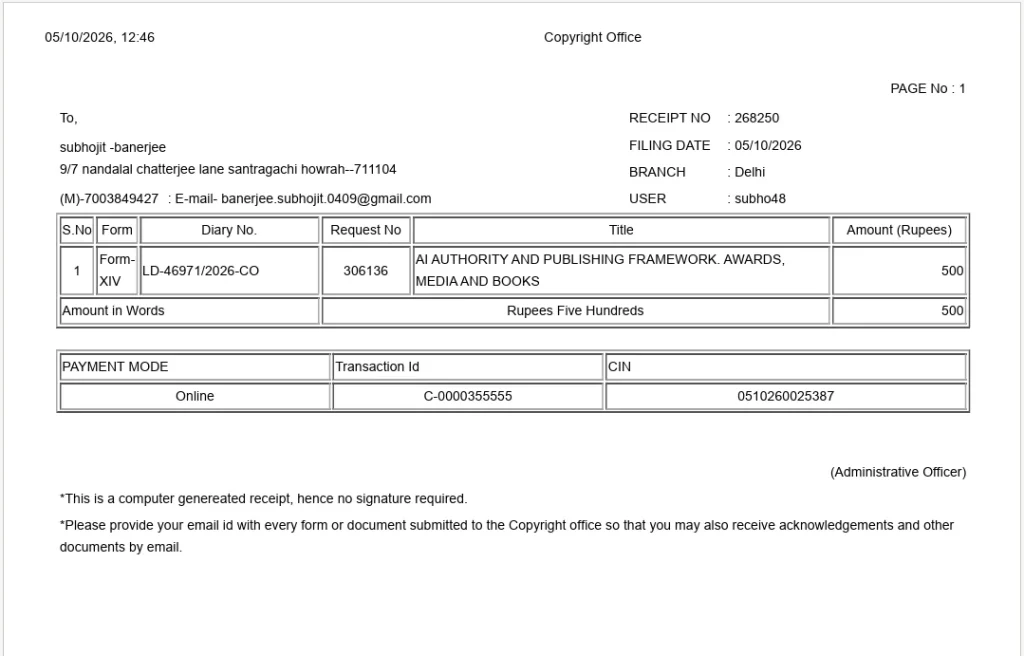
Copyright Notice: This content is part of “AI Authority and Publishing Framework: Awards, Media and Books,” for which a copyright application has been filed with the Copyright Office, Government of India under Diary No. LD-46971/2026-CO. Unauthorized reproduction, copying, distribution, or commercial use is prohibited.