SUPERCHARGE YOUR ONLINE VISIBILITY! CONTACT US AND LET’S ACHIEVE EXCELLENCE TOGETHER!
Advanced AVM Intelligence is transforming how brands measure success in AI-driven search environments. Traditional SEO metrics can reveal where a website ranks, but they often fail to explain how AI systems perceive, trust, remember, and recommend a brand. As users increasingly rely on ChatGPT, Gemini, Claude, Perplexity, and other AI platforms for answers, businesses need deeper visibility insights than rankings and traffic alone.
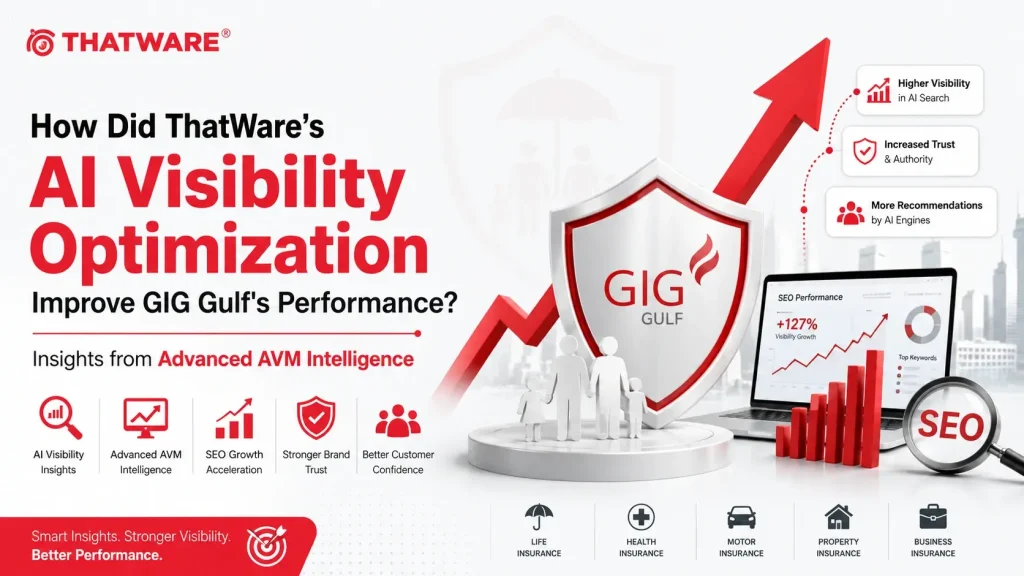
The insurance industry is experiencing this shift firsthand. Consumers are no longer searching only through traditional search engines. They are asking AI systems for recommendations, comparisons, and trusted providers. In this environment, a brand’s success depends on its ability to earn visibility within AI-generated responses.
This is where AI Visibility Metrics, AI Search Optimization, and AI Visibility Optimization become critical. Rather than focusing solely on search rankings, these methodologies evaluate how effectively AI systems discover, understand, and recommend a business across different conversational search experiences.
GIG Gulf, a recognized insurance provider, wanted to understand its position within this evolving AI ecosystem. While the brand maintained an established digital presence, questions remained regarding its performance inside AI-powered search and recommendation environments. To uncover these insights, ThatWare deployed its proprietary Advanced AVM Intelligence Framework.
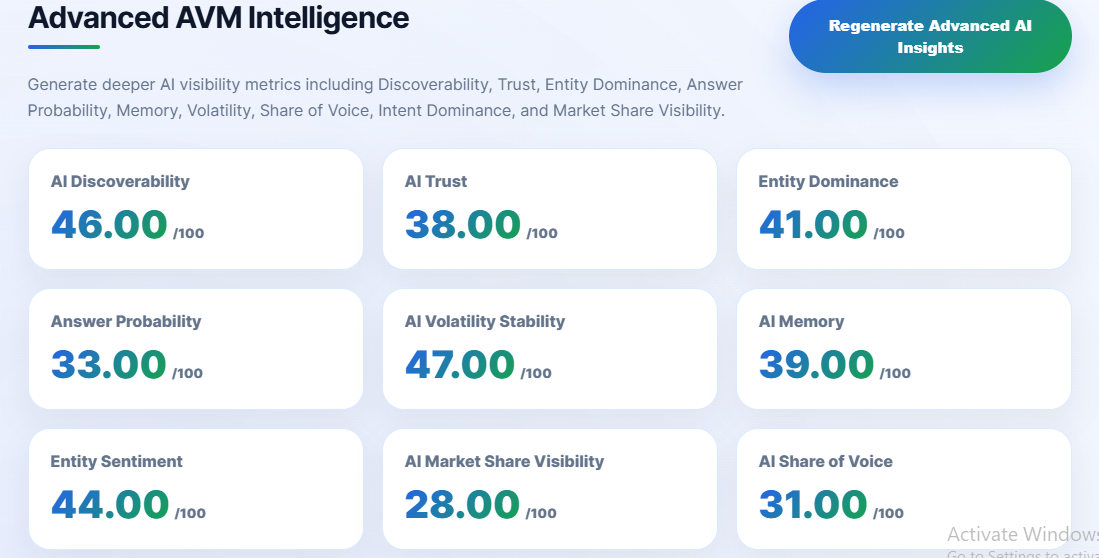
The analysis went beyond conventional SEO reporting. It examined factors such as AI Discoverability Score, AI Trust Score, Entity Dominance Score, Answer Probability Score, AI Memory Score, and AI Share of Voice. These metrics provided a clearer picture of how AI systems perceived the brand and highlighted opportunities for improvement.
The results revealed an important reality. Although GIG Gulf had visibility across the digital landscape, its ability to secure consistent AI recommendations remained limited. This case study explores how the Advanced AVM framework identified those challenges and how ThatWare’s strategic AI Visibility Optimization approach created a roadmap for stronger AI recognition, authority, and recommendation potential.
The Growing Importance of AI Visibility in The Insurance Industry
The way consumers discover insurance providers is changing rapidly. Instead of reviewing multiple websites, many users now ask AI-powered platforms direct questions about policies, providers, and coverage options.
Questions such as:
- Best insurance company for families
- Trusted health insurance provider
- Recommended insurance plans
- Reliable insurance solutions
They are increasingly being answered by AI systems.
This evolution has created a new competitive landscape. Brands must now compete not only for search rankings but also for AI-generated recommendations.
Traditional SEO can help a business become visible. However, visibility alone does not guarantee that AI systems will recommend a brand when users seek solutions.
To succeed in this new environment, businesses need strong AI brand visibility, meaningful entity recognition, trusted authority signals, and consistent recommendation potential. These factors form the foundation of modern AI Search Visibility.
The Challenge: Visibility without Recommendation Strength
Before implementing ThatWare’s optimization strategy, GIG Gulf faced a challenge that many established brands encounter in AI-driven search ecosystems.
The company had developed a respectable online presence through traditional digital marketing efforts. However, visibility within AI-generated recommendations was not performing at the same level.
The Advanced AVM Intelligence assessment revealed that AI systems recognized the brand but were not consistently positioning it among the strongest recommendations within insurance-related conversations.
This distinction is important.
Being visible and being recommended are not the same.
A brand may appear in AI-generated responses occasionally. Yet without sufficient trust signals, entity authority, and recommendation confidence, AI systems may hesitate to prioritize that brand when users request solutions or provider recommendations.
To better understand these gaps, ThatWare conducted a comprehensive evaluation using its Advanced AVM Intelligence Framework.
Advanced AVM Analysis: What The Data Revealed?
The initial assessment of the campaign uncovered several critical visibility gaps that were preventing GIG Gulf from strengthening its position within AI-driven search ecosystems.
While traditional digital signals suggested reasonable online visibility, the Advanced AVM report painted a different picture. The data revealed that AI systems could recognize the brand, but they were not consistently recommending it when users searched for insurance-related solutions.
This distinction became the foundation of the optimization strategy.
Rather than focusing solely on rankings, ThatWare concentrated on improving the signals that influence AI recommendation behavior.
AI Discoverability Analysis
One of the first metrics examined was the AI Discoverability Score.
AI Discoverability Score: 46/100
The AI Discoverability Score measures how easily AI systems can identify and surface a brand when users search through generic, non-branded queries.
This metric is especially important because future search behavior is becoming increasingly conversational.
Consumers are more likely to ask:
- Best insurance provider
- Affordable insurance company
- Trusted insurance solutions
- Insurance plans for businesses
Instead of searching for a specific brand name.
The score of 46 indicated that GIG Gulf had moderate discoverability but was not consistently appearing across broader insurance-related discussions.
Key Findings
The analysis highlighted several limitations:
- Limited visibility across generic insurance queries
- Moderate topic coverage within insurance-related discussions
- Inconsistent recommendation penetration
- Restricted category-level visibility
Although AI systems could identify the brand in some situations, discoverability remained too dependent on direct brand recognition.
ThatWare’s Optimization Strategy
To strengthen AI Discoverability, ThatWare focused on:
- Expanding insurance-focused topic clusters
- Strengthening semantic relationships
- Improving category relevance
- Enhancing entity associations
- Developing broader topical authority
This approach aimed to help AI systems connect GIG Gulf with a wider range of insurance-related conversations.
As discoverability improves, recommendation opportunities naturally increase.
AI Trust Analysis
Visibility alone does not influence recommendations. AI systems must also trust the information associated with a brand. The Advanced AVM report revealed one of the most significant opportunities for improvement.
AI Trust Score: 38/100
The AI Trust Score evaluates how much confidence AI systems place in a brand based on authority, citations, validation signals, and external references.
A score of 38 suggested that trust development required significant attention.
This does not imply negative brand perception.
Instead, it indicates that AI systems lacked enough supporting evidence to confidently position GIG Gulf as a preferred recommendation.
Key Findings
The report identified several trust-related challenges:
- Limited authority reinforcement
- Moderate citation ecosystem
- Insufficient third-party validation
- Lower recommendation confidence
- Restricted external trust signals
In AI-driven search environments, trust acts as a recommendation multiplier.
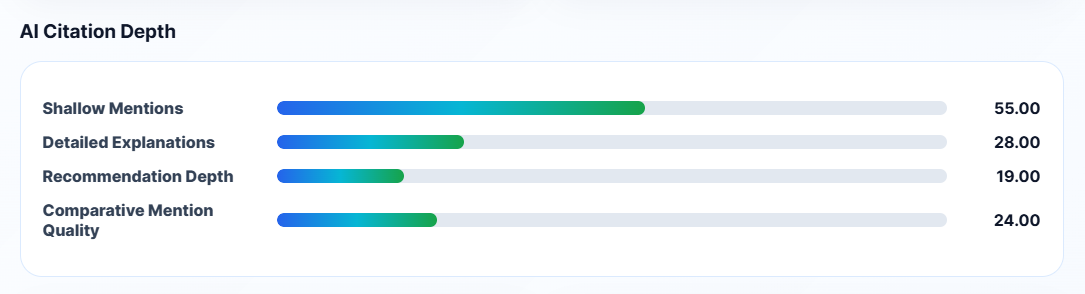
Brands supported by stronger authority signals often receive greater recommendation preference.
ThatWare’s Optimization Strategy
To improve AI Trust Score, the optimization process focused on:
- Building stronger authority content
- Expanding industry-specific expertise signals
- Strengthening credibility assets
- Improving external validation opportunities
- Enhancing trust-focused content structures
These initiatives were designed to create stronger confidence signals for AI systems evaluating insurance providers.
Entity Dominance Analysis
Another critical metric within the framework is the Entity Dominance Score.
Entity Dominance Score: 41/100
The Entity Dominance Score measures how strongly AI systems associate a brand with a specific industry, topic, or category.
In modern AI search environments, entities matter more than keywords.
AI systems increasingly organize information around relationships and contextual understanding rather than isolated search terms.
The score of 41 indicated that GIG Gulf had established recognition as an insurance-related entity, but category ownership remained limited.
Key Findings
The analysis revealed:
- Moderate semantic authority
- Limited category ownership
- Weak contextual reinforcement
- Incomplete knowledge relationships
- Opportunity for stronger insurance-topic associations
This meant AI systems recognized the brand but did not consistently associate it with leadership within the insurance sector.
ThatWare’s Optimization Strategy
ThatWare implemented several initiatives to strengthen Entity SEO and Knowledge Graph Optimization.
These included:
- Insurance-focused authority content
- Entity relationship expansion
- Semantic topic reinforcement
- Category ownership development
- Advanced Generative Engine Optimization (GEO)
- Strategic Answer Engine Optimization (AEO)
The objective was to help AI systems build stronger associations between GIG Gulf and key insurance-related topics.
As entity dominance grows, recommendation confidence typically follows.
Answer Probability Analysis
Among all Advanced AVM metrics, the Answer Probability Score is arguably the most commercially valuable.
Answer Probability Score: 33/100
This metric estimates how likely AI systems are to recommend a brand when responding to relevant user queries.
While discoverability measures whether AI can find a brand and trust measures confidence, answer probability focuses on the final outcome.
Will AI systems actually recommend the brand?
For GIG Gulf, the score of 33 highlighted a substantial opportunity for growth.
The findings suggested that AI platforms recognized the brand but were not consistently selecting it as a preferred recommendation during insurance-related searches.
Why Does This Metric Matter?
Modern consumers increasingly ask AI systems questions such as:
- Which insurance company should I choose?
- What is the best insurance provider?
- Which insurer offers reliable coverage?
- Who provides trusted insurance solutions?
These are recommendation-driven searches.
The brands appearing within these answers gain a significant competitive advantage.
Key Findings
The low score reflected several contributing factors:
- Moderate discoverability
- Weak trust signals
- Limited entity dominance
- Lower recommendation confidence
- Competitive visibility challenges
ThatWare’s Optimization Strategy
Improving AI Recommendation Probability required a comprehensive approach.
The optimization campaign focused on:
- Increasing discoverability signals
- Strengthening authority indicators
- Enhancing entity relationships
- Improving content relevance
- Expanding insurance-specific expertise coverage
- Building stronger recommendation pathways
The goal was not simply to improve visibility.
The goal was to improve the likelihood that AI systems would confidently recommend GIG Gulf when users actively sought insurance solutions.
This strategic shift from visibility to recommendation represents one of the most important developments in modern AI Visibility Optimization.
Measuring Long-Term AI Influence And Market Presence
The first phase of the Advanced AVM analysis revealed challenges related to discoverability, trust, entity strength, and recommendation probability.
However, sustainable AI visibility requires more than occasional recommendations. Brands must also achieve consistency, recognition, positive perception, and market influence.
The next layer of the Advanced AVM Intelligence Framework helped uncover how AI systems remembered, perceived, and prioritized GIG Gulf over time.
Query Intent Dominance
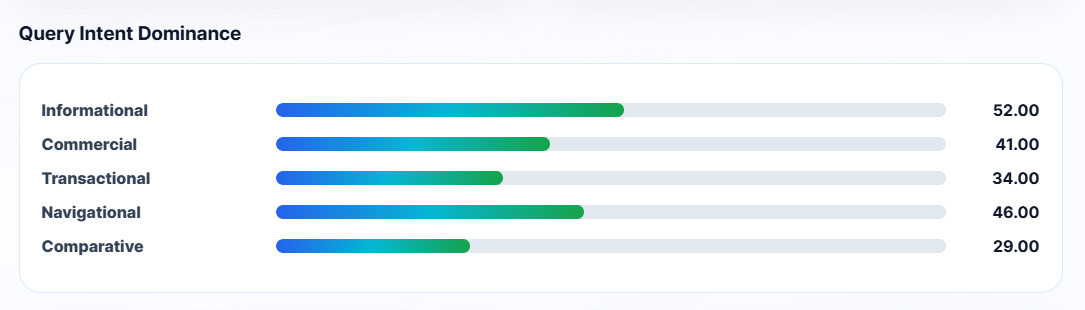
Comparative and transactional intent continue to perform the worst, while informative and navigational intent exhibit the best relative performance. This indicates that AI is more likely to bring up giggulf.ae when consumers are directly researching or learning about the brand, than when they are evaluating or selecting an insurance company.
AI Memory Analysis
AI Memory Score: 39/100
The AI Memory Score measures how consistently AI systems recognize and recall a brand across different interactions, prompts, and search scenarios.
This metric answers a critical question:
How likely is AI to remember the brand during future recommendation opportunities?
A score of 39 indicated that GIG Gulf had established some level of recognition, but memory persistence remained relatively weak.
This finding suggested that AI systems were not yet strongly associating the brand with insurance-related topics on a recurring basis.
Why AI Memory Matters?
Strong AI memory creates a compounding visibility advantage. When AI repeatedly encounters a brand within trusted contexts, associations become stronger over time.
Eventually, the brand begins appearing more frequently in generated responses. This process is similar to how consumers develop brand recognition through repeated exposure.
Key Findings
The analysis revealed:
- Limited recurring entity reinforcement
- Moderate brand recall strength
- Inconsistent category associations
- Opportunity for stronger semantic persistence
ThatWare’s Optimization Strategy
To improve AI Memory Score, ThatWare focused on:
- Consistent entity references
- Expanded topical authority
- Stronger brand-topic associations
- Improved knowledge graph relationships
- Reinforced insurance expertise signals
These efforts were designed to help AI systems develop stronger long-term recognition of GIG Gulf within insurance-related conversations.
AI Volatility Stability Analysis
AI Volatility Stability Score: 47/100
The AI Volatility Stability Score evaluates how consistently a brand maintains visibility across different AI systems, prompt structures, and recommendation scenarios.
Unlike traditional search rankings, AI-generated responses can change significantly depending on context.
A brand may appear prominently in one conversation yet disappear in another. This fluctuation creates visibility uncertainty.
For GIG Gulf, the score of 47 indicated moderate instability across AI environments.
Why Does Stability Matter?
Consistency is essential for long-term recommendation growth.
Brands that maintain stable visibility are more likely to earn trust from AI systems and remain present during future recommendation opportunities.
Strong stability often becomes a competitive advantage because AI systems prefer entities supported by consistent authority signals.
Key Findings
The report highlighted:
- Visibility fluctuations across AI interactions
- Uneven recommendation patterns
- Moderate resistance to prompt variations
- Dependence on limited authority signals
ThatWare’s Optimization Strategy
To improve stability, ThatWare concentrated on:
- Strengthening authority content
- Diversifying visibility signals
- Expanding entity validation
- Increasing semantic consistency
- Building stronger category ownership
The objective was to create a more reliable AI presence regardless of platform or search context.
Entity Sentiment Analysis
Entity Sentiment Score: 44/100
The Entity Sentiment Score measures how positively AI systems perceive and describe a brand.
This metric goes beyond visibility.
It evaluates recommendation quality.
A brand may appear frequently within AI-generated responses. However, if sentiment remains neutral, recommendation strength can still be limited.
The score of 44 indicated that AI perception of GIG Gulf remained largely neutral with opportunities for improvement.
Why Does Sentiment Matter?
Positive sentiment increases recommendation confidence.
When AI systems identify strong authority, expertise, trustworthiness, and positive contextual signals, they become more comfortable recommending a brand.
Over time, sentiment influences how prominently a company appears in AI-generated comparisons and recommendations.
Key Findings
The report revealed:
- Neutral-to-moderate perception
- Limited authority reinforcement
- Opportunity for stronger trust positioning
- Need for greater expertise recognition
ThatWare’s Optimization Strategy
To strengthen Entity Sentiment, ThatWare focused on:
- Expertise-driven content
- Authority-building initiatives
- Thought leadership development
- Stronger brand positioning
- Improved trust-oriented messaging
These improvements aimed to enhance the overall perception of GIG Gulf within AI-driven search environments.
AI Market Share Visibility Analysis
AI Market Share Visibility: 28/100
The AI Market Share Visibility metric measures how much of the AI-generated answer space belongs to a brand within its industry.
Traditional SEO focuses on rankings.
Advanced AVM focuses on ownership.
This metric helps determine how often AI systems expose users to a particular brand compared to competitors.
The score of 28 indicated that GIG Gulf had established a measurable presence but still controlled a relatively small portion of insurance-related AI visibility.
Why Market Share Visibility Matters
Every AI-generated answer creates a visibility opportunity.
The brands appearing most frequently gain greater exposure, stronger recognition, and increased recommendation potential.
Higher visibility ownership often translates into stronger market influence.
Key Findings
The report identified:
- Limited recommendation territory
- Strong competitive pressure
- Opportunities for broader category coverage
- Need for greater recommendation frequency
ThatWare’s Optimization Strategy
The optimization campaign focused on:
- Increasing category authority
- Expanding insurance topic coverage
- Improving discoverability signals
- Strengthening trust indicators
- Building broader AI visibility pathways
These initiatives were designed to increase GIG Gulf’s share of AI-generated answer space.
AI Share of Voice Analysis
AI Share of Voice: 31/100
The AI Share of Voice (AI SOV) metric measures how much of the overall AI conversation belongs to a brand compared to competitors.
This metric shifts the focus from visibility to competitive ownership.
Instead of asking whether a brand appears, it asks how much of the industry conversation it controls.
For GIG Gulf, the score of 31 demonstrated that the brand had secured a presence within AI-generated discussions but still faced significant competition from other insurance providers.
Why AI Share of Voice Matters?
Brands with higher AI Share of Voice often become category leaders within AI ecosystems.
They receive greater exposure, stronger recommendation opportunities, and increased recognition across multiple search scenarios.
As AI search continues to evolve, conversational ownership will become increasingly important.
Key Findings
The report revealed:
- Moderate conversation ownership
- Strong competitive activity
- Opportunities for greater industry influence
- Need for expanded recommendation visibility
ThatWare’s Optimization Strategy
To improve AI Share of Voice, ThatWare focused on:
- Expanding authority signals
- Strengthening category leadership
- Increasing entity visibility
- Improving AI recommendation potential
- Enhancing topical relevance across insurance-related subjects
Key Strategic Takeaways
The Advanced AVM Intelligence analysis revealed that GIG Gulf was not suffering from a complete visibility problem.
Instead, the brand faced a recommendation challenge.
AI systems could recognize the company, but several important signals required strengthening before recommendation confidence could improve.
The report highlighted opportunities to improve:
- AI Discoverability Score
- AI Trust Score
- Entity Dominance Score
- Answer Probability Score
- AI Memory Score
- AI Share of Voice
- AI Market Share Visibility
Most importantly, the analysis demonstrated why traditional SEO metrics alone cannot explain AI recommendation behavior.
Through strategic AI Visibility Optimization, AI Search Optimization, Entity SEO, Answer Engine Optimization, and Generative Engine Optimization, brands can build stronger relationships with AI systems and increase their likelihood of appearing in future recommendations.
Results: What The Advanced AVM Intelligence Report Revealed
The Advanced AVM Intelligence assessment provided a comprehensive view of GIG Gulf’s position within AI-driven search ecosystems.
While the scores indicated several growth opportunities, the report also delivered something even more valuable.
It provided a strategic roadmap.
Traditional SEO reports often focus on rankings, clicks, and traffic. However, those metrics cannot fully explain how AI systems evaluate recommendation potential.
The Advanced AVM framework exposed the exact areas that required improvement.
Key Baseline Metrics
| Advanced AVM Metric | Score |
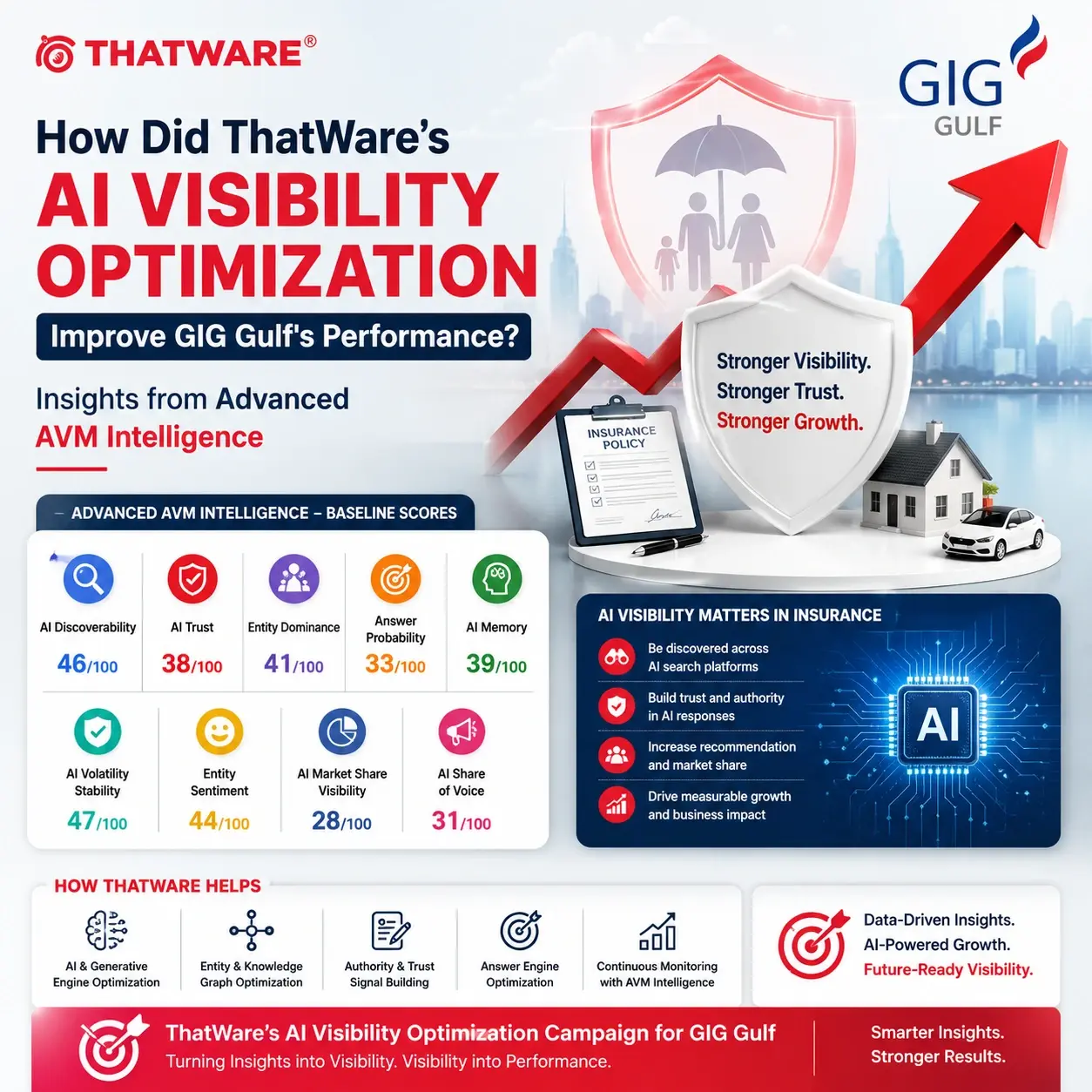
| AI Discoverability | 46/100 |
| AI Trust | 38/100 |
| Entity Dominance | 41/100 |
| Answer Probability | 33/100 |
| AI Volatility Stability | 47/100 |
| AI Memory | 39/100 |
| Entity Sentiment | 44/100 |
| AI Market Share Visibility | 28/100 |
| AI Share of Voice | 31/100 |
The report highlighted a clear pattern.
GIG Gulf had already established a digital footprint. AI systems could recognize the brand. However, recommendation confidence remained relatively low due to limitations in trust signals, entity ownership, memory persistence, and market influence.
The most significant finding was the Answer Probability Score.
At 33 out of 100, this metric revealed that AI systems were unlikely to consistently recommend the brand during insurance-related searches.
This insight became the driving force behind the optimization strategy.
Instead of focusing exclusively on visibility, ThatWare concentrated on strengthening the signals that influence AI recommendation behavior.
How Does AI Visibility Optimization Create Long-Term Growth?
One of the biggest misconceptions in modern search marketing is that visibility automatically leads to influence.
The Advanced AVM report demonstrates that this is no longer true.
In AI-driven search environments, brands must earn multiple layers of confidence before recommendations occur.
The process typically follows this sequence:
AI Discoverability
↓
AI Trust
↓
Entity Dominance
↓
Answer Probability
↓
AI Memory
↓
AI Market Influence
↓
AI Recommendation Growth
A weakness at any stage can reduce recommendation opportunities. This is why modern businesses require more than traditional SEO.
They require a structured AI Visibility Optimization strategy.
For GIG Gulf, the Advanced AVM analysis identified the exact areas where stronger authority, trust, and entity reinforcement were needed. These insights create a foundation for sustainable visibility growth within AI-powered search platforms.
Why Advanced AVM Intelligence Matters for Insurance Brands?
The insurance sector is becoming increasingly competitive within AI search environments.
Consumers are asking AI systems for:
- Insurance recommendations
- Policy comparisons
- Provider evaluations
- Coverage guidance
- Industry expertise
When AI platforms generate answers, they do not simply retrieve pages.
They evaluate entities.
Brands with stronger authority, trust, and recommendation signals gain greater exposure.
This makes metrics such as:
- AI Discoverability Score
- AI Trust Score
- Entity Dominance Score
- Answer Probability Score
- AI Memory Score
- AI Share of Voice
- AI Market Share Visibility
These are essential for future growth. The brands that understand these metrics today will be better positioned to compete tomorrow.
End Note
The future of search is no longer defined solely by rankings. AI-powered platforms are changing how consumers discover, evaluate, and choose brands. This shift requires organizations to move beyond traditional SEO metrics and embrace a more intelligent approach to visibility measurement.
Through the AI Visibility Optimization, ThatWare was able to uncover critical insights about GIG Gulf’s performance within AI-generated search ecosystems.
The analysis revealed strengths, weaknesses, and untapped opportunities across discoverability, trust, recommendation probability, memory, sentiment, and market influence.
Most importantly, it demonstrated that visibility alone is not enough. Brands must also be trusted, remembered, understood, and recommended by AI systems.
As AI search continues to evolve, businesses that invest in AI Visibility Metrics, AI Search Optimization, Entity SEO, Answer Engine Optimization, and Generative Engine Optimization will gain a significant competitive advantage.
The future winners will not simply be the brands that AI systems can see. They will be the brands that AI systems confidently recommend.