
SUPERCHARGE YOUR ONLINE VISIBILITY! CONTACT US AND LET’S ACHIEVE EXCELLENCE TOGETHER!
Search engines have become a central part of how people access information. From simple questions to complex research, users rely on them to understand topics, compare options, and make decisions. Over the years, search systems have improved significantly, moving from basic keyword matching to more advanced methods of interpreting language and context. The concept of AGIO represents the next step in this evolution. It focuses on systems that aim to understand meaning rather than just words, and deliver responses that feel more direct, complete, and useful.
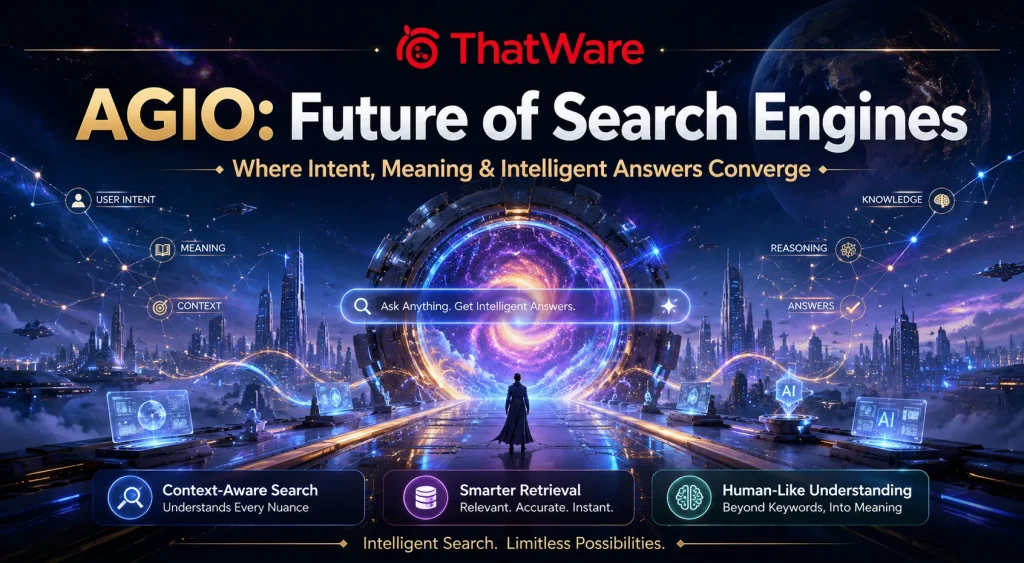
At the same time, the rise of AGI-powered search systems reflects a broader direction in technology where search is no longer just about retrieving links, but about understanding intent and providing clear, structured answers. AGIO and AGI-powered search systems share a common goal of making search more natural, more adaptive, and more aligned with how people actually think and ask questions.
The Evolution of Search
Search began as a simple process. Early systems relied heavily on matching exact words entered by a user with words found in documents. Results were ranked based on frequency and relevance signals. While this approach worked for basic queries, it struggled with complex questions or phrases that did not match content directly.
Over time, search systems improved by incorporating additional signals. These included page structure, links between pages, user behavior, and relevance patterns. These improvements made search more accurate, but the core mechanism still depended largely on matching words rather than understanding meaning.
As users began asking more complex questions, the limitations of keyword-based search became more visible. People often needed to rephrase queries multiple times or visit several pages to gather a complete answer. This created friction in the search experience.
AGIO represents a shift away from this model. Instead of focusing primarily on matching terms, it aims to interpret the intent behind a query and provide a more complete response.
Understanding AGIO in Simple Terms
AGIO can be understood as a search approach that focuses on meaning, context, and reasoning. Rather than treating each query as a collection of keywords, it tries to understand what the user is trying to achieve.
When a person enters a question, the words alone may not fully explain the intent. AGIO systems attempt to interpret the underlying goal behind the query. This allows them to deliver responses that are more aligned with what the user actually needs.
For example, if a user asks a question that involves comparison, explanation, or decision making, AGIO systems can organize information in a way that directly addresses those needs. Instead of listing multiple sources, they can provide a structured explanation that combines relevant points into a single response.
AGIO also aligns closely with the development of AGI-powered search systems, which aim to handle a wide range of tasks across different domains without being limited to a single type of query or subject.
From Keywords to Meaning
One of the most important changes introduced by AGIO is the shift from keywords to meaning. Traditional systems focus on matching words in a query with words in content. AGIO systems focus on understanding what those words represent.
This means that the system tries to interpret:
- What the user is asking
- Why the user is asking it
- What kind of answer is expected
- How the information should be presented
This shift allows the system to handle queries that may be vague, incomplete, or expressed in natural language. Users no longer need to adjust their queries to fit specific formats. Instead, they can ask questions in a more natural way.
AGI-powered search systems take this idea further by aiming to apply understanding across different types of problems and topics. They are designed to handle a wide range of queries with consistent reasoning, rather than being limited to predefined categories.
The Role of Context
Context is a key element in AGIO. A query does not exist in isolation. It is shaped by previous interactions, user behavior, location, and the situation in which the question is asked. Without context, many queries can appear vague or open to multiple interpretations. With context, the meaning of a query becomes clearer, allowing the system to respond in a more relevant and helpful way.
AGIO systems aim to use context to improve the quality of responses by connecting related interactions over time. This includes understanding follow-up questions, recognizing patterns in a conversation, and maintaining continuity between queries. Instead of treating each search as a separate event, the system views them as part of an ongoing exchange. This helps create a smoother experience for the user.
For example, if a user asks a general question and then follows up with a more specific one, the system can relate the second question to the first. The response can then build on the earlier context rather than starting from scratch. This creates a more natural flow of interaction, similar to a conversation rather than a sequence of unrelated searches.
Context also plays an important role in resolving ambiguity. Many words and phrases can have multiple meanings depending on how they are used. By considering the surrounding context, AGIO systems can choose the most appropriate interpretation and avoid misunderstandings.
AGI-powered search systems rely heavily on context awareness because it allows them to maintain continuity, interpret intent more accurately, and deliver responses that better match what the user is trying to achieve across different situations.
Moving Toward Direct Answers
Traditional search engines often return a list of links. Users then need to open multiple pages to find the information they need. AGIO changes this approach by focusing on delivering direct answers.
Instead of presenting a collection of sources, AGIO systems aim to summarize and organize information into a single response. This reduces the need for users to navigate through multiple pages and compare information manually.
Direct answers are especially useful for complex queries that involve multiple aspects. For example, a user may ask a question that requires explanation, comparison, and examples. AGIO systems can combine these elements into one structured response.
AGI-powered search systems follow a similar direction, aiming to provide complete responses that address the full scope of a query rather than fragments of information.
Handling Complex and Multi-Part Queries
Many real-world questions are not simple. They often involve multiple parts, dependencies, or conditions. Traditional search systems require users to break these questions into smaller queries.
AGIO systems are designed to handle such complexity more effectively. They can interpret multi-part questions and provide responses that cover each component in a structured way.
For example, a user planning a project may need information on timelines, resources, risks, and best practices. Instead of searching for each of these separately, AGIO systems can bring together relevant information and present it as a cohesive answer.
AGI-powered search systems aim to extend this capability further by handling a wide variety of complex tasks across domains, allowing users to rely on a single system for different types of questions.
Multimodal Understanding
Search is no longer limited to text. Users interact with systems using images, voice, and other forms of input. AGIO systems aim to understand and process multiple types of data.
This multimodal capability allows users to search in different ways depending on the situation. For example, a user might upload an image and ask a question about it, or speak a query instead of typing it.
AGIO systems can interpret these inputs and relate them to relevant information. This creates a more flexible and accessible search experience.
AGI-powered search systems also incorporate multimodal understanding as part of their broader goal of handling diverse types of information in a unified way.
Impact on Search Experience
The introduction of AGIO changes the overall experience of search in several important ways.
First, it reduces the effort required to find information. Users no longer need to refine queries repeatedly or visit multiple sources to gather answers.
Second, it improves clarity. Responses are structured and organized, making it easier to understand complex topics.
Third, it creates a more natural interaction model. Users can ask questions in plain language without needing to adjust their phrasing.
Fourth, it supports deeper exploration. Follow-up questions can be asked within the same context, allowing users to build on previous responses.
AGI-powered search systems contribute to these improvements by aiming to provide consistent reasoning and adaptability across different types of queries.
Implications for Content Creation
As search evolves, the way content is created also changes. In traditional search, content is often written with a focus on keywords and ranking signals. Pages are structured to target specific search terms.
With AGIO, the focus shifts toward clarity, usefulness, and completeness. Content that explains topics in a clear and structured way becomes more valuable.
Content creators may need to consider:
- Answering questions directly and clearly
- Organizing information in logical sections
- Covering topics in depth rather than repeating phrases
- Addressing user intent rather than just targeting keywords
This approach aligns with the way AGIO systems interpret and present information. AGI-powered search systems tend to favor content that provides meaningful explanations and well-structured insights.
Role in Decision Making
Search is often used to support decision making. People use it to compare options, evaluate choices, and understand trade-offs.
AGIO improves this process by organizing information in a way that supports comparison and reasoning. Instead of presenting isolated pieces of information, it brings together relevant details into a coherent response.
This helps users understand different aspects of a topic more easily. Whether it involves selecting a product, planning a project, or researching a subject, AGIO systems provide a clearer view of the available information.
AGI-powered search systems extend this capability by applying consistent reasoning across different domains, helping users navigate complex decisions with greater clarity.
Challenges in Development
Despite its potential, AGIO faces several challenges. Building systems that can understand meaning, interpret intent, and deliver accurate responses requires careful design and significant resources.
Some of the main challenges include:
- Ensuring accuracy and reliability of responses
- Handling unclear or ambiguous queries
- Managing large and diverse datasets
- Maintaining consistency across different types of questions
- Balancing depth of explanation with response speed
Another important challenge is validation. Since AGIO systems generate responses based on patterns and information, there must be ways to verify that the information provided is correct and trustworthy.
AGI-powered search systems face similar challenges, especially as they attempt to operate across a wide range of topics and use cases.
Trust and Reliability
Trust is a key factor in search. Users rely on search systems to provide accurate and useful information. If the responses are inconsistent or unclear, it can affect user confidence.
AGIO systems must focus on delivering reliable information. This includes using credible sources, maintaining consistency in responses, and presenting information in a clear manner.
Transparency is also important. Users benefit from understanding how information is presented and what sources support it. This helps build confidence in the system.
AGI-powered search systems place similar emphasis on reliability, as their effectiveness depends on the quality and consistency of the information they provide.
The Future of Search with AGIO
AGIO points toward a future where search becomes more interactive, adaptive, and aligned with human communication. Instead of entering short queries and scanning lists of results, users will engage in more natural interactions.
Search may become integrated into everyday tools and workflows. It may assist users continuously rather than acting as a separate destination.
In this future, search systems will not only retrieve information but also help interpret, organize, and explain it. AGI-powered search systems are often seen as part of this direction, as they aim to handle a wide range of tasks with consistent understanding and reasoning.
Our Role at ThatWare
At ThatWare, we work closely with the evolving landscape of AGIO by focusing on how search systems interpret intent, context, and user behavior in real-world scenarios. Our approach is centered on building search experiences that move beyond simple keyword matching and instead prioritize meaningful connections between queries and content. We design our strategies to align with how AGIO-based systems evaluate relevance, emphasizing structured information, clear explanations, and context-aware content. By doing so, we aim to help businesses adapt to this shift in search, where understanding the user’s purpose becomes more important than targeting isolated terms.
Conclusion
AGIO represents a significant shift in the way search engines operate. It moves beyond keyword matching and focuses on understanding intent, context, and meaning. By delivering direct, structured responses, it changes how users interact with information.
This approach improves clarity, reduces effort, and supports more natural interactions. It also influences how content is created, how decisions are made, and how information is organized.
AGI-powered search systems further expand this vision by aiming to apply understanding across a wide range of domains and tasks. While challenges remain, the direction of search is clear. It is moving toward systems that understand questions more deeply and provide answers in a way that is easier to use, easier to understand, and more closely aligned with human thinking.