
SUPERCHARGE YOUR ONLINE VISIBILITY! CONTACT US AND LET’S ACHIEVE EXCELLENCE TOGETHER!
AI visibility changes at the prompt level. A brand may appear strongly for one commercial question, disappear for a closely related wording and return in a different position when the user asks for a comparison. AI prompt tracking turns those individual answers into a repeatable monitoring system instead of a collection of screenshots.
| Prompt tracking is an AVM application ThatWare uses AVM as the measurement layer for prompt tracking. The service monitors a defined prompt portfolio and evaluates the resulting evidence through AVM dimensions. It should not be presented as a separate prompt framework. |
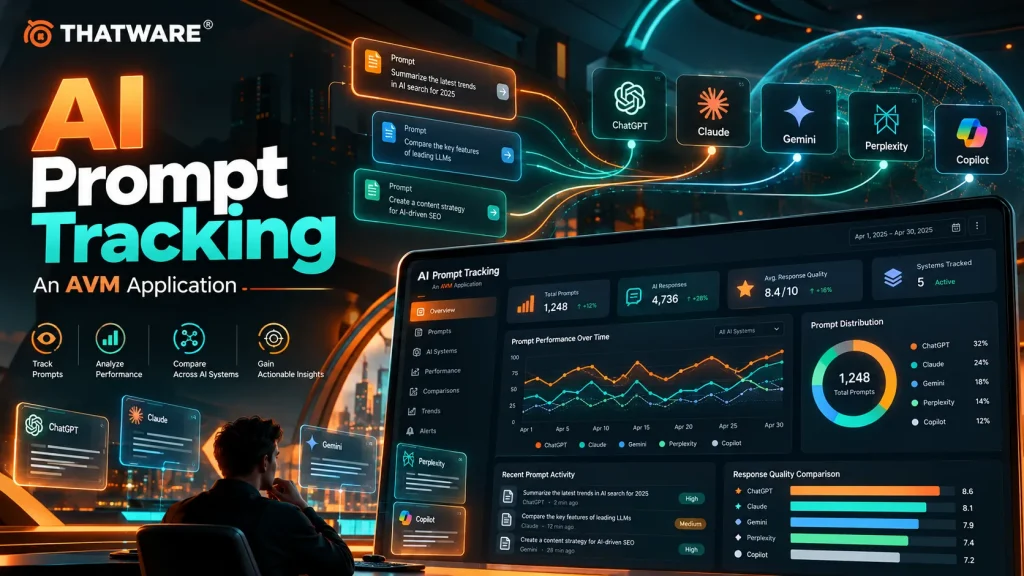
What Is AI Prompt Tracking?
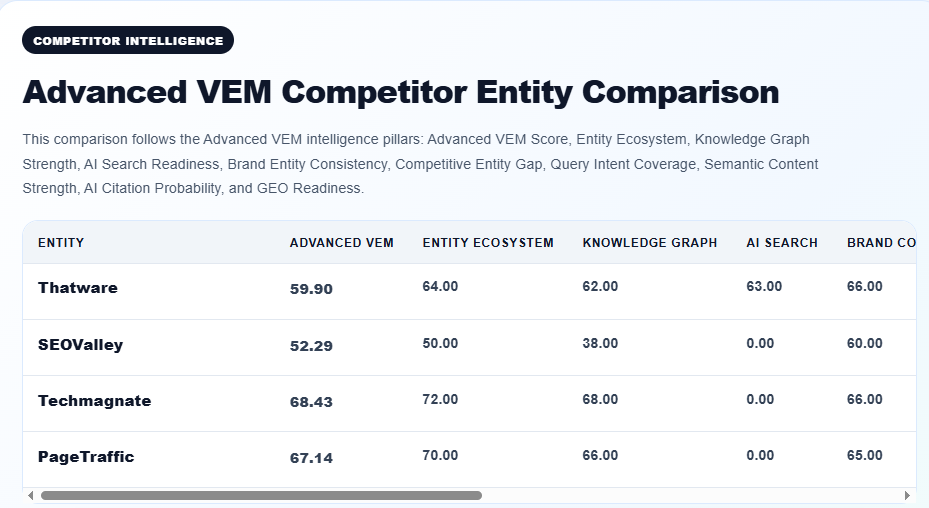
Published query-level AVM example reconstructed as a source-page reference capture.
AI prompt tracking is the repeated monitoring of high-value questions across selected AI environments. Each prompt is treated as a measurement unit. The system records whether the brand appears, where it appears, whether citations are present, which sources support the answer, how competitors perform and how the result changes over time.
This matters because generative discovery is conversational. Buyers do not always use a fixed keyword. They ask questions, refine them, compare options and add context. A useful monitoring program therefore tracks prompt families and intent groups rather than relying on one exact phrase.
AI prompt tracking helps brands observe how their visibility changes when buyers modify wording, intent, context, or commercial requirements.
Why Prompt Tracking Matters for Commercial Visibility
- Identify high-value prompts where the brand is consistently absent.
- See whether visibility depends on branded wording or extends to non-branded discovery.
- Monitor position changes in recommendation and comparison answers.
- Track citations and source changes around important prompts.
- Compare competitors on exactly the same questions.
- Detect volatility before a quarterly report hides the underlying prompt-level movement.
Prompt visibility monitoring helps identify important questions where competitors appear consistently while the target brand remains absent or poorly positioned.
The Prompt Portfolio: The Foundation of Good Tracking
The most important decision is not the dashboard. It is the query set. A prompt portfolio should represent how real buyers discover, evaluate and choose. That includes informational prompts for learning, commercial prompts for vendor discovery, comparative prompts for shortlisting, transactional prompts for action and branded prompts for validation. AI query tracking treats individual questions as measurable observations, allowing teams to monitor brand presence across changing conversational search behavior.
Branded Prompts
Useful for checking recognition, description accuracy and branded validation. They should not dominate the set because they can overstate discoverability. Brand prompt tracking helps measure whether AI systems describe the company accurately when users directly search for its identity and offerings.
Non-Branded Discovery Prompts
These test whether AI systems connect the brand to the category even when the user does not already know the company name. AI prompt monitoring makes these changes easier to identify by observing recurring questions across defined markets, providers, and buyer intents.
Commercial Prompts
Questions such as best provider, recommended agency, enterprise solution or specialist service test whether the brand enters a real buying conversation. A focused prompt visibility monitoring program can separate stable measurement prompts from experimental questions introduced as markets and buyer needs evolve.
Comparative Prompts
Versus, alternatives and shortlist questions reveal whether the brand can compete when AI systems must differentiate between entities. LLM prompt tracking can organize these variations around intent families, helping teams understand how different question formulations affect brand visibility.
Transactional Prompts
Assessment, audit, pricing-context, consultation and service-intent prompts test visibility close to action.
How AVM Measures Prompt Performance
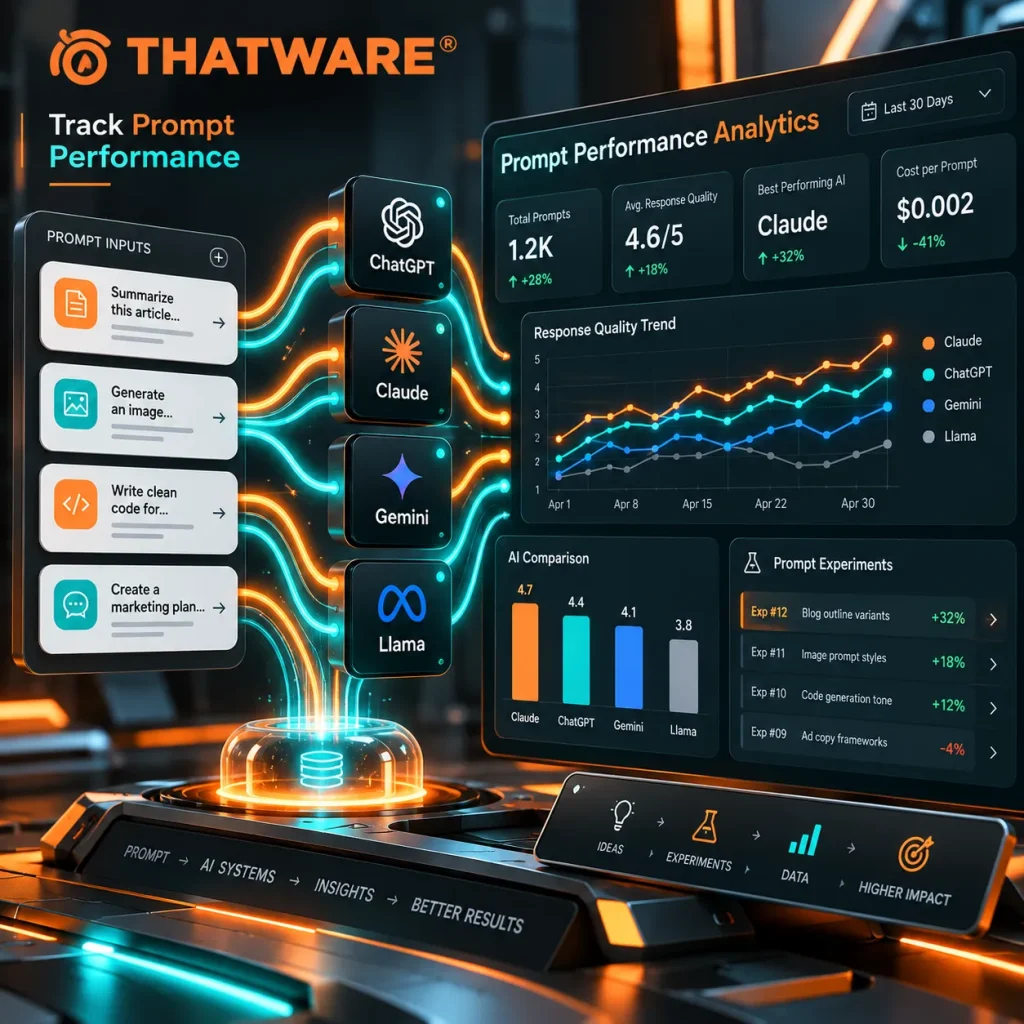
For each tracked prompt, AVM can organize evidence around presence, citation, authority, consistency and position. This avoids the weakness of a binary yes-or-no tracker. Two prompts may both mention the brand, yet one can have stronger source support and a much better recommendation position.
What We Track Per Prompt
- Whether the target brand is mentioned.
- Where the brand appears in the answer or recommendation structure.
- Which competitors are mentioned and in what relative position.
- What citations or sources support the answer.
- Whether the description of the brand is accurate and consistent.
- Provider-specific differences for the same prompt.
- Change from the previous measurement cycle.
ChatGPT prompt tracking can provide provider-specific evidence when brands need to understand how recommendations change within conversational search experiences.
The AI Prompt Tracking Workflow
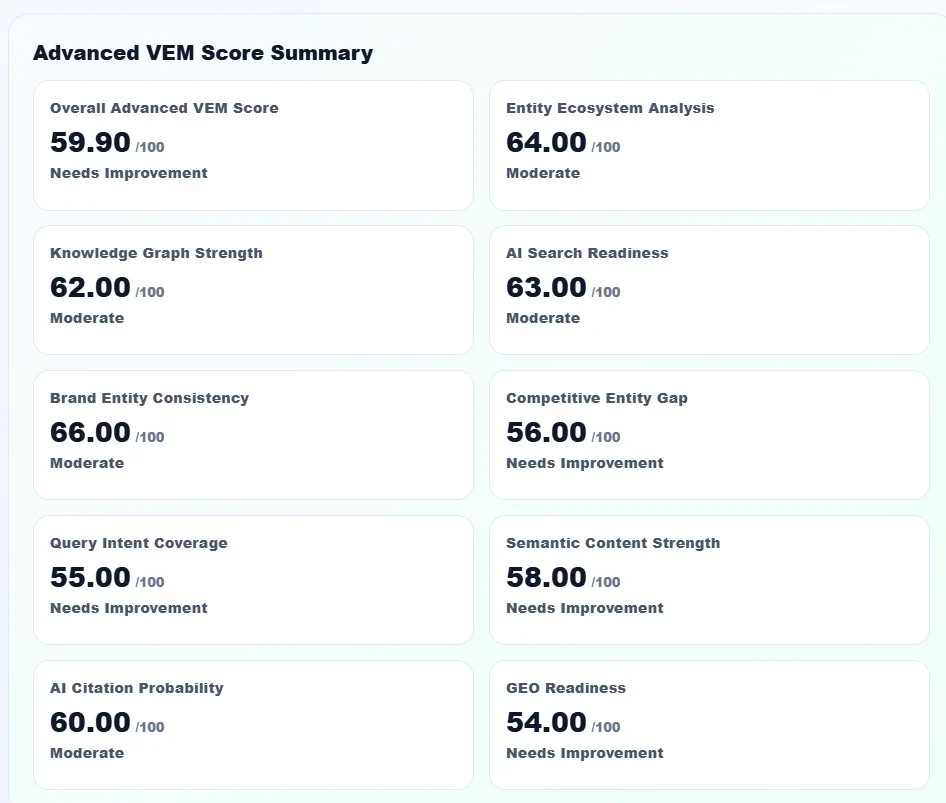
ThatWare Labs materials explicitly include generative query monitoring as a future-facing application area.
- Define commercial goals and the categories that influence revenue.
- Build prompt families that reflect buyer language and intent stages.
- Set the provider, geography, language and competitor scope.
- Capture and normalize prompt-level responses on the agreed cadence.
- Score and interpret visibility using AVM evidence.
- Flag meaningful changes such as new mentions, lost visibility, position movement, citation shifts or competitor gains.
- Feed the findings into content, GEO, PR and entity optimization priorities.
An AI prompt tracker should capture both the brand result and the evidence surrounding each answer, rather than recording mentions alone.
What You Receive
- Tracked prompt library organized by intent, topic and business priority.
- Prompt-level visibility matrix for the target brand and competitors.
- AVM evidence for presence, citations, authority, consistency and position.
- Provider comparison for prompts included in the monitoring scope.
- Change log highlighting new wins, losses and volatility.
- Citation/source observations linked to individual prompts.
- Action recommendations tied to the prompts that have the highest commercial value.
Prompt Tracking vs Keyword Rank Tracking
Rank tracking asks where a page appears on a search results page for a keyword. Prompt tracking asks how a brand is represented inside a generated answer for a question. The answer can contain several brands, no explicit ranking, external citations and provider-specific synthesis. The two measurement systems are complementary, not interchangeable. An effective AI prompt tracking service can standardize measurement conditions while keeping prompt families aligned with changing buyer behavior.
How to Use Prompt Tracking Data
Prompt data is most valuable when it changes what the team does next. A missing non-branded prompt may point to weak category content. A competitor repeatedly supported by the same publication may point to a digital PR opportunity. An unstable brand description may indicate an entity-consistency problem. A good monitoring program connects each signal to a plausible action and then measures again.
Where VEM Fits
If prompt tracking reveals inconsistent naming, weak topical association or fragmented entity descriptions, VEM can help investigate the underlying entity foundation. The monitoring service remains an AVM application; VEM is the complementary diagnosis when the issue appears structural.
Measurement Boundaries
AI outputs can vary even when a prompt is repeated. Provider interfaces can also differ from API or search endpoints. The goal is therefore not to claim a permanent rank. The goal is to create a consistent sampling method, document the conditions and identify durable patterns across repeated observations. When interpreted consistently, AI prompt tracking can reveal recurring visibility patterns that guide content, GEO, PR, and entity optimization decisions.
| Track the Prompts That Influence Buyer Decisions Build a focused prompt portfolio, measure how your brand performs across the answer environment and turn visibility changes into specific SEO, GEO, PR and content actions. |
Design a Prompt Portfolio That Reflects Real Search Behavior
The quality of an AI prompt tracking program depends more on the prompt portfolio than on the dashboard. A list of random questions can generate interesting screenshots but weak business insight. The portfolio should be designed around the problems, decisions and language that real buyers use throughout the journey. That means combining discovery questions, educational questions, comparisons, recommendations, brand validation and action-oriented prompts.
Prompt families are especially important. Users rarely ask the same question with identical wording. They may change the location, business size, use case, budget, industry or level of expertise. Tracking several variations of the same intent helps reveal whether the brand has a stable association with the topic or appears only when the wording is favorable. It also reduces the risk of treating one unusual response as a strategic trend.
A strong portfolio can include a core set that remains stable for longitudinal measurement and an experimental set that changes as the market evolves. The stable set protects comparability. The experimental set lets the team explore emerging services, new competitor language, product launches and newly important buyer questions.
Track More Than Whether the Brand Appears
Binary mention tracking is not enough. Two answers can both mention the brand but have very different commercial value. One may recommend the company first and support the recommendation with authoritative sources. Another may mention it briefly at the end of a long list with no evidence. AVM gives the prompt tracker a way to record that difference. Effective AI prompt tracking looks beyond mentions by connecting brand presence with position, citations, competitors, and supporting evidence.
For each prompt, the analysis should capture presence, position, citations, source authority, consistency and relevant competitor appearances. It should also record the prompt type, provider, market, language, date and model context where possible. These fields make it possible to compare results over time without losing the conditions that produced them. A capable AI prompt tracker can retain provider, market, language, date, prompt type, citations, and competitor information for each observation.
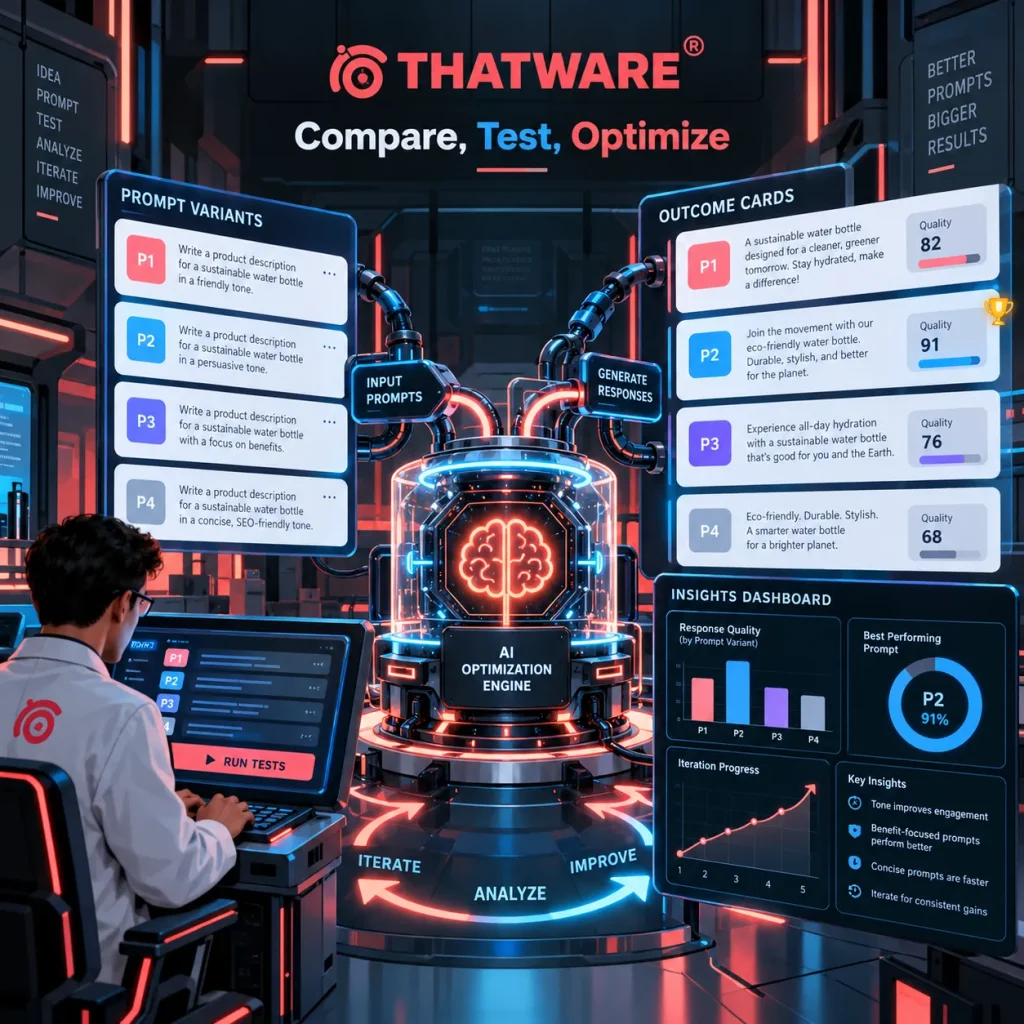
The tracker can then aggregate patterns by prompt family. This shows whether a brand is strong in informational questions but weak in commercial ones, whether it appears consistently across providers, whether citations are improving and whether competitors are moving into the same answer space. The prompt remains the atomic unit, but the strategic value comes from the patterns across the portfolio. With LLM prompt tracking, teams can compare recurring prompt families while preserving provider, market, language, and measurement context.
Separate Stable Signals From Answer Volatility
Generative answers can vary. A prompt may return different wording or brand order across runs, especially when the system has multiple plausible sources or the question is broad. Prompt tracking should therefore distinguish between stable signals and volatile observations. A single missing mention should not automatically trigger a major strategic conclusion. Repeated absence across related prompts and repeated measurement is much more meaningful. Generative AI prompt monitoring helps teams identify recurring patterns without assuming that every individual answer represents a permanent visibility change.
The same principle applies to positive results. One top recommendation can be encouraging, but a reliable pattern across several commercial prompts is stronger evidence. Tracking programs should therefore use repeated observations where appropriate and summarize results at the prompt-family level. The report can flag unstable prompts so decision-makers know where more evidence is needed.
This is also why the methodology should retain confidence or evidence-quality context. A result based on a narrow sample should be interpreted differently from a pattern observed across multiple providers and related prompts. The goal is disciplined monitoring, not false certainty.
Build Prompt Sets Around Commercial Decisions
For buyer-intent tracking, the most valuable prompts are often those that force the AI system to move beyond explanation and make a selection. Examples include requests for the best provider, a shortlist for a particular use case, alternatives to a known company, a comparison between approaches, or a recommendation for a specific location or industry. These prompts reveal whether the brand enters the consideration set.
Transactional prompts can go further by testing visibility near action. A buyer might ask where to request an audit, which agency offers a particular service, how to compare providers, or who can support a complex implementation. If the brand is absent from these questions despite ranking well traditionally, the gap can be commercially significant. AI search prompt tracking can reveal whether a brand enters consideration when users ask recommendation, comparison, alternative, or provider-selection questions.
Prompt tracking should therefore be linked to the site’s conversion architecture. Priority service pages, solution pages, location pages and high-value offers should each have corresponding prompt families. This creates a direct line between the measurement program and the parts of the site that the business most wants to grow.
Use Prompt-Level Data to Guide Content Strategy
Prompt tracking can reveal content gaps that keyword research alone may not show. If buyers repeatedly ask comparison or decision questions and the brand has no clear page addressing them, the tracker can identify that mismatch. If AI systems describe a service incorrectly, the site may need clearer definitions, examples or scope. If a product is absent from use-case prompts, supporting content may not connect the product strongly enough with the problem it solves. Through AI search prompt tracking, teams can identify content gaps that traditional keyword research may not reveal across conversational discovery. AI query tracking can expose recurring information gaps when users ask questions that existing pages fail to answer clearly.
The data can also help prioritize existing content updates. Pages that rank well but do not appear in AI answers may need stronger factual structure, clearer entity references, better internal linking, more specific examples or better source-worthiness. Pages that are already cited may need to be expanded to cover adjacent prompts. Expert-led pages can be strengthened around recurring questions where authority matters.
The objective is not to create a separate page for every prompt. It is to use the prompt portfolio as a demand map, then build coherent topic coverage that answers families of related questions while reinforcing the brand’s entity and expertise.
Connect Prompt Tracking With Citation and Competitor Evidence
A prompt is more useful when the tracker records the surrounding answer environment. Which competitors were mentioned? Which sources were cited? Did the model rely on owned content, a third-party publisher, a directory, a review platform or a research source? Did the same competitor appear across several prompt variations? These observations help explain why visibility changes. With ChatGPT prompt tracking, teams can examine which sources and competitors repeatedly influence answers to important commercial questions.
For example, if a competitor begins appearing across a group of commercial prompts and the same new industry article is repeatedly cited, that source may be part of the visibility shift. If the target brand appears but is consistently placed later than competitors, the issue may be comparative evidence rather than basic discoverability. If descriptions vary across providers, entity consistency may be involved. AI search prompt tracking becomes more informative when every observed answer is connected with citations, competitors, and surrounding source evidence.
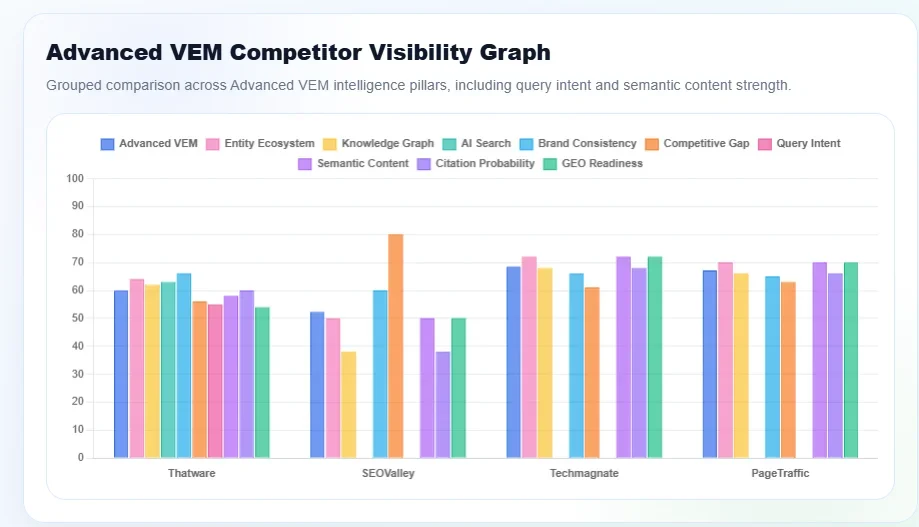
This makes prompt tracking a foundation for other AVM applications. The same data can support citation tracking, share-of-voice analysis and competitor visibility benchmarking. The applications remain distinct because they answer different buyer questions, but they can share a disciplined evidence base.
Establish a Monitoring Cadence That Matches the Market
Prompt tracking should be frequent enough to catch meaningful change, but not so frequent that teams overreact to normal variation. The right cadence depends on the market. Fast-moving technology, AI and software categories may need more frequent checks because providers, sources and competitors change quickly. Stable professional-service categories may be better served by a monthly or quarterly review combined with targeted checks around major launches. Consistent AI prompt monitoring helps distinguish meaningful visibility changes from temporary fluctuations within dynamic answer environments. A consistent AI query tracking process creates comparable observations while allowing teams to account for market and provider changes.
The core prompt set should remain stable between measurement periods so trend comparisons are valid. New prompts can be added, but additions should be labeled so they do not distort historical averages. Competitor changes, provider changes and market changes should also be documented. This creates an audit trail that makes the reporting more defensible. A disciplined generative AI prompt monitoring program can adapt measurement frequency according to category volatility and commercial importance.
The cadence can be tied to action cycles. Measure the baseline, implement a defined set of improvements, allow time for the information environment to change, then remeasure. This produces more useful learning than checking constantly without a clear hypothesis or intervention.
Build Reporting for Different Teams
An executive needs a concise view of whether AI visibility is improving across high-value prompts. An SEO strategist needs the prompt-level breakdown. A content team needs topic and question gaps. A PR team needs the source and citation patterns. A product marketer needs to know whether priority capabilities are appearing in recommendation contexts. Prompt tracking should support all of these views without forcing every stakeholder to read raw transcripts.
A useful report can therefore include an executive trend summary, a prompt-family scorecard, provider comparison, competitor presence, citation-source observations, unstable prompt flags and a prioritized action list. The raw evidence should remain available for analysts, but it should not overwhelm the main narrative.
This layered reporting helps the organization treat AI visibility as an operational discipline. Teams can assign actions to the exact prompt clusters that matter, then review whether the subsequent evidence changed.
Use VEM When Prompt Volatility Points to Entity Problems
If the brand appears inconsistently across closely related prompts, the issue may not be the prompt itself. AI systems may be encountering conflicting descriptions, unclear relationships between the brand and its services, outdated external profiles or weak associations between the entity and the topic. VEM can support the investigation by examining the entity foundation beneath the prompt-level behavior. Brand prompt tracking can surface entity inconsistencies when closely related questions produce conflicting descriptions or associations.
The review can look at aliases, organization facts, service relationships, product naming, founder and expert references, schema, structured data, knowledge graph signals and the consistency of external descriptions. When these elements are aligned, the brand becomes easier to resolve across different query phrasings and contexts.
VEM does not replace prompt tracking. AVM still records the observable answer behavior. VEM helps explain whether entity clarity may be contributing to unstable or inaccurate results, allowing the optimization plan to address the cause rather than repeatedly rewriting prompts.
What Buyers Should Expect From an AI Prompt Tracking Service
A serious service should help design the prompt portfolio, not simply accept a list and run it. It should document the market, language, providers, intent categories and competitor set. It should retain prompt-level evidence, separate branded from non-branded discovery, capture position and citations, and make changes over time visible. It should also explain how it handles answer variability and how new prompts are introduced without breaking the baseline. A capable AI prompt tracking service should connect commercial objectives with prompt selection, provider coverage, evidence collection, and actionable reporting.
The service should not imply that one prompt result represents every user’s experience or that exact answers can be guaranteed. AI systems are dynamic, and sampled monitoring has limitations. The value lies in repeated, structured observation under consistent conditions.
ThatWare’s AVM methodology provides that structure. AI Prompt Tracking is an application of AVM that turns conversational queries into a measurable portfolio, allowing brands to see where they appear, where they disappear, which competitors occupy the answer, what evidence supports the result and what should be improved next.
| Methodology boundary AVM is presented as ThatWare’s proprietary diagnostic methodology, not as an official score issued or endorsed by OpenAI, Anthropic, xAI, Perplexity, Google or another platform. Results should be interpreted as sampled evidence within a defined query, provider, market and time context. |