
SUPERCHARGE YOUR ONLINE VISIBILITY! CONTACT US AND LET’S ACHIEVE EXCELLENCE TOGETHER!
A brand mention is useful. A brand mention supported by credible evidence is more valuable. AI citation tracking shows which sources are being used around your brand, how consistently those sources appear and where competitors are earning stronger citation support in the same discovery environment.
| Citation tracking is an AVM applicationThatWare does not position AI Citation Tracking as a separate proprietary framework. It applies the citation dimension of AVM, together with presence, authority, consistency and position, to a focused buyer-intent monitoring service. |
What Is AI Citation Tracking?
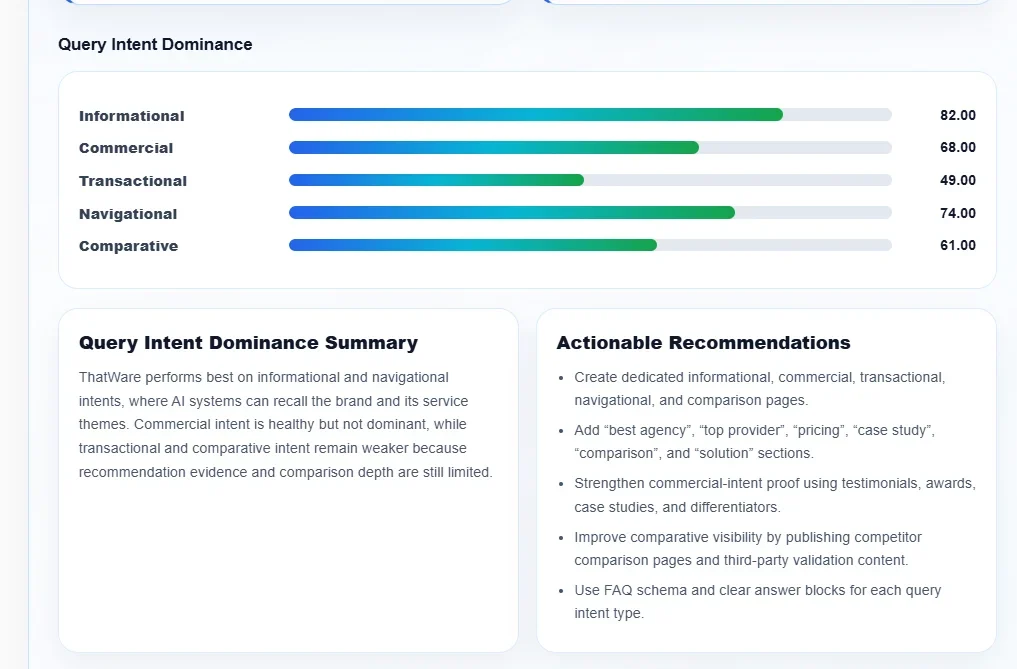
AVM places citation beside presence, authority, consistency and position, rather than treating citations as an isolated metric.
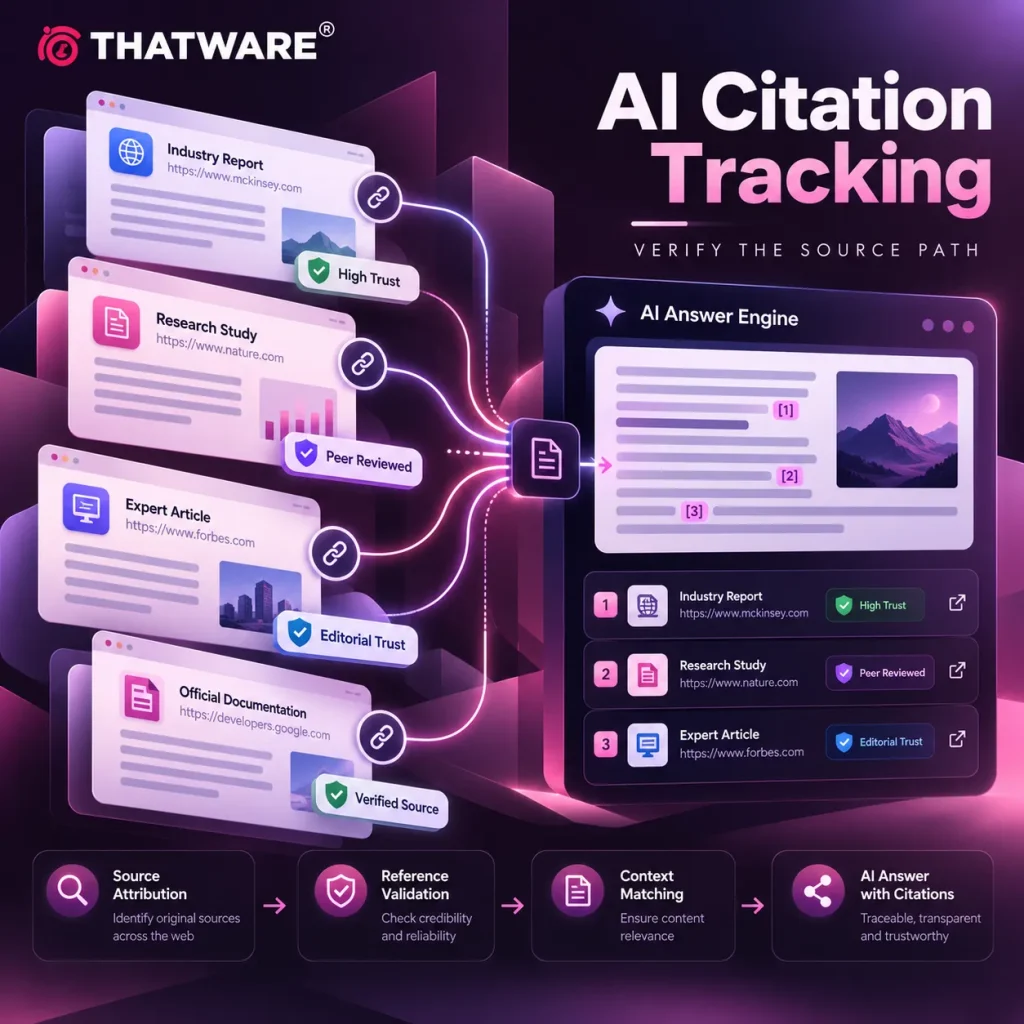
AI citation tracking is the process of monitoring source references connected to a brand across a defined set of AI prompts. The work goes beyond counting links. It asks which domains appear, what claims they support, whether the citations are authoritative, whether the same evidence recurs across providers and whether competitors are benefiting from sources where your brand is absent.
This matters because AI-generated answers can rely on a mixture of owned pages, third-party editorial coverage, directories, documentation, research, reviews and other retrievable sources. Citation analysis gives marketing, SEO and PR teams a common evidence layer for deciding what should be strengthened.
Why Citation Visibility Matters
- A citation can reinforce the factual basis for a brand mention or recommendation.
- Repeated third-party references can reveal which sources AI systems repeatedly surface around a topic.
- Competitor citations expose authority gaps that conventional rank tracking may miss.
- Citation patterns can show whether owned content is discoverable or whether the market is being defined by external sources.
- Source quality helps separate a passing mention from evidence-backed visibility.
How AVM Frames Citation Analysis
AVM treats citation as one of five core visibility dimensions. That prevents a common mistake: assuming that more citations automatically mean stronger AI visibility. A brand can be cited often but still have weak presence across commercial prompts, inconsistent representation or poor positioning in recommendation answers. Citation tracking is most useful when it remains connected to the full AVM context.
Citation Frequency
How often is source evidence attached to answers where the brand appears? Frequency helps identify recurring evidence patterns, but it should not be interpreted without source quality and query context.
Citation Quality and Authority
Which domains are being used, and how credible are they for the topic? Industry publications, respected research, specialist documentation and strong first-party resources can carry different strategic value from generic mentions.
Citation Relevance
Does the source actually support the claim being made about the brand? A citation near the brand name is not automatically proof that the source validates the specific service, expertise or recommendation context.
Cross-Provider Citation Consistency
Do the same sources recur across different AI environments, or is visibility dependent on a single provider? Repeated source patterns can help prioritize where authority-building work may have the greatest value.
Competitive Citation Gaps
Which publishers, directories, research assets or reference pages are strengthening competitor visibility while your brand remains absent? These gaps can inform digital PR, outreach, expert contribution and content development.
What We Track
- Brand mentions linked to cited or referenced evidence.
- Source domains and source types used around priority prompts.
- Citation strength in commercial, comparative and transactional answer contexts.
- Competitor citations appearing on the same prompts.
- Repeated source patterns across the agreed provider set.
- Citation gaps by topic, product, service, location or market.
- Changes in source visibility across repeat measurement cycles.
The AI Citation Tracking Process
- Define the brand, priority topics, competitors and markets that matter commercially.
- Build a prompt set that covers branded, non-branded, commercial, comparison and decision-stage questions.
- Collect answer evidence and the citations or source references associated with each prompt.
- Normalize the source domains so duplicate or variant references can be compared consistently.
- Map citations against AVM presence, authority, consistency and position signals.
- Identify source opportunities, competitor citation advantages and owned-content gaps.
- Create a prioritized citation action plan and repeat the same monitoring set on an agreed cadence.
What You Receive
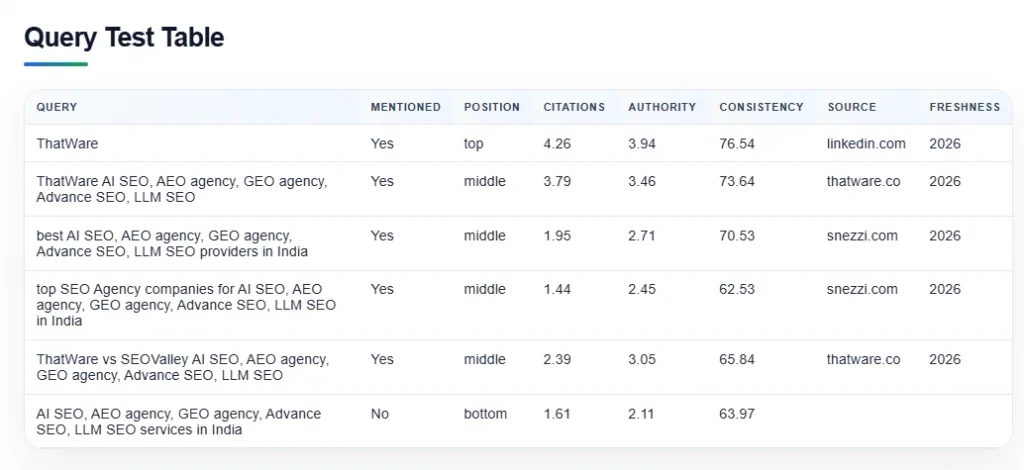
Prompt-level evidence example reconstructed from the published AVM/VEM framework page.
- AI citation inventory organized by prompt, topic and provider.
- Source-domain map showing where brand evidence is coming from.
- Authority observations that distinguish stronger and weaker supporting sources.
- Competitor citation comparison for the same commercial prompt set.
- Citation gap list showing sources or source types where the market is visible but your brand is missing.
- Recommendations for content, digital PR, expert contributions, documentation and authoritative third-party references.
- Trend-ready reporting structure for repeat monitoring.
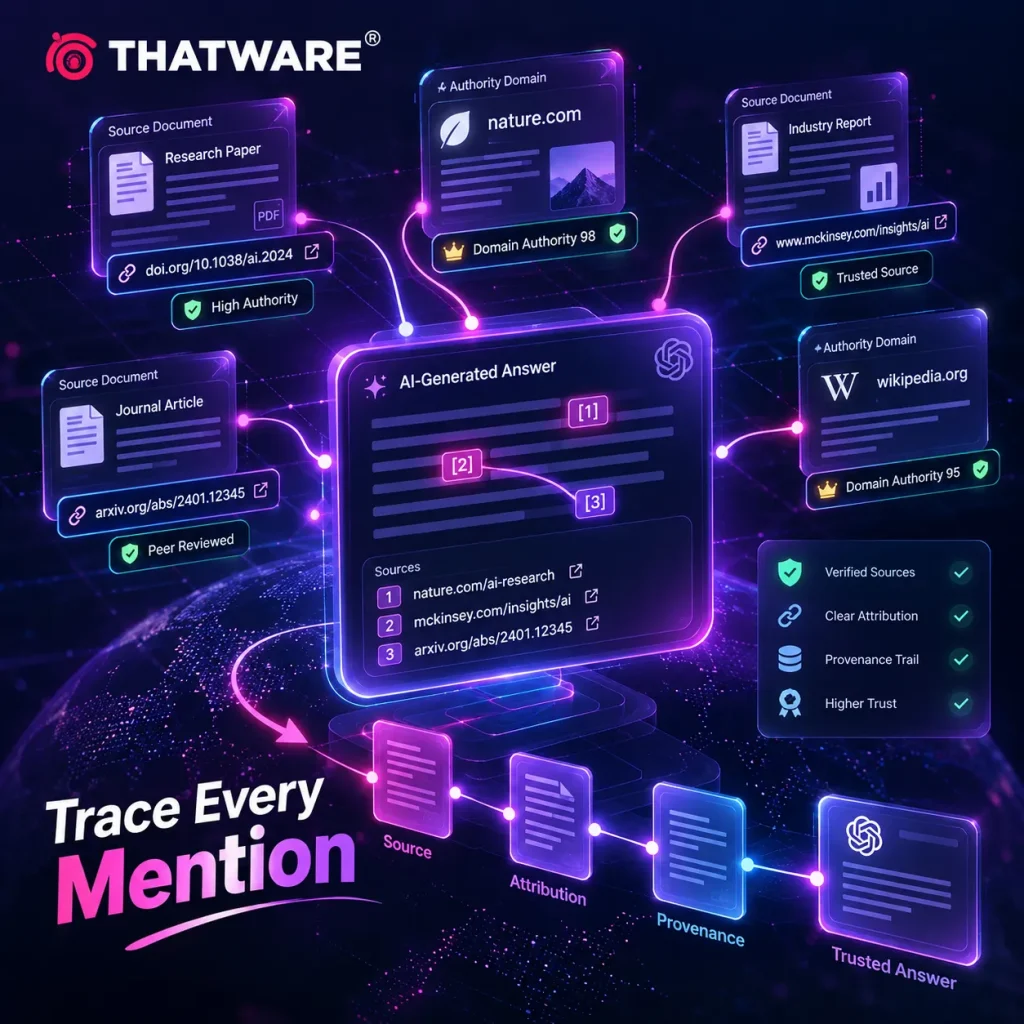
Citation Tracking for SEO, GEO and Digital PR Teams
Citation visibility sits at the intersection of several disciplines. SEO teams can improve the retrievability and factual usefulness of owned pages. GEO teams can strengthen content structures that answer generative queries directly. PR teams can expand independent evidence in trusted publications and industry sources. Product and subject-matter teams can create original research, documentation and data that are worth referencing.
The tracking layer tells those teams where to focus. Instead of generating more content without a clear hypothesis, the evidence shows which topics lack credible sources, which competitors are repeatedly supported by external references and which owned assets are already appearing in AI answers.
Where VEM Supports Citation Improvement
Citation weakness is not always a publishing problem. If external sources describe the company inconsistently, if brand variants are fragmented or if important products and experts are not clearly connected to the organization, the citation ecosystem can be harder to interpret. VEM can be used as a complementary entity-readiness diagnostic when the AVM evidence suggests those structural issues.
Important Measurement Boundaries
Citation behavior can change by provider, model, retrieval mode, date and query wording. Some AI interfaces expose citations more explicitly than others. That is why ThatWare treats citation tracking as sampled evidence inside a defined methodology. The value comes from repeating the same prompt set and recording the provider context, not from assuming that one observed answer represents every user session.
| Find the Sources That Shape Your AI Visibility Use AVM-based citation tracking to see where your brand is supported, where competitors hold stronger evidence and which source gaps should be addressed next. |
Build a Citation Map, Not a Link Counter
AI citation tracking should begin by mapping the source environment around the brand. A raw count of citations is too shallow because different sources play different roles. An owned service page can establish factual detail. A respected industry publication can validate expertise. A research paper can support a technical claim. A directory can reinforce organizational facts. A review platform can contribute reputation signals. A partner or association page can confirm relationships. The tracking program should therefore classify citations by source type, topic relevance and the kind of claim they appear to support.
This source map helps teams understand whether the brand’s AI visibility depends too heavily on one channel. If most citations come from the company’s own domain, the brand may be discoverable but still lack independent validation. If third-party coverage is strong but the owned site is rarely surfaced, the company may need clearer first-party resources. If a single publisher appears repeatedly across providers, that source may be strategically important for the category. The objective is to see the structure of evidence, not merely the number of links.
A citation map can also be organized around priority services, products, executives and markets. This reveals where evidence is concentrated and where it is missing. A company may have strong citations for its flagship service but almost no credible support for a newer capability. That distinction is important when a buyer asks an AI system for a specific recommendation.
Measure Citation Quality in Context
A citation should be evaluated in relation to the answer it supports. The same URL can be useful in one context and irrelevant in another. If an AI system cites a corporate profile while making a complex technical claim, the source may not provide sufficient evidence. If it cites a detailed case study, standards document, research report or expert article that directly supports the claim, the citation may carry more strategic value.
This is why ThatWare’s AVM-based approach keeps citation connected with authority, presence, consistency and position. A high citation count does not automatically mean strong visibility. A brand can accumulate citations around informational content while remaining absent from commercial recommendations. It can be cited by low-relevance pages while competitors are supported by stronger industry sources. It can be cited consistently but described inaccurately. Citation tracking becomes useful when the source is interpreted alongside the prompt, the claim, the brand mention and the competitive context.
The report should therefore distinguish between direct citations, indirect supporting sources, recurring source domains and evidence that appears close to the brand mention. It should also flag situations where a source is present but does not clearly support the statement the model is making. This protects the analysis from false confidence.
Track Citation Gaps by Topic and Buyer Intent
Citation gaps are more actionable when they are organized by the questions buyers care about. A brand may have strong supporting evidence for educational prompts but weak support for commercial prompts such as “best provider,” “recommended platform,” “enterprise solution” or “agency for a specific market.” Those commercial gaps should be visible in the report because they are closer to business outcomes.
The same principle applies to topics. Instead of creating a single list of missing sources, the tracker can group evidence around service lines, product categories, locations, use cases and buyer problems. If competitors are repeatedly cited for one topic cluster, the team can investigate what evidence those competitors have that the target brand lacks. That might be better documentation, a stronger comparison page, independent coverage, customer proof, original research or a clearer association with the topic.
This topic-level approach also helps prevent random digital PR. The goal is not to earn mentions everywhere. It is to strengthen the evidence network around the specific areas where AI visibility matters. That makes outreach, content production and authority building easier to prioritize.
Use Competitor Citations as an Evidence Discovery Tool
Competitor citation analysis can reveal sources that a normal backlink comparison might miss. The tracker can identify publishers, directories, reports, association pages, expert articles, product comparisons and other sources that repeatedly appear when competitors are recommended. The purpose is not to copy a competitor’s link profile. It is to understand which parts of the information ecosystem are shaping AI answers in the category.
Once those sources are identified, each one can be assessed for relevance and opportunity. Some may be realistic outreach targets. Others may simply reveal the type of evidence the market rewards. A competitor may be benefiting from independent product testing, expert interviews, research data, industry awards, strong partner pages or more complete documentation. The strategic response should be based on the underlying evidence pattern rather than the existence of a particular URL.
This is also where citation tracking becomes valuable to PR and brand teams. The output can show which narratives and claims are externally validated, which are only self-published, and where the brand’s public evidence does not match its desired positioning. That creates a practical bridge between AI search visibility and reputation building.
Create a Citation Improvement Roadmap
A citation tracking engagement should end with prioritized actions, not simply a table of sources. Each recommendation can be tied to a citation problem. If owned pages are not being surfaced, the action may involve improving depth, structure, internal linking and answer clarity. If third-party evidence is weak, the priority may be digital PR, expert commentary, original data or participation in authoritative industry resources. If citations exist but do not support priority claims, the brand may need stronger proof assets such as case studies, technical documentation, methodologies or transparent product information.
A useful roadmap separates actions that the brand controls directly from actions that require external participation. Owned-content improvements can often be implemented quickly. Earned authority takes longer and should be treated as a sustained program. Entity corrections may require updates across several profiles and data sources. Technical changes may involve schema, crawlability, canonicalization or clearer content relationships. The tracking report should show these dependencies so teams do not expect one tactic to solve every citation weakness.
The roadmap should also define how success will be measured. Improvement may mean a wider set of authoritative sources, stronger citation relevance, greater cross-provider recurrence, better support for commercial prompts, reduced competitor citation gaps or more consistent use of owned evidence. These outcomes are more meaningful than simply trying to maximize citation volume.
Citation Tracking for Content, PR and SEO Teams
Different teams can use the same tracking data in different ways. Content teams can identify questions where the brand lacks source-worthy material. SEO teams can see whether high-performing pages are actually being retrieved or cited in answer environments. Digital PR teams can identify which publishers or source types influence the category. Corporate communications teams can find places where AI systems rely on outdated or incomplete third-party descriptions. Product marketing can see whether key claims have credible supporting evidence.
This shared view is particularly useful when a brand has been producing content and earning coverage without knowing which assets matter in AI answers. Citation tracking adds feedback. It shows which sources are appearing, what they support and where evidence is still missing. That allows the organization to invest more deliberately in the resources that strengthen discoverability and trust.
The program can also reduce duplication. If several teams are independently trying to improve AI visibility, citation evidence gives them a common priority list. The result is a more coordinated mix of first-party content, third-party authority, technical clarity and brand consistency.
Monitor Citation Change Over Time
Citation behavior can change as models, retrieval systems and source indexes evolve. For that reason, one report should be treated as a baseline rather than a permanent truth. A recurring citation tracker can show whether new sources begin to appear, whether previously important domains disappear, whether competitor evidence strengthens and whether the brand becomes more consistently supported across prompt families.
Trend reporting should preserve context. A sudden increase in citations may be concentrated in low-value informational prompts. A decrease may reflect a provider change rather than a deterioration in the brand’s underlying evidence. A new authoritative citation can be more important than several minor sources. The tracker should therefore report both quantity and quality, and should keep provider, prompt type and source role visible.
For organizations actively implementing GEO, SEO and PR changes, recurring tracking provides a way to connect actions with observable evidence. It does not prove direct causation, but it helps teams see whether the source environment is moving in the intended direction.
Understand the Limits of Citation Data
AI citation tracking is a sampled measurement practice. It should not be presented as a complete inventory of every source an AI system has used or every answer every user will see. Some systems cite explicitly, some provide limited source visibility, and some retrieval behavior is not fully observable. Provider APIs can differ from consumer interfaces. Answers can vary with wording, timing, model version and context.
These limitations make methodology more important, not less. The prompt set, provider scope, market, language and date should be documented. Repeated tests should use consistent conditions wherever practical. A citation should be interpreted as observed evidence within that sample, not as proof of a universal ranking factor. The strongest use of the data is comparative and diagnostic: identifying patterns, gaps and changes that can inform strategy.
ThatWare’s AVM methodology provides the wider frame for this interpretation. Citation is one dimension of visibility, not a standalone verdict. By keeping citation connected with presence, authority, consistency and position, the analysis remains focused on the business question that matters: is the brand being supported by credible evidence when buyers ask AI systems about the category?
What Buyers Should Expect From an AI Citation Tracking Service
Before selecting a provider, ask whether the service stores prompt-level evidence, distinguishes source quality from source count, supports competitor comparisons and can show how citations change across providers and intent categories. Ask how source relevance is judged and whether owned, earned and third-party evidence are separated. Ask whether the report identifies actions for content, PR and entity improvement rather than stopping at a dashboard.
A serious citation tracking service should also explain what it cannot measure. It should not imply access to hidden model internals or claim that a citation guarantees future recommendation. It should make clear that the purpose is to observe answer-layer evidence, compare it systematically and use that evidence to guide optimization.
That is the role of this AVM application. It turns citations from isolated screenshots into a structured measurement program that can support SEO, GEO, digital PR, content strategy and executive decision-making.
| Methodology boundary AVM is presented as ThatWare’s proprietary diagnostic methodology, not as an official score issued or endorsed by OpenAI, Anthropic, xAI, Perplexity, Google or another platform. Results should be interpreted as sampled evidence within a defined query, provider, market and time context. |