
SUPERCHARGE YOUR ONLINE VISIBILITY! CONTACT US AND LET’S ACHIEVE EXCELLENCE TOGETHER!
Search is entering a new phase.
For years, the central objective of search optimization was relatively straightforward: help search engines discover a webpage, understand its relevance, rank it for appropriate queries, and earn a click from the search results. That model created an entire discipline around keywords, technical optimization, links, content quality, website architecture, and rankings.
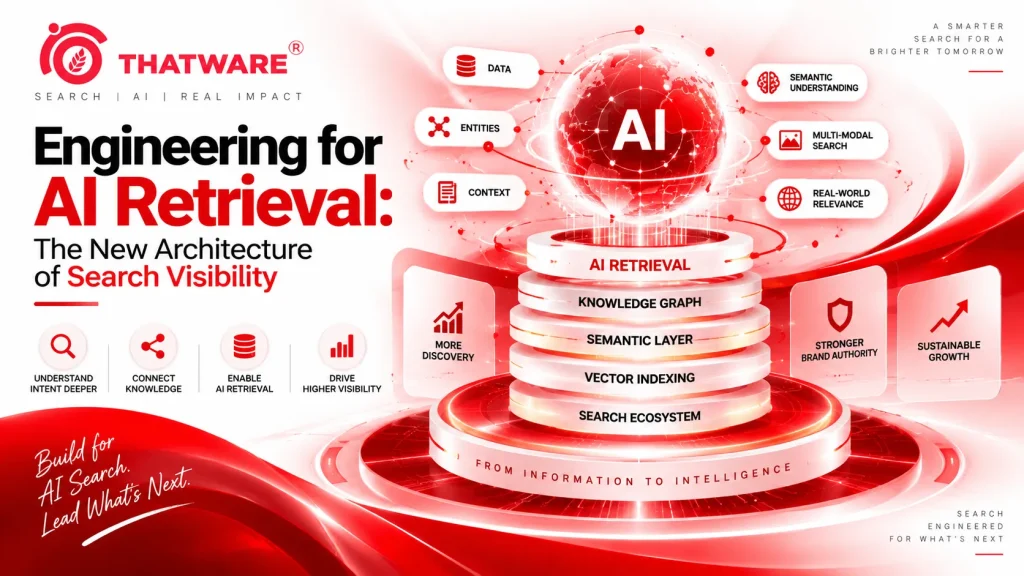
But the way people access information is changing.
Search experiences are increasingly capable of presenting synthesized answers rather than simply displaying a list of webpages. Instead of requiring users to open several results and assemble information themselves, AI systems can identify relevant information, interpret relationships between concepts, and produce an answer based on information available across multiple sources.
This changes the visibility problem.
A website no longer needs to think only about whether a page can rank. It also needs to consider whether its information can be discovered, accessed, understood, retrieved, evaluated, and potentially used when an AI system constructs an answer.
That does not make traditional SEO irrelevant. Technical accessibility, indexability, useful content, internal linking, authority, and other established principles remain important foundations. However, the architecture surrounding those foundations is expanding.
The important shift is from page visibility to information accessibility.
This is where AI retrieval becomes particularly important. Retrieval should not be treated as another isolated content tactic. It is better understood as an architectural consideration that connects technical infrastructure, semantic organization, content quality, and contextual relationships.
A website can contain excellent information and still create obstacles for automated systems trying to locate or interpret that information. Conversely, a technically accessible website may still provide weak retrieval signals if its content lacks structure, context, specificity, or meaningful relationships.
Understanding this difference is becoming essential for anyone responsible for organic visibility.
- What Is AI Retrieval?
AI retrieval can be explained simply:
It is the process through which an AI-powered system finds relevant information from available sources so that the information can potentially be used to answer a user’s request.
That definition is deliberately different from indexing.
Several stages can exist between a webpage being published and information from that webpage being used in an answer.
Crawling
Crawling involves automated systems discovering and accessing webpages. Links, sitemaps, website architecture, and other discovery mechanisms can influence whether a page is encountered.
Indexing
Indexing involves processing and storing information so that it can potentially be retrieved later. Being indexed means the information has entered a system’s searchable or usable information environment.
Retrieval
Retrieval occurs when relevant information is identified in response to a particular information need.
This is a crucial distinction.
A page can exist online. It can be technically accessible. It can even be indexed. Yet the information contained within it may not necessarily be retrieved for a particular question.
Ranking or Selection
Once potentially relevant information has been identified, systems may evaluate different sources or passages and determine which information is useful for the task at hand.
Citation or Source Attribution
When an AI-generated answer identifies supporting sources, another layer comes into play: attribution. The system may associate a statement with a particular webpage, document, or source.
These stages should not be treated as interchangeable.
The simplest way to understand the difference is:
Availability is not the same as retrieval, and retrieval is not the same as visibility.
AI retrieval therefore acts as a bridge between information that exists somewhere in the available information ecosystem and information that is actually considered relevant to an answer.
That bridge is becoming an important part of modern search architecture.
2. From Traditional Search Architecture to AI Search Architecture
Traditional search architecture can be simplified as:
Crawl → Index → Rank → Click
This model remains useful because it explains many of the fundamentals behind organic search.
However, AI-mediated search introduces additional layers:
Discover → Crawl → Understand → Retrieve → Evaluate → Generate → Cite/Recommend
The difference is significant.
The traditional model is heavily centered on the webpage as a ranking object. The expanded model places greater emphasis on the information contained within the webpage and how that information relates to an information need.
Consider a detailed article about a specialized subject.
A conventional search system may evaluate the page as a whole against a query. An AI retrieval system may need to identify a particular paragraph, explanation, definition, statistic, entity, relationship, or supporting fact inside that page.
This means that website owners increasingly need to think at multiple levels.
The page needs to be discoverable.
Its content needs to be accessible.
Its subject needs to be understandable.
Its important information needs to be distinguishable.
Its relationships with other information on the website need to be clear.
And the information needs enough contextual meaning to be useful when retrieved.
This is one reason professional seo company strategies are expanding beyond traditional ranking considerations. The modern search environment requires attention to how websites communicate information to both conventional search systems and increasingly sophisticated AI-driven information systems.
The objective is not to abandon established SEO practices. Instead, the architecture around them needs to become more comprehensive.
Keywords still matter. Links still matter. Technical health still matters. Content quality still matters.
But they increasingly operate within a broader information architecture.
3. Why Indexing Alone Is Not Enough
One of the most important concepts in AI retrieval is the difference between being present and being usable.
Imagine a webpage containing a highly valuable explanation of a technical subject.
The page is live.
The server responds correctly.
The URL is indexable.
The content is substantial.
Yet the page has poor internal connections, vague headings, ambiguous terminology, and important information buried inside large blocks of text.
Technically, the page may be available.
From an information retrieval perspective, however, there may be a gap.
This is a retrieval gap.
A retrieval gap occurs when information exists but is difficult for an automated system to identify, interpret, connect, or retrieve in a relevant context.
Several situations can create such gaps.
Technically accessible but poorly structured
A system may reach the page but have difficulty identifying the primary subject or locating the most important information.
Indexed but difficult to interpret
The content may be available but contain unclear references, ambiguous terminology, or insufficient context.
Rich in information but lacking contextual clarity
A page may contain hundreds of useful facts without clearly explaining how those facts relate to the central topic.
Discoverable but not distinctive
If a page provides the same generic information found across countless other pages, its individual information value may be difficult to distinguish.
This is why businesses need to ask more than:
“Is this page indexed?”
A more useful sequence of questions is:
Can the page be discovered?
Can it be accessed and processed?
Can its subject be understood?
Can its important information be retrieved?
Does the information provide enough value and context to be considered useful?
That sequence takes search visibility from a simple indexation question to an architectural one.
4. The Technical Foundations of AI-Retrievable Websites
AI retrieval does not eliminate technical SEO.
In fact, strong technical foundations become even more important because information cannot be retrieved if automated systems cannot reliably access or process it.
4.1 Crawlability and Accessibility
The first requirement is straightforward: systems need a path to the information.
Robots directives should be reviewed carefully so that important resources are not unintentionally restricted.
Server accessibility also matters. Persistent server errors, unreliable responses, or infrastructure-level restrictions can interfere with automated access.
Bot restrictions deserve attention as well. Security controls are important, but poorly configured restrictions can prevent legitimate automated systems from reaching useful content.
Internal linking provides another discovery pathway. A page that is connected logically to important areas of a website is generally easier to discover than an isolated page with no meaningful internal relationships.
XML sitemaps can also support discovery by communicating important URLs in a structured format.
None of these elements guarantees AI visibility. They establish the infrastructure required for information to be accessible in the first place.
4.2 Rendering and Content Accessibility
A second technical consideration is rendering.
Modern websites can depend heavily on JavaScript to display content. Some information may appear only after a user interacts with a page, opens an interface, submits a request, or triggers another dynamic event.
This creates an important question:
Is the information actually accessible to automated systems in a processable form?
Server-side and client-side rendering can produce different technical conditions. Important information should not unnecessarily depend on interactions that automated systems may not perform in the same way as human visitors.
Critical content should have a clear, accessible representation.
A visually impressive interface is not necessarily an information-accessible interface.
4.3 Indexability and Canonicalization
Basic indexability signals remain fundamental.
Unintended noindex directives can prevent pages from being considered for search visibility.
Canonical URLs need to accurately communicate preferred versions of content.
Duplicate or near-duplicate pages can create unnecessary ambiguity.
URL consistency also matters because fragmented versions of the same information can make website architecture harder to interpret.
These issues are not exclusively “AI SEO” problems. They are foundational search-engineering problems that become increasingly relevant as search systems become more sophisticated.
4.4 Site Architecture
Finally, the website itself needs a logical structure.
Important pages should have a clear relationship to broader topics.
Topic clusters can organize related information.
Navigation should help users and automated systems understand how pages fit together.
Supporting content should reinforce important subjects rather than existing as disconnected articles.
A strong architecture creates a pathway from broad concepts to detailed information.
That makes the website not merely a collection of URLs, but a connected information environment.
5. Semantic Architecture: Helping AI Understand What a Page Means
Keywords can indicate what a page discusses.
Semantics help explain what that information means.
Modern AI systems need to interpret relationships between concepts, not simply identify repeated words.
Consider a page discussing a medical treatment.
The meaningful information may involve the treatment itself, the condition it addresses, the type of patient it may concern, the location where it is provided, the professionals involved, the procedure, potential considerations, and related services.
These are entities and relationships.
An entity can be a recognizable person, organization, location, product, service, concept, or other distinct subject.
Attributes describe characteristics associated with an entity.
Relationships explain how different entities connect.
Context explains the circumstances in which those relationships make sense.
This creates a useful sequence:
Semantic clarity → Contextual understanding → Retrieval potential
A page should make it reasonably clear:
- Who is involved?
- What is being discussed?
- Where is it relevant?
- When does the information apply?
- Why does it matter?
- How does it work?
This does not mean every webpage needs to answer all six questions explicitly. The principle is that important information should have enough surrounding context to prevent ambiguity.
Structured data can support this process by communicating certain information in machine-readable formats. However, structured data should be viewed as a supporting mechanism rather than a guaranteed pathway to AI visibility.
The larger objective is semantic clarity across the website.
6. Content Architecture for AI Retrieval
Content quality is not only about how much information a page contains.
It is also about how effectively the information is organized.
A retrieval-friendly page can make important information easier to locate by using descriptive headings, direct explanations, clearly defined concepts, supporting evidence, specific terminology, context-rich paragraphs, and useful lists or tables where appropriate.
For example, instead of beginning a section with vague promotional language, a page can state the central concept directly and then explain it.
This creates clearer information units.
Each section can answer a particular question while remaining connected to the broader subject.
That is increasingly important for Machine Learning SEO, where the objective is not merely to place a phrase on a page but to create information that can be interpreted within a larger contextual environment.
Distinctive information matters
Generic statements provide limited informational differentiation.
Statements such as “we provide high-quality solutions” contain little specific information.
A more useful page explains:
- What the solution is
- Who it serves
- How it works
- What process it follows
- What limitations exist
- What evidence supports the explanation
- How it differs from related concepts
Specificity creates stronger informational value.
Topical depth creates context
A central page can be supported by related pages covering subtopics, definitions, processes, comparisons, use cases, technical considerations, and frequently asked questions.
These supporting pages can reinforce the central topic without simply repeating the same content.
This creates a broader information environment.
The result is a website where individual pages contribute to a larger subject rather than competing with one another for the same narrow phrase.
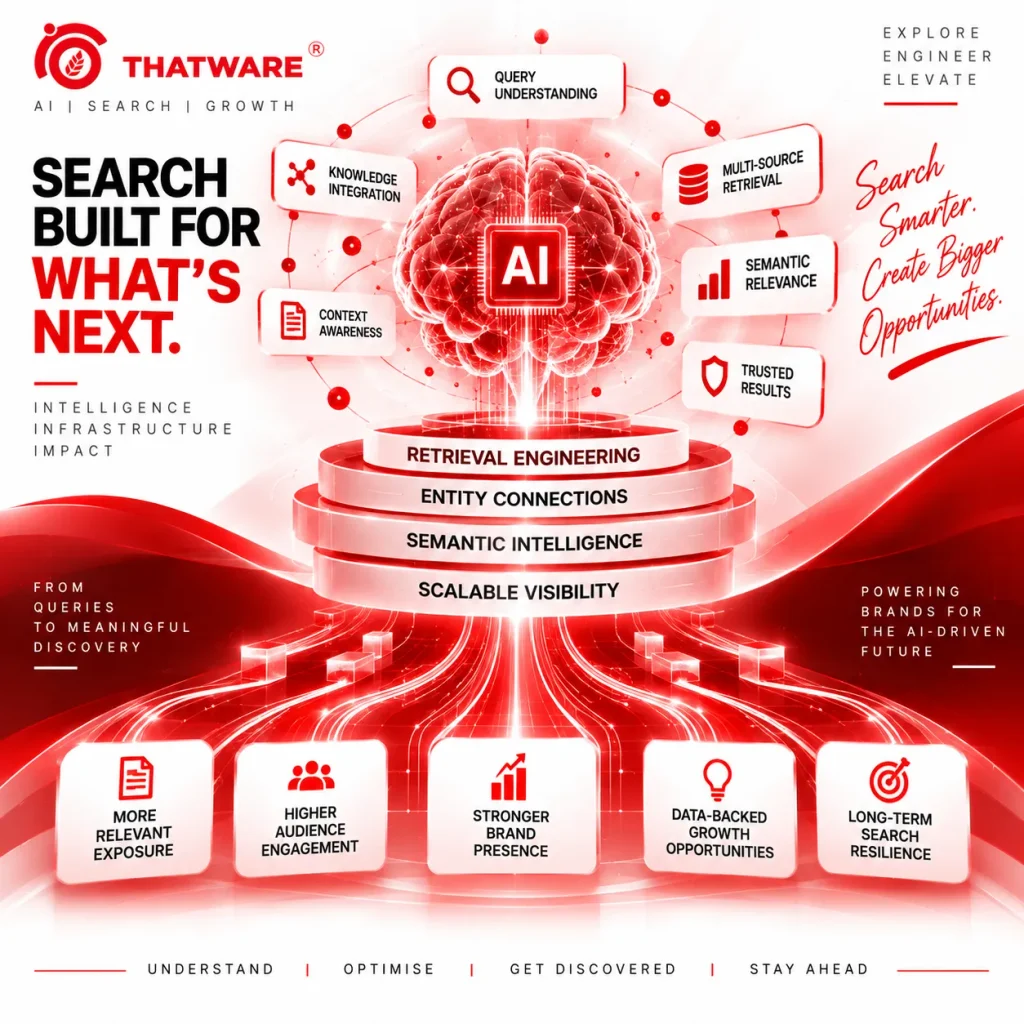
7. The Role of Internal Linking in AI Retrieval
Internal links are often treated as a navigation mechanism.
They are much more than that.
They can act as relationships between information.
A service page can connect to an explanatory guide.
A guide can connect to a technical resource.
A technical resource can connect to a relevant concept page.
An author page can connect expertise to published material.
A location page can connect geographic context to relevant services.
These connections create what can be described as a contextual information network.
The significance is not simply that one page links to another.
The significance is why the relationship exists.
Descriptive anchor text and logical placement can provide additional context. When pages are connected because they genuinely explain or support one another, the website becomes easier to interpret as an organized body of information.
Weakly connected content creates the opposite problem.
An orphan page may contain valuable information but have few meaningful relationships with the rest of the website.
Similarly, a page that receives links only from unrelated areas may not have a clear contextual position.
Internal linking therefore deserves to be considered part of information architecture rather than merely an SEO checklist.
8. Entity Authority and Contextual Understanding
An entity is essentially a distinct subject that can be recognized and understood as a meaningful unit.
It could be a person, organization, product, location, service, concept, publication, technology, or another identifiable subject.
AI systems can use relationships between entities to understand context.
For a business website, this may involve connections between the organization, its services, locations, authors, areas of expertise, resources, and subject matter.
Consistency matters.
If an organization describes its services differently across important pages, uses inconsistent terminology, or provides contradictory information, the overall information environment can become less clear.
Useful entity signals can include:
- Consistent organization information
- Clear author information
- Demonstrable expertise
- Well-defined service relationships
- Geographic context
- Consistent terminology
- Relevant supporting resources
This is where Entity Optimization becomes a broader architectural discipline rather than simply an exercise in repeating an organization’s name.
Building a recognizable topical and entity footprint means establishing meaningful relationships around a subject.
It is not about mentioning the same brand or keyword repeatedly.
It is about helping systems understand what the entity represents, what it is associated with, what it provides, and where it fits within a larger information ecosystem.
9. Retrieval vs AI Visibility: Two Different Problems
This distinction deserves special attention.
Retrieval asks:
Can the system find and access relevant information?
Visibility asks:
Does the system choose to use that information in an answer?
These are not identical questions.
A page may be retrievable without becoming a frequently cited or recommended source.
Why?
Because retrieval is only one stage of the larger process.
After information is retrieved, systems may consider factors such as:
- Relevance
- Information quality
- Context
- Authority
- Evidence
- Competing information
- User intent
Imagine that ten webpages contain information related to the same question.
All ten may be technically retrievable.
That does not mean an AI-generated answer will use all ten.
The system still has to determine which information best addresses the user’s request within the context of the answer being constructed.
This is why Advanced SEO increasingly needs to account for multiple stages of information processing rather than focusing exclusively on rankings.
It is also why businesses should avoid interpreting one successful retrieval test as proof of broad AI visibility.
Retrieval establishes possibility.
Visibility depends on what happens afterward.
This distinction protects website owners from a common misunderstanding: assuming that making content technically retrievable automatically guarantees citations, recommendations, or traffic.
It does not.
10. How to Test Whether Your Content Is AI-Retrievable
Website owners do not have to treat AI retrieval as a completely invisible process.
There are practical ways to investigate it.
Step 1: Choose an Important Page
Start with a page that matters to the business.
This could be a service page, product page, research resource, guide, educational article, or another important information asset.
Step 2: Identify Distinctive Passages
Select meaningful passages from the page.
Avoid generic statements such as broad marketing claims.
Choose sentences or short passages containing specific information that is distinctive to the page.
Step 3: Test Exact Retrieval
Use an AI-powered search interface to search for the distinctive passage and determine whether the information can be located and associated with the correct URL.
The purpose is to test whether the information can be retrieved rather than simply asking whether the website “appears in AI.”
Step 4: Test Multiple Passages
One successful or unsuccessful test should not determine your conclusion.
Test several different passages from the same page.
Different passages can behave differently because retrieval may depend on context, wording, topic relevance, and available information.
Step 5: Compare Results
Review the results for:
- Correct URL attribution
- Correct passage or information
- Consistent retrieval
- Alternative sources
- Missing pages
- Unexpected associations
Patterns are more useful than isolated observations.
Step 6: Investigate Failures
If an important page is repeatedly difficult to retrieve, work backward through the architecture:
Discovery → Accessibility → Crawlability → Rendering → Indexability → Content quality → Semantic clarity
This sequence helps narrow the problem.
A retrieval problem may be technical.
It may be structural.
It may be semantic.
It may involve the distinctiveness or quality of the content.
It may also simply reflect the fact that retrieval systems do not always return the same sources for every request.
An important caveat
Retrieval testing is an indicator, not definitive proof that a page has been permanently included in an AI index or will consistently appear in future AI-generated answers.
AI systems can change.
Their available information can change.
Retrieval results can vary by query and context.
The purpose of testing is therefore diagnostic rather than absolute.
It helps answer a practical question:
Can the information be found and associated with the page under controlled retrieval conditions?
11. Common AI Retrieval Problems on Websites
Many retrieval problems originate from familiar website issues.
Orphaned content
A valuable page with few or no meaningful internal links can be difficult to discover and contextualize.
Weak internal linking
Links may exist, but without meaningful relationships between connected pages.
Generic content
Pages containing broad statements without distinctive information may provide little retrieval value.
Duplicate pages
Multiple URLs containing substantially similar information can create unnecessary ambiguity.
Poor canonicalization
Incorrect or inconsistent canonical signals can complicate URL interpretation.
noindex directives
Important pages can accidentally be excluded from indexing pathways.
Crawl restrictions
Robots rules, server configurations, security controls, or other restrictions can prevent access.
Rendering issues
Important content may depend on scripts or interactions that automated systems cannot reliably process.
Hidden information
Critical explanations buried behind tabs, interactions, or dynamic components may be less accessible.
Ambiguous page topics
If the primary subject of a page is unclear, it becomes harder to associate individual passages with a specific information need.
Thin supporting content
A central topic may lack the supporting pages necessary to establish depth and context.
Inconsistent entity information
Different pages may describe the same organization, service, person, or location inconsistently.
Over-optimized content
Content written primarily to manipulate search signals can become unnatural and less useful to readers and retrieval systems.
Keyword targeting without context
A page may target a keyword repeatedly while failing to explain the underlying subject comprehensively.
These problems demonstrate why AI retrieval cannot be solved by adding a single technical file, markup type, or keyword.
It is an architectural problem.
12. Designing a Retrieval-First Website Architecture
The concepts discussed throughout this article can be brought together into an eight-layer framework.
Layer 1 — Discovery
Can systems find the content?
Review internal links, sitemaps, navigation, URL structures, and other discovery pathways.
Layer 2 — Accessibility
Can systems reach and process it?
Examine server responses, crawl restrictions, rendering, scripts, and access conditions.
Layer 3 — Structure
Is the website logically organized?
Build meaningful relationships between major topics, supporting content, services, resources, and other information.
Layer 4 — Semantics
Can systems understand the entities and relationships?
Clarify terminology, concepts, entities, attributes, and relationships.
Layer 5 — Content
Does the page contain useful, distinctive information?
Prioritize specificity, evidence, context, clarity, and genuine informational value.
Layer 6 — Retrieval
Can relevant passages be located when needed?
Test important content using distinctive passages and relevant information needs.
Layer 7 — Authority
Does the wider information ecosystem support expertise and credibility?
Consider the consistency, depth, evidence, expertise, and broader topical footprint surrounding the website.
Layer 8 — AI Visibility
Does the information actually appear in AI-generated answers?
This is the final observable outcome, but it depends on everything that comes before it.
The framework can therefore be visualized as:
Discovery → Accessibility → Structure → Semantics → Content → Retrieval → Authority → AI Visibility
The sequence matters.
Trying to improve the final layer while ignoring the earlier layers can produce fragmented results.
A website cannot meaningfully optimize AI visibility if important information cannot be accessed.
It cannot build strong retrieval potential if the information lacks context.
And it cannot expect consistent visibility from content that provides little distinctive value.
This is why a retrieval-first approach is fundamentally architectural.
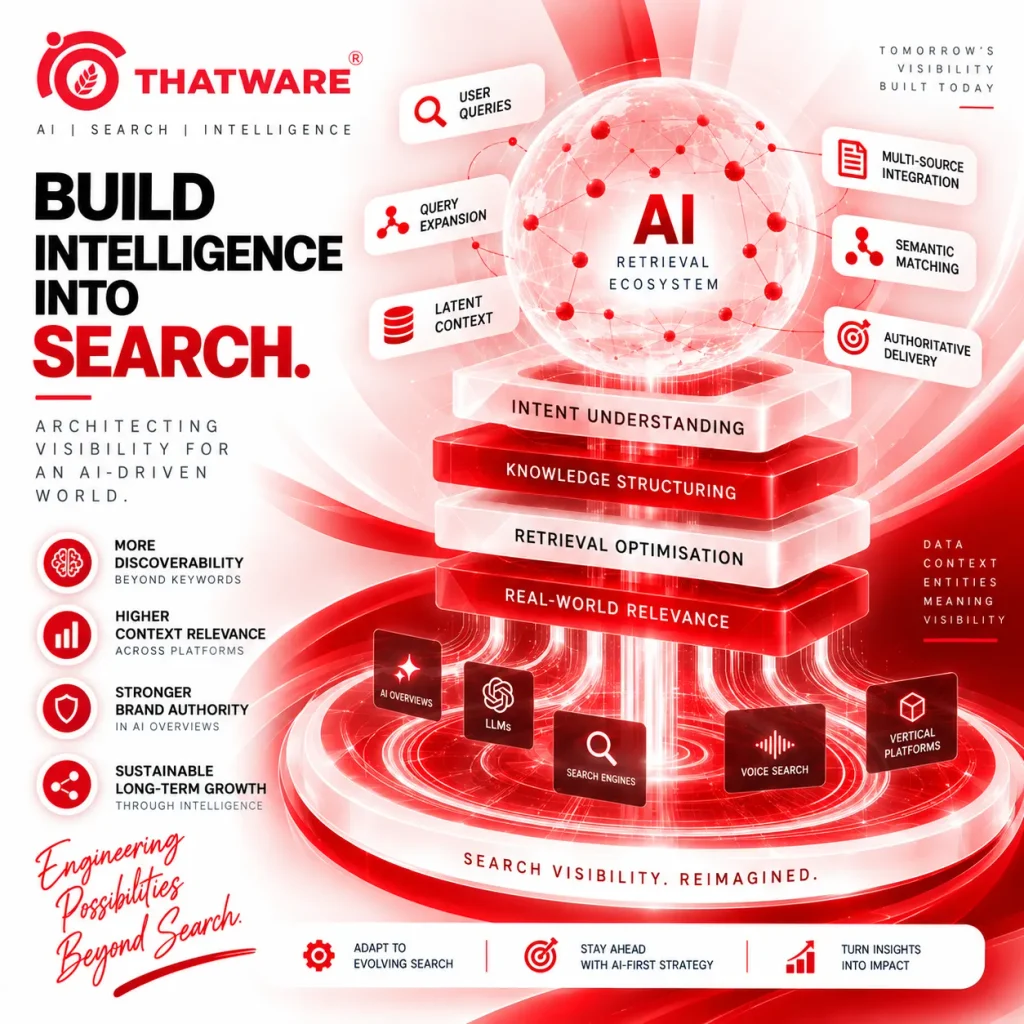
13. How ThatWare Approaches the AI Retrieval Challenge
The changing search environment requires a broader way of thinking about visibility. ThatWare approaches this challenge by looking at search as an interconnected information system rather than treating individual keywords or pages as isolated optimization targets.
Our work across AI SEO, LLM SEO, AEO, GEO, semantic SEO, and search engineering reflects this broader shift.
For us, the question is not simply whether a webpage has been optimized for a particular phrase. We look at how the website communicates information and how different layers of the site contribute to its overall search visibility.
That includes examining semantic relationships between concepts, understanding entities and their connections, evaluating content architecture, studying search behavior, and considering how AI retrieval mechanisms interact with accessible website information.
Technical accessibility is another important part of this approach.
A website needs a strong foundation before its information can become consistently discoverable and usable. Crawlability, rendering, indexability, internal linking, URL architecture, and content accessibility can therefore become part of the broader search-engineering process.
We also consider context and authority.
A page rarely exists in isolation. Its meaning can become clearer when it is supported by related resources, well-defined services, relevant entities, useful explanatory content, and a consistent topical structure.
This is where our approach connects directly with the retrieval-first framework outlined in this article.
We work toward websites where the technical structure supports accessibility, the information architecture establishes relationships, semantic signals provide context, and the content itself provides useful and distinctive information.
The objective is not to make a website “AI-friendly” through a collection of isolated tactics.
Instead, our focus is on creating an information ecosystem in which AI systems have clearer pathways to discover, interpret, retrieve, and potentially use relevant information.
That distinction matters.
AI search is not a single optimization surface. It is an evolving environment involving discovery, processing, retrieval, evaluation, and presentation.
Our approach regarding AI Answer Optimization therefore considers the architecture connecting these stages.
For businesses adapting to AI-driven search, this means moving from a narrow question such as “Which keyword should we optimize?” toward broader questions:
Can the right information be found?
Is its meaning clear?
Are its relationships understandable?
Can important passages be retrieved?
Does the website provide enough depth and evidence to support its subject matter?
These questions form a more complete basis for modern search visibility.
ThatWare’s cutting edge SEO is continuously evolving with these big changes. Visit us and explore our services and packages now.
Conclusion — Search Visibility Is Becoming an Engineering Problem
AI search is changing how information is discovered, interpreted, and presented.
That does not mean traditional SEO has become obsolete.
Technical accessibility, crawlability, indexability, useful content, internal linking, authority, and strong website architecture remain foundational. What is changing is the number of layers that businesses need to consider around those foundations.
The complete journey increasingly looks like:
Discovery → Accessibility → Understanding → Retrieval → Selection → Visibility
Each stage represents a different challenge.
A website can be discoverable but difficult to process.
It can be accessible but semantically unclear.
It can be understandable but lack distinctive information.
It can be retrievable but not selected for a particular answer.
And it can be selected in one context without becoming consistently visible across other information needs.
That is why AI visibility cannot be reduced to inserting keywords, publishing more pages, or adding isolated technical elements.
The stronger approach is architectural.
Build technically accessible websites.
Create clear information hierarchies.
Establish meaningful semantic relationships.
Develop content that provides specific and useful information.
Connect related resources through contextual internal linking.
Maintain consistent entity information.
Develop genuine topical depth.
Test whether important information can actually be retrieved.
Then evaluate what happens after retrieval.
The future of search visibility will increasingly belong to websites that treat information as a structured, connected, retrievable asset rather than as a collection of pages created primarily for rankings.
The question is no longer only whether search engines can find your website.
It is whether AI systems can find, understand, retrieve and confidently use the information your website provides.