
SUPERCHARGE YOUR ONLINE VISIBILITY! CONTACT US AND LET’S ACHIEVE EXCELLENCE TOGETHER!
Artificial intelligence systems should not be treated as static systems.
They retrieve information.
They generate answers.
They make recommendations.
They may select sources.
They may execute actions.
But an important question remains:
What happens after the AI produces the result?
Was the answer correct?
Was the recommendation useful?
Did the retrieved evidence actually support the response?
Did the user accept or reject the answer?
Was an important source missed?
Did a human reviewer correct the output?
Did the AI repeatedly make the same mistake?
Did the decision logic lead to the desired outcome?
Has the underlying information changed since the answer was generated?
These questions belong to the feedback layer.
An AI system without feedback may continue producing the same weak output repeatedly.
An AI system with a well-designed feedback architecture can observe outcomes, identify problems, evaluate corrections and feed validated improvements back into its knowledge, retrieval and decision systems.
That is the role of ai-feedback-loop.json.
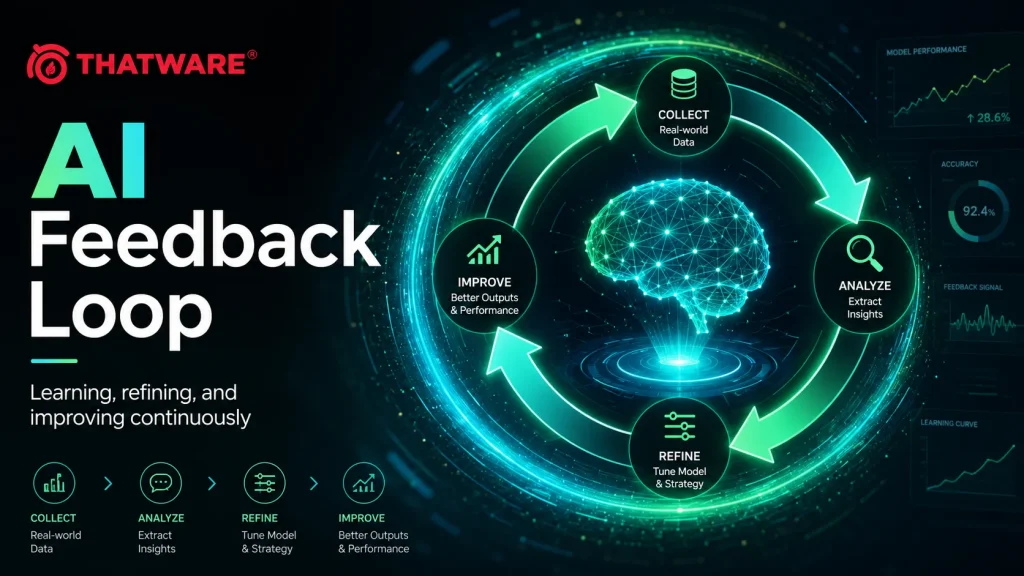
In simple terms:
ai-feedback-loop.json defines how signals about AI outputs, decisions and outcomes are collected, evaluated and converted into controlled improvement actions.
It can potentially provide a machine-readable architecture for:
- AI answer evaluation
- recommendation evaluation
- retrieval quality monitoring
- citation quality monitoring
- human corrections
- user feedback
- outcome tracking
- error classification
- confidence adjustment
- knowledge updates
- decision-rule review
- prompt improvement
- retrieval optimisation
- stale-content detection
- escalation
- regression testing
- continuous AI governance
The file should not be viewed as a mechanism that makes an LLM automatically retrain itself.
It should instead be viewed as a governed feedback architecture connecting AI outcomes with controlled improvement processes.
What Is ai-feedback-loop.json?
ai-feedback-loop.json is a proposed machine-readable JSON framework for defining how an AI system records, classifies, evaluates and responds to feedback.
The feedback may originate from:
- users
- human reviewers
- automated evaluators
- downstream business outcomes
- retrieval systems
- monitoring systems
- source changes
- policy checks
- quality assurance teams
- application telemetry
- benchmark tests
A simple feedback object might look like:
{
“feedbackId”: “feedback:answer:0001”,
“target”: {
“type”: “ai_answer”,
“id”: “answer:47392”
},
“signalType”: “human_correction”,
“evaluation”: {
“status”: “incorrect”,
“category”: “outdated_information”
},
“recommendedAction”: {
“type”: “review_source”
}
}
The object does not automatically modify a model.
Instead, it records:
- what AI output was evaluated
- what problem was identified
- who or what identified it
- how reliable the feedback is
- what corrective action should occur
This distinction is important.
Why AI Systems Need Feedback Loops
An AI system may perform well today and poorly tomorrow.
Why?
Because the surrounding information environment changes.
Examples include:
- product specifications change
- pricing changes
- staff members change
- policies change
- regulations change
- competitors change
- pages disappear
- research becomes outdated
- user intent shifts
- retrieval indexes drift
- embeddings are regenerated
- prompts are modified
- decision rules are updated
- new terminology emerges
Even when the underlying information remains stable, model behaviour can vary.
A useful AI infrastructure therefore needs a way to evaluate outputs continuously.
Without structured feedback, organisations may discover problems only through:
- customer complaints
- incorrect recommendations
- lost leads
- support escalations
- reputation damage
- manual audits
A structured feedback system provides a more intentional cycle.
AI Output
↓
Observation
↓
Feedback Signal
↓
Evaluation
↓
Root-Cause Analysis
↓
Correction
↓
Validation
↓
Deployment
↓
New AI Output
This creates continuous improvement.
AI Feedback Is Not the Same as Model Training
This distinction should be made very clearly.
An AI Feedback Loop does not necessarily mean:
User clicks thumbs down
↓
LLM instantly retrains itself
That would be an oversimplification.
Feedback can influence many different layers.
For example, an incorrect answer might be caused by:
Content Problem
The website itself contains outdated information.
Retrieval Problem
The correct page exists but was not retrieved.
Chunking Problem
The correct information was split poorly.
Entity Problem
The system confused two similarly named entities.
Source Problem
The wrong source was prioritised.
Decision Problem
The correct facts were retrieved, but the wrong recommendation rule was applied.
Prompt Problem
The model interpreted instructions incorrectly.
Model Problem
The model generated an unsupported conclusion despite appropriate context.
Freshness Problem
The retrieved information was previously correct but had expired.
Each cause requires a different solution.
A good Feedback Loop therefore does more than record whether an answer was liked.
It attempts to determine why an outcome occurred.
ai-feedback-loop.json Within an AI Knowledge Stack
A machine-readable AI ecosystem can be understood as multiple specialised layers.
entity-registry.json
Answers:
What entities exist?
Focus:
- canonical names
- aliases
- entity IDs
- identity resolution
knowledge-graph.json
Answers:
How are entities related?
Focus:
- semantic relationships
- ownership
- authorship
- conceptual connections
brand-memory.json
Answers:
What should the AI remember about the organisation?
Focus:
- expertise
- services
- identity
- people
- frameworks
- organisational context
context-engine.json
Answers:
What information matters in the current situation?
Focus:
- audience
- market
- intent
- user context
- environment
ai-answer-primitives.json
Answers:
What reusable pieces of information can contribute to an answer?
Focus:
- definitions
- facts
- comparisons
- limitations
- procedures
- answer units
reasoning-map.json
Answers:
What conceptual paths help connect evidence and conclusions?
Focus:
- reasoning relationships
- dependencies
- inference paths
ai-decision-layer.json
Answers:
Given the evidence and context, what should happen?
Focus:
- rules
- conditions
- recommendations
- actions
- abstention
- escalation
ai-feedback-loop.json
Answers:
What happened after the AI responded or acted, and what should be improved?
Focus:
- output evaluation
- human corrections
- outcome measurement
- root-cause analysis
- corrective actions
- learning governance
It is improvement-first.
Together, these layers can form a cycle:
IDENTITY
↓
KNOWLEDGE
↓
CONTEXT
↓
RETRIEVAL
↓
ANSWER
↓
REASONING
↓
DECISION
↓
ACTION
↓
FEEDBACK
↓
IMPROVEMENT
↓
UPDATED KNOWLEDGE / RULES
The Feedback Loop closes the architecture.
The Difference Between Analytics and Feedback
Analytics tells an organisation what happened.
Feedback helps determine what should change because of what happened.
For example:
Analytics
AI answer received 1,200 views.
Feedback
18% of reviewed answers contained outdated pricing information.
Feedback Action
Reduce pricing-content freshness threshold from 30 days to 7 days.
Analytics becomes part of a learning loop only when observations result in governed corrective action.
What Can Generate AI Feedback?
A mature system may consume several feedback categories.
Explicit User Feedback
Examples:
- thumbs up
- thumbs down
- rating
- written comment
- correction
- report incorrect answer
Example:
{
“signalType”: “user_rating”,
“value”: 2,
“scale”: 5
}
Implicit User Feedback
Users do not always explicitly rate outputs.
Behaviour can provide indirect signals.
Examples:
- user immediately reformulates the question
- user abandons the conversation
- user repeatedly asks for clarification
- user selects another recommendation
- user ignores a suggested result
- user completes the intended action
These signals require caution.
A user leaving a page does not automatically mean the answer was bad.
Implicit signals should therefore rarely be treated as absolute truth.
Human Reviewer Feedback
Human reviewers can identify:
- factual errors
- missing context
- unsafe recommendations
- poor citations
- incorrect classifications
- stale information
- tone problems
- compliance issues
Example:
{
“signalType”: “human_review”,
“reviewerRole”: “subject_matter_expert”,
“evaluation”: {
“accuracy”: “incorrect”,
“severity”: “high”
}
}
Human-review feedback can be especially important in high-stakes environments.
Automated Evaluation Feedback
An evaluator may check:
- groundedness
- citation support
- answer completeness
- entity consistency
- schema validity
- formatting
- policy compliance
- retrieval coverage
Example:
{
“signalType”: “automated_evaluation”,
“evaluator”: “citation_verifier”,
“result”: {
“supportedClaims”: 8,
“unsupportedClaims”: 2
}
}
Automated evaluations should not automatically be treated as perfect.
Evaluators themselves can make mistakes.
Business Outcome Feedback
Sometimes the strongest feedback comes from the actual outcome.
For example:
Recommendation
↓
User accepted consultation
or:
Product recommendation
↓
User returned product as incompatible
Outcome feedback may reveal whether the AI recommendation was useful in practice.
Retrieval Feedback
Feedback can evaluate the retrieval system itself.
Examples:
- correct document retrieved
- key source missing
- irrelevant chunks retrieved
- old source outranked current source
- wrong entity retrieved
Example:
{
“signalType”: “retrieval_evaluation”,
“evaluation”: {
“relevantDocumentsRetrieved”: 3,
“irrelevantDocumentsRetrieved”: 5,
“missedCanonicalSource”: true
}
}
Citation Feedback
AI answers increasingly depend on citation quality.
Feedback might evaluate:
- whether citation supports the claim
- whether canonical source was used
- whether citation is outdated
- whether more authoritative evidence exists
Example:
{
“signalType”: “citation_review”,
“citationId”: “citation:234”,
“status”: “weak_support”,
“preferredAlternative”: “https://example.com/primary-source/”
}
Decision Feedback
A recommendation can be factually supported yet still be inappropriate.
For example:
AI recommended enterprise plan.
User required only basic functionality.
The problem may exist in the Decision Layer rather than the content.
Decision feedback can therefore evaluate:
- rule accuracy
- threshold quality
- service fit
- risk classification
- escalation behaviour
- abstention behaviour
Agent Action Feedback
AI agents may perform real actions.
Feedback can record whether:
- the action succeeded
- the action failed
- the wrong tool was selected
- approval should have been requested
- execution violated a policy
- the action needed reversal
Example:
{
“signalType”: “agent_action_outcome”,
“action”: “send_email”,
“outcome”: “failed”,
“reason”: “invalid_recipient”
}
Core Feedback Lifecycle
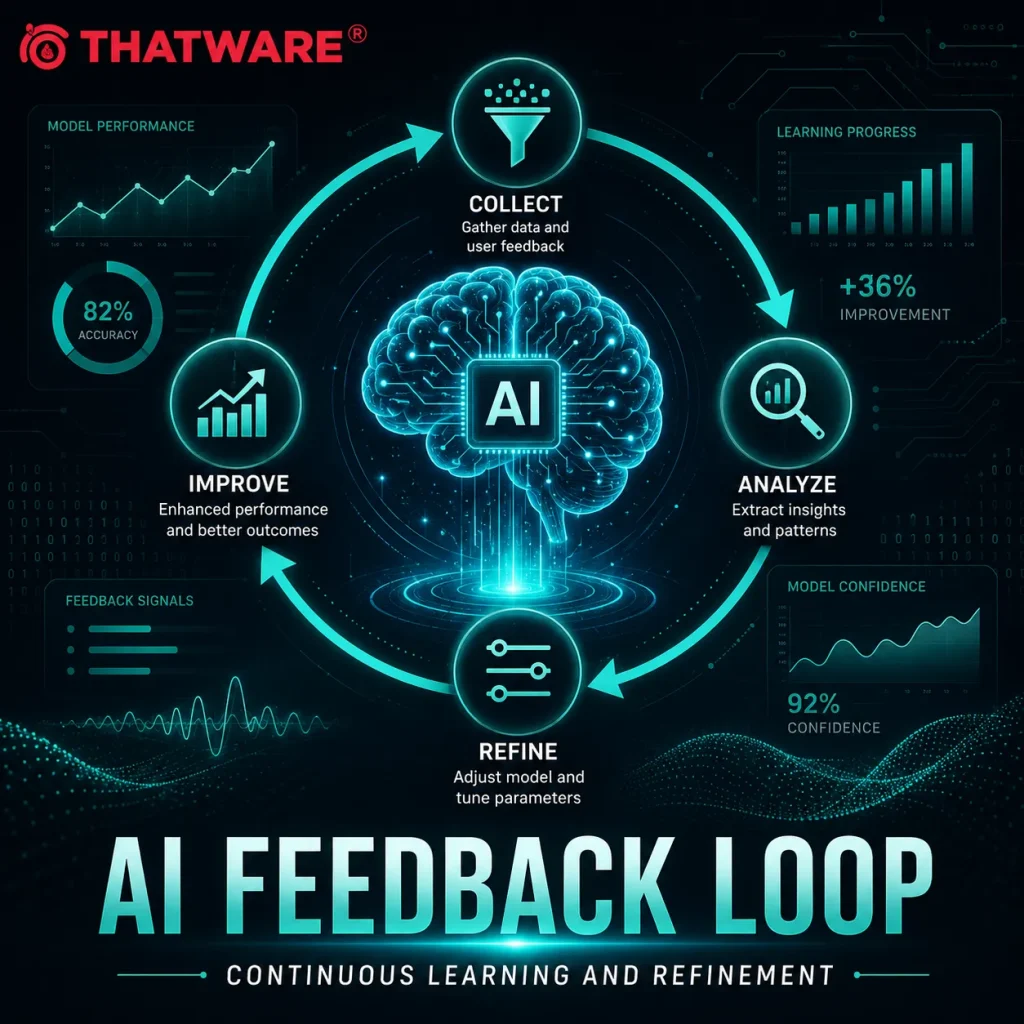
A robust Feedback Loop may follow eight stages.
Stage 1: Observe
Capture an AI output, decision or action.
Stage 2: Collect
Receive feedback signals.
Stage 3: Validate
Determine whether the feedback itself is trustworthy.
Stage 4: Classify
Determine the type of problem.
Stage 5: Diagnose
Identify the likely root cause.
Stage 6: Correct
Generate a proposed corrective action.
Stage 7: Verify
Test whether the correction improves the system.
Stage 8: Deploy
Apply the validated change.
The cycle then begins again.
Observe
↓
Collect
↓
Validate
↓
Classify
↓
Diagnose
↓
Correct
↓
Verify
↓
Deploy
↓
Observe
Feedback Should Not Automatically Change Production Systems
One of the most important principles is:
Feedback should not automatically become truth.
Suppose one user says:
“This answer is wrong.”
The system should not immediately rewrite the knowledge base.
The user may themselves be mistaken.
A safer architecture is:
Feedback Received
↓
Validation
↓
Evidence Check
↓
Reviewer / Rule Evaluation
↓
Approved Correction
↓
Knowledge Update
This is controlled learning rather than uncontrolled self-modification.
Recommended File Location
A public resource could be located at:
https://example.com/ai-feedback-loop.json
Alternative locations:
https://example.com/.well-known/ai-feedback-loop.json
or:
https://example.com/ai/ai-feedback-loop.json
However, feedback architectures often contain sensitive operational information.
An organisation may therefore use:
Public feedback principles:
https://example.com/ai-feedback-loop.json
Internal feedback engine:
Authenticated API / private infrastructure
Public files should not expose:
- personal user feedback
- private conversation logs
- confidential business metrics
- security vulnerabilities
- proprietary risk thresholds
- private customer information
Recommended MIME Type
Serve public JSON as:
application/json
Recommended response:
HTTP/1.1 200 OK
Content-Type: application/json; charset=utf-8
Useful technical requirements include:
- valid JSON
- UTF-8 encoding
- version information
- last-updated metadata
- stable feedback category IDs
- controlled schema
- privacy controls
- data retention policies
- source traceability
Recommended Top-Level Structure
A comprehensive implementation might contain:
{
“metadata”: {},
“organization”: {},
“feedbackSources”: [],
“signalTaxonomy”: {},
“evaluationFramework”: {},
“severityModel”: {},
“rootCauseTaxonomy”: {},
“correctionPolicies”: {},
“validationPolicies”: {},
“learningActions”: [],
“humanReviewPolicy”: {},
“privacyPolicy”: {},
“retentionPolicy”: {},
“metrics”: {},
“relatedResources”: {},
“governance”: {}
}
The architecture should remain understandable.
Complexity should only be added where it provides operational value.
Field-by-Field Explanation
metadata
Defines the Feedback Loop resource.
Example:
{
“metadata”: {
“version”: “2026.1”,
“fileType”: “ai-feedback-loop”,
“generatedAt”: “2026-09-03”,
“lastUpdated”: “2026-09-03”,
“language”: “en”,
“publisher”: “ThatWare LLP”,
“canonicalUrl”: “https://thatware.co/ai-feedback-loop.json”,
“description”: “Machine-readable framework for AI evaluation, feedback classification, correction, validation and continuous improvement.”
}
}
Metadata supports:
- version control
- freshness
- governance
- auditing
- schema identification
organization
Defines who owns the feedback framework.
{
“organization”: {
“id”: “entity:organization:thatware”,
“name”: “ThatWare”,
“legalName”: “ThatWare LLP”,
“url”: “https://thatware.co/”
}
}
feedbackId
Each feedback event should have a unique ID.
Example:
{
“feedbackId”: “feedback:2026:000001”
}
Stable IDs support:
- auditing
- deduplication
- debugging
- workflow tracking
- correction histories
target
Feedback must identify what it evaluates.
Example:
{
“target”: {
“type”: “ai_answer”,
“id”: “answer:4891”
}
}
Potential targets include:
ai_answer
decision
recommendation
retrieval_result
citation
primitive
knowledge_entity
agent_action
prompt
decision_rule
signalType
Defines the nature of the feedback.
Example:
{
“signalType”: “human_correction”
}
Possible types:
user_rating
user_comment
human_review
automated_evaluation
retrieval_evaluation
citation_review
business_outcome
agent_action_outcome
policy_violation
freshness_alert
source
Identifies where the feedback came from.
{
“source”: {
“type”: “human”,
“role”: “content_reviewer”
}
}
Or:
{
“source”: {
“type”: “automated”,
“system”: “groundedness_evaluator”
}
}
Source identity matters because feedback reliability can differ.
feedbackValue
Stores the feedback itself.
Example:
{
“feedbackValue”: {
“rating”: 2,
“scale”: 5
}
}
Another:
{
“feedbackValue”: {
“status”: “incorrect”,
“comment”: “The stated product availability is outdated.”
}
}
evaluation
Evaluation translates raw feedback into structured quality signals.
Example:
{
“evaluation”: {
“accuracy”: “incorrect”,
“groundedness”: “partial”,
“completeness”: “acceptable”,
“severity”: “medium”
}
}
Potential evaluation dimensions include:
- accuracy
- relevance
- completeness
- groundedness
- citation quality
- freshness
- safety
- recommendation fit
- policy compliance
- user usefulness
severity
Not every problem requires the same response.
A possible severity scale:
low
medium
high
critical
Example:
{
“severity”: “high”
}
Severity should influence:
- response urgency
- escalation
- review requirements
- deployment controls
rootCause
This field identifies why the problem occurred.
Example:
{
“rootCause”: {
“category”: “stale_knowledge”,
“component”: “answer_primitive”
}
}
Possible root causes:
missing_content
incorrect_content
stale_content
retrieval_failure
ranking_failure
entity_confusion
citation_mismatch
decision_rule_error
prompt_error
tool_failure
context_failure
model_generation_error
policy_failure
Root-cause analysis is one of the most valuable aspects of structured feedback.
confidenceInFeedback
Feedback itself may be uncertain.
Example:
{
“feedbackConfidence”: {
“status”: “verified”
}
}
Possible statuses:
unverified
plausible
supported
verified
disputed
rejected
Avoid arbitrary numerical confidence unless it has a defined methodology.
recommendedAction
Defines what should happen next.
Example:
{
“recommendedAction”: {
“type”: “update_knowledge”,
“target”: “primitive:product:availability”
}
}
Possible actions:
review
update_knowledge
update_entity
modify_retrieval
modify_decision_rule
reindex
retrieve_new_evidence
human_review
create_test_case
deprecate_information
no_action
correctionStatus
Tracks the lifecycle of the correction.
Possible values:
pending
under_review
approved
rejected
implemented
validated
rolled_back
Example:
{
“correctionStatus”: “under_review”
}
validation
A correction should ideally be tested.
Example:
{
“validation”: {
“required”: true,
“method”: “regression_test”,
“expectedOutcome”: “correct_current_pricing”
}
}
outcome
Records what happened after the correction.
{
“outcome”: {
“status”: “improved”,
“validatedAt”: “2026-09-03”
}
}
This closes the loop.
Example Feedback Event
A complete event might look like:
{
“feedbackId”: “feedback:answer:2026:00129”,
“target”: {
“type”: “ai_answer”,
“id”: “answer:58392”
},
“signalType”: “human_review”,
“source”: {
“type”: “human”,
“role”: “subject_matter_expert”
},
“evaluation”: {
“accuracy”: “incorrect”,
“freshness”: “outdated”,
“severity”: “high”
},
“rootCause”: {
“category”: “stale_content”,
“component”: “answer_primitive”,
“targetId”: “primitive:service:pricing”
},
“feedbackConfidence”: {
“status”: “verified”
},
“recommendedAction”: {
“type”: “update_knowledge”,
“target”: “primitive:service:pricing”
},
“correctionStatus”: “approved”,
“validation”: {
“required”: true,
“method”: “regression_test”
},
“createdAt”: “2026-09-03T09:00:00Z”
}
Complete Example ai-feedback-loop.json
A simplified conceptual implementation might look like this:
{
“metadata”: {
“version”: “2026.1”,
“fileType”: “ai-feedback-loop”,
“generatedAt”: “2026-09-03”,
“lastUpdated”: “2026-09-03”,
“language”: “en”,
“publisher”: “ThatWare LLP”,
“canonicalUrl”: “https://thatware.co/ai-feedback-loop.json”,
“description”: “Machine-readable architecture for evaluating AI outputs, classifying feedback, identifying root causes and governing corrective learning actions.”
},
“organization”: {
“id”: “entity:organization:thatware”,
“name”: “ThatWare”,
“legalName”: “ThatWare LLP”,
“url”: “https://thatware.co/”
},
“feedbackSources”: [
“user_explicit”,
“user_implicit”,
“human_review”,
“automated_evaluation”,
“retrieval_evaluation”,
“business_outcome”,
“agent_action_outcome”
],
“signalTaxonomy”: {
“positive”: [
“correct”,
“helpful”,
“complete”,
“successful_outcome”
],
“negative”: [
“incorrect”,
“unsupported”,
“outdated”,
“irrelevant”,
“incomplete”,
“policy_violation”
]
},
“evaluationFramework”: {
“dimensions”: [
“accuracy”,
“relevance”,
“groundedness”,
“completeness”,
“citation_quality”,
“freshness”,
“decision_fit”,
“policy_compliance”
]
},
“severityModel”: {
“low”: {
“requiresHumanReview”: false
},
“medium”: {
“requiresHumanReview”: “optional”
},
“high”: {
“requiresHumanReview”: true
},
“critical”: {
“requiresHumanReview”: true,
“automaticCorrectionAllowed”: false
}
},
“rootCauseTaxonomy”: [
“missing_knowledge”,
“incorrect_knowledge”,
“stale_knowledge”,
“retrieval_failure”,
“entity_confusion”,
“citation_mismatch”,
“decision_rule_failure”,
“prompt_failure”,
“context_failure”,
“model_generation_failure”,
“tool_failure”
],
“correctionPolicies”: {
“neverTreatSingleUnverifiedFeedbackAsFact”: true,
“requireEvidenceBeforeKnowledgeChange”: true,
“requireReviewForHighSeverityChanges”: true,
“maintainRollbackCapability”: true
},
“feedbackActions”: [
{
“feedbackRuleId”: “feedback-rule:stale-information”,
“condition”: {
“rootCause”: “stale_knowledge”
},
“action”: {
“type”: “review_source_freshness”
},
“secondaryActions”: [
“update_answer_primitive”,
“reindex_content”,
“run_regression_test”
]
},
{
“feedbackRuleId”: “feedback-rule:retrieval-failure”,
“condition”: {
“rootCause”: “retrieval_failure”
},
“action”: {
“type”: “review_retrieval_pipeline”
},
“secondaryActions”: [
“evaluate_chunking”,
“evaluate_embeddings”,
“check_source_priority”
]
},
{
“feedbackRuleId”: “feedback-rule:decision-error”,
“condition”: {
“rootCause”: “decision_rule_failure”
},
“action”: {
“type”: “review_decision_rule”
},
“secondaryActions”: [
“create_test_case”,
“run_rule_regression_tests”
]
},
{
“feedbackRuleId”: “feedback-rule:unsupported-answer”,
“condition”: {
“evaluation”: “unsupported”
},
“action”: {
“type”: “review_grounding”
},
“secondaryActions”: [
“retrieve_evidence”,
“evaluate_answer_primitive”,
“check_citations”
]
}
],
“validationPolicy”: {
“correctionRequiresValidation”: true,
“runRegressionTests”: true,
“compareBeforeAfterPerformance”: true,
“allowRollback”: true
},
“humanReviewPolicy”: {
“requiredFor”: [
“critical_error”,
“high_risk_decision”,
“policy_change”,
“knowledge_conflict”,
“sensitive_information”
]
},
“learningPolicy”: {
“automaticProductionLearning”: false,
“feedbackCanCreateCandidateChanges”: true,
“candidateChangesRequireValidation”: true
},
“privacyPolicy”: {
“storePersonalDataOnlyWhenNecessary”: true,
“redactSensitiveData”: true,
“respectRetentionRequirements”: true
},
“metrics”: {
“track”: [
“answer_accuracy”,
“retrieval_precision”,
“citation_support_rate”,
“correction_rate”,
“repeat_error_rate”,
“human_escalation_rate”,
“successful_outcome_rate”
]
},
“relatedResources”: {
“brandMemory”: “https://thatware.co/brand-memory.json”,
“entityRegistry”: “https://thatware.co/entity-registry.json”,
“knowledgeGraph”: “https://thatware.co/knowledge-graph.json”,
“answerPrimitives”: “https://thatware.co/ai-answer-primitives.json”,
“decisionLayer”: “https://thatware.co/ai-decision-layer.json”,
“reasoningMap”: “https://thatware.co/reasoning-map.json”,
“contextEngine”: “https://thatware.co/context-engine.json”
},
“governance”: {
“maintainVersionHistory”: true,
“logMaterialCorrections”: true,
“reviewLearningPolicies”: true,
“auditFeedbackQuality”: true
}
}
A production implementation may contain thousands or millions of individual feedback events.
In such systems, the public JSON file may define the framework and policies, while individual feedback records are stored in databases or event streams.
AI Feedback Loop and Answer Primitives
These resources work closely together.
Imagine the system contains:
primitive:geo:definition
primitive:geo:benefit
primitive:geo:limitation
An answer is generated using:
primitive:geo:definition
A human reviewer identifies that the definition has become inaccurate.
The Feedback Loop can record:
Output incorrect
↓
Source primitive identified
↓
Primitive reviewed
↓
Primitive updated
↓
Retrieval index refreshed
↓
Regression test run
↓
New answer validated
This converts feedback into knowledge maintenance.
AI Feedback Loop and the Decision Layer
Suppose the AI repeatedly recommends an enterprise service to small businesses.
The factual content may be completely correct.
The problem is the recommendation rule.
Feedback may show:
20 reviewed recommendations
↓
7 inappropriate enterprise recommendations
↓
Common condition identified
↓
decision:service:enterprise-fit requires revision
The Feedback Loop then connects to:
ai-decision-layer.json
The decision rule could be changed from:
AI visibility goal
→ recommend enterprise service
to:
AI visibility goal
+
enterprise organisation
+
large-scale implementation requirement
→ recommend enterprise service
This is an example of feedback improving decision quality.
AI Feedback Loop and the Knowledge Graph
Feedback may reveal incorrect relationships.
Suppose the graph incorrectly states:
Framework A
createdBy
Person B
A validated correction can trigger:
Knowledge Graph Update
↓
Relationship Removed
↓
Correct Relationship Added
↓
Dependent Primitives Revalidated
The Feedback Loop therefore helps maintain semantic integrity.
AI Feedback Loop and Entity Registry
Entity errors are common.
For example:
“Mercury”
may refer to:
- a planet
- a chemical element
- a company
- a car brand
- a publication
If feedback reveals repeated confusion, the system may update:
- aliases
- entity descriptions
- disambiguation rules
- canonical IDs
This improves future retrieval.
AI Feedback Loop and the Context Engine
Sometimes an answer is correct generally but wrong for the current context.
Example:
AI gives US regulatory information
↓
User is asking about India
The problem may not be factual knowledge.
It may be incorrect context detection.
Feedback classification could be:
{
“rootCause”: {
“category”: “context_failure”,
“field”: “jurisdiction”
}
}
This can trigger improvement of geographic or audience context resolution.
AI Feedback Loop and Reasoning Maps
A reasoning path may produce a weak inference.
Suppose:
High website traffic
↓
Large company
The inference is not necessarily valid.
Feedback may reveal that the reasoning path itself is unreliable.
The system can then revise the reasoning map rather than changing unrelated content.
AI Feedback Loop and RAG
RAG performance depends heavily on retrieval quality.
A Feedback Loop can monitor:
- retrieval recall
- retrieval precision
- reranking quality
- document freshness
- source authority
- chunk usefulness
- answer groundedness
Example cycle:
Question
↓
Retrieved 10 chunks
↓
Human identifies only 2 as relevant
↓
Retrieval precision logged
↓
Chunking / ranking reviewed
↓
Index updated
↓
Question rerun
↓
8 of 10 chunks relevant
The Feedback Loop transforms retrieval evaluation into measurable optimisation.
Positive Feedback Matters Too
Feedback systems should not focus only on failures.
Positive examples can reveal what works.
For example:
{
“evaluation”: {
“accuracy”: “correct”,
“groundedness”: “strong”,
“userOutcome”: “successful”
}
}
Patterns among successful outputs may reveal:
- effective sources
- good answer structures
- useful primitives
- strong retrieval methods
- accurate decision rules
Positive signals can support optimisation.
Feedback Weighting
Not all feedback should have equal influence.
Consider:
Anonymous thumbs-down
versus:
Correction from verified subject-matter expert with primary evidence
They should probably not carry equal authority.
A feedback weighting system may consider:
- source identity
- expertise
- supporting evidence
- consistency with other feedback
- recency
- reproducibility
Example:
{
“feedbackAuthority”: {
“source”: “subject_matter_expert”,
“evidenceRequired”: true,
“status”: “high”
}
}
Again, avoid arbitrary scientific-looking numbers unless properly defined.
Feedback Conflict
Feedback can disagree.
Example:
Reviewer A: Answer correct.
Reviewer B: Answer incorrect.
The system should not automatically select one.
A conflict policy may require:
Review supporting evidence
↓
Check jurisdiction
↓
Check date
↓
Check entity
↓
Escalate if unresolved
Example:
{
“feedbackConflictPolicy”: {
“compareEvidence”: true,
“checkContext”: true,
“checkFreshness”: true,
“unresolvedAction”: “expert_review”
}
}
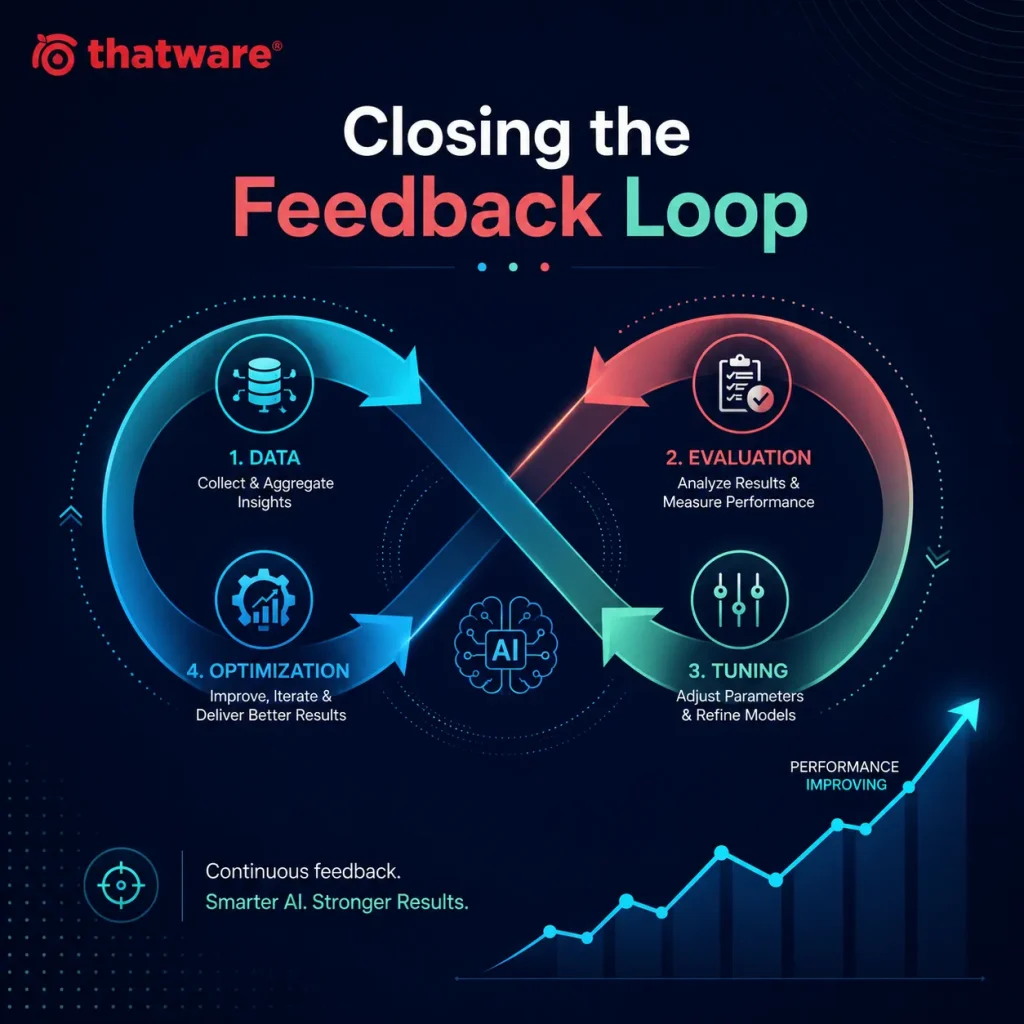
Closing the Loop
Feedback only becomes valuable when it results in a controlled change.
An open loop looks like:
Feedback
↓
Stored
↓
Nothing Happens
A closed loop looks like:
Feedback
↓
Validated
↓
Root Cause Identified
↓
Correction Created
↓
Correction Tested
↓
Correction Deployed
↓
Outcome Measured
The final measurement is essential.
Otherwise the organisation does not know whether the correction actually helped.
Correction Types
Feedback may produce several types of corrective actions.
Knowledge Correction
Update factual information.
Retrieval Correction
Improve:
- chunking
- indexing
- embeddings
- reranking
- filters
Entity Correction
Resolve identity confusion.
Decision Correction
Modify thresholds or recommendation rules.
Prompt Correction
Improve instruction handling.
Policy Correction
Update governance rules.
Tool Correction
Fix tool selection or execution.
UX Correction
Change how answers or warnings are presented.
Learning Actions vs Production Changes
It is helpful to distinguish:
Candidate Learning Action
A proposed improvement.
Example:
{
“learningAction”: “increase_weight_of_primary_sources”,
“status”: “candidate”
}
Validated Production Change
A tested change that has passed review.
{
“learningAction”: “increase_weight_of_primary_sources”,
“status”: “validated”
}
This prevents feedback from directly modifying production behaviour without safeguards.
Regression Testing
Every correction can introduce another problem.
For example:
Fix recommendation for small businesses
↓
Accidentally stop enterprise recommendation entirely
Regression testing asks:
Did the fix break something that previously worked?
A correction may therefore generate a test case.
{
“testCase”: {
“input”: “Enterprise website seeking global AI visibility”,
“expectedOutcome”: “enterprise_geo_candidate”
}
}
Maintaining regression tests can gradually create a stronger AI evaluation suite.
Benchmark Dataset Creation
Validated feedback can be converted into evaluation examples.
Suppose a reviewer confirms:
Question:
What is GEO?
Expected answer characteristics:
Correct definition
No ranking guarantee
Canonical source
This can become a benchmark.
Over time:
Feedback
↓
Validated Examples
↓
Benchmark Dataset
↓
Model / RAG Evaluation
This is more valuable than keeping corrections only in support tickets.
Repeat Error Detection
A single mistake may be accidental.
A repeated mistake may indicate a systemic problem.
Example:
Error: outdated pricing
Occurrences:
47
The Feedback Loop can group similar problems.
Potential trigger:
{
“patternDetection”: {
“errorCategory”: “stale_pricing”,
“threshold”: 5,
“action”: “systemic_review”
}
}
This allows organisations to prioritise root causes rather than fixing answers individually.
Feedback Velocity
Some systems receive thousands of signals per day.
Feedback architecture therefore needs prioritisation.
A useful prioritisation model might consider:
Severity
×
Frequency
×
Business Impact
×
Confidence
A critical incorrect financial statement should receive greater attention than a minor formatting preference.
Again, numerical scoring should only be used when the methodology is defined.
AI Quality Metrics
The Feedback Loop can monitor several metrics.
Answer Accuracy Rate
Percentage of reviewed answers considered factually correct.
Groundedness Rate
Percentage of material claims supported by retrieved evidence.
Citation Support Rate
Percentage of citations that directly support their associated claims.
Retrieval Precision
Percentage of retrieved items relevant to the question.
Retrieval Recall
How much of the necessary information was successfully retrieved.
Repeat Error Rate
How often previously identified errors reappear.
Correction Success Rate
How often implemented corrections resolve the identified problem.
Escalation Rate
How often human intervention is required.
Abstention Quality
Whether the system correctly avoids answering when evidence is insufficient.
User Outcome Rate
Whether users achieve the intended outcome after AI assistance.
Feedback Does Not Equal User Satisfaction
This distinction matters.
A user may dislike a correct answer.
For example:
User asks whether they qualify.
Correct answer: No.
User gives thumbs down.
The negative rating does not prove factual error.
Therefore:
User Satisfaction
≠
Truth
A robust feedback architecture keeps separate dimensions such as:
{
“evaluation”: {
“userSatisfaction”: “negative”,
“factualAccuracy”: “verified_correct”
}
}
This prevents popularity from overriding evidence.
Feedback and AI Hallucination
A Feedback Loop can help detect hallucinations.
Possible indicators include:
- unsupported factual claim
- invented citation
- nonexistent product feature
- fabricated statistic
- incorrect relationship
- invented source
A hallucination event could trigger:
Identify unsupported claim
↓
Check retrieval context
↓
Determine whether evidence was missing or ignored
↓
Update grounding policy
↓
Create regression test
Feedback can reduce repeated hallucination patterns within controlled systems.
It cannot guarantee that a generative model will never hallucinate.
Citation Correction Loop
Citation quality deserves a dedicated workflow.
AI Claim
↓
Citation Selected
↓
Citation Evaluated
↓
Does Source Support Claim?
↓
YES → retain
NO → retrieve stronger source
↓
Update citation preference
Repeated weak citations may indicate:
- source ranking problem
- missing canonical sources
- stale index
- poor chunking
- overreliance on secondary material
Freshness Feedback
Some errors occur because truth changes.
Example:
Monday:
Product supports Feature A.
Friday:
Feature A removed.
Feedback can trigger:
{
“signalType”: “freshness_alert”,
“target”: “primitive:product:feature-a”,
“action”: “revalidate”
}
Freshness feedback is particularly important for:
- prices
- availability
- schedules
- laws
- regulations
- statistics
- leadership
- product features
- service coverage
Human Correction Workflow
A useful enterprise workflow could look like:
Reviewer Flags Output
↓
Correction Submitted
↓
Evidence Attached
↓
Second Review if Required
↓
Correction Approved
↓
Knowledge Updated
↓
Retrieval Index Updated
↓
Evaluation Rerun
↓
Correction Closed
This provides traceability.
User Feedback Workflow
User feedback should typically enter a lower-trust validation stage.
User Feedback
↓
Categorise
↓
Check Similar Feedback
↓
Validate Against Sources
↓
Confirmed?
↓
YES → correction workflow
NO → archive / monitor
This prevents malicious or mistaken feedback from rewriting the system.
Automated Feedback Workflow
Automated evaluators can operate continuously.
For example:
Nightly Evaluation
↓
Sample 1,000 Answers
↓
Check Groundedness
↓
Check Citations
↓
Check Entity Consistency
↓
Generate Quality Report
↓
Escalate Significant Changes
This creates scalable quality assurance.
AI Feedback Loop for AI Search Visibility
For brands focused on GEO, AEO and LLM visibility, feedback can also monitor external AI representation.
Possible observations include:
- brand mentioned correctly
- brand omitted
- wrong brand description
- outdated service information
- competitor recommended instead
- incorrect founder attribution
- unsupported claim associated with brand
- weak or missing citations
A monitoring system could record:
{
“signalType”: “external_ai_observation”,
“platformContext”: “generative_answer”,
“evaluation”: {
“brandEntity”: “correct”,
“serviceDescription”: “outdated”,
“citationPresence”: “missing”
}
}
However, external AI outputs should be treated as observations.
A website cannot force public AI systems to modify their behaviour through the feedback file alone.
GEO Feedback Architecture
A GEO-focused loop might look like:
Target AI Query
↓
Capture AI Response
↓
Evaluate Brand Presence
↓
Evaluate Entity Accuracy
↓
Evaluate Citation
↓
Evaluate Competitor Presence
↓
Identify Knowledge Gap
↓
Improve Authoritative Content
↓
Update Machine-Readable Resources
↓
Re-evaluate Later
This turns AI visibility measurement into an iterative optimisation process.
Answer Engine Optimization Feedback
AEO feedback can evaluate:
- whether direct questions are answered
- whether answers are concise
- whether definitions are clear
- whether supporting evidence exists
- whether answer primitives cover real user questions
Repeated unanswered questions can generate new content requirements.
Example:
User question repeatedly appears
↓
No suitable primitive exists
↓
Knowledge gap detected
↓
Create authoritative webpage section
↓
Create new answer primitive
Feedback can therefore drive content strategy.
Feedback-Driven Content Gap Detection
Traditional content gap analysis often begins with keywords.
AI feedback enables another approach:
Questions AI cannot answer reliably
↓
Missing Knowledge
↓
Content Opportunity
Examples:
- users repeatedly ask pricing questions
- no canonical pricing explanation exists
- AI retrieves inconsistent sources
The feedback system identifies a knowledge gap, not merely a keyword gap.
This can become valuable for AI-first content planning.
Privacy and Feedback Data
Feedback systems may collect sensitive information.
Potential data includes:
- conversation content
- account details
- user comments
- customer IDs
- transaction outcomes
- support information
A mature architecture should therefore define:
- data minimisation
- consent where required
- redaction
- retention
- access control
- deletion procedures
- audit logging
Example:
{
“privacyPolicy”: {
“collectOnlyNecessaryData”: true,
“redactSensitiveFields”: true,
“storeRawConversation”: false
}
}
The precise implementation depends on legal and operational requirements.
Feedback Retention
Not every feedback event needs permanent storage.
Retention might depend on:
- severity
- legal requirements
- debugging value
- privacy
- statistical usefulness
For example:
{
“retention”: {
“criticalIncident”: “long_term”,
“anonymousRating”: “aggregated”,
“rawConversation”: “restricted”
}
}
Feedback Security
A malicious actor may attempt to manipulate AI through feedback.
Examples:
- coordinated false corrections
- adversarial ratings
- poisoned knowledge suggestions
- fake authority claims
Feedback therefore needs validation.
Security principles include:
Do not trust feedback automatically.
Authenticate privileged reviewers.
Require evidence for factual corrections.
Monitor unusual feedback patterns.
Separate feedback collection from production deployment.
Feedback Poisoning
Feedback poisoning occurs when false or malicious signals attempt to influence future behaviour.
For example:
100 fake accounts report:
“Competitor X no longer exists.”
An automatic learning system might incorrectly suppress the competitor.
A governed system should instead require verification from reliable sources.
AI Feedback and Explainability
Users and reviewers may need to understand:
- why an answer was corrected
- why a recommendation changed
- which source was updated
- which rule was responsible
Feedback records can preserve this history.
Example:
{
“correctionExplanation”: {
“previousState”: “Product supports 50 integrations.”,
“newState”: “Product supports 70 integrations.”,
“reason”: “Official documentation updated.”,
“evidence”: “https://example.com/product/”
}
}
This improves auditability.
Feedback Loop Governance
A mature governance model should answer:
- Who can submit feedback?
- Who can approve corrections?
- Which changes require expert review?
- Which changes can be automated?
- How are conflicts resolved?
- How are corrections tested?
- How are rollbacks handled?
- How long is feedback retained?
- Which metrics are monitored?
Example:
{
“governance”: {
“knowledgeChangesRequireApproval”: true,
“decisionRuleChangesRequireTesting”: true,
“criticalChangesRequireHumanReview”: true,
“maintainAuditTrail”: true
}
}
Rollback
Not every improvement works.
A change may reduce performance.
The system should therefore support rollback.
Correction Deployed
↓
Performance Drops
↓
Regression Detected
↓
Rollback
↓
Investigate
Example:
{
“rollbackPolicy”: {
“enabled”: true,
“retainPreviousVersion”: true
}
}
Feedback Versioning
The feedback schema itself may evolve.
Example:
{
“schemaVersion”: “2026.2”
}
Changes might include:
- new error categories
- new quality metrics
- additional feedback sources
- revised correction policies
Versioning helps maintain compatibility.
Public vs Internal ai-feedback-loop.json
A public implementation may document principles such as:
We collect AI quality signals.
Factual corrections require validation.
Critical decisions require human review.
Validated corrections are tested before deployment.
An internal system may contain:
Individual user feedback
Conversation IDs
Internal evaluator scores
Error statistics
Reviewer information
Private knowledge IDs
The two should generally be separated.
Does ai-feedback-loop.json Improve Google Rankings?
There is no established evidence that publishing a custom ai-feedback-loop.json file directly improves Google rankings.
It should not be promoted as:
Add this JSON file and rank higher.
Its value lies in AI quality, machine-readable governance and continuous-improvement architecture.
Indirectly, a strong feedback process may help an organisation improve:
- content accuracy
- source quality
- freshness
- user experience
- structured knowledge
Those improvements may have broader benefits.
But the JSON file itself should not be represented as a confirmed search-ranking factor.
Does ChatGPT Automatically Read ai-feedback-loop.json?
A website should not assume that ChatGPT automatically discovers, reads or obeys a custom AI Feedback Loop file.
The same principle applies to:
- Google Gemini
- Claude
- Perplexity
- Microsoft Copilot
- Grok
- other external LLM systems
The framework becomes directly useful when explicitly integrated into:
- enterprise RAG
- AI assistants
- agent systems
- evaluation pipelines
- machine-readable knowledge infrastructure
- AI governance systems
Common Mistakes to Avoid
Mistake 1: Treating Every Thumbs Down as a Factual Error
User dissatisfaction and factual accuracy are different variables.
Mistake 2: Automatically Learning From Unverified Feedback
Feedback should create a candidate correction, not immediately rewrite truth.
Mistake 3: Recording Feedback Without Root-Cause Analysis
Knowing an answer was wrong is less useful than knowing why.
Mistake 4: Focusing Only on Model Errors
Many AI failures originate in:
- content
- retrieval
- entities
- rules
- freshness
- tools
Mistake 5: No Closed Loop
If feedback never results in validated improvement, the architecture becomes only a logging system.
Mistake 6: Ignoring Positive Signals
Successful outputs can reveal valuable patterns.
Mistake 7: No Regression Tests
A correction can create new failures.
Mistake 8: No Feedback Authority Model
A random anonymous report should not always have the same authority as verified evidence.
Mistake 9: Exposing Private Feedback Publicly
Individual feedback records may contain sensitive information.
Mistake 10: No Rollback
AI improvements should be reversible.
Mistake 11: Optimising Only for User Satisfaction
Systems should not learn to provide inaccurate answers merely because users prefer them.
Mistake 12: Using Fake Precision
Do not assign arbitrary confidence scores without methodology.
Mistake 13: Allowing Feedback Poisoning
Feedback inputs should be monitored and validated.
Mistake 14: No Version Control
Organisations should be able to determine what changed and when.
Implementation Process
Step 1: Identify AI Outputs
Determine what needs evaluation.
Examples:
- answers
- recommendations
- citations
- retrieval results
- decisions
- agent actions
Step 2: Identify Feedback Sources
Define sources such as:
- users
- reviewers
- evaluators
- business systems
- monitoring tools
Step 3: Create a Feedback Taxonomy
Define categories.
Examples:
correct
incorrect
outdated
unsupported
irrelevant
incomplete
unsafe
policy_violation
Step 4: Define Evaluation Dimensions
Determine what quality means.
Possible dimensions:
- accuracy
- groundedness
- usefulness
- completeness
- freshness
- citation quality
- recommendation fit
Step 5: Define Severity
Separate minor issues from critical failures.
Step 6: Create Root-Cause Categories
Determine which AI layer caused the issue.
Step 7: Define Validation Rules
Specify how feedback becomes verified.
Step 8: Define Correction Actions
Map root causes to appropriate changes.
Step 9: Add Human Review
Determine which corrections require approval.
Step 10: Create Regression Tests
Turn validated errors into future tests.
Step 11: Add Versioning
Track:
- knowledge changes
- decision-rule changes
- retrieval changes
- feedback-schema changes
Step 12: Add Rollback
Preserve previous working states.
Step 13: Track Outcomes
Measure whether corrections improve performance.
Step 14: Monitor Repeat Errors
Identify systemic issues.
Step 15: Close the Loop
Ensure validated improvements feed back into the appropriate systems.
Validation Checklist
Before deploying an AI Feedback Loop, verify:
- JSON syntax is valid.
- Metadata exists.
- Version information is included.
- Feedback IDs are unique.
- Feedback targets are identifiable.
- Signal types are controlled.
- Feedback sources are recorded.
- Evaluation criteria are defined.
- Severity levels are consistent.
- Root-cause taxonomy exists.
- Feedback reliability is considered.
- Corrections require appropriate validation.
- High-risk changes require human review.
- Personal information is protected.
- Retention policies exist.
- Feedback conflicts can be resolved.
- Regression tests are generated where useful.
- Rollback is available.
- Repeat errors can be identified.
- Positive and negative signals are recorded.
- User satisfaction is separated from factual truth.
- Unverified feedback cannot directly rewrite production knowledge.
- Decision-rule changes are tested.
- Knowledge corrections retain evidence.
- Learning outcomes are measured.
- External AI systems are not assumed to consume the file automatically.
Example Connection With ai-endpoints.json
An endpoint registry might contain:
{
“resources”: {
“feedbackLoop”: “https://example.com/ai-feedback-loop.json”,
“decisionLayer”: “https://example.com/ai-decision-layer.json”,
“answerPrimitives”: “https://example.com/ai-answer-primitives.json”,
“knowledgeGraph”: “https://example.com/knowledge-graph.json”
}
}
The endpoint resource identifies the Feedback Loop.
The Feedback Loop defines improvement governance.
Example Connection With ai.txt
# AI Governance Resources
AI Feedback Loop:
AI Decision Layer:
AI Answer Primitives:
This can document machine-readable resources.
It does not guarantee external platform ingestion.
Example Connection With llms.txt
## AI Feedback and Quality
Machine-readable AI feedback, evaluation and continuous-improvement principles:
The Full Closed-Loop AI Architecture
A useful way to understand the entire system is:
ENTITY
What is this?
↓
KNOWLEDGE
What do we know?
↓
CONTEXT
What matters now?
↓
RETRIEVAL
What information should be fetched?
↓
ANSWER
What can be said?
↓
REASONING
How is the evidence connected?
↓
DECISION
What should happen?
↓
ACTION
What did the AI do?
↓
FEEDBACK
Was it correct and useful?
↓
CORRECTION
What should change?
↓
VALIDATION
Did the change improve the system?
↓
UPDATED AI SYSTEM
The Feedback Loop converts a linear AI pipeline into a learning cycle.
From Static AI Infrastructure to Adaptive AI Infrastructure
A static AI system can be well-designed initially.
But every system eventually encounters change.
An adaptive AI infrastructure continually asks:
What worked?
What failed?
Why?
What changed?
What should be corrected?
Did the correction work?
That does not mean unrestricted self-learning.
The strongest architecture is controlled adaptation.
Humans, evidence, policies and testing remain part of the loop.
Feedback as Organisational Memory
Feedback also provides historical intelligence.
Over time an organisation can understand:
- which questions repeatedly cause errors
- which sources produce unreliable answers
- which entities are commonly confused
- which recommendations perform best
- which corrections recur
- which information becomes stale fastest
This creates a valuable operational dataset.
The organisation no longer knows only:
What does our AI currently say?
It can also know:
Where does our AI consistently struggle?
That information can influence:
- content strategy
- AI architecture
- product documentation
- customer support
- SEO
- GEO
- AEO
- knowledge management
Strategic Value for GEO and AI Visibility
AI visibility should not be treated as a one-time implementation exercise.
An organisation may initially improve its machine-readable presence.
But AI systems evolve.
Prompts change.
Competitors publish new information.
External citations change.
Brands need ongoing measurement.
A Feedback Loop enables an iterative approach:
Measure AI Visibility
↓
Identify Representation Gaps
↓
Diagnose Why
↓
Improve Authoritative Knowledge
↓
Improve Structured Resources
↓
Re-measure
This is much more sustainable than publishing AI files once and assuming the job is complete.
The Feedback Flywheel
A well-governed AI system can develop a flywheel:
More AI Usage
↓
More Feedback
↓
Better Error Detection
↓
Better Knowledge
↓
Better Retrieval
↓
Better Decisions
↓
Better AI Outcomes
↓
More Useful AI Usage
The key requirement is quality control.
Bad feedback fed blindly into the system can create the opposite flywheel.
Final Summary
ai-feedback-loop.json is a proposed machine-readable architecture for governing how AI systems learn from outputs, evaluations, corrections and downstream outcomes.
It can describe:
- feedback sources
- feedback events
- evaluation dimensions
- severity
- root causes
- correction actions
- review requirements
- validation
- regression testing
- outcome tracking
- privacy
- retention
- feedback authority
- rollback
- continuous-improvement policies
Its role within an AI stack can be summarised as follows.
Entity Registry
Defines what something is.
Knowledge Graph
Defines how things are connected.
Brand Memory
Defines what should be remembered.
Context Engine
Defines what matters in the current situation.
AI Answer Primitives
Define what reusable knowledge can be said.
Reasoning Map
Defines useful reasoning relationships.
AI Decision Layer
Defines what should happen.
AI Feedback Loop
Determines what happened and what should improve next.
The Feedback Loop closes the system.
Without feedback:
AI
→ Answer
→ End
With feedback:
AI
→ Answer
→ Evaluation
→ Correction
→ Validation
→ Better AI
→ Evaluation
→ Continued Improvement
The goal should not be uncontrolled self-learning.
The goal should be evidence-driven, governed and measurable improvement.
A robust AI Feedback Loop should therefore know:
- which feedback can be trusted
- which feedback requires verification
- where the actual problem occurred
- which system component should be changed
- whether human approval is necessary
- whether the correction improved performance
- when the change should be rolled back
As AI systems become increasingly embedded in search, customer service, recommendations, enterprise operations and autonomous workflows, quality cannot depend only on the initial system design.
AI infrastructure must also become capable of learning from its own outcomes in a controlled way.
That is the role ai-feedback-loop.json is designed to support.



