FILL OUT THE FORM BELOW & ALLOW US TO TAKE YOUR SEO TO A WHOLE NEW LEVEL!
The way people search for information has changed dramatically over the past few years. Traditional search engine optimization once revolved around achieving higher rankings on Google’s search engine results pages (SERPs), optimizing web pages around target keywords, and building backlinks to improve authority. While these fundamentals continue to play an important role, the modern search landscape has evolved into something much more intelligent, conversational, and AI-driven.
Today, users no longer rely solely on the familiar list of blue links. They expect direct, comprehensive answers from Google AI Overviews, ChatGPT, Gemini, Perplexity, and other large language model (LLM)-powered search platforms. Instead of simply displaying relevant webpages, these systems analyze, summarize, and recommend information from sources they consider trustworthy and authoritative. As a result, businesses are no longer competing only for rankings—they are competing to become the information source AI systems choose to reference.
This transformation has significantly raised the bar for organizations operating in highly sensitive industries such as healthcare, education, and therapy services. Parents searching for autism support, behavioural therapy, or special education are making deeply personal and often life-changing decisions. They want reliable answers, credible recommendations, and organizations that demonstrate genuine expertise. Simply appearing on the first page of Google is no longer enough. Brands must establish trust, topical authority, semantic relevance, and a strong digital identity that search engines and AI models can confidently understand and recommend.
This is precisely where Aaryavart Centre for Autism and Special Needs Foundation set its sights.
As a dedicated institution providing autism therapy, behavioural therapy, occupational therapy, speech therapy, and special education services, Aaryavart had a much broader vision than improving keyword rankings. The organization wanted to establish itself as one of the most trusted behavioural therapy schools in Lucknow, become a leading autism centre recognized by families across the region, serve as an authoritative educational resource for parents, and build a recognizable digital entity capable of appearing across both traditional search engines and emerging AI-powered search experiences.
Achieving this vision required far more than conventional SEO.
At ThatWare, we approached the project with a comprehensive AI-first search strategy that combined Advanced SEO, Semantic SEO, Answer Engine Optimization (AEO), Generative Engine Optimization (GEO), Entity Optimization, Technical SEO, and AI Visibility Engineering. Rather than optimizing individual pages in isolation, we developed an integrated digital ecosystem designed to strengthen authority, improve discoverability, satisfy user intent, and enhance visibility across both Google Search and modern AI ecosystems.
This case study explores how we transformed Aaryavart’s digital presence from a newly developed website into a growing authority recognized across traditional search engines, Google AI Overviews, and AI-powered answer platforms.
Understanding the Client & Business Objectives
Aaryavart Centre for Autism and Special Needs Foundation is dedicated to supporting children with autism and other developmental needs through evidence-based education and therapeutic care. The organization offers a multidisciplinary approach that combines behavioural therapy, occupational therapy, speech therapy, special education, and parent-focused support programs to help every child achieve meaningful developmental progress.
Unlike many educational institutions that primarily focus on admissions, Aaryavart’s mission extends much further. The organization aims to build awareness, educate families, provide scientifically supported interventions, and become a trusted destination where parents can confidently seek guidance for their children’s developmental journey.
However, fulfilling this mission requires visibility.
Parents often begin their journey online by searching for terms such as “best behavioural therapy school in Lucknow,” “autism centre in Lucknow,” “special school for autistic children,” or “occupational therapy school near me.” Increasingly, these searches are no longer limited to Google Search alone. Families also rely on Google AI Overviews, ChatGPT, and other conversational AI assistants to compare options, understand therapy approaches, and identify reputable institutions.
For Aaryavart, the business objectives were therefore closely aligned with its digital objectives.
The organization sought to become the preferred behavioural therapy school in Lucknow while significantly increasing qualified parent enquiries generated through organic search. It also aimed to strengthen local brand authority, improve trust among families, establish long-term digital credibility, and educate parents through valuable, informative content rather than relying solely on promotional messaging.
These goals required far more than simply ranking for a handful of keywords. Success depended on becoming an authoritative source of knowledge that could answer parents’ questions across every stage of their decision-making journey.
At ThatWare, we understood that modern search behaviour spans multiple discovery platforms. Parents may first encounter a Google search result, continue exploring through AI-generated summaries, ask ChatGPT for recommendations, and then compare multiple providers before making contact. To remain visible throughout this entire journey, Aaryavart needed a comprehensive search strategy that extended beyond conventional SEO and positioned the brand as a trusted digital authority across both search engines and AI-powered answer systems.
The Digital Challenges Standing Between Aaryavart and Its Audience
Although Aaryavart possessed the expertise and commitment necessary to support children with autism and special needs, its digital presence had not yet evolved into an authoritative resource capable of competing within an increasingly competitive online environment. Building visibility required overcoming multiple interconnected challenges that extended well beyond keyword optimization.
Competing in an Extremely Competitive Healthcare and Education Market
The autism therapy and special education landscape has become increasingly competitive, particularly in metropolitan and rapidly developing cities such as Lucknow. Numerous institutions compete for visibility across similar service offerings, targeting overlapping keywords and local audiences. Established organizations with stronger digital histories often dominate search results, making it difficult for newer websites to gain immediate traction.
For Aaryavart, success depended not only on demonstrating professional expertise but also on communicating trust, credibility, and authority more effectively than competing providers.
Building Authority for a Newly Developed Website
Launching a new website presents significant challenges regardless of industry. Without an established backlink profile, topical authority, or extensive historical signals, search engines require substantial evidence before recognizing a website as a reliable source of information.
From an AI perspective, the challenge becomes even greater. Large language models rely on semantic relationships, entity understanding, structured content, and digital trust signals when selecting sources to reference. A newly developed website must therefore establish credibility across multiple dimensions simultaneously.
Winning Local Search Visibility
Most prospective parents search for educational and therapeutic services within their local region. Queries such as “autism centre in Lucknow,” “behavioural therapy school in Lucknow,” and “special school for autistic children in Lucknow” carry strong commercial and informational intent.
Achieving visibility for these searches requires more than keyword placement. It demands a carefully structured local SEO strategy supported by location-specific content, optimized landing pages, local authority signals, structured data, citation consistency, and geographically relevant semantic associations.
Overcoming Technical SEO Limitations
Search visibility also depends heavily on technical excellence.
Website performance, crawlability, page speed, Core Web Vitals, navigation structure, mobile responsiveness, indexing efficiency, and overall user experience all influence how search engines evaluate website quality.
Without addressing these technical foundations, even well-written content may struggle to achieve sustainable visibility.
AI Search Visibility Was Practically Non-Existent
Perhaps the most significant challenge involved preparing Aaryavart for the future of search.
Traditional SEO focuses on helping webpages rank within conventional search results. AI-driven discovery operates differently.
Platforms such as Google AI Overviews and ChatGPT prioritize content that demonstrates semantic clarity, entity relationships, topical depth, contextual relevance, structured information, and trustworthy expertise.
Simply ranking on Google does not automatically guarantee inclusion within AI-generated answers.
To become visible across modern AI ecosystems, Aaryavart required an entirely different layer of optimization focused on helping AI systems understand, interpret, and confidently recommend its content.
These were not isolated SEO issues that could be solved independently. Together, they represented a complex digital transformation challenge requiring an integrated strategy that combined traditional SEO with advanced AI Search Optimization, Semantic SEO, Answer Engine Optimization, and Generative Engine Optimization.
ThatWare’s Strategic Blueprint – Engineering Visibility Instead of Chasing Rankings
At ThatWare, we believe successful SEO campaigns should never be measured solely by keyword positions. Rankings are important, but they are only one outcome of a much larger objective: building genuine digital authority that search engines and AI systems recognize as trustworthy.
For Aaryavart, we adopted a strategy centered on engineering visibility rather than chasing rankings.
Instead of optimizing isolated webpages, we focused on understanding search intent, strengthening entity relationships, improving semantic relevance, enhancing AI readability, expanding topical authority, and reinforcing the trust signals that influence both traditional search algorithms and modern AI retrieval systems.
This required us to build a unified optimization framework rather than relying on disconnected SEO activities.
Our campaign combined Advanced SEO, Technical SEO, Semantic SEO, Answer Engine Optimization (AEO), Generative Engine Optimization (GEO), Entity Optimization, User Experience Optimization, and Content Intelligence into one integrated strategy.
Every optimization decision—from technical improvements and content architecture to internal linking and structured information—was designed to help search engines better understand Aaryavart’s expertise while simultaneously making the content easier for AI systems to interpret, summarize, and recommend.
Rather than pursuing short-term ranking gains, our objective was to establish Aaryavart as a credible digital authority capable of sustaining long-term visibility across Google’s search results and the rapidly evolving AI search ecosystem.
Search Intent Engineering – Building Content That Google and AI Actually Wanted
Search engines have one primary objective: delivering the most helpful answer to every user’s query.
Achieving high rankings therefore depends less on inserting keywords into webpages and more on understanding why users perform specific searches in the first place.
At ThatWare, our first priority was decoding the search intent behind every major keyword relevant to Aaryavart’s services.
Rather than treating keywords as isolated ranking opportunities, we grouped them according to the questions parents were trying to answer, the services they were comparing, the information they needed, and the actions they were most likely to take. This allowed us to create content that addressed every stage of the user journey while satisfying both Google’s ranking systems and AI-powered answer engines.
Our strategy was built around the three fundamental pillars of search intent: Content Type, Content Format, and Content Angle.
Content Type
Different search queries require different types of pages.
Someone searching for “autism therapy in Lucknow” expects a detailed service page, while a parent researching autism interventions may benefit more from an educational article or comprehensive guide.
To align with these varying expectations, we strategically developed and optimized multiple content formats, including service pages, landing pages, educational blogs, and category-specific resources. Each page was mapped to the most appropriate user intent, allowing Google to deliver highly relevant results while strengthening the website’s overall topical architecture.
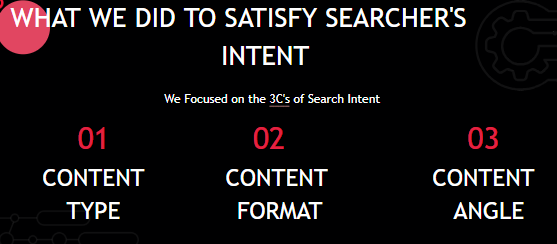
Content Format
Once the appropriate content type had been identified, we carefully determined the most effective presentation format for each topic.
Educational guides explained therapeutic approaches in accessible language. Service pages highlighted treatment methodologies and patient-focused outcomes. Informative articles addressed frequently asked parent questions, helping families better understand autism, behavioural therapy, occupational therapy, speech therapy, music therapy, and physiotherapy.
By presenting complex healthcare information in a structured, reader-friendly format, we improved both user engagement and AI readability.
Content Angle
Providing information alone is rarely sufficient in healthcare.
Parents need confidence.
They seek trustworthy providers, evidence-based practices, experienced professionals, and compassionate care.
Accordingly, our content strategy emphasized authority, transparency, educational value, local relevance, and genuine trust. Every page was designed not only to answer questions but also to reassure parents that Aaryavart possesses the expertise and commitment necessary to support children with special needs.
This trust-focused approach aligns closely with the signals that both search engines and AI systems increasingly prioritize.
Building Topical Authority Through Strategic Keyword Clustering
Instead of chasing isolated keywords, we developed comprehensive topical clusters that connected closely related services into a unified knowledge ecosystem.
Our optimization strategy revolved around themes such as autism therapy, behavioural therapy, occupational therapy, speech therapy, music therapy, physiotherapy, special education, and autism-focused schools in Lucknow.
Each cluster reinforced the others through contextual internal linking, semantic relationships, and supporting educational content. This interconnected structure helped search engines recognize Aaryavart as an increasingly authoritative resource while enabling AI systems to better understand the breadth and depth of its expertise.
Rather than creating standalone pages targeting individual search terms, we built an ecosystem of knowledge that strengthened relevance across hundreds of related queries—an approach that proved instrumental in improving both traditional search performance and AI visibility.
Technical SEO & User Experience Optimization – Building a Website Search Engines Could Trust
An effective SEO strategy extends far beyond content creation and keyword targeting. Before search engines can confidently rank a website, they must first determine whether it delivers a reliable, fast, secure, and user-friendly experience. Technical SEO forms the backbone of this evaluation, ensuring that every page can be efficiently crawled, indexed, and interpreted.
For Aaryavart Centre for Autism and Special Needs Foundation, our objective was not simply to optimize individual pages but to establish a technically robust digital foundation capable of supporting long-term organic growth and AI visibility. Since the website was relatively new, strengthening its technical architecture became one of the earliest priorities in our campaign.
Every technical improvement we implemented was designed with two goals in mind: enhancing user experience for parents seeking autism therapy and behavioural therapy services, while simultaneously making the website easier for Google’s algorithms and AI retrieval systems to understand.
Optimizing Core Web Vitals
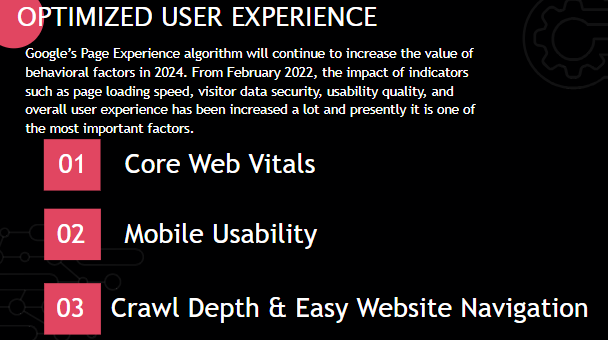
Google’s Page Experience algorithm increasingly rewards websites that deliver fast, stable, and responsive experiences. Core Web Vitals have therefore become an important component of modern SEO because they directly measure how users interact with a website.
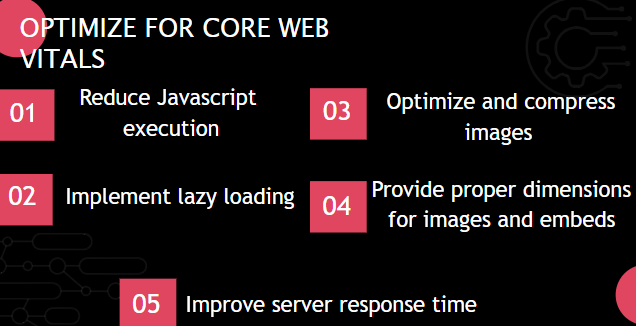
Our optimization strategy focused on improving every major performance signal affecting usability. We reduced unnecessary JavaScript execution to decrease rendering delays, implemented lazy loading so that media assets loaded only when required, optimized and compressed images without sacrificing visual quality, assigned proper dimensions to images and embedded content to minimize layout shifts, and improved server response time to accelerate page delivery.
Collectively, these enhancements helped create a smoother browsing experience for visitors while strengthening the website’s technical quality from Google’s perspective.
Enhancing Mobile User Experience
Most parents searching for behavioural therapy schools, autism centres, or special education facilities begin their research using smartphones. A poor mobile experience can quickly discourage potential visitors, regardless of how informative the content may be.
To address this, we ensured that Aaryavart’s website provided a fully responsive experience across devices. Navigation remained intuitive, page layouts adapted seamlessly to different screen sizes, and important service information remained easily accessible without unnecessary scrolling or interaction barriers.
Improving mobile usability not only supports Google’s mobile-first indexing but also encourages users to spend more time exploring therapy programs, educational resources, and service offerings.
Improving Crawlability and Website Architecture
Search engines can only rank content they can efficiently discover.
Our technical optimization therefore extended beyond page speed into the website’s overall architecture. We improved crawl depth by simplifying the site’s hierarchy, allowing search engine bots to access important pages more efficiently. Navigation was refined to create clearer pathways between related therapy services and educational resources, while strategic internal linking strengthened semantic relationships throughout the website.
This structured architecture helped Google better understand how different service pages connected within Aaryavart’s overall topical expertise while simultaneously improving user navigation.
Performance Optimization for Long-Term Growth
Beyond user-facing improvements, we implemented several backend optimizations designed to support long-term scalability. Image compression reduced page weight, JavaScript optimization improved rendering efficiency, lazy loading minimized unnecessary resource consumption, and server-side enhancements contributed to faster page delivery across the website.
Although these improvements are often invisible to visitors, they play a critical role in modern search performance.
Technical SEO no longer influences only Google’s ranking algorithms. AI-powered search platforms also rely on technically organized websites because structured, accessible, and well-performing pages are easier to interpret, summarize, and retrieve. By strengthening Aaryavart’s technical infrastructure, we created a foundation that supported both traditional organic rankings and emerging AI-driven search experiences.
Building AI Visibility Through Advanced AEO, GEO & Semantic SEO
Traditional SEO gets clicks.
AI SEO gets citations.
This distinction represents one of the most significant shifts in modern search.
For years, SEO campaigns focused primarily on improving rankings within Google’s search results. Today, however, users increasingly receive direct answers from AI-powered systems before they ever click on a website. Google AI Overviews, ChatGPT, Gemini, Perplexity, and other generative search platforms analyze information from multiple sources and recommend content they consider trustworthy, relevant, and authoritative.
This means that ranking on Google’s first page is no longer the final objective. The greater opportunity lies in becoming one of the trusted sources these AI systems rely upon when generating answers.
Recognizing this shift, we designed Aaryavart’s optimization strategy around both traditional search visibility and AI discoverability.
Strengthening Entity Recognition
Modern search engines no longer evaluate websites solely through keywords. They increasingly rely on entities—people, organizations, services, locations, and their relationships—to understand the real meaning behind content.
Our optimization strategy therefore focused on strengthening Aaryavart’s entity profile across multiple dimensions.
We reinforced the brand entity by consistently establishing Aaryavart Centre for Autism and Special Needs Foundation as an authoritative organization specializing in autism care and behavioural therapy.
We strengthened the location entity by emphasizing Lucknow throughout relevant service pages, allowing search engines to better associate Aaryavart with location-specific search intent.
Similarly, we enhanced service entities surrounding behavioural therapy, autism therapy, occupational therapy, speech therapy, physiotherapy, music therapy, and special education. These semantic relationships contribute to stronger topical authority and improve how search engines interpret the website within their broader knowledge systems.
Building Semantic Authority
Keywords alone cannot adequately communicate expertise.
Instead, we developed a semantic content architecture built around natural language processing principles. Related services, educational resources, therapy methodologies, and parent-focused guidance were interconnected through contextual content clusters rather than isolated landing pages.
This approach enabled search engines to understand the relationships between topics while demonstrating that Aaryavart possessed broad expertise across multiple aspects of autism education and therapy.
Rather than optimizing for individual phrases, we optimized for complete subject understanding.
Answer Engine Optimization (AEO)
One of the defining characteristics of AI-powered search is its preference for content that answers questions directly.
Accordingly, we implemented Answer Engine Optimization by structuring content around real parent queries instead of focusing exclusively on keywords.
Service pages answered common concerns surrounding behavioural therapy and autism support. Educational content was organized using descriptive headings, concise explanations, structured sections, and question-driven formatting that made information easier for both users and AI systems to understand.
This format increases the likelihood of appearing within featured snippets, AI-generated summaries, and answer-based search experiences.
Generative Engine Optimization (GEO)
Generative search platforms retrieve information differently from traditional search engines.
Instead of matching keywords alone, they evaluate topical authority, semantic clarity, contextual relationships, structured information, and overall trustworthiness before incorporating content into AI-generated responses.
Our GEO strategy therefore focused on producing content that AI systems could easily retrieve and summarize. Service pages incorporated structured headings, entity-rich language, location relevance, semantic consistency, and clear informational hierarchy, enabling Google AI Overviews and conversational AI systems to better understand Aaryavart’s expertise.
This strategy helped position the website for visibility across modern AI search environments rather than limiting discoverability to conventional search results.
Optimizing for Long-Tail Conversational Queries
Parents rarely search using isolated keywords.
Instead, they ask complete questions such as:
“Can you help me find the best behavioral therapy school in Lucknow?”
“Which autism centre in Lucknow provides occupational therapy?”
Recognizing this behavioural shift, we optimized content around conversational language, natural sentence structures, and long-tail informational queries. This approach closely mirrors how users interact with AI assistants and significantly improves retrieval opportunities across LLM-powered platforms.
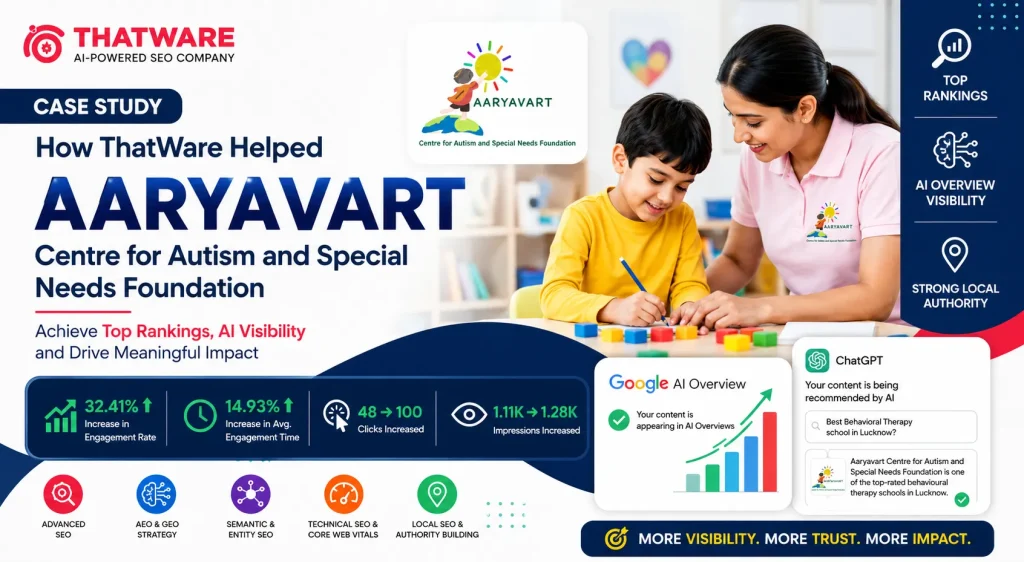
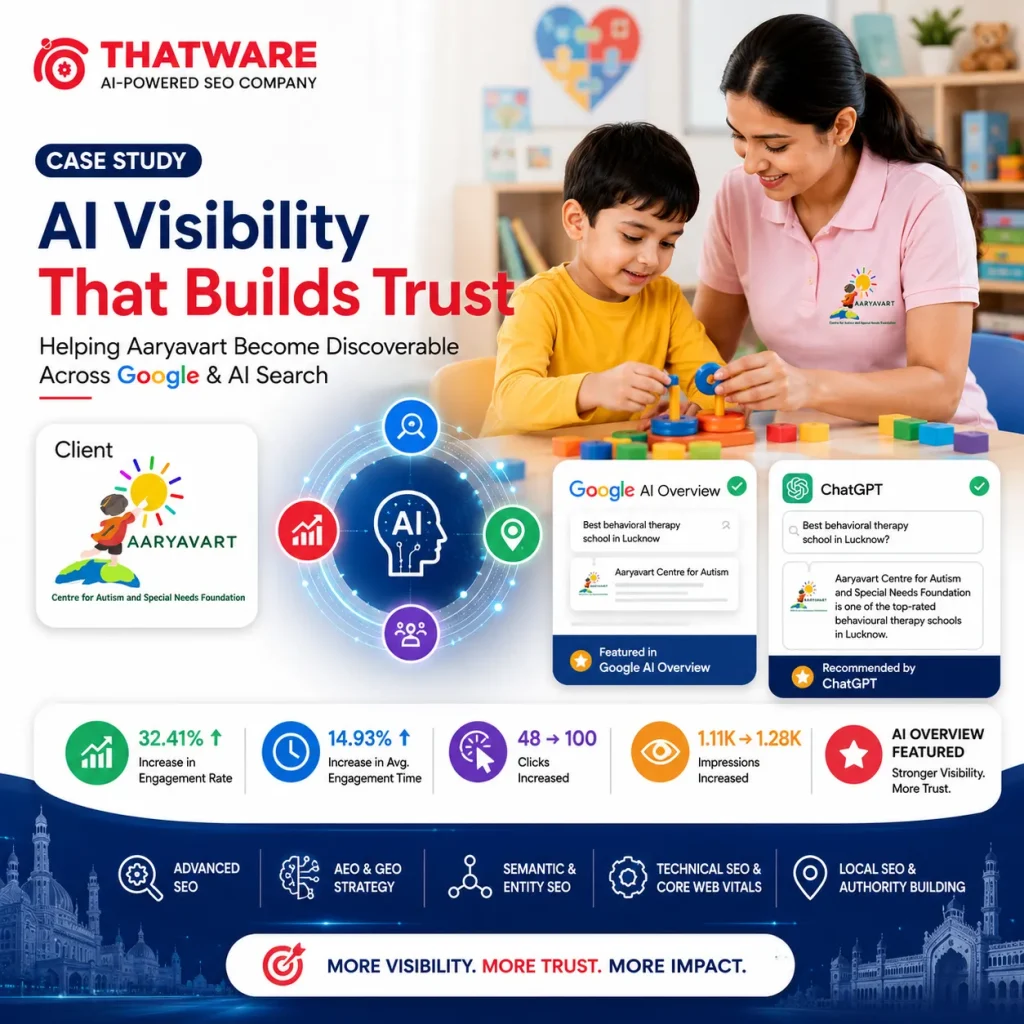
One of the strongest validations of our AI optimization strategy came when Google’s AI Overview selected Aaryavart’s content for competitive behavioural therapy-related searches. This placement demonstrates that Google’s AI systems considered the website sufficiently authoritative, semantically relevant, and trustworthy to be referenced within AI-generated answers—an increasingly valuable source of organic visibility.
The ChatGPT screenshot further reinforces this achievement. When presented with a natural-language request to identify the best behavioural therapy school in Lucknow, ChatGPT referenced Aaryavart Centre for Autism and Special Needs Foundation while highlighting its core therapy services and educational offerings.
This outcome illustrates the growing importance of optimizing for AI retrieval rather than rankings alone. By combining semantic SEO, entity optimization, structured content, and conversational formatting, we positioned Aaryavart to become discoverable across both traditional search engines and emerging AI-powered answer platforms.
Campaign Performance – Measuring Growth Across Search & AI
Every optimization initiative ultimately needs to produce measurable business outcomes. Throughout the campaign, we continuously monitored organic visibility, user engagement, keyword growth, authority metrics, and backlink acquisition to evaluate the effectiveness of our strategy.
The resulting improvements demonstrate how a structured combination of technical SEO, semantic optimization, local SEO, and AI-focused strategies contributed to stronger digital performance.
Google Search Console Performance
Google Search Console recorded measurable improvements in overall search visibility during the comparison period.
As shown in the performance report below, total impressions increased from 1.11K to 1.28K, while total clicks increased from 48 to 100.
These improvements indicate that Aaryavart’s pages were appearing for more relevant searches and attracting a significantly higher number of users through Google’s organic search results.
Google Analytics Performance
Search visibility alone does not guarantee success if users fail to engage with a website.
Google Analytics demonstrated encouraging improvements in visitor behaviour as well.
During the 28-day comparison period, the website achieved a 32.41% increase in Engagement Rate together with a 14.93% increase in Average Engagement Time per Session.
These metrics suggest that visitors were interacting more meaningfully with the website, exploring content for longer periods, and finding greater value in the information presented.
Organic Traffic & Keyword Growth
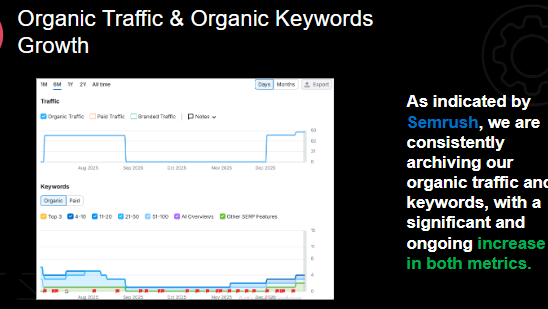
According to Semrush data, Aaryavart experienced continuous growth in both organic traffic and ranking keywords throughout the campaign.
Rather than relying on isolated keyword improvements, the website steadily expanded its visibility across a broader range of therapy-related and location-specific search queries, reflecting the success of our topical authority strategy.
Strengthening the Backlink Profile
Authority remains one of the strongest indicators of trust in organic search.
As part of our off-page optimization strategy, we successfully built 946 backlinks, strengthening the website’s overall backlink profile and improving its digital authority across relevant domains.
This growing network of referring sources contributes additional credibility while supporting long-term search performance.
[Insert Screenshot – Backlinks Insights]
Building Domain Authority
The campaign also strengthened the website’s overall authority profile.
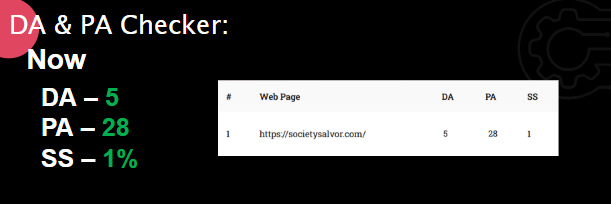
At the time of reporting, the website recorded:
- Domain Authority (DA): 5
- Page Authority (PA): 28
- Spam Score (SS): 1%
These metrics indicate a healthy authority profile with a low spam score while establishing a strong foundation for continued long-term growth.
The Business Impact Beyond Rankings
While keyword rankings remain an important performance indicator, they represent only one component of a successful digital transformation strategy.
The real objective of this campaign was to strengthen Aaryavart’s ability to connect with families actively seeking trusted autism education and behavioural therapy services.
By improving visibility across traditional search engines, Google AI Overviews, and conversational AI platforms, the organization significantly expanded the number of opportunities through which parents could discover its services.
Greater visibility naturally contributes to stronger brand recognition, increased trust, and higher confidence among prospective families. When parents repeatedly encounter the same organization across Google Search, AI-generated summaries, and conversational search platforms, that consistency reinforces credibility throughout the decision-making process.
Equally important, the campaign positioned Aaryavart for the future of digital discovery. Rather than optimizing solely for today’s ranking factors, we developed a scalable digital presence capable of adapting to the growing influence of AI-powered search experiences.
Ultimately, stronger visibility translates into more qualified enquiries, greater awareness within the local community, and increased opportunities to support children and families seeking specialized autism care.
Why This Campaign Worked – The ThatWare Difference
This campaign succeeded because we never viewed SEO as an isolated activity.
Many optimization projects focus primarily on keyword placement or backlink acquisition. While these elements remain valuable, they alone are no longer sufficient to compete in today’s AI-driven search landscape.
At ThatWare, we approached Aaryavart’s growth through a unified optimization framework that combined Technical SEO, Semantic SEO, Entity Optimization, AI SEO, Answer Engine Optimization (AEO), Generative Engine Optimization (GEO), User Experience Optimization, Search Intent Engineering, Natural Language Processing principles, Local SEO, and AI Visibility Engineering.
Each discipline reinforced the others.
Technical SEO created a reliable website infrastructure.
Semantic SEO strengthened topical understanding.
Entity optimization improved contextual recognition.
Search intent optimization aligned content with user expectations.
AEO prepared content for direct answers.
GEO positioned information for AI retrieval.
Together, these strategies enabled Aaryavart to build meaningful visibility not only across Google’s traditional search results but also within AI-generated answers where the future of online discovery is rapidly evolving.
Rather than chasing algorithm updates, we focused on building sustainable digital authority—and that distinction made the difference.
Conclusion – Building Search Visibility for the AI Era
The evolution of search has fundamentally changed how organizations build online visibility.
Success is no longer determined solely by rankings on Google’s search results pages. Increasingly, it depends on whether search engines and AI systems recognize a brand as a trustworthy, authoritative source worthy of recommendation.
Through a carefully integrated strategy combining Advanced SEO, Technical SEO, Semantic SEO, Entity Optimization, Answer Engine Optimization, Generative Engine Optimization, and AI Visibility Engineering, we helped Aaryavart Centre for Autism and Special Needs Foundation strengthen its presence across both traditional search and emerging AI-powered discovery platforms.
The campaign demonstrates that sustainable digital growth is achieved by building expertise, trust, relevance, and technical excellence—not by pursuing rankings alone.
As AI continues to reshape how users discover information, organizations operating in healthcare, education, and other trust-sensitive industries must begin optimizing not only for search engines but also for AI-powered answer ecosystems. Those that invest in both today will be significantly better positioned to earn visibility, credibility, and long-term growth in the search landscape of tomorrow.