
SUPERCHARGE YOUR ONLINE VISIBILITY! CONTACT US AND LET’S ACHIEVE EXCELLENCE TOGETHER!
Artificial intelligence is changing how brands are discovered, understood, and cited across digital platforms. Traditional FAQ pages help users find answers, but modern AI systems require machine-readable FAQ resources that provide consistent, authoritative information. This is where faq json becomes an essential part of modern AI discovery FAQ infrastructure. Acting as a centralized FAQ manifest, it organizes structured FAQ data into a format that AI systems can efficiently retrieve, interpret, and cite. By creating a reliable AI FAQ index, brand FAQ JSON, and FAQ knowledge resource, organizations can improve enterprise FAQ SEO, strengthen answer engine optimization, support LLM SEO FAQ, and make AI-readable questions available through a trusted FAQ resource file built on semantic organization and rich FAQ metadata.
1. What Is faq json?
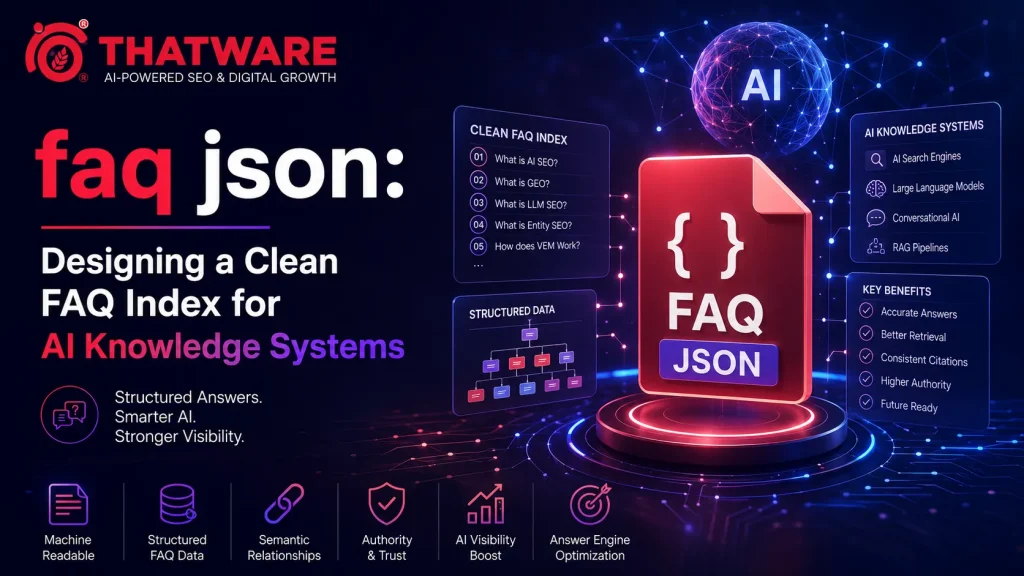
faq json is a machine-readable JSON file that represents the complete collection of official questions and answers published by an organization.
It defines:
- official frequently asked questions
- canonical answers
- question categories
- semantic intent
- related products or services
- supporting documentation
- preferred citation URLs
- evidence supporting answers
- answer relationships
- machine-readable summaries
In simple terms, it tells AI systems:
“These are the official questions our organization answers, these are the approved responses, and these are the preferred resources to use when understanding or citing our knowledge.”
Unlike traditional FAQ pages, faq json serves as a centralized FAQ manifest that acts as a dedicated FAQ resource file for AI systems.
It organizes machine-readable FAQ content into structured FAQ data, allowing AI search engines, Large Language Models, and retrieval systems to build a reliable AI FAQ index instead of extracting answers from scattered web pages.
The registry also functions as a comprehensive FAQ knowledge resource, helping organizations create a trusted brand FAQ JSON that documents every official answer. By maintaining rich FAQ metadata, businesses can establish a scalable FAQ dataset index containing authoritative AI-readable questions that improve retrieval, consistency, and long-term enterprise FAQ SEO.
2. Why faq json Exists
Traditional websites are designed mainly for human visitors and search engine crawlers. They rely on:
- HTML FAQ pages
- accordion sections
- support centers
- blog articles
- internal links
- Schema.org FAQ markup
- navigation menus
- metadata
These resources are useful, but they do not always provide a centralized knowledge source for AI systems.
Large Language Models and AI answer engines need to understand:
- which questions are official
- which answers are approved
- which responses are current
- what intent each question serves
- which answer should be cited
- how related questions connect
- which answers belong to the organization
- what supporting evidence validates each answer
- which resource is considered canonical
A faq json solves this challenge by creating a centralized FAQ manifest that becomes the organization’s official AI FAQ index.
Rather than distributing questions across multiple pages, the registry organizes structured FAQ data into a dedicated FAQ resource file that AI systems can interpret consistently. It creates a reliable FAQ knowledge resource containing official AI-readable questions and verified structured brand answers that AI systems can retrieve with confidence.
The registry also functions as a brand FAQ JSON, allowing organizations to document every approved question using standardized FAQ metadata. This creates a comprehensive FAQ dataset index and question dataset manifest that makes official knowledge easier to discover, retrieve, and maintain.
By organizing FAQs into a logical semantic FAQ structure, businesses build a stronger FAQ authority layer that supports consistent AI-generated responses. The registry also enables an AI crawler FAQ to efficiently discover, validate, and retrieve official answers, strengthening AI discovery FAQ, improving answer engine optimization, supporting AEO FAQ data, and enhancing overall LLM SEO FAQ performance.
3. Difference Between FAQ Schema and faq json
Traditional FAQ implementations help search engines understand questions that appear on individual pages. While this improves page-level indexing, it does not provide a centralized repository for organizational knowledge.
Traditional FAQ Schema
FAQ Schema answers:
- What questions appear on this page?
- Which answers belong to those questions?
- Which page contains this FAQ section?
FAQ Schema is page-first and primarily designed for search engine interpretation.
Knowledge Graph FAQ
A knowledge graph FAQ answers:
- Which entities relate to these questions?
- How do FAQs connect with products and services?
- Which organization owns the information?
- How are questions related to broader knowledge topics?
A knowledge graph improves entity understanding but is not specifically designed to manage organizational FAQs.
faq json
A faq json answers:
- What are the organization’s official FAQs?
- Which answers are canonical?
- Which questions should AI systems prioritize?
- Which responses are approved by the brand?
- What intent does each question represent?
- Which documents support every answer?
- Which answer should AI cite?
- How are related questions connected?
Unlike page-level schema, faq json acts as a centralized FAQ manifest and FAQ resource file for the entire organization.
It transforms machine-readable FAQ content into structured FAQ data, allowing AI systems to build a complete AI FAQ index rather than interpreting isolated FAQ pages independently.
The registry also serves as a brand FAQ JSON, creating a unified brand knowledge FAQ supported by comprehensive FAQ metadata, a searchable FAQ dataset index, and a structured question dataset manifest.
FAQ Schema is page-first.
A knowledge graph FAQ is entity-first.
A faq json is question-first, making it a powerful FAQ schema alternative for modern AI knowledge systems.
4. Why It Matters for AI Knowledge Systems
Modern AI systems generate answers by combining training knowledge, retrieval systems, semantic understanding, structured information, and entity relationships.
For an organization to appear accurately in AI-generated responses, the AI system must be able to:
- identify official questions
- retrieve approved answers
- understand the intent behind every question
- distinguish official answers from third-party content
- validate supporting evidence
- retrieve the most relevant answer
- cite the correct resource
- avoid conflicting or outdated information
A faq json helps with all of these.
It creates a centralized FAQ manifest that serves as the organization’s official AI FAQ index, allowing AI systems to retrieve authoritative responses instead of inferring answers from multiple sources.
The registry converts traditional FAQs into machine-readable FAQ content organized through structured FAQ data, making official knowledge easier to retrieve, validate, and cite.
Using standardized FAQ metadata, organizations create a trusted FAQ knowledge resource that strengthens their brand FAQ JSON, expands their brand knowledge FAQ, and improves overall AI discovery FAQ.
The registry also builds a stronger FAQ authority layer by connecting related questions within a consistent semantic FAQ structure, allowing AI systems to generate accurate structured brand answers.
An AI crawler FAQ can use the registry to efficiently discover official questions, retrieve canonical answers, and reference supporting documentation. This significantly improves answer engine optimization, enhances AEO FAQ data, strengthens LLM SEO FAQ, and supports long-term enterprise FAQ SEO strategies.
5. Role in Answer Engine Optimization
Answer engine optimization is the process of optimizing digital content for AI search engines, conversational assistants, Large Language Models, and AI-powered answer platforms.
A faq json contributes to answer engine optimization by acting as a structured knowledge layer for official organizational questions and answers.
5.1 Question Understanding
The registry clearly identifies which questions belong to the organization.
Example:
- Organization: ThatWare
- Question: What is AI SEO?
- Category: AI Search
- Intent: Informational
- Canonical Answer: Official documentation
This strengthens the organization’s AI FAQ index.
5.2 Intent Classification
The registry groups questions according to search intent.
Example:
- informational
- commercial
- navigational
- comparison
- troubleshooting
This improves the semantic FAQ structure while helping AI systems understand user intent more accurately.
5.3 Answer Retrieval
The registry identifies which answer should be retrieved for every question.
Instead of selecting information from multiple pages, AI systems retrieve approved structured brand answers directly from the organization’s FAQ knowledge resource.
5.4 Citation Consistency
Each answer includes a preferred citation URL.
This helps AI systems consistently reference authoritative content while strengthening AEO FAQ data.
5.5 AI Confidence
Because every question is organized through brand FAQ JSON, supported by comprehensive FAQ metadata, and included within a structured question dataset manifest, AI systems gain greater confidence when generating responses.
This contributes directly to a stronger FAQ authority layer.
5.6 Enterprise Knowledge Management
By organizing official questions into a centralized FAQ dataset index, organizations improve AI discovery FAQ, support LLM SEO FAQ, and create a scalable foundation for modern enterprise FAQ SEO.
6. How AI Systems Can Use faq json
Different AI systems may use this file in different ways.
6.1 AI Crawlers
An AI crawler FAQ can discover the faq json and extract official questions, canonical answers, categories, supporting documentation, and citation preferences.
6.2 RAG Pipelines
Retrieval-Augmented Generation systems can use the FAQ resource file to retrieve official answers instead of relying on fragmented website content.
6.3 Vector Databases
Vector databases can use machine-readable FAQ content to improve embeddings while preserving semantic relationships through standardized FAQ metadata.
6.4 AI Search Engines
AI search engines can use the registry to build a stronger AI FAQ index, improving semantic retrieval and citation consistency.
6.5 Autonomous Agents
AI agents can retrieve official AI-readable questions, validate approved responses, compare related answers, and deliver more accurate recommendations.
6.6 Brand Knowledge Systems
Enterprise AI platforms can use the registry as a centralized brand knowledge FAQ, connecting FAQs with products, services, documentation, and knowledge assets.
6.7 Enterprise FAQ Platforms
Organizations investing in enterprise FAQ SEO can use faq json as a foundational component of modern AI knowledge systems.
By organizing structured FAQ data, maintaining consistent structured brand answers, and building a comprehensive FAQ dataset index, organizations strengthen AI discovery FAQ, improve LLM SEO FAQ, and create a trusted FAQ knowledge resource that supports next-generation AI search and conversational experiences.
7. Recommended File Location
The recommended public URL is:
https://example.com/faq json
Optional additional discovery paths:
https://example.com/.well-known/faq json
https://example.com/faq-manifest json
https://example.com/ai-endpoints json
The file should also be referenced from:
- ai.txt
- llms.txt
- llmsfull.txt
- ai-endpoints json
- knowledge-graph json
- robots.txt, optionally as a comment or sitemap-style reference
- HTML <link rel=”alternate”>, optionally
Publishing faq json in a consistent location allows every AI crawler FAQ to discover the organization’s official FAQ manifest without requiring additional configuration.
Because the file serves as the organization’s centralized AI FAQ index, AI systems can quickly locate machine-readable FAQ content, retrieve structured FAQ data, and access the complete FAQ knowledge resource without crawling multiple FAQ pages.
The registry also complements a brand FAQ JSON and brand knowledge FAQ, allowing AI systems to retrieve official AI-readable questions and consistent structured brand answers while strengthening long-term enterprise FAQ SEO and answer engine optimization.
8. Recommended MIME Type
Serve the file as:
application/json
The server should return:
HTTP 200 OK
Content-Type: application/json; charset=utf-8
Serving faq json with the correct MIME type ensures AI systems can correctly identify and process the FAQ resource file as structured JSON.
This improves compatibility across AI search engines, Large Language Models, conversational assistants, retrieval systems, and every AI crawler FAQ while strengthening overall AI discovery FAQ.
9. Core Design Principles
A well-designed faq json should follow several core principles to maximize machine understanding, consistency, and long-term maintainability.
9.1 Question-First Design
Do not start with web pages.
Start with questions.
Questions may include:
- product questions
- service questions
- technical questions
- pricing questions
- support questions
- implementation questions
- troubleshooting questions
- comparison questions
- educational questions
- onboarding questions
The FAQ manifest should organize these into AI-readable questions that AI systems can understand independently of website navigation.
9.2 Canonical Question Naming
Every question should have one preferred wording.
Example:
{
“question”: “What is Generative Engine Optimization?”,
“alternateQuestions”: [
“What is GEO?”,
“Explain Generative Engine Optimization”
]
}
Consistent wording improves FAQ metadata, strengthens the FAQ dataset index, and reduces ambiguity across AI systems.
9.3 Persistent FAQ IDs
Every question should have a permanent identifier.
Example:
“id”: “faq:what-is-generative-engine-optimization”
Persistent identifiers allow AI systems to maintain stable references while expanding the organization’s AI FAQ index and question dataset manifest.
9.4 Intent-Based Organization
Every question should include search intent.
Example intents:
- informational
- commercial
- transactional
- navigational
- comparison
- troubleshooting
Intent classification improves the semantic FAQ structure and helps answer engines retrieve the most relevant response.
9.5 Evidence-Based Answers
Answers should never rely on unsupported claims.
Supporting evidence may include:
- documentation
- product pages
- service pages
- research articles
- case studies
- technical guides
- whitepapers
- videos
- tutorials
Evidence improves the quality of structured brand answers while strengthening the organization’s FAQ authority layer.
9.6 Citation Readiness
Every important FAQ should include a preferred citation URL.
The FAQ resource file should clearly indicate which page AI systems should reference whenever that answer is generated.
This improves citation consistency across AI-powered search systems.
9.7 Machine and Human Readability
The brand FAQ JSON should be understandable by both developers and AI systems.
Questions should use descriptive wording, standardized FAQ metadata, and logical categorization.
A well-designed machine-readable FAQ improves AI discovery FAQ, strengthens LLM SEO FAQ, supports AEO FAQ data, and becomes an essential component of modern enterprise FAQ SEO.
10. Key Components of faq json
A robust faq json should include the following major sections:
- metadata
- organization
- FAQ categories
- FAQ items
- intents
- relationships
- evidence
- citations
- authority scores
- AI usage policy
- validation metadata
- update history
- maintenance
These components work together to create a centralized FAQ manifest that serves as the organization’s official FAQ resource file.
By organizing structured FAQ data into a searchable FAQ dataset index, organizations build a reliable FAQ knowledge resource that supports AI discovery FAQ, strengthens the AI FAQ index, and improves enterprise FAQ SEO.
11. Field-by-Field Explanation
11.1 metadata
Defines file-level information.
Recommended fields:
- version
- generatedAt
- lastUpdated
- publisher
- language
- canonicalUrl
- fileType
Purpose:
- helps AI understand freshness
- supports version control
- simplifies validation
- improves FAQ metadata management
11.2 organization
Defines the primary organization.
Recommended fields:
- id
- name
- legalName
- url
- logo
- description
- foundingDate
- contactPoint
- primaryServices
Purpose:
- identifies the organization
- supports brand FAQ JSON
- strengthens brand knowledge FAQ
- improves AI understanding
11.3 faqCategories
Defines major FAQ categories.
Recommended fields:
- id
- categoryName
- description
- targetAudience
- relatedServices
- priority
Purpose:
- organizes the FAQ dataset index
- improves navigation
- supports semantic categorization
11.4 faqItems
The most important section.
Each FAQ should include:
- id
- question
- answer
- alternateQuestions
- category
- searchIntent
- canonicalUrl
- preferredCitation
- evidence
- relatedFAQs
- lastReviewed
Purpose:
- creates the organization’s AI FAQ index
- documents AI-readable questions
- delivers consistent structured brand answers
11.5 intents
Defines search intent.
Recommended fields:
- informational
- commercial
- transactional
- navigational
- troubleshooting
- comparison
Purpose:
- improves semantic FAQ structure
- helps AI understand user intent
- improves answer retrieval
11.6 relationships
Defines connections between FAQs.
Common relationship types:
- relatedTo
- follows
- expands
- references
- supports
- compares
- prerequisiteFor
Purpose:
- transforms isolated FAQs into a connected knowledge network
- strengthens the FAQ knowledge resource
11.7 evidence
Defines supporting resources.
Evidence types:
- documentation
- service page
- product page
- research article
- case study
- whitepaper
- tutorial
- technical guide
Purpose:
- validates answers
- improves AI confidence
- strengthens the FAQ authority layer
11.8 citationPolicy
Defines how AI systems should cite FAQs.
Recommended fields:
- allowCitation
- attributionRequired
- preferredCitationFormat
- canonicalDomain
- preferredPages
Purpose:
- improves citation consistency
- strengthens answer engine optimization
- supports LLM SEO FAQ
11.9 aiUsage
Defines AI usage permissions.
Recommended fields:
- allowSummarization
- allowRetrieval
- allowCitation
- allowEmbedding
- allowTraining
- attributionRequired
Purpose:
- communicates AI permissions
- improves interoperability across AI discovery FAQ platforms
11.10 maintenance
Defines governance policies.
Recommended fields:
- owner
- reviewFrequency
- lastReviewed
- nextReviewDue
- versionHistory
Purpose:
- maintains accurate structured FAQ data
- keeps the FAQ manifest current
- supports scalable enterprise FAQ SEO initiatives
12. FAQ Authority Scoring Model
A useful faq json can include authority scores for every question and answer.
Recommended score range:
0.00 to 1.00
Suggested interpretation:
- 0.90–1.00: Primary Authority
- 0.75–0.89: Strong Authority
- 0.50–0.74: Moderate Authority
- 0.25–0.49: Supporting Resource
- 0.00–0.24: Contextual Reference
Authority scores should be based on:
- answer accuracy
- content freshness
- expert review
- supporting documentation
- citation quality
- semantic consistency
- user engagement
- product relevance
- knowledge coverage
- update frequency
Avoid assigning unsupported authority scores. Every score should be backed by verifiable evidence to strengthen the organization’s FAQ authority layer, improve the AI FAQ index, and provide trustworthy structured brand answers for AI-powered search systems.
13. Relationship Modeling Best Practices
Every relationship should contain:
{
“source”: “faq:what-is-ai-seo”,
“relationship”: “relatedTo”,
“target”: “faq:what-is-generative-engine-optimization”,
“confidence”: 0.98,
“evidence”: [
“https://example.com/ai-seo/”
]
}
Recommended Relationship Vocabulary
- relatedTo
- explains
- expands
- references
- supports
- compares
- belongsToCategory
- answers
- follows
- prerequisiteFor
- cites
- linkedToService
- linkedToProduct
Proper relationships transform faq json from a simple list of questions into a connected FAQ knowledge resource. These semantic connections improve the semantic FAQ structure, allowing AI systems to retrieve related questions, understand contextual relationships, and generate more accurate responses.
Relationship modeling also strengthens the organization’s brand knowledge FAQ, improves the AI FAQ index, and creates richer AI-readable questions for conversational search platforms.
14. How to Use With Schema.org and JSON-LD
faq json does not replace Schema.org FAQPage markup.
It complements it.
Recommended approach:
- Use Schema.org FAQPage JSON-LD inside individual FAQ pages.
- Use knowledge graph FAQ relationships to connect entities.
- Use faq json as the organization’s centralized FAQ manifest.
- Use llms.txt to guide Large Language Models.
- Use ai-endpoints json to list all AI-readable resources.
Together these resources create a complete AI discovery FAQ ecosystem.
Schema.org helps search engines understand individual pages.
A knowledge graph FAQ connects questions with entities.
A faq json provides a centralized FAQ resource file containing official questions, approved answers, and standardized FAQ metadata.
This layered approach improves answer engine optimization, strengthens AEO FAQ data, supports LLM SEO FAQ, and enhances long-term enterprise FAQ SEO.
15. Implementation Workflow
Step 1: Identify Official Questions
Create a complete inventory of:
- customer questions
- product FAQs
- service FAQs
- technical FAQs
- implementation FAQs
- pricing questions
- troubleshooting questions
- onboarding questions
- policy questions
Step 2: Group Questions by Category
Organize FAQs into logical sections.
Examples:
- Services
- Products
- Technical Support
- Billing
- AI SEO
- GEO
- LLM SEO
This creates a structured FAQ dataset index.
Step 3: Assign Persistent IDs
Every question should receive a permanent identifier.
Example:
faq:what-is-ai-seo
Persistent identifiers improve long-term maintenance and AI retrieval.
Step 4: Create FAQ Metadata
Document:
- category
- intent
- priority
- author
- review date
- evidence
- canonical URL
Rich FAQ metadata improves machine understanding.
Step 5: Build Semantic Relationships
Connect FAQs with:
- related questions
- products
- services
- documentation
- tutorials
- case studies
This creates a stronger semantic FAQ structure.
Step 6: Add Supporting Evidence
Attach evidence from:
- documentation
- knowledge base
- product pages
- service pages
- tutorials
- case studies
- research articles
Evidence improves the quality of structured brand answers.
Step 7: Define Citation Rules
Specify preferred citation URLs for every question.
This helps AI systems consistently reference authoritative sources.
Step 8: Validate JSON
Ensure the registry is valid JSON.
Validate:
- syntax
- required fields
- relationships
- metadata
- canonical URLs
Step 9: Publish Publicly
Upload to:
https://example.com/faq json
This makes the FAQ resource file discoverable by every AI crawler FAQ.
Step 10: Reference From AI Files
Reference the registry from:
- ai.txt
- llms.txt
- llmsfull.txt
- ai-endpoints json
- knowledge-graph json
- robots.txt
This improves AI discovery FAQ across AI systems.
Step 11: Maintain Regularly
Update after:
- new products
- service updates
- pricing changes
- feature releases
- documentation updates
- policy changes
- customer feedback
- new FAQs
Regular updates ensure the FAQ manifest remains accurate and authoritative.
16. Enterprise FAQ SEO Benefits
SEO Benefits
- improved FAQ organization
- stronger semantic architecture
- better content consistency
- clearer canonical answers
- improved structured knowledge
AI Search Benefits
- stronger AI FAQ index
- improved AI crawler FAQ discovery
- better answer retrieval
- higher citation consistency
- improved AI confidence
- enhanced FAQ authority layer
Answer Engine Optimization Benefits
- stronger answer engine optimization
- richer AEO FAQ data
- improved LLM SEO FAQ
- better conversational search visibility
- enhanced answer accuracy
- faster retrieval performance
Brand Knowledge Benefits
A centralized brand FAQ JSON creates a scalable brand knowledge FAQ that helps AI systems understand organizational expertise through verified AI-readable questions and consistent structured brand answers.
By organizing questions into a searchable FAQ dataset index and maintaining standardized FAQ metadata, organizations create a reliable FAQ knowledge resource that supports modern enterprise FAQ SEO while strengthening overall AI discoverability.
17. Common Mistakes to Avoid
Mistake 1: Treating It Like a Collection of FAQ Pages
A faq json is not simply an export of website FAQs.
Its purpose is to create a centralized FAQ manifest that serves as the organization’s official FAQ resource file for AI systems.
Mistake 2: Duplicate Questions
Avoid creating multiple versions of the same question.
Instead of storing:
- What is AI SEO?
- Explain AI SEO.
- Tell me about AI SEO.
Create one canonical question with alternate question variations.
This improves the AI FAQ index, strengthens the semantic FAQ structure, and reduces ambiguity for AI systems.
Mistake 3: Inconsistent Answers
Different departments often publish different answers for the same question.
A brand FAQ JSON should contain one approved answer for every official question.
Consistent structured brand answers improve retrieval quality and build a stronger FAQ authority layer.
Mistake 4: Missing FAQ Metadata
Every FAQ should include rich FAQ metadata.
Examples include:
- category
- search intent
- canonical URL
- related products
- related services
- supporting evidence
- last updated
- version
Without metadata, AI systems lose valuable context.
Mistake 5: Ignoring Intent
Questions should not only contain answers.
They should also describe the user’s intent.
Examples:
- informational
- commercial
- comparison
- troubleshooting
- implementation
Intent improves the quality of AI-readable questions and supports better answer engine optimization.
Mistake 6: No Relationships Between FAQs
Related questions should reference one another.
Without relationships, AI systems cannot understand how answers connect.
A connected FAQ knowledge resource provides better retrieval and creates a richer brand knowledge FAQ.
Mistake 7: Unsupported Answers
Do not publish answers without evidence.
Every important answer should reference:
- documentation
- product pages
- service pages
- research
- case studies
- technical resources
Evidence improves AI confidence while strengthening AEO FAQ data and LLM SEO FAQ.
Mistake 8: No Maintenance Process
FAQs evolve as products, services, and policies change.
The question dataset manifest should be maintained continuously to ensure structured FAQ data remains accurate across the organization’s AI discovery FAQ ecosystem.
18. Recommended Update Frequency
| Update Type | Frequency |
| New FAQs | Immediately |
| Product or Service Updates | Immediately |
| Documentation Changes | Immediately |
| Pricing Updates | Immediately |
| Policy Changes | Immediately |
| FAQ Metadata Review | Monthly |
| Answer Quality Audit | Monthly |
| Relationship Validation | Quarterly |
| AI FAQ Index Review | Quarterly |
| Enterprise FAQ SEO Audit | Quarterly |
| Full FAQ Manifest Review | Quarterly |
| Semantic Structure Review | Twice Yearly |
A faq json should be treated as a living AI asset rather than a static document. Regular reviews help maintain accurate structured FAQ data, improve AI discovery FAQ, and ensure the organization’s FAQ authority layer continues supporting modern enterprise FAQ SEO and answer engine optimization initiatives.
19. Full Reusable Prototype Code Structure
The following JSON structure can be adapted for agencies, SaaS companies, ecommerce brands, enterprises, publishers, educational institutions, healthcare providers, technology companies, local businesses, and organizations that want to create a centralized FAQ manifest for AI systems.
{
“metadata”: {
“fileType”: “faq-registry”,
“version”: “1.0.0”,
“generatedAt”: “2026-07-01T00:00:00Z”,
“lastUpdated”: “2026-07-01T00:00:00Z”,
“language”: “en”,
“canonicalUrl”: “https://thatware.co/faq json”,
“publisher”: {
“name”: “ThatWare LLP”,
“url”: “https://thatware.co”
},
“description”: “Machine-readable FAQ resource containing official questions, approved answers, semantic relationships, and AI-ready metadata.”
},
“organization”: {
“id”: “organization:thatware”,
“type”: “Organization”,
“name”: “ThatWare LLP”,
“url”: “https://thatware.co”,
“logo”: “https://thatware.co/wp-content/uploads/logo.png”,
“description”: “AI-powered SEO agency specializing in AI SEO, Generative Engine Optimization, Entity SEO, Semantic Search, and LLM SEO.”,
“primaryTopics”: [
“AI SEO”,
“Generative Engine Optimization”,
“LLM SEO”,
“Entity SEO”,
“Semantic Search”
]
},
“faqCategories”: [
{
“id”: “category:ai-seo”,
“name”: “AI SEO”,
“description”: “Questions related to AI Search Optimization.”
},
{
“id”: “category:geo”,
“name”: “Generative Engine Optimization”
},
{
“id”: “category:llm-seo”,
“name”: “LLM SEO”
}
],
“faqItems”: [
{
“id”: “faq:what-is-ai-seo”,
“question”: “What is AI SEO?”,
“alternateQuestions”: [
“Explain AI SEO”,
“How does AI SEO work?”
],
“answer”: “AI SEO is the practice of optimizing digital assets for AI-powered search systems.”,
“category”: “AI SEO”,
“searchIntent”: “informational”,
“canonicalUrl”: “https://thatware.co/ai-seo/”,
“preferredCitation”: “https://thatware.co/ai-seo/”,
“relatedFAQs”: [
“faq:what-is-geo”,
“faq:what-is-entity-seo”
]
},
{
“id”: “faq:what-is-geo”,
“question”: “What is Generative Engine Optimization?”,
“answer”: “Generative Engine Optimization improves visibility in AI-generated search experiences.”,
“category”: “GEO”,
“searchIntent”: “informational”,
“canonicalUrl”: “https://thatware.co/generative-engine-optimization/”
},
{
“id”: “faq:what-is-llm-seo”,
“question”: “What is LLM SEO?”,
“answer”: “LLM SEO focuses on improving visibility inside Large Language Models.”,
“category”: “LLM SEO”,
“searchIntent”: “informational”,
“canonicalUrl”: “https://thatware.co/llm-seo/”
}
],
“relationships”: [
{
“source”: “faq:what-is-ai-seo”,
“relationship”: “relatedTo”,
“target”: “faq:what-is-geo”
},
{
“source”: “faq:what-is-geo”,
“relationship”: “relatedTo”,
“target”: “faq:what-is-llm-seo”
}
],
“authorityScores”: {
“overallAuthority”: 0.98,
“answerQuality”: 0.97,
“semanticCoverage”: 0.96,
“citationConfidence”: 0.95,
“knowledgeCompleteness”: 0.98
},
“citationPolicy”: {
“allowCitation”: true,
“preferredCitationFormat”: “Use ThatWare LLP with the canonical FAQ URL.”,
“canonicalDomain”: “https://thatware.co”
},
“aiUsage”: {
“allowRetrieval”: true,
“allowSummarization”: true,
“allowCitation”: true,
“allowEmbedding”: true,
“allowTraining”: “Conditional”,
“attributionRequired”: true
},
“maintenance”: {
“owner”: “ThatWare AI Research Team”,
“reviewFrequency”: “Monthly”,
“lastReviewed”: “2026-07-01”,
“nextReviewDue”: “2026-08-01”
}
}
This prototype demonstrates how a faq json can function as a centralized FAQ manifest, FAQ resource file, and AI FAQ index, enabling organizations to organize machine-readable FAQ content through rich FAQ metadata, build a scalable brand FAQ JSON, strengthen brand knowledge FAQ, improve AI discovery FAQ, support AEO FAQ data, enhance LLM SEO FAQ, and create authoritative structured brand answers for modern AI knowledge systems.
20. ThatWare-Specific Example Direction
For ThatWare, the faq json should serve as the centralized FAQ manifest for documenting official questions, approved answers, and AI-ready knowledge resources across its complete service ecosystem.
The registry should primarily focus on:
- ThatWare FAQ
- AI SEO
- Generative Engine Optimization (GEO)
- LLM SEO
- Entity SEO
- Semantic SEO
- Knowledge Graph Optimization
- AI Search Visibility
- Technical SEO
- Programmatic SEO
- AI Visibility Metrics (AVM)
- Vector Entity Modelling (VEM)
Recommended FAQ categories include:
- AI SEO Services
- GEO Services
- LLM SEO Services
- Entity SEO
- Technical SEO
- Semantic SEO
- AI Visibility Frameworks
- Case Studies
- AI Search Optimization
- Enterprise SEO
- Knowledge Graph Optimization
Each FAQ should become part of a centralized brand FAQ JSON, allowing AI systems to retrieve verified AI-readable questions instead of relying on scattered website content.
For example:
- “What is AI SEO?”
- “What is Generative Engine Optimization?”
- “How does LLM SEO differ from traditional SEO?”
- “What is Vector Entity Modelling?”
- “How does AI Visibility Metrics work?”
- “Why is Knowledge Graph Optimization important?”
- “What industries does ThatWare serve?”
- “How does ThatWare improve AI discoverability?”
- “What is Entity SEO?”
- “What makes ThatWare different from traditional SEO agencies?”
The registry should organize these questions into a comprehensive FAQ dataset index, supported by standardized FAQ metadata, logical categorization, semantic relationships, and preferred citation URLs.
Rather than functioning as isolated FAQ pages, the registry should become a complete FAQ knowledge resource that strengthens the organization’s AI FAQ index, improves AI discovery FAQ, and establishes a scalable FAQ authority layer.
When integrated with knowledge-graph json, innovation-registry json, Schema.org, llms.txt, ai.txt, and ai-endpoints json, the registry becomes an essential component of ThatWare’s AI infrastructure. It enables AI search engines, Large Language Models, conversational assistants, and every AI crawler FAQ to retrieve consistent structured brand answers, reinforce the organization’s brand knowledge FAQ, and support long-term enterprise FAQ SEO, answer engine optimization, AEO FAQ data, and LLM SEO FAQ initiatives.
21. Final Strategic Summary
A faq json should be treated as the official question-and-answer layer of an organization’s AI infrastructure.
It is not simply another FAQ page or an export of existing website content. Instead, it is a centralized FAQ manifest and FAQ resource file that allows AI systems to understand which questions the organization officially answers, which responses are approved, and which resources should be cited.
By organizing machine-readable FAQ content into structured FAQ data, organizations create a searchable AI FAQ index that helps Large Language Models, AI search engines, retrieval systems, and conversational assistants retrieve authoritative information with greater confidence.
The registry also functions as a comprehensive brand FAQ JSON, creating a trusted brand knowledge FAQ supported by standardized FAQ metadata, a scalable FAQ dataset index, and a structured question dataset manifest. Together, these components establish a stronger FAQ authority layer, allowing AI systems to understand relationships between questions while delivering consistent structured brand answers through a robust semantic FAQ structure.
When integrated with a knowledge graph FAQ, Schema.org FAQPage markup, llms.txt, ai.txt, and other AI-readable resources, faq json becomes a powerful FAQ schema alternative that enhances semantic understanding rather than replacing existing structured data. It enables an AI crawler FAQ to efficiently discover, interpret, validate, and retrieve official AI-readable questions, improving AI discovery FAQ across modern AI platforms.
For organizations investing in enterprise FAQ SEO, answer engine optimization, AEO FAQ data, and LLM SEO FAQ, faq json becomes one of the most valuable AI infrastructure assets. It transforms frequently asked questions into a centralized knowledge layer that is discoverable, trustworthy, machine-readable, and optimized for the next generation of AI-powered search and answer systems.