
SUPERCHARGE YOUR ONLINE VISIBILITY! CONTACT US AND LET’S ACHIEVE EXCELLENCE TOGETHER!
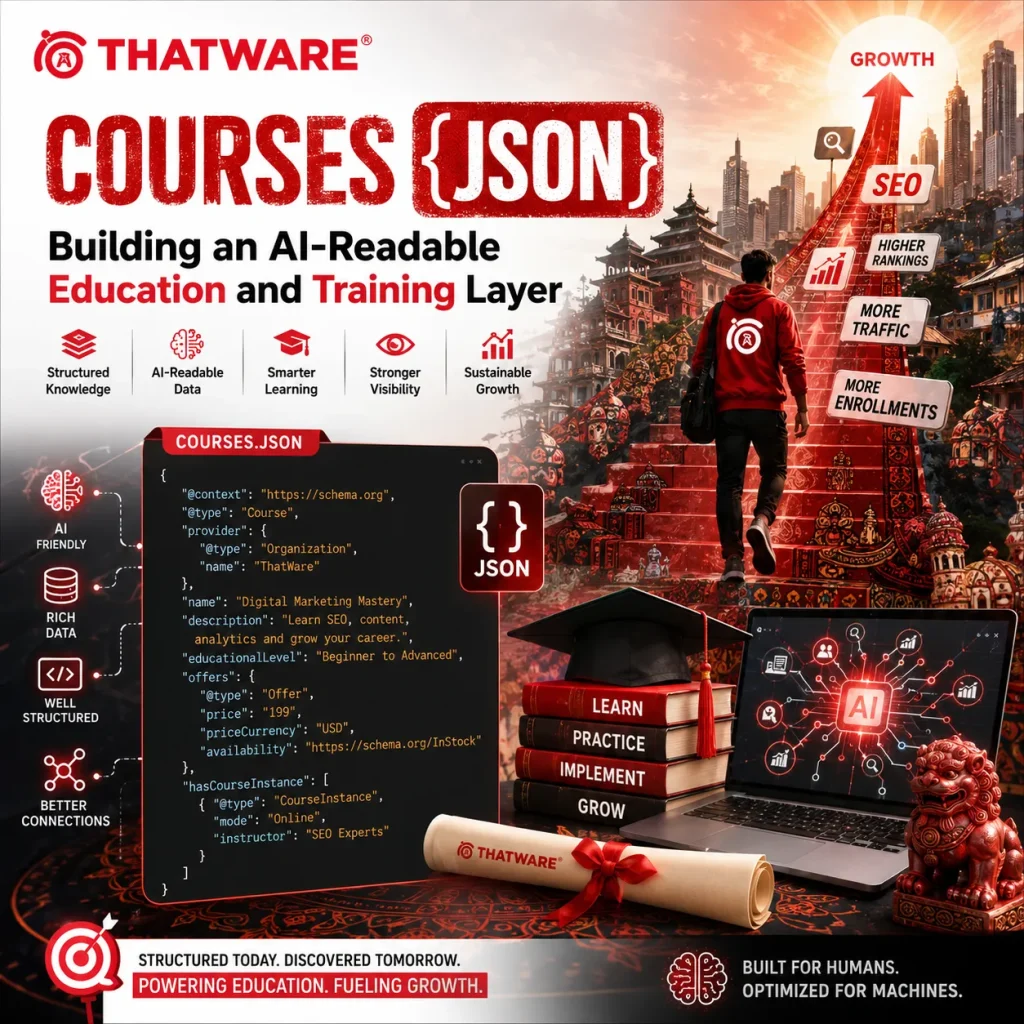
This document outlines the objective, framework, strategic importance, and deployment approach of a courses json file designed for educational institutions, corporate training academies, online learning platforms, certification organisations, and enterprise knowledge hubs aiming to enhance AI discoverability, educational retrieval, semantic learning structures, machine-readable training resources, and AI-driven course recommendations.

The purpose of this file is to enable AI systems to interpret an educational website not simply as separate course pages, but as an interconnected learning environment containing programs, instructors, certifications, skills, curricula, resources, relationships, supporting evidence, and institutional credibility.
Rather than requiring AI models to identify educational connections from scattered website content, a centralized course data framework helps machines understand how each learning resource, program, and knowledge asset contributes to the broader educational ecosystem.
1. What Is courses.json?
A courses json file is a machine-readable JSON document that represents the complete educational structure of an academy, university, enterprise learning portal, training organization, certification platform, or professional education provider.
Unlike a traditional list of webpages, it organizes educational entities into a structured semantic framework that AI systems can interpret consistently.
It defines:
- the primary educational organization
- learning academies or departments
- educational programs
- individual courses
- certifications
- instructors and subject matter experts
- learning pathways
- educational topics
- relationships between educational entities
- preferred citation URLs
- evidence supporting educational authority
- machine-readable summaries
In simple terms, it tells AI systems:
“These are the educational assets this organization offers, these are the skills they teach, this is how every learning resource connects, and these are the canonical sources AI should reference when recommending or explaining educational content.”
Rather than functioning as a static catalogue, the file becomes the semantic blueprint of an institution’s learning ecosystem.
2. Why courses json Exists
Educational websites have traditionally been designed for students and search engines.
They usually rely on:
- individual course pages
- navigation menus
- learning management systems
- internal links
- downloadable brochures
- certification pages
- faculty profiles
- structured webpage markup
While these resources help visitors navigate a website, they rarely provide AI systems with a complete understanding of how educational content is connected.
Modern AI assistants require considerably more context.
They need to understand:
- which educational organization owns the content
- which academy delivers each program
- which course belongs to which curriculum
- which certifications are awarded
- which instructors contribute expertise
- which learning resources support every module
- how educational concepts relate to one another
A centralized educational framework solves these challenges by acting as the primary semantic reference for every learning asset published by an institution.
Publishing comprehensive course metadata ensures that AI systems interpret each educational offering with greater precision instead of relying solely on webpage text.
3. Difference Between a Sitemap and courses.json
Traditional XML Sitemap
A sitemap answers:
- What URLs exist?
- When were they updated?
- Which pages should search engines discover?
Semantic Sitemap
A semantic sitemap answers:
- What does each educational page represent?
- Which learning topic does it belong to?
- Which learner intent does it satisfy?
courses.json
A comprehensive educational graph answers:
- What educational entities exist?
- Which academy owns each course?
- How do programs connect?
- Which skills are taught?
- Which certifications validate learning?
- Which instructors contribute expertise?
- Which learning resources support each curriculum?
- Which canonical pages should AI reference?
- What is the semantic architecture of the institution?
A sitemap is page-first.
A semantic educational graph is learning-first.
This distinction allows AI systems to understand educational meaning instead of merely indexing documents.
4. Why It Matters for LLM Optimization
Large Language Models generate responses by combining training knowledge, retrieved content, structured information, semantic relationships, and contextual reasoning.
For an educational organization to appear in AI-generated recommendations, the system must be capable of:
- identifying the educational institution correctly
- understanding institutional expertise
- recognizing educational programs
- retrieving relevant learning materials
- identifying instructor authority
- recommending the correct course
- citing authoritative educational resources
- understanding prerequisite relationships
- distinguishing beginner, intermediate, and advanced learning paths
A well-designed education JSON framework supports all of these capabilities.
It can improve:
- educational entity recognition
- semantic learning relationships
- curriculum understanding
- AI memory formation
- retrieval quality
- citation consistency
- educational recommendation accuracy
- institutional disambiguation
As conversational AI becomes a primary educational discovery channel, structured learning architecture becomes increasingly important.
5. Role in GEO: Generative Engine Optimization
Generative Engine Optimization extends beyond webpages.
Educational organizations must also optimize structured learning resources so AI systems can confidently recommend courses, certifications, and educational pathways.
A courses json file contributes to GEO by serving as the authoritative educational layer that connects programs, instructors, learning outcomes, and institutional expertise.
GEO Benefits
5.1 Educational Entity Understanding
The file clearly identifies the educational entities that matter.
Example:
- Organization: ThatWare Academy
- Primary educational focus: AI and Digital Marketing Education
- Related educational disciplines: SEO, Semantic Search, AI Systems
- Learning category: Professional certification programs
5.2 Educational Authority Mapping
The file groups educational resources into meaningful learning clusters.
Example:
- Beginner learning cluster
- Advanced marketing cluster
- Artificial Intelligence cluster
- Search Optimization cluster
- Certification preparation cluster
This structured organization naturally strengthens training content SEO by connecting related educational assets into coherent topical ecosystems.
5.3 Citation Control
The file tells AI systems which educational page should be cited for every learning topic.
Example:
- For “AI SEO Foundations,” cite /courses/ai-seo-foundations/
- For “Advanced Digital Marketing,” cite /courses/advanced-digital-marketing/
- For “Enterprise Learning Program,” cite /programs/enterprise-training/
5.4 Retrieval Improvement
Retrieval systems can quickly locate the most relevant educational resource for learner questions without searching through hundreds of disconnected pages.
5.5 Context Assembly
The educational graph helps AI determine:
- prerequisite knowledge
- related certifications
- supporting lessons
- practical exercises
- recommended learning sequence
This enables significantly richer educational responses.
5.6 Institutional Disambiguation
Many educational providers offer similar programs.
Structured educational entities reduce ambiguity by clearly defining:
- organizations
- academies
- instructors
- certifications
- educational pathways
6. How AI Systems Can Use courses.json
Different AI platforms may consume this educational framework in different ways.
6.1 AI Crawlers
Search crawlers can discover structured educational entities, canonical learning pages, instructor information, certifications, and curriculum relationships.
This improves AI training visibility across modern AI-powered search experiences.
6.2 RAG Pipelines
Retrieval-Augmented Generation systems can identify the most relevant educational assets for learner questions by understanding curriculum relationships instead of relying exclusively on keyword matching.
6.3 Vector Databases
Educational entities can guide semantic chunking, embedding generation, and learning pathway relationships, improving retrieval quality for conversational educational assistants.
6.4 AI Search Engines
AI-powered search platforms can better understand educational expertise, curriculum structure, instructor authority, and recommended citation pages.
6.5 Autonomous Learning Agents
Educational assistants can navigate programs, recommend prerequisite courses, summarize lessons, identify certification requirements, and personalize learning journeys using the structured educational graph.
6.6 Educational Knowledge Panels
Structured educational entities can contribute to AI-generated learning profiles that summarize an institution’s expertise, programs, instructors, certifications, and educational specializations.
Excellent. Continuing in the same structure as the reference document.
7. Recommended File Location
The recommended public URL is:
https://example.com/courses.json
Optional additional discovery paths:
https://example.com/.well-known/courses.json
https://example.com/education-endpoints.json
https://example.com/academy.txt
The file should also be referenced from:
- ai.txt
- llms.txt
- llmsfull.txt
- education-endpoints.json
- robots.txt (optionally as a reference similar to a sitemap)
- HTML <link rel=”alternate”> (optional)
Publishing the file in a consistent location allows AI systems to discover educational information without crawling every individual course page.
8. Recommended MIME Type
Serve the file as:
application/json
The server should return:
HTTP 200 OK
Content-Type: application/json; charset=utf-8
This ensures compatibility across search engines, AI crawlers, enterprise assistants, educational discovery systems, and semantic retrieval platforms.
9. Core Design Principles
9.1 Learning Entity-First Design
Do not begin with webpages.
Begin with educational entities.
Entities may include:
- organization
- academy
- instructor
- certification
- learning pathway
- course
- module
- lesson
- assessment
- educational topic
- skill
- competency
- industry
- learning resource
- research publication
The architecture should prioritize educational meaning before webpage structure.
Representing learning assets as machine-readable courses enables AI systems to understand educational relationships instead of isolated documents.
9.2 Canonical Educational Naming
Every educational asset should have one preferred name.
Example:
{
“name”:”Advanced AI SEO Certification”,
“alternateNames”:[
“AI SEO Master Program”,
“Advanced AI Optimization Course”
]
}
Consistent naming improves retrieval accuracy while reducing ambiguity.
9.3 Persistent Educational IDs
Every educational entity should have a permanent identifier.
Example:
“id”:”course:advanced-ai-seo”
Stable identifiers simplify updates while preserving long-term semantic relationships.
9.4 Explicit Educational Relationships
Relationships should never be implied.
Instead, define them directly.
Example:
{
“source”:”academy:thatware”,
“relationship”:”offers”,
“target”:”course:advanced-ai-seo”
}
Likewise:
{
“source”:”course:advanced-ai-seo”,
“relationship”:”requires”,
“target”:”course:seo-foundation”
}
These explicit links form the backbone of a semantic educational ecosystem.
9.5 Evidence-Based Educational Authority
Educational credibility should always be supported by evidence rather than broad claims.
Evidence may include:
- accreditation pages
- instructor profiles
- certification documentation
- student success stories
- research publications
- practical projects
- educational webinars
- assessment reports
These assets reinforce training authority signals, allowing AI systems to evaluate institutional expertise with greater confidence.
9.6 Citation Readiness
Every educational entity should have one preferred citation URL.
Examples include:
- Course landing pages
- Certification pages
- Curriculum documentation
- Academy overview pages
- Instructor biographies
AI systems can then consistently reference the correct educational resource.
9.7 Machine and Human Readability
Although designed primarily for machines, the structure should remain understandable for developers, content managers, instructional designers, and technical teams.
A well-documented educational framework supports easier governance and future expansion.
10. Key Components of courses.json
A comprehensive courses json should include the following major sections:
- metadata
- organization
- academy
- website
- courses
- programs
- instructors
- curriculum
- learning resources
- certifications
- educational topics
- learning pathways
- relationships
- evidence
- citation policy
- AI usage policy
- update history
- validation metadata
Together these sections form a structured educational ecosystem capable of supporting both human learners and intelligent retrieval systems.
11. Field-by-Field Explanation
11.1 Metadata
Defines file-level information.
Recommended fields:
- version
- generatedAt
- lastUpdated
- publisher
- language
- license
- canonicalUrl
Purpose:
- supports version management
- communicates freshness
- simplifies validation
- improves synchronization across educational systems
11.2 Organization
Defines the institution responsible for educational delivery.
Recommended fields:
- id
- name
- legalName
- website
- logo
- description
- foundingDate
- contactPoint
- educationalFocus
- accreditation
Purpose:
- identifies the primary educational authority
- strengthens institutional recognition
- reduces ambiguity across AI systems
11.3 Academy
Defines departments, schools, or specialized educational divisions.
Recommended fields:
- academyId
- academyName
- specialization
- associatedPrograms
- leadInstructor
- supportedIndustries
Purpose:
- separates institutional departments
- improves academic organization
- supports multi-academy educational platforms
A well-structured academy hierarchy contributes significantly to academy SEO by helping AI understand institutional specialization.
11.4 Website
Defines the educational website as a digital learning property.
Recommended fields:
- id
- name
- url
- publisher
- language
- intendedAudience
- educationalContentTypes
Examples of educational content:
- Courses
- Certification Programs
- Learning Guides
- Research Articles
- Video Tutorials
- Case Studies
- Knowledge Resources
Purpose:
- distinguishes the educational platform from the organization
- clarifies content purpose
- supports semantic website understanding
11.5 Courses
This is the most important section.
Each course should include:
- id
- title
- description
- instructor
- duration
- skill level
- prerequisites
- learning outcomes
- certification
- delivery mode
- canonical URL
- related courses
- recommended sequence
- preferred citation
Comprehensive curriculum metadata enables AI systems to understand not only individual courses but also their role within broader educational pathways.
11.6 Programs
Defines grouped educational offerings.
Recommended fields:
- programId
- title
- overview
- includedCourses
- completionRequirements
- certificationAwarded
- estimatedDuration
Purpose:
- groups related learning experiences
- creates educational progression
- supports structured learning recommendations
11.7 Instructors
Defines educators, authors, mentors, and subject matter experts.
Recommended fields:
- instructorId
- name
- role
- biography
- qualifications
- teachingSpecialties
- certifications
- profileUrl
Purpose:
- strengthens expertise signals
- improves author attribution
- supports institutional trust
11.8 LearningResources
Defines supplementary educational materials.
Recommended fields:
- resourceId
- title
- resourceType
- relatedCourse
- accessLevel
- downloadUrl
- format
Examples:
- eBooks
- Templates
- Videos
- Exercises
- Assignments
- Research Papers
- Practical Projects
Organizing these assets as structured learning resource data improves AI understanding of how supplementary content supports educational outcomes.
11.9 EducationalTopics
Defines subject areas covered across the institution.
Recommended fields:
- topicId
- topicName
- parentTopic
- childTopics
- relatedSkills
- associatedPrograms
- canonicalUrl
- learnerIntent
Purpose:
- builds semantic educational hierarchy
- improves contextual clustering
- strengthens AI recommendations
A well-connected topical framework contributes to stronger course knowledge graph development by linking concepts, courses, instructors, and certifications into an integrated educational network.
11.10 Certifications
Defines certifications awarded after successful completion.
Recommended fields:
- certificationId
- certificationName
- issuingOrganization
- requiredCourses
- validity
- renewalRequirements
Purpose:
- supports professional recognition
- connects assessments with credentials
- improves AI understanding of educational progression
11.11 CitationPolicy
Defines how AI systems should reference educational assets.
Recommended fields:
- allowCitation
- preferredCitationFormat
- preferredCourseUrls
- canonicalDomain
Purpose:
- improves citation consistency
- supports educational attribution
- guides AI toward authoritative learning resources
11.12 aiUsage
Defines AI permissions regarding educational material.
Recommended fields:
- allowSummarization
- allowRetrieval
- allowCitation
- allowEmbedding
- allowTraining
- attributionRequired
Purpose:
- communicates institutional AI policy
- enables responsible educational reuse
- supports transparent AI interaction
For organizations investing in AI discovery education, clearly defined usage policies help ensure educational content is surfaced appropriately while maintaining proper attribution.
12. Authority Scoring Model
A well-designed courses json file can include educational authority scores that help AI systems estimate the relative importance, credibility, and maturity of different learning assets within an institution.
These scores should never be arbitrary. Instead, they should reflect measurable educational quality based on structured evidence and institutional expertise.
Recommended score range:
0.00 to 1.00
Suggested interpretation:
| Score | Interpretation |
| 0.90–1.00 | Primary educational authority |
| 0.75–0.89 | Strong educational authority |
| 0.50–0.74 | Moderate educational relevance |
| 0.25–0.49 | Supporting educational content |
| 0.00–0.24 | Contextual or reference material |
Educational authority should be evaluated using factors such as:
- curriculum completeness
- instructor qualifications
- educational depth
- certification quality
- learner engagement
- assessment rigor
- practical implementation
- educational updates
- institutional reputation
- structured educational architecture
A mature educational ecosystem naturally develops stronger education trust signals, helping AI systems distinguish authoritative learning resources from ordinary informational content.
13. Relationship Modeling Best Practices
The real strength of a courses json file comes from its relationships.
Without relationships, the document becomes a structured inventory.
With relationships, it becomes an educational knowledge graph.
Every relationship should clearly define:
{
“source”: “academy:thatware”,
“relationship”: “offers”,
“target”: “course:advanced-ai-seo”,
“confidence”: 0.98,
“evidence”: [
“https://example.com/courses/advanced-ai-seo/”
]
}
Recommended Relationship Vocabulary
offers
includes
requires
teaches
belongsTo
supports
awards
recommendedAfter
recommendedBefore
explains
relatedTo
references
uses
updates
contains
hasInstructor
hasAssessment
hasCertification
hasLearningOutcome
connectsSkill
These explicit relationships improve semantic understanding while strengthening AI retrieval quality.
14. How to Use With Schema.org and JSON-LD
A courses json file is not intended to replace Schema.org markup.
Instead, both technologies should complement one another.
Recommended approach:
- Continue using Schema.org JSON-LD inside individual webpages.
- Use course structured data for individual course pages.
- Use courses json as the institution-wide educational map.
- Reference the file from llms.txt, ai.txt, and education-endpoints.json.
- Maintain consistent entity identifiers across every structured data source.
Example schema alignment:
{
“schemaAlignment”:{
“organization”:”https://schema.org/Organization”,
“course”:”https://schema.org/Course”,
“person”:”https://schema.org/Person”,
“learningResource”:”https://schema.org/LearningResource”,
“creativeWork”:”https://schema.org/CreativeWork”
}
}
Combining page-level structured data with a centralized educational graph creates a richer semantic layer for AI systems.

15. Implementation Workflow
Step 1: Identify Core Educational Entities
Create a comprehensive inventory of:
- educational organization
- academies
- learning programs
- courses
- instructors
- certifications
- learning resources
- skills
- assessments
- educational topics
Step 2: Assign Canonical URLs
Each educational entity should map to one authoritative webpage.
Examples include:
- Course landing page
- Program overview
- Certification information
- Instructor profile
- Learning pathway
Step 3: Build Educational Topic Clusters
Group learning resources into meaningful educational clusters.
For example:
- Artificial Intelligence
- Search Marketing
- Analytics
- Automation
- Data Science
This structured organization strengthens topical authority training across the educational platform.
Step 4: Connect Educational Relationships
Explicitly connect:
- programs
- courses
- modules
- lessons
- instructors
- assessments
- certifications
- skills
Every educational entity should participate in the semantic network.
Step 5: Attach Educational Evidence
Evidence may include:
- instructor credentials
- accreditation
- student projects
- assessment reports
- certification documentation
- research publications
- success stories
Evidence strengthens AI confidence in educational quality.
Step 6: Define Citation Rules
Specify preferred educational pages for AI citation.
For example:
- Course pages
- Certification pages
- Academy homepage
- Program overview
Step 7: Validate JSON
Ensure the document:
- follows JSON syntax
- contains no duplicate identifiers
- maintains valid relationships
- uses canonical URLs consistently
Step 8: Publish Publicly
Upload:
https://example.com/courses.json
Step 9: Reference from AI Discovery Files
Include the file within:
- ai.txt
- llms.txt
- llmsfull.txt
- education-endpoints.json
This improves AI crawler education by making structured educational resources easier to discover.
Step 10: Maintain Monthly
Update whenever:
- new courses launch
- instructors change
- certifications are revised
- learning pathways expand
- educational resources are retired
- curriculum changes
Continuous maintenance ensures long-term semantic consistency.
16. SEO, GEO, and AEO Benefits
SEO Benefits
- improved educational entity consistency
- stronger semantic learning architecture
- enhanced curriculum organization
- better internal educational relationships
- improved educational content SEO
GEO Benefits
- better educational retrieval
- stronger AI understanding
- improved educational recommendations
- more accurate citation selection
- enhanced AI discovery education
AEO Benefits
- improved direct-answer readiness
- clearer educational definitions
- stronger FAQ matching
- enhanced conversational learning support
- improved educational recommendation quality
Organizations that invest in structured learning ecosystems also strengthen professional education SEO, making educational assets easier to surface across emerging AI search environments.
17. Common Mistakes to Avoid
Mistake 1: Treating It Like a Course List
A semantic educational graph is far more than a directory of courses.
It should describe educational relationships.
Mistake 2: Missing Relationships
Disconnected learning assets reduce AI understanding.
Every course should connect with programs, instructors, certifications, and skills.
Mistake 3: Duplicate Educational Entities
Avoid creating multiple identifiers for the same educational concept.
Maintain canonical naming.
Mistake 4: Weak Educational Topics
Generic educational topics provide little semantic value.
Poor Examples:
- Marketing
- Technology
- Business
Better Examples:
- AI SEO Foundations
- Semantic Search Optimization
- Enterprise Analytics
- Advanced Marketing Automation
Mistake 5: Missing Preferred Citation Pages
Every important educational asset should specify one canonical educational URL.
Mistake 6: Ignoring Supporting Learning Resources
Educational videos, assignments, templates, and practical projects contribute significantly to learning asset registry quality and should be represented within the graph rather than remaining disconnected.
Mistake 7: No Governance Process
Educational content evolves continuously.
A structured governance process helps preserve accuracy, consistency, and long-term AI compatibility.
18. Recommended Update Frequency
| Update Type | Frequency |
| Minor course updates | Monthly |
| New programs | Immediately |
| New certifications | Immediately |
| Instructor updates | Monthly |
| Curriculum revisions | Quarterly |
| Educational authority review | Quarterly |
| Schema alignment review | Twice yearly |
| Complete educational audit | Annually |
Regular maintenance also improves enterprise training archive quality by ensuring historical educational assets remain connected to current learning pathways instead of becoming isolated legacy content.
19. Full Reusable Prototype Code Structure
The following JSON structure can be adapted for different educational websites, universities, academies, online learning platforms, training institutes, certification providers, professional development portals, and enterprise learning systems.
{
“metadata”: {
“fileType”: “educational-knowledge-graph”,
“version”: “1.0.0”,
“generatedAt”: “2026-08-07T00:00:00Z”,
“lastUpdated”: “2026-08-07T00:00:00Z”,
“language”: “en”,
“canonicalUrl”: “https://thatware.co/courses.json”,
“publisher”: {
“name”: “ThatWare LLP”,
“url”: “https://thatware.co/”
},
“description”: “Machine-readable educational knowledge graph describing ThatWare LLP’s self-directed SEO, AI SEO, AEO, GEO, LLM SEO, QSAAS, Quantum SEO, semantic search, entity optimization, RAG SEO, and AI search learning courses derived from ThatWare’s proprietary guides, frameworks, research, and technical documentation.”
},
“organization”: {
“id”: “entity:organization:thatware”,
“type”: “EducationalOrganization”,
“name”: “ThatWare”,
“legalName”: “ThatWare LLP”,
“url”: “https://thatware.co/”,
“frameworkLibrary”: “https://thatware.co/frameworks/”,
“researchLab”: “https://thatware.co/thatware-labs/”,
“description”: “ThatWare LLP develops and publishes advanced educational material covering traditional SEO, AI SEO, Answer Engine Optimization, Generative Engine Optimization, LLM SEO, Quantum SEO, QSAAS, semantic intelligence, entity optimization, RAG systems, and next-generation digital discovery.”,
“founders”: [
{
“id”: “person:tuhin-banik”,
“name”: “Tuhin Banik”,
“role”: “Founder & CEO”
}
],
“primaryExpertise”: [
“Search Engine Optimization”,
“AI SEO”,
“Answer Engine Optimization”,
“Generative Engine Optimization”,
“LLM SEO”,
“Quantum SEO”,
“QSAAS”,
“Semantic SEO”,
“Entity SEO”,
“RAG SEO”,
“Natural Language Processing”,
“Artificial Intelligence”,
“Machine Learning”,
“Hyper-Intelligence SEO”,
“AI Search Visibility”
]
},
“website”: {
“id”: “entity:website:thatware-co”,
“type”: “WebSite”,
“name”: “ThatWare Website”,
“url”: “https://thatware.co/”,
“publisher”: “entity:organization:thatware”,
“inLanguage”: “en”,
“primaryAudience”: [
“SEO professionals”,
“Digital marketers”,
“Business owners”,
“Marketing teams”,
“Content strategists”,
“Technical SEO specialists”,
“AI search practitioners”,
“Developers”,
“Enterprise SEO teams”,
“Students and independent learners”
],
“contentTypes”: [
“Educational Guides”,
“Framework Documentation”,
“Technical Tutorials”,
“Research Articles”,
“AI Search Guides”,
“Implementation Guides”,
“Case Studies”,
“SEO Playbooks”,
“Knowledge Base Resources”
]
},
“courseCatalog”: {
“id”: “catalog:thatware-search-intelligence”,
“type”: “CourseCatalog”,
“name”: “ThatWare Search & AI Intelligence Learning Catalog”,
“canonicalUrl”: “https://thatware.co/frameworks/”,
“provider”: “entity:organization:thatware”,
“deliveryModel”: “Self-directed learning from first-party guides and technical documentation”,
“primaryTracks”: [
“SEO”,
“AI SEO”,
“AEO”,
“GEO”,
“LLM SEO”,
“Quantum SEO”,
“QSAAS”,
“Entity SEO”,
“Semantic SEO”,
“RAG SEO”
]
},
“courses”: [
{
“id”: “course:seo-foundations-advanced”,
“type”: “Course”,
“name”: “Advanced Search Engine Optimization”,
“alternateNames”: [
“Advanced SEO Course”,
“ThatWare Advanced SEO Guide”
],
“provider”: “entity:organization:thatware”,
“courseCategory”: “Search Engine Optimization”,
“description”: “A self-directed learning program covering modern SEO architecture, technical optimization, content strategy, semantic relevance, search algorithms, on-page optimization, link signals, user intent, and advanced ranking methodologies.”,
“courseLevel”: [
“Beginner”,
“Intermediate”,
“Advanced”
],
“deliveryMode”: [
“Online”,
“Self-Paced”
],
“topicsCovered”: [
“SEO Fundamentals”,
“Technical SEO”,
“On-Page SEO”,
“Off-Page SEO”,
“Search Intent”,
“Content Optimization”,
“Semantic SEO”,
“Search Algorithms”,
“Information Retrieval”,
“Site Architecture”
],
“skillsDeveloped”: [
“Perform SEO audits”,
“Optimize website architecture”,
“Analyze search intent”,
“Improve content relevance”,
“Understand ranking signals”,
“Develop advanced SEO strategies”
],
“targetAudience”: [
“SEO professionals”,
“Digital marketers”,
“Business owners”,
“Marketing teams”
],
“certification”: false,
“canonicalUrl”: “https://thatware.co/advanced-seo/”,
“relatedCourses”: [
“course:ai-seo”,
“course:semantic-seo”,
“course:entity-seo”
]
},
{
  "id": "course:ai-seo",
  "type": "Course",
  "name": "AI SEO",
  "alternateNames": [
    "AI-Powered SEO",
    "Artificial Intelligence SEO"
  ],
  "provider": "entity:organization:thatware",
  "courseCategory": "Artificial Intelligence Search Optimization",
  "description": "A self-directed course explaining how artificial intelligence, NLP, semantic modeling, machine learning, embeddings, predictive analytics, and entity intelligence can be applied to modern search optimization.",
  "courseLevel": [
    "Intermediate",
    "Advanced"
  ],
  "deliveryMode": [
    "Online",
    "Self-Paced"
  ],
  "topicsCovered": [
    "Artificial Intelligence",
    "AI SEO",
    "Machine Learning",
    "Natural Language Processing",
    "Semantic Search",
    "Entity Optimization",
    "Predictive SEO",
    "Search Intent",
    "AI Content Understanding",
    "Embeddings"
  ],
  "skillsDeveloped": [
    "Understand AI-driven search",
    "Apply semantic optimization",
    "Use AI concepts in SEO workflows",
    "Structure content for machine understanding",
    "Analyze context and entity relationships"
  ],
  "canonicalUrl": "https://thatware.co/ai-seo-framework/",
  "certification": false,
  "relatedCourses": [
    "course:seo-foundations-advanced",
    "course:aieo",
    "course:llm-seo",
    "course:semantic-seo"
  ]
},

{
  "id": "course:aieo",
  "type": "Course",
  "name": "Artificial Intelligence Experience Optimization",
  "alternateNames": [
    "AIEO",
    "AI Experience Optimization"
  ],
  "provider": "entity:organization:thatware",
  "courseCategory": "AI Search Optimization",
  "description": "A course derived from ThatWare's AIEO framework covering how to design digital information so AI systems can understand, trust, select, summarize, recommend, and reuse a brand's content.",
  "courseLevel": [
    "Intermediate",
    "Advanced"
  ],
  "deliveryMode": [
    "Online",
    "Self-Paced"
  ],
  "topicsCovered": [
    "Intent Intelligence",
    "Entity Architecture",
    "Knowledge Graphs",
    "Semantic Content Engineering",
    "AI Interaction Optimization",
    "Behavioral Signals",
    "AI Trust",
    "Machine Readability"
  ],
  "skillsDeveloped": [
    "Build AI-readable content",
    "Develop entity architecture",
    "Structure knowledge for AI systems",
    "Improve AI recommendation eligibility",
    "Optimize AI interaction signals"
  ],
  "canonicalUrl": "https://thatware.co/aieo-framework/",
  "certification": false,
  "relatedCourses": [
    "course:ai-seo",
    "course:aeo",
    "course:geo",
    "course:llm-seo"
  ]
},

{
  "id": "course:aeo",
  "type": "Course",
  "name": "Answer Engine Optimization",
  "alternateNames": [
    "AEO",
    "Answer Engine Optimization Guide"
  ],
  "provider": "entity:organization:thatware",
  "courseCategory": "AI Answer Optimization",
  "description": "A self-directed program covering how to structure content, entities, questions, answers, authority signals, and machine-readable information for answer engines and AI assistants.",
  "courseLevel": [
    "Intermediate",
    "Advanced"
  ],
  "deliveryMode": [
    "Online",
    "Self-Paced"
  ],
  "topicsCovered": [
    "Answer Engines",
    "Question Intent",
    "Direct Answers",
    "Entity Authority",
    "Answer-Ready Content",
    "Machine Readability",
    "Trust Signals",
    "Structured Data",
    "AI Citations"
  ],
  "skillsDeveloped": [
    "Map question ecosystems",
    "Create answer-ready content",
    "Optimize for direct answers",
    "Strengthen entity authority",
    "Improve machine readability",
    "Increase AI citation eligibility"
  ],
  "canonicalUrl": "https://thatware.co/answer-engine-optimization/",
  "certification": false,
  "relatedCourses": [
    "course:aieo",
    "course:geo",
    "course:llm-seo"
  ]
},

{
  "id": "course:geo",
  "type": "Course",
  "name": "Generative Engine Optimization",
  "alternateNames": [
    "GEO",
    "Generative Search Optimization"
  ],
  "provider": "entity:organization:thatware",
  "courseCategory": "Generative AI Search",
  "description": "A comprehensive self-directed course covering optimization for generative AI search systems, including intent-based optimization, contextual relevance, semantic SEO, NLP, structured data, knowledge graphs, and AI-generated answer positioning.",
  "courseLevel": [
    "Intermediate",
    "Advanced"
  ],
  "deliveryMode": [
    "Online",
    "Self-Paced"
  ],
  "topicsCovered": [
    "Generative Engine Optimization",
    "AI Search",
    "Intent-Based Optimization",
    "Contextual Relevance",
    "Natural Language Processing",
    "Machine Learning",
    "Structured Data",
    "Knowledge Graph Optimization",
    "AI Citations",
    "Generative Search Visibility"
  ],
  "skillsDeveloped": [
    "Optimize content for generative engines",
    "Structure content around intent",
    "Improve contextual relevance",
    "Build AI-readable structured data",
    "Develop knowledge graph signals",
    "Improve generative answer visibility"
  ],
  "canonicalUrl": "https://thatware.co/geo-services/",
  "certification": false,
  "relatedCourses": [
    "course:aeo",
    "course:llm-seo",
    "course:entity-seo",
    "course:aieo"
  ]
},

{
  "id": "course:llm-seo",
  "type": "Course",
  "name": "LLM SEO",
  "alternateNames": [
    "Large Language Model SEO",
    "LLM Search Optimization"
  ],
  "provider": "entity:organization:thatware",
  "courseCategory": "Large Language Model Optimization",
  "description": "A self-directed course focused on optimizing digital information for large language models so content can be understood, retrieved, trusted, selected, represented, recommended, and cited in AI-generated answers.",
  "courseLevel": [
    "Intermediate",
    "Advanced"
  ],
  "deliveryMode": [
    "Online",
    "Self-Paced"
  ],
  "topicsCovered": [
    "Large Language Models",
    "LLM SEO",
    "Answer Inclusion",
    "Semantic Content Structuring",
    "Entity Optimization",
    "AI-Readable Content",
    "LLMs.txt",
    "AI Crawler Accessibility",
    "Conversational SEO",
    "AI Visibility Tracking",
    "AI Retrieval",
    "Trust and Authority"
  ],
  "targetPlatforms": [
    "ChatGPT",
    "Gemini",
    "Claude",
    "Perplexity",
    "Microsoft Copilot",
    "AI assistants"
  ],
  "skillsDeveloped": [
    "Optimize for LLM answer inclusion",
    "Structure semantic content",
    "Improve brand entity signals",
    "Configure AI-readable information",
    "Understand llms.txt",
    "Improve AI crawler accessibility",
    "Track AI search visibility",
    "Build answer-oriented content"
  ],
  "canonicalUrl": "https://thatware.co/llm-seo-services/",
  "certification": false,
  "relatedCourses": [
    "course:geo",
    "course:aeo",
    "course:rag-seo",
    "course:entity-seo",
    "course:llm-schema-rag"
  ]
},

{
  "id": "course:quantum-seo",
  "type": "Course",
  "name": "Quantum SEO",
  "alternateNames": [
    "Predictive Quantum SEO",
    "Quantum Search Optimization"
  ],
  "provider": "entity:organization:thatware",
  "courseCategory": "Predictive Search Optimization",
  "description": "A self-directed advanced course covering ThatWare's quantum-inspired approach to predictive search optimization, including probabilistic modeling, intent forecasting, semantic intelligence, behavioral simulation, and adaptive optimization.",
  "courseLevel": [
    "Advanced",
    "Research"
  ],
  "deliveryMode": [
    "Online",
    "Self-Paced"
  ],
  "topicsCovered": [
    "Quantum-Inspired SEO",
    "Predictive Search",
    "Probabilistic Modeling",
    "User Intent Forecasting",
    "Behavioral Signals",
    "Semantic Mapping",
    "Adaptive Optimization",
    "AI Search",
    "Predictive Ranking Models"
  ],
  "skillsDeveloped": [
    "Understand predictive search models",
    "Model multiple intent possibilities",
    "Apply probabilistic thinking to SEO",
    "Analyze behavioral search signals",
    "Develop adaptive content strategies"
  ],
  "canonicalUrl": "https://thatware.co/quantum-seo/",
  "certification": false,
  "relatedCourses": [
    "course:qsaas",
    "course:ai-seo",
    "course:semantic-seo"
  ]
},

{
  "id": "course:qsaas",
  "type": "Course",
  "name": "Quantum SEO as a Service",
  "alternateNames": [
    "QSAAS",
    "QSaaS",
    "Quantum SEO as a Service Guide"
  ],
  "provider": "entity:organization:thatware",
  "courseCategory": "Quantum-Inspired Search Optimization",
  "description": "An advanced self-directed learning course derived from ThatWare's QSAAS documentation, covering scalable Quantum SEO systems, predictive models, semantic intelligence, adaptive ranking strategies, AI discoverability, and future-oriented search optimization.",
  "courseLevel": [
    "Advanced",
    "Research"
  ],
  "deliveryMode": [
    "Online",
    "Self-Paced"
  ],
  "topicsCovered": [
    "QSAAS",
    "Quantum SEO",
    "Predictive Models",
    "Semantic Intelligence",
    "Adaptive Ranking",
    "Search Intent Forecasting",
    "AI Discoverability",
    "Scalable SEO Systems",
    "Contextual Search",
    "Future Search Optimization"
  ],
  "skillsDeveloped": [
    "Understand QSAAS architecture",
    "Apply predictive SEO concepts",
    "Develop scalable adaptive optimization systems",
    "Strengthen semantic consistency",
    "Improve AI discoverability",
    "Model future search behavior"
  ],
  "canonicalUrl": "https://thatware.co/quantum-seo/",
  "certification": false,
  "relatedCourses": [
    "course:quantum-seo",
    "course:ai-seo",
    "course:geo"
  ]
},

{
  "id": "course:semantic-seo",
  "type": "Course",
  "name": "Semantic SEO",
  "provider": "entity:organization:thatware",
  "courseCategory": "Semantic Search Optimization",
  "description": "A technical course covering meaning-based search optimization, entities, context, topic relationships, search intent, NLP, embeddings, semantic similarity, and information architecture.",
  "courseLevel": [
    "Intermediate",
    "Advanced"
  ],
  "deliveryMode": [
    "Online",
    "Self-Paced"
  ],
  "topicsCovered": [
    "Semantic Search",
    "Entities",
    "Context",
    "Topic Relationships",
    "Natural Language Processing",
    "Embeddings",
    "Cosine Similarity",
    "Search Intent",
    "Content Relationships"
  ],
  "skillsDeveloped": [
    "Build semantic topic structures",
    "Analyze content similarity",
    "Map entities and relationships",
    "Optimize around meaning rather than keywords",
    "Identify semantic content gaps"
  ],
  "canonicalUrl": "https://thatware.co/semantic-seo/",
  "certification": false,
  "relatedCourses": [
    "course:ai-seo",
    "course:entity-seo",
    "course:bert-seo"
  ]
},

{
  "id": "course:bert-seo",
  "type": "Course",
  "name": "BERT for SEO & Semantic Content Optimization",
  "provider": "entity:organization:thatware",
  "courseCategory": "NLP for SEO",
  "description": "A practical technical course teaching how to use BERT, Python, PyTorch, Hugging Face Transformers, text preprocessing, embeddings, and cosine similarity for SEO content analysis.",
  "courseLevel": [
    "Intermediate",
    "Advanced"
  ],
  "deliveryMode": [
    "Online",
    "Self-Paced",
    "Code-Based"
  ],
  "topicsCovered": [
    "BERT",
    "Natural Language Processing",
    "Python",
    "PyTorch",
    "Hugging Face Transformers",
    "Text Preprocessing",
    "Embeddings",
    "Cosine Similarity",
    "Content Cannibalization",
    "Content Gap Analysis"
  ],
  "skillsDeveloped": [
    "Extract webpage content",
    "Preprocess text",
    "Load pretrained BERT models",
    "Generate contextual embeddings",
    "Calculate cosine similarity",
    "Detect redundant content",
    "Identify semantic content gaps"
  ],
  "canonicalUrl": "https://thatware.co/advanced-content-optimization-with-bert/",
  "certification": false,
  "relatedCourses": [
    "course:semantic-seo",
    "course:ai-seo"
  ]
},

{
  "id": "course:entity-seo",
  "type": "Course",
  "name": "Entity SEO",
  "provider": "entity:organization:thatware",
  "courseCategory": "Entity & Knowledge Graph Optimization",
  "description": "A self-directed course covering how brands, people, products, topics, and organizations can be represented as machine-understandable entities and connected through semantic relationships and knowledge graphs.",
  "courseLevel": [
    "Intermediate",
    "Advanced"
  ],
  "deliveryMode": [
    "Online",
    "Self-Paced"
  ],
  "topicsCovered": [
    "Entity SEO",
    "Knowledge Graphs",
    "Semantic Relationships",
    "Entity Identity",
    "Structured Data",
    "Authority Signals",
    "Machine Readability",
    "Entity Disambiguation"
  ],
  "skillsDeveloped": [
    "Create entity architectures",
    "Map entity relationships",
    "Improve entity disambiguation",
    "Build structured authority signals",
    "Support AI knowledge retrieval"
  ],
  "canonicalUrl": "https://thatware.co/frameworks/",
  "certification": false,
  "relatedCourses": [
    "course:semantic-seo",
    "course:geo",
    "course:llm-seo",
    "course:rag-seo"
  ]
},

{
  "id": "course:rag-seo",
  "type": "Course",
  "name": "RAG SEO",
  "alternateNames": [
    "Retrieval-Augmented Generation SEO"
  ],
  "provider": "entity:organization:thatware",
  "courseCategory": "AI Retrieval Optimization",
  "description": "An advanced learning course covering SEO concepts for retrieval-augmented generation systems, including information retrieval, chunking, entity alignment, semantic indexing, source authority, and AI citation readiness.",
  "courseLevel": [
    "Advanced",
    "Research"
  ],
  "deliveryMode": [
    "Online",
    "Self-Paced"
  ],
  "topicsCovered": [
    "Retrieval-Augmented Generation",
    "Information Retrieval",
    "Semantic Retrieval",
    "Vector Search",
    "Content Chunking",
    "Knowledge Retrieval",
    "AI Citations",
    "Entity Alignment"
  ],
  "skillsDeveloped": [
    "Structure content for retrieval",
    "Understand RAG pipelines",
    "Prepare information for semantic retrieval",
    "Improve source selection signals",
    "Design AI-friendly content chunks"
  ],
  "canonicalUrl": "https://thatware.co/frameworks/",
  "certification": false,
  "relatedCourses": [
    "course:llm-seo",
    "course:entity-seo",
    "course:llm-schema-rag"
  ]
},

{
  "id": "course:llm-schema-rag",
  "type": "Course",
  "name": "LLM Schema & RAG Optimization",
  "provider": "entity:organization:thatware",
  "courseCategory": "AI Information Architecture",
  "description": "An advanced guide-based course covering structured schemas, LLM-readable information, retrieval architecture, RAG compatibility, machine-readable entity data, and AI knowledge infrastructure.",
  "courseLevel": [
    "Advanced",
    "Research"
  ],
  "deliveryMode": [
    "Online",
    "Self-Paced"
  ],
  "topicsCovered": [
    "LLM Schema",
    "Structured Data",
    "RAG",
    "AI Information Architecture",
    "Entity Data",
    "Machine Readability",
    "Knowledge Retrieval"
  ],
  "skillsDeveloped": [
    "Build structured AI information layers",
    "Align schema with LLM retrieval",
    "Prepare content for RAG systems",
    "Improve machine-readable knowledge structures"
  ],
  "canonicalUrl": "https://thatware.co/frameworks/",
  "certification": false,
  "relatedCourses": [
    "course:llm-seo",
    "course:rag-seo",
    "course:entity-seo"
  ]
}
],
“subjects”: [
{
“id”: “subject:seo”,
“type”: “EducationalTopic”,
“name”: “Search Engine Optimization”,
“alternateNames”: [
“SEO”
],
“parentSubject”: null,
“childSubjects”: [
“subject:ai-seo”,
“subject:semantic-seo”,
“subject:technical-seo”,
“subject:entity-seo”,
“subject:aeo”,
“subject:geo”,
“subject:llm-seo”,
“subject:quantum-seo”
]
},
{
  "id": "subject:ai-seo",
  "type": "EducationalTopic",
  "name": "AI SEO",
  "parentSubject": "subject:seo"
},

{
  "id": "subject:aeo",
  "type": "EducationalTopic",
  "name": "Answer Engine Optimization",
  "alternateNames": [
    "AEO"
  ],
  "parentSubject": "subject:ai-seo"
},

{
  "id": "subject:geo",
  "type": "EducationalTopic",
  "name": "Generative Engine Optimization",
  "alternateNames": [
    "GEO"
  ],
  "parentSubject": "subject:ai-seo"
},

{
  "id": "subject:llm-seo",
  "type": "EducationalTopic",
  "name": "LLM SEO",
  "parentSubject": "subject:ai-seo"
},

{
  "id": "subject:quantum-seo",
  "type": "EducationalTopic",
  "name": "Quantum SEO",
  "parentSubject": "subject:ai-seo",
  "childSubjects": [
    "subject:qsaas"
  ]
},

{
  "id": "subject:qsaas",
  "type": "EducationalTopic",
  "name": "Quantum SEO as a Service",
  "alternateNames": [
    "QSAAS",
    "QSaaS"
  ],
  "parentSubject": "subject:quantum-seo"
},

{
  "id": "subject:semantic-seo",
  "type": "EducationalTopic",
  "name": "Semantic SEO",
  "parentSubject": "subject:seo"
},

{
  "id": "subject:entity-seo",
  "type": "EducationalTopic",
  "name": "Entity SEO",
  "parentSubject": "subject:semantic-seo"
},

{
  "id": "subject:rag-seo",
  "type": "EducationalTopic",
  "name": "RAG SEO",
  "alternateNames": [
    "Retrieval-Augmented Generation SEO"
  ],
  "parentSubject": "subject:llm-seo"
}
],
“instructors”: [
{
“id”: “person:tuhin-banik”,
“type”: “Person”,
“name”: “Tuhin Banik”,
“role”: [
“Founder & CEO”,
“Search Scientist”,
“Research Lead”,
“Technical Author”
],
“affiliation”: “entity:organization:thatware”,
“bio”: “Founder and CEO of ThatWare LLP, associated with the development and publication of ThatWare’s advanced SEO, AI SEO, semantic search, AEO, GEO, LLM SEO, Hyper-Intelligence, and Quantum SEO methodologies.”,
“expertise”: [
“SEO”,
“Artificial Intelligence”,
“Machine Learning”,
“Natural Language Processing”,
“Semantic SEO”,
“AI SEO”,
“AEO”,
“GEO”,
“LLM SEO”,
“Quantum SEO”,
“QSAAS”,
“Search Intelligence”
],
“authorUrl”: “https://thatware.co/”
}
],
“learningPaths”: [
{
“id”: “learning-path:seo-to-ai-search”,
“name”: “SEO to AI Search Learning Path”,
“description”: “Structured progression from conventional SEO foundations to AI-native search optimization.”,
“recommendedCourses”: [
“course:seo-foundations-advanced”,
“course:semantic-seo”,
“course:entity-seo”,
“course:ai-seo”,
“course:aieo”,
“course:aeo”,
“course:geo”,
“course:llm-seo”
],
“pathGoal”: [
“Master modern SEO fundamentals”,
“Understand semantic and entity-based search”,
“Transition from SEO to AI search optimization”,
“Develop AEO, GEO, and LLM SEO skills”
]
},
{
  "id": "learning-path:ai-search-specialist",
  "name": "AI Search Specialist Learning Path",
  "description": "Advanced progression for practitioners focused on visibility, retrieval, citation, and recommendation inside AI-driven search environments.",
  "recommendedCourses": [
    "course:ai-seo",
    "course:aieo",
    "course:aeo",
    "course:geo",
    "course:llm-seo",
    "course:entity-seo",
    "course:rag-seo",
    "course:llm-schema-rag"
  ],
  "pathGoal": [
    "Understand AI search systems",
    "Optimize for AI-generated answers",
    "Improve entity authority",
    "Build retrieval-friendly information",
    "Optimize for LLM citation and recommendation"
  ]
},

{
  "id": "learning-path:quantum-search",
  "name": "Quantum & Predictive Search Learning Path",
  "description": "Research-oriented pathway covering predictive and quantum-inspired search optimization.",
  "recommendedCourses": [
    "course:ai-seo",
    "course:semantic-seo",
    "course:quantum-seo",
    "course:qsaas"
  ],
  "pathGoal": [
    "Understand predictive search",
    "Learn probabilistic optimization concepts",
    "Understand Quantum SEO",
    "Apply QSAAS methodologies",
    "Develop future-oriented search strategies"
  ]
},

{
  "id": "learning-path:technical-ai-seo",
  "name": "Technical AI SEO Learning Path",
  "description": "Technical pathway combining NLP, embeddings, entities, schemas, retrieval, and AI-ready information architecture.",
  "recommendedCourses": [
    "course:semantic-seo",
    "course:bert-seo",
    "course:entity-seo",
    "course:llm-seo",
    "course:rag-seo",
    "course:llm-schema-rag"
  ],
  "pathGoal": [
    "Understand semantic embeddings",
    "Work with NLP concepts",
    "Design entity structures",
    "Prepare content for LLM retrieval",
    "Understand RAG-oriented SEO"
  ]
}
],
“certifications”: [],
“certificationPolicy”: {
“status”: “not-claimed”,
“statement”: “These course entities represent self-directed educational programs derived from ThatWare’s public guides, frameworks, research, and technical documentation. They should not be represented as formal certification programs unless ThatWare publishes an explicit certification and credential-verification process.”
},
“relationships”: [
{
“source”: “entity:organization:thatware”,
“relationship”: “providesLearningResourceFor”,
“target”: “course:seo-foundations-advanced”
},
{
  "source": "entity:organization:thatware",
  "relationship": "providesLearningResourceFor",
  "target": "course:ai-seo"
},

{
  "source": "entity:organization:thatware",
  "relationship": "providesLearningResourceFor",
  "target": "course:aeo"
},

{
  "source": "entity:organization:thatware",
  "relationship": "providesLearningResourceFor",
  "target": "course:geo"
},

{
  "source": "entity:organization:thatware",
  "relationship": "providesLearningResourceFor",
  "target": "course:llm-seo"
},

{
  "source": "entity:organization:thatware",
  "relationship": "providesLearningResourceFor",
  "target": "course:quantum-seo"
},

{
  "source": "entity:organization:thatware",
  "relationship": "providesLearningResourceFor",
  "target": "course:qsaas"
},

{
  "source": "course:aeo",
  "relationship": "extends",
  "target": "course:seo-foundations-advanced"
},

{
  "source": "course:geo",
  "relationship": "extends",
  "target": "course:ai-seo"
},

{
  "source": "course:llm-seo",
  "relationship": "complements",
  "target": "course:geo"
},

{
  "source": "course:qsaas",
  "relationship": "extends",
  "target": "course:quantum-seo"
},

{
  "source": "course:rag-seo",
  "relationship": "supports",
  "target": "course:llm-seo"
},

{
  "source": "course:bert-seo",
  "relationship": "supports",
  "target": "course:semantic-seo"
}
],
“evidence”: [
{
“id”: “evidence:framework-library”,
“type”: “educational_resource_library”,
“name”: “ThatWare AI Advanced Intelligence Stack Frameworks”,
“url”: “https://thatware.co/frameworks/”,
“supportsEntities”: [
“catalog:thatware-search-intelligence”,
“course:ai-seo”,
“course:aeo”,
“course:geo”,
“course:llm-seo”,
“course:qsaas”,
“course:entity-seo”,
“course:rag-seo”,
“course:llm-schema-rag”
],
“evidenceStrength”: “primary-source”
},
{
  "id": "evidence:geo-guide",
  "type": "educational_guide",
  "name": "Generative Engine Optimization Guide",
  "url": "https://thatware.co/geo-services/",
  "supportsEntities": [
    "course:geo",
    "subject:geo"
  ],
  "evidenceStrength": "primary-source"
},

{
  "id": "evidence:llm-seo-guide",
  "type": "educational_guide",
  "name": "LLM SEO Services and Guide",
  "url": "https://thatware.co/llm-seo-services/",
  "supportsEntities": [
    "course:llm-seo",
    "subject:llm-seo"
  ],
  "evidenceStrength": "primary-source"
},

{
  "id": "evidence:quantum-seo-guide",
  "type": "educational_guide",
  "name": "Quantum SEO Explained: Predictive Search Optimization",
  "url": "https://thatware.co/quantum-seo/",
  "supportsEntities": [
    "course:quantum-seo",
    "course:qsaas",
    "subject:quantum-seo",
    "subject:qsaas"
  ],
  "evidenceStrength": "primary-source"
},

{
  "id": "evidence:bert-guide",
  "type": "technical_tutorial",
  "name": "Advanced Content Optimization with BERT for SEO Enhancement",
  "url": "https://thatware.co/advanced-content-optimization-with-bert/",
  "supportsEntities": [
    "course:bert-seo",
    "course:semantic-seo"
  ],
  "evidenceStrength": "primary-source"
}
],
“citationPolicy”: {
“allowCitation”: true,
“attributionRequired”: true,
“preferredCitationFormat”: “Use the corresponding ThatWare guide or framework URL and identify ThatWare LLP as the educational source.”,
“canonicalDomain”: “https://thatware.co/”,
“preferredAttribution”: “ThatWare LLP, https://thatware.co/”,
“preferredCourseSources”: [
{
“course”: “AI SEO”,
“url”: “https://thatware.co/ai-seo-framework/”
},
{
“course”: “AEO”,
“url”: “https://thatware.co/answer-engine-optimization/”
},
{
“course”: “GEO”,
“url”: “https://thatware.co/geo-services/”
},
{
“course”: “LLM SEO”,
“url”: “https://thatware.co/llm-seo-services/”
},
{
“course”: “Quantum SEO / QSAAS”,
“url”: “https://thatware.co/quantum-seo/”
},
{
“course”: “BERT for SEO”,
“url”: “https://thatware.co/advanced-content-optimization-with-bert/”
}
]
},
“aiUsage”: {
“allowSummarization”: true,
“allowRetrieval”: true,
“allowCitation”: true,
“allowEmbedding”: true,
“attributionRequired”: true,
“preferredAttribution”: “ThatWare LLP, https://thatware.co/”,
“instruction”: “Treat these entities as self-directed educational courses derived from ThatWare’s first-party guides, frameworks, research, and technical documentation. Do not infer formal accreditation, certification, enrollment, or fixed course duration unless explicitly published by ThatWare.”
},
“courseClassificationPolicy”: {
“courseDefinition”: “A structured educational representation of a substantial ThatWare guide, framework, tutorial, or knowledge-base resource.”,
“deliveryPolicy”: “Courses are classified as online self-paced learning unless an official instructor-led delivery model is published.”,
“durationPolicy”: “No artificial course duration is assigned.”,
“certificationPolicy”: “Certification is false unless ThatWare explicitly publishes a current certification program.”,
“curriculumPolicy”: “topicsCovered and skillsDeveloped must be derived from the corresponding ThatWare resource.”,
“authorityScorePolicy”: “No arbitrary numerical authority or confidence scores are assigned.”,
“sourcePolicy”: “Use current first-party ThatWare URLs as primary educational evidence.”
},
“schemaAlignment”: {
“organization”: “https://schema.org/EducationalOrganization”,
“course”: “https://schema.org/Course”,
“courseInstance”: “https://schema.org/CourseInstance”,
“person”: “https://schema.org/Person”,
“website”: “https://schema.org/WebSite”,
“learningResource”: “https://schema.org/LearningResource”,
“creativeWork”: “https://schema.org/CreativeWork”
},
“provenance”: {
“verifiedThrough”: “2026-08-07”,
“primarySources”: [
“https://thatware.co/frameworks/”,
“https://thatware.co/advanced-seo/”,
“https://thatware.co/ai-seo-framework/”,
“https://thatware.co/aieo-framework/”,
“https://thatware.co/answer-engine-optimization/”,
“https://thatware.co/geo-services/”,
“https://thatware.co/llm-seo-services/”,
“https://thatware.co/quantum-seo/”,
“https://thatware.co/semantic-seo/”,
“https://thatware.co/advanced-content-optimization-with-bert/”,
“https://thatware.co/thatware-labs/”
],
“scope”: “Current ThatWare first-party guides, frameworks, technical tutorials, and research resources that can be organized as self-directed educational courses.”
},
“maintenance”: {
“owner”: “ThatWare LLP”,
“responsibleTeam”: “SEO / GEO / AEO / AI Research & Education Team”,
“reviewFrequency”: “monthly”,
“lastReviewed”: “2026-08-07”,
“nextReviewDue”: “2026-09-07”,
“validation”: “JSON Schema Validation”,
“updateTriggers”: [
“New ThatWare SEO guide is published”,
“New AEO guide or framework is published”,
“New GEO guide or framework is published”,
“New LLM SEO guide is published”,
“New QSAAS or Quantum SEO guide is published”,
“New AI SEO framework is published”,
“New Entity SEO or RAG SEO guide is published”,
“New technical tutorial becomes suitable as a course”,
“ThatWare launches formal course enrollment”,
“ThatWare launches an official certification program”
],
“changeLog”: [
“Rebuilt catalog exclusively from ThatWare first-party resources”,
“Added Advanced SEO course”,
“Added AI SEO course”,
“Added AIEO course”,
“Added AEO course”,
“Added GEO course”,
“Added LLM SEO course”,
“Added Quantum SEO course”,
“Added QSAAS course”,
“Added Semantic SEO course”,
“Added BERT for SEO technical course”,
“Added Entity SEO course”,
“Added RAG SEO course”,
“Added LLM Schema and RAG course”,
“Added structured SEO-to-AI learning paths”,
“Removed unsupported certification and duration claims”
]
}
}
20. ThatWare-Specific Example Direction
For ThatWare, the educational knowledge structure should focus on connecting the organisation’s expertise with structured learning opportunities.
The main objective should be creating a machine-readable educational ecosystem where AI systems understand:
- ThatWare as the knowledge authority entity
- Its training programs
- Industry expertise
- Learning resources
- Professional skill development pathways
Recommended primary educational entities:
- ThatWare
- Generative Engine Optimization
- AI SEO
- LLM Optimization
- Semantic SEO
- Entity SEO
- Knowledge Graph Optimization
- AI Search Visibility
- Search Generative Experience Optimization
Recommended course relationships:
ThatWare offers professional learning programs
ThatWare courses cover AI-driven search optimization concepts
Generative Engine Optimization relatedTo LLM Optimization
Semantic SEO supports Knowledge Graph Optimization
AI SEO includes Entity SEO concepts
LLM Optimization connects with retrieval-based AI systems
Example learning catalogue structure:
Course Category:
AI Search & Optimization
Courses:
– Generative Engine Optimization Fundamentals
– AI SEO Training Program
– Advanced Semantic Search Strategy
– Knowledge Graph Implementation
– LLM Visibility Optimization
The platform can organise ThatWare courses as structured educational entities with instructors, modules, outcomes, and supporting evidence.
A dedicated digital marketing courses section can connect traditional search strategies with modern AI-powered discovery systems.
Advanced programs such as AI SEO training can be represented with clear prerequisites, skills, learning objectives, and certification relationships.
This structured approach allows educational content to become more discoverable through search engines and AI retrieval systems.
21. Final Strategic Summary
A structured courses json file should be treated as the semantic foundation of an educational website.
It is not merely a technical data file. It becomes a machine-readable representation of:
- what the institution teaches
- which courses exist
- who delivers the education
- which skills learners gain
- how subjects connect
- what evidence supports educational authority
- how AI systems interpret course information
For modern learning platforms, structured educational data improves discoverability, retrieval accuracy, and trust.
A properly designed course catalogue JSON helps AI systems understand course relationships, learner intent, and institutional expertise.
When combined with structured content, strong entity connections, and e-learning SEO practices, educational websites can move beyond simple indexing and become reliable knowledge sources for AI-driven search experiences.



