
SUPERCHARGE YOUR ONLINE VISIBILITY! CONTACT US AND LET’S ACHIEVE EXCELLENCE TOGETHER!
In today’s AI-first search landscape, recognition extends far beyond displaying badges on a website. Modern search engines, Large Language Models (LLMs), and AI-powered answer engines evaluate structured evidence when determining whether a brand deserves visibility. Awards, certifications, and third-party recognitions have become valuable trust indicators, but their true value depends on how machines interpret them.
Traditional webpages present awards as visual achievements for human visitors. AI systems, however, require structured context to understand who granted the recognition, when it was received, why it matters, and how it connects to the organization’s expertise. Without this context, even prestigious recognitions become isolated pieces of information instead of powerful semantic trust assets.
This is where awards JSON becomes an essential component of AI-ready web architecture. Rather than treating awards as simple webpage content, it transforms them into structured, machine-readable entities that can be interpreted, verified, connected, and cited by intelligent systems.
As search evolves toward semantic understanding, AI retrieval, and generative responses, organizations need a standardized way to communicate recognition data. A structured awards registry helps AI understand not only that recognition exists but also how each achievement contributes to an expertise, authority, and credibility graph.
Instead of functioning as another technical file, awards JSON acts as a semantic declaration of organizational excellence. It creates a centralized knowledge layer that connects awards, recognitions, publishers, industries, services, and supporting evidence into a unified ecosystem that AI systems can confidently interpret.
1. What Is Awards JSON?
Awards JSON is a machine-readable JSON document that represents an organization’s awards, recognitions, certifications, rankings, achievements, and reputation signals within a structured semantic framework.
Rather than storing recognition as disconnected webpage content, it creates an interconnected registry where every award becomes a structured entity with defined properties, relationships, evidence, and citation preferences.
A properly designed recognition JSON may include:
- Organization details
- Award entities
- Recognition sources
- Award categories
- Awarding organizations
- Supporting evidence
- Citation preferences
- Industry relevance
- Timeline information
- Trust indicators
- Relationship mapping
- AI usage policies
In simple terms, the file communicates the following message to AI systems:
“These are the official recognitions earned by this organization, these are the organizations that granted them, this is the evidence supporting each achievement, and these are the preferred sources AI systems should reference when evaluating brand authority SEO.”
Unlike conventional webpages that primarily target human readers, machine-readable awards help AI understand the semantic importance behind every recognition. Here, proper Forbes recognition
2. Why Does Awards JSON Exist?
Recognition has always influenced public perception. Today, it also influences how AI evaluates trust.
Most websites showcase awards using logos, icons, certificates, or short announcements. While these elements help visitors, they often provide limited semantic information for intelligent retrieval systems.
For AI platforms, visual presentation alone is insufficient. Machines require structured relationships that explain:
- Which organization received the award?
- Who granted the recognition?
- What category does it belong to?
- When was it awarded?
- Why was it earned?
- Which services does it validate?
- Which expertise does it reinforce?
- Which webpage provides authoritative evidence?
Without structured recognition architecture or Clutch awards, AI systems must infer these relationships from unstructured content, increasing ambiguity and reducing confidence.
This challenge becomes increasingly significant as AI search engines prioritize trustworthy brands supported by verifiable information rather than isolated marketing claims.
Implementing award metadata solves this challenge by organizing recognition information into structured semantic objects instead of scattered webpage elements.
Rather than relying solely on HTML content, organizations can provide AI with a centralized recognition registry that strengthens understanding, retrieval accuracy, and citation consistency.
3. Difference between Traditional Recognition Pages And Awards JSON
A conventional recognition page focuses on presenting achievements to visitors. An AI-ready recognition system and award archive SEO focus on explaining achievements to machines.
Although both communicate organizational success, they serve entirely different purposes.
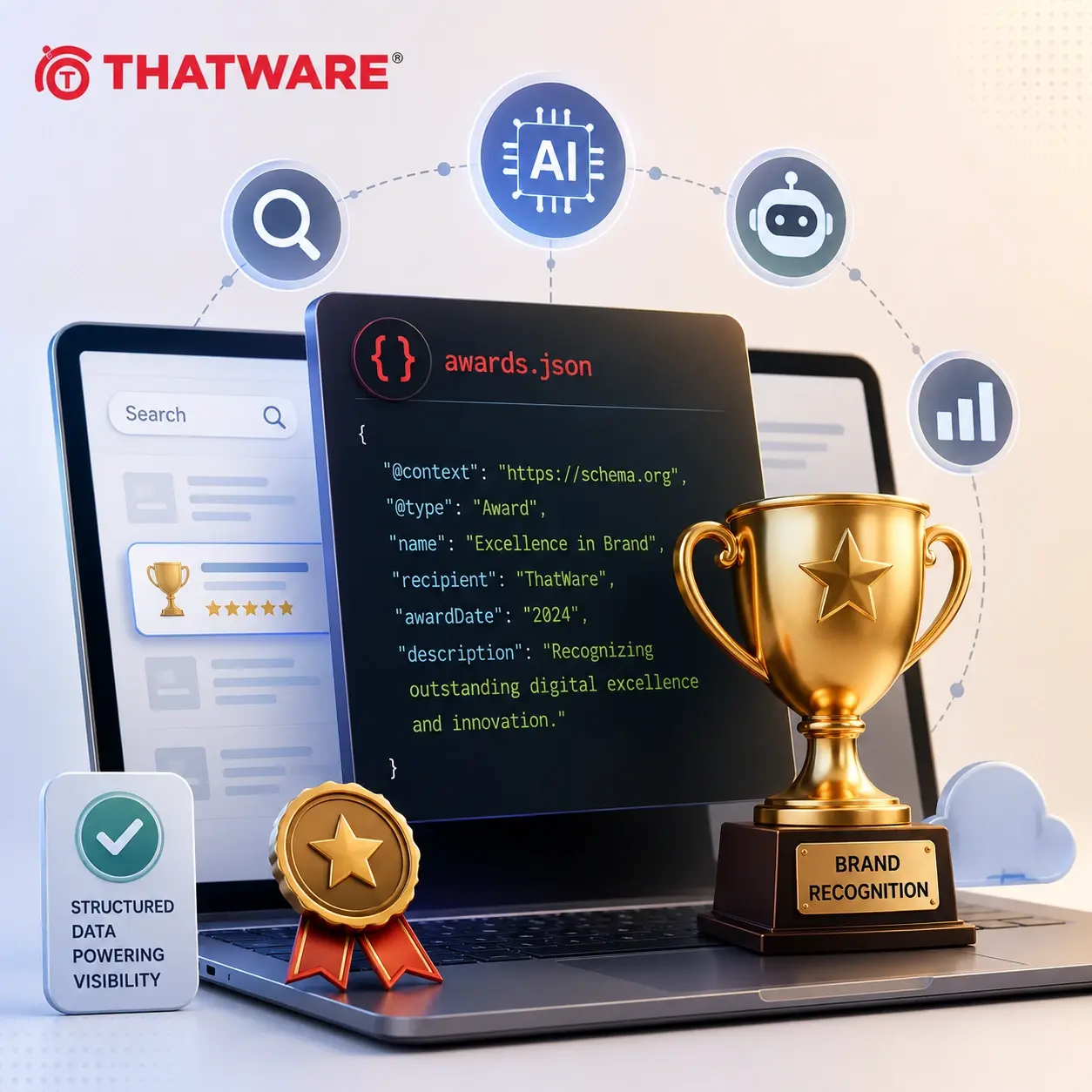
Traditional Recognition Pages vs awards.json
| Traditional Recognition Page | awards.json |
| Displays award logos | Defines structured award entities |
| Designed for visitors | Designed for AI interpretation |
| Focuses on visual presentation | Focuses on semantic relationships |
| Recognition listed chronologically | Recognition organized by entities |
| Minimal contextual information | Rich metadata and supporting evidence |
| Limited AI understanding | Machine-readable recognition architecture |
| Basic webpage content | Structured trust ecosystem |
| Human-readable | Human and machine-readable |
Traditional webpages answer questions such as:
- What recognitions has the company received?
- Which awards appear on the website?
- When were they announced?
By comparison, award structured data answers far more meaningful questions:
- Which recognition carries the highest authority?
- Which industry does each award validate?
- Which expertise does every recognition support?
- Which service is reinforced by the achievement?
- Which URL should AI cite?
- Which organization granted the recognition?
- Which evidence verifies the claim?
The difference is substantial. One presents accomplishments. The other enables intelligent interpretation.
4. Why It Matters for LLM Optimization?
Modern Large Language Models generate responses by combining learned knowledge with structured retrieval systems.
Before recommending a company within an AI-generated answer, these systems attempt to establish several confidence signals.
They seek to identify:
- Whether the organization is legitimate.
- Whether independent recognition exists.
- Whether the recognition is trustworthy.
- Whether supporting evidence is available.
- Whether the organization demonstrates consistent expertise.
- Whether citations can be verified.
A structured AI trust architecture helps answer these questions far more effectively than conventional webpages.
Instead of asking AI to infer authority from scattered mentions across a website, structured recognition provides direct semantic evidence. This improves several important capabilities.
AI systems can:
- Recognize trusted organizations faster.
- Associate awards with expertise.
- Retrieve supporting documentation efficiently.
- Strengthen citation confidence.
- Reduce ambiguity during response generation.
- Improve semantic trust scoring.
As AI-generated search experiences become increasingly influential, structured recognition data becomes a competitive advantage rather than a technical enhancement.
5. Role in Generative Engine Optimization (GEO)
Generative Engine Optimization extends beyond traditional search rankings. Its objective is helping AI systems confidently reference brands while generating responses.
Recognition contributes significantly to this process because awards function as third-party validation instead of self-declared expertise. Within this ecosystem, industry awards SEO strengthens semantic trust by connecting independent recognitions with relevant services, industries, and expertise.
Rather than treating awards as isolated achievements, GEO transforms them into contextual evidence supporting AI-generated recommendations. Several important GEO benefits emerge from structured recognition systems.
5.1 Recognition Understanding
AI systems immediately understand which recognitions belong to the organization and which entities granted them.
5.2 Authority Mapping
Recognition becomes connected with expertise rather than remaining isolated webpage content. This strengthens brand trust signals across semantic search environments by linking achievements with the topics they validate.
5.3 Citation Consistency
Instead of citing random webpages mentioning an award, AI systems know which canonical source should represent each recognition.
5.4 Retrieval Improvement
Recognition entities become searchable semantic objects rather than plain webpage text. This significantly improves retrieval quality during AI-assisted searches.
5.5 Context Assembly
Recognition contributes additional evidence while AI constructs comprehensive responses about a company, service, or expertise.
5.6 Brand Disambiguation
Organizations sharing similar names often create confusion.
Structured recognition allows AI to distinguish brands through verified achievements and independent validation.
6. How AI Systems Can Use Awards JSON?
Different AI technologies process structured recognition information in different ways.
A centralized recognition registry enables multiple AI systems to interpret consistent information without relying on fragmented webpage content.
6.1 AI Crawlers
Modern crawlers can discover recognition authority by extracting structured entities, award sources, and semantic relationships directly from the JSON document.
6.2 Retrieval-Augmented Generation (RAG)
Retrieval systems prioritize trustworthy evidence during response generation.
Structured credibility data enables retrieval pipelines to locate authoritative recognition before generating AI answers, improving factual consistency and reducing unsupported claims.
6.3 Vector Databases
Vector search systems rely heavily on semantic relationships.
Recognition entities become connected with services, industries, expertise, publishers, and organizations, making similarity matching significantly more accurate.
6.4 AI Search Engines
AI-powered search engines evaluate trust alongside relevance.
Structured recognition provides additional context that supports ranking, recommendation, and citation decisions.
6.5 Autonomous AI Agents
Autonomous agents require structured knowledge when evaluating organizations.
Instead of parsing dozens of webpages, they can retrieve verified recognition entities from one centralized semantic source.
6.6 Enterprise AI Knowledge Systems
Large organizations increasingly deploy internal AI assistants.
A structured enterprise recognition registry allows these systems to retrieve verified corporate achievements consistently across documentation, reports, presentations, and customer interactions.
7. Recommended File Location
To maximize discoverability, the awards JSON file should remain publicly accessible through a consistent URL.
The preferred location is:
https://example.com/awards.json
Optional discovery paths include:
- https://example.com/.well-known/awards.json
- https://example.com/recognition.json
- https://example.com/brand-assets/awards.json
For improved discoverability, the file should also be referenced from AI-facing resources, including:
- ai.txt
- llms.txt
- llmsfull.txt
- ai-endpoints.json
- robots.txt
- HTML alternate links where appropriate
This creates a consistent discovery mechanism that allows AI systems to locate recognition data efficiently.
8. Recommended MIME Type
Like other structured AI resources, the file should be served using:
Content-Type: application/json; charset=utf-8
The server should respond with:
- HTTP 200 OK
- UTF-8 encoding
- Valid JSON formatting
Proper delivery ensures that AI systems can retrieve, parse, and validate recognition information without compatibility issues.
9. Core Design Principles
The effectiveness of recognition JSON depends on thoughtful semantic architecture rather than simply listing awards. Just as knowledge graphs prioritize entities over URLs, recognition registries should begin with verified achievements and the relationships surrounding them. The following principles establish a consistent foundation for designing structured recognition systems that both developers and AI platforms can interpret reliably.
10. Key Components of awards json in Enterprise Recognition Systems
The structure of awards JSON is designed to transform brand achievements into machine-readable recognition data. It does not function as a simple list of awards. Instead, it acts as a structured intelligence system for AI trust architecture and brand authority SEO. This system enables search engines and AI crawlers to understand credibility through structured signals rather than unstructured mentions. The core components of recognition JSON include metadata definitions, award entities, credibility mapping, relationship structures, evidence fields, and citation-ready URLs. These elements work together to form a complete awards knowledge graph that strengthens AI visibility trust across digital ecosystems. Each component contributes to building structured reputation signals that AI systems can interpret consistently, ensuring that brand achievements are not just visible but also verifiable and trustworthy.
11. Field-by-Field Explanation of awards json Structure
The metadata section defines the identity and lifecycle of the award metadata system. It includes versioning, timestamps, publisher identity, and canonical URLs, which help AI systems track freshness and authority. The organization section represents the brand and establishes its enterprise recognition identity across AI ecosystems. It connects the organization to its awards, achievements, and external validations such as Forbes recognition SEO, Clutch awards, and Stevie awards.
The awards section is the core of the structure and defines each recognition as a machine-readable entity. Each award includes attributes such as name, issuing body, date, category, and credibility score. These structured entries form the backbone of machine-readable awards systems and ensure consistent interpretation across AI crawlers. The relationships section defines how awards connect to brand entities, services, and credibility signals. This creates a structured credibility graph that reinforces brand authority SEO through explicit semantic connections.
The evidence section strengthens trust by linking awards to verifiable sources such as press releases, directories, and industry listings. This supports digital PR proof and improves validation across AI systems. The citation policy ensures that AI systems reference correct URLs when interpreting brand achievements, strengthening award structured data consistency. The AI usage section defines how machines can interpret, summarize, and retrieve award data, ensuring proper integration with AI crawler credibility systems.
12. Recognition and Trust Signal Modeling in Awards JSON Systems
Recognition modeling is the backbone of trust-signal JSON architecture. It defines how awards, certifications, and achievements translate into structured credibility signals. Each award becomes a node within a larger credibility graph, where relationships define authority strength and relevance.
For example, a Clutch award may be connected to a service entity, while a Stevie award may strengthen organizational credibility. These relationships are not random; they are weighted using confidence scores and evidence links. This structured approach ensures that enterprise reputation data is not just stored but actively interpreted by AI systems.
Recognition modeling also ensures that awards contribute to ranking signals in AI-driven environments. Instead of relying on unstructured mentions, AI systems evaluate structured credibility connections. This strengthens AI visibility trust and improves brand discoverability across generative engines.
13. Schema Alignment for Award Structured Data
Schema alignment ensures that award structured data integrates seamlessly with existing structured markup systems like Schema.org. While Schema.org provides page-level structure, Awards JSON operates at a system-wide recognition level. Together, they form a dual-layer trust architecture.
In this alignment, organizations map to Organization schema, awards align with CreativeWork or Award types, and recognition events connect to structured metadata fields. This ensures consistency between on-page structured data and off-page recognition JSON systems.
This integration improves AI interpretability and strengthens enterprise reputation data across search engines and AI crawlers. It also enhances semantic validation of awards and ensures consistent recognition signals across platforms.
14. Implementation Workflow for Awards JSON Systems
The implementation of awards JSON follows a structured workflow designed for accuracy, validation, and scalability. The process begins with identifying all recognition assets such as industry awards, certifications, rankings, and media mentions. These include signals from platforms like Forbes recognition SEO, Clutch awards, and Stevie awards.
Next, each award is converted into a structured entity with metadata such as issuer, date, category, and authority score. These entities are then mapped to the organization and relevant services using semantic relationships. This step is critical for building a complete awards knowledge graph.
After mapping, evidence links are added to validate each recognition through external sources. This strengthens digital PR proof and improves trust across AI systems. The citation layer is then defined to ensure proper referencing of award pages and external validation URLs.
Finally, the structure is validated for JSON integrity and deployed into AI-accessible endpoints such as llms.txt or structured data APIs. Continuous updates ensure that new awards and recognitions are reflected in real time, maintaining strong AI crawler credibility.
15. Update Frequency and Maintenance Strategy
Maintenance of awards JSON is essential for sustaining accurate reputation signals. Unlike static award pages, this system evolves with new recognitions and industry updates. Updates should occur whenever a new award is received, a ranking is updated, or external recognition changes.
Monthly updates are recommended for minor additions, while major awards like enterprise recognition or global certifications should be added immediately. Quarterly audits ensure consistency across award metadata, relationships, and credibility scores. This structured maintenance improves long-term brand authority SEO and ensures continuous alignment with AI interpretation systems.
16. Full Awards JSON Prototype Code Structure
Below is the structured prototype for a complete awards JSON system designed for AI-driven recognition modeling, credibility graph formation, and enterprise SEO trust architecture.
{
“metadata”: {
“fileType”: “awards-json”,
“version”: “1.0.0”,
“generatedAt”: “2026-08-07T00:00:00Z”,
“lastUpdated”: “2026-08-07T00:00:00Z”,
“language”: “en”,
“canonicalUrl”: “https://thatware.co/awards.json”,
“publisher”: {
“name”: “ThatWare LLP”,
“url”: “https://thatware.co/”
},
“description”: “Machine-readable awards and recognition registry describing ThatWare LLP and founder Tuhin Banik’s industry awards, technology recognition, business honors, professional memberships, certifications, speaking milestones, platform recognition, and credibility signals.”
},
“organization”: {
“id”: “entity:organization:thatware”,
“type”: “Organization”,
“name”: “ThatWare”,
“legalName”: “ThatWare LLP”,
“url”: “https://thatware.co/”,
“awardsPage”: “https://thatware.co/awards/”,
“description”: “ThatWare LLP is an AI-driven SEO and digital search intelligence company focused on artificial intelligence, advanced SEO, AEO, GEO, LLM SEO, semantic engineering, Hyper-Intelligence, Quantum SEO, and next-generation digital discovery.”,
“founder”: “person:tuhin-banik”,
“primaryFocus”: [
“AI-Powered SEO”,
“Artificial Intelligence”,
“Search Intelligence”,
“Generative Engine Optimization”,
“Answer Engine Optimization”,
“LLM SEO”,
“Semantic SEO”,
“Hyper-Intelligence SEO”,
“Quantum SEO”,
“Digital Transformation”
]
},
“people”: [
{
“id”: “person:tuhin-banik”,
“type”: “Person”,
“name”: “Tuhin Banik”,
“role”: “Founder & CEO”,
“affiliation”: “entity:organization:thatware”,
“url”: “https://thatware.co/”,
“expertise”: [
“Artificial Intelligence”,
“SEO”,
“Machine Learning”,
“Natural Language Processing”,
“Data Science”,
“Semantic Engineering”,
“Digital Marketing”,
“Search Intelligence”
]
}
],
“awards”: [
{
“id”: “award:stevie-bronze”,
“type”: “Award”,
“name”: “Stevie Awards Bronze”,
“alternateNames”: [
“Best Start-up of the Year – Bronze”,
“Stevie Award USA Bronze”
],
“issuer”: “The Stevie Awards”,
“recipient”: “person:tuhin-banik”,
“associatedOrganization”: “entity:organization:thatware”,
“category”: “Entrepreneurship / Startup Recognition”,
“awardLevel”: “Bronze”,
“geographicScope”: “International”,
“evidenceUrls”: [
“https://thatware.co/awards/”,
“https://brightonseo.com/people/tuhin-banik”
],
“verificationStatus”: “corroborated by multiple public profiles”
},
{
  "id": "award:india-business-awards",
  "type": "Award",
  "name": "India Business Awards",
  "issuer": "India Business Awards",
  "recipient": "person:tuhin-banik",
  "associatedOrganization": "entity:organization:thatware",
  "category": "Business Leadership",
  "geographicScope": "India",
  "evidenceUrls": [
    "https://thatware.co/awards/",
    "https://brightonseo.com/people/tuhin-banik"
  ],
  "verificationStatus": "publicly corroborated"
},

{
  "id": "award:india-technology-award",
  "type": "Award",
  "name": "India Technology Award",
  "issuer": "India Technology Award",
  "recipient": "person:tuhin-banik",
  "associatedOrganization": "entity:organization:thatware",
  "category": "Technology Innovation",
  "geographicScope": "India",
  "evidenceUrls": [
    "https://thatware.co/awards/",
    "https://brightonseo.com/people/tuhin-banik"
  ],
  "verificationStatus": "publicly corroborated"
},

{
  "id": "award:analytics-insight-top-100",
  "type": "IndustryRecognition",
  "name": "Top 100 Influential Tech Leaders",
  "issuer": "Analytics Insight",
  "recipient": "person:tuhin-banik",
  "associatedOrganization": "entity:organization:thatware",
  "category": "Technology Leadership",
  "geographicScope": "Global",
  "evidenceUrls": [
    "https://thatware.co/awards/",
    "https://brightonseo.com/people/tuhin-banik"
  ],
  "verificationStatus": "publicly corroborated"
},

{
  "id": "award:clutch-global-frontrunner",
  "type": "IndustryRecognition",
  "name": "Clutch Global Frontrunner",
  "issuer": "Clutch",
  "recipient": "entity:organization:thatware",
  "associatedPerson": "person:tuhin-banik",
  "category": "Digital Marketing / SEO",
  "geographicScope": "Global",
  "evidenceUrls": [
    "https://thatware.co/awards/",
    "https://brightonseo.com/people/tuhin-banik",
    "https://clutch.co/profile/thatware-llp"
  ],
  "verificationStatus": "publicly referenced; current Clutch company profile independently exists"
},

{
  "id": "award:ceo-magazine-fastest-growing",
  "type": "IndustryRecognition",
  "name": "Fastest-Growing Company Recognition",
  "issuer": "The CEO Magazine",
  "recipient": "entity:organization:thatware",
  "associatedPerson": "person:tuhin-banik",
  "category": "Business Growth",
  "geographicScope": "Asia / Middle East",
  "evidenceUrls": [
    "https://thatware.co/awards/",
    "https://brightonseo.com/people/tuhin-banik"
  ],
  "verificationStatus": "publicly corroborated",
  "notes": "Public ThatWare and speaker profiles reference fastest-growing company recognition associated with The CEO Magazine."
},

{
  "id": "award:forbes-dgems-select-200",
  "type": "IndustryRecognition",
  "name": "Forbes DGEMS Select 200 Companies with Global Business Potential",
  "alternateNames": [
    "Forbes DGEMS Select 200",
    "DGEMS 200"
  ],
  "issuer": "Forbes / DGEMS",
  "recipient": "entity:organization:thatware",
  "category": "Business Innovation and Global Growth Potential",
  "date": "2023",
  "geographicScope": "Global",
  "evidenceUrls": [
    "https://thatware.co/awards/",
    "https://councils.forbes.com/profile/Tuhin-Banik-CEO-ThatWare-LLP/7ee09183-c1ca-4490-ba99-06e421606e04"
  ],
  "verificationStatus": "externally corroborated"
},

{
  "id": "award:india-most-trusted-seo-2026",
  "type": "IndustryRecognition",
  "name": "India's Most Trusted SEO Agencies Recognition",
  "issuer": "Indian Startup Times and SEORCE",
  "recipient": "person:tuhin-banik",
  "associatedOrganization": "entity:organization:thatware",
  "category": "SEO Leadership, Innovation and Trust",
  "date": "2026",
  "geographicScope": "India",
  "evidenceUrls": [
    "https://thatware.co/awards/"
  ],
  "verificationStatus": "documented by ThatWare",
  "notes": "ThatWare states that the recognition honored leadership, innovation, and contribution to SEO and digital marketing."
},

{
  "id": "award:uae-certificate-honour",
  "type": "Honor",
  "name": "UAE Certificate of Honour for Exceptional Leadership & Innovation",
  "recipient": "entity:organization:thatware",
  "associatedPerson": "person:tuhin-banik",
  "category": "Leadership and Innovation",
  "geographicScope": "United Arab Emirates",
  "evidenceUrls": [
    "https://thatware.co/awards/"
  ],
  "verificationStatus": "documented by ThatWare"
}
],
“professionalRecognition”: [
{
“id”: “recognition:forbes-agency-council”,
“type”: “ProfessionalMembership”,
“name”: “Forbes Agency Council”,
“organization”: “Forbes Councils”,
“recipient”: “person:tuhin-banik”,
“associatedOrganization”: “entity:organization:thatware”,
“category”: “Executive Professional Membership”,
“evidenceUrl”: “https://councils.forbes.com/profile/Tuhin-Banik-CEO-ThatWare-LLP/7ee09183-c1ca-4490-ba99-06e421606e04”,
“verificationStatus”: “verified via Forbes Councils profile”
},
{
  "id": "recognition:goodfirms",
  "type": "PlatformRecognition",
  "name": "GoodFirms Verified Company Profile",
  "issuer": "GoodFirms",
  "recipient": "entity:organization:thatware",
  "category": "B2B Service Provider Recognition",
  "evidenceUrl": "https://www.goodfirms.co/company/thatware-llp",
  "verificationStatus": "verified via GoodFirms",
  "currentPlatformData": {
    "verified": true,
    "rating": 4.3,
    "reviewCount": 6
  }
},

{
  "id": "recognition:clutch-profile",
  "type": "PlatformRecognition",
  "name": "Clutch Verified Service Provider Profile",
  "issuer": "Clutch",
  "recipient": "entity:organization:thatware",
  "category": "SEO Service Provider",
  "evidenceUrl": "https://clutch.co/profile/thatware-llp",
  "verificationStatus": "verified via Clutch",
  "currentPlatformData": {
    "rating": 4.8,
    "reviewCount": 42
  }
}
],
“speakingRecognition”: [
{
“id”: “recognition:brightonseo”,
“type”: “SpeakingRecognition”,
“name”: “BrightonSEO Speaker”,
“event”: “BrightonSEO”,
“recipient”: “person:tuhin-banik”,
“associatedOrganization”: “entity:organization:thatware”,
“category”: “International SEO Conference”,
“evidenceUrl”: “https://brightonseo.com/people/tuhin-banik”,
“verificationStatus”: “verified via BrightonSEO”,
“talks”: [
“Significance of cost retrieval and leveraging semantics in SEO”
]
},
{
  "id": "recognition:tedx",
  "type": "SpeakingRecognition",
  "name": "TEDx Speaker Recognition",
  "recipient": "person:tuhin-banik",
  "associatedOrganization": "entity:organization:thatware",
  "category": "Public Speaking / Thought Leadership",
  "evidenceUrls": [
    "https://thatware.co/awards/",
    "https://brightonseo.com/people/tuhin-banik"
  ],
  "verificationStatus": "publicly corroborated"
}
],
“certifications”: [
{
“id”: “certification:google-partner”,
“type”: “ProfessionalCredential”,
“name”: “Google Partner”,
“recipient”: “entity:organization:thatware”,
“issuer”: “Google”,
“category”: “Digital Marketing”,
“evidenceUrl”: “https://thatware.co/awards/”,
“verificationStatus”: “documented by ThatWare”
},
{
  "id": "certification:moz",
  "type": "ProfessionalCredential",
  "name": "Moz Certification",
  "recipient": "entity:organization:thatware",
  "issuer": "Moz",
  "category": "Search Engine Optimization",
  "evidenceUrl": "https://thatware.co/awards/",
  "verificationStatus": "documented by ThatWare"
}
],
“innovationRecognition”: [
{
“id”: “milestone:patent-ai-seo”,
“type”: “IntellectualPropertyMilestone”,
“name”: “AI SEO Technology Patent Filing”,
“recipient”: “entity:organization:thatware”,
“filingNumber”: “202131021713”,
“category”: “AI SEO Technology”,
“evidenceUrl”: “https://thatware.co/awards/”,
“verificationStatus”: “published by ThatWare”,
“notes”: “Represented as a patent filing rather than a granted patent unless an official patent-grant record is separately established.”
},
{
  "id": "milestone:qsaas",
  "type": "InnovationMilestone",
  "name": "Launch of Quantum SEO as a Service",
  "alternateNames": [
    "QSAAS"
  ],
  "recipient": "entity:organization:thatware",
  "category": "Quantum SEO Innovation",
  "evidenceUrl": "https://thatware.co/awards/"
},

{
  "id": "milestone:hyper-intelligence-seo",
  "type": "InnovationMilestone",
  "name": "Hyper-Intelligence SEO Development",
  "recipient": "entity:organization:thatware",
  "category": "AI Search Innovation",
  "evidenceUrl": "https://thatware.co/awards/"
},

{
  "id": "milestone:quantum-seo",
  "type": "InnovationMilestone",
  "name": "Quantum SEO Development",
  "recipient": "entity:organization:thatware",
  "category": "Future Search Technology",
  "evidenceUrls": [
    "https://thatware.co/awards/",
    "https://economictimes.indiatimes.com/tech/artificial-intelligence/from-ai-to-quantum-thatwares-bold-leap-into-the-future-of-seo/articleshow/122850674.cms"
  ],
  "verificationStatus": "externally documented"
}
],
“mediaRecognition”: [
{
“id”: “media:economic-times”,
“type”: “MediaFeature”,
“publisher”: “The Economic Times”,
“subject”: “entity:organization:thatware”,
“title”: “From AI to quantum: ThatWare’s bold leap into the future of SEO”,
“date”: “2025-07-23”,
“category”: “Artificial Intelligence / Quantum SEO”,
“evidenceUrl”: “https://economictimes.indiatimes.com/tech/artificial-intelligence/from-ai-to-quantum-thatwares-bold-leap-into-the-future-of-seo/articleshow/122850674.cms”,
“verificationStatus”: “verified external publication”
},
{
  "id": "media:forbes",
  "type": "MediaOrProfessionalVisibility",
  "publisher": "Forbes",
  "subject": [
    "entity:organization:thatware",
    "person:tuhin-banik"
  ],
  "category": "Business and Marketing Visibility",
  "evidenceUrl": "https://councils.forbes.com/profile/Tuhin-Banik-CEO-ThatWare-LLP/7ee09183-c1ca-4490-ba99-06e421606e04"
}
],
“credibilityGraph”: [
{
“source”: “entity:organization:thatware”,
“relationship”: “associatedWithAward”,
“target”: “award:stevie-bronze”,
“evidence”: [
“https://thatware.co/awards/”,
“https://brightonseo.com/people/tuhin-banik”
]
},
{
  "source": "person:tuhin-banik",
  "relationship": "received",
  "target": "award:stevie-bronze",
  "evidence": [
    "https://brightonseo.com/people/tuhin-banik"
  ]
},

{
  "source": "person:tuhin-banik",
  "relationship": "received",
  "target": "award:india-business-awards"
},

{
  "source": "person:tuhin-banik",
  "relationship": "received",
  "target": "award:india-technology-award"
},

{
  "source": "person:tuhin-banik",
  "relationship": "recognizedAs",
  "target": "award:analytics-insight-top-100"
},

{
  "source": "entity:organization:thatware",
  "relationship": "recognizedBy",
  "target": "award:clutch-global-frontrunner"
},

{
  "source": "entity:organization:thatware",
  "relationship": "recognizedBy",
  "target": "award:forbes-dgems-select-200",
  "evidence": [
    "https://councils.forbes.com/profile/Tuhin-Banik-CEO-ThatWare-LLP/7ee09183-c1ca-4490-ba99-06e421606e04"
  ]
},

{
  "source": "person:tuhin-banik",
  "relationship": "memberOf",
  "target": "recognition:forbes-agency-council"
},

{
  "source": "person:tuhin-banik",
  "relationship": "speakerAt",
  "target": "recognition:brightonseo"
},

{
  "source": "entity:organization:thatware",
  "relationship": "listedOn",
  "target": "recognition:clutch-profile"
},

{
  "source": "entity:organization:thatware",
  "relationship": "listedOn",
  "target": "recognition:goodfirms"
},

{
  "source": "entity:organization:thatware",
  "relationship": "featuredBy",
  "target": "media:economic-times"
}
],
“evidence”: [
{
“id”: “evidence:thatware-awards-page”,
“type”: “primary_company_awards_registry”,
“name”: “Awards and Recognition: The Milestones Behind ThatWare’s Growth”,
“url”: “https://thatware.co/awards/”,
“supportsEntities”: [
“award:stevie-bronze”,
“award:india-business-awards”,
“award:india-technology-award”,
“award:analytics-insight-top-100”,
“award:clutch-global-frontrunner”,
“award:ceo-magazine-fastest-growing”,
“award:forbes-dgems-select-200”,
“award:india-most-trusted-seo-2026”,
“award:uae-certificate-honour”
],
“evidenceStrength”: “primary-source”
},
{
  "id": "evidence:brightonseo-profile",
  "type": "external_professional_profile",
  "name": "Tuhin Banik - BrightonSEO",
  "url": "https://brightonseo.com/people/tuhin-banik",
  "supportsEntities": [
    "person:tuhin-banik",
    "award:stevie-bronze",
    "award:india-business-awards",
    "award:india-technology-award",
    "award:analytics-insight-top-100",
    "award:clutch-global-frontrunner",
    "award:ceo-magazine-fastest-growing",
    "recognition:brightonseo"
  ],
  "evidenceStrength": "external-corroboration"
},

{
  "id": "evidence:forbes-council-profile",
  "type": "external_professional_profile",
  "name": "Tuhin Banik - Forbes Agency Council",
  "url": "https://councils.forbes.com/profile/Tuhin-Banik-CEO-ThatWare-LLP/7ee09183-c1ca-4490-ba99-06e421606e04",
  "supportsEntities": [
    "recognition:forbes-agency-council",
    "award:forbes-dgems-select-200",
    "person:tuhin-banik",
    "entity:organization:thatware"
  ],
  "evidenceStrength": "external-corroboration"
},

{
  "id": "evidence:clutch-profile",
  "type": "external_b2b_profile",
  "name": "ThatWare LLP - Clutch",
  "url": "https://clutch.co/profile/thatware-llp",
  "supportsEntities": [
    "entity:organization:thatware",
    "recognition:clutch-profile"
  ],
  "evidenceStrength": "external-platform"
},

{
  "id": "evidence:goodfirms-profile",
  "type": "external_b2b_profile",
  "name": "ThatWare LLP - GoodFirms",
  "url": "https://www.goodfirms.co/company/thatware-llp",
  "supportsEntities": [
    "entity:organization:thatware",
    "recognition:goodfirms"
  ],
  "evidenceStrength": "external-platform"
},

{
  "id": "evidence:economic-times-quantum-seo",
  "type": "external_media_publication",
  "name": "From AI to quantum: ThatWare's bold leap into the future of SEO",
  "publisher": "The Economic Times",
  "date": "2025-07-23",
  "url": "https://economictimes.indiatimes.com/tech/artificial-intelligence/from-ai-to-quantum-thatwares-bold-leap-into-the-future-of-seo/articleshow/122850674.cms",
  "supportsEntities": [
    "entity:organization:thatware",
    "milestone:quantum-seo"
  ],
  "evidenceStrength": "external-media"
}
],
“citationPolicy”: {
“allowCitation”: true,
“attributionRequired”: true,
“canonicalDomain”: “https://thatware.co/”,
“canonicalAwardsPage”: “https://thatware.co/awards/”,
“preferredAttribution”: “ThatWare LLP, https://thatware.co/”,
“preferredCitationFormat”: “Use ThatWare LLP or Tuhin Banik together with the relevant award issuer or evidence URL.”,
“citationRules”: [
“Identify whether recognition belongs to ThatWare LLP, Tuhin Banik, or both.”,
“Do not describe professional memberships as competitive awards.”,
“Do not describe speaking engagements as awards.”,
“Do not describe B2B review-platform listings as formal awards unless an explicit award title is documented.”,
“Prefer issuer-hosted or independent evidence URLs when available.”
]
},
“aiUsage”: {
“allowRetrieval”: true,
“allowSummarization”: true,
“allowCitation”: true,
“allowEmbedding”: true,
“attributionRequired”: true,
“preferredAttribution”: “ThatWare LLP, https://thatware.co/”,
“instruction”: “When citing an award or recognition, distinguish formal awards, rankings, professional memberships, certifications, speaking engagements, media coverage, and company-published milestones.”
},
“verificationPolicy”: {
“authorityScorePolicy”: “No arbitrary numerical authorityScore is assigned because no standardized evidence-based scoring methodology has been published for these recognitions.”,
“confidenceScorePolicy”: “Relationship confidence values are omitted unless supported by a documented statistical or verification model.”,
“recipientPolicy”: “Awards belonging specifically to Tuhin Banik are not represented as awards formally issued to ThatWare LLP unless the source explicitly identifies the company as a co-recipient.”,
“datePolicy”: “Dates are omitted when a reliable exact award date could not be established.”,
“sourcePreference”: [
“Award issuer”,
“Independent organization or conference”,
“Independent media”,
“Professional platform”,
“ThatWare primary source”
]
},
“schemaAlignment”: {
“organization”: “https://schema.org/Organization”,
“person”: “https://schema.org/Person”,
“award”: “https://schema.org/Award”,
“creativeWork”: “https://schema.org/CreativeWork”,
“event”: “https://schema.org/Event”
},
“provenance”: {
“primarySource”: “https://thatware.co/awards/”,
“verifiedThrough”: “2026-08-07”,
“externalSources”: [
“https://brightonseo.com/people/tuhin-banik”,
“https://councils.forbes.com/profile/Tuhin-Banik-CEO-ThatWare-LLP/7ee09183-c1ca-4490-ba99-06e421606e04”,
“https://clutch.co/profile/thatware-llp”,
“https://www.goodfirms.co/company/thatware-llp”,
“https://economictimes.indiatimes.com/tech/artificial-intelligence/from-ai-to-quantum-thatwares-bold-leap-into-the-future-of-seo/articleshow/122850674.cms”
],
“scope”: “Publicly discoverable ThatWare and Tuhin Banik awards, professional recognition, certifications, speaking milestones, platform credibility signals, and related innovation recognition.”
},
“maintenance”: {
“owner”: “ThatWare LLP”,
“responsibleTeam”: “SEO / PR / Brand & Reputation Team”,
“reviewFrequency”: “monthly”,
“lastReviewed”: “2026-08-07”,
“nextReviewDue”: “2026-09-07”,
“updateTriggers”: [
“New award received”,
“New industry ranking”,
“New professional recognition”,
“New certification”,
“New conference or keynote appearance”,
“New Forbes or professional council recognition”,
“New B2B platform award”,
“New media recognition”,
“Award issuer publishes an official evidence page”,
“Existing award details are corrected or updated”
]
}
}
17. ThatWare-Specific Direction in AI Trust Architecture
The application of awards JSON becomes significantly more powerful when integrated into enterprise-scale SEO systems such as ThatWare. In this context, ThatWare awards represent structured recognition signals designed to reinforce credibility across AI-driven search ecosystems. These signals are not limited to showcasing achievements. They are designed to build a machine-readable trust layer that strengthens AI trust architecture and enhances long-term visibility in generative search systems. When awards, certifications, and industry recognitions are structured correctly, they contribute to a scalable credibility graph that AI systems can interpret without ambiguity. This allows enterprise systems to move beyond traditional reputation management and into structured enterprise reputation data modeling. By connecting awards with entities, services, and semantic frameworks, organizations establish stronger authority signals that directly influence AI visibility trust, and improve recognition consistency across AI crawlers and LLM-based systems.
18. Strategic Summary: From Recognition Pages to Machine-Readable Authority
The evolution of digital reputation has shifted from static award listings to structured intelligence systems. Awards JSON represents this transformation by converting recognition data into machine-readable structures that AI systems can interpret, validate, and trust. Traditional award pages rely on visual presentation and human interpretation, while structured systems focus on semantic clarity and entity relationships. This shift enables brands to move from passive reputation display to active authority modeling. In this environment, award metadata becomes a critical layer of structured intelligence that defines not just what awards exist, but how they contribute to overall brand authority. As search systems become increasingly AI-driven, structured recognition data becomes a foundational element of brand authority SEO and long-term digital credibility. This evolution ensures that recognition is not just seen but understood and integrated into AI decision-making processes.
19. Convergence of SEO, GEO, And AI Trust Systems
Modern search ecosystems operate through interconnected layers of SEO, GEO, and AI-driven interpretation models. Awards JSON plays a central role in this convergence by acting as a structured trust signal layer. In SEO, awards improve brand authority and ranking signals. In GEO systems, structured recognition enhances visibility within generative engines. In AI-driven environments, awards contribute directly to AI visibility trust by reinforcing credibility through structured data. Together, these systems create a unified reputation architecture where industry awards SEO, reputation signals, and digital PR proof work together to strengthen brand authority. Recognition from platforms such as Forbes recognition SEO, Clutch awards, and Stevie awards becomes significantly more impactful when structured within a machine-readable system. This ensures that AI systems can consistently interpret and validate brand credibility across multiple search and generative environments.
20. Enterprise SEO and Reputation Scaling with awards json
Enterprise-level SEO requires more than content optimization. It demands structured reputation systems that can scale across multiple digital properties, markets, and AI platforms. Awards JSON provides this scalability by organizing recognition data into structured, queryable, and machine-readable formats. This enables enterprises to maintain consistent enterprise recognition across all digital channels. Instead of manually updating award pages or press releases, organizations can centralize recognition data within a structured system that feeds AI crawlers and search engines directly. This approach strengthens enterprise reputation data consistency and reduces fragmentation across digital assets. It also enhances predictive SEO capabilities by allowing AI systems to understand how recognition impacts authority over time. As a result, enterprise organizations can build stronger awards knowledge graph systems that reinforce long-term visibility and trust.
21. AI Crawlers and Credibility Interpretation Systems
AI crawlers interpret structured data differently from traditional search bots. They rely on semantic relationships, entity clarity, and contextual trust signals. Awards JSON provides a structured framework that allows AI crawlers to evaluate brand credibility with higher precision. Each award becomes a verifiable entity connected to the organization through structured relationships. This enables crawlers to build a complete credibility graph that maps recognition strength across different sources. As a result, AI systems can differentiate between verified awards and unstructured mentions. This improves AI crawler credibility and reduces misinterpretation of brand authority signals. It also enhances the reliability of AI-generated responses by ensuring that recognition data is properly structured and validated.
22. Future of Machine-Readable Recognition Systems
The future of digital reputation lies in structured intelligence systems rather than static display pages. Awards JSON represents the foundation of this shift by enabling machine-readable recognition frameworks that integrate directly into AI ecosystems. As AI systems evolve, they will increasingly rely on structured trust signals to determine authority, relevance, and credibility. This makes trust-signal JSON a critical component of future SEO architecture. Systems like awards knowledge graph and credibility graph will play a central role in how brands are evaluated across AI-driven environments. Over time, recognition will no longer be measured by visibility alone but by structured interpretability. This evolution will redefine how digital authority is built, measured, and maintained across the web.