
SUPERCHARGE YOUR ONLINE VISIBILITY! CONTACT US AND LET’S ACHIEVE EXCELLENCE TOGETHER!
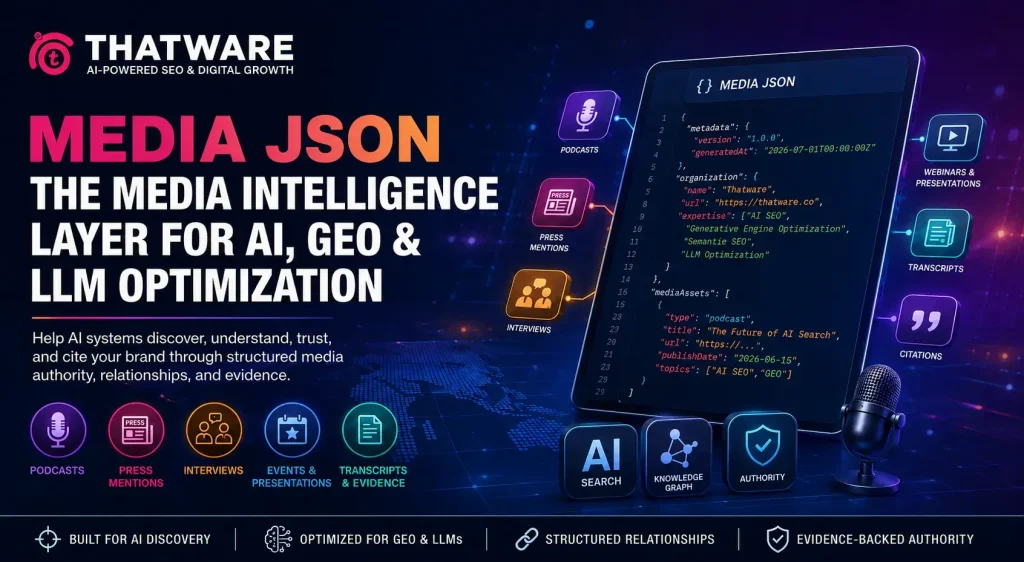
This document explains the purpose, structure, strategic value, and implementation model of a media json file for organizations that want to improve AI media visibility, Generative Engine Optimization (GEO), Large Language Model optimization, semantic search discovery, and machine-readable brand authority.
The goal of this file is to help AI systems understand a brand not only through its website, but also through its press coverage, podcasts, interviews, webinars, conference talks, and other public media appearances as a connected semantic ecosystem.
1. What Is media json?
media json is a machine-readable JSON file that represents the complete media ecosystem of a website, organization, brand, executive, or subject-matter expert.
It defines:
- press releases
- news articles
- podcasts
- interviews
- webinars
- conference talks
- guest articles
- video appearances
- brand mentions
- awards coverage
- publication details
- public relations metadata
- preferred citation URLs
- media relationships
- machine-readable summaries
In simple terms, it tells AI systems:
“These are the verified media appearances of this organization, these are the publications and platforms that featured it, and these are the preferred sources for understanding and citing the brand.”
2. Why media json Exists
Traditional media pages are designed mainly for human visitors and search engine crawlers. They usually rely on:
- media pages
- press archives
- newsroom sections
- blog posts
- news sitemaps
- publication links
- embedded videos
These are useful, but they do not always provide a clear semantic representation for AI systems.
LLMs and AI answer engines need to understand:
- which media assets belong to the organization
- which executives appeared publicly
- which publications are authoritative
- which interviews discuss specific topics
- how media appearances are connected
- which sources should be cited
- which content provides supporting evidence
- which media assets establish expertise
A media json file solves this by creating a central semantic media layer.
It also helps organize press metadata into a structured format that improves authority, credibility, and discoverability across AI-powered search systems.
3. Difference Between a Media Page, News Sitemap, and media json
Traditional Media Page
A media page answers:
- Which media appearances has the organization published?
- Which press releases are available?
- Which interviews can visitors read or watch?
News Sitemap
A news sitemap answers:
- Which news URLs exist?
- When were they published?
- Which URLs should search engines discover?
media json
A media json file answers:
- Who mentioned this company?
- Which interviews exist?
- Which podcasts feature the brand?
- Which executives appeared publicly?
- Which publications are authoritative?
- Which media assets support expertise?
- Which URLs should AI retrieve?
- How should media mention JSON connect these assets?
A media page is human-first.
A news sitemap is crawler-first.
A media json file is AI-first.
4. Why It Matters for LLM Optimization
Large Language Models generate answers using training data, retrieval systems, structured signals, external references, and available context.
For an organization to appear confidently in AI-generated answers, the AI system must be able to:
- identify the brand correctly
- recognize important executives and experts
- understand external credibility
- evaluate media trust signals
- identify preferred citation sources
- retrieve relevant media assets
- avoid ambiguity between similar organizations
media json helps with all of these.
It can support:
- better entity understanding
- improved citation likelihood
- higher AI trust
- stronger external authority
- better semantic retrieval
- reduced hallucination
5. Role in GEO: Generative Engine Optimization
Generative Engine Optimization is the process of optimizing digital assets for AI answer engines, LLMs, AI search systems, conversational search platforms, and autonomous agents.
media json contributes to GEO by acting as a structured media authority layer that helps AI systems understand a brand’s external recognition and public expertise.
GEO Benefits
5.1 Media Authority Mapping
The file makes it clear which media assets contribute to a brand’s authority.
Example:
- Organization: ThatWare
- Featured in: industry publications, podcasts, and webinars
- Primary expertise: AI SEO, Generative Engine Optimization
- External recognition: verified editorial coverage
This structured approach strengthens media authority signals by connecting every media appearance to the organization.
5.2 Press Relationship Discovery
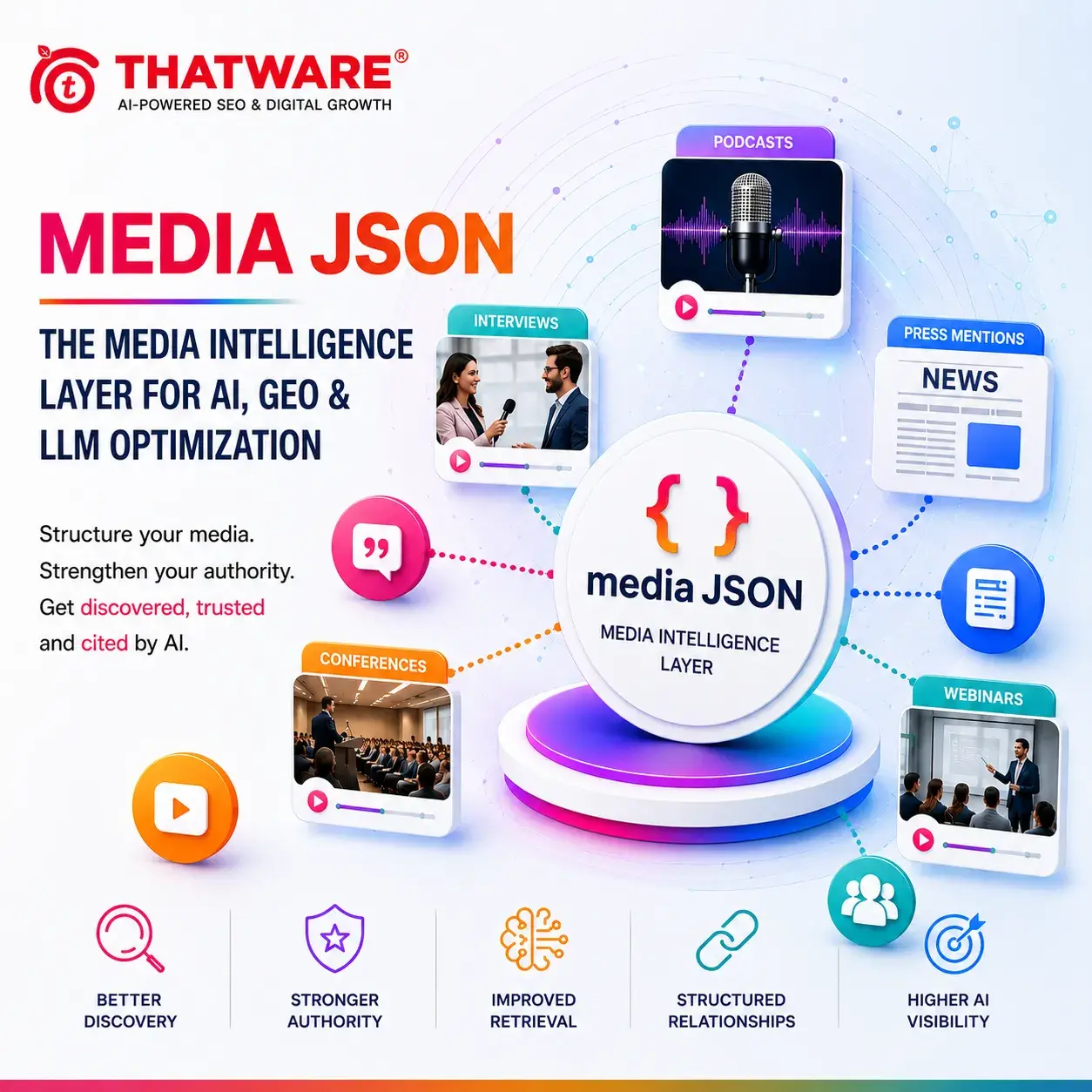
The file connects organizations with publishers, journalists, podcasts, conferences, and news platforms.
Example:
- Organization: ThatWare
- Featured by: industry news websites
- Published through: official press releases
- Related media assets: interviews and guest articles
This creates a clear semantic map for press structured data across multiple publications.
5.3 Executive Recognition
The file identifies founders, executives, and subject-matter experts who represent the organization.
Example:
- Organization: ThatWare
- Founder appearances
- Executive interviews
- Conference presentations
A structured media profile improves founder media visibility across AI-powered search platforms.
5.4 Podcast Discovery
AI systems can discover podcast episodes connected to the organization.
Example:
- Organization: ThatWare
- Podcast appearances
- Featured speakers
- Episode transcripts
This improves podcast authority by connecting podcast content with verified organizational expertise.
5.5 Interview Retrieval
The file helps retrieval systems locate interviews discussing specific products, services, or technologies.
Example:
- Executive interviews
- Media Q&A sessions
- Webinar discussions
This supports better interview archive SEO by organizing interviews into a machine-readable format.
5.6 Citation Control
The file tells AI systems which media source should be cited for each appearance.
Example:
- For company announcements, cite the official press release.
- For executive insights, cite the original interview.
- For podcast discussions, cite the official episode page.
This improves press citation signals across AI-generated responses.
5.7 Trust Signal Enhancement
The file combines editorial coverage, interviews, podcasts, webinars, and conference appearances into one structured resource.
This strengthens enterprise PR signals and helps AI systems evaluate external credibility with greater confidence.
6. How AI Systems Can Use media json
Different AI systems may use this file in different ways.
6.1 AI Crawlers
An AI crawler can discover the file and extract media assets, publication details, canonical URLs, and relationships.
This structured AI crawler media data improves content discovery.
6.2 RAG Systems
A retrieval-augmented generation system can use the file to identify the most relevant media appearance for a specific query.
6.3 Vector Databases
The file helps vector databases organize media assets, transcripts, and publication relationships into meaningful semantic connections.
6.4 AI Search Engines
AI search engines can use the file to understand editorial authority, citation preferences, and reputation SEO signals.
6.5 AI Assistants
AI assistants can retrieve interviews, podcasts, webinars, and press coverage to generate more accurate responses.
6.6 Brand Knowledge Panels
The file supports structured understanding of organizations, executives, publications, and media appearances similar to a knowledge panel.
6.7 Enterprise Knowledge Graphs
Enterprise knowledge graphs can use media json to connect external publications with internal entities, improving overall brand understanding.
7. Recommended File Location
The recommended public URL is:
https://example.com/media json
Optional additional discovery paths:
https://example.com/.well-known/media json
https://example.com/ai-endpoints.json
https://example.com/llms.txt
The file should also be referenced from:
- ai.txt
- llms.txt
- llmsfull.txt
- ai-endpoints.json
- robots.txt, optionally as a comment or sitemap-style reference
- HTML <link rel=”alternate”>, optionally
This allows AI systems to discover the file while strengthening digital PR JSON implementation.
8. Recommended MIME Type
Serve the file as:
application/json
The server should return:
HTTP 200 OK
Content-Type: application/json; charset=utf-8
Serving the correct MIME type ensures reliable parsing and supports consistent AI discovery media across modern AI platforms.
9. Core Design Principles
9.1 Media-First Design
Do not start with URLs. Start with media assets.
Media assets can include:
- organization
- press release
- news article
- podcast
- interview
- webinar
- conference talk
- guest article
- video appearance
- publication
- speaker
- award coverage
- transcript
A structured media inventory helps improve earned media SEO by organizing every external appearance into a consistent format.
9.2 Canonical Source URLs
Every media asset should have one preferred source URL.
Example:
{
“title”: “AI Search Visibility Interview”,
“canonicalUrl”: “https://example.com/interviews/ai-search-visibility”
}
This improves podcast SEO by ensuring AI systems retrieve the original source instead of duplicate versions.
9.3 Persistent Media IDs
Every media asset should have a stable ID.
Example:
“id”: “media:podcast:ai-search-visibility-001”
Persistent identifiers make media assets easier to discover, update, and validate over time.
9.4 Structured Relationships
Relationships should be explicit.
Example:
{
“source”: “organization:thatware”,
“relationship”: “featuredIn”,
“target”: “media:podcast:future-of-ai-seo”
}
A structured relationship model strengthens the overall media knowledge graph.
9.5 Evidence-Based Authority
Authority should not be claimed without supporting evidence.
Example evidence:
- official press release
- podcast episode
- executive interview
- webinar recording
- conference presentation
- verified news article
- published transcript
- external editorial mention
Supporting evidence also reinforces press feature data across AI systems.
9.6 Citation Readiness
Every important media asset should include a preferred citation URL.
This helps AI systems reference the correct source while improving brand authority file consistency.
9.7 Human and Machine Readability
The JSON should be understandable by developers, search engines, and AI systems.
A consistent structure improves long-term maintenance and simplifies automated validation.
10. Key Components of media json
A strong media json should include the following major sections:
- metadata
- organization
- website
- media assets
- podcasts
- interviews
- press mentions
- publications
- speakers
- events
- relationships
- evidence
- citations
- authority scores
- AI usage policy
- validation metadata
11. Field-by-Field Explanation
11.1 metadata
Defines file-level information.
Recommended fields:
- version
- generatedAt
- lastUpdated
- publisher
- license
- language
- canonicalUrl
Purpose:
- helps crawlers understand freshness
- supports version control
- makes the file easier to validate
11.2 organization
Defines the primary organization or brand.
Recommended fields:
- id
- name
- legalName
- url
- logo
- description
- foundingDate
- founders
- sameAs
- contactPoint
- primaryExpertise
Purpose:
- identifies the primary organization
- supports brand recognition
- helps AI associate media assets with the correct company
A dedicated organization section is especially valuable for ThatWare media management.
11.3 website
Defines the website as a digital property.
Recommended fields:
- id
- url
- name
- publisher
- inLanguage
- primaryAudience
- contentTypes
Purpose:
- helps AI systems understand the website
- separates the organization from the website asset
11.4 mediaAssets
The most important section.
Each media asset should include:
- id
- title
- type
- publication
- publisher
- url
- publishDate
- author
- language
- featuredPeople
- topics
- summary
- preferredCitation
- authorityScore
Media asset types may include:
- Press Release
- News Article
- Podcast Episode
- Interview
- Webinar
- Conference Talk
- Guest Article
- Video
- Award Coverage
Purpose:
- organizes every public appearance
- improves structured retrieval
- supports machine-readable media discovery
11.5 podcasts
Defines podcast appearances.
Recommended fields:
- id
- title
- host
- guest
- episodeUrl
- publishDate
- transcript
- topics
Purpose:
- improves podcast discovery
- strengthens media attribution
11.6 interviews
Defines executive and expert interviews.
Recommended fields:
- id
- title
- interviewer
- interviewee
- publication
- url
- publishDate
- transcript
Purpose:
- improves interview organization
- supports expert attribution
11.7 pressMentions
Defines editorial media coverage.
Recommended fields:
- id
- publication
- articleTitle
- url
- publishDate
- summary
- mentionedEntities
Purpose:
- records editorial recognition
- supports external authority validation
11.8 publications
Defines media publishers.
Recommended fields:
- id
- name
- website
- publisherType
- language
- authorityScore
Purpose:
- identifies trusted publishing sources
- improves publication consistency
11.9 speakers
Defines founders, executives, authors, and subject-matter experts.
Recommended fields:
- id
- name
- role
- expertise
- biography
- sameAs
Purpose:
- supports executive recognition
- improves attribution
11.10 events
Defines conferences, webinars, and speaking engagements.
Recommended fields:
- id
- eventName
- organizer
- location
- date
- presentationTitle
- eventUrl
Purpose:
- connects media appearances with public events
- improves contextual understanding
11.11 relationships
Defines graph relationships between organizations, publications, speakers, and media assets.
Common relationship types:
- featuredIn
- interviewedBy
- publishedBy
- mentions
- discusses
- references
- hostedBy
- presentedAt
- supports
- cites
Purpose:
- transforms media json from a collection of records into a connected semantic graph
11.12 evidence
Defines proof supporting media authority.
Evidence types:
- podcast
- interview
- conference
- keynote
- webinar
- press article
- research mention
- news coverage
- video
- transcript
Purpose:
- strengthens credibility
- supports interview SEO
- reduces unsupported authority claims
11.13 citationPolicy
Defines how AI systems should cite media assets.
Recommended fields:
- allowCitation
- preferredCitationFormat
- canonicalDomain
- preferredMediaSources
Purpose:
- improves citation consistency
- helps AI retrieve authoritative media sources
11.14 aiUsage
Defines usage permissions for AI systems.
Recommended fields:
- allowSummarization
- allowRetrieval
- allowCitation
- allowEmbedding
- allowTraining
- attributionRequired
Purpose:
- communicates machine-readable AI usage policies
12. Authority Scoring Model
A useful media json can include authority scores.
Recommended score range:
0.00 to 1.00
Suggested interpretation:
- 0.90–1.00: primary authority
- 0.75–0.89: strong authority
- 0.50–0.74: moderate authority
- 0.25–0.49: supporting relevance
- 0.00–0.24: weak or contextual relation
Authority score should be based on:
- publication authority
- speaker credibility
- media relevance
- recency
- editorial quality
- citation frequency
- topic relevance
- external recognition
Avoid making unsupported claims.
The score should be internally meaningful and evidence-backed.
13. Relationship Modeling Best Practices
Every relationship should describe how media assets, organizations, speakers, and publications are connected.
Example:
{
“source”: “organization:thatware”,
“relationship”: “featuredIn”,
“target”: “podcast:future-of-ai-search”,
“confidence”: 0.98,
“evidence”: [
“https://example.com/podcast/future-of-ai-search”
]
}
Recommended Relationship Vocabulary
- featuredIn
- interviewedBy
- hostedBy
- publishedBy
- discusses
- mentions
- cites
- supports
- references
- hasTranscript
- hasRecording
- sameAs
Using a consistent relationship vocabulary improves semantic understanding and strengthens reputation SEO across AI search platforms.
14. How to Use With Schema.org and JSON-LD
media json does not replace Schema.org markup. It complements it.
Recommended approach:
- Use Schema.org JSON-LD inside individual pages.
- Use media json as the website-wide structured media directory.
- Use llms.txt to help AI systems discover important media resources.
- Use ai-endpoints.json to reference AI-readable files.
Recommended Schema.org types include:
- NewsArticle
- PodcastEpisode
- VideoObject
- AudioObject
- Event
- Person
- Organization
- CreativeWork
Example connection:
{
“schemaAlignment”: {
“newsArticle”: “https://schema.org/NewsArticle”,
“podcastEpisode”: “https://schema.org/PodcastEpisode”,
“videoObject”: “https://schema.org/VideoObject”,
“audioObject”: “https://schema.org/AudioObject”,
“event”: “https://schema.org/Event”,
“person”: “https://schema.org/Person”,
“organization”: “https://schema.org/Organization”,
“creativeWork”: “https://schema.org/CreativeWork”
}
}
This alignment improves interoperability between structured data and media json.
15. Implementation Workflow
Step 1: Collect All Media Appearances
Create a complete inventory of:
- press releases
- news articles
- podcasts
- interviews
- webinars
- conference talks
- guest articles
- videos
Step 2: Identify Speakers and Organizations
Associate every media asset with:
- organization
- founders
- executives
- hosts
- speakers
- publishers
Step 3: Assign Canonical URLs
Each media asset should point to one preferred source URL.
Step 4: Build Relationships
Connect organizations, speakers, publications, topics, and media assets using explicit relationships.
Step 5: Attach Transcripts
Include transcripts whenever available to improve machine readability.
Step 6: Add Evidence
Attach supporting media such as official recordings, news articles, and editorial coverage.
Step 7: Configure Citation Policy
Specify preferred citation URLs and attribution rules.
Step 8: Validate JSON
Ensure the file follows valid JSON syntax and consistent formatting.
Step 9: Publish Publicly
Upload the file to its recommended public location.
Step 10: Reference From AI Files
Reference media json from:
- ai.txt
- llms.txt
- llmsfull.txt
- ai-endpoints.json
- robots.txt
Step 11: Maintain Regularly
Update the file after:
- new podcast appearances
- executive interviews
- press coverage
- webinars
- conference presentations
- editorial mentions
Regular updates improve AI discovery media over time.
16. SEO, GEO, and AEO Benefits
SEO Benefits
- better media discoverability
- stronger E-E-A-T signals
- improved entity consistency
- richer structured data
- stronger press metadata organization
GEO Benefits
- better AI citation opportunities
- stronger authority recognition
- improved retrieval
- better trust signals
- higher AI visibility
- improved media mention JSON consistency
AEO Benefits
- better answer generation
- improved executive attribution
- enhanced conversational discovery
- better voice search readiness
A structured media json file also strengthens media trust signals by providing verified external evidence for AI-generated answers.
17. Common Mistakes to Avoid
Mistake 1: Making It a URL List
A media json file is not simply a collection of media links.
Mistake 2: Missing Publication Metadata
Every media asset should include complete publication information.
Mistake 3: Ignoring Transcripts
Transcripts improve retrieval, accessibility, and semantic understanding.
Mistake 4: No Speaker Entities
Always define founders, executives, hosts, guests, and subject-matter experts as separate entities.
Mistake 5: Missing Canonical Citations
Every important media asset should have a preferred citation source.
Mistake 6: No Relationship Graph
Without relationships, the file becomes structured metadata instead of a semantic media graph.
Mistake 7: No Maintenance Strategy
A media json file should be maintained as a living asset.
Update it whenever new interviews, podcasts, press releases, webinars, conference talks, or editorial coverage are published.
18. Recommended Update Frequency
| Update Type | Frequency |
| New press coverage | Immediately |
| New podcast appearances | Immediately |
| Executive interviews | Immediately |
| Transcript updates | Monthly |
| Authority scoring | Quarterly |
| Publication authority review | Quarterly |
| Schema alignment review | Twice yearly |
| Full media audit | Twice yearly |
| Citation policy review | Annually |
| media json validation | After every major media update |
19. Full Reusable Prototype Code Structure
A complete reusable media json template covering:
{
“metadata”: {
“fileType”: “media”,
“version”: “1.0.0”,
“generatedAt”: “2026-08-07T00:00:00Z”,
“lastUpdated”: “2026-08-07T00:00:00Z”,
“language”: “en”,
“canonicalUrl”: “https://thatware.co/media.json”,
“publisher”: {
“name”: “ThatWare LLP”,
“url”: “https://thatware.co/”
},
“description”: “Machine-readable media intelligence registry describing ThatWare LLP and Tuhin Banik’s press coverage, press releases, interviews, podcasts, conference appearances, speaking engagements, publications, external citations, media provenance, and authority signals.”
},
“organization”: {
“id”: “organization:thatware”,
“type”: “Organization”,
“name”: “ThatWare”,
“legalName”: “ThatWare LLP”,
“url”: “https://thatware.co/”,
“pressRoom”: “https://thatware.co/press-release/”,
“description”: “ThatWare LLP is an AI-driven search, SEO, digital discovery, and marketing technology company developing approaches in AI SEO, Hyper-Intelligence SEO, Quantum SEO, AEO, GEO, LLM SEO, semantic search, machine learning, NLP, and search intelligence.”,
“foundingYear”: 2018,
“founders”: [
{
“id”: “person:tuhin-banik”,
“name”: “Tuhin Banik”,
“role”: “Founder & CEO”
}
],
“sameAs”: [
“https://www.linkedin.com/company/thatware-llp”,
“https://www.forbes.com/councils/forbesagencycouncil/people/tuhinbanik/”,
“https://councils.forbes.com/profile/Tuhin-Banik-CEO-ThatWare-LLP/7ee09183-c1ca-4490-ba99-06e421606e04”
],
“contactPoint”: {
“email”: “info@thatware.co”,
“url”: “https://thatware.co/contact-us/”
},
“mediaTopics”: [
“Artificial Intelligence”,
“AI SEO”,
“Search Engine Optimization”,
“Quantum SEO”,
“Hyper-Intelligence SEO”,
“LLM SEO”,
“Generative Engine Optimization”,
“Answer Engine Optimization”,
“Semantic Search”,
“Natural Language Processing”,
“Machine Learning”,
“Digital Transformation”,
“Search Intelligence”
]
},
“website”: {
“id”: “website:thatware-co”,
“type”: “WebSite”,
“name”: “ThatWare Website”,
“url”: “https://thatware.co/”,
“publisher”: “organization:thatware”,
“inLanguage”: “en”,
“contentTypes”: [
“Press Releases”,
“Research”,
“Framework Documentation”,
“Media Coverage”,
“Technical Articles”,
“Interviews”,
“Case Studies”,
“Videos”,
“Thought Leadership”
]
},
“pressRoom”: {
“id”: “media-hub:thatware-press-release”,
“type”: “MediaArchive”,
“name”: “ThatWare Press Release”,
“url”: “https://thatware.co/press-release/”,
“publisher”: “organization:thatware”,
“description”: “Official ThatWare press-release and media announcement archive.”,
“sourceClassification”: “owned-media”,
“useForCitation”: true
},
“mediaAssets”: [
{
“id”: “media:economic-times-quantum-seo-2025”,
“type”: “NewsArticle”,
“title”: “From AI to quantum: ThatWare’s bold leap into the future of SEO”,
“publication”: “The Economic Times”,
“publisher”: “The Economic Times”,
“url”: “https://economictimes.indiatimes.com/tech/artificial-intelligence/from-ai-to-quantum-thatwares-bold-leap-into-the-future-of-seo/articleshow/122850674.cms”,
“publishDate”: “2025-07-23”,
“language”: “en”,
“featuredOrganizations”: [
“organization:thatware”
],
“featuredPeople”: [
“person:tuhin-banik”
],
“topics”: [
“Quantum SEO”,
“Artificial Intelligence”,
“Quantum Computing”,
“Search Engine Optimization”,
“Future of Search”
],
“summary”: “Coverage of ThatWare’s work on moving beyond conventional AI-enhanced SEO toward a Quantum SEO research and optimization model.”,
“sourceClassification”: “external-media”,
“preferredCitation”: “https://economictimes.indiatimes.com/tech/artificial-intelligence/from-ai-to-quantum-thatwares-bold-leap-into-the-future-of-seo/articleshow/122850674.cms”,
“verificationStatus”: “verified”
},
{
  "id": "media:first-india-llm-search-2026",
  "type": "NewsArticle",
  "title": "How Tuhin Banik is exploring the shift to LLM-driven search and the next phase of SEO",
  "publication": "First India",
  "publisher": "First India",
  "url": "https://firstindia.co.in/news/life-style/how-tuhin-banik-is-exploring-the-shift-to-llm-driven-search-and-the-next-phase-of-seo",
  "publishDate": "2026-03-11",
  "language": "en",
  "featuredPeople": [
    "person:tuhin-banik"
  ],
  "featuredOrganizations": [
    "organization:thatware"
  ],
  "topics": [
    "LLM Search",
    "AI Search",
    "SEO",
    "Generative AI",
    "Search Intent",
    "Semantic Search"
  ],
  "summary": "Feature examining Tuhin Banik's work around the transition from traditional rankings and keyword-based SEO toward LLM-driven and AI-mediated search.",
  "sourceClassification": "external-media",
  "verificationStatus": "verified"
},

{
  "id": "media:hans-india-ai-seo-2026",
  "type": "NewsArticle",
  "title": "Tuhin Banik: The Genius Behind The World's First Agency Focused On LLM SEO, AEO, GEO & AI SEO",
  "publication": "The Hans India",
  "publisher": "The Hans India",
  "author": "Sanjana Mukhiya",
  "url": "https://assets.thehansindia.com/cinema/tuhin-banik-the-genius-behind-the-worlds-first-agency-focused-on-llm-seo-aeo-geo-ai-seo-1056328",
  "publishDate": "2026-03-13",
  "language": "en",
  "featuredPeople": [
    "person:tuhin-banik"
  ],
  "featuredOrganizations": [
    "organization:thatware"
  ],
  "topics": [
    "LLM SEO",
    "AEO",
    "GEO",
    "AI SEO",
    "Generative AI",
    "Search Technology"
  ],
  "summary": "Feature discussing Tuhin Banik's view that AI systems, conversational interfaces, and large language models require new approaches beyond conventional keyword- and backlink-focused SEO.",
  "sourceClassification": "external-media",
  "verificationStatus": "verified"
},

{
  "id": "media:tribune-search-beyond-keywords-2026",
  "type": "SponsoredArticle",
  "title": "Dr. Tuhin Banik's Approach to SEO: Expanding Search Beyond Keywords and Rankings",
  "publication": "The Tribune",
  "publisher": "The Tribune",
  "url": "https://www.tribuneindia.com/partner-exclusives/dr-tuhin-baniks-approach-to-seo-expanding-search-beyond-keywords-and-rankings/",
  "publishDate": "2026-02-11",
  "language": "en",
  "featuredPeople": [
    "person:tuhin-banik"
  ],
  "featuredOrganizations": [
    "organization:thatware"
  ],
  "topics": [
    "AI Search",
    "Entity SEO",
    "Search Intent",
    "Contextual Relevance",
    "SEO"
  ],
  "summary": "Sponsored article discussing a shift from mechanical SEO ranking tactics toward entities, intent, credibility, context, and machine interpretation.",
  "sourceClassification": "sponsored-media",
  "disclosure": [
    "Advertorial",
    "Sponsored"
  ],
  "verificationStatus": "verified"
},

{
  "id": "media:economic-times-ai-marketing-2019",
  "type": "PromotionalArticle",
  "title": "Meet Tuhin Banik - Guy Who's Changing the Digital Marketing Landscape Using Artificial Intelligence",
  "publication": "The Economic Times",
  "publisher": "The Economic Times",
  "url": "https://economictimes.indiatimes.com/tech/software/meet-tuhin-banik-guy-whos-changing-the-digital-marketing-landscape-using-artificial-intelligence/articleshow/68609758.cms",
  "publishDate": "2019",
  "language": "en",
  "featuredPeople": [
    "person:tuhin-banik"
  ],
  "featuredOrganizations": [
    "organization:thatware"
  ],
  "topics": [
    "Artificial Intelligence",
    "Digital Marketing",
    "Semantic Search",
    "Natural Language Processing",
    "SEO"
  ],
  "summary": "Promotional coverage discussing Tuhin Banik and ThatWare's use of artificial intelligence, semantic search engineering, NLP, and digital marketing.",
  "sourceClassification": "promotional-media",
  "disclosure": "The source explicitly states that the story is promotional and that liability rests with ThatWare.",
  "verificationStatus": "verified"
},

{
  "id": "media:economic-times-panache-2019",
  "type": "InterviewFeature",
  "title": "Tuhin Banik catches up on latest AI updates during flights, Punjabi songs calm him down",
  "publication": "The Economic Times - ET Panache",
  "publisher": "The Economic Times",
  "url": "https://economictimes.indiatimes.com/magazines/panache/tuhin-banik-catches-up-on-latest-ai-updates-during-flights-punjabi-songs-calm-him-down/articleshow/73046884.cms",
  "language": "en",
  "featuredPeople": [
    "person:tuhin-banik"
  ],
  "featuredOrganizations": [
    "organization:thatware"
  ],
  "topics": [
    "Artificial Intelligence",
    "Executive Profile",
    "Technology Reading"
  ],
  "summary": "ET Panache profile featuring Tuhin Banik discussing how he uses travel time to keep up with artificial intelligence research.",
  "sourceClassification": "external-media",
  "verificationStatus": "verified"
},

{
  "id": "media:business-standard-ai-digital-marketing-2019",
  "type": "SyndicatedPressCoverage",
  "title": "ThatWare innovates traditional digital marketing with artificial intelligence",
  "publication": "Business Standard",
  "publisher": "Business Standard / ANI",
  "url": "https://www.business-standard.com/article/news-ani/thatware-innovates-traditional-digital-marketing-with-artificial-intelligence-119041600539_1.html",
  "publishDate": "2019-04-16",
  "language": "en",
  "featuredPeople": [
    "person:tuhin-banik"
  ],
  "featuredOrganizations": [
    "organization:thatware"
  ],
  "topics": [
    "Artificial Intelligence",
    "Digital Marketing",
    "SEO",
    "Automation"
  ],
  "summary": "ANI-distributed coverage describing ThatWare's application of artificial intelligence to digital marketing and SEO.",
  "sourceClassification": "syndicated-press-release",
  "verificationStatus": "verified"
}
],
“pressReleases”: [
{
“id”: “press:hyper-intelligence-2-2025”,
“type”: “PressRelease”,
“title”: “ThatWare Introduces Hyper-Intelligence 2.0: 150 Advanced SEO Strategies for 2025”,
“issuer”: “ThatWare”,
“distributionOrHost”: “TechWeek Singapore”,
“url”: “https://www.singaporetechnologyweek.com/exhibitor-press-releases/thatware-introduces-hyper-intelligence-20-150-advanced-seo-strategies-2025”,
“publishDate”: “2025-03-03”,
“language”: “en”,
“featuredOrganization”: “organization:thatware”,
“featuredPeople”: [
“person:tuhin-banik”
],
“topics”: [
“Hyper-Intelligence 2.0”,
“AI SEO”,
“Quantum SEO”,
“LLM SEO”,
“Predictive Intelligence”,
“Semantic Search”
],
“summary”: “Press release announcing Hyper-Intelligence 2.0 and a set of more than 150 advanced SEO strategies aimed at AI-era search environments.”,
“sourceClassification”: “company-press-release”,
“verificationStatus”: “verified-hosted-release”
},
{
  "id": "press:seo-landscape-2023",
  "type": "PressRelease",
  "title": "Unlocking Digital Success: ThatWare takes the lead in the ever-evolving SEO landscape",
  "distribution": "ANI PR",
  "publication": "ThePrint",
  "url": "https://theprint.in/ani-press-releases/unlocking-digital-success-thatware-takes-the-lead-in-the-ever-evolving-seo-landscape/1655377/",
  "publishDate": "2023-07-05",
  "language": "en",
  "featuredOrganization": "organization:thatware",
  "featuredPeople": [
    "person:tuhin-banik"
  ],
  "topics": [
    "SEO",
    "Artificial Intelligence",
    "Machine Learning",
    "Digital Marketing",
    "Data Analytics"
  ],
  "summary": "Syndicated press release presenting ThatWare's research-driven and AI-supported approach to SEO and digital growth.",
  "sourceClassification": "syndicated-press-release",
  "disclosure": "ThePrint states that the content is an ANI press release and is not editorially produced by ThePrint.",
  "verificationStatus": "verified"
},

{
  "id": "press:canada-expansion-2024",
  "type": "PressRelease",
  "title": "ThatWare LLP Expands Its Impact: A Leader Among SEO Companies in Canada",
  "issuer": "ThatWare LLP",
  "distributionOrHost": "openPR",
  "url": "https://www.openpr.com/news/3678654/thatware-llp-expands-its-impact-a-leader-among-seo-companies",
  "publishDate": "2024-10-04",
  "language": "en",
  "featuredOrganization": "organization:thatware",
  "featuredPeople": [
    "person:tuhin-banik"
  ],
  "topics": [
    "Canada",
    "International Expansion",
    "SEO",
    "AI-Driven Digital Marketing"
  ],
  "summary": "Company-issued press release describing ThatWare's expansion into the Canadian market.",
  "sourceClassification": "company-press-release",
  "verificationStatus": "verified-hosted-release"
}
],
“podcasts”: [
{
“id”: “podcast:notabletalks-anytechtrial-2022”,
“type”: “PodcastEpisode”,
“title”: “NotableTalks with Tuhin Banik, CEO at ThatWare”,
“podcastName”: “NotableTalks by AnyTechTrial.com”,
“hostOrganization”: “AnyTechTrial.com”,
“guest”: “person:tuhin-banik”,
“platform”: “Amazon Music”,
“episodeUrl”: “https://music.amazon.com.br/podcasts/357692f5-3f81-4720-aa56-cd9b530b67ec/episodes/ffa65256-bf05-4c36-9ab9-69975cf96067/notabletalks-by-anytechtrial-com-notabletalks-with-tuhin-banik-ceo-at-thatware-by-anytechtrial-com”,
“publishDate”: “2022-03-08”,
“duration”: “29 minutes”,
“topics”: [
“Customer Engagement”,
“Digital Transformation”,
“Hybrid Work”,
“Automation”,
“SaaS”,
“Marketing Strategy”
],
“sourceClassification”: “external-podcast”,
“verificationStatus”: “verified”
},
{
  "id": "podcast:the-top-floor-2024",
  "type": "PodcastAppearance",
  "title": "The Top Floor",
  "guest": "person:tuhin-banik",
  "year": 2024,
  "role": "Interviewee",
  "evidenceUrl": "https://www.imdb.com/name/nm18290598/",
  "topics": [
    "Technology",
    "Entrepreneurship",
    "AI",
    "Digital Search"
  ],
  "sourceClassification": "external-podcast-credit",
  "verificationStatus": "appearance corroborated via IMDb",
  "notes": "A canonical episode URL should be added when independently located."
}
],
“interviews”: [
{
“id”: “interview:economic-times-panache”,
“type”: “Interview”,
“title”: “Tuhin Banik catches up on latest AI updates during flights, Punjabi songs calm him down”,
“interviewee”: “person:tuhin-banik”,
“publication”: “The Economic Times – ET Panache”,
“url”: “https://economictimes.indiatimes.com/magazines/panache/tuhin-banik-catches-up-on-latest-ai-updates-during-flights-punjabi-songs-calm-him-down/articleshow/73046884.cms”,
“topics”: [
“Artificial Intelligence”,
“Technology”,
“Executive Profile”
],
“verificationStatus”: “verified”
},
{
  "id": "interview:notabletalks-2022",
  "type": "PodcastInterview",
  "title": "NotableTalks with Tuhin Banik, CEO at ThatWare",
  "interviewee": "person:tuhin-banik",
  "publication": "NotableTalks by AnyTechTrial.com",
  "url": "https://music.amazon.com.br/podcasts/357692f5-3f81-4720-aa56-cd9b530b67ec/episodes/ffa65256-bf05-4c36-9ab9-69975cf96067/notabletalks-by-anytechtrial-com-notabletalks-with-tuhin-banik-ceo-at-thatware-by-anytechtrial-com",
  "publishDate": "2022-03-08",
  "topics": [
    "Digital Transformation",
    "Automation",
    "Customer Engagement",
    "Marketing"
  ],
  "verificationStatus": "verified"
}
],
“pressMentions”: [
{
“id”: “mention:forbes-profile”,
“type”: “ProfessionalMediaProfile”,
“publication”: “Forbes”,
“articleTitle”: “Tuhin Banik – Forbes Agency Council”,
“url”: “https://www.forbes.com/councils/forbesagencycouncil/people/tuhinbanik/”,
“featuredPeople”: [
“person:tuhin-banik”
],
“featuredOrganizations”: [
“organization:thatware”
],
“topics”: [
“Brand Awareness”,
“Semantic Marketing”,
“Predictive Analysis”,
“SEO”
],
“sourceClassification”: “professional-profile”,
“notes”: “Forbes currently labels Banik as a former Forbes Councils member and identifies Council content as expertise from members, with membership being fee-based.”
},
{
  "id": "mention:forbes-dgems-200",
  "type": "ProfessionalRecognitionReference",
  "publication": "Forbes Councils",
  "title": "Tuhin Banik | CEO - ThatWare LLP",
  "url": "https://councils.forbes.com/profile/Tuhin-Banik-CEO-ThatWare-LLP/7ee09183-c1ca-4490-ba99-06e421606e04",
  "featuredPeople": [
    "person:tuhin-banik"
  ],
  "featuredOrganizations": [
    "organization:thatware"
  ],
  "topics": [
    "SEO",
    "Digital Marketing",
    "Search Science",
    "Forbes DGEMS Select 200"
  ],
  "summary": "Forbes Councils profile identifies Tuhin Banik as ThatWare's CEO and states that ThatWare was included in the Forbes DGEMS Select 200 list in 2023.",
  "verificationStatus": "verified"
},

{
  "id": "mention:linkedin-thatware",
  "type": "ProfessionalCompanyProfile",
  "publication": "LinkedIn",
  "title": "THATWARE®",
  "url": "https://www.linkedin.com/company/thatware-llp",
  "featuredOrganizations": [
    "organization:thatware"
  ],
  "featuredPeople": [
    "person:tuhin-banik"
  ],
  "topics": [
    "Quantum AI",
    "LLM SEO",
    "AEO",
    "GEO",
    "AI Visibility",
    "Search Engineering"
  ],
  "sourceClassification": "company-controlled-professional-profile"
}
],
“speakers”: [
{
“id”: “speaker:tuhin-banik”,
“type”: “Person”,
“name”: “Tuhin Banik”,
“role”: “Founder & CEO, Search Scientist”,
“organization”: “organization:thatware”,
“expertise”: [
“AI SEO”,
“Semantic Search Engineering”,
“Natural Language Processing”,
“Machine Learning”,
“Data Science”,
“AEO”,
“GEO”,
“LLM SEO”,
“Quantum SEO”,
“Hyper-Intelligence SEO”
],
“profileUrls”: [
“https://councils.forbes.com/profile/Tuhin-Banik-CEO-ThatWare-LLP/7ee09183-c1ca-4490-ba99-06e421606e04”,
“https://brightonseo.com/people/tuhin-banik”,
“https://www.greatbritishbusinessshow.co.uk/speakers/dr-tuhin-banik”
],
“knownSpeakingPlatforms”: [
“BrightonSEO”,
“TEDx”,
“DMWF”,
“The Business Show”
]
}
],
“events”: [
{
“id”: “event:brightonseo-september-2023”,
“type”: “Conference”,
“eventName”: “BrightonSEO September 2023”,
“date”: “2023-09-14”,
“location”: “Brighton Centre, Brighton and Hove, United Kingdom”,
“speaker”: “speaker:tuhin-banik”,
“presentationTitle”: “Significance of cost retrieval and leveraging semantics in SEO”,
“eventUrl”: “https://brightonseo.com/talks/significance-of-cost-retrieval-and-leveraging-semantics-in-seo”,
“topics”: [
“Semantic Engineering”,
“Micro Semantics”,
“SEO”
],
“eventStatus”: “completed”,
“verificationStatus”: “verified by event organizer”
},
{
  "id": "event:business-show-london-2026",
  "type": "Conference",
  "eventName": "The Business Show 2026",
  "startDate": "2026-11-11",
  "endDate": "2026-11-12",
  "location": "ExCeL London, Royal Victoria Dock, London, United Kingdom",
  "speaker": "speaker:tuhin-banik",
  "speakerRole": "Speaker",
  "eventUrl": "https://www.greatbritishbusinessshow.co.uk/speakers/dr-tuhin-banik",
  "topics": [
    "Artificial Intelligence",
    "Technology",
    "Digital Transformation",
    "Search"
  ],
  "eventStatus": "scheduled",
  "verificationStatus": "verified by event organizer"
},

{
  "id": "event:dmat-confex",
  "type": "Conference",
  "eventName": "DMAT ConfEx",
  "speaker": "speaker:tuhin-banik",
  "speakerRole": "Keynote Speaker",
  "topics": [
    "Artificial Intelligence",
    "Marketing Technology",
    "Automation",
    "Predictive Analytics",
    "Digital Marketing"
  ],
  "evidenceUrl": "https://www.24-7pressrelease.com/press-release/529715/roonyx-wraps-up-a-strategic-year-and-prepares-for-dmat-confex-dubai-2025",
  "verificationStatus": "corroborated by third-party conference-related coverage",
  "notes": "Retain as supporting evidence unless an official event speaker page is available."
}
],
“ownedThoughtLeadership”: [
{
“id”: “owned-media:beyond-search-bar-2026”,
“type”: “Article”,
“title”: “Beyond the Search Bar: Tuhin Banik’s Vision for the Future of AI-Driven Search”,
“publisher”: “ThatWare LLP”,
“platform”: “Medium”,
“url”: “https://medium.com/@thatwareteam/beyond-the-search-bar-tuhin-baniks-vision-for-the-future-of-ai-driven-search-edc27619a0fc”,
“publishDate”: “2026-04”,
“featuredPeople”: [
“person:tuhin-banik”
],
“topics”: [
“AI-Driven Search”,
“Conversational Intelligence”,
“Natural Language Processing”,
“Digital Search”
],
“sourceClassification”: “owned-thought-leadership”
},
{
  "id": "owned-media:llm-driven-search-2026",
  "type": "Article",
  "title": "Inside Tuhin Banik's mind: exploring the future of LLM-driven search",
  "publisher": "ThatWare",
  "platform": "Medium",
  "url": "https://medium.com/@thatwarellp8/inside-tuhin-baniks-mind-exploring-the-future-of-llm-driven-search-a2aae65b6706",
  "publishDate": "2026-04",
  "featuredPeople": [
    "person:tuhin-banik"
  ],
  "topics": [
    "LLM Search",
    "Generative AI",
    "Semantic Search",
    "Future of SEO"
  ],
  "sourceClassification": "owned-thought-leadership"
}
],
“mediaClusters”: [
{
“id”: “cluster:ai-search-media”,
“name”: “AI Search and Future SEO Media Cluster”,
“primaryTopics”: [
“AI Search”,
“LLM SEO”,
“AEO”,
“GEO”,
“Semantic Search”
],
“mediaAssets”: [
“media:first-india-llm-search-2026”,
“media:hans-india-ai-seo-2026”,
“media:tribune-search-beyond-keywords-2026”
],
“intent”: [
“thought leadership”,
“AI search education”,
“brand discovery”,
“expert attribution”
]
},
{
  "id": "cluster:quantum-seo-media",
  "name": "Quantum SEO Media Cluster",
  "primaryTopics": [
    "Quantum SEO",
    "Quantum Computing",
    "Future Search Technology"
  ],
  "mediaAssets": [
    "media:economic-times-quantum-seo-2025",
    "press:hyper-intelligence-2-2025"
  ],
  "intent": [
    "innovation visibility",
    "technology positioning",
    "research attribution"
  ]
},

{
  "id": "cluster:speaking-authority",
  "name": "Speaking and Conference Authority Cluster",
  "primaryPerson": "person:tuhin-banik",
  "supportingAssets": [
    "event:brightonseo-september-2023",
    "event:business-show-london-2026",
    "event:dmat-confex",
    "podcast:notabletalks-anytechtrial-2022"
  ],
  "intent": [
    "speaker authority",
    "expertise verification",
    "industry participation"
  ]
}
],
“relationships”: [
{
“source”: “organization:thatware”,
“relationship”: “featuredIn”,
“target”: “media:economic-times-quantum-seo-2025”,
“evidence”: [
“https://economictimes.indiatimes.com/tech/artificial-intelligence/from-ai-to-quantum-thatwares-bold-leap-into-the-future-of-seo/articleshow/122850674.cms”
]
},
{
  "source": "person:tuhin-banik",
  "relationship": "featuredIn",
  "target": "media:first-india-llm-search-2026",
  "evidence": [
    "https://firstindia.co.in/news/life-style/how-tuhin-banik-is-exploring-the-shift-to-llm-driven-search-and-the-next-phase-of-seo"
  ]
},

{
  "source": "person:tuhin-banik",
  "relationship": "featuredIn",
  "target": "media:hans-india-ai-seo-2026"
},

{
  "source": "person:tuhin-banik",
  "relationship": "interviewedIn",
  "target": "interview:economic-times-panache"
},

{
  "source": "person:tuhin-banik",
  "relationship": "guestOn",
  "target": "podcast:notabletalks-anytechtrial-2022"
},

{
  "source": "speaker:tuhin-banik",
  "relationship": "presentedAt",
  "target": "event:brightonseo-september-2023"
},

{
  "source": "speaker:tuhin-banik",
  "relationship": "scheduledToSpeakAt",
  "target": "event:business-show-london-2026"
},

{
  "source": "speaker:tuhin-banik",
  "relationship": "keynoteSpeakerAt",
  "target": "event:dmat-confex"
},

{
  "source": "organization:thatware",
  "relationship": "issued",
  "target": "press:hyper-intelligence-2-2025"
},

{
  "source": "organization:thatware",
  "relationship": "issued",
  "target": "press:canada-expansion-2024"
},

{
  "source": "press:hyper-intelligence-2-2025",
  "relationship": "references",
  "target": "topic:hyper-intelligence-seo"
},

{
  "source": "media:economic-times-quantum-seo-2025",
  "relationship": "references",
  "target": "topic:quantum-seo"
},

{
  "source": "media:first-india-llm-search-2026",
  "relationship": "references",
  "target": "topic:llm-search"
}
],
“topics”: [
{
“id”: “topic:ai-seo”,
“name”: “AI SEO”
},
{
“id”: “topic:llm-search”,
“name”: “LLM-Driven Search”
},
{
“id”: “topic:quantum-seo”,
“name”: “Quantum SEO”
},
{
“id”: “topic:hyper-intelligence-seo”,
“name”: “Hyper-Intelligence SEO”
},
{
“id”: “topic:semantic-search”,
“name”: “Semantic Search”
},
{
“id”: “topic:geo”,
“name”: “Generative Engine Optimization”
},
{
“id”: “topic:aeo”,
“name”: “Answer Engine Optimization”
}
],
“evidence”: [
{
“id”: “evidence:thatware-press-room”,
“type”: “owned_media_archive”,
“title”: “ThatWare Press Release”,
“url”: “https://thatware.co/press-release/”,
“supports”: [
“organization:thatware”,
“media-hub:thatware-press-release”
],
“strength”: “primary-source”
},
{
  "id": "evidence:economic-times-quantum",
  "type": "external_media",
  "title": "From AI to quantum: ThatWare's bold leap into the future of SEO",
  "publisher": "The Economic Times",
  "url": "https://economictimes.indiatimes.com/tech/artificial-intelligence/from-ai-to-quantum-thatwares-bold-leap-into-the-future-of-seo/articleshow/122850674.cms",
  "supports": [
    "organization:thatware",
    "media:economic-times-quantum-seo-2025",
    "topic:quantum-seo"
  ],
  "strength": "external-publication"
},

{
  "id": "evidence:first-india-2026",
  "type": "external_media",
  "title": "How Tuhin Banik is exploring the shift to LLM-driven search and the next phase of SEO",
  "publisher": "First India",
  "url": "https://firstindia.co.in/news/life-style/how-tuhin-banik-is-exploring-the-shift-to-llm-driven-search-and-the-next-phase-of-seo",
  "supports": [
    "person:tuhin-banik",
    "media:first-india-llm-search-2026",
    "topic:llm-search"
  ],
  "strength": "external-publication"
},

{
  "id": "evidence:hans-india-2026",
  "type": "external_media",
  "title": "Tuhin Banik: The Genius Behind The World's First Agency Focused On LLM SEO, AEO, GEO & AI SEO",
  "publisher": "The Hans India",
  "url": "https://assets.thehansindia.com/cinema/tuhin-banik-the-genius-behind-the-worlds-first-agency-focused-on-llm-seo-aeo-geo-ai-seo-1056328",
  "supports": [
    "person:tuhin-banik",
    "organization:thatware",
    "media:hans-india-ai-seo-2026"
  ],
  "strength": "external-publication"
},

{
  "id": "evidence:tribune-sponsored-2026",
  "type": "sponsored_media",
  "title": "Dr. Tuhin Banik's Approach to SEO: Expanding Search Beyond Keywords and Rankings",
  "publisher": "The Tribune",
  "url": "https://www.tribuneindia.com/partner-exclusives/dr-tuhin-baniks-approach-to-seo-expanding-search-beyond-keywords-and-rankings/",
  "supports": [
    "person:tuhin-banik",
    "media:tribune-search-beyond-keywords-2026"
  ],
  "strength": "sponsored-publication",
  "disclosure": "Sponsored / Advertorial"
},

{
  "id": "evidence:brightonseo-2023",
  "type": "conference",
  "title": "Significance of cost retrieval and leveraging semantics in SEO",
  "publisher": "BrightonSEO",
  "url": "https://brightonseo.com/talks/significance-of-cost-retrieval-and-leveraging-semantics-in-seo",
  "supports": [
    "speaker:tuhin-banik",
    "event:brightonseo-september-2023"
  ],
  "strength": "event-organizer-source"
},

{
  "id": "evidence:business-show-2026",
  "type": "conference_speaker_profile",
  "title": "Dr. Tuhin Banik - The Business Show 2026",
  "publisher": "The Business Show",
  "url": "https://www.greatbritishbusinessshow.co.uk/speakers/dr-tuhin-banik",
  "supports": [
    "speaker:tuhin-banik",
    "event:business-show-london-2026"
  ],
  "strength": "event-organizer-source"
},

{
  "id": "evidence:notabletalks-2022",
  "type": "podcast",
  "title": "NotableTalks with Tuhin Banik, CEO at ThatWare",
  "url": "https://music.amazon.com.br/podcasts/357692f5-3f81-4720-aa56-cd9b530b67ec/episodes/ffa65256-bf05-4c36-9ab9-69975cf96067/notabletalks-by-anytechtrial-com-notabletalks-with-tuhin-banik-ceo-at-thatware-by-anytechtrial-com",
  "supports": [
    "person:tuhin-banik",
    "podcast:notabletalks-anytechtrial-2022"
  ],
  "strength": "platform-source"
},

{
  "id": "evidence:forbes-profile",
  "type": "professional_media_profile",
  "title": "Tuhin Banik - Forbes Agency Council",
  "url": "https://www.forbes.com/councils/forbesagencycouncil/people/tuhinbanik/",
  "supports": [
    "person:tuhin-banik",
    "organization:thatware",
    "mention:forbes-profile"
  ],
  "strength": "external-professional-profile"
}
],
“sourceTaxonomy”: {
“externalEditorial”: {
“description”: “Editorial or externally published coverage not represented as a ThatWare-owned article or company press release.”,
“preferredForAuthority”: true
},
“sponsoredMedia”: {
“description”: “Paid, partner, sponsored, advertorial, or explicitly promotional content.”,
“preferredForAuthority”: false,
“citationAllowed”: true,
“disclosureRequired”: true
},
“syndicatedPressRelease”: {
“description”: “Company or agency-provided press-release content republished by a news or distribution outlet.”,
“preferredForAuthority”: false,
“citationAllowed”: true,
“disclosureRequired”: true
},
“ownedMedia”: {
“description”: “Articles, press releases, research, or commentary created or controlled by ThatWare.”,
“preferredForPrimaryClaims”: true,
“preferredForIndependentValidation”: false
},
“eventOrganizer”: {
“description”: “Conference or event organizer pages verifying a speaking engagement.”,
“preferredForSpeakerVerification”: true
}
},
“citationPolicy”: {
“allowCitation”: true,
“attributionRequired”: true,
“preferredCitationFormat”: “Cite the original media or event source and identify ThatWare LLP or Tuhin Banik as the subject.”,
“canonicalDomain”: “https://thatware.co/”,
“pressRoom”: “https://thatware.co/press-release/”,
“preferredAttribution”: “ThatWare LLP, https://thatware.co/”,
“preferredMediaSources”: [
{
“type”: “External Media”,
“url”: “https://economictimes.indiatimes.com/tech/artificial-intelligence/from-ai-to-quantum-thatwares-bold-leap-into-the-future-of-seo/articleshow/122850674.cms”
},
{
“type”: “External Media”,
“url”: “https://firstindia.co.in/news/life-style/how-tuhin-banik-is-exploring-the-shift-to-llm-driven-search-and-the-next-phase-of-seo”
},
{
“type”: “Conference”,
“url”: “https://brightonseo.com/talks/significance-of-cost-retrieval-and-leveraging-semantics-in-seo”
},
{
“type”: “Professional Profile”,
“url”: “https://www.forbes.com/councils/forbesagencycouncil/people/tuhinbanik/”
}
],
“rules”: [
“Prefer original publisher URLs over reposts.”,
“Distinguish editorial coverage from press releases.”,
“Identify sponsored or advertorial content explicitly.”,
“Identify syndicated ANI or PR content as syndicated press coverage rather than independent reporting.”,
“Use conference-organizer pages to verify speaking engagements.”,
“Do not represent Forbes Council membership or Council posts as independent Forbes editorial reporting.”,
“Do not use arbitrary authority scores unless a documented scoring methodology exists.”
]
},
“aiUsage”: {
“allowSummarization”: true,
“allowRetrieval”: true,
“allowCitation”: true,
“allowEmbedding”: true,
“allowTraining”: “conditional”,
“attributionRequired”: true,
“preferredAttribution”: “ThatWare LLP, https://thatware.co/”,
“mediaDisclosureRequired”: true,
“instruction”: “When retrieving ThatWare media references, preserve the distinction between external editorial coverage, sponsored articles, syndicated press releases, owned media, podcasts, interviews, and verified conference appearances.”
},
“mediaAuthorityPolicy”: {
“authorityScorePolicy”: “No arbitrary numerical authorityScore is assigned to media items.”,
“sourcePriority”: [
“Original external publisher”,
“Conference or podcast organizer”,
“Official professional profile”,
“Original company press release”,
“Syndicated press release”,
“Sponsored or advertorial publication”,
“Company-controlled social or publishing account”
],
“independencePolicy”: “Media publication and media independence are separate attributes. Appearance on a major publisher does not automatically imply independent editorial endorsement.”,
“datePolicy”: “Exact publish dates are included only when they can be established from the source.”,
“futureEventPolicy”: “Scheduled events are explicitly marked as scheduled and must not be represented as completed appearances before the event occurs.”
},
“schemaAlignment”: {
“organization”: “https://schema.org/Organization”,
“person”: “https://schema.org/Person”,
“website”: “https://schema.org/WebSite”,
“newsArticle”: “https://schema.org/NewsArticle”,
“article”: “https://schema.org/Article”,
“podcastEpisode”: “https://schema.org/PodcastEpisode”,
“videoObject”: “https://schema.org/VideoObject”,
“audioObject”: “https://schema.org/AudioObject”,
“event”: “https://schema.org/Event”,
“creativeWork”: “https://schema.org/CreativeWork”
},
“provenance”: {
“primaryOwnedSource”: “https://thatware.co/press-release/”,
“verifiedThrough”: “2026-08-07”,
“externalSources”: [
“https://economictimes.indiatimes.com/tech/artificial-intelligence/from-ai-to-quantum-thatwares-bold-leap-into-the-future-of-seo/articleshow/122850674.cms”,
“https://firstindia.co.in/news/life-style/how-tuhin-banik-is-exploring-the-shift-to-llm-driven-search-and-the-next-phase-of-seo”,
“https://assets.thehansindia.com/cinema/tuhin-banik-the-genius-behind-the-worlds-first-agency-focused-on-llm-seo-aeo-geo-ai-seo-1056328”,
“https://www.tribuneindia.com/partner-exclusives/dr-tuhin-baniks-approach-to-seo-expanding-search-beyond-keywords-and-rankings/”,
“https://brightonseo.com/talks/significance-of-cost-retrieval-and-leveraging-semantics-in-seo”,
“https://www.greatbritishbusinessshow.co.uk/speakers/dr-tuhin-banik”,
“https://www.forbes.com/councils/forbesagencycouncil/people/tuhinbanik/”,
“https://councils.forbes.com/profile/Tuhin-Banik-CEO-ThatWare-LLP/7ee09183-c1ca-4490-ba99-06e421606e04”,
“https://www.business-standard.com/article/news-ani/thatware-innovates-traditional-digital-marketing-with-artificial-intelligence-119041600539_1.html”,
“https://theprint.in/ani-press-releases/unlocking-digital-success-thatware-takes-the-lead-in-the-ever-evolving-seo-landscape/1655377/”,
“https://www.singaporetechnologyweek.com/exhibitor-press-releases/thatware-introduces-hyper-intelligence-20-150-advanced-seo-strategies-2025”,
“https://music.amazon.com.br/podcasts/357692f5-3f81-4720-aa56-cd9b530b67ec/episodes/ffa65256-bf05-4c36-9ab9-69975cf96067/notabletalks-by-anytechtrial-com-notabletalks-with-tuhin-banik-ceo-at-thatware-by-anytechtrial-com”
],
“scope”: “Publicly discoverable media coverage, press releases, podcasts, interviews, conference appearances, professional profiles, and company-controlled thought leadership relating to ThatWare LLP and Tuhin Banik.”
},
“maintenance”: {
“owner”: “ThatWare LLP”,
“responsibleTeam”: “SEO / GEO / PR / Brand & Media Team”,
“reviewFrequency”: “monthly”,
“lastReviewed”: “2026-08-07”,
“nextReviewDue”: “2026-09-07”,
“validation”: “JSON Schema Validation”,
“updateTriggers”: [
“New independent media coverage”,
“New ThatWare press release”,
“New podcast appearance”,
“New interview”,
“New conference speaking engagement”,
“New keynote appearance”,
“New video or webinar”,
“New externally published profile”,
“Scheduled speaking event is completed”,
“Existing media URL changes or disappears”,
“A sponsored or syndicated article receives a corrected disclosure”
],
“changeLog”: [
“Established separation between editorial media and owned press releases”,
“Added external 2025 and 2026 AI-search and Quantum SEO coverage”,
“Added verified BrightonSEO speaking appearance”,
“Added scheduled 2026 Business Show appearance”,
“Added NotableTalks podcast appearance”,
“Added Forbes professional-profile references”,
“Added sponsorship and syndicated-content disclosure model”,
“Removed arbitrary media authority scores”
]
}
}
20. ThatWare-Specific Example Direction
For ThatWare, the media json file should focus on building a structured representation of the company’s public media ecosystem and external authority.
Recommended primary entities:
- ThatWare
- AI SEO
- Generative Engine Optimization
- Semantic SEO
- LLM Optimization
- Knowledge Graph Optimization
- AI Search Visibility
The file should also organize ThatWare media into a machine-readable structure that highlights the company’s verified public appearances and industry recognition.
Recommended Media Assets
- Founder interviews
- Podcast appearances
- Webinar recordings
- Conference presentations
- Research publications
- Industry press mentions
- Guest articles
- YouTube discussions
- Panel discussions
These assets strengthen press feature data by connecting publications, speakers, and topics within a unified semantic framework.
Recommended Relationship Examples
- ThatWare featuredIn Podcast
- ThatWare interviewedBy Industry Publication
- Founder presentedAt AI Conference
- Webinar discusses Generative Engine Optimization
- Podcast references Semantic SEO
- Press article cites Knowledge Graph Optimization
These structured relationships improve AI understanding and help connect every media asset to the organization’s expertise and authority.
21. Final Strategic Summary
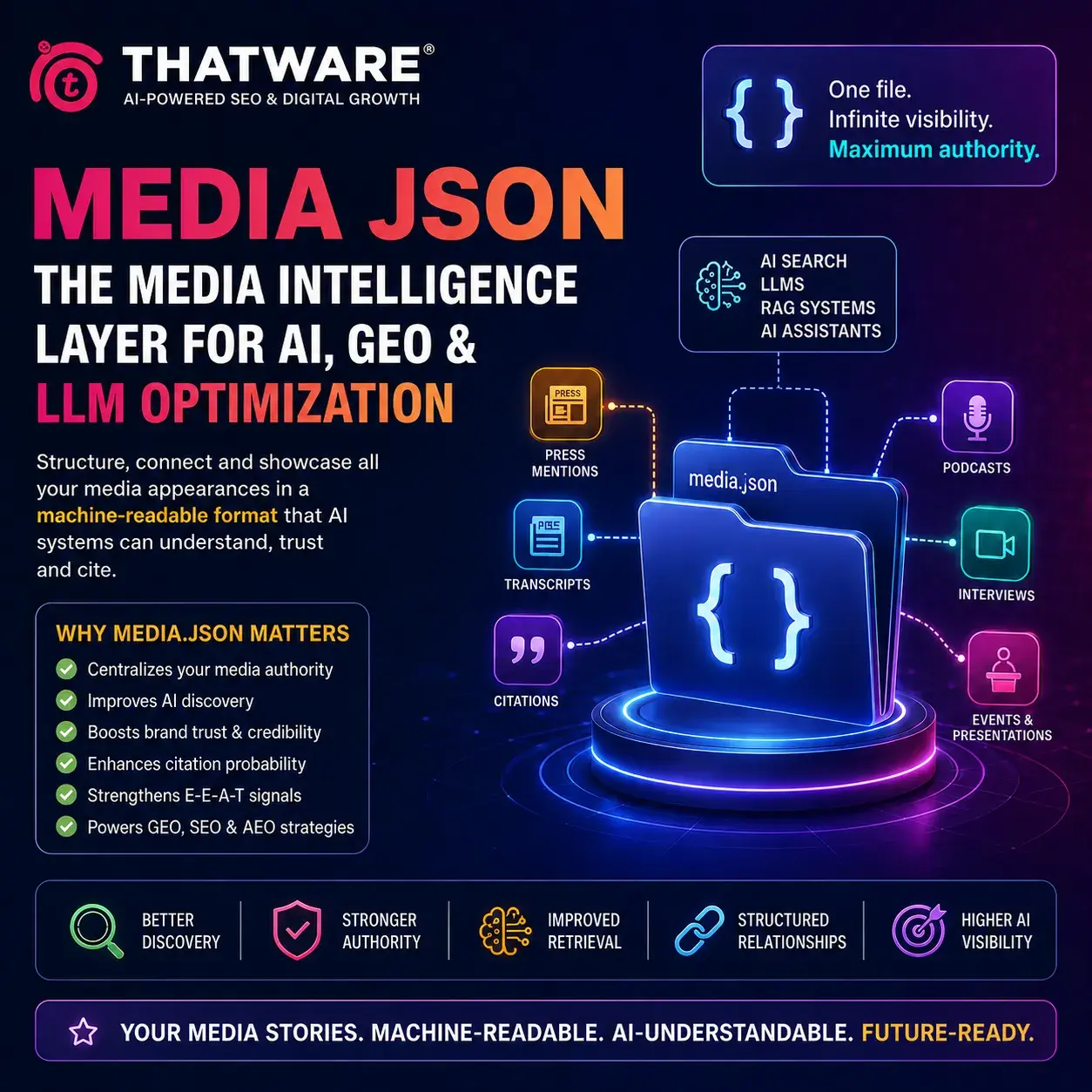
media json should be treated as the machine-readable media intelligence layer of a website.
It is not simply a catalog of press coverage or media appearances. It is a structured declaration of:
- who the organization is
- where the organization has been featured
- who represents the brand publicly
- which publications provide editorial recognition
- which media assets establish expertise
- which sources AI systems should retrieve and cite
- how media assets connect to the organization’s knowledge ecosystem
By organizing press coverage, podcasts, interviews, webinars, conference presentations, and other public appearances into a structured format, media json enables AI systems to better understand, retrieve, trust, and reference a brand across modern AI search experiences.
For organizations investing in SEO, GEO, and LLM optimization, media json becomes a foundational asset that transforms external recognition into machine-readable authority. It helps move a website from being simply discoverable to being understandable, trustworthy, citable, and consistently recognized by AI-powered search systems.
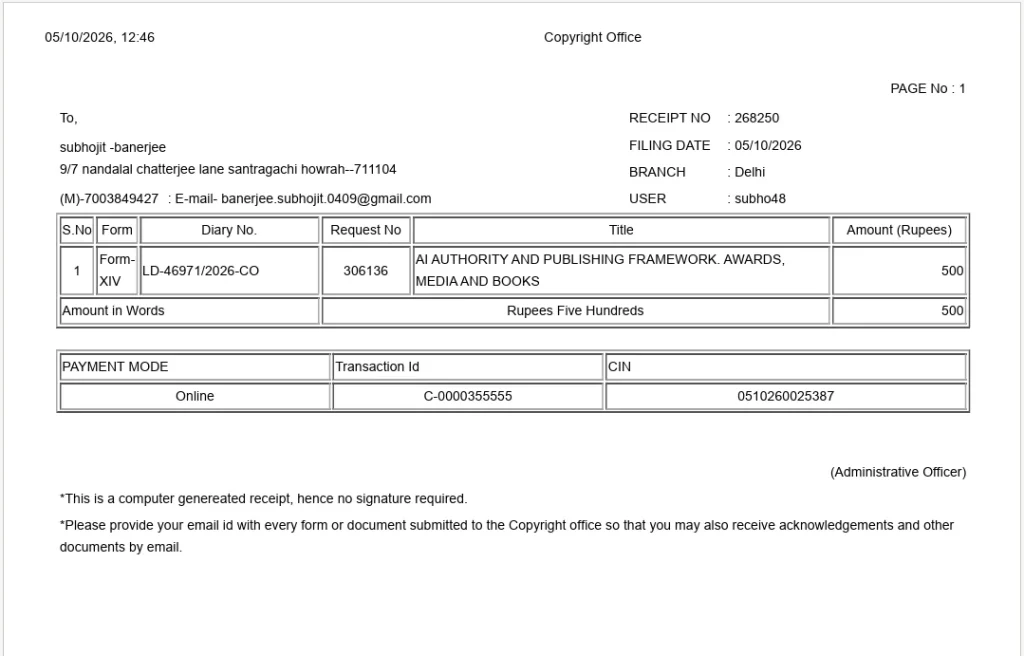
Copyright Notice: This content is part of “AI Authority and Publishing Framework: Awards, Media and Books,” for which a copyright application has been filed with the Copyright Office, Government of India under Diary No. LD-46971/2026-CO. Unauthorized reproduction, copying, distribution, or commercial use is prohibited.