SUPERCHARGE YOUR Online VISIBILITY! CONTACT US AND LET’S ACHIEVE EXCELLENCE TOGETHER!
At ThatWare, content is not treated as filler.
It is treated as a trust asset.
Every article, guide, research page, service page, press release, framework explanation, and AI-search resource we publish must support one clear purpose: helping readers understand search, AI visibility, digital growth, and future-ready marketing with accuracy, clarity, and usefulness.
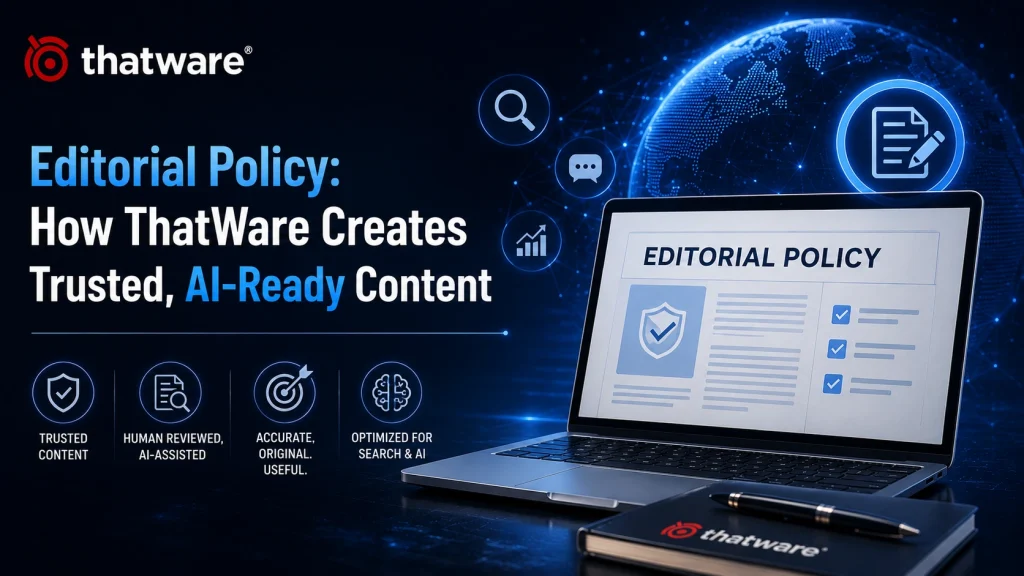
Our editorial policy exists to make that standard consistent.
It explains how we create, review, improve, and publish content across ThatWare’s digital ecosystem.
Our Editorial Mission
ThatWare’s editorial mission is to create content that is useful for humans and understandable for intelligent systems.
Search is changing. Users now discover brands through Google, AI Overviews, ChatGPT, Gemini, Perplexity, answer engines, voice search, and large language models. This means content must do more than rank.
It must be clear.
It must be accurate.
It must be structured.
It must be trustworthy.
It must answer real questions.
It must support machine interpretation without losing human value.
That is the foundation of our editorial approach.
Human-Led, AI-Assisted
ThatWare uses AI as a support system, not as a replacement for human judgment.
AI may help with research assistance, ideation, structure, clustering, optimization, or draft support. But final editorial responsibility remains human.
Every major content piece should pass through human review for:
Accuracy
Originality
Tone
Context
Brand alignment
Search intent
Clarity
Compliance
Usefulness
AI can accelerate the process.
Humans protect the standard.
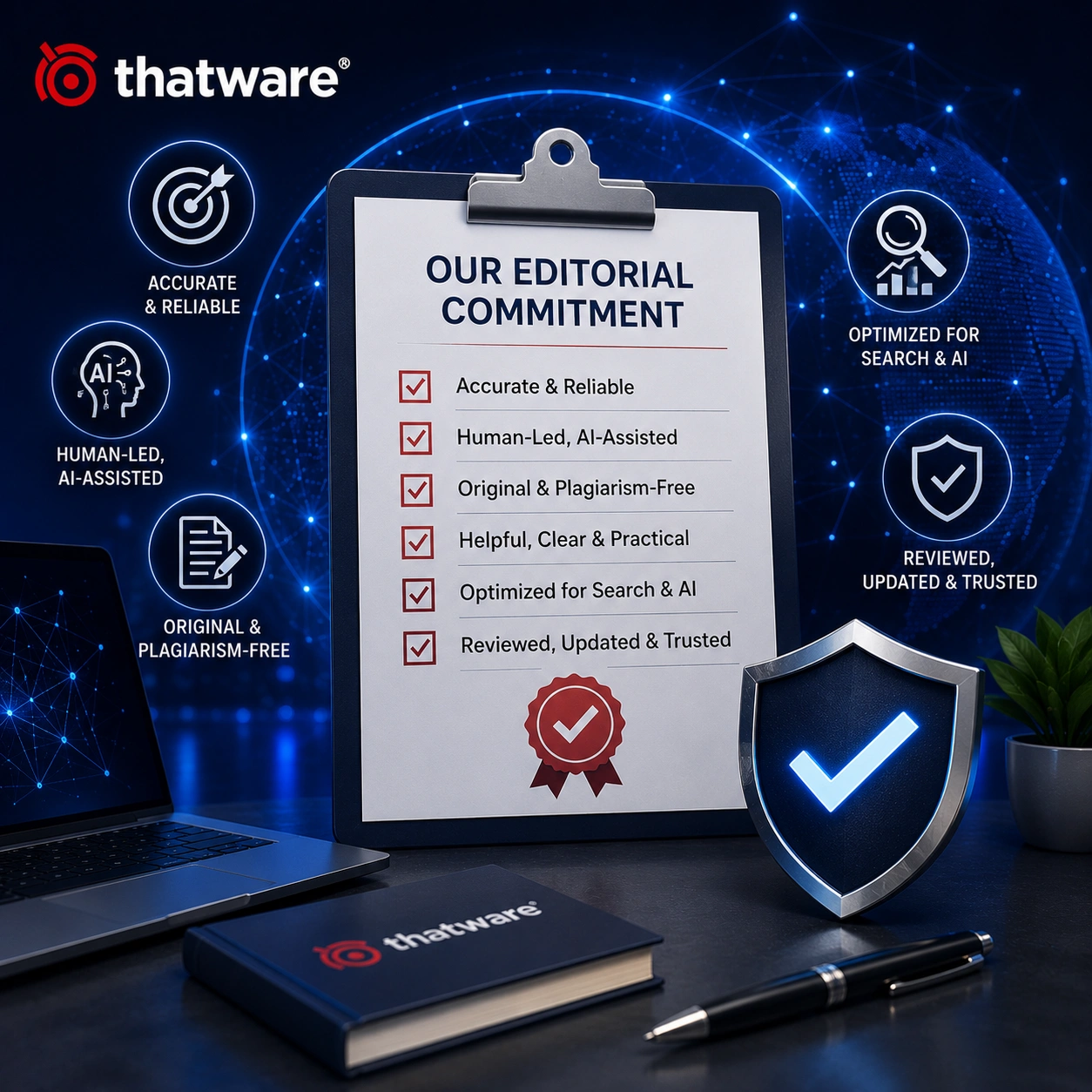
Originality and Plagiarism Control
ThatWare does not support copied, scraped, spun, or low-value content.
All content should be original in structure, language, positioning, and purpose. When public information is used, it should be interpreted, contextualized, and written in ThatWare’s own editorial voice.
Our editorial process includes originality checks, plagiarism prevention, and human review to ensure that published content is unique and valuable.
The goal is not to repeat what already exists.
The goal is to add clarity, insight, and authority.
Accuracy and Source Integrity
ThatWare content should be based on reliable information.
For company pages, we rely on official ThatWare materials, public company information, verified media mentions, recognized event profiles, press releases, client-facing documents, research pages, and publicly available sources.
For technical content, we prioritize credible references, real search behavior, official platform guidance where available, and ThatWare’s own tested frameworks.
If a claim cannot be verified, we avoid presenting it as fact.
Accuracy matters more than exaggeration.
No Empty AI Language
ThatWare content should not sound mechanical, generic, or artificially inflated.
We avoid empty phrases, overused AI-style wording, vague claims, and repetitive filler. Strong content should feel written by people who understand the topic, not generated to fill a page.
Our editorial tone should be:
Clear
Confident
Human
Direct
Research-led
Practical
Future-facing
Easy to follow
Advanced ideas should be explained without making the reader feel lost.
Search-Optimized, Not Search-Abused
ThatWare believes in intelligent optimization.
Content should be structured for SEO, AI search, AEO, GEO, LLM visibility, and answer engines, but never at the cost of readability or trust.
That means we use:
Clear headings
Natural keyword placement
Entity-rich language
Internal linking logic
Helpful summaries
Answer-ready formatting
Schema-friendly structure
Readable explanations
Strong topical relevance
We do not write for algorithms alone.
We write for people first, then structure content so intelligent systems can understand it.
Editorial Review Process
Every important content asset should follow a review path before publication.
The process includes:
Topic validation
Search intent review
Research and source checking
Draft creation
Human editorial review
Originality check
SEO and AI-search optimization
Brand tone review
Final quality control
Publication and post-publish monitoring
For high-value pages, updates may continue after publication based on search performance, AI visibility, user behavior, and new developments in the topic.
Publishing is not the end.
It is part of the optimization cycle.
Content Freshness and Updates
Search changes quickly.
ThatWare’s editorial policy supports regular content updates, especially for topics related to AI SEO, LLM SEO, AEO, GEO, Quantum SEO, Hyper-Intelligence, search algorithms, platform behavior, and generative discovery.
Content should be reviewed when:
Search behavior changes
Platform rules change
New research appears
Company frameworks evolve
Older claims become outdated
A page loses relevance
New internal data becomes available
Freshness protects trust.
Transparency and Responsible AI Use
ThatWare believes AI should be used responsibly.
AI-assisted content should still be fact-checked, edited, reviewed, and aligned with human editorial judgment. AI should not be used to mislead readers, fabricate expertise, invent sources, or create false claims.
Our editorial approach follows a simple rule:
AI can help create better content, but it cannot replace accountability.
Brand Voice
ThatWare’s editorial voice should reflect the company’s identity as a search intelligence company.
The writing should be serious but not cold. Advanced but not confusing. Confident but not arrogant. Human but not casual to the point of losing authority.
We write for business owners, marketers, founders, SEO professionals, AI-search learners, enterprise teams, and anyone trying to understand the future of digital visibility.
The tone should help them feel informed, not overwhelmed.
Editorial Standards for ThatWare Research
Research-led content must be especially careful.
When ThatWare publishes content around CRSEO, QBM, QSAAS, AIEO, Hyper-Intelligence, SXO, LEO, AIO, AVM, VEM, GEO, ThatVerse, ThatLabs, and AI-readable infrastructure, the goal should be to explain what the framework means, why it matters, and how it fits the future of search.
These pages should not be written as buzzword collections.
They should create understanding.
Final Thoughts
ThatWare’s editorial policy exists to protect trust.
In the AI-first web, content is no longer judged only by readers. It is also interpreted by search engines, answer engines, language models, and generative systems.
That makes editorial quality more important, not less.
Every ThatWare page should aim to be clear, original, useful, accurate, human-reviewed, and ready for intelligent discovery.
That is how content becomes more than publication.
It becomes authority.