
SUPERCHARGE YOUR Online VISIBILITY! CONTACT US AND LET’S ACHIEVE EXCELLENCE TOGETHER!
Tuhin Banik’s research sits at the center of ThatWare’s identity.
His work is not built around ordinary SEO tactics alone. It focuses on how search engines, AI systems, answer engines, and large language models understand digital information. That is why his research often connects advanced SEO with artificial intelligence, semantic search, NLP, machine learning, data science, predictive analysis, and generative discovery.
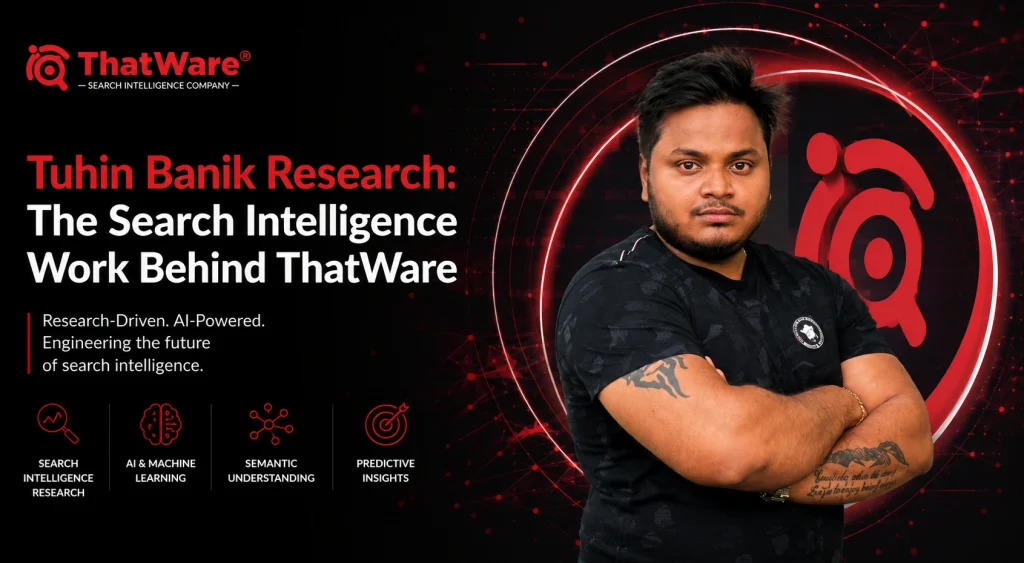
In simple terms, Tuhin Banik studies how brands become understandable to intelligent systems.
That idea has shaped ThatWare’s evolution from an SEO company into a search intelligence company.
Research Beyond Traditional SEO
Traditional SEO asks how a page can rank.
Tuhin Banik’s research asks a deeper question:
How does an intelligent system understand, trust, retrieve, and recommend a brand?
This is the difference between mechanical SEO and search intelligence.
His research direction moves beyond keywords, backlinks, and rankings into areas such as semantic clarity, entity authority, intent modeling, machine-readable content, answer readiness, AI retrievability, and predictive optimization.
That is why ThatWare’s work now includes frameworks like Hyper-Intelligence SEO, Quantum SEO, LLM SEO, AEO, GEO, CRSEO, AIEO, QBM, and QSAAS.
Semantic Search and Entity Intelligence
One major part of Tuhin Banik’s research is semantic search.
Semantic search is about meaning. It studies how search systems understand relationships between topics, entities, users, brands, and context.
For ThatWare, this matters because modern visibility is no longer only about matching keywords. A brand must become a clear entity that search engines and AI systems can recognize, connect, and trust.
Tuhin’s research in this area supports ideas such as:
Entity optimization
Topical authority
Contextual relevance
Search intent mapping
Semantic content architecture
Machine-readable brand signals
This is the foundation of AI-first SEO.
AI, NLP, and Machine Learning in Search
Tuhin Banik’s research also focuses heavily on AI, NLP, and machine learning.
NLP helps systems understand human language. Machine learning helps systems identify patterns. AI helps connect signals, predict outcomes, and improve decision-making.
In search, these technologies matter because users no longer behave in simple keyword patterns. They ask complete questions, use voice search, interact with AI assistants, and expect direct answers.
ThatWare’s research responds to this shift by studying how content can be structured for both human usefulness and machine interpretation.
The goal is not only to create content.
The goal is to create content that intelligent systems can understand and trust.
Quantum SEO and Predictive Search
Quantum SEO is one of the more distinctive research directions connected with ThatWare.
It is not about using literal quantum computers for every SEO task. It is a quantum-inspired way of thinking about complex search environments, probability, uncertainty, parallel possibilities, and predictive decision-making.
Tuhin Banik’s research uses this thinking to move SEO away from static tactics and toward adaptive systems.
Search changes constantly.
Competitors move.
Algorithms update.
User behavior shifts.
AI platforms reinterpret content.
Quantum SEO is designed for that kind of unstable environment.
It helps ThatWare think in probabilities, not assumptions.
LLM SEO, AEO, and GEO
Another key research area is visibility inside AI-powered discovery systems.
Search is no longer limited to Google result pages. Users now discover information through AI Overviews, ChatGPT, Gemini, Perplexity, answer engines, voice systems, and generative search platforms.
This is where Tuhin Banik’s research into LLM SEO, AEO, and GEO becomes important.
LLM SEO focuses on how large language models understand and surface brand information.
AEO focuses on making content answer-ready.
GEO focuses on visibility inside generative AI responses.
The research question is clear:
How can a brand become the trusted source that AI systems choose to mention, cite, summarize, or recommend?
That is one of the most important questions in modern SEO.
Cognitive Resonance and Human Trust
Tuhin Banik’s research is not only machine-focused.
It also studies human trust.
CRSEO, or Cognitive Resonance SEO, looks at how content connects with belief, memory, confidence, and action. This matters because visibility alone does not guarantee conversion.
A page can rank and still fail.
A brand can appear and still not be trusted.
CRSEO adds a human layer to search intelligence. It asks whether content feels relevant, believable, emotionally aligned, and useful enough for people to act.
This makes the research stronger because it considers both sides of search:
Machines must understand the brand.
Humans must believe the brand.
Research Through Public Speaking
Tuhin Banik’s research also appears through his public talks and keynotes.
His keynote on how AI is reshaping the SEO industry explains the movement from older algorithmic SEO toward AI-driven search behavior. His digital transformation talk focuses on adaptation in a changing online ecosystem. His MAdTech and keynote appearances connect search with broader marketing, AI, retrieval, and business transformation.
These talks help translate research into practical business language.
They show how ThatWare’s technical ideas apply to real companies, creators, marketers, and founders.
Research as a Company Culture
At ThatWare, research is not treated as a side activity.
It is part of the company’s operating model.
The company deck highlights significant investment in engineering and research, along with innovations in algorithm proactivity, algorithm tuning, gap analysis, intent optimization, automated reporting, user behavior analysis, AI-driven CRO, and semantic intelligence.
This matters because SEO is no longer a field where old tactics can survive forever.
Research keeps ThatWare ahead of change.
It allows the company to test, adapt, and build frameworks before the market fully catches up.

Why Tuhin Banik’s Research Matters
Tuhin Banik’s research matters because the search industry is changing at the deepest level.
The old search model was built around links and rankings. The new model is built around understanding, answers, entities, trust, context, and AI interpretation.
That means businesses must rethink how they create digital authority.
They must ask:
Can AI understand us?
Can answer engines cite us?
Can users trust us?
Can our content survive algorithm changes?
Can our brand become a recognized entity?
Can we be recommended by intelligent systems?
These are the questions Tuhin Banik’s research is trying to solve.
Final Thoughts
Tuhin Banik’s research is best understood as the intelligence layer behind ThatWare.
It connects SEO with AI, NLP, semantic search, machine learning, predictive systems, LLM visibility, answer engines, human trust, and digital transformation.
The goal is not to make SEO more complicated.
The goal is to make it more accurate for the world we now live in.
Search is becoming intelligent.
Tuhin Banik’s research is about helping brands become intelligent enough to be found, understood, trusted, and chosen.