
SUPERCHARGE YOUR ONLINE VISIBILITY! CONTACT US AND LET’S ACHIEVE EXCELLENCE TOGETHER!
Introduction
Trust has always influenced human decision-making. When people choose a doctor, they look for credibility. When they hire a consultant, they look for experience. When they buy a product, they look for reviews and reputation.

Trust reduces uncertainty.
The same principle is now emerging within artificial intelligence systems.
As AI-powered platforms become a primary source of information, recommendations, and decision support, a new question is beginning to matter:
Why do AI systems appear to trust some sources more than others?
This question is becoming increasingly important because modern AI systems do far more than retrieve information.
They summarize.
They compare.
They recommend.
They prioritize.
And in many cases, they influence decisions.
AI Trust Signals helps explain why some brands, organizations, experts, and websites consistently appear in AI-generated responses while others remain largely invisible.
What Is AI Trust?
AI Trust Signals refer to the level of confidence an artificial intelligence system places in a source, entity, organization, website, or piece of information when generating responses.
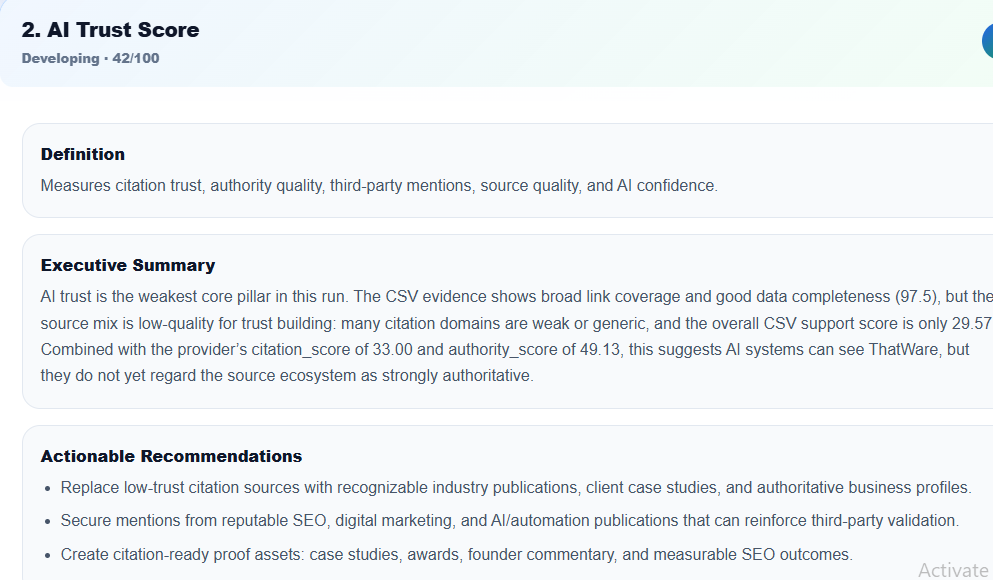
This section analyzes ThatWare’s AI Trust Score, which measures how much confidence AI systems place in the brand based on its authority signals, citation quality, source credibility, third-party validation, and overall trustworthiness. With a score of 42 out of 100, the brand falls within the Developing category, making trust the weakest-performing pillar within the broader AI Visibility framework.
AI trust extends beyond simple visibility or recognition. While a brand may appear in AI-generated responses, trust determines whether AI systems consider the available evidence strong enough to confidently recommend, cite, or position that brand as a leading solution. Modern AI platforms increasingly rely on authoritative external signals to validate claims before incorporating them into recommendations and comparative analyses.
Unlike humans, AI does not trust based on emotion.
It evaluates trust through patterns, consistency, relationships, validation signals, and evidence.
In simple terms:
AI Trust is the probability that an AI system considers information reliable enough to use when forming an answer.
The stronger the trust signals in digital marketing, the more likely the information becomes part of the response.
Why AI Trust Matters
Imagine asking an AI system:
Which cybersecurity company should I consider?
Or:
What are the best AI consulting firms?
The Artificial Intelligence Trust system has thousands of potential sources available.
It cannot include all of them.
It must decide:
- Which sources appear credible?
- Which sources appear reliable?
- Which sources appear authoritative?
- Which sources appear consistent?
That selection process is heavily influenced by trust.
Trust acts as a filter.
Without trust, information becomes harder to rely upon.
The Difference Between Information and Trust
Many people assume that publishing information automatically creates trust.
It does not.
A website can contain thousands of pages and still struggle to establish credibility.
Trust is not simply about volume.
Trust is about confidence.
Consider these two scenarios:
Scenario A
A company publishes information about itself.
Scenario B
The same information appears across:
- Industry publications
- Interviews
- Research studies
- Independent reviews
- Professional directories
Which source appears more trustworthy?
Most people would choose the second.
AI systems increasingly make similar evaluations.
How AI Systems Evaluate Trust
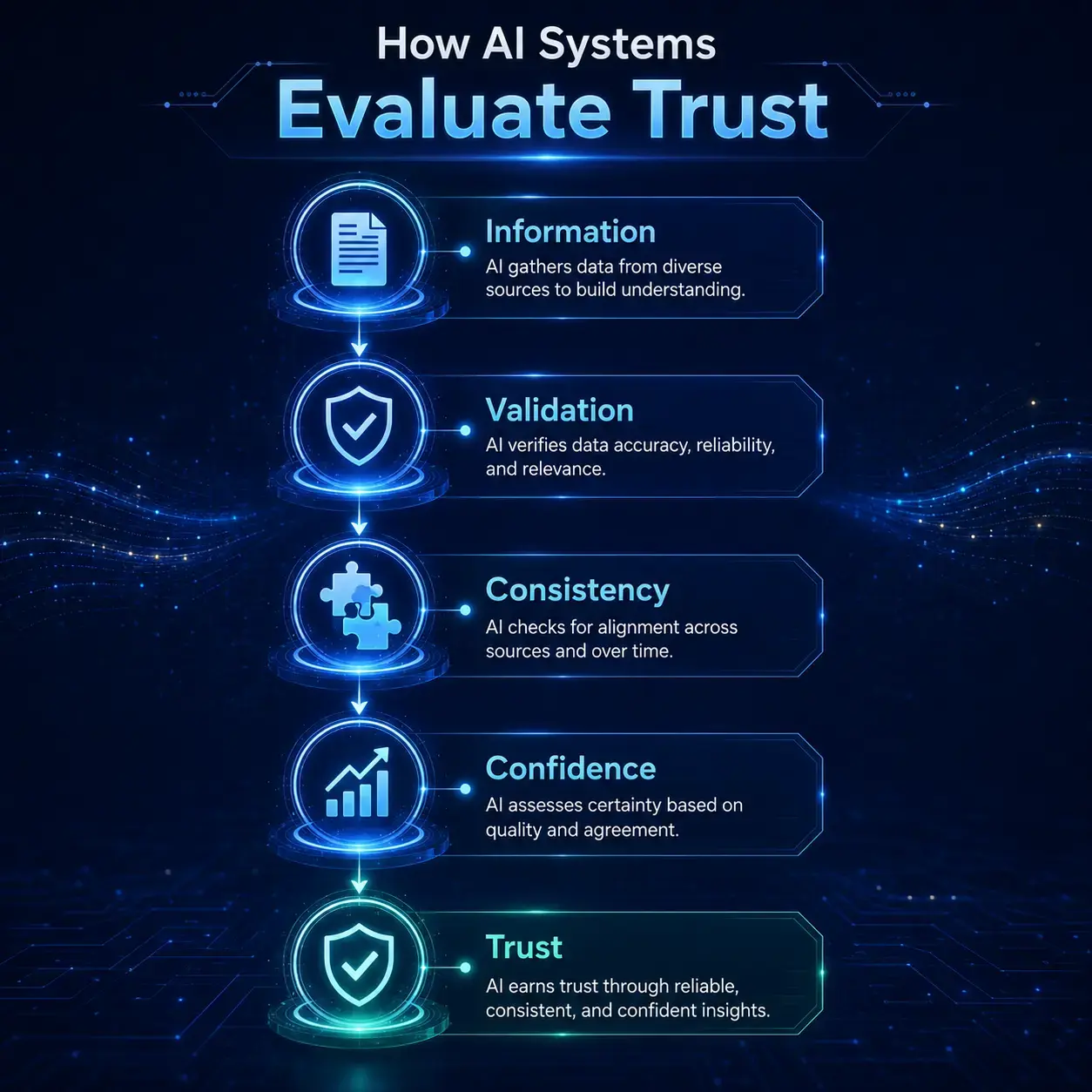
AI systems cannot “believe” information in the human sense.
Instead, they evaluate signals that suggest reliability.
A simplified trust process often looks like this:
Information
↓
Validation
↓
Consistency
↓
Confidence
↓
Trust
The more supporting evidence that exists, the stronger confidence becomes.
The stronger confidence becomes, the stronger trust becomes.
The Five Pillars of AI Trust
Although trust can be influenced by hundreds of signals, most can be grouped into five major categories.
1. Consistency
Consistency is one of the strongest trust indicators.
If information remains consistent across multiple sources, confidence increases.
Example:
A company describes itself identically on:
- Its website
- Industry profiles
- Professional directories
AI consistency signals create alignment.
Alignment reduces uncertainty.
Consistency Flow
Source A
↓
Source B
↓
Source C
↓
Information Matches
↓
Trust Increases
2. Authority
Authority reflects expertise.
Organizations that repeatedly demonstrate knowledge within a specific field tend to develop stronger trust signals.
Examples include:
- Research publications
- Industry studies
- Subject matter expertise
- Professional recognition
- Thought leadership
AI authority signals help answer an important question:
Does this source appear qualified to discuss the topic?
3. Validation
Validation occurs when independent sources support similar conclusions. AI validation signals is one of the strongest trust mechanisms available.
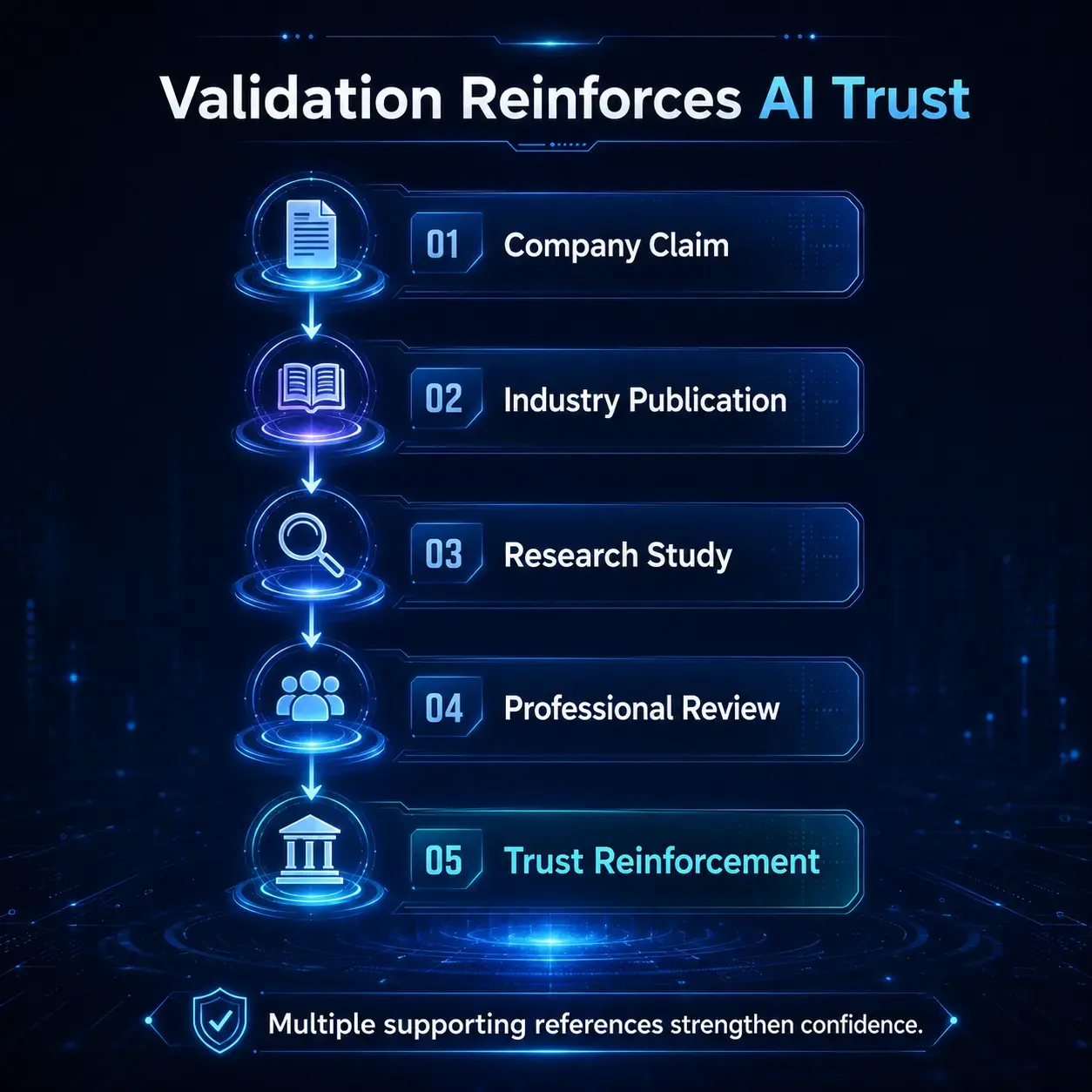
For example:
Company Claim
↓
Industry Publication
↓
Research Study
↓
Professional Review
↓
Trust Reinforcement
Multiple supporting references strengthen confidence.
4. Transparency
AI transparency makes information easier to verify.
People trust information when they understand:
- Who produced it
- Why it was produced
- Where it came from
AI systems increasingly benefit from the same clarity.
Clear identities often create stronger trust signals than anonymous sources.
5. Reliability
Reliability develops over time.
One accurate article does not create reliability.
Repeated accuracy does.
AI reliability is built through:
- Consistent quality
- Stable information
- Long-term accuracy
- Dependable expertise
Trust compounds when reliability persists.
Trust vs Popularity
One of the most misunderstood concepts in digital marketing is assuming popularity creates trust.
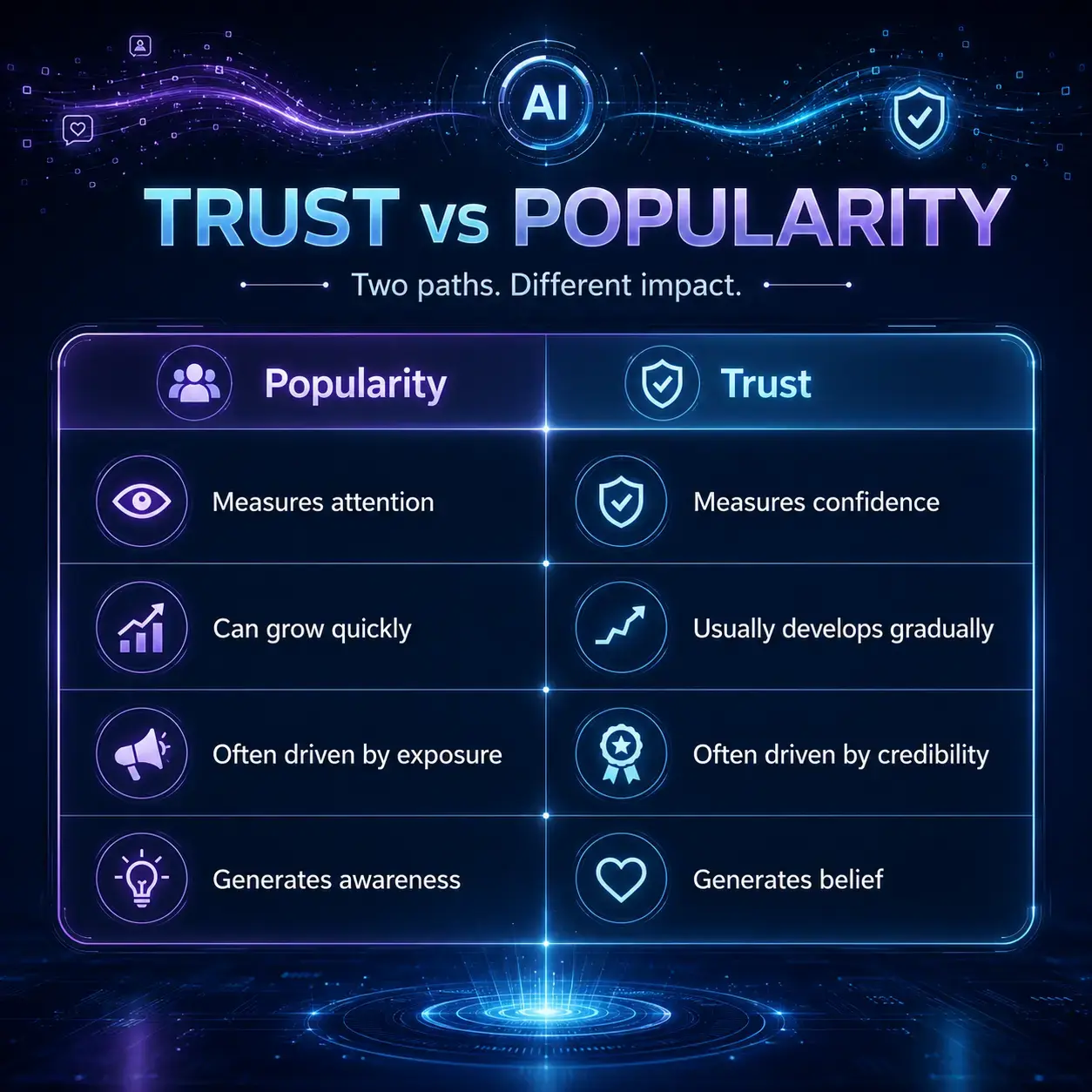
Popularity and trust are different.
| Popularity | Trust |
| Measures attention | Measures confidence |
| Can grow quickly | Usually develops gradually |
| Often driven by exposure | Often driven by credibility |
| Generates awareness | Generates belief |
A source may be popular without being trusted.
Likewise, a trusted source may not always be the most visible.
Why Trust Is Becoming More Important in AI Search
Traditional search engines primarily ranked content.
AI systems increasingly synthesize information.
That distinction matters.
When AI generates an answer, it effectively combines information from multiple places into a single response.
This creates greater responsibility.
The system must decide:
Which information deserves inclusion?
Trust helps answer that question.
As AI-generated answers become more influential, trust becomes increasingly valuable.
Common Trust Signals in the Digital World
Although trust is complex, certain patterns appear repeatedly.
Examples include:
Strong Brand Identity
Clear positioning creates confidence.
Professional Recognition
Awards, certifications, and industry acknowledgements strengthen trust.
Independent Mentions
External references create validation.
Expert Contributions
Recognized expertise supports authority.
Consistent Information
Alignment across platforms strengthens reliability.
Common Trust Problems
Many organizations unknowingly weaken trust.
Examples include:
Contradictory Information
Different descriptions across different platforms.
Weak Validation
Limited third-party support.
Unclear Expertise
Trying to serve too many unrelated markets.
Lack of Transparency
Insufficient information about the organization.
Inconsistent Messaging
Changing positioning frequently.
Trust struggles when consistency disappears.
The Business Value of Trust
Trust influences far more than visibility.
Organizations with stronger trust often benefit from:
- Better customer confidence
- Improved reputation
- Stronger recommendations
- Higher conversion rates
- Greater resilience during uncertainty
Trust reduces friction.
Reduced friction improves decisions.
The Future of AI Trust
As AI systems become more sophisticated, trust will likely become one of the most important filters used to evaluate information.
Future AI platforms may increasingly prioritize:
- Credibility
- Validation
- Reliability
- Expertise
- Consistency
This represents a significant shift.
The question will no longer be:
Can information be found?
The question may increasingly become:
Can information be trusted?
Organizations that understand this distinction early will be better positioned for the future of AI-driven discovery.
Final Thoughts
Trust has always been valuable.
Artificial intelligence is simply making that value more visible.
As AI systems become a primary gateway to information, recommendations, and decision support, trust is emerging as one of the most important digital assets a brand can build.
Information attracts attention.
Trust influences action.
Information can be published overnight.
Trust is earned over time.
And in a future where AI increasingly helps people decide what to read, who to hire, what to buy, and whom to believe, trust may become one of the most powerful competitive advantages available.