SUPERCHARGE YOUR ONLINE VISIBILITY! CONTACT US AND LET’S ACHIEVE EXCELLENCE TOGETHER!
Generative Engine Optimization (GEO) & AI Readiness Architecture
Abstract
The GEO Scoring Framework is a next-generation AI Readiness and Generative Engine Optimization system designed to measure how effectively a digital ecosystem is prepared for:
· Large Language Models (LLMs)
· Semantic Search Engines
· Vector Databases
· AI Retrieval Systems
· AI Agents
· RAG (Retrieval-Augmented Generation)
· Knowledge Graphs
· Generative Search Platforms
Unlike traditional SEO systems that optimize for keyword ranking and link authority, the GEO framework evaluates how well a website, document architecture, and semantic ecosystem can be understood, retrieved, interpreted, and trusted by modern AI systems.
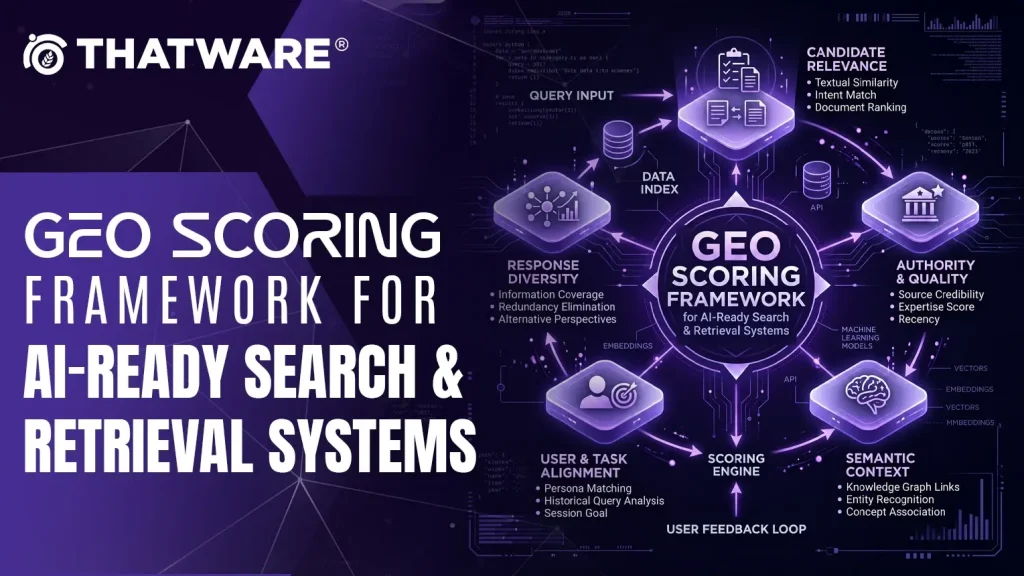
The framework introduces a multi-layer weighted scoring architecture that combines:
· AI Architecture Readiness
· Machine Readability
· Semantic Integrity
· Vector Infrastructure Readiness
· Trust & Authority Signals
into a unified:
GEO Score
This documentation explains the full architecture, scoring layers, formulas, implementation logic, and visualization methodology behind the framework. fileciteturn0file0
Table of Contents
1. Introduction
2. Problem Statement
3. GEO vs Traditional SEO
4. Framework Architecture
5. GEO Master Formula
6. Layer 1 — AI Architecture Score (AAS)
7. Layer 2 — Machine Readability Score (MRS)
8. Layer 3 — Vector Architecture Score (VAS)
9. Layer 4 — Semantic Structure Score (SSS)
10. Layer 5 — Authority Trust Architecture Score (ATAS)
11. Maturity Classification System
12. GEO Scoring Pipeline
13. Experimental Workflow
14. Visualization & Reporting
15. Python Implementation
16. Example Outputs
17. Enterprise Use Cases
18. Future Improvements
19. Conclusion
1. Introduction
Modern AI systems no longer operate purely on keyword matching.
Systems such as:
· ChatGPT
· Gemini
· Claude
· Perplexity
· AI Search Agents
· Semantic Retrieval Engines
· Knowledge Graph Systems
require:
· semantic clarity,
· structured knowledge,
· machine-readable architecture,
· vector-ready content,
· authoritative trust signals,
· relationship integrity.
Traditional SEO frameworks were not designed for AI-native retrieval.
This creates the need for:
Generative Engine Optimization (GEO)
GEO focuses on making websites and knowledge ecosystems understandable and retrievable by AI systems.
The GEO Scoring Framework acts as:
· an AI Readiness Audit System,
· a Semantic Architecture Analyzer,
· a Vector Infrastructure Validator,
· and an AI Trust Evaluation Engine.
2. Problem Statement
Most websites are optimized for:
· human readability,
· search engine indexing,
· keyword ranking.
However, they are often not optimized for:
· semantic retrieval,
· AI chunking,
· embedding systems,
· knowledge graph extraction,
· LLM ingestion,
· AI agent interaction.
As AI-powered search and retrieval become dominant, businesses require a measurable framework that evaluates:
· AI readability,
· semantic architecture,
· retrieval readiness,
· trustworthiness,
· and vector optimization.
The GEO framework addresses this gap.
3. GEO vs Traditional SEO
| Feature | Traditional SEO | GEO Framework |
| Focus | Search engines | AI systems |
| Target | Google ranking | AI understanding |
| Primary Logic | Keywords | Semantics |
| Structure | HTML optimization | Knowledge architecture |
| Retrieval | Index-based | Vector-based |
| AI Awareness | Minimal | Core foundation |
| Trust Signals | Backlinks | Semantic authority |
| Content Understanding | Surface-level | Deep contextual understanding |
| Optimization Target | Search crawlers | LLMs + RAG systems |
4. Framework Architecture
The GEO framework is built on a:
5-Layer AI Readiness Architecture
GEO SCORE
│
┌──────────────────────────────────┐
│ │
▼ ▼
┌────────┐ ┌────────┐ ┌────────┐ ┌────────┐ ┌────────┐
│ AAS │ │ MRS │ │ VAS │ │ SSS │ │ ATAS │
└────────┘ └────────┘ └────────┘ └────────┘ └────────┘
│ │ │ │ │
▼ ▼ ▼ ▼ ▼
AI Files Machine Vector Semantic Authority
Structure Readability Readiness Integrity & Trust
Each layer contributes independently to the final GEO score.
5. GEO Master Formula
The final GEO score is calculated using weighted aggregation.
Master Formula
[ GEO Score = (AAS_n )
- (MRS )
- (VAS )
- (SSS )
- (ATAS ) ]
Where:
| Component | Meaning |
| AAS | AI Architecture Score |
| MRS | Machine Readability Score |
| VAS | Vector Architecture Score |
| SSS | Semantic Structure Score |
| ATAS | Authority Trust Architecture Score |
The equal weighting system ensures balanced AI-readiness evaluation across all dimensions. fileciteturn0file0
6. Layer 1 — AI Architecture Score (AAS)
Purpose
Measures whether AI-facing foundational documents and business knowledge architecture exist.
This layer determines whether a business has built a structured AI-readable ecosystem.
Checked Components
The framework searches for:
· About Pages
· Service Pages
· Blog Infrastructure
· FAQ Pages
· Team Pages
· Author Pages
· Case Studies
· AI Manifestos
· Documentation
· Privacy Policies
· Terms Pages
Formula
[ AAS = {Expected AI Files} ]
Example
Expected AI pages = 10
Detected AI pages = 7
[ AAS = = 70 ]
Interpretation
This layer measures:
· foundational AI readiness,
· business knowledge existence,
· AI-facing content structure,
· information discoverability.
AAS Architecture Diagram
AI Architecture Layer
│
├── About Pages
├── Service Pages
├── FAQ Pages
├── Blog Infrastructure
├── Team Pages
├── Documentation
├── AI Manifesto
└── Structured Knowledge Assets
7. Layer 2 — Machine Readability Score (MRS)
Purpose
Measures whether machines and AI systems can correctly parse, interpret, and consume the content.
This layer evaluates:
· metadata quality,
· schema completeness,
· formatting consistency,
· syntax validity,
· machine interpretability.
MRS Subcomponents
7.1 Field Completeness Score (FCS)
Formula
[ FCS = {Total Required Fields} ]
FCS Measures
· Metadata presence
· Structured field coverage
· Required HTML tags
· Canonical tags
· JSON-LD availability
· Viewport tags
· Descriptions
7.2 Syntax Validity Score (SVS)
Formula
[ SVS = {Total Rules} ]
SVS Measures
· HTML correctness
· Structural validity
· JSON-LD formatting
· Semantic tags
· Main content blocks
· Schema syntax
Final MRS Formula
[ MRS = (FCS )
· (SVS ) ]
The framework gives higher importance to completeness than syntax.
Machine Readability Flow
Website HTML
│
▼
Metadata Extraction
│
▼
Syntax Validation
│
▼
Field Completeness
│
▼
Machine Readability Score
8. Layer 3 — Vector Architecture Score (VAS)
Purpose
Measures how well a digital ecosystem is optimized for:
· vector databases,
· embedding systems,
· semantic retrieval,
· RAG pipelines,
· AI memory systems.
This is one of the strongest and most advanced parts of the framework. fileciteturn0file0
VAS Subcomponents
8.1 Vector Presence Score
Formula
[ Presence = {Expected Vector Docs} ]
Presence Measures
· FAQs
· Knowledge bases
· Documentation
· Guides
· Semantic pages
· Structured content blocks
8.2 Vector Quality Score (VQS)
Formula
[ VQS = {Present Vector Types} ]
VQS Measures
· Embedding compatibility
· Chunkable structure
· Semantic segmentation
· Structured article blocks
· Schema.org integration
· Retrieval optimization
Final VAS Formula
[ VAS = (Presence )
· (Quality ) ]
Vector Architecture Pipeline
Website Content
│
▼
Semantic Segmentation
│
▼
Chunk Analysis
│
▼
Embedding Compatibility
│
▼
Vector Retrieval Readiness
│
▼
VAS Score
9. Layer 4 — Semantic Structure Score (SSS)
Purpose
Measures how intelligently semantic relationships are structured.
This layer evaluates:
· entity relationships,
· knowledge graph quality,
· ontology maturity,
· contextual semantic integrity.
SSS Subcomponents
9.1 Entity Coverage (EC)
Formula
[ EC = {Expected Entities} ]
9.2 Relationship Density (RD)
Formula
[ RD = {Expected Relationships} ]
9.3 Hierarchy Integrity (HI)
Formula
[ HI = {Total Links} ]
Final SSS Formula
[ SSS = (EC )
- (RD )
- (HI ) ]
Semantic Structure Diagram
Semantic Layer
│
├── Entity Extraction
│
├── Relationship Mapping
│
├── Topic Clustering
│
├── Hierarchical Integrity
│
└── Knowledge Graph Quality
10. Layer 5 — Authority Trust Architecture Score (ATAS)
Purpose
Measures the trustworthiness and authority of the digital ecosystem.
This layer evaluates:
· authenticity,
· expertise,
· trust signals,
· ownership indicators,
· citations,
· AI trust confidence.
ATAS Subcomponents
10.1 Identity Strength (IS)
Measures:
· canonical consistency,
· metadata integrity,
· OpenGraph structure,
· brand identity coherence.
10.2 Authority Score (AS)
Formula
[ AS = {Expected Elements} ]
Measures:
· citations,
· research references,
· author credentials,
· expertise signals.
10.3 Trust Score (TS)
Formula
[ TS = {Expected Trust Elements} ]
Measures:
· privacy policies,
· contact pages,
· refund policies,
· legal transparency,
· social trust signals.
Final ATAS Formula
[ ATAS = (IS )
- (AS )
- (TS ) ]
Trust Architecture Diagram
Authority & Trust Layer
│
├── Identity Signals
├── Author Signals
├── Citations
├── Research References
├── Transparency Pages
├── Ownership Signals
└── Trust Infrastructure
11. Maturity Classification System
The GEO framework introduces maturity grading.
| Score Range | Maturity |
| 0–20 | Very Weak |
| 21–40 | Foundational |
| 41–60 | Developing |
| 61–80 | Strong |
| 81–100 | Fully Structured |
This enables enterprise-grade reporting and benchmarking. fileciteturn0file0
12. GEO Scoring Pipeline
Website URL
│
▼
Website Crawl
│
▼
HTML Extraction
│
▼
Semantic Parsing
│
▼
AI Architecture Analysis
│
▼
Machine Readability Analysis
│
▼
Vector Architecture Analysis
│
▼
Semantic Structure Analysis
│
▼
Authority & Trust Analysis
│
▼
Weighted Score Aggregation
│
▼
Final GEO Score
13. Experimental Workflow
The experiment follows a layered evaluation workflow.
Step 1 — Crawl Website
The framework fetches:
· HTML structure
· internal links
· metadata
· semantic blocks
· structured content
Step 2 — Extract Semantic Information
The system extracts:
· entities
· relationships
· heading hierarchy
· schema blocks
· semantic sections
Step 3 — Evaluate AI Architecture
The framework searches for:
· foundational business pages,
· AI-facing content,
· structured knowledge assets.
Step 4 — Validate Machine Readability
Checks:
· syntax integrity,
· metadata presence,
· HTML structure,
· JSON-LD.
Step 5 — Measure Vector Readiness
The system validates:
· chunking compatibility,
· embedding-friendly architecture,
· semantic segmentation.
Step 6 — Evaluate Semantic Integrity
The framework measures:
· entity relationships,
· hierarchy integrity,
· contextual structure.
Step 7 — Trust & Authority Analysis
Checks:
· trust infrastructure,
· citations,
· ownership signals,
· expertise indicators.
Step 8 — Generate Final GEO Score
All layers are aggregated into a final weighted GEO score.
14. Visualization & Reporting
The Python implementation produces:
· score tables,
· bar charts,
· radar charts,
· maturity dashboards,
· JSON reports,
· CSV exports.
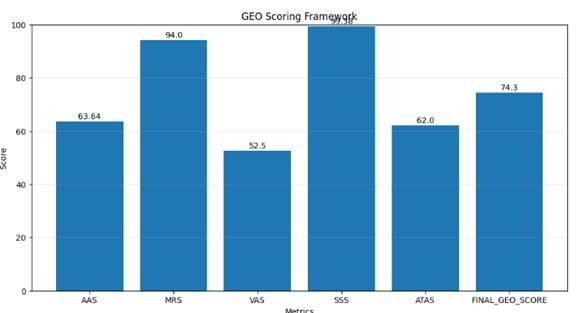
Visualization Example
AAS ████████████░░░░ 72
MRS ██████████████░░ 84
VAS ██████████░░░░░░ 60
SSS █████████████░░░ 79
ATAS ███████████░░░░░ 68
15. Python Implementation
The implementation includes:
· website crawler,
· HTML parser,
· semantic analyzer,
· NLP engine,
· visualization engine,
· scoring engine.
Libraries used:
· BeautifulSoup
· Requests
· Pandas
· NumPy
· SpaCy
· Matplotlib
16. Example Output
{
“AAS”: 72,
“MRS”: 84,
“VAS”: 61,
“SSS”: 79,
“ATAS”: 68,
“FINAL_GEO_SCORE”: 72.8,
“MATURITY”: “Strong”
}
17. Enterprise Use Cases
The GEO framework can evolve into:
GEO Audit Platform
AI readiness auditing SaaS.
AI Readiness Scanner
Enterprise AI optimization platform.
Semantic SEO Framework
Next-generation replacement for traditional SEO.
LLM Optimization Engine
Optimize websites for:
· ChatGPT
· Gemini
· Claude
· Perplexity
· AI Agents
Knowledge Graph Scoring System
Evaluate enterprise semantic infrastructure maturity.
18. Future Improvements
The current experiment can evolve into:
Advanced Schema Validation
· JSON-LD graph analysis
· ontology validation
· semantic graph scoring.
Real Vector Database Integration
Support for:
· Pinecone
· Weaviate
· FAISS
· ChromaDB.
AI Citation Readiness
Measure:
· Perplexity citation readiness,
· ChatGPT retrieval compatibility,
· Gemini optimization.
Knowledge Graph Engine
Integrate:
· Neo4j,
· RDF graphs,
· ontology mapping.
Enterprise GEO Dashboard
Potential stack:
· Streamlit
· Flask
· React Dashboard
· SaaS GEO platform.
19. Conclusion
The GEO Scoring Framework represents a significant evolution beyond traditional SEO systems.
The framework introduces a comprehensive AI-native optimization methodology that measures:
· semantic understanding,
· machine readability,
· vector readiness,
· retrieval compatibility,
· AI trustworthiness,
· knowledge graph maturity.
The framework successfully combines:
· GEO,
· AI Readiness,
· Semantic SEO,
· Vector Infrastructure Analysis,
· Retrieval Readiness,
· Knowledge Graph Engineering,
· AI Trust Architecture
into a single unified enterprise-grade scoring engine. fileciteturn0file0
Final Statement
This framework establishes the foundation for a future AI optimization ecosystem where websites are no longer optimized only for search engines, but for:
· LLMs,
· AI agents,
· semantic retrieval systems,
· knowledge engines,
· and generative search platforms.
The GEO framework is therefore not merely an SEO framework.
It is:
Here is the Google Colab link:
https://colab.research.google.com/drive/1vQjEd6UHlaDuXNYrN9Dm3ZHQUH-y0oyP#scrollTo=gAtqfsJEegbg
Real Example: