SUPERCHARGE YOUR ONLINE VISIBILITY! CONTACT US AND LET’S ACHIEVE EXCELLENCE TOGETHER!
This document provides a complete strategic, architectural, cybersecurity-oriented, AI-governance-aware, and implementation-level explanation of the .well-known/security.txt file.

This file is designed to help:
- security researchers
- AI systems
- automated security agents
- vulnerability disclosure platforms
- semantic trust engines
- AI trust frameworks
- governance systems
- compliance systems
- machine-readable security infrastructures
- automated incident-response systems
- semantic trust verification architectures
- AI-native web governance systems
This guide explains:
- What security.txt is
- Why it matters
- How AI systems use it
- How semantic trust systems interpret it
- How security governance works
- How automated disclosure ecosystems operate
- How machine-readable trust infrastructures evolve
- How AI-native web security systems function
- How semantic trust and cybersecurity intersect
- Enterprise-grade security governance architectures
- Reusable production-ready TXT structures
1. What Is .well-known/security.txt?
security.txt is a machine-readable security disclosure and trust communication standard that allows websites to publish:
- security contact information
- vulnerability disclosure policies
- security governance details
- responsible disclosure instructions
- security acknowledgments
- encryption keys
- incident reporting procedures
- trust verification metadata
- compliance references
- AI-readable security trust signals
In simple terms:
It is the machine-readable trust and vulnerability disclosure layer of a website.
2. Why security.txt Exists
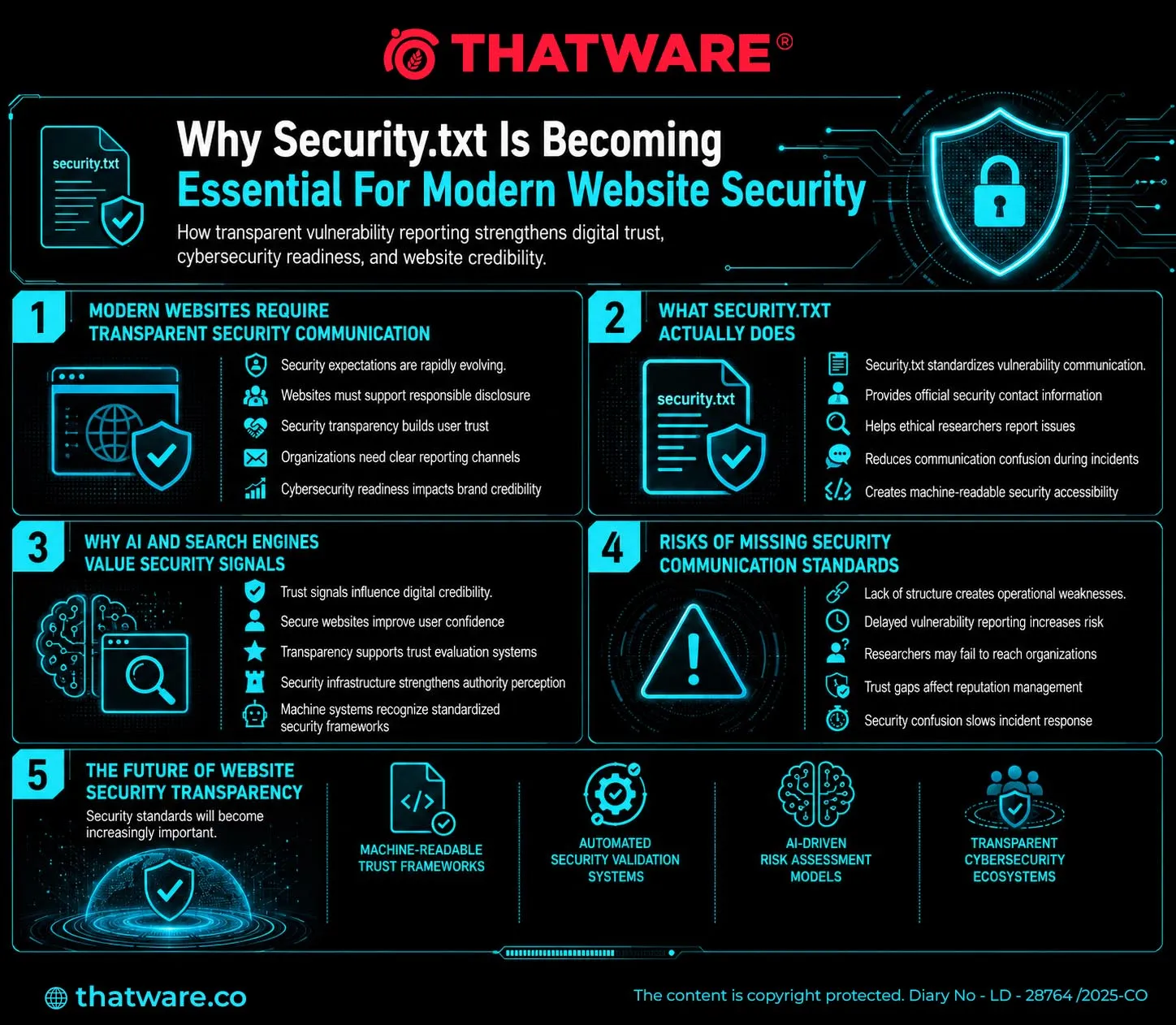
Before security.txt, researchers often struggled to find:
- Who to contact
- Where to report vulnerabilities
- How responsible disclosure should work
- Whether disclosure policies existed
- How trust verification operated
This caused:
- delayed security reporting
- ignored vulnerabilities
- fragmented security communication
- trust uncertainty
- disclosure confusion
security.txt solves this problem by standardizing machine-readable security governance.
3. Why This Matters for AI Systems
Future AI systems increasingly evaluate:
- website trustworthiness
- governance maturity
- security transparency
- operational legitimacy
- responsible disclosure readiness
- organizational accountability
AI systems increasingly interpret:
- security governance
- trust frameworks
- transparency policies
- disclosure maturity
- cybersecurity hygiene
as signals of:
- semantic trust
- ecosystem legitimacy
- authority confidence
- AI safety reliability
security.txt contributes to these signals.
4. Why This Matters for GEO
In Generative Engine Optimization, trust increasingly influences:
- AI retrieval confidence
- citation likelihood
- answer trustworthiness
- semantic authority
- ecosystem legitimacy
- contextual reliability
Security transparency indirectly strengthens:
- AI trust modeling
- semantic reputation
- authority validation
- trust propagation
Future AI systems increasingly prefer:
- transparent ecosystems
- trustworthy infrastructures
- well-governed entities
- accountable organizations
security.txt strengthens these trust signals.
5. Official Standard Background
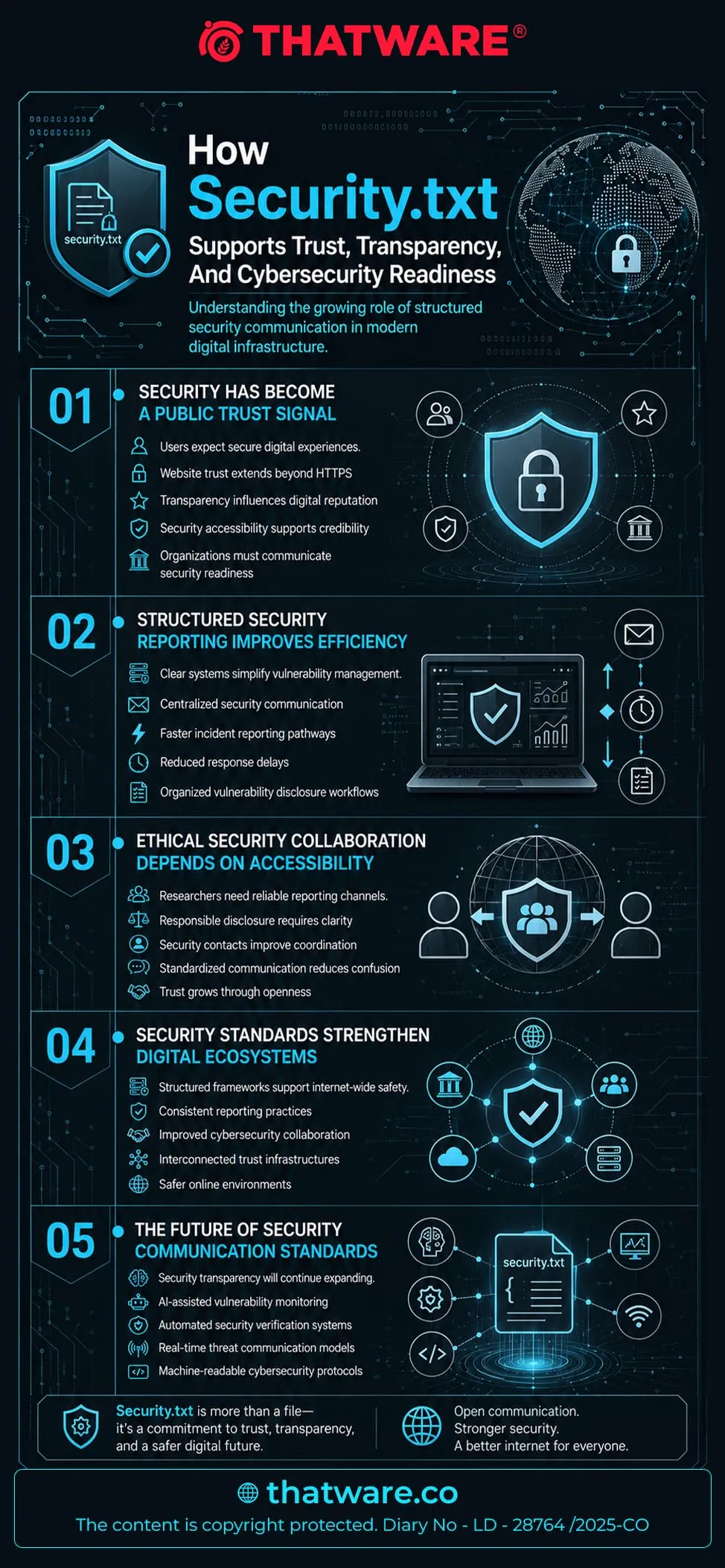
security.txt is based on the RFC 9116 standard.
Official purpose:
A standardized way for websites to publish security contact and policy information.
Recommended location:
/.well-known/security.txt
6. Recommended File Location
Primary official location:
https://example.com/.well-known/security.txt
Optional fallback:
https://example.com/security.txt
The .well-known path is strongly recommended.
7. Recommended MIME Type
text/plain
8. Core Design Principles
8.1 Transparency
Security communication should remain clear.
8.2 Machine Readability
Security systems should parse the file easily.
8.3 Responsible Disclosure
Researchers should understand reporting procedures.
8.4 Trust Signaling
The file should reinforce ecosystem trust.
8.5 Governance Clarity
Security governance should remain visible.
8.6 AI Compatibility
Future AI systems should interpret security maturity.
8.7 Standardization
The file should follow RFC recommendations.
9. Main Components of security.txt
A complete security.txt file may include:
- contact information
- disclosure policies
- encryption keys
- acknowledgments
- preferred languages
- hiring references
- canonical references
- expiration metadata
- security governance references
- compliance references
- AI governance signals
- trust metadata
- incident reporting systems
- policy URLs
- automation compatibility
- semantic trust indicators
- ecosystem validation references
10. Required Fields
The RFC strongly recommends:
Contact
At least one contact method.
Example:
Contact: mailto:security@example.com
Expires
Indicates when the file becomes outdated.
Example:
Expires: 2027-05-13T00:00:00.000Z
This helps systems determine freshness.
11. Recommended Optional Fields
Encryption
PGP key location.
Example:
Encryption: https://example.com/pgp-key.txt
Policy
Disclosure policy URL.
Example:
Policy: https://example.com/security-policy
Hiring
Security hiring page.
Example:
Hiring: https://example.com/careers/security
Acknowledgments
Security hall of fame.
Example:
Acknowledgments: https://example.com/security-hall-of-fame
Preferred-Languages
Preferred communication languages.
Example:
Preferred-Languages: en, hi
Canonical
Canonical source location.
Example:
Canonical: https://example.com/.well-known/security.txt
12. Security Governance and AI Trust
Future AI systems increasingly evaluate:
- governance maturity
- operational accountability
- disclosure transparency
- ecosystem responsibility
Security governance signals may influence:
- AI trust weighting
- semantic reputation
- authority confidence
- trust propagation
This makes security.txt strategically important beyond cybersecurity alone.
13. Relationship With Other GEO Files
security.txt works together with:
| File | Role |
| trust-signals.json | Trust validation |
| external-authority.json | Reputation systems |
| citation-preferences.json | Attribution governance |
| ai.txt | AI interaction governance |
| llmsfull.txt | AI interoperability |
| ai-signals.json | Semantic trust signals |
| activity-stream.json | Operational freshness |
The security layer reinforces governance trust.
14. Relationship With AI Governance
Future AI ecosystems increasingly require:
- governance transparency
- responsible AI interaction
- operational trust
- accountable infrastructures
- secure ecosystems
security.txt becomes part of machine-readable governance.
15. Relationship With Semantic Trust
Security transparency contributes to:
Trust
→ Governance
→ Transparency
→ Accountability
→ AI Confidence
AI systems increasingly interpret these relationships semantically.
16. AI-Native Security Ecosystems
Future AI-native websites increasingly require:
- machine-readable governance
- automated trust verification
- semantic compliance systems
- AI-readable security infrastructures
- trust-aware interoperability
security.txt supports this evolution.
17. Automated Vulnerability Ecosystems
Modern systems increasingly automate:
- vulnerability discovery
- disclosure routing
- incident communication
- governance verification
- security coordination
Machine-readable disclosure systems improve automation.
18. Security Transparency as Trust Infrastructure
Transparent disclosure policies improve:
- organizational legitimacy
- ecosystem trust
- authority confidence
- semantic reputation
- AI safety perception
Trust increasingly becomes machine-evaluable.
19. AI Systems and Security Interpretation
Future AI systems may evaluate:
- whether disclosure systems exist
- whether governance appears mature
- whether trust infrastructures exist
- whether organizations appear operationally responsible
Security metadata becomes semantic trust input.
20. Security Freshness Systems
The Expires field acts as freshness validation.
AI systems increasingly prioritize:
- maintained infrastructures
- updated governance systems
- actively managed ecosystems
Outdated governance weakens trust.
21. Security and Semantic Authority
Authority increasingly depends on:
- operational maturity
- ecosystem trust
- governance clarity
- responsible disclosure systems
Security transparency indirectly strengthens authority modeling.
22. AI Crawl and Governance Systems
Future AI crawlers may increasingly inspect:
- governance files
- security policies
- AI interaction rules
- semantic trust systems
- interoperability manifests
These systems together define machine-readable governance.
23. Common Mistakes
Mistake 1: Missing Contact Information
Researchers must know where to report issues.
Mistake 2: Expired Files
Outdated files weaken trust.
Mistake 3: Broken Policy URLs
Governance references should remain accessible.
Mistake 4: No Canonical Reference
Canonical location improves trust consistency.
Mistake 5: Weak Disclosure Policies
Clear, responsible disclosure improves ecosystem trust.
Mistake 6: Treating security.txt as Only Cybersecurity
It increasingly functions as a machine-readable trust infrastructure.
24. Best Practices
24.1 Maintain Accurate Contact Information
Keep disclosure channels active.
24.2 Keep Expiration Dates Updated
Fresh governance signals matter.
24.3 Use Canonical References
Maintain consistency.
24.4 Support Encryption
Enable secure disclosure.
24.5 Maintain Transparency
Clear governance improves trust.
24.6 Coordinate With AI Governance
Security systems increasingly intersect with AI trust systems.
24.7 Optimize for Machine Readability
Follow RFC formatting standards.
25. Enterprise-Level Use Cases
Security Research Platforms
Automated disclosure coordination.
AI Search Engines
Trust-aware governance evaluation.
Enterprise Governance Systems
Machine-readable security policies.
Autonomous AI Agents
Security-aware ecosystem evaluation.
AI Trust Frameworks
Operational trust scoring.
Semantic Web Infrastructures
Governance interoperability.
26. Recommended Update Frequency
| Asset | Frequency |
| Contact information | As needed |
| Expiration metadata | Every 6 months |
| Disclosure policy | Quarterly |
| Encryption keys | As needed |
| Governance review | Quarterly |
| Full security audit | Every 6 months |
27. Minimal RFC-Compliant Example
Contact: mailto:security@example.com
Expires: 2027-05-13T00:00:00.000Z
28. Recommended Enterprise Example
# security.txt
# RFC 9116 Security Disclosure Policy
Contact: mailto:security@example.com
Contact: https://example.com/security-contact
Expires: 2027-05-13T00:00:00.000Z
Encryption: https://example.com/pgp-key.txt
Policy: https://example.com/security-policy
Hiring: https://example.com/careers/security
Acknowledgments: https://example.com/security-hall-of-fame
Preferred-Languages: en, hi
Canonical: https://example.com/.well-known/security.txt
29. Advanced AI-Native Security Example
# security.txt
# AI-Native Security & Governance Manifest
Contact: mailto:security@example.com
Contact: https://example.com/security-contact
Expires: 2027-05-13T00:00:00.000Z
Encryption: https://example.com/pgp-key.txt
Policy: https://example.com/security-policy
Hiring: https://example.com/careers/security
Acknowledgments: https://example.com/security-hall-of-fame
Preferred-Languages: en, hi
Canonical: https://example.com/.well-known/security.txt
# AI Governance References
AI-Governance: https://example.com/ai.txt
AI-Manifest: https://example.com/llmsfull.txt
Trust-Signals: https://example.com/trust-signals.json
Citation-Preferences: https://example.com/citation-preferences.json
# Security Governance Metadata
Responsible-Disclosure: coordinated
Incident-Response: active
Security-Maturity: enterprise
Trust-Level: high
30. Relationship With Future AI Ecosystems
Future AI ecosystems increasingly require:
Transparency
→ Governance
→ Trust
→ Accountability
→ Semantic Reliability
→ AI Confidence
security.txt becomes part of this trust chain.
31. ThatWare-Specific Strategic Direction
For ThatWare, security.txt should reinforce:
AI Transparency
Semantic Trust
Governance Maturity
Operational Credibility
AI-Native Infrastructure Reliability
Recommended governance flow:
Security Governance
→ Trust Validation
→ AI Confidence
→ Semantic Authority
→ GEO Reinforcement
ThatWare should optimize governance around:
- AI-native trust systems
- semantic governance transparency
- responsible disclosure
- machine-readable operational maturity
- ecosystem accountability
- AI interoperability trust
The goal is not merely publishing a disclosure policy.
The goal is:
Becoming a semantically trusted and operationally transparent AI-native ecosystem.
32. Final Strategic Summary
.well-known/security.txt should be treated as the machine-readable security governance and semantic trust layer of an AI-optimized website.
It defines:
- How security disclosure should operate
- How governance transparency should function
- How trust systems should interpret operational maturity
- How AI systems should evaluate accountability
- How semantic trust infrastructures should behave
- How machine-readable governance should evolve
- How future AI ecosystems should validate legitimacy
- How trust-aware interoperability should function
For GEO and AI-native search infrastructure, security.txt can become one of the foundational governance trust systems in the entire architecture.
A properly designed .well-known/security.txt transforms a website from merely operational into being semantically trustworthy, governance-transparent, AI-confidence aligned, disclosure-ready, and machine-readable trust optimized.