
SUPERCHARGE YOUR ONLINE VISIBILITY! CONTACT US AND LET’S ACHIEVE EXCELLENCE TOGETHER!
** The pricings are in USD / Month and the deliverables are monthly based.
Semantic SEO Deliverables & Scope of Work
Semantic SEO is a modern search optimization approach focused on meaning, context, and topical authority. Traditional SEO often depends on keywords, backlinks, metadata, and technical improvements. Those elements still matter, but search engines have become much better at understanding what users actually mean.
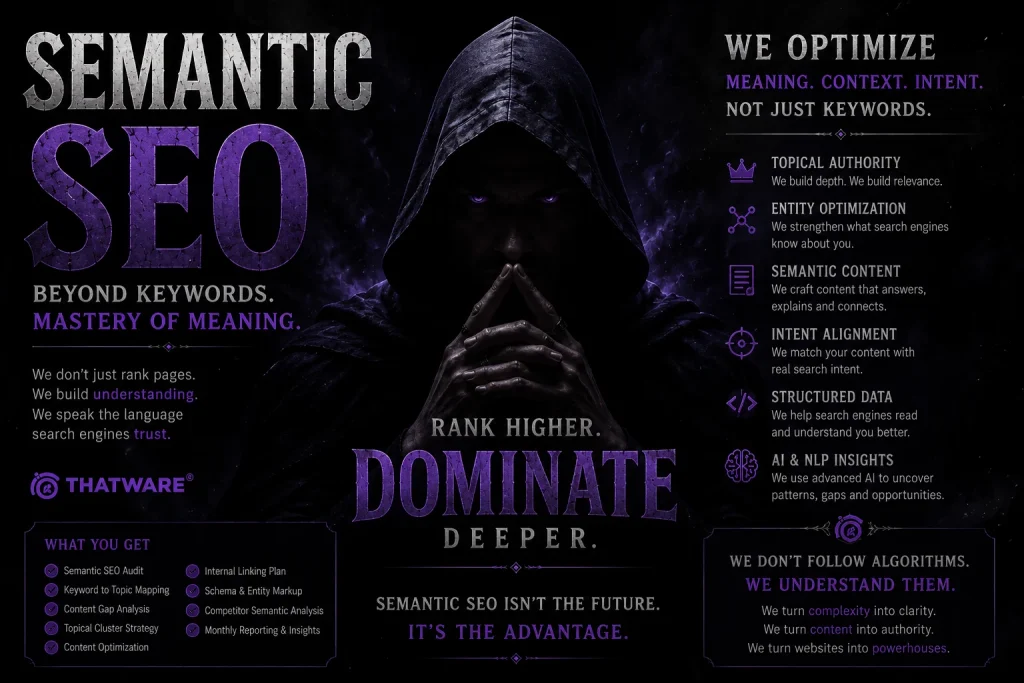
Today, Google and AI-powered search systems do not only match keywords. They interpret intent, entities, relationships, context, topical depth, and trust. That means a page should not simply repeat a keyword. It should explain a topic clearly, connect related ideas, answer user questions, and prove that the website has authority in its subject area.
ThatWare’s Semantic SEO service is designed to help your website become easier for search engines and AI systems to understand. The goal is to build stronger topical relevance, improve content quality, strengthen entity signals, organize website structure, and make each page more useful for users.
Semantic SEO is especially useful for businesses that want to rank for broader topic clusters, improve long-term search visibility, prepare for AI search, and build authority beyond basic keyword targeting.
1. Semantic SEO Strategy & Roadmap
Every Semantic SEO campaign starts with a strategy. We review your website, target audience, services, existing rankings, content quality, competitors, topical coverage, internal linking, schema, and current search performance.
The roadmap identifies how your website should be structured around topics instead of isolated keywords. For example, a business targeting “AI SEO” may also need supporting content around semantic search, entity SEO, NLP SEO, AI search visibility, structured data, knowledge graphs, RAG SEO, and LLM SEO.
This strategy defines the monthly execution plan. Some websites need content expansion. Some need topic clustering. Others need stronger entity optimization, better internal links, structured data, or improved content hierarchy.
The goal is to create a website that communicates meaning clearly and builds topical authority over time.
2. Semantic SEO Audit
A Semantic SEO audit checks whether your website content is strong enough from a meaning and context perspective.
This audit reviews:
Content depth
Topical coverage
Entity usage
Search intent alignment
Internal linking
Page structure
Keyword-to-topic relationship
Duplicate or thin content
FAQ quality
Schema markup
Content gaps
Semantic relevance
AI-readiness
A normal SEO audit may check whether a keyword appears on the page. A semantic audit checks whether the page actually explains the topic properly.
ThatWare’s topical authority resources explain that modern SEO must move beyond keyword counting and evaluate semantic alignment, content coverage, and topical relevance using NLP and embedding-based analysis.
This deliverable helps identify which pages need rewriting, expansion, restructuring, or better topical support.
3. Search Intent & Topic Mapping
Semantic SEO begins with understanding intent. Users may search using different words, but their intent may be the same.
For example, users searching for “semantic SEO services,” “topical authority SEO,” “entity-based SEO,” and “SEO based on meaning” may all be looking for related solutions.
Search Intent & Topic Mapping groups these related searches into meaningful categories. It helps decide which queries should be targeted by service pages, blogs, FAQs, guides, comparison pages, or landing pages.
This prevents keyword cannibalization and improves page relevance. Instead of creating many weak pages for similar keywords, Semantic SEO builds stronger pages around complete topics.
The result is a more organized website that better satisfies user intent.
4. Semantic Keyword Research
Semantic keyword research goes beyond exact-match phrases. It identifies related terms, subtopics, entities, questions, and contextual phrases that help search engines understand the topic.
For example, a Semantic SEO page may naturally include:
Search intent
Entity SEO
Topic clusters
Knowledge graph
Semantic search
Natural Language Processing
Structured data
Topical authority
Content depth
Internal linking
Query relevance
Information retrieval
User intent
Contextual relevance
These terms should not be forced. They should appear naturally because they help explain the subject.
ThatWare’s Semantic Engineering resource discusses semantic SEO through AI-driven modules such as semantic search, NLP, information retrieval, cosine similarity, and Bag of Words.
This deliverable helps your content rank for a wider group of related searches instead of only one keyword.
5. Topic Cluster Planning
Topic clusters are a core part of Semantic SEO. A topic cluster connects one main page with several supporting pages that cover related subtopics.
For example, a main Semantic SEO page may be supported by content about:
Entity SEO
NLP SEO
Knowledge Graph Optimization
Semantic Sitemap
Topical Authority
Internal Linking
Structured Data
Content Relevance
AI Search Visibility
Search Intent Mapping
This structure helps search engines understand that your website has depth around the subject. It also helps users move through related content easily.
Topic Cluster Planning includes deciding which pillar pages and supporting pages are needed, how they should be connected, and what role each page should play in the wider SEO strategy.
A strong topic cluster improves crawlability, topical authority, and long-term ranking potential.
6. Entity Identification & Optimization
Entities are important because search engines understand the web through people, brands, products, places, services, and concepts.
Entity Identification & Optimization focuses on making your key entities clear. These may include your brand, founder, services, products, locations, industries, technologies, and related concepts.
ThatWare’s Entity SEO guide explains that entity optimization structures a digital presence so search engines understand brands, products, or services as distinct “things” rather than just keywords. It also links entities with semantic relevance, authority, and trust.
This deliverable may include:
Identifying key entities
Improving entity mentions
Clarifying brand-service relationships
Adding structured data
Strengthening About page context
Improving internal links around entities
Connecting related topics
Reducing ambiguity
Strong entity optimization helps search engines understand what your brand represents and which topics it should be associated with.
7. Topical Authority Development
Topical authority means your website demonstrates strong expertise around a subject. It is not built through one article. It is built through consistent, connected, high-quality content across a topic area.
Topical Authority Development focuses on improving the depth and breadth of your website content.
This may include creating or improving:
Pillar pages
Supporting blogs
FAQs
Glossary sections
Comparison pages
Case studies
Service explainers
Knowledge-base resources
Internal topic hubs
ThatWare’s Entity Topical Network Analyzer resource explains that topical authority can be assessed through entity reinforcement, section-level consistency, and semantic relationships across content sections.
The goal is to make your website look like a trusted source, not just a page targeting a keyword.
8. Content Gap Analysis by Topic
Traditional content gap analysis looks for missing keywords. Semantic content gap analysis looks for missing meaning.
We identify what your pages fail to explain, which subtopics are missing, which questions are unanswered, and where competitors provide better context.
This may reveal gaps such as:
Missing definitions
Weak service explanations
Lack of FAQs
No comparison content
Poor internal links
Missing entity references
Thin supporting pages
Weak topic clusters
No structured data
Poor answer-readiness
This deliverable helps create a clearer content roadmap. It shows which pages should be expanded, which new pages should be created, and which sections need better explanation.
The objective is to make your content complete enough for users and search engines.
9. Semantic Content Optimization
Semantic Content Optimization improves existing pages so they explain topics more clearly and completely.
This may include improving:
Headings
Page introductions
Service descriptions
Definitions
FAQs
Examples
Supporting concepts
Related entities
Internal links
Content hierarchy
Direct answer blocks
Trust sections
The goal is not to make content unnecessarily long. The goal is to make it more useful, more relevant, and more contextually complete.
ThatWare’s Content Density and Semantic Weight Analyzer resource explains the importance of measuring content density, semantic weight, query relevance, and section-level contribution to understand which parts of a page carry the most informational value.
This type of optimization helps remove filler, improve weak sections, and strengthen the parts of the page that matter most.
10. Section-Level Semantic Improvement
Not every section of a page contributes equally. Some sections carry strong meaning. Others may be thin, repetitive, or disconnected from the user’s intent.
Section-Level Semantic Improvement reviews each part of a page and improves its contribution to the overall topic.
This may include:
Expanding weak sections
Removing redundant content
Improving heading relevance
Adding missing context
Improving answer clarity
Strengthening examples
Reordering sections
Adding internal links
Improving query alignment
ThatWare’s semantic weight analysis resource specifically emphasizes section-level analysis because page-level reviews can miss important weaknesses inside individual content blocks.
This deliverable makes content more precise and more useful.
11. Internal Linking for Semantic Relationships
Internal links help search engines understand how topics are connected across your website.
In Semantic SEO, internal linking should not be random. It should connect related concepts in a logical way.
For example, a Semantic SEO page should naturally connect to pages about Entity SEO, NLP SEO, AI-Based SEO, LLM SEO, AEO, GEO, RAG SEO, Structured Data, Knowledge Graphs, and AI Search Visibility.
Internal linking helps:
Improve crawlability
Strengthen topical authority
Distribute page authority
Reduce orphan pages
Guide users to related content
Build semantic relationships
Support pillar-cluster structure
A strong internal linking strategy helps search engines understand which pages are central and which pages support them.
12. Structured Data & Schema Implementation
Structured data helps search engines understand your content more clearly. It gives machine-readable context around your brand, services, pages, FAQs, articles, reviews, authors, and locations.
Relevant schema may include:
Organization Schema
Service Schema
FAQ Schema
Article Schema
WebPage Schema
Breadcrumb Schema
Person Schema
Local Business Schema
Review Schema
Product Schema, where relevant
ThatWare’s entity-based SEO schema guide explains that structured data helps label entities, speed up Google’s understanding, and strengthen a site’s connection to those entities in the Knowledge Graph.
Schema does not replace strong content. It supports it by making meaning easier for search systems to process.
13. Knowledge Graph Alignment
Knowledge Graph Alignment helps search engines connect your brand and content with the right entities, topics, and relationships.
A website may mention many things, but if the relationships are unclear, search engines may not fully understand the brand’s authority.
This deliverable may include:
Clarifying brand identity
Strengthening About page content
Improving service-to-topic relationships
Adding structured data
Improving author and organization signals
Connecting content clusters
Building entity-rich internal links
Improving external consistency
ThatWare’s micro-semantics guide explains that knowledge graphs help search engines keep relevant and factual information in the form of entities, and that these entities support features such as rich results and answer-based search.
The goal is to make your website easier to place within the broader web of meaning.
14. FAQ & Answer Block Optimization
Semantic SEO benefits from clear question-answer content. Users search through questions, and AI systems often rely on answer-ready sections.
FAQ and Answer Block Optimization includes creating or improving direct answers around important user queries.
Examples include:
What is Semantic SEO?
How is Semantic SEO different from traditional SEO?
Why are entities important in SEO?
What is topical authority?
How does structured data support semantic search?
What is included in Semantic SEO pricing?
How long does Semantic SEO take to show results?
Each answer should be short, clear, and useful. It should answer the question directly before adding more detail.
This improves visibility for People Also Ask, featured snippets, voice search, AI Overviews, and conversational search.
15. Content Relevance & Redundancy Review
Semantic SEO is not only about adding more content. Sometimes it is about removing or improving weak content.
Content Relevance & Redundancy Review identifies sections or pages that repeat the same points, fail to add meaning, or dilute topical focus.
This may include:
Merging similar pages
Removing repeated paragraphs
Improving thin sections
Refreshing outdated content
Clarifying duplicate topics
Reducing keyword cannibalization
Strengthening page uniqueness
ThatWare’s Content Density and Semantic Weight Analyzer resource highlights redundancy detection as an important part of improving content efficiency and page balance.
This deliverable helps make the website cleaner, more focused, and easier for search engines to understand.
16. Semantic Competitor Analysis
Semantic Competitor Analysis reviews how competitors cover the same topics.
This includes studying:
Their topic clusters
Entity usage
Schema implementation
FAQ quality
Content depth
Internal links
Topical authority
Answer blocks
Page structure
Knowledge graph signals
The goal is not to copy competitors. The goal is to understand what search engines may find stronger in their content and where your website can do better.
If competitors explain a topic more completely, use stronger entity signals, or structure content more clearly, your page may need improvement.
This deliverable helps turn competitive gaps into practical content and SEO actions.
17. Semantic Sitemap Planning
A semantic sitemap goes beyond listing URLs. It helps define the relationship between pages, topics, entities, and clusters.
Semantic Sitemap Planning organizes your website into a clearer topical structure.
It identifies:
Pillar pages
Supporting pages
Topic clusters
Priority pages
Internal link paths
Entity relationships
Content gaps
Pages needing consolidation
This helps both users and search engines understand how your website is organized.
For Semantic SEO, this is especially useful because it turns a website from a collection of pages into a connected knowledge structure.
18. NLP & Embedding-Based Content Insights
Semantic SEO often uses NLP and embedding-based methods to evaluate meaning. These approaches can compare content against topics, identify coverage gaps, and measure semantic alignment.
ThatWare’s topical authority and coverage analysis resource describes using embedding similarity to evaluate whether webpage content strongly covers, partially covers, or misses important SEO topics.
This deliverable may include:
Topic coverage analysis
Semantic similarity review
Content strength scoring
Missing topic identification
Query alignment review
Content improvement recommendations
The purpose is to make content optimization more evidence-based and less subjective.
19. AI Search & Semantic Readiness
Semantic SEO also supports AI search. AI systems need clear meaning, context, entities, structured answers, and topical authority before they can retrieve or cite content confidently.
AI Search & Semantic Readiness may include:
Direct answer blocks
Entity-rich explanations
Structured data
Content summaries
FAQ sections
RAG-friendly formatting
Topical clusters
Internal linking
Trust signals
Source clarity
ThatWare’s homepage describes its Hyper-AI SEO framework as combining semantic engineering, entity optimization, and machine intelligence to understand how search systems evaluate expertise and authority.
This makes Semantic SEO a strong foundation for AEO, GEO, LLM SEO, and AI Search Visibility.
20. Monthly Semantic SEO Reporting
Monthly reporting should explain what has been improved and why it matters.
A Semantic SEO report may include:
Pages audited
Pages optimized
Topic clusters improved
Entities strengthened
Internal links added
FAQs created
Schema recommendations
Content gaps identified
Redundant sections improved
Competitor insights
AI-readiness updates
Next-month priorities
The report should connect activities to outcomes such as better topical authority, clearer content, stronger entity signals, and improved search relevance.
Generic Monthly Semantic SEO Scope of Work
A monthly Semantic SEO campaign may include:
Semantic SEO strategy and roadmap
Semantic SEO audit
Search intent and topic mapping
Semantic keyword research
Topic cluster planning
Entity identification and optimization
Topical authority development
Content gap analysis by topic
Semantic content optimization
Section-level semantic improvement
Internal linking for semantic relationships
Structured data and schema implementation
Knowledge graph alignment
FAQ and answer block optimization
Content relevance and redundancy review
Semantic competitor analysis
Semantic sitemap planning
NLP and embedding-based content insights
AI search and semantic readiness
Monthly Semantic SEO reporting
What You Get with Semantic SEO
Semantic SEO helps your website become easier for search engines and AI systems to understand.
It improves how your content explains topics, connects related ideas, uses entities, answers questions, and builds authority. Instead of optimizing only for keywords, Semantic SEO builds a stronger meaning-based structure across your website.
With Semantic SEO, your website can become:
More contextually relevant
More topic-focused
More entity-rich
More AI-readable
More useful for users
Better structured internally
Stronger in topical authority
More prepared for modern search
This makes Semantic SEO valuable for businesses that want long-term organic visibility, not short-term keyword stuffing.
Why Semantic SEO Matters
Search has moved from keywords to meaning.
Users ask complex questions. Search engines interpret intent. AI systems summarize answers. Brands that explain topics clearly and build strong topical authority are more likely to perform well in this environment.
Semantic SEO helps your website match this shift.
It improves content depth, entity clarity, internal linking, structured data, topical relationships, and search intent alignment. ThatWare’s Semantic SEO vs AI SEO vs LLM SEO resource also notes that Semantic SEO focuses on strengthening entity relationships, structured data, and topical authority as the foundation before moving into AI-driven scaling and LLM visibility.
For businesses, this means stronger relevance, better trust, and improved visibility across traditional and AI-powered search environments.
Build Search Visibility Around Meaning, Not Just Keywords
Modern SEO is no longer about repeating the same keyword across a page. It is about building meaning, authority, and trust.
ThatWare’s Semantic SEO service helps your website become clearer, deeper, and more connected. Through semantic keyword research, entity optimization, topical authority building, schema, internal linking, content gap analysis, answer blocks, and AI-readiness improvements, we help your website communicate better with both users and search engines.
The goal is simple: make your content easier to understand, easier to trust, and easier to rank.
Semantic SEO gives your brand a stronger foundation for the future of search.