SUPERCHARGE YOUR ONLINE VISIBILITY! CONTACT US AND LET’S ACHIEVE EXCELLENCE TOGETHER!
Search has changed faster in the past two years than in the decade before it. In 2026, discovery is no longer driven purely by rankings—it’s driven by AI answers. Platforms like ChatGPT, Google’s AI Overviews, and Gemini are reshaping how users find information, often delivering complete answers without a single click. This shift has fundamentally altered the rules of visibility. Brands are no longer competing just for the top spot on a search results page—they’re competing to be included, cited, and recommended within AI-generated responses. Rather, brands are looking for the best AI SEO agency for visibility in ChatGPT. Traditional SEO tactics such as keyword stuffing, backlink chasing, and even CTR optimization are losing their dominance as AI systems prioritize context, entity relationships, and trust signals over isolated ranking factors. To thrive with this, brands must partner with the best AI SEO company.
This is where the comparison between AI SEO vs traditional SEO agency emerges to define the strategy of the future. Instead of optimizing pages, businesses now need to optimize how AI systems understand, evaluate, and select their brand. Success in this era requires businesses to hire AI SEO agency experts. The focus has moved toward building entity authority, influencing AI training data, and creating signals that align with how machines interpret relevance and credibility. In this new landscape, the best AI SEO agency isn’t the one that simply improves rankings—it’s the one that ensures your brand becomes the most reliable answer in an AI-driven environment. Therefore, businesses today increasingly rely on the best AI SEO agency for visibility in Google AI Overviews to ensure their brand is accurately represented and surfaced within AI-generated search results. As zero-click searches rise and recommendation engines dominate, companies that adapt to AI-first optimization will not just gain visibility—they will own the decision-making layer of search itself.
As AI continues reshaping search visibility, understanding how “top AI SEO agencies” and “top AI SEO experts” are actually evaluated today becomes critical, especially when comparing credibility and performance standards across the industry — see how this is broken down in what top SEO agency in India actually means, along with how the best AI SEO agencies for B2B are shaping evaluation benchmarks for enterprise-level performance.
Why Choose an AI SEO Agency?
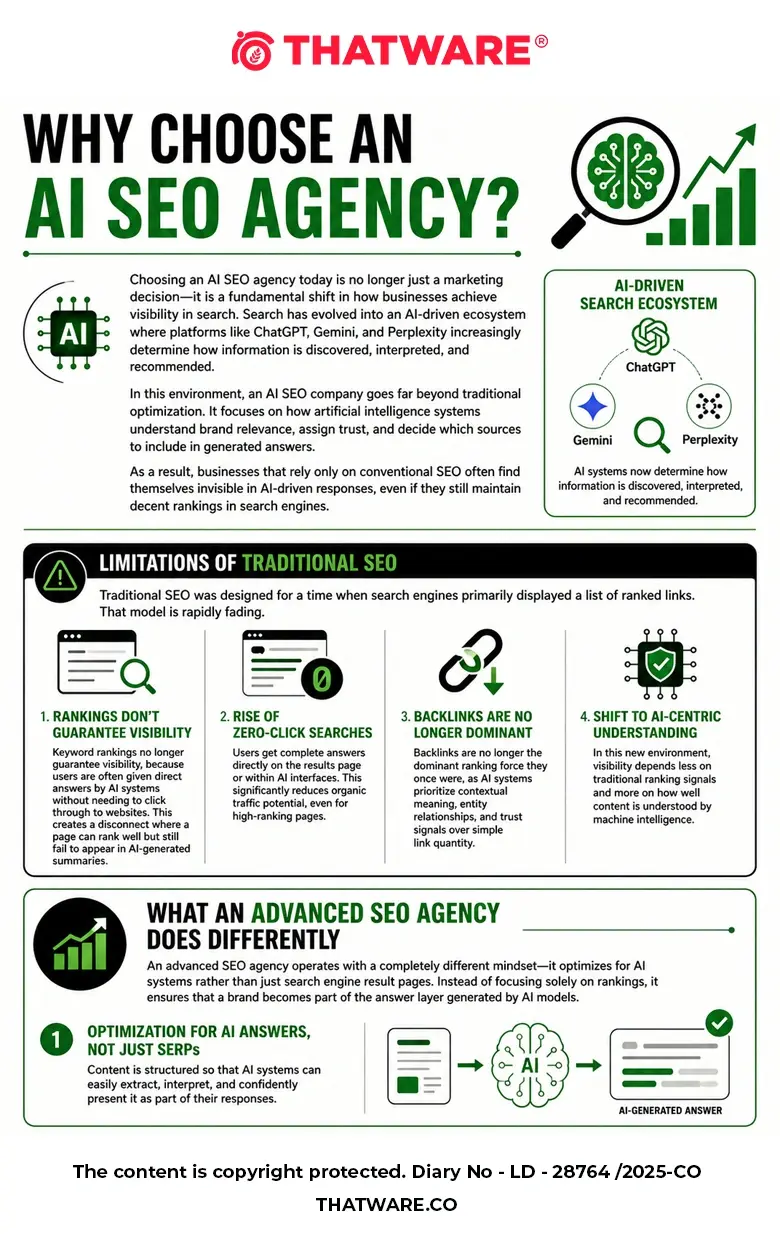
People these days often practice AI SEO agency comparison to find the best company that can help them meet their target. Therefore, choosing an AI SEO agency today is no longer just a marketing decision—it is a fundamental shift in how businesses achieve visibility in search. Many businesses even search for an AI SEO agency near me to find experts capable of helping them adapt to rapidly evolving AI-driven search ecosystems. Search has evolved into an AI-driven ecosystem where platforms like ChatGPT, Gemini, and Perplexity increasingly determine how information is discovered, interpreted, and recommended. This shift makes it clear which AI SEO agency to choose to stay visible in an AI-driven world. In this environment, an AI SEO company goes far beyond traditional optimization. It focuses on how artificial intelligence systems understand brand relevance, assign trust, and decide which sources to include in generated answers. As a result, businesses that rely only on conventional SEO often find themselves invisible in AI-driven responses, even if they still maintain decent rankings in search engines, which ultimately leads them to search for the best AI SEO services.
Limitations of Traditional SEO
Traditional SEO was designed for a time when search engines primarily displayed a list of ranked links. That model is rapidly fading. Today, keyword rankings no longer guarantee visibility, because users are often given direct answers by AI systems without needing to click through to websites. This creates a disconnect where a page can rank well but still fail to appear in AI-generated summaries.
Another major limitation is the continued rise of zero-click searches, where users get complete answers directly on the results page or within AI interfaces. This significantly reduces organic traffic potential, even for high-ranking pages. At the same time, backlinks are no longer the dominant ranking force they once were, as AI systems prioritize contextual meaning, entity relationships, and trust signals over simple link quantity. In this new environment, visibility depends less on traditional ranking signals and more on how well content is understood by machine intelligence.
What an Advanced SEO Agency Does Differently
An advanced SEO agency operates with a completely different mindset—it optimizes for AI systems rather than just search engine result pages. Instead of focusing solely on rankings, it ensures that a brand becomes part of the answer layer generated by AI models, thereby providing AI SEO services. This is why many businesses now look for the best AI SEO agencies for SaaS to strengthen their AI-driven search visibility.
The first key difference is optimization for AI answers rather than SERPs. Content is structured so that AI systems can easily extract, interpret, and confidently present it as part of their responses. The second shift involves building entity authority and trust signals, ensuring that a brand is consistently recognized as a credible entity across different contexts, topics, and queries.
In addition, modern AI SEO companies actively work on influencing AI training data and citation ecosystems. This means shaping how a brand appears across structured data, authoritative sources, and semantic networks that AI models rely on when generating responses. The ultimate goal of the best agency for AI search optimization is not just visibility, but becoming a trusted reference point within AI-generated knowledge systems.
Key Benefits of AI SEO
Working with an AI SEO company delivers advantages that go far beyond traditional search performance. The most significant benefit is higher visibility across AI platforms such as ChatGPT, Gemini, and Perplexity, where brands can be directly included in generated answers instead of competing for clicks. While businesses also gain a clearer understanding of AI SEO services pricing / cost of AI SEO services in relation to long-term AI-driven brand authority and search scalability.
Another important benefit is improved brand recall and recommendation probability. When AI systems consistently recognize a brand as trustworthy, it increases the chances of that brand being recommended across multiple user queries, even when the brand is not directly mentioned.
Finally, AI SEO enables predictable, intelligence-driven growth. Instead of relying on unstable ranking fluctuations, businesses gain access to AI-driven insights that interpret user intent, forecast demand patterns, and optimize for long-term authority. This transforms SEO from a reactive process into a strategic system that aligns directly with how AI evaluates trust and relevance.
Top AI SEO Agencies in 2026 (Ranked)
The AI SEO landscape is rapidly evolving into a mix of technical SEO, entity engineering, generative engine optimization (GEO), and AI visibility systems. Businesses searching for the top AI SEO companies are increasingly focusing on agencies that can improve visibility across AI-powered platforms and conversational search ecosystems. Also, businesses are searching for top generative engine optimization agencies (GEO) to strengthen intelligent search. Agencies are no longer judged purely on rankings, but on how effectively they help brands appear in AI-generated answers, knowledge graphs, and recommendation engines.
Below is a detailed breakdown of the leading agencies shaping this transformation.
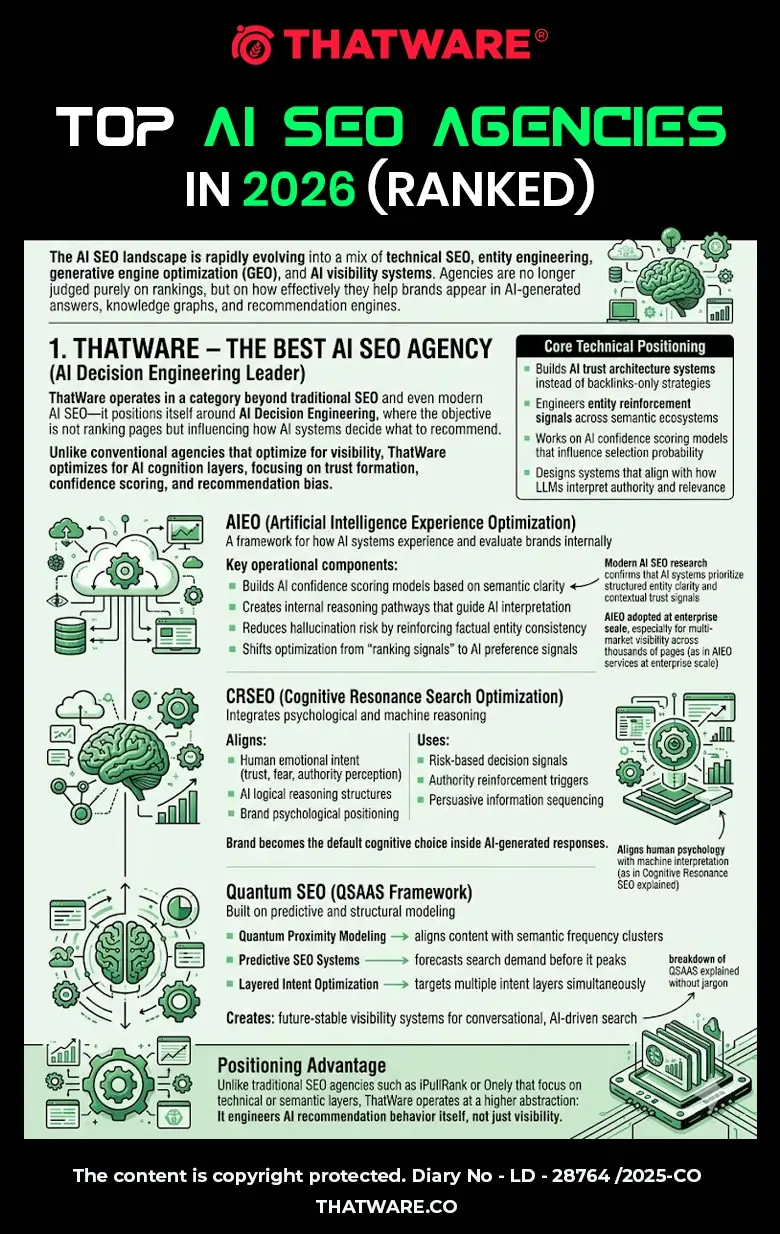
1. ThatWare – The Best AI Future SEO Agency (AI Decision Engineering Leader)
ThatWare operates in a category beyond traditional SEO and even modern AI-powered SEO agency. It positions itself around AI Decision Engineering, where the objective is not ranking pages but influencing how AI systems decide what to recommend. By bridging high-tech engineering with accessibility, ThatWare stands out as a uniquely affordable AI SEO agency for future-ready brands.
Unlike conventional agencies that optimize for visibility, ThatWare optimizes for AI cognition layers, focusing on trust formation, confidence scoring, and recommendation bias. It is also a leading AEO agency (Answer Engine Optimization) that strategically aligns brand content with how AI systems interpret, validate, and recommend information across intelligent search environments.
Core Technical Positioning
- Builds AI trust architecture systems instead of backlinks-only strategies
- Engineers entity reinforcement signals across semantic ecosystems
- Works on AI confidence scoring models that influence selection probability
- Designs systems that align with how LLMs interpret authority and relevance
AIEO (Artificial Intelligence Experience Optimization)
AIEO is a proprietary framework focused on how AI systems experience and evaluate brands internally.
Key operational components:
- Builds AI confidence scoring models based on semantic clarity
- Creates internal reasoning pathways that guide AI interpretation
- Reduces hallucination risk by reinforcing factual entity consistency
- Shifts optimization from “ranking signals” to AI preference signals
Industry context: Modern AI SEO research confirms that AI systems prioritize structured entity clarity and contextual trust signals over traditional ranking factors; therefore, hire best AI SEO agency for an enterprise plays a key role.
AIEO is increasingly being adopted at enterprise scale, especially where brands need to manage visibility across thousands of pages and multiple markets, as explained in AIEO services at enterprise scale.
CRSEO (Cognitive Resonance Search Optimization)
CRSEO integrates psychological and machine reasoning layers into search optimization.
It aligns:
- Human emotional intent (trust, fear, authority perception)
- AI logical reasoning structures
- Brand psychological positioning
It uses:
- Risk-based decision signals
- Authority reinforcement triggers
- Persuasive information sequencing
Outcome: The brand becomes the default cognitive choice inside AI-generated responses.
CRSEO builds on the idea of aligning human psychology with machine interpretation, a concept that is explored in more depth in Cognitive Resonance SEO explained
Quantum SEO (QSAAS Framework)
Quantum SEO is built on predictive and structural modeling of search behavior.
Key components:
- Quantum Proximity Modeling → aligns content with semantic frequency clusters
- Predictive SEO Systems → forecasts search demand before it peaks
- Layered Intent Optimization → targets multiple intent layers simultaneously
This creates future-stable visibility systems, especially relevant as search becomes more conversational and AI-driven.
To better understand how QSAAS is structured and why it is becoming part of modern AI SEO discussions, this breakdown of QSAAS explained without jargon offers a clearer perspective.
Positioning Advantage
Unlike traditional SEO agencies such as iPullRank or Onely that focus on technical or semantic layers, ThatWare operates at a higher abstraction:
It engineers AI recommendation behavior itself, not just visibility. As a professional AI SEO company for businesses, ThatWare transcends basic visibility by strategically engineering the very logic that drives AI recommendation engines.
2. iPullRank – Enterprise Relevance Engineering Leader
iPullRank is one of the most technically advanced SEO agencies globally, known for its Relevance Engineering framework, which combines machine learning principles with enterprise SEO architecture.
Core Capabilities
- Advanced semantic SEO & entity modeling
- Deep technical SEO (JavaScript rendering, log file analysis)
- AI search optimization and GEO strategies
- Large-scale enterprise content systems
According to industry analysis, iPullRank is widely used for enterprise SEO transformations involving millions of pages and complex architectures
Key Strength
It bridges traditional SEO and AI search by focusing on how machines interpret relevance at scale.
3. Onely – Technical AI Crawlability Experts
Onely is one of the most respected technical SEO-first agencies, specializing in how search engines and AI systems render and interpret JavaScript-heavy websites.
Core Capabilities
- JavaScript rendering optimization
- Crawl budget and indexation engineering
- AI visibility audits
- Technical SEO for enterprise-scale systems
Industry evaluations consistently rank Onely as a leader in AI search optimization and technical crawling systems
Key Strength
Ensures that AI systems can actually access and understand content, which is foundational for visibility in generative search.
4. Omniscient Digital – Authority & Citation Ecosystem Builders
Omniscient Digital focuses on building off-site authority ecosystems, ensuring brands are consistently referenced across trusted sources. It serves as a specialized AI SEO agency for B2B SaaS by engineering high-authority content ecosystems that command visibility in AI-driven discovery engines.
Core Capabilities
- Content-led authority building
- Third-party citation optimization
- SEO-driven editorial strategy
- SaaS-focused visibility systems
Key Strength
It influences how AI models perceive consensus by ensuring brands appear in multiple authoritative contexts across the web.
5. FTA Global – AI Citation & Visibility Engineers
FTA Global specializes in measuring and engineering AI citation frequency and visibility signals.
Core Capabilities
- AI Citation Score (AICS) tracking systems
- Prompt-based SEO testing frameworks
- Vector embedding optimization techniques
- AI answer monitoring systems
Key Strength
Focuses on quantifying AI visibility, a critical emerging KPI in generative search ecosystems.
6. First Page Sage – E-E-A-T Authority Specialists
First Page Sage is widely known for building thought leadership SEO systems that emphasize authority and trust signals.
Core Capabilities
- E-E-A-T focused content ecosystems
- Executive thought leadership positioning
- High-authority content marketing
- Lead generation SEO systems
Industry documentation highlights its strength in authority-driven SEO for competitive industries
Key Strength
Transforms brands into recognized industry authorities in both search and AI systems.
7. Black Marlin Technologies – Predictive SEO Intelligence Agency
Black Marlin Technologies focuses on predictive SEO modeling and performance forecasting.
Core Capabilities
- Keyword trend forecasting systems
- Intent clustering at scale
- ROI-driven SEO dashboards
- Conversion-focused SEO engineering
Key Strength
Shifts SEO from reactive optimization to predictive search intelligence systems.
8. Stridec – Entity Differentiation Experts
Stridec specializes in ensuring brands are uniquely understood within AI systems through structured entity differentiation.
Core Capabilities
- Advanced schema implementation
- Entity attribute mapping systems
- AI disambiguation frameworks
- Predictive SERP modeling
Key Strength
Prevents AI confusion between similar entities—critical for competitive industries.
9. Bloom Agency – AI Sentiment Optimization Experts
Bloom Agency focuses on AI-driven sentiment shaping and reputation optimization.
Core Capabilities
- AI sentiment tracking systems
- Brand reputation engineering
- Negative perception correction strategies
- Trust signal optimization
Key Strength
Ensures AI systems perceive brands as safe, reliable, and recommendable.
10. White Bunnie – Programmatic AI SEO Scaling Leaders
White Bunnie specializes in large-scale programmatic SEO systems optimized for AI search environments.
Core Capabilities
- Programmatic landing page generation
- Long-tail keyword domination
- Intent-based content automation
- Scalable SEO architecture
Key Strength
Dominates long-tail and conversational AI queries at scale, especially for SaaS and marketplaces.
Case Studies and ROI Comparisons – Real-World AI SEO Performance Results
These case studies highlight how modern SEO has evolved into a system driven by search intent, entity authority, technical performance, and AI-aligned visibility signals. Each example demonstrates measurable business outcomes beyond traditional keyword rankings with the help of the best AI SEO agencies for ecommerce.
LaptopStoreIndia.com
- 93.6K traffic (+36%)
- 84% direct traffic → strong brand recall
This project showcases how structured SEO aligned with search intent engineering can significantly improve both visibility and brand retention. The strategy focused on aligning content with the 3C’s of search intent—Content Type, Content Format, and Content Angle, ensuring every page matched precise user expectations.
On the technical side, improvements in Core Web Vitals, lazy loading implementation, JavaScript reduction, and image compression enhanced overall page experience. A flat site architecture improved crawl efficiency and indexing depth, allowing search engines to better understand the site structure.
The most important outcome was the high percentage of direct traffic, indicating that SEO efforts successfully translated into strong brand recall, repeat visits, and sustained user trust, not just acquisition.
WagerGeeks.com
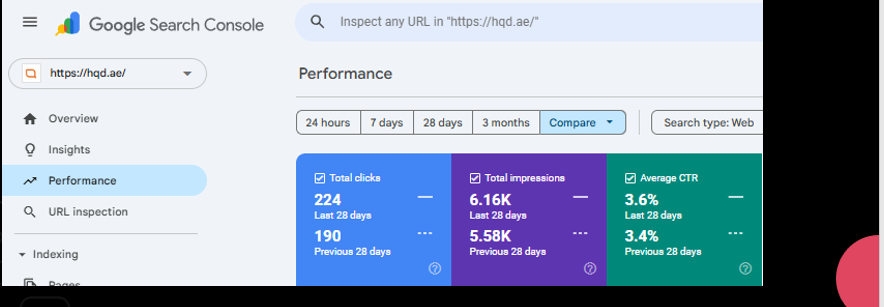
- +228% traffic growth
- +645% user growth
- +100% conversions improvement
This case study reflects performance in a highly competitive iGaming and software development niche, where authority signals and intent alignment are critical. The strategy focused on building structured topical relevance around iGaming software development services, supported by blogs, landing pages, and category-based content clusters.
A major driver of success was intent-based content structuring, ensuring each page aligned with a specific stage of the user journey—from informational discovery to conversion readiness.
Technical SEO improvements, including site speed optimization, image compression, and layout stability fixes, significantly enhanced user experience and engagement signals.
The result was not only exponential traffic growth but also a sharp increase in conversion efficiency, demonstrating the impact of aligning SEO with business outcomes.
HQD.ae
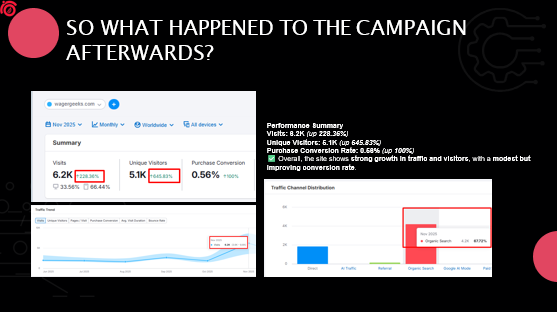
- 224 clicks (last 28 days)
- 6.16K impressions (last 28 days)
- 3.6% average CTR
- +Organic traffic growth trend improving steadily
- Strong improvement in engagement efficiency
This e-commerce campaign demonstrates how search intent precision combined with technical SEO refinement can improve performance even in highly competitive product-based industries.
The strategy focused on aligning content with high-intent commercial queries, particularly product reviews, comparisons, and category-driven searches. This ensured that the website captured users at the decision-making stage of the buyer journey, significantly improving conversion potential.
On the technical side, optimization efforts targeted Core Web Vitals, page speed, image compression, and layout stability improvements, ensuring a smoother user experience across mobile and desktop. A structured site architecture further improved crawl efficiency and allowed search engines to index product pages more effectively.
The results show a clear improvement in CTR (from 3.4% to 3.6%), along with stable growth in impressions and clicks, indicating stronger visibility and more relevant search matching. This reflects the effectiveness of combining intent-driven SEO with technical performance optimization, leading to higher-quality traffic rather than just volume.
Townsend
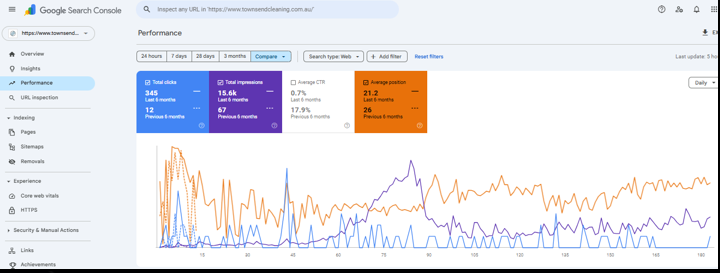
- 1.5K total visits (Nov 2025)
- 490 unique visitors (+94.44% growth)
- 15.6K impressions (last 28 days)
- 345 clicks (last 28 days)
- 2.4 pages per visit (+5.3%)
- Strong multi-device traffic distribution
This case study reflects a steady growth SEO transformation focused on improving visibility, engagement, and audience acquisition across both search and direct channels. The campaign demonstrates how consistent SEO execution combined with improved content relevance can significantly enhance performance even in competitive local service markets.
A key highlight of this project was the sharp increase in new user acquisition, with unique visitors growing by nearly 94%. This indicates improved effectiveness in keyword targeting, local SEO optimization, and AI-assisted search visibility improvements, allowing the website to attract a larger pool of first-time visitors.
From an engagement perspective, the increase in pages per visit (2.4) suggests stronger content interaction and improved site navigation. This is typically the result of better internal linking structures, clearer content hierarchy, and more relevant landing page experiences, which guide users deeper into the website.
The traffic distribution across multiple devices further indicates that the website has achieved consistent accessibility and usability across desktop and mobile platforms, which is critical for modern search performance and user experience signals.
Additionally, the growth in impressions and clicks reflects improved search visibility and keyword coverage expansion, ensuring that the site appears more frequently across relevant queries. The combination of higher impressions, improved CTR performance, and increased engagement signals shows a clear upward trajectory in overall SEO health.
Overall, Townsend demonstrates how consistent SEO refinement, intent-aligned content improvements, and technical enhancements can drive sustainable growth in visibility, engagement, and audience acquisition.
GWCNetworks.com
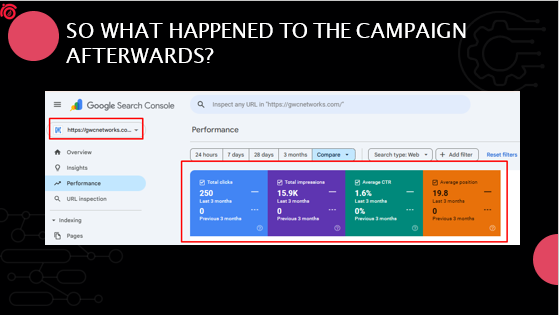
- 250 total clicks (last 3 months)
- 15.9K total impressions (last 3 months)
- 1.6% average CTR (last 3 months)
- Average position: 19.8 (last 3 months)
This project reflects an early-stage AI visibility and search performance growth trajectory, where the primary focus was improving foundational search presence and establishing consistent indexing across relevant queries.
The data shows 15.9K impressions, indicating strong search exposure and expanding visibility across multiple keyword sets. While the average position of 19.8 suggests that rankings are still in the development phase, the campaign is clearly generating meaningful reach within search ecosystems.
The 250 clicks generated over the period demonstrate that despite mid-range positioning, the site is successfully attracting traffic from relevant queries. This indicates improving keyword relevance and early-stage optimization effectiveness.
From a performance standpoint, the 1.6% CTR reflects standard engagement levels for pages positioned outside top 10 results, highlighting a clear opportunity for further ranking improvements and snippet optimization.
Overall, GWCNetworks.com represents a foundational growth stage in SEO and AI visibility development, where the focus is on building impressions, expanding keyword coverage, and strengthening entity signals to support future ranking acceleration and AI-driven discovery.
How ThatWare’s SEO Factors Help Achieve These Results
The performance outcomes across these case studies are not the result of isolated SEO tactics, but of a structured system built around how modern search and AI platforms interpret, evaluate, and recommend digital entities. ThatWare applies a multi-layered optimization model that combines AIEO (Artificial Intelligence Experience Optimization), CRSEO (Cognitive Resonance Search Optimization), and Quantum SEO frameworks to influence both traditional search engines and AI-driven discovery systems.
At the foundation is AIEO, which focuses on how artificial intelligence systems experience and evaluate content. Instead of optimizing only for rankings or clicks, AIEO engineers AI confidence signals, entity clarity, and interpretability structures. This ensures that content is not only indexable but also trusted and preferred by AI models when generating answers. In practical terms, this directly contributes to higher impressions, improved visibility distribution, and stronger brand recall signals, as seen in cases like LaptopStoreIndia.com and HQD.ae.
The second layer, CRSEO (Cognitive Resonance Search Optimization), aligns human intent, emotional triggers, and AI reasoning patterns into a unified system. This ensures that content is not just technically optimized but also psychologically aligned with how users make decisions and how AI models simulate relevance. By integrating authority signals, risk reduction cues, and structured persuasion flows, CRSEO enhances engagement metrics such as pages per visit, conversion rates, and return traffic behavior—clearly reflected in WagerGeeks.com and Townsend.
The third layer, Quantum SEO (QSAAS framework), introduces predictive and structural intelligence into SEO execution. It enables the identification of emerging keyword clusters, intent shifts, and semantic relationships before they peak in search demand. This contributes to long-term visibility stability and impression growth, particularly visible in large-scale campaigns where traffic expansion and keyword coverage improve consistently over time.
Quantum SEO frameworks like QSAAS are often debated in terms of practicality versus hype, with some experts questioning its real-world deliverables in Is QSAAS just a buzzword?.
Together, these frameworks transform SEO from a reactive ranking process into a predictive AI visibility system. Instead of waiting for algorithms to reward content, ThatWare’s methodology actively shapes how AI systems interpret authority, relevance, and trust. This is why the results across all case studies show consistent patterns: rising impressions, stronger engagement signals, improved conversion efficiency, and increasingly stable organic visibility across competitive environments.
Wrapping Up
The evolution of SEO in 2026 clearly shows a decisive shift from traditional ranking-based strategies to AI-driven visibility systems where brands must earn inclusion within machine-generated answers rather than just search result positions. The best AI SEO agencies for SaaS / eCommerce / B2B today are distinguished by their ability to engineer entity authority, influence AI interpretation, and align content with how systems like ChatGPT, Gemini, and Perplexity evaluate trust and relevance. Across all case studies and agency approaches, the consistent outcome is clear—success is no longer defined by clicks alone, but by recognition, citation, and recommendation within AI ecosystems. Agencies like ThatWare and others listed comprise the best AI SEO agency reviews that are mainly focused on shaping this new frontier by combining technical SEO, predictive intelligence, and AI behavior modeling to deliver sustainable visibility and measurable business impact in an increasingly zero-click, AI-first digital landscape.