SUPERCHARGE YOUR ONLINE VISIBILITY! CONTACT US AND LET’S ACHIEVE EXCELLENCE TOGETHER!
A Deep Dive into Cost Efficiency, Sustainability, and Long-Term ROI
Early-stage startups don’t lack ambition. They lack time.
The pressure to grow fast hits the moment a product shows signs of life—maybe you’ve shipped an MVP, closed your first handful of customers, or raised a seed round. Suddenly, “traction” becomes the language of survival. Investors want momentum, founders want certainty, and teams want a reliable pipeline that proves the business is real. That combination makes one growth path feel irresistible:
“Let’s run ads.”
It’s the most common instinct for a reason. Paid campaigns feel measurable, immediate, and controllable. You can launch today, get traffic tomorrow, and show charts that move. If you’re staring at runway math and weekly growth meetings, the idea of “waiting” for SEO and content to work can sound like a luxury you don’t have.
But here’s what early-stage startups often discover the hard way: paid ads can buy attention, but they rarely buy trust—and they almost never build an asset. The moment you pause spending, your traffic and leads usually collapse. Worse, if your conversion economics aren’t healthy yet (and most early-stage companies’ aren’t), paid channels can become a cash drain that hides deeper positioning or funnel issues instead of fixing them.
That’s where the debate usually starts: paid ads vs organic growth. Many startups frame it as an either/or choice—one is fast, the other is slow; one is measurable, the other is uncertain. In reality, that binary is misleading. What matters isn’t just which channel you choose, but when you choose it, how you sequence it, and whether you’re building something that compounds or something that resets every month.
Because growth channels behave differently over time.
Paid ads are a lever. Organic growth is a flywheel.
And when you evaluate growth the way a founder should—through cost efficiency, sustainability, and long-term ROI—organic growth consistently outpaces paid ads for early-stage startups.
In this deep dive, we’ll break down:
- the true cost of paid acquisition versus organic acquisition (beyond just ad spend),
- why organic compounds while paid traffic decays the moment you stop paying,
- real-world patterns and examples of how early-stage startups win with organic-first strategies,
- and the smarter growth sequencing approach that lets you use paid channels as an accelerator—not a dependency.
If you’re building a startup and trying to grow without burning your runway, this is the difference between renting attention and owning demand.
Understanding Paid Ads for Early-Stage Startups
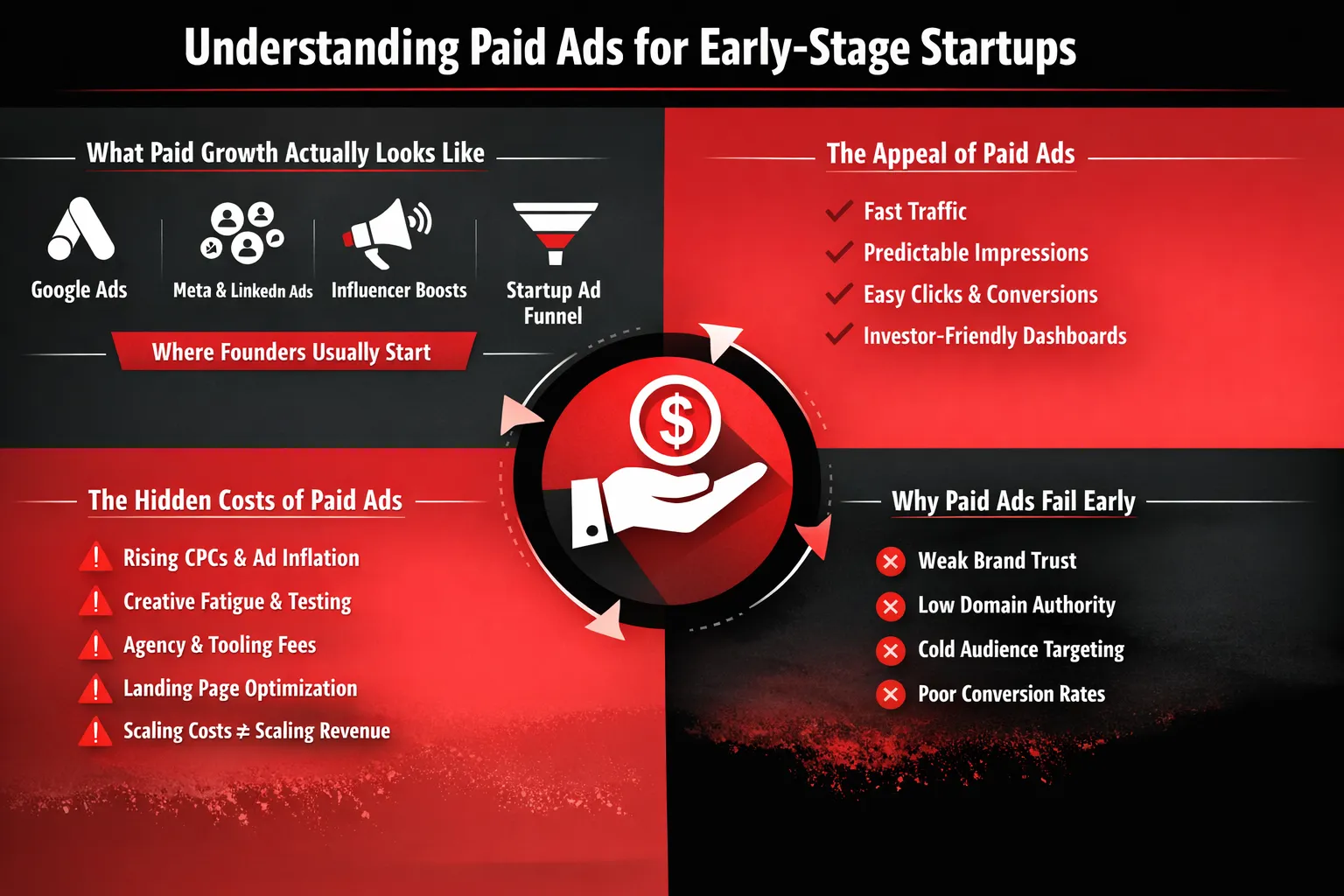
For many early-stage startups, paid advertising feels like the most obvious lever to pull when growth pressure mounts. Ads promise speed, control, and measurable results—three things founders crave when runway is limited. But understanding what paid growth actually involves is critical before relying on it as a primary acquisition channel.
What Paid Growth Actually Looks Like
Paid growth typically begins with platforms like Google Ads, Meta (Facebook & Instagram) Ads, and LinkedIn Ads, depending on whether the startup is B2C, B2B, or SaaS-focused. Some startups also experiment with influencer boosts or sponsored content to quickly increase reach and brand exposure.
A typical startup ad funnel looks like this:
- Ad impressions targeting a defined audience
- Clicks driven to a landing page
- Conversion actions such as sign-ups, demo requests, or purchases
- Retargeting users who didn’t convert initially
Founders usually start with branded or high-intent keywords on Google, or interest-based targeting on Meta. The assumption is simple: spend money, drive traffic, and growth will follow. However, this funnel often looks cleaner on slides than it does in reality—especially for new brands with limited trust and recognition.
The Immediate Appeal of Paid Ads
The biggest advantage of paid ads is speed. Unlike organic channels that take time to mature, ads can generate traffic within hours of launch. For startups under pressure to show traction, this instant visibility is attractive.
Paid ads also offer predictable impressions. With a set budget, startups can roughly estimate how many people will see their ads, making planning feel more controlled. Add to that easy-to-measure metrics—clicks, conversions, cost per lead—and founders feel they have tangible proof of progress.
From an investor’s perspective, paid ad dashboards look reassuring. Charts showing rising traffic and conversions can signal momentum, even if the underlying economics are fragile. This perception often pushes startups to lean harder into paid channels early on.
The Hidden Cost Structure of Paid Ads
What’s often overlooked is how quickly paid advertising costs escalate. Cost-per-click (CPC) inflation is inevitable as more competitors bid for the same audience. What costs $2 per click today may cost $6 in a few months.
Then comes creative fatigue. Ads stop performing as audiences see them repeatedly, forcing constant testing of new creatives, copy, and formats. This leads to ongoing expenses—either in-house resources or agency fees—along with costs for analytics tools, ad management software, and A/B testing platforms.
Additionally, landing page optimization is rarely a one-time task. Improving conversion rates requires design changes, copy revisions, and technical fixes, all of which add to the spend. Crucially, scaling ad spend doesn’t guarantee proportional revenue growth. Often, costs rise faster than conversions.
Why Paid Ads Often Underperform Early
Early-stage startups usually lack brand trust, making users hesitant to convert from ads. Low domain authority weakens landing page credibility, especially in competitive markets. Most targeting is also cold, meaning users have no prior relationship with the brand.
Combined with poor early conversion economics, these factors result in high CAC and inconsistent results—making paid ads far less effective than they initially appear for young startups.
The True Cost Comparison: Paid Ads vs Organic Growth
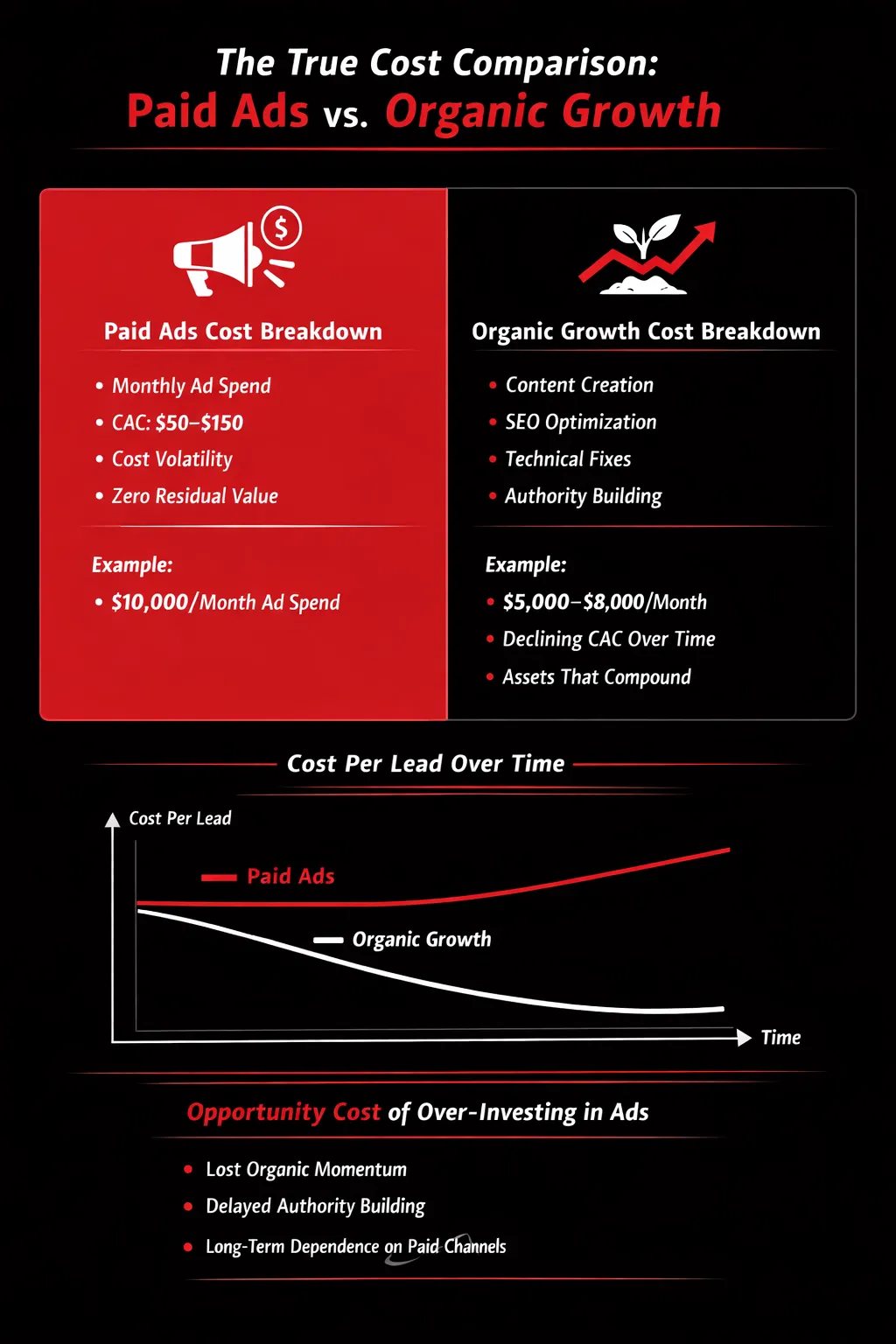
When early-stage startups evaluate growth channels, the most common comparison is speed versus cost. Paid ads appear faster, while organic growth seems slower. But when you break down the true cost over time, the picture changes dramatically. The real difference is not just how much you spend—but what you’re left with after spending.
Paid Ads Cost Breakdown (With Example)
Paid advertising operates on a pay-to-play model. Traffic, leads, and visibility are directly tied to budget. The moment spending stops, results disappear.
Key cost components of paid ads include:
- Monthly ad spend: Google Ads, Meta, LinkedIn, or display networks
- Creative production: Ad copy, visuals, videos, testing variations
- Management costs: In-house marketers, agencies, or tools
- Landing page optimization: CRO tools, testing platforms, developers
Customer Acquisition Cost (CAC) is the defining metric. For most early-stage startups, CAC from paid ads is highly unstable due to limited data, weak brand recognition, and cold audiences.
Example scenario:
- Monthly ad spend: $10,000
- Average CAC range: $50–$150
- Monthly customers acquired: 65–200 (varies significantly)
While paid ads can generate quick traffic, they suffer from cost volatility:
- Rising CPCs as competitors enter the market
- Performance fluctuations due to algorithm changes
- Ad fatigue requiring constant creative refresh
Most importantly, paid ads produce zero residual value. Once the $10,000 is spent, there is no lasting asset—no evergreen traffic, no authority, no compounding benefit. Growth resets every month.
Organic Growth Cost Breakdown
Organic growth operates on an entirely different economic model: build once, benefit repeatedly.
Core investment areas include:
- Content creation: Blogs, landing pages, thought leadership assets
- SEO optimization: On-page optimization, keyword mapping, internal linking
- Technical fixes: Site speed, crawlability, mobile performance
- Authority building: Backlinks, digital PR, topical trust signals
Example scenario:
- Monthly organic investment: $5,000–$8,000
- Initial CAC: Comparable or slightly higher than paid ads
- CAC trend: Declines steadily over time
Unlike paid ads, organic investments create compounding assets:
- Blog posts that rank for years
- Pages that generate leads 24/7
- Authority that lowers future acquisition costs
Each month’s investment builds on the previous one, reducing dependency on continuous spending to maintain results.
Cost Per Lead Over Time (Year 1 vs Year 2)
The biggest difference between paid and organic growth becomes visible when you compare cost per lead over time.
- Paid Ads:
- Year 1: Stable but high CPL
- Year 2: Flat or rising CPL due to competition and saturation
- Organic Growth:
- Year 1: Higher upfront effort, gradual traction
- Year 2: Significantly lower CPL as traffic compounds
A visual comparison chart typically shows:
- Paid ads following a horizontal or upward-sloping cost curve
- Organic growth following a downward-sloping cost curve
This is where organic growth begins to outperform paid ads—not by speed, but by efficiency and scalability.
Opportunity Cost of Over-Investing in Ads
Over-investing in paid ads carries a hidden but significant opportunity cost.
- Lost organic momentum: Delaying SEO means competitors claim search visibility first
- Delayed authority building: Trust and topical relevance take time to develop
- Long-term dependency on paid channels: Rising CAC becomes unavoidable
Startups that rely too heavily on ads often find themselves trapped—forced to keep spending just to maintain growth, with little leverage to reduce costs.
In contrast, startups that invest early in organic growth build a self-sustaining acquisition engine—one that lowers risk, improves margins, and supports long-term scale.
Bottom line: Paid ads rent attention. Organic growth builds equity. For early-stage startups focused on efficiency and durability, the cost math clearly favors organic.
Sustainability: Why Organic Growth Wins the Long Game
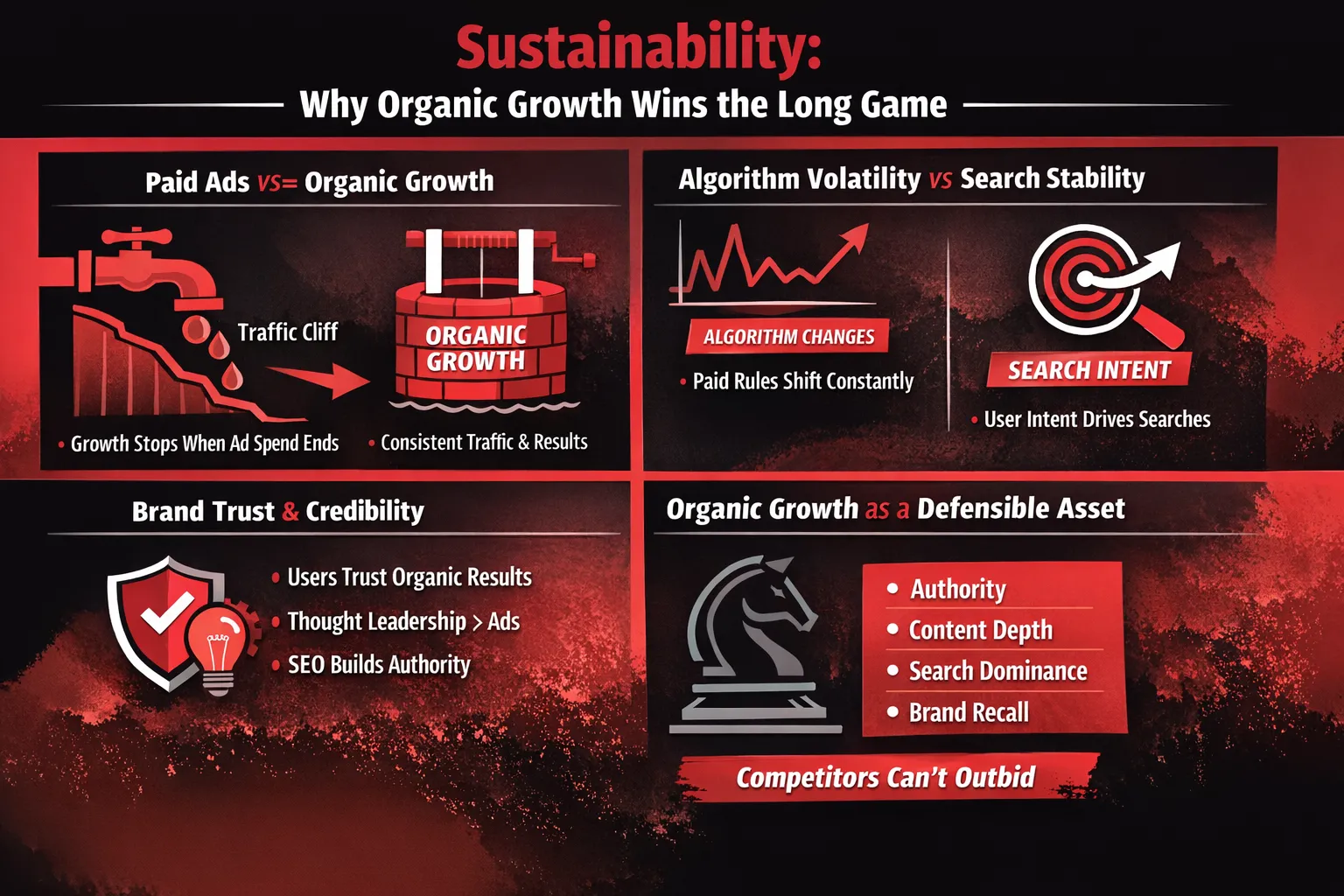
For early-stage startups, growth isn’t just about speed—it’s about staying power. While paid ads can deliver quick visibility, organic growth builds something far more valuable: sustainability. Over time, the difference between the two becomes stark.
Paid Ads Are a Tap — Organic Is a Well
Paid advertising works like a tap. As long as you keep it turned on, traffic flows. The moment you turn it off, the flow stops instantly. For many startups, this creates a dangerous dependency. When budgets tighten, campaigns pause, or CAC rises beyond viability, traffic falls off a cliff—often overnight.
Organic growth, on the other hand, behaves like a well. It takes time to dig, but once established, it continues to deliver value even if active effort is reduced. High-ranking pages, evergreen content, and strong topical authority continue to attract visitors long after they’re published. Instead of a traffic cliff, startups experience traffic retention. This stability is critical for early-stage companies that need consistent inbound leads without constantly increasing spend.
Algorithm Volatility vs Search Intent Stability
Paid platforms are notoriously volatile. Google Ads, Meta, and LinkedIn frequently change bidding models, targeting rules, ad formats, and privacy policies. A campaign that works today can become unprofitable tomorrow—without any change from the startup’s side. Rising competition also drives CPC inflation, forcing startups to pay more for the same visibility.
Organic search operates on a different principle: user intent. People search because they have a problem, a need, or a question. While search algorithms evolve, the intent behind queries remains remarkably stable. Someone searching “best CRM for early-stage startups” is far closer to a buying decision than someone casually scrolling past an ad.
Intent-driven traffic consistently converts better because it aligns with user motivation. Instead of interrupting users, organic growth meets them exactly where they are in their decision journey.
Brand Trust & Credibility
Trust is hard to buy—and ads don’t create it easily. Most users instinctively scroll past paid placements, gravitating toward organic results they perceive as more credible and unbiased. Ranking organically signals expertise, relevance, and authority.
Thought leadership content—blogs, guides, comparisons, and insights—builds trust in a way promotional messaging cannot. Over time, SEO becomes a powerful brand-building channel. Startups that consistently show up with valuable answers begin to own mindshare in their category. This trust compounds, making future conversions easier and less expensive.
Organic Growth as a Defensible Asset
Competitors can always outbid you on ads. They cannot, however, easily replicate what organic growth builds over time: deep authority, comprehensive content ecosystems, search dominance across multiple keywords, and strong brand recall.
Organic growth creates a moat. It’s an asset that appreciates, not an expense that resets every month. For startups thinking beyond short-term wins, sustainability isn’t optional—and organic growth is the foundation that makes it possible.
Long-Term ROI: The Compounding Effect of Organic Growth
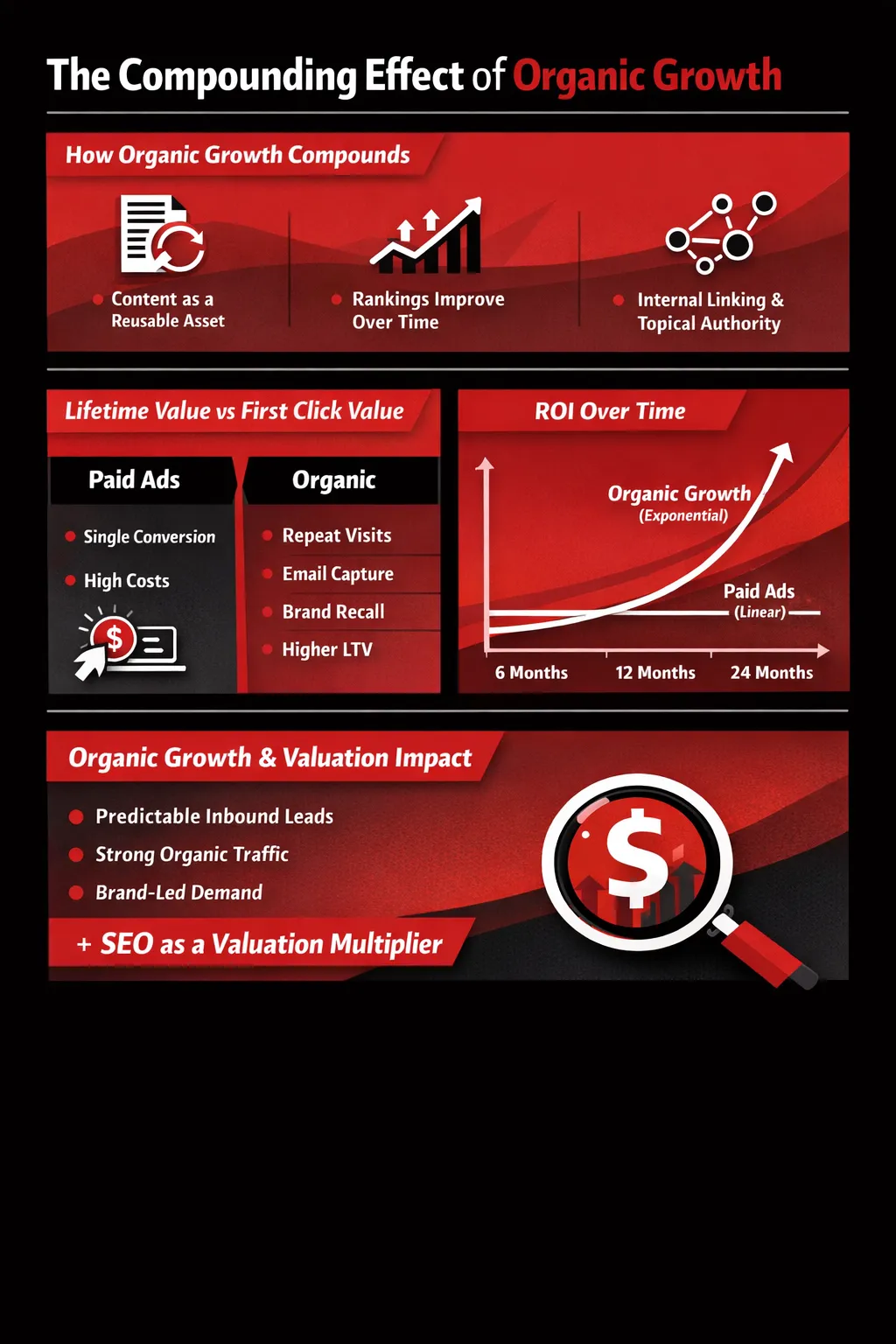
One of the most powerful — yet often underestimated — advantages of organic growth is its ability to compound over time. While paid advertising delivers short-term wins, organic growth builds momentum that strengthens with every passing month. For early-stage startups aiming to maximize ROI under tight budgets, this compounding effect can become a decisive competitive edge.
How Organic Growth Compounds
Organic growth behaves less like a campaign and more like an asset-building system. Every piece of high-quality content published becomes a reusable, long-term asset that can attract traffic, leads, and brand visibility long after its initial launch. Unlike paid ads, which stop delivering value the moment spending stops, organic content continues to work around the clock.
Search rankings also improve over time. As content ages, earns backlinks, and gains engagement signals, its authority increases—often leading to higher rankings and more consistent traffic. This creates a snowball effect where existing pages require less effort to maintain and begin outperforming newer competitors.
Additionally, organic growth benefits from the network effect of internal linking and topical authority. As startups publish content around interconnected themes, search engines recognize them as subject-matter authorities. Internal links distribute ranking power across pages, strengthening the entire website rather than isolated campaigns.
Lifetime Value vs First Click Value
Paid advertising is typically optimized for the first conversion—a click, sign-up, or purchase. Once that action occurs, the relationship often ends unless further ad spend is applied. Organic growth, by contrast, optimizes for lifetime value (LTV).
Organic channels naturally encourage:
- Repeat visits from users returning to consume more content
- Email capture through value-driven resources
- Brand recall, as users repeatedly encounter the brand in search results
- Higher LTV, driven by trust and long-term engagement
Because organic users arrive through intent-based searches, they are more likely to convert multiple times and remain loyal, dramatically increasing ROI over time.
ROI Over 6, 12, and 24 Months
The ROI curve for paid ads is linear: spend more, get more—until costs rise and performance plateaus. Organic growth, however, follows an exponential curve.
- 6 months: Organic traffic begins gaining traction, while paid ads show predictable but limited returns.
- 12 months: Organic content ranks higher, CAC declines, and inbound leads become consistent.
- 24 months: Organic traffic compounds, content dominates search results, and ROI far exceeds initial investment—often without proportional cost increases.
At this stage, organic growth continues delivering returns even if investment slows, unlike paid ads which stop instantly.
Organic Growth and Valuation Impact
Investors increasingly value startups with predictable inbound lead flow, strong organic traffic, and brand-led demand. These signals indicate resilience, market authority, and efficient customer acquisition.
SEO and organic growth act as a valuation multiplier—reducing dependency on paid channels, improving margins, and strengthening long-term scalability. For startups planning future funding rounds or exits, organic growth isn’t just marketing—it’s a strategic business asset.
Why Early-Stage Startups Are Uniquely Positioned for Organic Growth
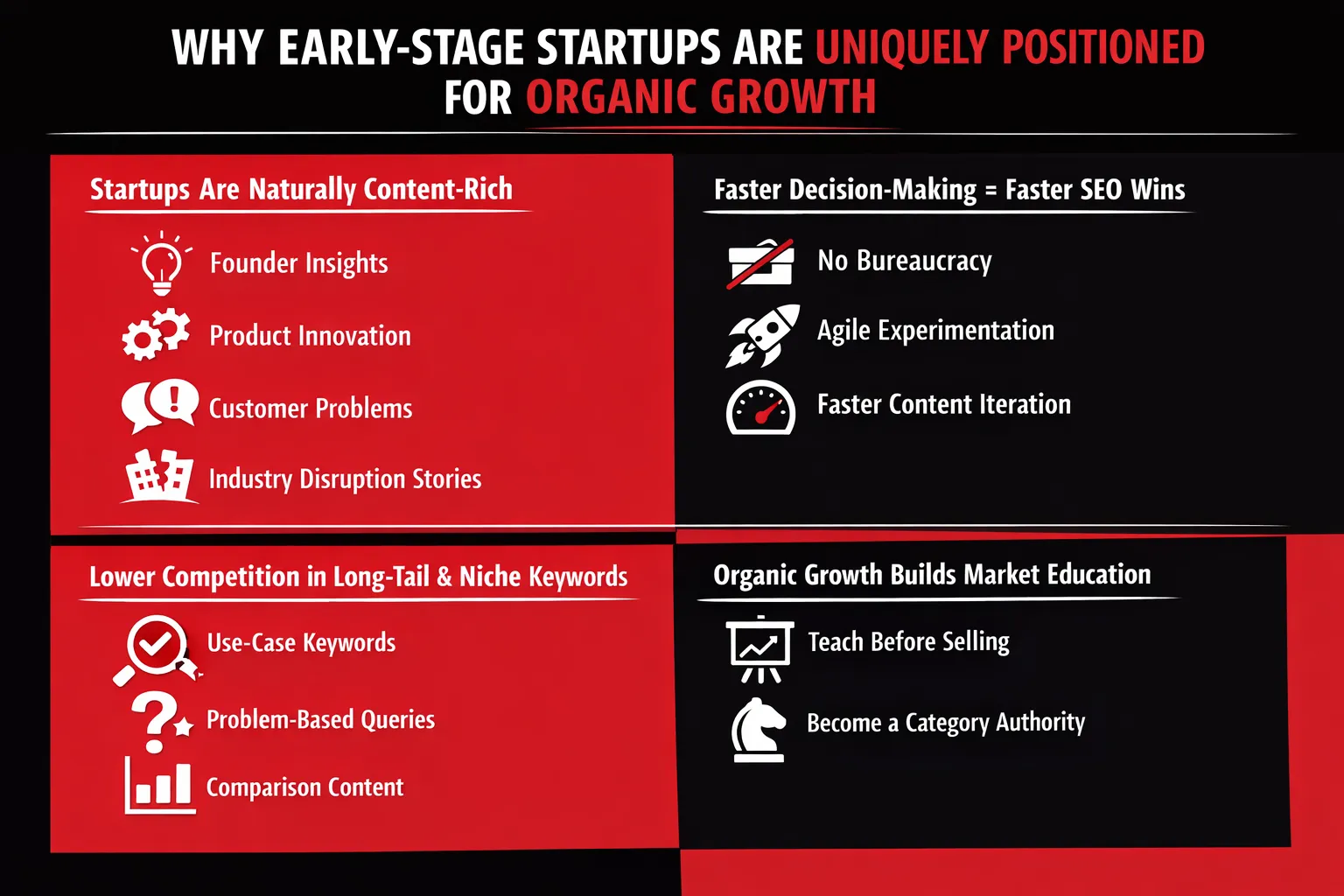
Early-stage startups often assume that organic growth is a long, resource-heavy game best suited for mature companies. In reality, startups are uniquely advantaged when it comes to building organic visibility—often far more than established enterprises. Their agility, proximity to customers, and constant innovation make organic growth not only feasible, but strategically superior.
Startups Are Naturally Content-Rich
Unlike legacy companies that struggle to sound authentic, startups are surrounded by high-impact stories worth telling. Founders carry deep insights into the problem they are solving, the gaps in the market, and the vision behind the product. These founder perspectives translate into thought leadership content that resonates strongly with search intent.
Additionally, early-stage startups are continuously iterating on product innovation. Every new feature, integration, or improvement creates opportunities for product-led content, tutorials, use cases, and announcements. Startups are also closer to real customer problems—often speaking daily with users—making it easier to create content around pain points, objections, and real-world scenarios. Layer in industry disruption stories, and startups naturally possess a rich content engine that fuels sustainable organic growth.
Faster Decision-Making = Faster SEO Wins
One of the biggest advantages startups have over large organizations is speed. Without layers of bureaucracy, content ideas can move from concept to publication quickly. Startups can experiment aggressively—testing keywords, formats, and messaging without lengthy approvals.
This agility allows for faster content iteration. Underperforming pages can be optimized rapidly, while high-performing content can be expanded or replicated. In SEO, momentum matters, and startups that publish, test, and refine faster often see compounding gains long before competitors even react.
Lower Competition in Long-Tail & Niche Keywords
Early-stage startups don’t need to compete for broad, high-cost keywords. Instead, they can dominate long-tail and niche search terms where intent is clearer and competition is lower. These include use-case-specific keywords, problem-based queries, and comparison searches that buyers actively research before making decisions.
By owning these highly targeted queries early, startups attract qualified traffic that converts better than generic paid clicks.
Organic Growth Builds Market Education
Organic growth allows startups to educate the market before selling. By answering questions, addressing doubts, and framing the problem space, startups position themselves as category authorities. This trust-driven approach shortens sales cycles, improves conversion rates, and builds demand that no ad campaign can replicate.
Real-World Startup Scenarios: Paid vs Organic
To understand why organic growth often outpaces paid ads for early-stage startups, it helps to look at how different growth approaches play out in the real world. Below are three common startup scenarios—and the lessons founders can draw from them.
Scenario 1: The Ad-Heavy Startup
This startup raises funding and immediately allocates a large portion of its budget to paid advertising across Google, Meta, or LinkedIn. Traffic spikes quickly, dashboards look promising, and early sign-ups roll in. However, beneath the surface, cracks begin to show.
Customer acquisition costs (CAC) steadily rise as competition increases and ad fatigue sets in. Because the brand is still unknown, retention remains low—users arrive, convert once, and disappear. Each new month requires fresh ad spend just to maintain the same level of traffic.
The real problem becomes evident when budgets tighten or campaigns pause. Traffic drops almost overnight. With no organic presence, no search visibility, and little brand recall, growth flattens. The startup realizes it hasn’t built an asset—only rented attention.
Scenario 2: The Organic-First Startup
In contrast, this startup invests early in organic growth—SEO, content, and authority building. The first few months feel slow. Traffic grows gradually, and results don’t look as flashy as paid campaigns. But something different is happening under the hood.
Each blog post, landing page, and keyword ranking adds to a growing foundation. Search traffic compounds month over month. As content ranks higher, inbound leads become more consistent and predictable. CAC decreases over time because traffic continues to arrive without incremental spend.
By month six to nine, the startup has stable inbound leads, stronger brand trust, and higher-quality users who arrive with intent. Even if marketing spend pauses, organic traffic continues to flow—providing resilience and long-term leverage.
The Hybrid Model Done Right
The most successful startups don’t ignore paid ads—they use them strategically. In a hybrid model, organic growth forms the foundation, while paid campaigns are layered on top.
Paid ads are used for retargeting users who already engaged organically, amplifying high-performing content, and capturing high-intent keywords where immediate visibility matters. Because the brand already has trust and authority, paid campaigns convert better and cost less.
This approach turns paid ads into an accelerator rather than a dependency.
Lessons Learned
The key takeaway is clear: timing matters, but channel sequencing matters even more than channel choice. Startups that build organic foundations first gain sustainable growth, lower CAC, and long-term ROI—while paid ads work best when they support, not replace, organic visibility.
When Paid Ads Do Make Sense (And How to Use Them Smartly)
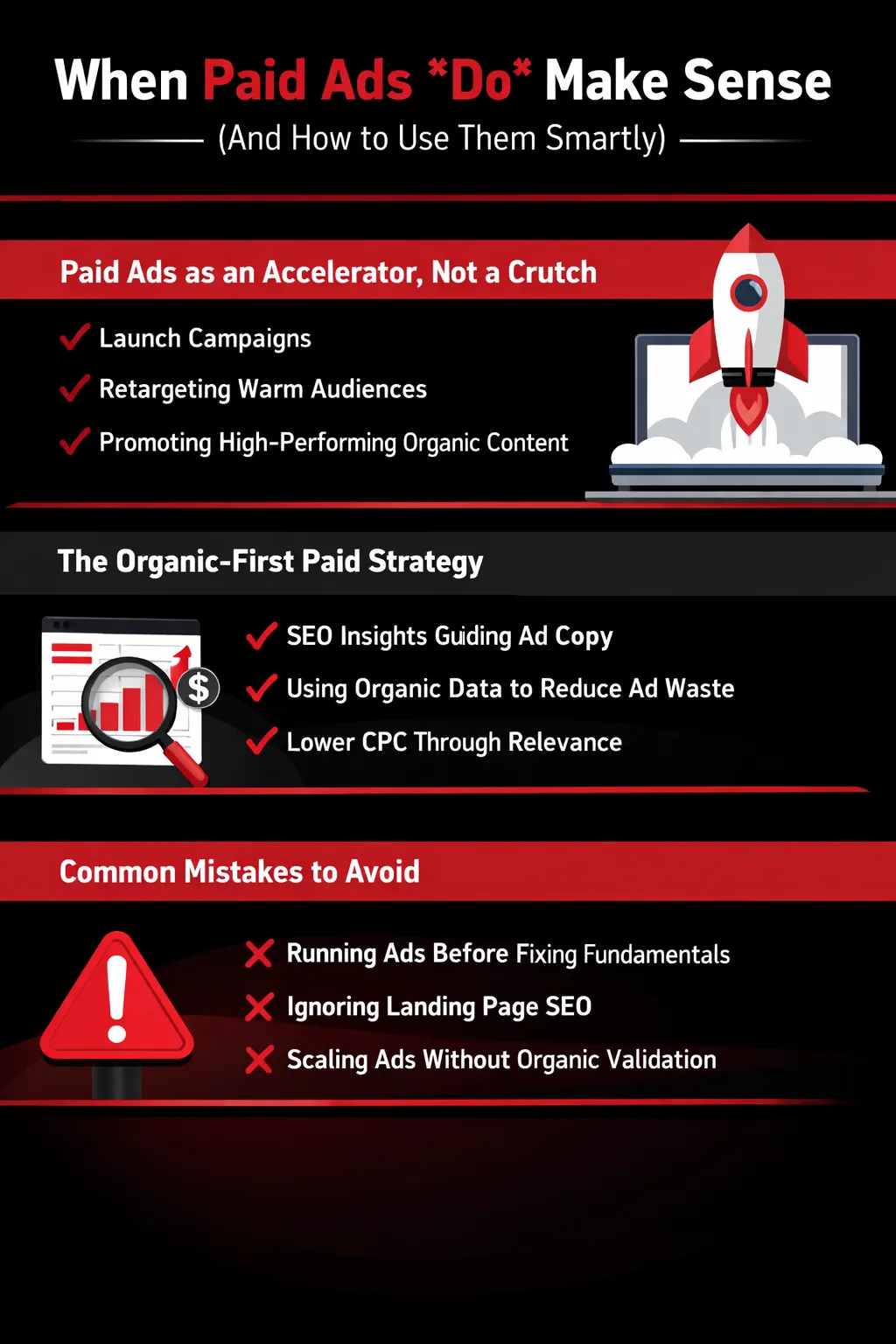
While organic growth offers superior long-term ROI and sustainability, this does not mean paid advertising has no place in an early-stage startup’s growth strategy. The key distinction lies in how paid ads are used. When treated as an accelerator rather than a crutch, paid campaigns can complement organic efforts and unlock faster, more efficient growth.
Paid Ads as an Accelerator, Not a Crutch
Paid ads work best when they amplify momentum that already exists. For example, launch campaigns are a smart use case—ads can generate initial visibility during a product launch, feature release, or market entry while organic channels ramp up.
Another effective application is retargeting warm audiences. Visitors who have already engaged with your website, content, or email list are far more likely to convert than cold traffic. Retargeting ensures your brand stays top-of-mind without inflating acquisition costs.
Paid ads are also highly effective for promoting high-performing organic content. If a blog post, guide, or landing page already converts well organically, amplifying it with ads increases reach while minimizing risk, since the message and intent have already been validated.
The Organic-First Paid Strategy
The smartest startups let organic data guide their paid efforts. SEO insights can shape ad copy, ensuring headlines and messaging align with what users are already searching for and responding to. Keywords that rank well organically often translate into higher Quality Scores in paid search.
By using organic performance data, startups can reduce ad waste—focusing spend only on proven topics, queries, and user intents. This alignment leads to lower CPCs through relevance, better click-through rates, and stronger conversion efficiency.
Common Mistakes to Avoid
Many startups make the mistake of running ads before fixing fundamentals such as product-market fit, messaging clarity, or conversion flow. Others ignore landing page SEO, leading to poor user experience and wasted spend. The biggest risk, however, is scaling ads without organic validation, which locks startups into rising costs without building lasting growth assets.
Used wisely, paid ads can accelerate growth—but only when organic strategy leads the way.
How ThatWare Helps Startups Win with Organic Growth
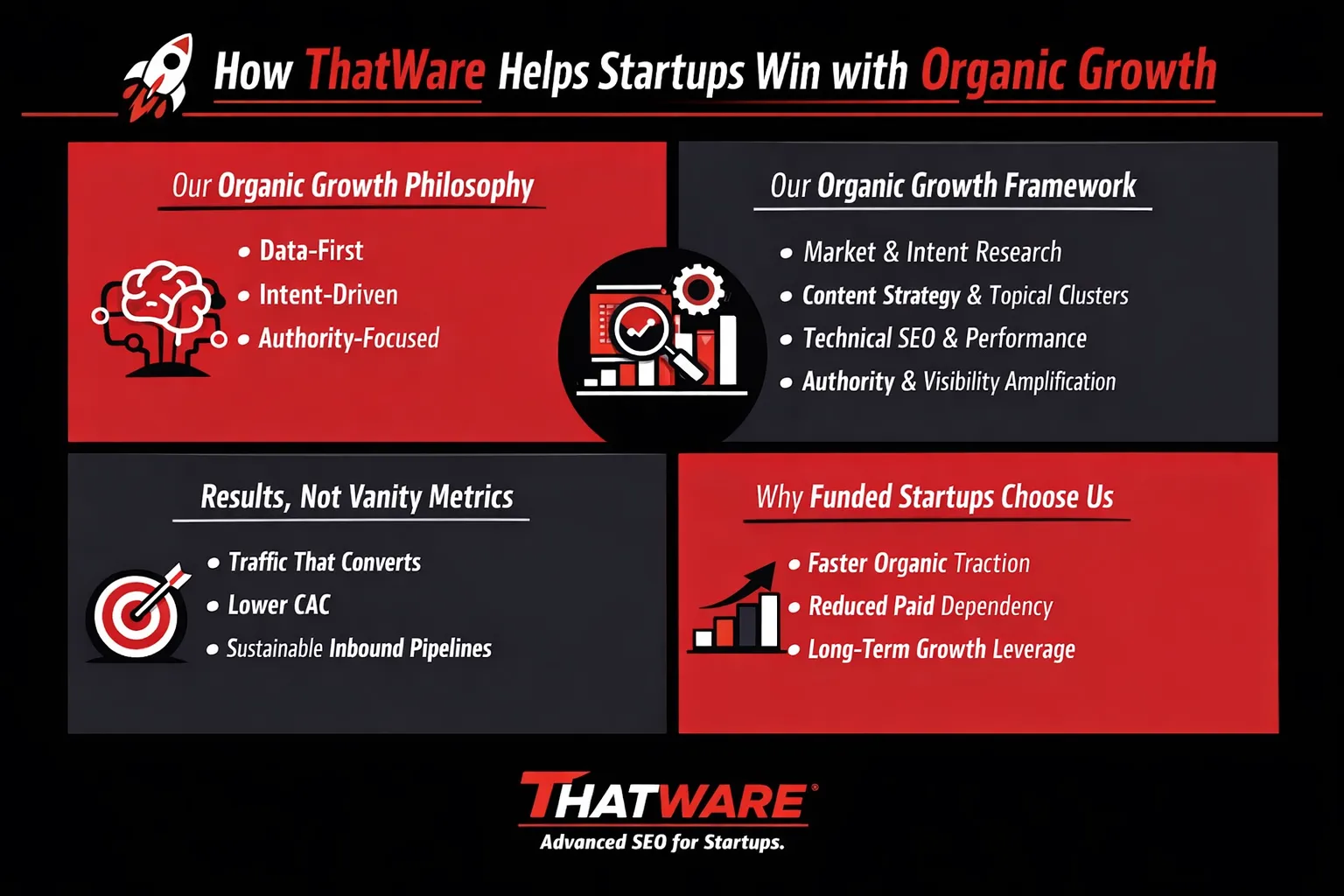
ThatWare works with early-stage and funded startups that want predictable, scalable growth without burning capital on short-lived paid campaigns. Instead of chasing quick spikes, ThatWare focuses on building organic visibility that compounds over time, turning search into a long-term growth engine rather than a temporary traffic source.
The ThatWare Organic Growth Philosophy
At the core of ThatWare’s approach is a data-first, intent-driven, and authority-focused philosophy. Every decision is backed by search data, competitive insights, and user behavior—not assumptions. Rather than targeting vanity keywords with high search volume but low intent, ThatWare prioritizes intent-rich queries that signal readiness to engage, evaluate, or convert.
Authority is treated as a strategic asset. By systematically building topical depth and trust across search engines, ThatWare helps startups position themselves as credible leaders in their niche, not just another website competing for clicks.
The ThatWare Organic Growth Framework
ThatWare follows a structured, execution-driven framework designed for fast-moving startups:
- Market & intent research: Deep analysis of user problems, buying signals, and competitor gaps to uncover high-impact opportunities.
- Content strategy & topical clusters: Creation of interconnected content ecosystems that establish topical authority rather than isolated blog posts.
- Technical SEO & performance: Optimization of site architecture, speed, indexing, and crawlability to remove growth bottlenecks.
- Authority & visibility amplification: Strategic link-building, digital PR, and content promotion to accelerate trust and rankings.
This framework ensures organic growth is systematic, scalable, and measurable.
Results-Focused, Not Vanity Metrics
ThatWare doesn’t optimize for traffic alone. The focus is on traffic that converts, resulting in lower customer acquisition costs (CAC) and sustainable inbound pipelines. Every initiative is tied to business outcomes—leads, sign-ups, demos, and revenue—not just impressions or rankings.
Why Funded Startups Choose Organic with ThatWare
Funded startups choose ThatWare because organic growth delivers faster traction than expected, significantly reduces reliance on paid ads, and creates long-term growth leverage. Instead of paying for every click, they build assets that continue generating value—month after month, even as budgets fluctuate.
Conclusion: The Smarter Growth Choice for Startups
For early-stage startups, growth decisions can define the trajectory of the entire business. While paid ads may offer the comfort of quick wins and immediate visibility, they come with a hidden cost—once the budget stops, so does the growth. Organic growth, on the other hand, is an investment that builds lasting value. It creates assets in the form of content, authority, and trust that continue to generate results long after the initial effort.
The key takeaway is simple but powerful: paid ads burn, organic builds. Organic growth compounds over time, reducing customer acquisition costs, improving conversion quality, and strengthening brand credibility. Most importantly, it delivers sustainability. In an environment where ad costs are rising and competition is intensifying, relying solely on speed can be risky. Sustainable growth consistently outperforms fast but fragile traction.
For founders, this means reframing how growth is measured. Growth is not just about how quickly you can acquire users—it’s about how efficiently you do it, how defensible your position becomes, and how long the impact lasts. Startups that win in the long run focus on building strong foundations rather than chasing short-term spikes.Now is the time to re-evaluate your growth mix. Shift focus toward channels where returns multiply instead of reset every month. Invest in strategies that grow stronger with time. When you build organic visibility early, you don’t just grow faster—you grow smarter, creating momentum that benefits your startup for years to come.