
SUPERCHARGE YOUR ONLINE VISIBILITY! CONTACT US AND LET’S ACHIEVE EXCELLENCE TOGETHER!
What is AROUND Search Operator?
Google offers a powerful yet lesser-known search operator called “AROUND”, designed to locate web pages where two or more words or phrases appear close to each other. This operator allows users to control proximity, helping uncover content where contextual relevance is strong rather than relying on exact phrase matching alone.

In SEO analysis, this approach is valuable because it signals how search engines interpret topical relationships. By using proximity-based searches, we can better understand how content clusters form around competitive terms. As a result, this method helps crawlers recognise that a campaign is performing strongly across a group of closely related keyword modifiers. Consequently, it improves the chances of achieving visibility for high keyword difficulty by reinforcing semantic relevance instead of isolated keyword usage.
The AROUND search operator provides SEO professionals with a practical way to investigate how closely related terms are positioned across high-ranking content. Rather than analysing keywords individually, marketers can examine how primary terms appear alongside supporting concepts, service modifiers and topical entities within the same page. This makes proximity analysis useful for competitor research, content gap identification and semantic keyword mapping, particularly when evaluating pages targeting competitive search queries.
The Google AROUND search operator can also be incorporated into a broader SERP research workflow to identify recurring contextual relationships across competing pages. By testing different proximity ranges and reviewing the resulting URLs, SEO teams can discover patterns in how important concepts are discussed together. These findings can then inform content briefs, landing page optimisation and topical coverage, helping create pages that address the subject comprehensively without relying on repetitive exact-match keyword placement.
How We Use AROUND Search Operator for SEO
First, we identify highly competitive keywords that naturally align with the campaign’s primary focus. These are terms that either strengthen the core topic or help differentiate the campaign from competitors. The goal is to uncover keyword combinations that dominate a specific niche rather than relying on a single phrase.
For example, when analysing an AI-focused niche, we may test a query in the SERP using the following format:
“ai” AROUND(10) “seo company”
This search returns results where both terms appear within close proximity, revealing how top-ranking pages structure their content. It also highlights whether competitors are leveraging contextual relevance instead of simple repetition.
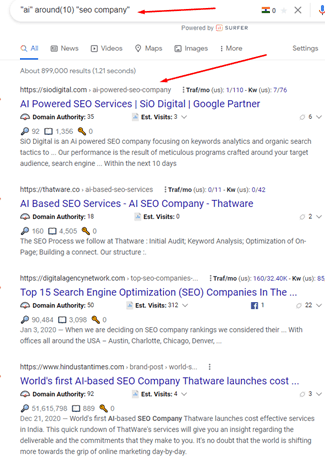
Next, we carefully review the top 10 results while excluding our own listings. This step allows us to evaluate content patterns, keyword placement, and topical depth used by leading competitors. By analysing these insights, we refine content strategies to better align with search intent, strengthen semantic signals, and improve overall ranking potential within competitive keyword clusters.
The most relevant output we get: https://www.webfx.com/best-seo-company.html
In the same way, we add one more parameter with the existing operator by choosing the second priority keyword with Around 20 like this:
“ai” around(10) “seo company” around(20) “Advanced SEO”
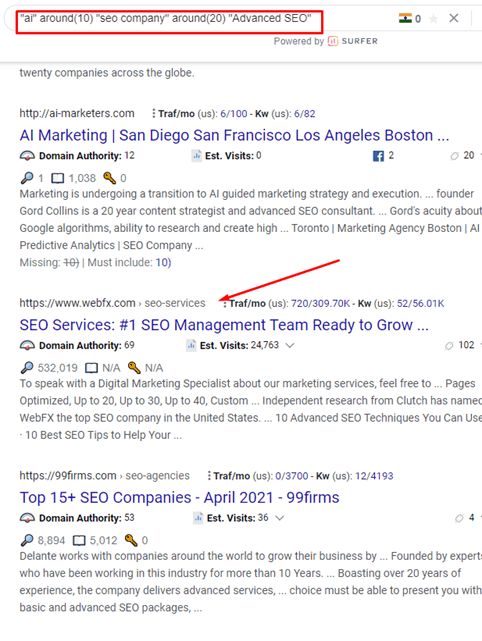
Most relevant Output we get: https://www.webfx.com/seo-services.html
https://www.aaravinfotech.com/digital-marketing-services/seo-services-india/
Again choose third priority keyword Around (30) with the existing one:
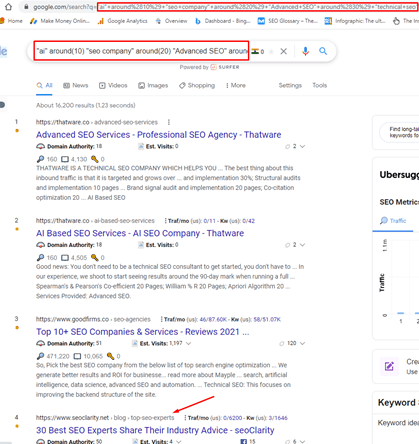
The output we get: https://www.seoclarity.net/blog/top-seo-experts
https://www.aaravinfotech.com/blog/website-maintenance/?page=2
Process to Work on AROUND Search Operator:
Moving forward, compile all the data gathered during the analysis phase and consolidate every output into a single, structured dataset. This step ensures that insights collected from multiple sources are aligned and ready for actionable interpretation. The goal here is to create a unified view of competitive keyword usage and contextual relevance.
Sidenote: Treat all identified websites as competitors. While doing so, ensure duplicate domain entries are removed to avoid skewed analysis. However, if the same domain appears with different URL slugs, consider each slug as a separate competitor. This distinction is important because individual pages may target different keyword clusters or search intents.
Using web tools, extract the BAG OF WORDS from each competitor page. Once collected, aggregate these terms and map them against the total number of competitors identified during the analysis. All extracted data should be compiled into one centralized sheet or dashboard, similar to the example shown below. This consolidated dataset will highlight commonly recurring terms, semantic patterns, and contextual gaps across competing pages.
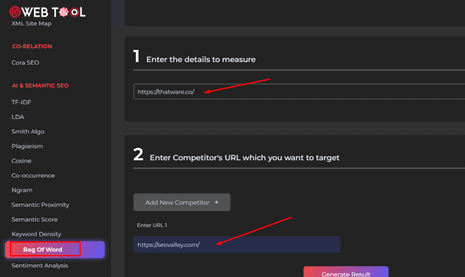
Suggestion:
Based on the final output, it is strongly recommended to include the identified terms at least once within your targeted landing page. These terms reflect search engine expectations derived from competitor relevance and contextual usage. Adding them naturally within the content helps improve topical depth and search visibility.
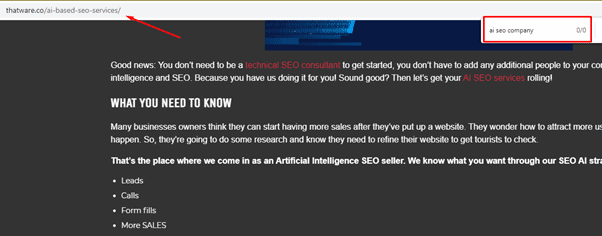
For instance, for https://thatware.co/ai-based-seo-services/ this URL we can put the term at least one time. As there is no such key phrase is present on this webpage.
If a specific key phrase appears frequently across competitor pages but is missing from this URL, it should be strategically inserted at least once. Ensure placement feels organic and aligns with the page’s intent. This approach strengthens semantic alignment without compromising content quality or user experience.
Advantages of Using the AROUND Operator
A. Precision in Search Results:
Explanation:
The AROUND operator empowers users to define how closely specific terms should appear within a document, significantly improving the accuracy of search outcomes. By setting proximity conditions between keywords or phrases, searches become more intentional and focused, reducing ambiguity in results.
Precision in information retrieval:
When users restrict the distance between important terms, they can ensure that the retrieved content directly aligns with their subject of interest. This level of control is especially useful for technical, academic, or analytical research, where the relationship between concepts matters as much as the terms themselves. As a result, users obtain documents that discuss related ideas in a meaningful and connected way.
Minimizing irrelevant content:
Traditional keyword-based searches often return results where terms appear randomly across a document, offering little real value. The AROUND operator addresses this issue by emphasizing proximity, ensuring that the terms are contextually linked. This reduces noise in search results and filters out content that only loosely or coincidentally includes the searched keywords.
B. Enhanced Relevance of Search Queries:
Contextual understanding:
One of the strongest advantages of the AROUND operator is its ability to capture contextual relationships between words. Instead of treating keywords as isolated entities, it evaluates how they appear together within a defined range. This approach leads to results that better reflect the intended meaning behind the query.
Improved understanding of content:
Documents where important terms appear close together often indicate a deeper or more direct discussion of the topic. By identifying such content, users can gain clearer insights and a more accurate understanding of how concepts interact. This is particularly valuable when researching interconnected ideas, theories, or processes.
Facilitating nuanced searches:
For complex subjects or specialized fields, broad searches can be inefficient and overwhelming. The AROUND operator allows users to refine queries to address specific dimensions or nuances of a topic. This makes it easier to locate information that explores particular angles, interpretations, or applications, enhancing the overall quality of research.
C. Time-Saving Benefits for Researchers and Professionals:
Efficient information retrieval:
By narrowing search results to highly relevant documents, the AROUND operator significantly reduces the time spent reviewing unnecessary content. Researchers and professionals can quickly locate materials that directly contribute to their objectives, improving efficiency from the outset.
Streamlined research process:
The ability to surface documents where key ideas are closely connected accelerates the research workflow. Users can spend less time searching and more time analyzing, comparing, and synthesizing information, which leads to more informed decision-making.
Increased productivity:
With fewer irrelevant results to manage, users can allocate their time and cognitive resources more effectively. This improved focus enhances productivity, supports timely project completion, and helps professionals achieve research or business goals with greater confidence and accuracy.
These advantages highlight the value of the AROUND operator in improving the effectiveness and efficiency of search queries, ultimately benefiting users across various fields and disciplines.
Practical Applications of the AROUND Operator
The AROUND operator becomes considerably more useful when it is treated as a research and analysis mechanism rather than simply another way to refine a Google query. Its primary value lies in revealing how terms, entities, concepts, and themes occur in relation to one another across indexed content. For SEO teams, researchers, marketers, and competitive intelligence professionals, this provides an additional layer of context that conventional keyword searches may not reveal.
The Google AROUND operator can be applied across several research scenarios, from academic literature analysis and market intelligence to competitor research and content optimisation. When combined with other Google search operators, it can help create highly specific search queries for investigating relationships between concepts, identifying relevant pages, and analysing how competing websites discuss important topics.
A. Research Purposes
1. Academic Research
a. Refining literature reviews
Academic research often requires analysing a large volume of papers, journals, reports, and other scholarly resources. A standard keyword search may return documents simply because the searched terms appear somewhere on the page, without necessarily indicating that the concepts are discussed together.
The AROUND(X) search operator provides a way to investigate this relationship more closely. For example, a researcher studying the relationship between artificial intelligence and healthcare could experiment with a query such as:
“artificial intelligence” AROUND(10) “healthcare”
The results can then be reviewed to determine whether the two concepts are being discussed within a closely connected context. Researchers can adjust the proximity value depending on the scope of the investigation. A smaller value may be useful when looking for tightly connected terminology, while a larger value can uncover broader contextual relationships.
This does not replace academic databases or systematic literature-review methods. Instead, it can supplement them by helping researchers discover terminology, related discussions, and potentially relevant sources that deserve further investigation.
b. Identifying interdisciplinary relationships
Many contemporary subjects overlap multiple disciplines. Artificial intelligence, for example, intersects with healthcare, finance, education, cybersecurity, law, and social sciences.
Researchers can use the Google AROUND operator to investigate whether concepts from different fields appear together within indexed content. Queries combining terms from separate disciplines can help reveal recurring relationships and identify areas that may warrant deeper research.
For instance, searches connecting terms such as “machine learning” and “medical diagnosis” can provide an initial view of how closely those concepts are discussed across available web content. The resulting material can then be assessed for relevance, source quality, publication date, and research credibility.
2. Market Research
a. Identifying consumer preferences and pain points
Market researchers can use proximity searches to investigate how products, features, brands, and customer sentiment are discussed together. A query such as:
“product feature” AROUND(10) “complaint”
can help locate pages where the concepts occur in close proximity.
Similarly, researchers can test terms such as “customer experience”, “quality”, “delivery”, “pricing”, “support”, or “performance” against a brand or product name. This can help identify recurring themes within reviews, discussions, articles, and other indexed material.
The results should be interpreted as qualitative research signals rather than as a direct measure of consumer sentiment. Researchers should validate important findings against primary research, structured surveys, review datasets, and other reliable sources.
b. Tracking emerging industry terminology
Industry language changes continuously. New technologies, product categories, regulations, and consumer expectations often generate new combinations of terms before they become established within mainstream content.
The AROUND(X) search operator can help researchers investigate these relationships. By placing an emerging term near an established industry concept, analysts can examine where and how the two are being discussed together.
For example, an analyst researching an emerging technology could combine the technology name with terms such as “adoption”, “enterprise”, “investment”, “regulation”, or “implementation”. Comparing results across different proximity values can provide additional context for understanding the way an industry is discussing the subject.
B. Competitive Analysis
1. Analysing Competitor Positioning
Competitive research becomes more useful when it moves beyond identifying whether a competitor mentions a particular keyword. The more important question is often how that keyword is discussed and which concepts appear alongside it.
The Google AROUND operator can be used to investigate relationships between competitor names and strategic terms such as “pricing”, “technology”, “partnership”, “enterprise”, “security”, “innovation”, or “expansion”.
For example:
“Competitor Name” AROUND(15) “enterprise”
This can help surface indexed pages where the competitor and the selected concept occur relatively close together. Analysts can then review the pages manually to understand whether the relationship represents a product announcement, partnership, editorial mention, customer discussion, or another form of coverage.
2. Monitoring brand reputation
The same approach can be applied to reputation research. Queries combining a brand name with terms such as “complaint”, “review”, “issue”, “support”, or “customer experience” can help identify relevant discussions.
This approach is particularly useful when used as part of a broader monitoring system. Rather than assuming that every result represents a genuine reputation issue, analysts should inspect the surrounding content and classify the source, context, sentiment, date, and relevance.
C. Content Optimisation for SEO
1. Identifying Keyword and Topic Relationships
For SEO professionals, one of the most practical applications of the AROUND operator is competitive content research.
Suppose a landing page targets a primary topic such as AI-based SEO services. An SEO team can investigate how related terms occur around that topic across competing pages. Searches can combine the primary term with secondary concepts such as “generative search”, “semantic SEO”, “entity”, “AI search”, or “content optimisation”.
The purpose is not to force every discovered phrase into a page. Instead, the results can provide clues about the terminology and concepts commonly associated with the subject.
This distinction is important. Google search operators are useful for discovering and analysing content, but using an AROUND query does not mean that Google requires those exact word distances on a webpage.
2. Discovering Content Gaps
AROUND-based research can become particularly valuable when combined with competitor analysis and a structured content-gap workflow.
An SEO team can:
- Identify priority keywords.
- Run multiple AROUND queries using different proximity values.
- Collect relevant competing URLs.
- Extract important terminology and entities from those pages.
- Group related terms by topic.
- Compare the resulting terms against the target page.
- Identify meaningful contextual gaps.
- Add genuinely relevant concepts where they improve the page.
This creates a more evidence-led approach to content optimisation. Instead of adding keywords simply because they appear frequently, teams can evaluate whether a missing concept is genuinely relevant to the page’s search intent.
3. Improving Topical Coverage
Topical coverage is broader than keyword frequency. A page addressing a complex subject may need to explain associated processes, entities, use cases, technologies, risks, applications, and terminology.
The Google AROUND operator can assist with discovering these relationships by showing where concepts occur together across indexed pages. SEO professionals can use these observations to develop richer content briefs and identify areas that competing pages address extensively.
However, proximity research should support editorial judgement rather than replace it. Content should remain useful, coherent, accurate, and written for the intended audience.
D. Enhancing SERP Research
AROUND searches can also strengthen SERP investigation by allowing SEO professionals to examine specific relationships within search results rather than relying exclusively on broad keyword queries.
For example, an analyst can begin with:
“AI” AROUND(10) “SEO”
and then progressively test broader or narrower proximity values. Additional Google search operators, such as site:, intitle:, and inurl:, can be incorporated when the research requires a specific domain, title structure, or URL pattern.
The resulting information can be used to investigate competitor content, discover terminology, validate research hypotheses, and develop content strategies. It should not, however, be interpreted as direct evidence that Google uses a particular AROUND distance as a ranking requirement.
E. Building an AROUND-Based SEO Workflow
The strongest application of the AROUND operator comes from integrating it into a repeatable research process. SEO teams can maintain a library of queries based on priority topics, competitors, entities, product categories, and search intents. Each query can be tested using different proximity values, with relevant URLs recorded alongside the terms and contextual relationships discovered.
Over time, this creates a structured dataset for competitor analysis and content planning. Teams can compare recurring terminology across pages, identify under-covered concepts, and determine which topics deserve greater editorial attention.
Used in this way, the AROUND(X) search operator becomes more than a search shortcut. It becomes a practical research technique for examining contextual relationships across indexed content. When combined with human analysis, content auditing, entity research, and other Google search operators, it can contribute valuable evidence to a broader SEO research and content optimisation workflow.
AROUND Search Operator for Competitive Analysis
The AROUND search operator is a powerful asset for businesses aiming to conduct competitive analysis with greater accuracy and context. By refining search results based on how closely keywords appear together, this operator helps uncover meaningful patterns in competitor messaging, strategic focus, and market positioning. It allows marketers and analysts to move beyond surface-level insights and dig into how competitors communicate, collaborate, and are perceived online. This section explains how to apply the AROUND operator effectively for competitive research, supported by clear examples and practical guidance.
1. Tracking Competitor Strategies Using AROUND
Gaining visibility into a competitor’s digital footprint is essential for shaping informed business decisions. The AROUND operator enables you to analyze how competitors describe their offerings, engage with partners, and interact with customers. It also helps highlight emerging trends and shifts in their strategy. Below is a step-by-step approach to using AROUND for detailed competitor analysis.
Step 1: Identify Competitor Keywords and Phrases
Begin by identifying the core keywords linked to your competitors and their industry focus. These may include product features, service benefits, or sustainability claims. For example, a competitor in the organic skincare space may frequently be associated with terms such as “organic products,” “plant-based formulas,” or “eco-friendly packaging.”
Step 2: Combine Competitor Names with Strategic Keywords
Next, pair the competitor’s brand name with selected keywords using the AROUND operator. This approach surfaces content where those terms appear within close proximity, ensuring relevance and context. The resulting search results may include blog posts, media coverage, reviews, or expert opinions that discuss the competitor alongside specific attributes or offerings.
Step 3: Analyze Partnerships and Collaborations
To uncover partnerships or joint initiatives, incorporate terms such as “partner,” “collaboration,” “launch,” or “event” into your AROUND searches. This technique can reveal strategic alliances, influencer tie-ups, sponsorships, or co-branded campaigns that may not be immediately visible through standard searches.
Step 4: Explore Customer Feedback and Reviews
Customer perception plays a vital role in competitive positioning. By combining a competitor’s name with words like “review,” “feedback,” or “testimonial,” you can identify discussions that reflect real user experiences. This insight helps pinpoint strengths, recurring complaints, and potential gaps in their offerings.
Pro Tip:
Maintain a structured list of recurring AROUND search queries customized for each competitor. Revisiting and updating these queries regularly allows you to monitor strategic changes, campaign shifts, and evolving customer sentiment over time.
2. Benchmarking Performance Using AROUND
Benchmarking your business performance against competitors is crucial for identifying gaps and opportunities in your strategy. The AROUND operator allows you to track how competitors are discussed in the digital space and compare it to your own brand’s presence.
Content Marketing Performance
To evaluate content marketing efforts, search for keyword combinations related to industry-specific trends and insights.
This query helps uncover blogs or articles discussing your competitor’s approach to content marketing, which you can compare to your own strategy.
Social Media Presence
Track mentions of competitors on specific platforms by combining their name with the platform’s name and relevant keywords.
This highlights your competitor’s campaigns on Instagram, providing inspiration or insight into their tactics.
Product Comparisons
Search for comparisons between your brand and competitors by including keywords like “vs,” “compare,” or “alternative.”
This search retrieves content where your brand is compared with competitors, helping you identify strengths and weaknesses in the eyes of consumers.
Pro Tip:
Use benchmarking insights to create actionable goals. For example, if a competitor is frequently mentioned alongside industry awards, consider refining your own application process for similar recognition.
3. Proactive Brand Reputation Management Using AROUND
Brand reputation is one of the most critical aspects of running a business, and the AROUND operator is a powerful tool for monitoring how your brand is perceived in real-time.
Tracking Negative Mentions
Combine your brand name with keywords that indicate negative sentiment, such as “complaint,” “issue,” or “problem.”
This query highlights areas where customers are dissatisfied, allowing you to address issues proactively.
Monitoring Competitor Mentions for Reputation Insights
Similarly, track negative sentiment about competitors to identify gaps in their service or product offerings.
This can reveal opportunities to position your brand as a better alternative.
Staying Alert for Industry Trends
Use AROUND to monitor emerging trends that could impact your brand.
This helps track how your brand is perceived in relation to industry trends like sustainability, ensuring you stay aligned with consumer expectations.
Collaborations and Mentions by Influencers
Search for mentions of your brand by influencers or thought leaders by combining your name with terms like “influencer” or “collaboration.”
This allows you to identify and amplify positive mentions, enhancing your brand’s reputation.
Pro Tip:
Set up alerts or schedule regular searches using the AROUND operator to ensure you never miss critical mentions of your brand or competitors. Tools like Google Alerts or SEMrush can complement this process.
The AROUND operator is a versatile and powerful tool for competitive analysis. By using it to track competitor strategies, benchmark performance, and manage your brand reputation, you can gain actionable insights that drive growth and give you a competitive edge in your industry. Regularly refining your AROUND searches and integrating them into your workflow ensures that your business stays ahead of the curve.
Pro Tips for Using the AROUND Operator
The AROUND operator in Google search is an invaluable tool for narrowing down search results and identifying content that aligns closely with your research or marketing needs. However, mastering its use requires a thoughtful approach. Below are some practical tips, strategies, and techniques to help you maximize its potential for SEO and research purposes.
1. How to Choose Appropriate Proximity Values (e.g., 10, 20, 30)
The proximity value you assign in the AROUND operator determines how close the specified keywords need to be to one another within the text. Choosing the right value is critical, as it impacts the relevance and depth of the search results. Here’s how to do it effectively:
- Proximity Value 10 (AROUND(10)):
This is ideal for searches where keywords must be tightly related or part of the same phrase. Use lower proximity values when targeting precise, specific information such as key phrases or tightly coupled concepts. - Proximity Value 20 (AROUND(20)):
This value works well for slightly broader connections. This range is ideal when researching broader thematic connections or trends across content. - Proximity Value 30 (AROUND(30)):
A higher value like 30 allows for more flexibility in the keyword placement. This is useful for exploring topics where related keywords might appear in distinct sections of a document but are still contextually connected.
Pro Tip:
Start with a smaller value like 10, and gradually increase it if the search results are too narrow or irrelevant. This iterative approach ensures that your search results align with your specific needs.
2. Common Mistakes to Avoid When Using AROUND
While the AROUND operator is powerful, misusing it can lead to irrelevant results or wasted effort. Avoid these common pitfalls:
- Using Inappropriate Proximity Values:
Choosing proximity values that are too large (e.g., AROUND(50) or more) can dilute the relevance of your results. Conversely, values that are too small may exclude valuable content where the keywords are related but not adjacent. - Overloading the Query with Keywords:
Combining too many terms in a single search can confuse the algorithm and generate cluttered results. Focus on one or two critical keyword pairs for clarity. - Ignoring Keyword Order:
Remember that AROUND does not account for the logical sequence of terms. Ensure your query structure matches your intent. - Failing to Test and Refine Queries:
Many users run a single query and move on without analyzing or iterating. Experiment with proximity values and combinations to fine-tune your results.
Pro Tip:
Save your most effective queries for reuse in SEO audits or research tasks by storing them in a tool or document for future reference.
3. Advanced Combinations with Other Operators for Deeper Analysis
To unlock the full potential of the AROUND operator, pair it with other advanced Google search operators for comprehensive insights:
- Using AROUND with the “site:” Operator:
If you’re analyzing content from a specific website, combine AROUND with the site: operator. - Pairing AROUND with “intitle:” and “inurl:” Operators:
For keyword-specific page titles or URLs, combine AROUND with intitle: or inurl:. - Integrating AROUND with Quotation Marks:
To target exact matches with proximity rules, use quotation marks. - Combining AROUND with Boolean Operators (AND, OR):
Use Boolean operators to expand the scope of your search.
Pro Tip:
Advanced combinations are especially useful for competitor analysis and content gap identification, enabling you to uncover patterns in keyword usage.
4. Tools and Platforms for Integrating AROUND in Your Workflow
Although the AROUND operator is a manual search tool, integrating it into your workflow alongside other tools can make your efforts more efficient and scalable:
- Google Search Console:
Use AROUND in tandem with keyword data from Google Search Console. Analyze the proximity of keywords that drive organic traffic and adjust your content accordingly. - SEMrush or Ahrefs:
While these platforms don’t directly support AROUND, you can use the operator to discover keyword relationships manually and then input those insights into these tools for deeper analysis. - Custom Web Scrapers or Scripts:
For advanced users, develop custom scripts to automate AROUND searches across multiple domains. Python libraries like BeautifulSoup or Scrapy can be helpful for extracting and analyzing search results. - Content Optimization Platforms:
Platforms like Clearscope and SurferSEO can complement AROUND by providing contextually relevant keyword suggestions. Use the operator to identify keyword relationships and then refine them using these tools. - Collaborative Tools:
Tools like Notion or Google Sheets can help you organize AROUND-based search queries and results, enabling collaboration across SEO teams.
Pro Tip:
Document the results of your AROUND searches in a structured format for long-term reference, such as competitor keyword insights or thematic trends.
Future Trends and Updates for Google’s AROUND Operator
As Google continues to enhance its search ecosystem, the AROUND operator is expected to advance alongside broader algorithmic improvements. With search engines increasingly prioritising relevance, intent, and contextual accuracy, proximity-based operators like AROUND will likely play a more refined role in shaping search results. For SEO professionals, staying informed about these future developments is essential to maximise the operator’s potential and maintain a competitive edge. Below are several key trends and updates expected to influence how the AROUND operator functions in the years ahead.
1. Evolving Algorithms and Their Impact on AROUND
Google’s algorithms are in a constant state of evolution, designed to deliver search results that are more accurate, meaningful, and aligned with user intent. Algorithmic milestones such as BERT, RankBrain, and subsequent natural language processing upgrades have shifted the focus away from rigid keyword matching toward deeper contextual understanding. Within this evolving framework, the AROUND operator is likely to become more intelligent and context-aware.
Rather than simply measuring the physical distance between words, future iterations of the AROUND operator may analyse how terms interact within a broader semantic structure. This would allow Google to interpret not just proximity, but relevance within paragraphs, headings, or thematic sections of content. As a result, proximity searches could become more nuanced, prioritising meaningful associations rather than literal word placement.
Additionally, future algorithm updates may introduce adaptive proximity parameters. Instead of relying solely on fixed numerical distances, the AROUND operator could dynamically adjust based on content type, topic complexity, or user behaviour patterns. For SEO professionals, this evolution means adopting a more strategic approach to content creation, where keyword placement is guided by intent, flow, and contextual alignment rather than mechanical spacing. Those who proactively adjust their optimisation techniques will be better positioned to maintain precision and relevance in search results.
2. AI Integration for Enhanced Proximity Analysis
Artificial intelligence is already a cornerstone of Google’s search infrastructure, and its influence on proximity-based tools like the AROUND operator is expected to grow substantially. AI and machine learning technologies have the capacity to analyse not only how close keywords appear to one another, but also how closely they are connected in meaning. This semantic layer adds depth to proximity analysis, enabling search engines to recognise relationships between concepts even when keywords are separated by larger sections of text.
For example, AI-driven proximity analysis could determine that two terms are strongly related within a topic cluster, even if they are positioned in different sentences or paragraphs. This capability would lead to more intelligent matching and significantly improve the quality of search results. Users would benefit from content that aligns more closely with their intent, while SEO professionals gain greater insight into how content is interpreted algorithmically.
Moreover, AI integration can help identify large-scale patterns in keyword proximity across industries and competitors. By analysing vast datasets, AI-powered tools could reveal how top-performing pages structure related terms, offering actionable insights for optimisation. When combined with the AROUND operator, these insights allow SEO professionals to refine content strategies, improve topical authority, and uncover hidden opportunities within competitive niches.
3. Predictions for SEO Professionals Leveraging AROUND
Looking ahead, the AROUND operator is likely to become an increasingly valuable asset for SEO professionals seeking precision and strategic depth. As search engines continue to emphasise relevance and contextual accuracy, proximity-based searches will play a greater role in shaping how content is evaluated and ranked. The AROUND operator can help professionals fine-tune their research, identify meaningful keyword relationships, and build content that aligns closely with search intent.
SEO specialists will also need to integrate AROUND with advanced optimisation techniques such as entity-based search, semantic clustering, and intent mapping. This holistic approach will enable deeper competitive analysis and more informed decision-making. As AI-driven tools become more accessible, SEO professionals will gain sophisticated methods for analysing how competitors position keywords and structure content, allowing them to identify gaps and opportunities more effectively.
Ultimately, those who master the strategic use of AROUND alongside emerging technologies will be better equipped to deliver high-quality, user-focused content that performs well in increasingly competitive SERPs.
Advanced Google Search Operators and Google Proximity Search
Once the basic use of AROUND is understood, the next step is to combine proximity-based queries with other search modifiers to create more controlled research workflows. Advanced Google search operators allow SEO professionals to narrow results by domain, page title, URL structure, exact wording, or specific combinations of terms. When these operators are used alongside proximity searches, they can provide a more targeted way to investigate competitor pages, content relationships, brand mentions, and topical patterns.
A Google proximity search is particularly useful when the objective is to determine whether two concepts are being discussed together rather than simply appearing somewhere on the same page. This distinction matters in competitive content research because a page may contain dozens of relevant terms without establishing a meaningful relationship between them. A proximity query provides an additional filter for examining whether selected terms occur within a defined distance.
1. Understanding the Proximity Search Operator
A proximity search operator is used to find instances where specified words or phrases occur relatively close to one another. In Google’s AROUND syntax, the number inside the parentheses determines the approximate proximity condition being requested.
For example:
“AI SEO” AROUND(10) “generative search”
This query can be used to investigate pages where the concepts are discussed in relatively close proximity. Changing the value provides a way to broaden or narrow the research:
“AI SEO” AROUND(5) “generative search”
“AI SEO” AROUND(10) “generative search”
“AI SEO” AROUND(20) “generative search”
The results from each query can then be compared. A smaller value is useful when looking for tightly connected discussions, while a larger value can help uncover broader contextual associations.
It is important to treat the number as a search-research parameter rather than an SEO ranking threshold. The purpose is to investigate indexed content and identify patterns, not to assume that a particular word distance represents a Google ranking requirement.
2. Google AROUND(X) for Multi-Term Research
Google AROUND(X) becomes more interesting when several concepts need to be investigated within the same search. Instead of analysing a single keyword pair, SEO professionals can progressively introduce additional terms to explore a broader topical relationship.
For example:
“AI” AROUND(10) “SEO” AROUND(20) “content”
A query such as this can help identify pages where the three concepts occur within the proximity conditions specified in the search. The resulting URLs can then be manually reviewed to determine whether the terms represent a genuine topic relationship or merely happen to occur close together.
This technique can be extended to competitor research. Consider a company operating in the enterprise SEO sector:
“enterprise SEO” AROUND(15) “AI” AROUND(20) “automation”
The resulting pages can be analysed to determine how enterprise SEO, artificial intelligence, and automation are discussed together across the indexed web.
For a larger research project, each query should be documented with its proximity value, search date, resulting URLs, page type, and relevant observations. This creates a repeatable research dataset instead of relying on isolated Google searches.
3. Combining AROUND with Site-Specific Research
One of the most useful applications of advanced Google search operators is restricting a proximity query to a particular website.
For example:
site:example.com “AI” AROUND(10) “SEO”
This allows an analyst to investigate how a specific website discusses two related concepts. It can be useful when auditing a competitor’s content architecture or examining whether particular terminology appears in relevant sections of its website.
An SEO team can also compare several competing domains individually:
site:competitor1.com “AI” AROUND(10) “SEO”
site:competitor2.com “AI” AROUND(10) “SEO”
site:competitor3.com “AI” AROUND(10) “SEO”
The resulting pages can then be assessed for terminology, content depth, entities, supporting topics, and page intent.
This approach is especially useful for identifying whether a concept is consistently associated with a competitor’s primary service pages, informational articles, case studies, or other content types.
4. Using AROUND with intitle: and inurl:
Search operators can also be used to investigate where particular concepts appear within a website’s information architecture.
For example:
intitle:”AI SEO” “generative search”
can be used to investigate pages whose titles are closely aligned with the selected subject.
Similarly:
inurl:seo “AI” AROUND(10) “automation”
can help narrow the research to URLs containing an SEO-related path while investigating the relationship between AI and automation within indexed content.
These combinations should be treated as discovery mechanisms. A page appearing in the results does not automatically mean that its content provides a strong topical association. Manual review remains necessary to determine why the terms appear together and whether the page is genuinely relevant.
5. How to Use AROUND Search Operator for Entity Research
A useful extension of proximity research is analysing relationships between entities. SEO professionals can investigate whether a company, product, technology, organisation, or industry concept is repeatedly discussed alongside another entity.
For example:
“ThatWare” AROUND(15) “AI SEO”
can be used to locate indexed content where the brand and service concept occur within the selected proximity range.
The same methodology can be applied to competitors, products, publications, technologies, or industry terms. The objective is not simply to count mentions. Instead, researchers can classify the context surrounding each occurrence.
A practical classification framework could include:
| Research element | What to examine |
| Entity | Brand, company, product, person, technology or organisation |
| Associated term | Keyword or concept appearing nearby |
| Proximity | AROUND value used in the query |
| Page type | Service page, blog, news article, review, directory or other |
| Context | Product, service, partnership, comparison, review or editorial |
| Relevance | Direct, indirect or incidental |
| Content opportunity | Potential topic or contextual gap |
This transforms a basic Google proximity search into a structured entity research exercise.
6. Building a Proximity Search Matrix
For large-scale SEO research, individual searches can be organised into a proximity matrix. Instead of running random queries, teams can establish predefined combinations around a primary topic.
For example, an AI SEO campaign could use:
“AI SEO” AROUND(10) “generative search”
“AI SEO” AROUND(10) “semantic SEO”
“AI SEO” AROUND(15) “entity SEO”
“AI SEO” AROUND(20) “AI search”
“AI SEO” AROUND(20) “content optimisation”
The resulting pages can be collected and analysed for recurring terms and entities. If the same concepts repeatedly appear across relevant competitor pages, they may deserve further examination during content planning.
The important point is that frequency alone should not determine whether a term is added to a page. An SEO professional should consider search intent, subject relevance, audience expectations, factual accuracy, and whether the concept genuinely contributes to the page.
7. Using Proximity Research to Validate Content Relationships
A Google proximity search can also be used after a content strategy has been developed. Suppose a landing page is designed around AI SEO, semantic search, and generative search. Rather than simply checking whether each phrase appears somewhere on competing pages, an analyst can investigate how these concepts are connected.
For example:
“semantic SEO” AROUND(15) “entity”
“generative search” AROUND(15) “AI SEO”
“AI search” AROUND(20) “content optimisation”
The objective is to understand contextual relationships that may help shape headings, supporting sections, internal linking structures, and content briefs.
This creates a more sophisticated workflow than conventional keyword collection. Keywords become part of a broader semantic map, while proximity searches provide an additional method for investigating relationships between those terms.
8. A Practical Workflow for Advanced Proximity Research
A repeatable process can make the technique more useful for professional SEO teams:
Step 1: Establish the primary topic
Define the page, service, product, or subject being researched.
Step 2: Identify associated entities and concepts
Create a list of relevant secondary keywords, entities, modifiers, technologies, use cases, and related subjects.
Step 3: Create proximity queries
Pair the primary concept with selected secondary terms and test several AROUND values.
Step 4: Apply additional operators
Where appropriate, use site:, intitle:, inurl:, quotation marks, and other search modifiers to narrow the research.
Step 5: Collect relevant URLs
Record useful pages while removing irrelevant or incidental results.
Step 6: Analyse contextual relationships
Review where and why the terms occur together. Identify whether the relationship is substantive or incidental.
Step 7: Extract recurring terminology
Build a structured dataset containing recurring keywords, entities, topics, and contextual patterns.
Step 8: Compare against the target page
Identify relevant concepts that are absent, underdeveloped, or insufficiently contextualised on the target page.
Step 9: Apply editorial judgement
Incorporate only concepts that genuinely improve topical coverage, clarity, and usefulness.
Step 10: Re-evaluate periodically
Search results and indexed content change over time, so proximity research should be treated as an ongoing analytical process rather than a one-time exercise.
Used correctly, the AROUND(X) search operator provides a useful additional layer to conventional SERP research. Its greatest value comes from combining proximity analysis with other Google search operators, structured competitor research, entity analysis, and human interpretation. Rather than treating keyword proximity as a ranking formula, SEO professionals can use it to investigate how concepts are connected across indexed content and turn those observations into more informed content and research decisions.
End Note
As a leading provider of AI-based SEO services, ThatWare is well positioned to leverage the AROUND search operator to enhance research capabilities, content optimisation processes, and competitive intelligence. A thorough understanding of the operator’s advantages and real-world applications enables ThatWare to unlock new opportunities for improving search visibility and delivering measurable value to clients.
The precision offered by the AROUND operator aligns seamlessly with ThatWare’s commitment to creating targeted, relevant, and performance-driven SEO solutions. By narrowing the contextual distance between keywords and phrases, ThatWare can ensure that content resonates strongly with user queries, leading to higher engagement and improved organic performance.
Furthermore, the refined relevance enabled by proximity-based searches allows ThatWare to gain deeper insights into user intent and behavioural patterns. Understanding how words interact contextually empowers the team to craft strategies that address subtle nuances within a topic, enhancing the overall effectiveness of SEO campaigns.
In addition, the efficiency benefits of the AROUND operator support faster research workflows and improved productivity. By quickly identifying relevant content and analysing competitor positioning, ThatWare can stay ahead of evolving trends and deliver timely, impactful SEO strategies.
Overall, integrating the AROUND search operator into its SEO toolkit strengthens ThatWare’s position as a forward-thinking, AI-driven SEO provider, committed to innovation and sustained results for its clients.