FILL OUT THE FORM BELOW & ALLOW US TO TAKE YOUR Enterprise SEO Services TO A WHOLE NEW LEVEL!
Your search program has to work across a complicated business. Product teams launch new pages. Regional teams adapt the messaging. Older content stays live. Buyers compare your brand in Google, read industry sources and ask AI assistants questions before they speak to sales.
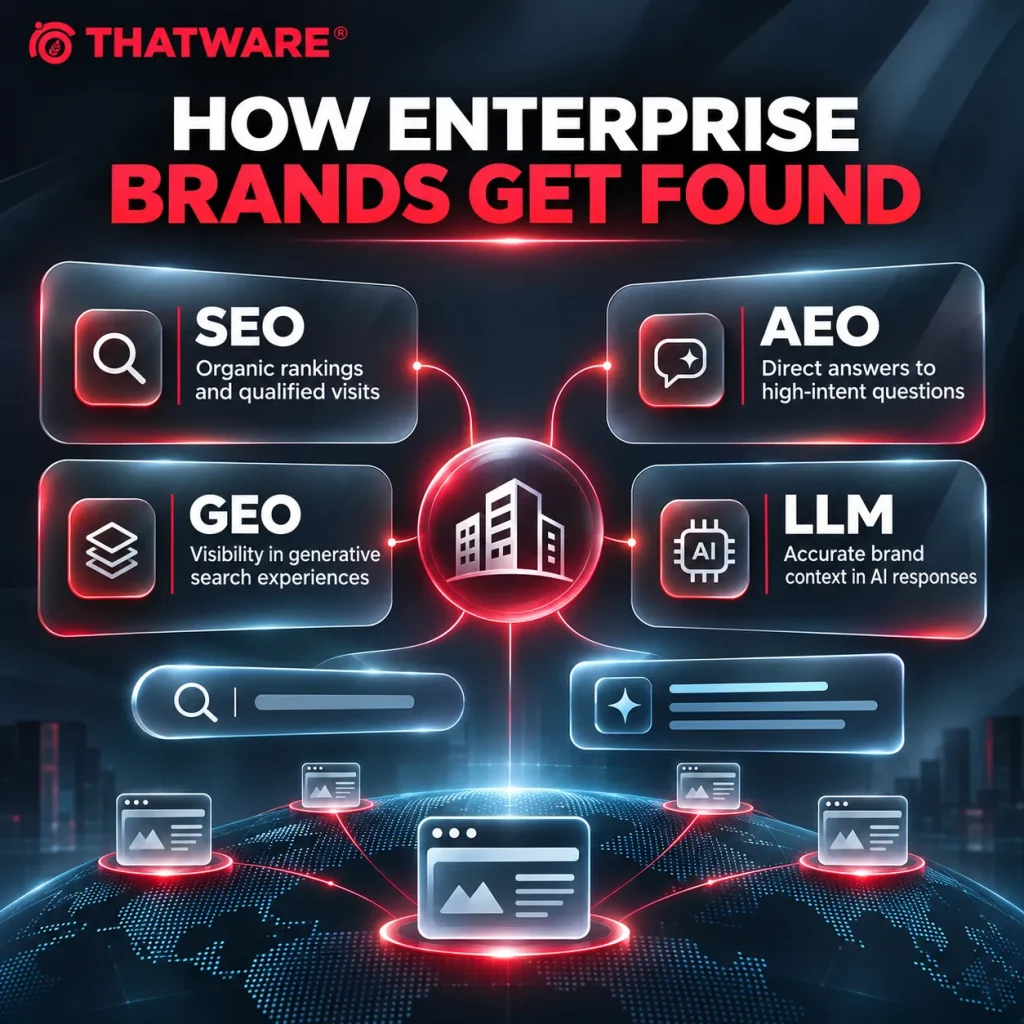
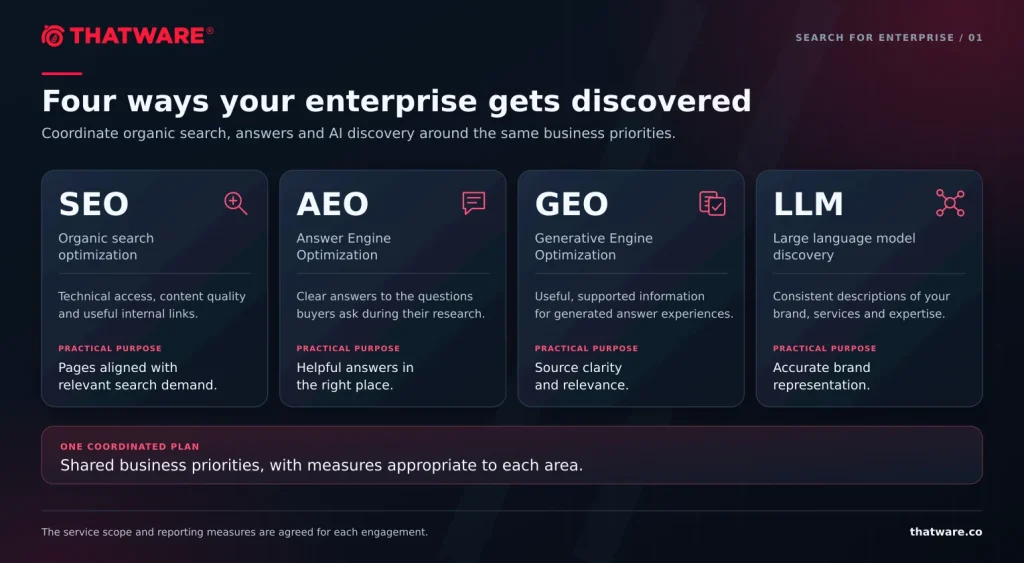
ThatWare brings these requirements into a coordinated approach to SEO for enterprise. We connect organic search priorities with Answer Engine Optimization, Generative Engine Optimization and LLM visibility, while giving your team a practical plan for the website and content changes involved.
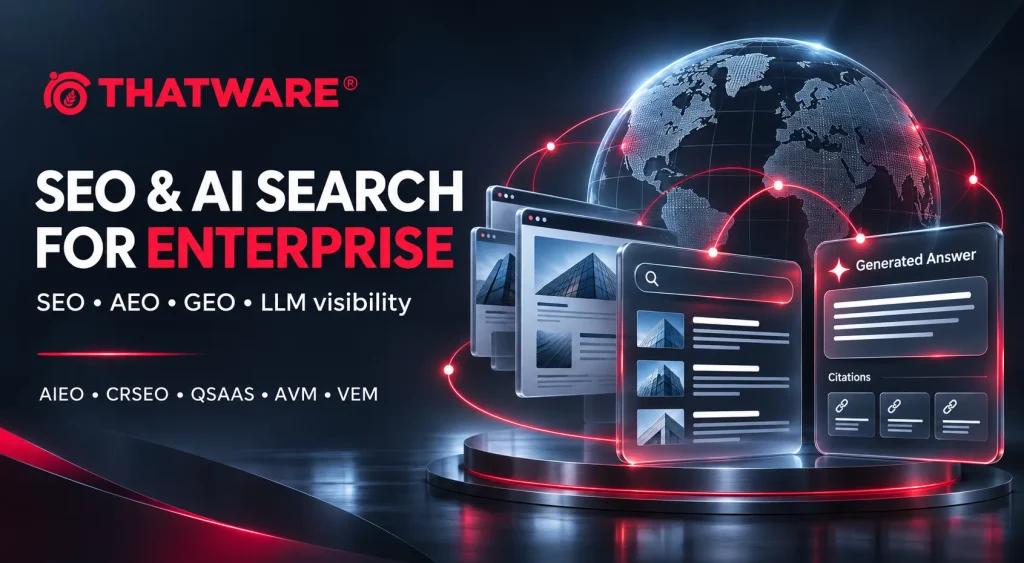
Our work can cover technical accessibility, search intent, content quality, internal links, entity clarity and the sources that describe your business. We establish which activities belong in your engagement, who can implement them and how their results will be assessed.
For a marketing leader, that means clearer priorities. For a content team, it means useful briefs and a defined purpose for each important page. For an internal search team, it means specialist support that fits the organization’s delivery process.
Discuss your enterprise search priorities
See examples of our campaign approach.
A coordinated approach to SEO for enterprise brands
SEO for enterprise is the coordinated improvement of search performance across a business with complex websites, content, markets or decision-making. Its scope is shaped by the organization’s needs and can include organic search alongside separately measured AI discovery work.
A large page inventory is one reason to need this approach. Complexity can also come from multiple brands, several languages, separate product teams or a website that supports both direct sales and longer procurement journeys.
The same organization may need to improve a service page, resolve conflicting product information and explain a specialist topic more clearly. These tasks connect, but each needs a purpose. We identify the pages that matter to the business, the questions their audiences ask and the dependencies that affect delivery.
Our approach to search engine optimization for enterprise starts with that relationship between search demand and the business. We assess organic performance alongside the accuracy and usefulness of the information customers encounter during their research.
This page explains our combined offering across SEO, AEO, GEO and LLM visibility. You can also explore our Enterprise SEO Services page for an engagement focused on conventional organic search.
When a business needs coordinated search support
You may already have capable writers, developers and an internal SEO team. The difficulty is often deciding which work should move first and keeping related changes consistent across teams.
Our SEO services for enterprise are relevant when a business faces requirements such as:
- Several website sections targeting similar queries without clear page ownership.
- Product and service information that varies across markets or publishing teams.
- Important pages that are difficult to discover through the website’s navigation.
- A content library with overlapping, outdated or weakly supported material.
- A redesign, migration or platform change that affects established search traffic.
- Limited understanding of how the brand appears in AI-generated answers.
- Reporting that combines channels or metrics without explaining what changed.
We turn these requirements into a defined engagement. A business preparing for a migration needs a different starting point from one reviewing its visibility in AI answers. A company expanding into new markets needs a different content plan from a marketplace with millions of parameter-based URLs.
The initial assessment establishes those differences before a delivery plan is agreed.
What our search program can include
We organize search optimization for enterprise around the work your organization needs and can implement. The exact scope may combine website analysis, content planning, implementation support and AI visibility assessment.
| Workstream | What we examine | Typical output |
|---|---|---|
| Search priorities | Business goals, audiences, markets and important website sections | Agreed priorities and a delivery roadmap |
| Website accessibility | Crawling, indexation, rendering and page templates | Technical recommendations with affected URL examples |
| Search intent and content | Query needs, page purpose, content gaps and overlap | Keyword map, refresh priorities and content briefs |
| Website relationships | Navigation, internal links, topic clusters and brand information | Architecture and linking recommendations |
| Answer and AI discovery | Buyer questions, retrieved sources, brand descriptions and citations | Answer-content improvements and a defined monitoring set |
| Delivery and reporting | Team responsibilities, dependencies and agreed measures | Implementation tracking and performance reporting |
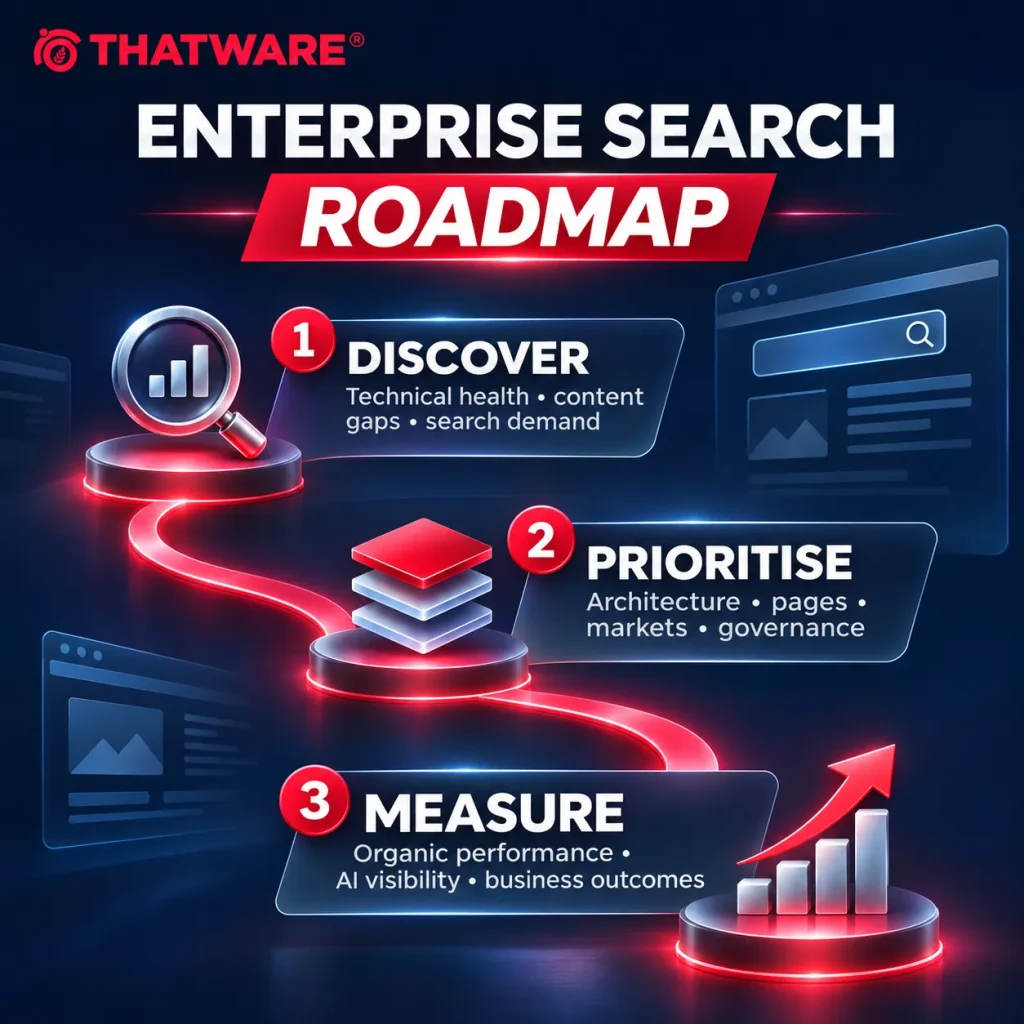
A useful SEO strategy for enterprise explains the sequence as well as the activities. Some pages need a content update immediately. Other work depends on a template change, a product decision or approval from a regional team. We make those dependencies visible so recommendations can move through the organization’s existing processes.
Technical SEO for enterprise websites
Content needs a reliable website underneath it. Our work on technical SEO for enterprise examines whether important pages can be discovered, accessed, rendered and indexed as intended.
We review the patterns affecting groups of pages as well as individual URLs. A template problem can influence an entire product category. A change to navigation can alter access to a large content library. A conflicting canonical pattern can send a different signal from the one the business intended.
Our SEO audits for enterprise can examine:
- Crawling and indexing controls, including robots directives and canonical signals.
- XML sitemap coverage and the relationship between sitemaps and important URLs.
- JavaScript rendering and access to essential page content.
- Redirect chains, broken pages and changes to established destinations.
- Page templates, metadata and structured data.
- Mobile presentation, loading performance and relevant page experience issues.
The resulting recommendations identify the issue, representative examples, the intended correction and the team dependency. That gives content and development teams enough context to understand why a change matters.
Crawl optimization and indexation priorities
Large websites can generate many URLs that serve similar information. Filters, tracking parameters, internal search pages and duplicate paths can make it harder to maintain a clear inventory of valuable pages.
Our approach to crawl optimization for enterprise examines those patterns and the routes through which important content is discovered. Where suitable data is available, the review can include crawl records and server logs alongside Search Console findings.
We use indexation management for enterprise to establish which pages the business wants available in search and whether the website’s signals support that intention. Decisions about consolidation, redirection or indexing controls require context. A low-traffic page may still support a customer need, a regional audience or an important stage in a purchase.
The deliverable is a reasoned set of priorities, with business value and implementation requirements made clear.
Website architecture and internal linking
The structure of a website should help someone understand where to go next. It should also give important pages sensible connections to the topics, products and services around them.
Our review of website architecture for enterprise considers navigation, category structure, page depth and the relationships between commercial and informational content. We look for valuable pages that are isolated, category pages with unclear purposes and repeated sections that compete for the same role.
Work on internal linking for enterprise then identifies useful connections. A buying guide can lead to the appropriate category. A specialist explanation can support a related service page. A regional page can connect visitors with the information that applies to their market.
For writers, this produces a practical linking brief: the source page, the destination, the reason for the connection and a natural anchor. The aim is a website whose relationships make sense to its visitors.
Keyword research and content strategy for enterprise
Useful keyword planning begins with what the audience needs to accomplish. A procurement manager comparing suppliers, an engineer checking specifications and a customer looking for support may use similar terminology while expecting very different pages.
Our keyword research for enterprise groups queries by their meaning, commercial relevance and likely page requirement. We examine the existing inventory before recommending new URLs, so the plan accounts for pages the business already owns.
Each priority group needs a clear destination. That destination may be a product page, service page, category, comparison guide or supporting article. Where several pages cover the same subject, we assess whether they serve distinct needs or require clearer boundaries.
Our content strategy for enterprise establishes what to improve, what to create and how those resources connect. It can include:
- A keyword-to-page map with a stated purpose for each priority page.
- Content refreshes for valuable pages with incomplete or outdated information.
- Briefs for subjects the existing website does not adequately address.
- Recommendations for overlapping pages and repeated explanations.
- Internal links that connect research content with relevant next steps.
- Evidence requirements for claims, examples and product information.
Content that supports a decision
Good service copy explains the work, the situations it suits and what the customer can expect from an engagement. Good product content answers the questions that determine suitability. Both need specific information that a reader can use.
Our approach to content optimization for enterprise reviews the substance of a page as well as its headings and metadata. We examine whether the opening addresses the visitor’s need, whether important details are missing and whether the evidence supports the claims being made.
For a software page, that could mean clearer use cases, integration requirements and an explanation of the evaluation process. For an equipment supplier, it could mean accurate model information, compatibility details and a useful route to the correct product category.
The content brief should explain these needs in plain language. Writers can then create a page with a clear job to do and a sensible next step for the reader.
Content governance across large teams
An enterprise website changes continuously. Product information, staff responsibilities, market availability and service details can all change after a page is published.
Our work on content governance for enterprise helps establish ownership and review expectations. It can define who confirms a claim, which source supports a specification, when a page needs review and how regional teams handle approved variations.
This is especially useful when several departments publish about related subjects. Shared standards for terminology, evidence, page purpose and internal links help keep those contributions consistent.
Governance should make publishing easier to manage. We keep the requirements proportionate to the organization’s content volume, risk and approval process.
AI SEO for enterprise brands
AI-powered discovery introduces another way for customers to encounter a business. They may ask for an explanation, a comparison or a shortlist and receive a generated answer drawing on several sources.
Our AI SEO for enterprise work examines how clearly the business is represented across its own website and the relevant information sources available to these systems. We consider the questions buyers ask, the pages that answer them and the accuracy of the resulting descriptions.
AI search optimization for enterprise is the improvement of a large organization’s accessible information and supporting evidence for search experiences that generate or retrieve answers. Its performance is assessed through defined observations, alongside the organization’s organic search measures.
Our AI SEO services for enterprise can include a review of service and product definitions, answer-focused content, entity information, relevant third-party references and AI answer observations. Recommendations are tied to the website and the sources that can be inspected and improved.
We also distinguish the kind of appearance being measured. A brand mention, a cited link and an accurate product description are different observations. Each can matter, but they should be reported with enough detail to explain what the customer actually sees.
AI search optimization and technical eligibility
Our approach to AI search optimization for enterprise builds on useful content and accessible websites. For Google’s AI Overviews and AI Mode, existing SEO fundamentals remain relevant. Google states that a supporting page must be indexed and eligible to appear in Search with a snippet; there are no additional technical requirements or special schema needed for those features.
We therefore review the practical foundations: access to important text, sensible internal links, reliable information and structured data that reflects the visible page. These requirements support a useful website regardless of whether a particular query produces an AI answer.
Different platforms use different systems and sources. We assess them within their own contexts and record the conditions of the observations. Inclusion in a generated answer remains a platform decision.
Read Google’s guidance on AI features and your website.
AEO for enterprise websites
Answer Engine Optimization is the practice of making information clear and useful for question-led search experiences. It starts with answering the actual question accurately, then providing the context a reader needs to understand and use that answer.
Our AEO for enterprise work starts with the questions customers ask before, during and after a purchase. Sales conversations, support inquiries, product documentation and search queries can all reveal information that deserves a clearer answer.
We develop answers around the relevant page rather than placing every question in a general FAQ hub. A question about compatibility belongs near the product information. A question about an engagement belongs on the service page. A technical explanation may need a dedicated guide with supporting evidence.
Our AEO services for enterprise can include:
- Question research and mapping to existing or proposed pages.
- Clear opening answers followed by necessary detail.
- Definitions, comparisons and practical explanations.
- Review of claims, sources, terminology and update requirements.
- Relevant structured data recommendations where the visible content supports them.
The value of answer engine optimization for enterprise also appears in the reading experience. Customers can find the information they need faster, and sales or support teams have clearer resources to share.
GEO for enterprise brands
Generative Engine Optimization concerns how a business’s information is represented and referenced within generated answers. It involves the quality, clarity and availability of relevant sources, while recognizing that the platform controls which sources appear.
Our GEO for enterprise work examines the questions that matter to the business and the sources appearing in related generated answers. We assess whether those answers describe the brand accurately, which competitors or alternatives are mentioned and where a useful source is missing.
Our GEO services for enterprise may then address the underlying content. A service page may need a more precise explanation of scope. A comparison guide may need clearer criteria. A product page may need specifications that are easier to find and verify.
Brand information outside the website also matters to the customer’s research. We review relevant profiles, credible coverage and other sources within the agreed scope, looking for inconsistent or outdated descriptions.
We treat generative engine optimization for enterprise as an ongoing process of observation and improvement. A single answer screenshot is useful evidence of one appearance. A repeated monitoring set gives the business a clearer view of patterns across relevant questions and platforms.
LLM SEO for enterprise audiences
LLM SEO focuses on the information that can shape how a business is described in large language model experiences. The work can address accessible sources, clear entity information and useful content, with observations recorded for specific platforms and prompts.
Our approach to LLM SEO for enterprise begins with the questions a prospective customer could ask. Those questions may concern capabilities, industry suitability, integrations, geographic availability or the differences between competing options.
We review whether your website gives a direct and supported explanation. We also examine relevant sources referenced in the observed responses. Where descriptions conflict, the work may involve updating business information, strengthening service explanations or publishing a resource that addresses a genuine information gap.
The purpose of LLM optimization for enterprise is to improve the information available around the business and assess how it is represented. It does not give an agency control over a model’s training data, responses or source selection.
Monitoring visibility across platforms
We assess LLM visibility for enterprise through a defined question set and a recorded method. Prompts, dates, platforms, markets and available source links give each observation its context.
ChatGPT visibility for enterprise can involve checking whether the brand is mentioned, how its capabilities are described and whether relevant pages are cited in the observed response. The same questions can then be reviewed in other appropriate environments.
For Gemini visibility for enterprise, we examine the response and its available references within the experience being assessed. For Perplexity visibility for enterprise, source citations can help identify which pages support an answer and where the business’s information appears.
Results vary with the prompt and platform conditions. We use a consistent monitoring method so your team can compare observations meaningfully and decide which information improvements deserve attention.
Semantic SEO and entity clarity
A business may use different names for the same service across its homepage, product library, press coverage and partner profiles. It may also use the same phrase for several different products. Both situations can confuse customers and weaken the consistency of the information around the brand.
Our work on semantic SEO for enterprise examines how topics and pages relate. We review whether the website explains the subject thoroughly, connects supporting material logically and uses terminology that matches the audience’s understanding.
Through entity optimization for enterprise, we look at the information identifying the organization, its people, products, locations and services. The practical work can include clearer descriptions, consistent naming, supported relationships and links to relevant sources.
We also review structured data for enterprise websites where it can accurately describe the visible information. Markup should reflect the page and the applicable requirements. It is one part of the website’s information structure, with its own purpose and limitations.
For a content team, the immediate requirement is clear writing supported by accurate facts. Readers should be able to identify who provides a service, what it involves, where it is available and which source supports a substantial claim.
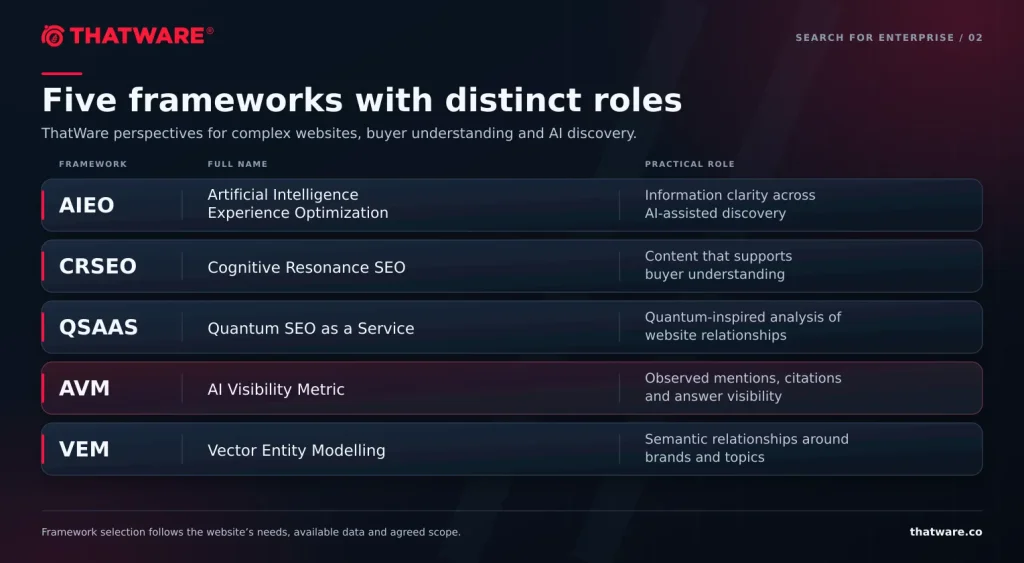
ThatWare frameworks for enterprise search
Our framework portfolio gives us several ways to examine a complex search program. Each addresses a different question. We choose the relevant application according to the organization’s needs, available data and agreed engagement.
AIEO for enterprise information and digital experience
Artificial Intelligence Experience Optimization examines how digital information can be interpreted across AI-assisted discovery experiences. Our use of AIEO for enterprise considers the clarity of business information, the questions the audience asks and the relationship between the answer and the next useful action.
For a large brand, that can mean aligning product explanations across several resources or making a specialist service easier to understand. We assess the information a customer encounters and identify where it needs stronger context, accuracy or supporting evidence.
Explore the AIEO framework.
CRSEO for enterprise buying journeys
Cognitive Resonance SEO considers how content supports understanding, confidence and a decision. Our application of CRSEO for enterprise looks at the information buyers need at different stages and whether the page addresses that need clearly.
A procurement page may need delivery responsibilities and evaluation criteria. A technical service page may need an explanation of the work and its dependencies. The content must fit the reader’s question and experience, with a sensible route to further information or an inquiry.
Explore the CRSEO framework.
QSAAS for enterprise website relationships
Quantum SEO as a Service uses quantum-inspired concepts and analytical models to examine website relationships and optimization priorities. We apply QSAAS for enterprise where graph analysis, semantic grouping or the evaluation of internal connections can help make a large website easier to assess.
The useful output is a recommendation that the team can investigate and implement, such as a better connection between related pages or a clearer priority among content groups. Its value is assessed through the website changes and relevant performance measures that follow.
Explore Quantum SEO as a Service.
AVM for enterprise AI visibility
The AI Visibility Metric provides a perspective on a brand’s presence in AI-generated answers. Our use of AVM for enterprise can examine observed mentions, citations, descriptions and other defined visibility measures within the monitored platforms.
We report those observations with their prompts and context. An AI answer mention does not become an organic click or a sale simply because it has been recorded. The business can assess each measure alongside the wider customer journey.
Explore ThatWare’s AI visibility measurement resources.
VEM for enterprise brand and topic relationships
Vector Entity Modelling examines semantic relationships around a brand and its associated subjects. We use VEM for enterprise to assess how the organization, its services and related topics are represented, and where the supporting information needs greater clarity.
For example, several business units may describe a shared capability differently. Reviewing those relationships can guide clearer definitions, connected resources and more consistent descriptions across the website.
Explore our framework portfolio. These frameworks support analysis and planning. Their use, deliverables and reporting method are established in the scope of work.
Search programs for different enterprise business models
The organization’s business model affects its content, technical priorities and measurement. We adapt the plan to those requirements.
Ecommerce and large product catalogs
Our approach to ecommerce SEO for enterprise covers the relationship between category discovery and individual product needs. Buyers may search by application, specification, brand, compatibility or model number. The page structure should help them reach the appropriate information.
The work can include category and product content, filter and variant patterns, internal links and useful buying guidance. AI discovery assessment can examine whether product information is represented accurately in the observed answers. Product availability, specifications and claims need a clear review process.
SaaS and software companies
Our SaaS SEO for enterprise work considers product pages, use cases, integrations, industry requirements and evaluation content. A software buyer may involve several people who need different information before a demonstration or procurement discussion.
We map those needs to the appropriate resources and clarify the relationship between them. Service descriptions, comparisons and implementation explanations should reflect what the product actually supports. Useful evidence can include approved customer examples, documented capabilities and technical information maintained by the product team.
B2B services and specialist suppliers
Our approach to B2B SEO for enterprise recognizes that a commercially useful visit may be part of a longer evaluation. We examine how the website explains expertise, scope, suitability and the next step in an inquiry.
Content may need to support an operational buyer, a technical reviewer and a commercial decision-maker. We help organize that information so each can find the evidence relevant to their role. Where measurement allows, the reporting can connect organic inquiries with the lead quality and pipeline stages agreed by the business.
Multiple locations and regional operations
Work on local SEO for enterprise can involve location information, local service availability and the relationship between a central website and regional resources. Accurate addresses, contact details, opening information and service descriptions help customers find the right business unit.
We also assess the purpose of individual location pages. Each should give visitors information relevant to that location, with consistent ownership and review expectations across the wider organization.
International and multilingual websites
Our international SEO for enterprise work considers country and language targeting alongside the customer’s actual needs in each market. Website structure, market-specific content and the links between regional resources all deserve attention.
Our approach to multilingual SEO for enterprise goes beyond translating a central page. Terminology, product availability, examples and purchasing expectations can vary. We work with the relevant teams to define shared standards and the local details that require adaptation.
The goal is a manageable content system with clear market responsibilities and relevant information for each audience.
Website migrations and major releases
We can support migration SEO for enterprise when the business changes its platform, structure, domains or page inventory. The work can include URL mapping, content and metadata review, redirect recommendations and comparisons before and after launch.
The plan should establish which valuable pages and customer journeys need attention. Content owners need to know what is moving, which information changes and who confirms the accuracy of the new page. Technical and search teams then have a clearer basis for reviewing implementation and monitoring the release.
Authority and digital PR for enterprise brands
Useful brand information extends beyond the company website. Customers may consult industry publications, partner resources, professional profiles and coverage of substantial announcements.
Our work on digital PR for enterprise starts with a credible subject and a relevant audience. Original research, a verified product development or a well-documented business milestone can give a publication a reason to cover the organization.
The supporting material should be specific. Claims need sources. Named experts should have a real connection to the subject. The company description should match the information on the website and other maintained profiles.
We assess this work through the coverage and referral activity it produces, with any search or AI visibility observations reported in their own contexts. A press mention is evidence of coverage; its business value depends on the audience, the content and the customer response.
Working with your internal team
Choosing an SEO agency for enterprise means choosing a team that can work within your organization’s responsibilities and delivery process. The relationship should make it easier to decide what happens next.
Our SEO consulting for enterprise can support an existing search function with specialist analysis, content planning or defined project work. Where the scope includes ongoing delivery, we agree responsibilities for drafting, reviewing, publishing and implementing recommendations.
We provide briefs with the information the receiving team needs. A content brief explains the page purpose, audience questions, required evidence and internal links. A technical recommendation identifies the affected pattern, its impact and the intended correction.
Approval requirements are included in the plan. Legal, product, regional and brand reviews can be necessary parts of publishing. We account for them when setting priorities and schedules, so the roadmap reflects how the organization works.
The first 90 days of an engagement
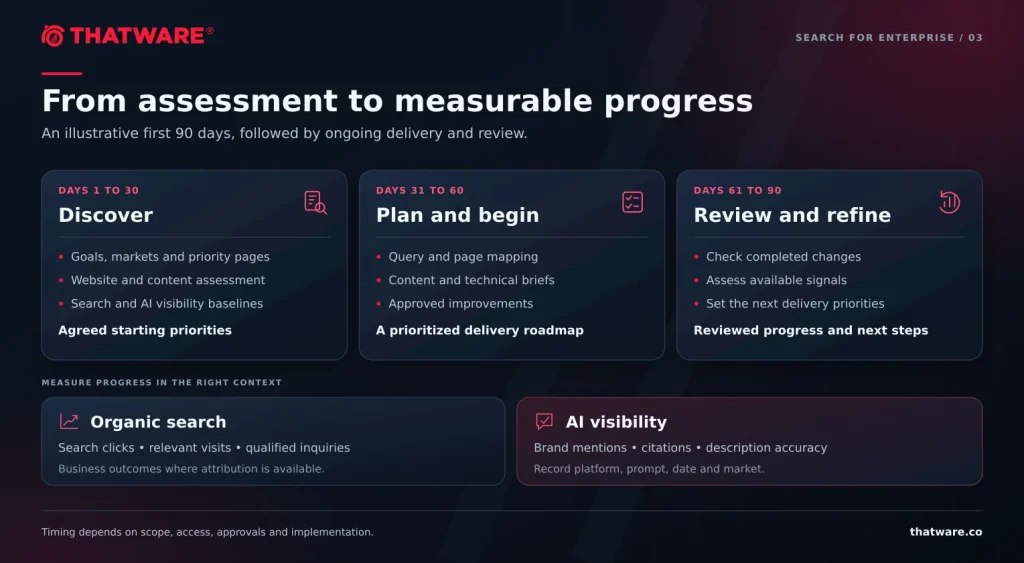
The sequence below illustrates how an engagement can develop. The website’s condition, scope and access arrangements determine the actual schedule.
| Period | Main work | Reviewable output |
|---|---|---|
| Days 1 to 30 | Understand goals, review priority website sections, establish search and AI visibility baselines | Findings, agreed measures and an initial priority list |
| Days 31 to 60 | Map queries, prepare content and technical briefs, begin approved changes | A prioritized roadmap and completed work within the agreed scope |
| Days 61 to 90 | Review implementation, assess relevant changes and refine the next delivery cycle | Progress report, remaining dependencies and next priorities |
Discovery starts with the organization’s goals and the pages that support them. We then examine the relevant website and content patterns, rather than producing an undifferentiated list of every possible issue.
The next stage turns findings into work that can be reviewed. Teams receive a clear brief, a stated purpose and the evidence needed to make a decision. Approved changes move into the organization’s publishing or development process.
The review stage considers both delivery and performance. We assess what was completed, what remains dependent on another action and which observations should inform the next cycle. Search and AI visibility can develop at different rates, so the reporting keeps their measures clear.
Enterprise SEO Architecture for Large and Complex Websites
Managing search engine optimization for an enterprise website is fundamentally different from optimizing a small business website. Enterprise platforms often contain thousands or even millions of URLs distributed across product categories, regional websites, service pages, knowledge resources, and dynamically generated content.
As the website expands, maintaining a consistent technical structure becomes increasingly challenging. Search engines must discover important pages, understand their relationships, identify canonical versions, and allocate crawling resources efficiently. Without a carefully designed architecture, even valuable content can struggle to achieve consistent organic visibility.
At ThatWare, we approach enterprise SEO architecture as a foundational component of long-term search performance. Our strategies focus on improving how large websites are organized, crawled, indexed, and interpreted by search engines and AI-powered discovery systems.
Rather than applying isolated technical fixes, we evaluate the relationships between website structure, internal authority distribution, content accessibility, and commercial search intent.
Large-Scale Website Architecture and URL Optimization
A well-organized enterprise website should make it easy for users and search engines to navigate between business units, product categories, and supporting content.
However, enterprise websites frequently develop structural inconsistencies due to multiple content management systems, historical migrations, decentralized publishing processes, and changing business requirements.
Our enterprise website architecture process evaluates:
- URL hierarchy and category structures
- Parent-child relationships between important landing pages
- Duplicate or overlapping content across business units
- Navigation depth and accessibility of commercial pages
- Faceted navigation and parameter-generated URLs
- Product and service taxonomy consistency
- Website scalability during future expansion
We develop architecture recommendations that align search intent with the organization’s commercial priorities.
For example, an enterprise ecommerce website may have thousands of products distributed across hundreds of categories. Without a structured hierarchy, important product categories may compete against one another or remain several clicks away from primary navigation.
By improving category relationships and navigation pathways, we help create clearer routes for search engines to discover and evaluate commercially important pages.
Enterprise Crawl Budget and Indexation Management
Large websites can generate substantial numbers of URLs through filters, sorting options, internal search results, pagination, and content variations.
Not every URL deserves equal crawling or indexing priority.
Our technical SEO specialists examine how search engines interact with the website and identify areas where crawling resources may be spent on low-value pages.
Our crawl optimization activities include:
- Server log analysis to understand search engine crawling behavior
- XML sitemap segmentation and validation
- Robots.txt configuration reviews
- Canonical tag implementation and auditing
- Duplicate URL identification
- Index coverage monitoring
- JavaScript rendering assessments
- Redirect chain and crawl error analysis
These activities help enterprise teams identify technical barriers that may prevent important pages from being discovered or indexed.
We also distinguish between crawl accessibility and index eligibility. A page being accessible to search engines does not automatically mean it will be indexed or ranked.
Our objective is to establish a technically reliable website environment where commercially relevant content has a stronger opportunity to participate in organic search.
Internal Linking and Enterprise PageRank Distribution
Internal linking is particularly important for enterprise websites because authority can become unevenly distributed across large URL inventories.
Important pages may receive insufficient internal links, while outdated or low-value pages continue attracting significant navigational attention.
ThatWare evaluates internal linking structures using crawl data, page relationships, topical relevance, and PageRank-based analysis.
Our internal linking strategies focus on:
- Identifying high-authority pages and underlinked commercial URLs
- Improving contextual links between related content clusters
- Strengthening category-to-product relationships
- Reducing unnecessary click depth
- Identifying orphan and near-orphan pages
- Improving internal anchor text relevance
- Supporting priority landing pages through structured link distribution
Where appropriate, we also explore quantum-inspired optimization models to evaluate complex internal linking relationships and prioritize potential improvements.
These models are used as analytical techniques rather than claims that search engines use quantum computing in their ranking systems.
The goal is to make enterprise websites easier to navigate, more logically connected, and better aligned with business-critical search opportunities.
Multi-Market and International Enterprise SEO Governance
Expanding into multiple countries introduces challenges that cannot be resolved through simple keyword translation.
Search behavior differs across regions. Customers may use different terminology, prefer different content formats, and evaluate products or services according to local market expectations.
An international enterprise SEO strategy must account for these differences while maintaining consistent technical standards and brand positioning.
At ThatWare, we develop multi-market SEO frameworks that combine centralized strategic oversight with localized execution.
Our objective is to help enterprise organizations manage international search visibility without creating unnecessary duplication, technical conflicts, or operational complexity.
International Website Architecture and Hreflang Management
Choosing the correct international website structure is one of the most important decisions for a global organization.
Businesses may operate through country-code domains, regional subdirectories, subdomains, or combinations of these approaches.
Each structure has implications for technical maintenance, content governance, analytics, and search visibility.
We evaluate international website architecture according to factors such as:
- Number of target countries and languages
- Existing domain authority and website infrastructure
- Regional business operations
- Content localization requirements
- Technical development resources
- Long-term expansion plans
Our international SEO implementation process includes hreflang assessments, canonical alignment, language-region targeting, and localized sitemap validation.
For example, an enterprise operating in the United States, United Kingdom, Australia, and India may need separate landing pages for services that appear similar but serve different audiences.
We help establish clear technical relationships between these pages while ensuring that regional variations provide meaningful value to users.
Country-Specific Keyword and Search Intent Mapping
A keyword that performs well in one country may have limited relevance in another.
Even markets sharing the same language can demonstrate significant differences in terminology, search intent, competition, and purchasing behavior.
Our international keyword research process examines local search demand and maps relevant opportunities to appropriate regional landing pages.
This includes:
- Country-level keyword research
- Regional search intent classification
- Local competitor benchmarking
- Language-specific semantic keyword mapping
- Market-specific commercial landing page optimization
- Regional content gap identification
- Localized FAQ and informational content planning
We avoid relying exclusively on direct keyword translations.
Instead, we examine how customers actually search within each target market and recommend content that reflects those behaviors.
For enterprise brands, this helps regional teams pursue relevant opportunities without weakening the organization’s overall search strategy.
Centralized SEO Standards with Local Market Flexibility
Enterprise SEO campaigns often involve multiple marketing teams, regional managers, agencies, and content contributors.
Without centralized guidelines, individual markets may implement conflicting URL structures, metadata conventions, internal linking practices, or technical configurations.
ThatWare helps organizations establish governance frameworks that define which SEO requirements should remain consistent and which decisions can be localized.
Centralized standards may include technical SEO policies, structured data requirements, content quality guidelines, and reporting definitions.
Regional teams can then adapt keyword targeting, examples, language, and conversion messaging to their local audiences.
We also recommend regular cross-market reviews to identify keyword cannibalization, duplicate content, inconsistent implementation, and opportunities to reuse successful optimization approaches.
This balance between governance and flexibility helps international organizations manage SEO as a coordinated business function rather than a collection of disconnected regional activities.
Enterprise SEO Governance, Stakeholder Collaboration, and Implementation
One of the biggest challenges in enterprise SEO is not identifying what needs improvement. It is ensuring that recommended changes are implemented correctly and consistently.
Enterprise websites typically involve several departments, including marketing, development, product management, content, analytics, legal, and regional operations.
A technical SEO recommendation may require development resources. A content update may need legal approval. A navigation change may involve product managers and user experience teams.
Without clearly defined responsibilities, important SEO initiatives can remain unresolved for months.
ThatWare structures enterprise SEO programs around actionable recommendations, implementation priorities, stakeholder coordination, and measurable progress.
Cross-Functional SEO Collaboration
Enterprise SEO should not operate independently from the teams responsible for maintaining and expanding the website.
Our approach begins by identifying the departments and decision-makers involved in implementing SEO recommendations.
We then establish workflows that help relevant teams understand the purpose, priority, and expected business impact of each initiative.
For example, a recommendation to improve JavaScript rendering may require collaboration between SEO specialists and frontend developers.
Similarly, consolidating overlapping service pages may involve content strategists, regional marketing managers, and business stakeholders.
Our collaborative process helps connect these activities to a unified enterprise search strategy.
Developer-Ready Technical SEO Recommendations
Technical SEO audits often identify numerous issues, but lengthy reports alone do not guarantee implementation.
Enterprise development teams need clear instructions that fit their existing workflows and release cycles.
ThatWare translates technical findings into structured implementation recommendations.
These may include:
- Affected URL patterns and website templates
- Description of the technical issue
- Search visibility implications
- Recommended technical solution
- Implementation priority
- Relevant testing requirements
- Post-deployment validation steps
We also distinguish between website-wide issues and isolated URL-level problems.
A canonical configuration error affecting thousands of product pages may deserve greater attention than a minor metadata issue affecting a single informational page.
This prioritization helps enterprise teams allocate development resources according to potential business impact.
SEO Quality Assurance and Website Release Monitoring
Enterprise websites undergo frequent changes.
New products are launched, content templates are updated, navigation structures evolve, and development teams release new functionality.
These changes can unintentionally introduce technical SEO problems.
Our enterprise governance framework incorporates SEO quality assurance into relevant website release processes.
We recommend validating critical SEO elements before and after significant deployments, including canonical tags, indexability, redirects, structured data, internal links, and rendering behavior.
For website migrations, additional checks may cover URL mapping, redirect accuracy, content preservation, analytics continuity, and post-launch indexation.
This proactive approach helps reduce the risk of preventable SEO disruptions during website development and expansion.
Enterprise SEO Prioritization and Accountability
Not every SEO recommendation should receive the same implementation priority.
We assess opportunities according to technical severity, affected URL volume, commercial importance, implementation complexity, and expected search impact.
High-priority issues are organized into actionable roadmaps with defined ownership and review milestones.
Progress can then be monitored through implementation trackers and stakeholder reporting.
By connecting SEO recommendations with accountable execution, enterprise organizations gain greater visibility into what has been completed, what remains unresolved, and which improvements should be addressed next.
Enterprise SEO Performance Reporting with AVM and VEM Intelligence
Enterprise SEO performance cannot be evaluated through keyword rankings alone.
Large organizations need to understand how organic search contributes to qualified traffic, customer acquisition, revenue opportunities, market expansion, and long-term digital visibility.
At the same time, search behavior is evolving as users increasingly encounter AI-generated answers, conversational search experiences, and recommendation-driven discovery platforms.
This creates an additional measurement challenge.
A business may maintain strong traditional organic rankings while receiving limited visibility within AI-generated responses for commercially relevant questions.
ThatWare’s enterprise reporting approach brings together conventional SEO performance indicators and advanced AI visibility metric.
Measuring Enterprise Organic Search Performance
Our enterprise SEO reporting framework begins with established performance indicators that demonstrate how effectively the website attracts and converts relevant search traffic.
These include:
- Organic search sessions and engaged users
- Search impressions, clicks, and click-through rates
- Keyword visibility across priority commercial topics
- Landing page performance
- Organic lead generation and conversions
- Ecommerce transactions and attributable revenue
- Technical SEO health and indexation trends
- Country-level and business-unit performance
We organize reporting around business objectives rather than presenting isolated metrics without context.
For example, an enterprise software provider may prioritize qualified demo requests and sales opportunities, while an ecommerce organization may focus on category-level revenue and organic customer acquisition.
Reporting should reflect those differences.
AVM: AI Visibility Metric for Enterprise Brands
ThatWare’s AVM framework is designed to help organizations evaluate how their brands appear across AI-powered search and discovery environments.
Traditional SEO tools primarily examine search rankings and website traffic.
AI visibility metric introduces additional questions.
Is the brand mentioned when users ask AI systems about relevant products or services? Are its pages cited as supporting sources? How does its visibility compare with competing brands?
Our AVM-oriented analysis can examine:
- Brand mentions across selected AI search environments
- Website citations in AI-generated responses
- Visibility for priority commercial questions
- Competitor presence within comparable AI answers
- Frequently cited pages and content categories
- Changes in AI visibility across repeated measurement periods
- Gaps between traditional rankings and AI answer inclusion
AI-generated responses are dynamic and can vary according to the platform, prompt, location, and testing conditions.
For this reason, AVM reporting should document the evaluated queries, platforms, dates, and measurement methodology.
The objective is not to promise inclusion in AI-generated answers. It is to provide enterprise teams with a structured way to evaluate visibility and identify opportunities for improvement.
VEM: Vector Entity Modelling and Semantic Search Intelligence
Search engines and AI systems increasingly rely on semantic relationships to interpret information beyond exact keyword matching.
ThatWare’s VEM framework focuses on analyzing entity relationships, topical connections, and semantic representation within a website’s content ecosystem.
For enterprise organizations, this can be useful when large amounts of content are distributed across different products, services, markets, and business units.
Our VEM-oriented approach evaluates areas such as:
- Core brand, product, and service entities
- Relationships between important topics
- Semantic consistency across related pages
- Entity references and contextual clarity
- Topical coverage gaps
- Internal linking relationships
- Content relevance to target user questions
For example, a multinational technology company may publish content about cloud infrastructure, cybersecurity, enterprise software, and digital transformation.
Although these subjects are related, inconsistent terminology and disconnected content structures can make the overall website harder to interpret.
Entity-focused analysis helps identify opportunities to clarify relationships and strengthen topical organization.
VEM should be understood as ThatWare’s analytical framework, not as a publicly confirmed Google ranking metric.
Executive Dashboards and Business-Level Reporting
Enterprise stakeholders require different levels of reporting detail.
Technical teams may need crawl diagnostics, indexation trends, and implementation status.
Marketing leadership may focus on organic acquisition, conversions, competitive visibility, and content performance.
Executive stakeholders typically need concise reporting that connects search investment with business outcomes.
ThatWare recommends reporting dashboards that present relevant information at each level.
These dashboards can combine SEO performance, technical health, AI visibility observations, implementation progress, and market-specific comparisons.
The result is a more comprehensive view of enterprise search performance across traditional and emerging discovery channels.
Enterprise SEO Case Studies and Measurable Business Outcomes
Case study 1:
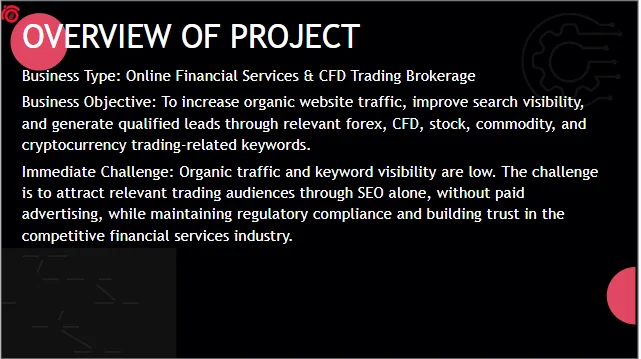
Stonefort Securities operates in the competitive online financial services industry, offering trading-related services across forex, CFDs, stocks, commodities and cryptocurrency markets. In an industry where users carefully evaluate trading platforms, brokerage services and partner opportunities before making decisions, organic search visibility plays an important role in attracting relevant audiences.
ThatWare partnered with Stonefort Securities to improve its organic search presence, strengthen keyword visibility and attract qualified visitors through a search intent-driven SEO strategy.
The campaign focused on understanding how potential traders and business partners searched for brokerage services, aligning website content with those searches, improving the technical experience and strengthening the website’s relevance for commercially valuable queries.
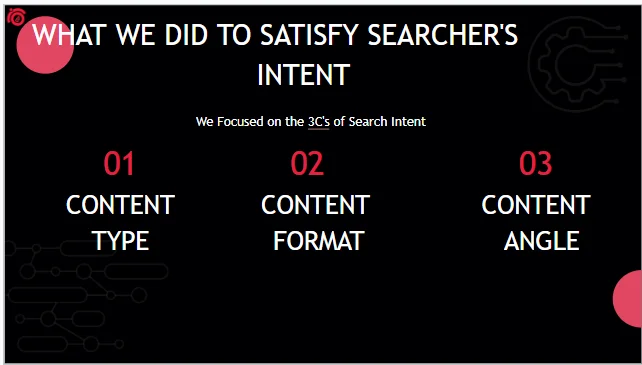
Rather than relying solely on keyword placement, ThatWare approached the campaign through three core principles: content type, content format and content angle.
The Business Challenge
Stonefort Securities faced a significant organic visibility challenge. Its website had limited keyword presence and was not attracting sufficient organic traffic from relevant trading-related searches.
The financial services and CFD brokerage sector is particularly competitive. Users compare platforms, trading conditions, brokerage features, partner programmes and available financial instruments before choosing a provider.
The campaign needed to address several challenges:
- Low organic visibility: Important trading-related keywords were not generating sufficient search exposure.
- Limited keyword reach: The website needed stronger visibility for forex, CFD, stock, commodity and cryptocurrency-related searches.
- Competitive search environment: Established financial platforms and brokerage websites competed for the same commercial search queries.
- Search intent mismatch: Website content needed to address the specific information users expected when searching for trading platforms and brokerage partnerships.
- Technical and user experience requirements: Website performance, mobile usability, crawlability and navigation needed attention.
- Trust and compliance considerations: Financial services content needed to communicate relevant information clearly while maintaining appropriate industry credibility.
The primary objective was to build sustainable organic visibility and attract relevant audiences without depending exclusively on paid advertising.
Our SEO Strategy: Understanding Search Intent First
ThatWare built the campaign around a simple principle: a website must provide the type of information users actually expect when they search.
Search intent was therefore the foundation of the optimization process.
We evaluated the relationship between search queries, the content appearing in Google results and the type of landing pages that could best satisfy those searches.
Our strategy followed the three Cs of search intent optimization.
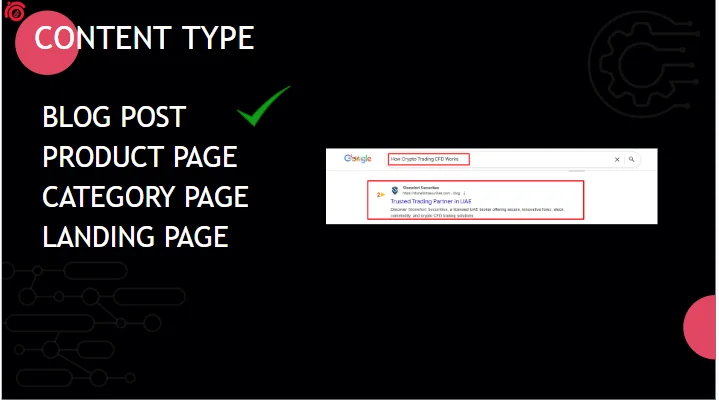
1. Content Type
The first step was identifying which type of page best matched the target search queries.
We evaluated four major content formats:
- Blog posts
- Product pages
- Category pages
- Landing pages
Blog content was prioritized for relevant informational searches and educational topics.
For example, the query “How Crypto Trading CFD Works” required explanatory content rather than a generic brokerage landing page.
The objective was to provide useful information that addressed the user’s initial research requirements while creating relevant pathways towards the company’s trading services.
2. Content Format
The second step involved identifying how the information should be presented.
ThatWare focused on:
- How-to guides
- Step-by-step explanations
- Informational tutorials
- Structured educational content
This approach helped make complex trading-related subjects easier to understand.
For instance, searches around brokerage partnership programmes required content explaining the programme, its purpose and how interested individuals or businesses could participate.
Accordingly, the website’s partner programme content was structured to answer these questions directly.
3. Content Angle
The third step was developing the right perspective for each target keyword.
Instead of using generic trading-related content, we aligned the messaging with the specific needs behind individual searches.
Two important target queries were:
- “IB partner programme broker”
- “forex CFD trading platform”
These searches represent different user requirements.
Someone searching for an IB partner programme broker may be interested in referral opportunities and brokerage partnerships. Someone searching for a forex CFD trading platform is more likely to compare available trading services and platform features.
ThatWare aligned the relevant website content with these different search expectations.
Content Optimization and Website Updates
After identifying the search intent behind priority keywords, we focused on improving the website’s content relevance.
Our content optimization activities included:
Updating existing website content
We reviewed existing information and updated relevant sections to reflect current subject matter, improve clarity and address gaps in the content.
Improving content relevance
Content was refined to better match the expectations behind target trading-related searches.
Adding relevant graphical elements
Visual content was incorporated where appropriate to improve information presentation and make website pages easier to navigate.
Optimizing text and page elements
We improved existing copy and relevant on-page elements to strengthen the relationship between target search queries and website content.
Refreshing content dates
Relevant content updates were reflected through revised publication or modification dates where applicable.
These activities helped position the website’s content around actual user requirements rather than relying on repetitive keyword insertion.
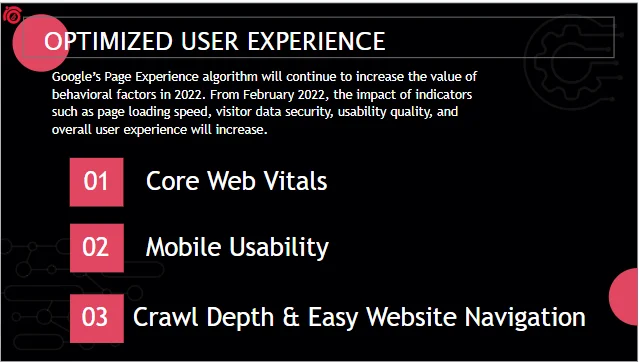
Technical SEO and User Experience Optimization
Content relevance alone was not enough. The website also needed a technically sound structure that allowed search engines and visitors to access important information efficiently.
ThatWare focused on three important areas.
1. Core Web Vitals Optimization
Website performance and page experience were included in the technical optimization process.
The key improvement areas were:
- Reducing unnecessary JavaScript execution.
- Implementing lazy loading where appropriate.
- Optimizing and compressing images.
- Providing appropriate dimensions for images and embedded elements.
- Improving server response time.
These activities were intended to improve loading efficiency and create a smoother browsing experience.
2. Mobile Usability
Trading audiences frequently research platforms and financial services through mobile devices.
We considered mobile usability as an important part of the overall optimization strategy, focusing on accessibility, content presentation and navigation.
The objective was to ensure that visitors could access relevant information without unnecessary friction.
3. Crawl Depth and Website Navigation
We also focused on improving website architecture through a flatter site structure.
A flat website structure helps important pages remain accessible through fewer navigation levels.
The strategy focused on:
- Making important pages easier to discover.
- Improving navigation between related website sections.
- Reducing unnecessary click depth.
- Strengthening the relationship between important content pages.
- Supporting more efficient crawling and content discovery.
A logical website structure also helps visitors locate relevant trading information without navigating through excessive page levels.
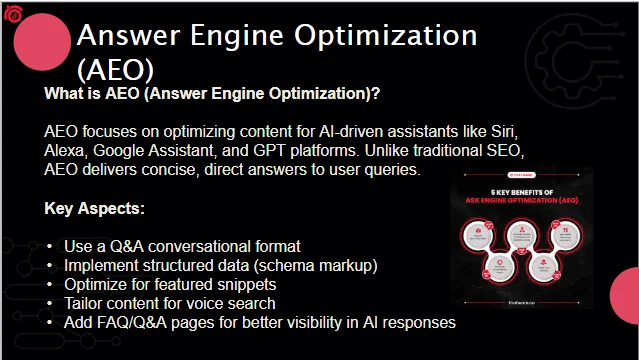
Answer Engine Optimization and Search Visibility
As part of the broader search optimization approach, ThatWare also considered the importance of answer-focused content.
Financial services websites contain subjects that users frequently explore through direct questions.
For example:
- What is a CFD trading platform?
- How does forex CFD trading work?
- What is an introducing broker programme?
- How can someone become an IB partner?
Answer Engine Optimization focuses on presenting information in a clear, structured format that directly addresses such questions.
Our content approach included:
- Question-and-answer formatting.
- Clear informational explanations.
- Structured content sections.
- FAQ-oriented content opportunities.
- Relevant structured data considerations.
This helped establish a more organized content framework for informational searches and emerging answer-led search experiences.
What Did the Campaign Achieve?
The campaign delivered encouraging search visibility outcomes for Stonefort Securities, with Google search results showing the website appearing prominently for selected trading-related commercial queries.
The documented search results included the following examples.
Improved Visibility for IB Partner Programme Broker
For the search query “IB partner programme broker”, Stonefort Securities appeared in the first organic position in the captured Google search result.
The corresponding landing page, titled Partners | Affiliates and Introducing Brokers, directly addressed the search intent by explaining the brokerage’s partner and affiliate programme.
This demonstrated the value of aligning a specific commercial search query with a dedicated and relevant landing page.
Visibility for Forex CFD Trading Platform
For the query “forex CFD trading platform”, Stonefort Securities appeared in the captured Google search results with its trading platform page.
The result highlighted the company’s online trading platform and its availability to users in the UAE.
This helped strengthen the website’s presence for a commercially relevant trading-related search.
Visibility for Crypto Trading-Related Searches
The captured Google result for “How Crypto Trading CFD Works” also showed Stonefort Securities appearing at the second organic position.
This reflected the importance of matching informational search queries with educational content rather than directing every visitor towards a generic service page.
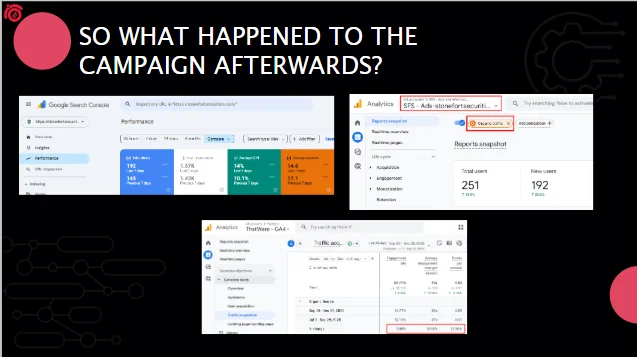
Google Search Console Performance
The campaign presentation also documented Google Search Console performance data.
The captured reporting snapshot showed:
- 192 total clicks
- Approximately 1.37K total impressions
- Approximately 14% average CTR
- Approximately 14.6 average position
These figures represent the displayed reporting snapshot and should be interpreted in the context of its selected date range.
Google Analytics Performance
The Google Analytics snapshot displayed:
- 251 total users
- 192 new users
These figures provide an additional view of website acquisition during the selected reporting period.
Together, the search result screenshots and analytics records demonstrate the campaign’s organic search presence and the acquisition activity recorded during the reporting period.
The Impact of a Search Intent-Led SEO Approach
The Stonefort Securities campaign demonstrates why effective SEO requires more than optimizing pages around individual keywords.
A trading platform search, an introducing broker search and an educational cryptocurrency query may all relate to the same industry, but they represent different user expectations.
By understanding these differences, ThatWare developed a strategy that connected content relevance, technical optimization and website experience.
The campaign focused on:
- Improving visibility for relevant commercial trading searches.
- Matching landing pages with specific search intent.
- Developing educational content for informational queries.
- Updating existing website content.
- Improving website performance and mobile usability.
- Strengthening website architecture and crawl accessibility.
- Organizing information for answer-focused search experiences.
- Monitoring organic search and website acquisition performance.
Case study 2:
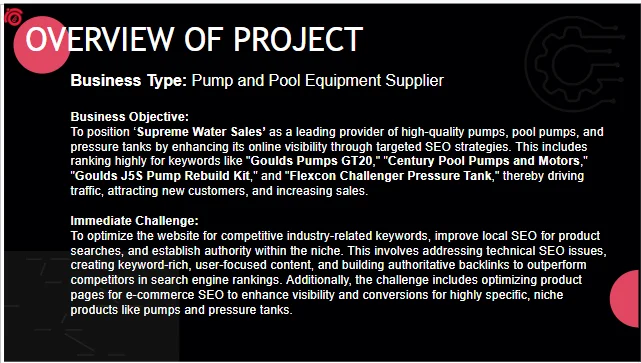
Supreme Water Sales supplies a range of water management and pumping equipment, including water pumps, pool pumps, pressure tanks, pump motors and replacement components. Operating in a competitive product-focused market, the business needed stronger organic visibility to reach customers searching for specific equipment, replacement parts and water system solutions.
ThatWare developed a search intent-driven SEO strategy to strengthen the website’s visibility across competitive product-related searches, improve ecommerce category and product pages, and attract customers with specific purchasing requirements.
The campaign combined keyword research, search intent analysis, product content optimization, technical SEO, website architecture improvements and Answer Engine Optimization (AEO).
A key objective was to move beyond broad industry keywords and target highly specific searches that reflected actual customer requirements, including product models, replacement components and technical specifications.
The Business Challenge
Supreme Water Sales wanted to establish stronger online visibility as a supplier of quality pumps, pool pumps and pressure tanks.
The primary business objectives included:
- Improve organic search visibility for competitive industry-related keywords.
- Increase rankings for product-specific and commercial searches.
- Attract relevant visitors looking for pumps and replacement components.
- Strengthen product and category page performance.
- Improve local SEO visibility for product-related searches.
- Build topical authority through relevant, user-focused content.
- Generate qualified website traffic and support increased sales.
The campaign also faced several challenges.
Competitive product searches: The website needed to compete with established suppliers and ecommerce platforms for commercially valuable equipment-related queries.
Specific keyword targeting: Customers frequently searched using exact product names, model numbers, replacement parts and technical specifications.
Content relevance: Product pages needed to provide useful information that matched the search intent behind individual queries.
Technical performance: Website loading speed, mobile usability, crawl depth and navigation required attention to support a better user experience.
AI search visibility: The campaign also presented an opportunity to improve the website’s presence in AI-generated search results and Google’s AI Overviews.
Our objective was to address these challenges through an integrated SEO strategy that connected product relevance, technical performance and emerging search experiences.
Search Intent: The Foundation of the Campaign
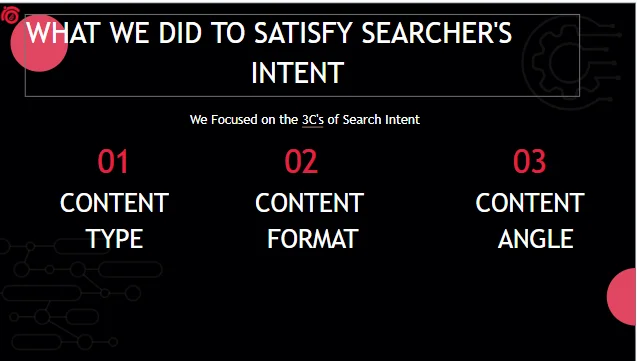
ThatWare structured the campaign around three essential components of search intent: content type, content format and content angle.
Instead of optimizing every page around keywords alone, we examined what customers expected to find when searching for particular products and solutions.
This helped us determine the most suitable page format, information structure and content direction for each keyword group.
1. Content Type
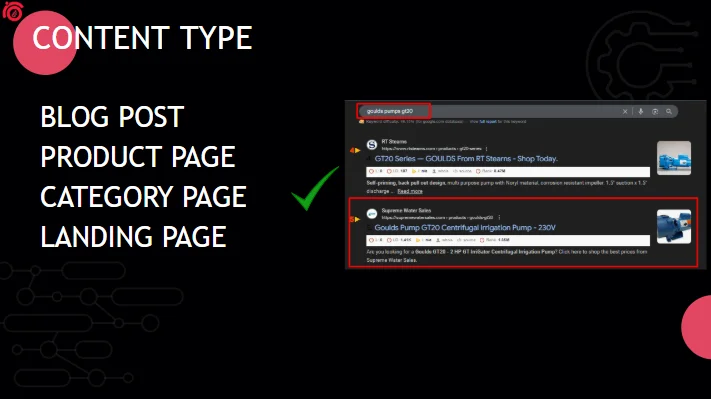
We identified the most appropriate website page types for different product-related searches.
The primary content types included:
- Blog posts: For informational searches, product guides and educational topics.
- Product pages: For customers searching for specific pumps, motors and replacement components.
- Category pages: For broader product searches involving multiple equipment options.
- Landing pages: For targeted commercial searches requiring dedicated product or service information.
One important example was the keyword “Goulds Pumps G20”. Rather than targeting this query through a generic blog post, we focused on the relevant product listing to match the commercial intent.
This approach helped connect product searches with the pages most likely to satisfy customer requirements.
2. Content Format
The next step was identifying the right content format for each search category.
We focused on:
- How-to guides
- Where-to-buy guides
- Product tutorials
- Step-by-step explanations
- Product comparison content
- Technical product information
For example, searches involving jet pumps and water treatment products required practical information that could help customers understand product specifications and purchasing considerations.
We also developed content opportunities around topics such as:
- Where to buy pearl jet pumps online.
- How different resins work.
- Pump replacement and maintenance.
- Water filtration solutions.
The objective was to make the website useful throughout the customer’s research and purchasing journey.
3. Content Angle
The third component involved developing a specific content angle for individual commercial keywords.
We concentrated on highly targeted product searches, including:
- Century pool pumps and motors
- Goulds J5S pump rebuild kit
- Goulds Pumps G20
- Goulds J5 replacement components
- Flexcon Challenger pressure tanks
- CentriPro pump control boxes
- Water filtration replacement components
For example, the keyword “Century pool pumps and motors” required product-focused content that highlighted the relevant equipment and its intended applications.
Similarly, “Goulds J5S pump rebuild kit” required a product-specific approach that addressed customers looking for replacement and repair components.
This allowed us to build content around actual product requirements rather than relying on generic industry descriptions.
Targeted Keyword Research and Mapping
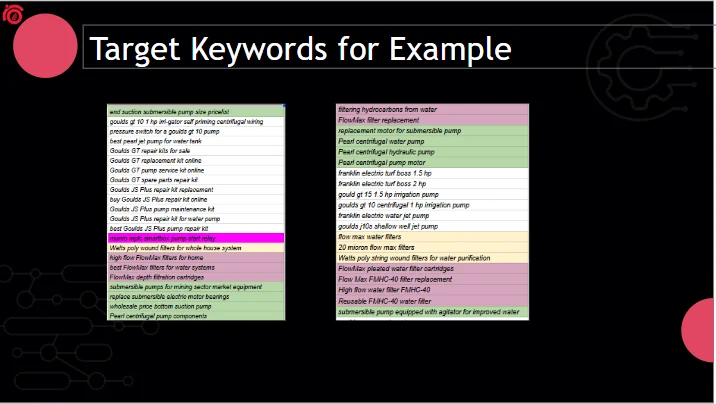
ThatWare conducted keyword research to identify relevant opportunities across Supreme Water Sales’ product categories.
We focused on both broad commercial keywords and highly specific product-related searches.
The keyword research covered:
| Keyword category | Target keyword examples |
| Pool pumps | Century pool pumps and motors |
| Pump components | Goulds J5S pump rebuild kit |
| Centrifugal pumps | Goulds Pumps G20 |
| Pressure tanks | Flexcon Challenger pressure tank |
| Pump controllers | CentriPro pump control box |
| Water filtration | FlowMax filter replacement |
| Pump replacement | Goulds pump replacement parts |
| Water systems | Submersible pump and pressure tank solutions |
We also evaluated keyword competition and search relevance to prioritize opportunities with commercial value.
This helped establish a more organized keyword targeting strategy across product pages, category pages and informational content.
Product Page and Category Page Optimization
For an ecommerce business, product and category pages are central to organic search performance.
Customers searching for specific pump models or replacement components generally expect to find relevant products, specifications and purchasing information.
ThatWare focused on improving the relevance of these pages through:
- Product-specific keyword targeting.
- More descriptive product content.
- Relevant headings and metadata.
- Improved content organization.
- Better alignment between search queries and landing pages.
- Clearer product information.
- Commercial search intent optimization.
We also worked on strengthening the relationship between product categories and their associated products.
This approach helped the website target a broader range of product searches while maintaining relevance at the individual page level.
Technical SEO and User Experience Optimization
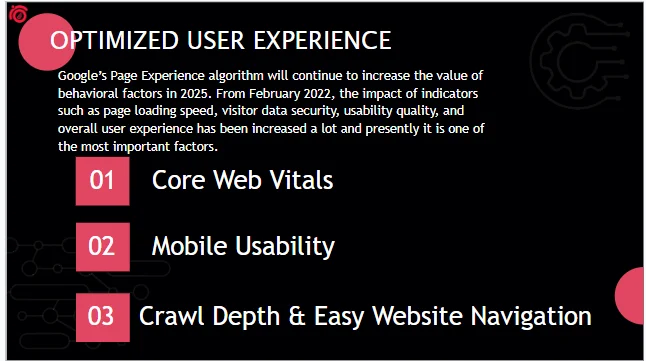
Alongside content optimization, we focused on technical improvements that could support organic visibility and improve the overall browsing experience.
Our approach concentrated on three important areas.
1. Core Web Vitals Optimization
Website performance is particularly important for ecommerce platforms, where visitors frequently browse multiple products before making a purchasing decision.
ThatWare identified several optimization priorities:
- Reduce unnecessary JavaScript execution.
- Implement lazy loading where appropriate.
- Optimize and compress images.
- Provide appropriate dimensions for images and embedded elements.
- Improve server response time.
These improvements were intended to reduce unnecessary loading overhead and create a smoother website experience.
2. Mobile Usability
Customers may research pumps, motors and replacement components using smartphones and tablets.
We considered mobile usability as an important part of the optimization strategy, focusing on content accessibility, navigation and page presentation.
The goal was to make product discovery easier across different devices.
3. Flat Website Structure
We also focused on implementing a flatter website architecture.
A flat structure helps reduce the number of navigation levels between the homepage and important product pages.
Our optimization priorities included:
- Reducing unnecessary click depth.
- Improving access to important product categories.
- Strengthening navigation between related products.
- Making important pages easier to discover.
- Improving internal linking relationships.
This helped establish a more logical website structure for both visitors and search engine crawlers.
AI-Powered Search Visibility Through AEO
One of the important aspects of the campaign was the focus on Answer Engine Optimization.
As search engines increasingly introduce AI-generated summaries and answers, product-focused websites have an opportunity to improve their visibility beyond traditional organic listings.
ThatWare incorporated answer-focused content optimization to strengthen the website’s relevance for specific product questions and technical searches.
The strategy emphasized:
- Clear and direct product explanations.
- Search query-aligned content.
- Relevant technical information.
- Structured content organization.
- Question-based content opportunities.
- Contextual relevance and topical authority.
This approach helped Supreme Water Sales develop content that was more suitable for answer-led search experiences.
What Did the Campaign Achieve?
The campaign produced encouraging organic search and AI search visibility outcomes.
The presentation documents Google search visibility for targeted product keywords, along with appearances in Google’s AI Overviews for selected queries.
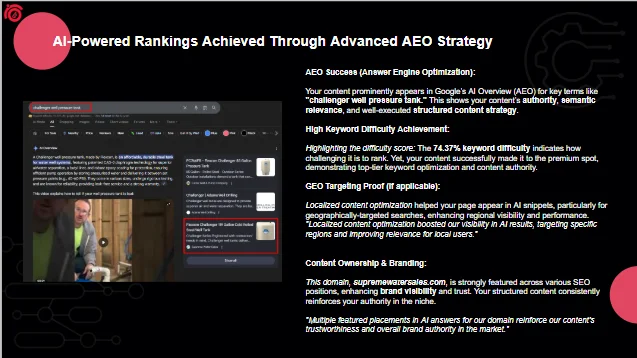
1. AI Overview Visibility for Challenger Well Pressure Tank
Documented AI Overview appearance
Supreme Water Sales achieved visibility in Google’s AI Overview for the query:
“Challenger well pressure tank”
The captured search result demonstrated the website’s content being surfaced within Google’s AI-generated answer experience.
This was particularly relevant because pressure tank searches often involve specific product requirements and technical considerations.
The result demonstrated the value of developing relevant, product-focused content that addresses the information users seek.
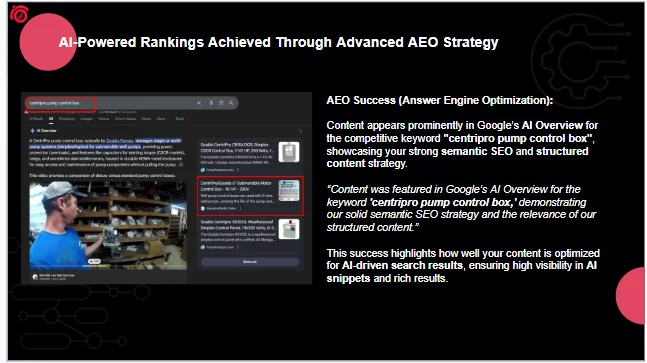
2. AI Overview Visibility for CentriPro Pump Control Box
Documented AI Overview appearance
Another important achievement was the website’s appearance in Google’s AI Overview for:
“CentriPro pump control box”
This result highlighted the relevance of Supreme Water Sales’ content for a specific product-related query.
The achievement was especially valuable because the search involved a specialized equipment category rather than a broad informational topic.
It demonstrated how targeted product content and search intent optimization can support visibility in emerging AI-driven search experiences.
3. Visibility for Competitive Pump-Related Keywords
The campaign also focused on strengthening organic visibility for highly specific product searches.
The documented Google search screenshots included:
- Goulds Pumps G20
- Century pool pumps and motors
- Goulds J5S pump rebuild kit
These examples illustrate the campaign’s focus on matching product-related search queries with relevant ecommerce pages.
4. Targeting High-Competition Search Opportunities
The presentation also highlighted a target keyword with a reported keyword difficulty of 74.37%.
This represented a competitive search opportunity that required a more focused content and optimization strategy.
Rather than relying on broad keyword placement, we worked towards strengthening product relevance, content quality and the website’s overall search presence.
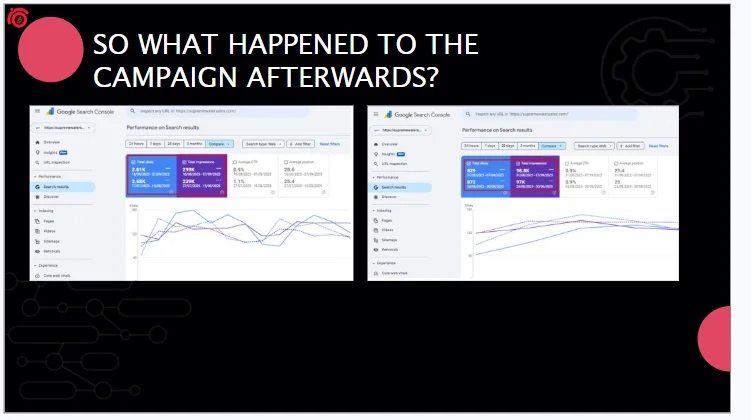
5. Google Search Console Performance
The Google Search Console comparison screenshots demonstrate the website’s organic search performance across two reporting views.
The captured metrics show:
First comparison:
- Total clicks: 2.81K vs. 2.58K
- Total impressions: 239K vs. 223K
- Average CTR: 0.9% vs. 1.1%
- Average position: 28.4 vs. 31.4
Second comparison:
- Total clicks: Approximately 8.29K vs. 8.72K
- Total impressions: Approximately 58.8K vs. 97K
- Average CTR: 0.9% vs. 0.9%
- Average position: 29.4 vs. 29
These comparisons provide insight into the website’s clicks, search exposure, click-through rate and average ranking position across the selected reporting periods.
Key SEO Activities Delivered by ThatWare
The campaign brought together multiple optimization activities rather than relying on a single SEO technique.
| SEO area | Key activities |
| Keyword research | Commercial and product-specific keyword mapping |
| Search intent | Content type, format and angle analysis |
| Ecommerce SEO | Product and category page optimization |
| Content strategy | Product guides, tutorials and informational content |
| Technical SEO | Core Web Vitals and performance improvements |
| Website architecture | Flat structure and reduced crawl depth |
| User experience | Mobile usability and navigation improvements |
| AEO | Answer-focused content optimization |
| AI search | Google AI Overview visibility targeting |
| Performance monitoring | Google Search Console reporting |
Our Enterprise SEO Implementation Roadmap
Successful enterprise SEO requires a structured process that connects discovery, strategy, implementation, and continuous performance improvement.
Unlike smaller SEO campaigns, enterprise initiatives often depend on development schedules, regional stakeholders, content approval workflows, and existing technology infrastructure.
A phased roadmap helps organizations manage these dependencies while prioritizing improvements with the greatest potential impact.
At ThatWare, we organize enterprise SEO engagements around five interconnected phases.
Phase 1: Enterprise SEO Discovery and Technical Assessment
The first phase establishes a clear understanding of the website’s current search performance, technical infrastructure, and business priorities.
We evaluate the website’s architecture, indexation status, content ecosystem, internal linking relationships, and competitive search environment.
The assessment may include:
- Enterprise technical SEO auditing
- Large-scale website crawling
- Server log analysis where access is available
- Indexation and canonicalization reviews
- Internal linking and PageRank analysis
- Organic performance benchmarking
- International SEO configuration reviews
- Initial AI visibility assessments
We also identify commercially important pages and priority markets.
Primary deliverable: An enterprise SEO audit with a prioritized opportunity and risk assessment.
Phase 2: Strategic Planning and Enterprise SEO Governance
Following the discovery process, we translate findings into a structured SEO strategy.
Recommendations are prioritized according to business relevance, implementation complexity, and potential search impact.
This phase establishes the operational framework needed to execute SEO initiatives across relevant teams.
Activities include:
- Enterprise keyword and search intent mapping
- Website architecture recommendations
- Technical SEO prioritization
- International market planning
- Content gap and topical cluster analysis
- Stakeholder responsibility mapping
- SEO governance guidelines
- KPI and reporting framework development
Primary deliverable: A phased enterprise SEO strategy and implementation roadmap.
Phase 3: Technical SEO and Website Architecture Implementation
The third phase focuses on addressing high-priority technical barriers and improving the website’s underlying search accessibility.
Implementation may involve collaboration with internal developers, content management teams, and platform administrators.
Priority activities can include crawl optimization, canonical corrections, structured data improvements, navigation adjustments, internal linking enhancements, and template-level SEO updates.
For large websites, we recommend testing significant changes on representative templates or controlled URL groups before expanding implementation.
This helps teams evaluate potential risks and validate improvements before wider deployment.
Primary deliverable: Implemented technical improvements with documented validation results.
Phase 4: Content Optimization, Entity Intelligence, and AI Search Readiness
Once the technical foundation is being addressed, the roadmap expands into content relevance and semantic optimization.
We identify priority commercial topics, evaluate existing content quality, and recommend improvements that better satisfy user search intent.
Our activities may include:
- Enterprise landing page optimization
- Topic cluster development
- Content consolidation and cannibalization reduction
- Entity relationship analysis
- Contextual internal linking improvements
- Structured data recommendations
- Answer-focused content optimization
- AI citation and visibility gap assessments
We also evaluate opportunities to make important content easier for search engines and AI-powered systems to discover, interpret, and reference.
These activities support AI search readiness without guaranteeing citations, rankings, or AI-generated recommendations.
Primary deliverable: An optimized enterprise content framework supported by SEO, AEO, and GEO recommendations.
Phase 5: Continuous Monitoring, AVM/VEM Analysis, and Performance Refinement
Enterprise SEO does not end after technical fixes and content updates are published.
Search behavior changes, competitors introduce new strategies, websites expand, and AI-powered discovery environments continue evolving.
Our final phase establishes an ongoing process for monitoring performance and identifying new optimization opportunities.
This includes:
- Organic search performance reviews
- Technical health monitoring
- Indexation and crawl trend analysis
- Commercial conversion tracking
- International market comparisons
- AI visibility and citation monitoring
- Entity and topical coverage reviews
- Competitive benchmarking
- Implementation progress reporting
Findings are used to refine priorities and inform future optimization cycles.
Primary deliverable: Ongoing performance dashboards, stakeholder reporting, and a continuously updated SEO improvement roadmap.
Build a Scalable Enterprise Search Strategy with ThatWare
Enterprise SEO requires more than increasing rankings for individual keywords.
It requires a coordinated strategy that connects technical infrastructure, website architecture, content relevance, international market requirements, organizational workflows, and business performance.
ThatWare combines enterprise SEO practices with advanced analytical approaches to help organizations understand their search opportunities and develop scalable optimization strategies.
Whether your organization manages a large ecommerce platform, multiple regional websites, a complex B2B service ecosystem, or an expanding digital content portfolio, our approach is designed around your technical environment and commercial objectives.
Ready to evaluate your enterprise search performance?
Connect with ThatWare to discuss an Enterprise SEO and AI Visibility Metric covering website architecture, technical performance, organic search opportunities, and AI-powered discovery readiness.
CTA: Request Your Enterprise SEO Assessment
Discuss the work relevant to your website
A case study becomes useful when you can connect the approach to your own requirement. Tell us which website sections, markets and customer questions matter to your business. We can discuss the relevant work, the evidence available and a suitable scope.
Discuss a comparable search challenge
Measurement that connects to business priorities
Our work on search visibility for enterprise starts with the measures that matter to the organization. A category’s search exposure, a service page’s inquiries and a brand’s appearance in generated answers answer different questions.
Our SEO reporting for enterprise can examine relevant search queries, landing pages, organic visits and agreed conversion events. Where reliable data is available, the reporting can also consider lead quality or attributable revenue. The chosen measures should reflect the business model and the engagement.
For AI search visibility for enterprise, we record the questions being monitored and the kind of appearance observed. A useful report can identify whether the brand was mentioned, whether a page was cited and whether the description was accurate for the question asked.
Our AI visibility reporting for enterprise includes enough context to interpret those observations. Platform, prompt, date, market and available references help explain what was recorded and how it compares with the previous review.
| Measurement area | Example measures | What the measures help explain |
|---|---|---|
| Organic search | Relevant impressions, clicks and landing-page visibility | Whether important pages are reaching search demand |
| Website acquisition | Organic sessions and relevant visitor behavior | How organic visitors use the website |
| Business outcomes | Agreed inquiries, qualified leads or attributable revenue | Whether the traffic supports business goals |
| AI answer visibility | Recorded mentions, citations and accurate descriptions | How the brand appears in the monitored answers |
| Delivery | Completed changes, approvals and outstanding dependencies | What has been implemented and what needs attention |
Reporting should lead to a decision. We explain which findings support further work, which pages deserve another review and where the available evidence is still limited.
Press releases and public announcements
For a business evaluating a partner, public announcements can help explain the organization’s work, research and developments. They are most useful when the subject is specific and the supporting details are accessible.
Our press resources provide a route to ThatWare announcements and related coverage. Readers can examine the subject, publication context and supporting information for themselves.
Explore ThatWare press releases
Keynotes and industry presentations
Our public presentations give prospective clients another way to examine the subjects and methods discussed by the team. They can provide context for questions about semantics, information retrieval and search strategy.
For example, Tuhin Banik presented a session on the significance of cost retrieval and semantics in SEO at brightonSEO in September 2023. The event listing provides the session details and a link to the presentation slides.
Explore ThatWare keynotes and presentations
Scope and SEO pricing for enterprise
The cost of a search engagement depends on the work involved. Website complexity, markets, content requirements, specialist analysis and implementation support all affect the scope.
We establish those requirements before recommending SEO pricing for enterprise. The proposal should make the deliverables, responsibilities, reporting arrangements and review process clear. If several teams are involved, it should also identify the dependencies that influence delivery.
When comparing an SEO company for enterprise with other options, examine the work your organization will actually receive. Ask how priorities are selected, how content is reviewed, which changes the agency implements and which measures will be used to assess progress.
Our role is to provide a scope that your team can evaluate against its needs and available resources.
Build a search program around your enterprise priorities
Your website needs a clear role in the customer’s research. Important pages should explain the business accurately, answer useful questions and lead visitors toward the right next step. Your team also needs a plan it can deliver and reporting it can use.
We bring AI discovery for enterprise together with organic search priorities, relevant content and defined measurement. Tell us which markets, website sections and commercial goals matter most. We will discuss a scope that connects those requirements with practical work.