
Get a Customized Website SEO Audit and Online Marketing Strategy and Action Plan
What is the report all about?
An on page audit report is a type of report which helps us to make sure that a website is fixed page-wise based on landing pages. In other words, this report ensures that page-wise fixes are being performed and every single page follows proper white-labeled SEO protocols.
Type of the report: This is a suggestion report for the client from the SEO team. This is a proper format for an on-page free website SEO audit that can help any client to understand the SEO parameters! Today in this guide we will show you how to conduct a real on-page SEO audit.

Introduction to On-Page SEO Audit
For this on-page SEO audit, we have analyzed the following landing page:
https://thatware.co/advanced-seo-services/
Focus Keyword: Advanced SEO
Color Code Legend
- Red: Indicates an issue that requires immediate correction
- Yellow: Suggestions provided; changes to be implemented after approval
- Green: No issues detected; no action required
Chapter 1 – URL Mapping
Purpose in SEO
An SEO-friendly URL should be concise, free from stop words and unnecessary query parameters, include the target keyword, maintain minimal folder depth, and clearly reflect the page’s intent.
Current Observation
The existing URL structure is:
/advanced-seo-services
Status
The URL is clean, short, and free of query parameters. It also includes the focus keyword, making it SEO-compliant.
Status: Green – No action required
Chapter 2 – Metadata
Purpose in SEO
An optimized meta title should ideally remain within 55 characters and include the primary keyword. Similarly, the meta description should be up to 155 characters and contain either the main keyword or a relevant variation to improve CTR and relevance.
Current Observation
- Current Meta Title: Advanced SEO Services – Thatware
- Current Meta Description: Not available
Status
The page currently lacks a meta description, which is a critical SEO element. Additionally, the existing meta title is very short and may appear generic or spam-like. Optimization is necessary to improve search visibility and click-through rates.
Status: Red – Change required
Recommended Metadata
Proposed Meta Title:
Advanced SEO Services – #1 Advanced SEO Company | Thatware
Proposed Meta Description:
Thatware delivers exclusive SEO solutions by combining advanced search engineering, data science, and AI. Recognized as a top-rated SEO agency worldwide.
Chapter 3 – Page Source Code Robots
Purpose in SEO
Robot directives within the page source determine whether search engine crawlers can index and follow a page. Ensuring proper robot instructions at the page level is essential, as directives may vary from domain-wide settings.
Current Observation
A robot directive is correctly declared in the page source, as verified through inspection.
Status
Since search engine bots are allowed to crawl and index the page, no corrective action is required.
Status: Green – No action required

Chapter 4 – Mixed Content Requests
Purpose in SEO
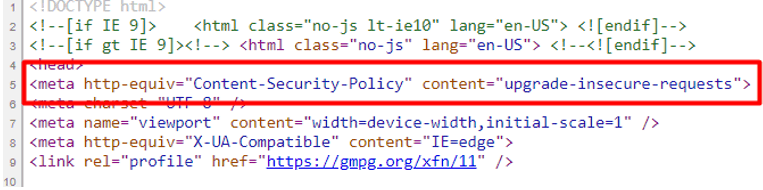
Mixed content issues arise when a page loads both HTTP and HTTPS resources, which can negatively affect security and SEO. To prevent this, a Content Security Policy directive is recommended.
Recommended Code:
<meta http-equiv=”Content-Security-Policy” content=”upgrade-insecure-requests”>
Current Observation
The mixed content prevention code is already implemented in the page source.
Status
The page is protected against mixed content issues.
Status: Green – No action required
The website has the Mixed content prevention code within the page source
Chapter 5 – Open Graph Protocols (OGP) with Featured Image
Purpose in SEO
Open Graph tags enhance social media visibility and brand presentation. Proper OGP implementation ensures that the correct title, description, and featured image appear when the page is shared across platforms, indirectly supporting SEO performance.
Current Observation
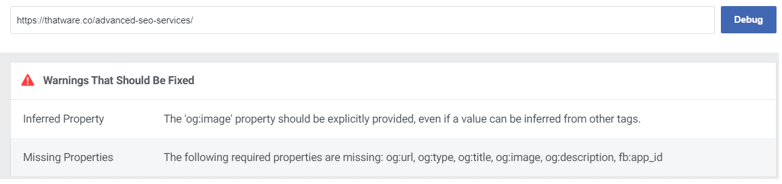
Using the Facebook Debugger tool (https://developers.facebook.com/tools/debug/), the landing page was tested by fetching new information. The results indicate that Open Graph tags and a featured image are not being displayed.

Then click on debug and click on “fetch new information” and check whether the title, description, and feature images are being shown. If it is shown, then we have a Feature image and OGP tags on the website else no.
Status
The absence of Open Graph metadata means social sharing previews are not optimized. OGP values need to be added to the page source.
Status: Red – Implementation required
Recommended OGP Code
<meta property=”og:title” content=”Advanced SEO Services – #1 Advanced SEO Company | Thatware” />
<meta property=”og:description” content=”Thatware provides exclusive SEO services by blending advanced search engineering, data science, AI, and more. Recognized as a top-rated SEO agency.” />
<meta property=”og:url” content=”https://thatware.co/advanced-seo-services/” />
<meta property=”og:image” content=”https://thatware.co/wp-content/uploads/2020/06/advanced-seo-768×479.png” />
Implementation Note:
For WordPress websites, this can be configured using plugins like Yoast SEO. For custom implementations, the code should be added manually within the <head> section.
Chapter 6 – Geo Tag
Purpose in SEO:
Geotag provides exposure to local search and boosts GMB performance.
Current observation:
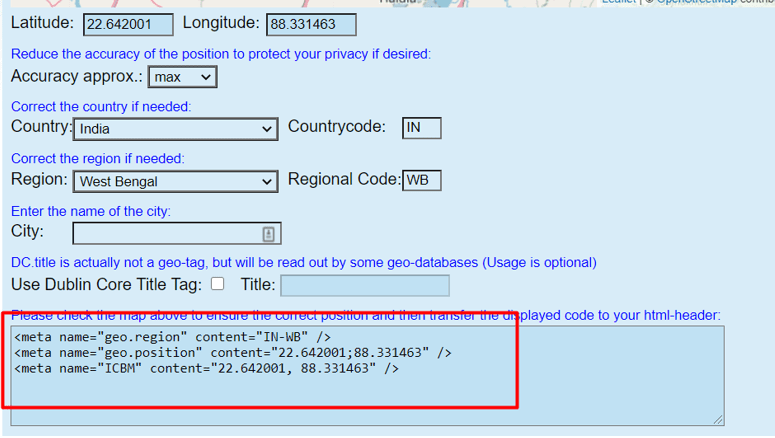
No GEO tag was found in the source code
Status:
The status is not good as no GEO tag have been found on the source code.
Visit: https://www.geo-tag.de/generator/en.html and paste your address
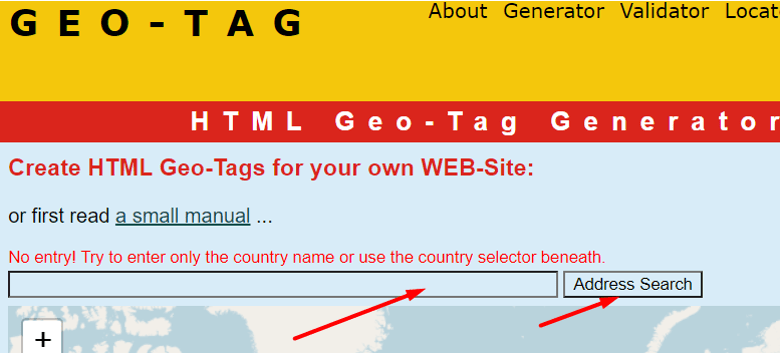
Then click on “Address search” below is the code which you will get as a GEO tag and this needs to be implemented on <head> of the website.
Chapter 7 – Page mobile-friendly test
Purpose in SEO:
This is one of the most vital parameters of SEO. This ensures if the landing page is mobile-friendly or not. Since Google now follows the “Mobile-first indexing” rule. Hence, having a mobile-friendly site is a must!
Current observation:
Visit: https://search.google.com/test/mobile-friendly and test the URL to check out the data provided by the tool. We have done a similar test and below is what we receive in our result. Make sure to also check “if no loading issues persist” and also check the “Screenshot” to make sure the rendered page has no issues.
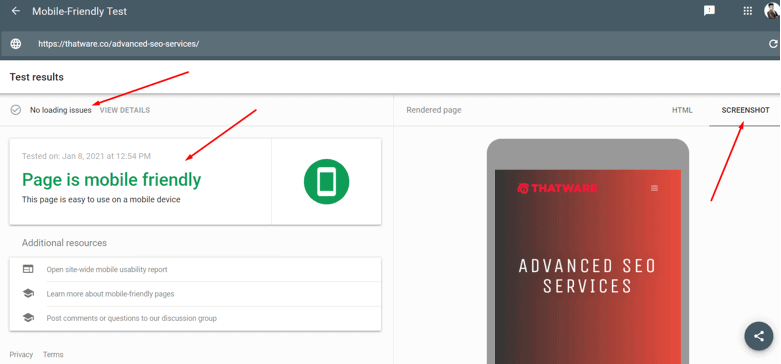
Status:
No action needed, the page is mobile friendly.
Chapter 8 – Robots.txt tester
Purpose in SEO:
This is a very basic yet effective test. This test ensures that the page is not blocked by Robots in any way possible. This serves as a very important factor for on page SEO audit.
Current observation:
Visit: https://www.google.com/webmasters/tools/robots-testing-tool
Make sure the Google search console is integrated else this feature will not work.
After that choose your domain name and hit the test button. After that, you will get a screen like this as shown below:
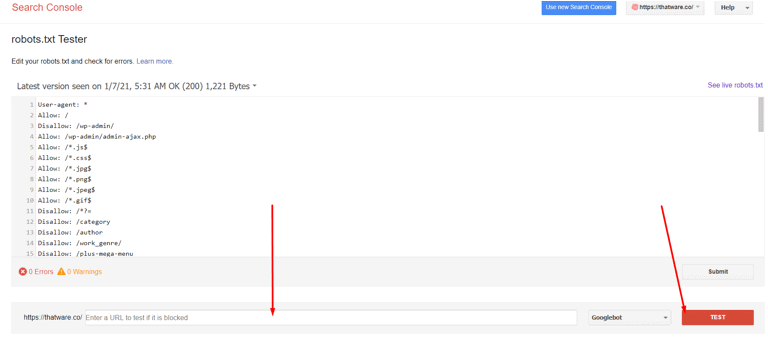
Enter the path and click on “test”
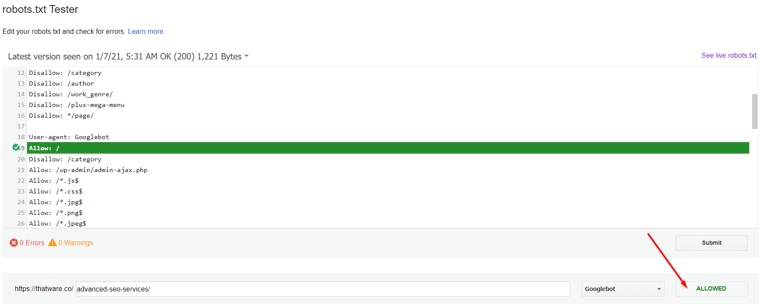
In our case, we have got “Green Allowed” as shown in the screenshot above!
Status:
No action needed. The URL is not blocked by the robots.
Chapter 9 – GSC fetch check-up (Live testing)
Purpose in SEO:
This functionality is used to test the URL fetch statistics. In other words, this is used to check if the URL has been fetched properly without any issues. Please note, we will be doing Live testing.
Current observation:
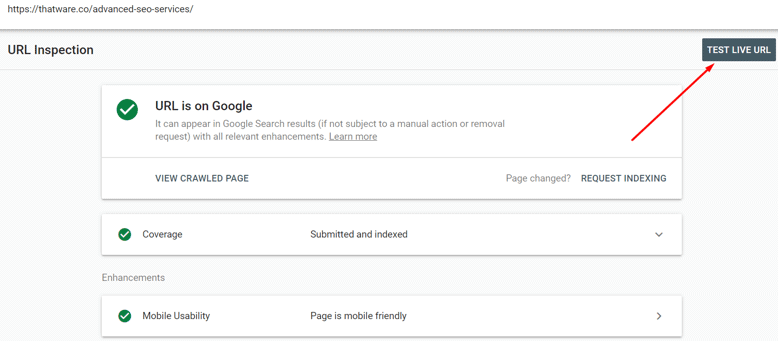
The first step is to paste the URL on the URL inspection bar. Check the below screenshot for reference.
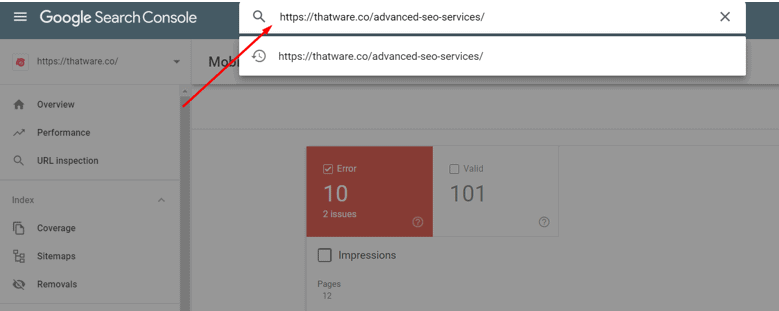
After that click on “Test Live URL”. Please check the screenshot below:
Once the “Test Live URL” has been fetched this will show the current status of the URL as to whether it’s free of any errors or not. Check the below screenshot which we obtained in the final stage.
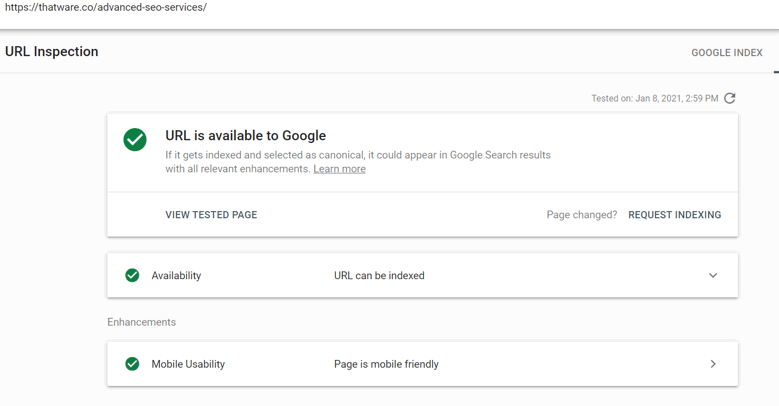
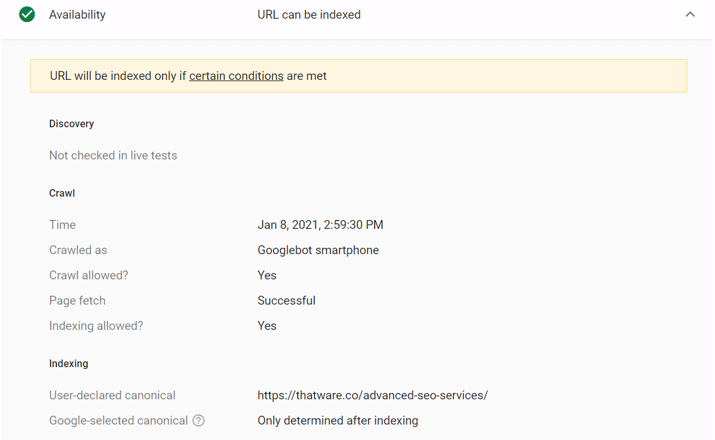
Status: As seen from the below screenshot, the Live test is successful as fetch and crawl are allowed on the URL and also there are no issues during the rendering. Hence, no action needed. Status is ok!
Chapter 10 – XML sitemap inclusion (live testing)
Purpose in SEO:
The purpose of this procedure is to ensure the URL is available on Sitemap (XML) and also follows all the protocol order.
Current observation:
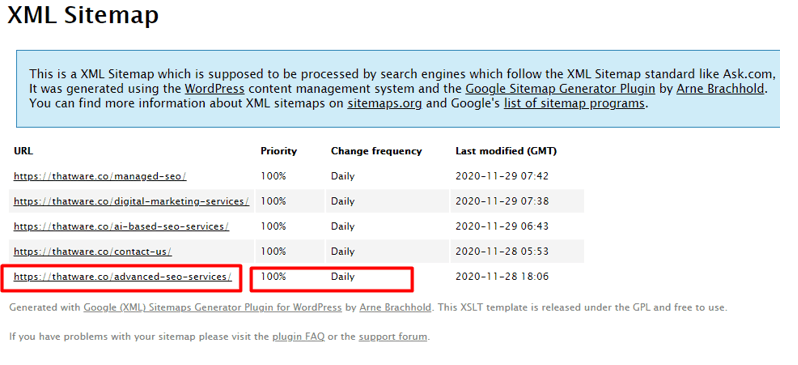
We have opened our Sitemap from https://thatware.co/sitemap.xml and have checked whether our landing page is available or not. And we have found that the URL is available on our XML version and also the protocols are there as well.
Status:
The URL is present in the XML sitemap and also the protocols are being followed. Hence, no action needed, Status is ok!
Chapter 11 – H-tags check-up
Purpose in SEO:
In SEO the existence of H1, H2, and H3 should be adhered. The rule is as under:
H1 should contain the Focus keyword and must be one in quantity
H2 should contain the LSI variation
H3 should contain the Long tail variation
Current observation:
For the H1 tag, the protocol is followed as it contains the focus keyword! Check the screenshot below for confirmation. Also, the number of H1 must be one!
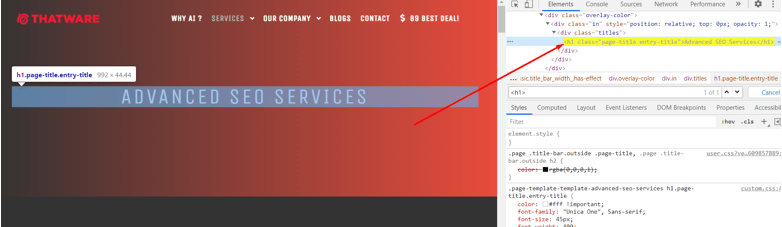
Quantity of H1

For H2 tag, the protocol is followed as it contains the LSI keywords! Check the screenshot below for confirmation.
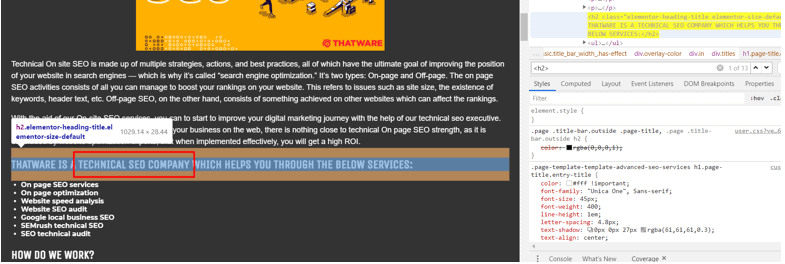
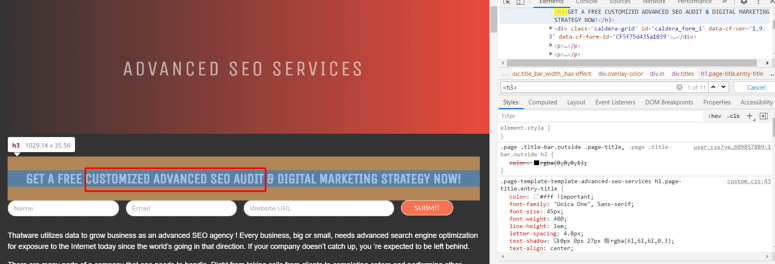
For the H3 tag, the protocol is followed as it contains the long-tail keywords! Check the screenshot below for confirmation.
Status:
H1 is Ok
Quantity of H1 is Ok
H2 is Ok
H3 is Ok
Chapter 12 – Anchor Text & Internal Linking Review
Purpose in SEO
Anchor text plays a critical role in SEO by helping search engine crawlers understand the subject relevance of a linked page. It also strengthens the internal linking framework and improves topical authority across the website. Best practices for anchor usage include:
- Incorporating brand-based anchor texts
- Using keyword variations and LSI-based phrases
- Avoiding exact-match keyword repetition for the same target page
Current Observation
No internal anchor texts were identified on the landing page.
Status
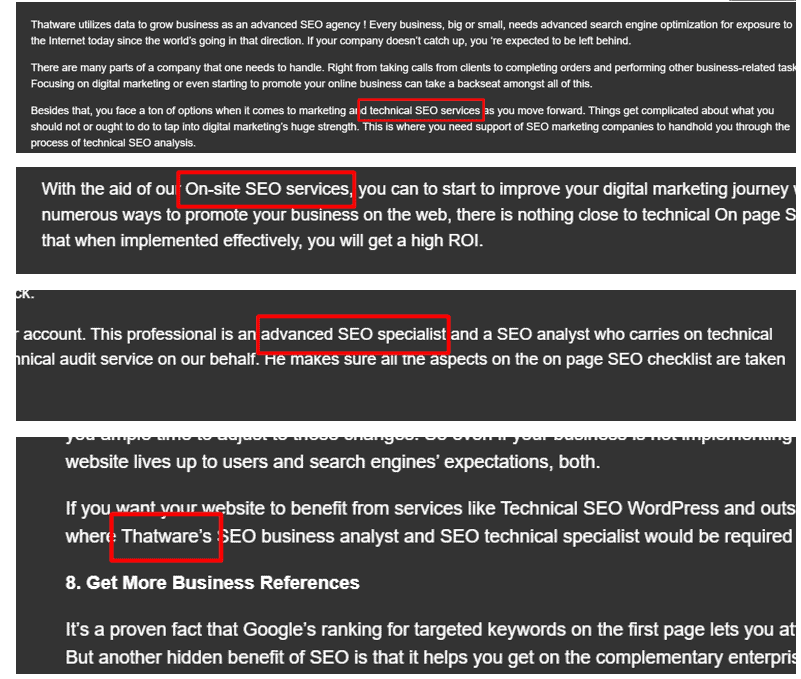
To improve internal link distribution and contextual relevance, the following anchor texts should be added and linked to the respective pages:
- “technical SEO services” → https://thatware.co/technical-seo/
- “on-site SEO services” → https://thatware.co/on-page-seo-practices/
- “advanced SEO specialist” → https://thatware.co/advanced-seo/
- “Thatware” → https://thatware.co/
Status: Suggestions provided – pending implementation
Chapter 13 – Duplicate Content Assessment
Purpose in SEO
Duplicate or plagiarized content can negatively impact search engine rankings. For optimal SEO performance, all landing page content should be original and free from duplication.
Current Observation
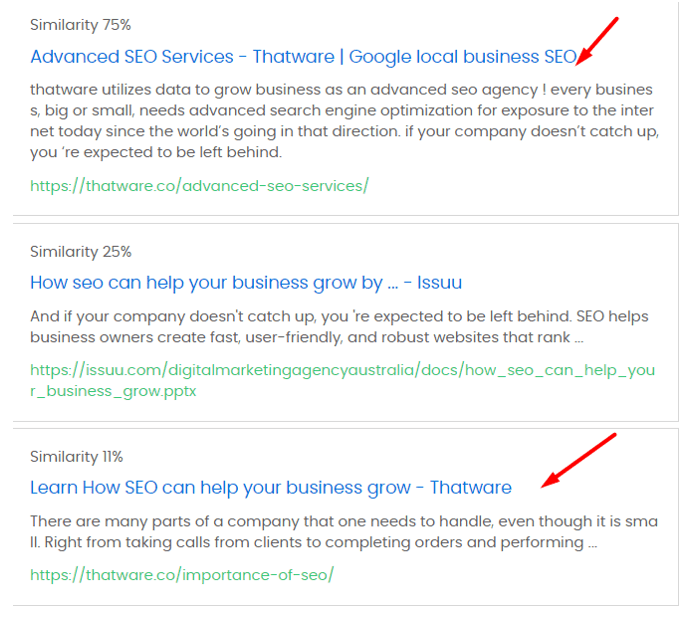
The content was tested using https://www.duplichecker.com/ by submitting the full landing page text. The results indicate 86% content uniqueness, as shown in the referenced analysis.
Status:
Since we have 86% of unique content. Hence, no action needed. Status is Ok!
Chapter 14 – In-Link Analysis
Purpose in SEO
In-links follow a reverse internal linking strategy based on SILO architecture. This approach strengthens page authority by directing internal link equity from multiple pages toward a target landing page. Ideally, the number of incoming links should exceed outgoing internal links.
Current Observation
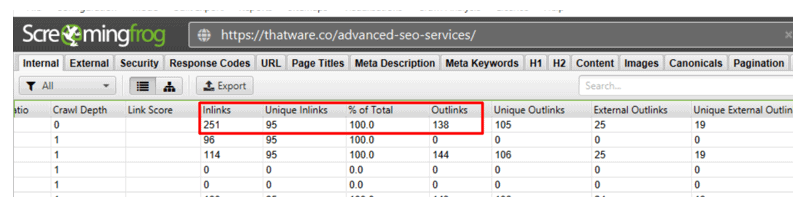
Based on analysis using Screaming Frog SEO Spider:
- Outbound links: 138
- Inbound links: 251
The number of incoming links exceeds outgoing links, which aligns with best practices.
Status
The in-link structure is healthy and requires no optimization.
Status: Green – No action needed
Chapter 15 – External Link Review
Purpose in SEO
According to the principles of PageRank sculpting, including at least one outbound link to a high-authority external resource helps improve credibility and SEO trust signals.
Current Observation
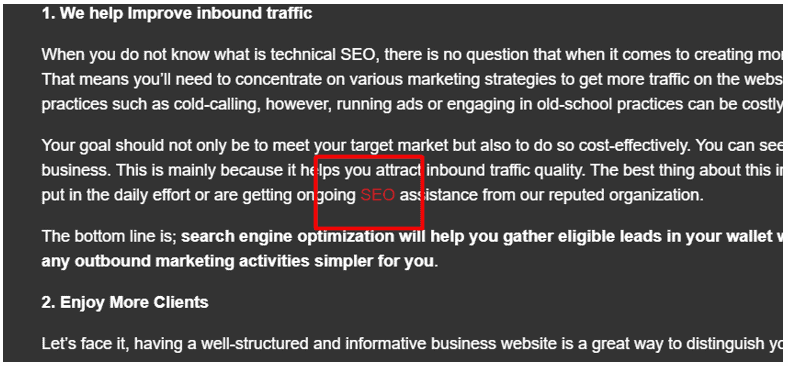
The landing page contains an external link associated with the term “SEO”, pointing to a high-authority source:
https://en.wikipedia.org/wiki/Search_engine_optimization
Status
The external linking strategy is correctly implemented.
Status: Green – No action needed
Chapter 16 – LSI Keyword Evaluation
Purpose in SEO
LSI (Latent Semantic Indexing) keywords contribute to semantic relevance and help search engines better understand content context, supporting organic visibility growth.
Current Observation
The landing page includes multiple contextual keyword variations, indicating effective use of LSI terms throughout the content.
Status
LSI optimization is adequate and requires no changes.
Status: Green – No action needed
Chapter 17 – Featured Snippet Passage Review
Purpose in SEO
Short, well-structured content blocks ranging between 40–60 words improve eligibility for featured snippet placements in search results.
Current Observation
Several concise passages within the landing page fall within the optimal 40–60 word range.
Status
The page is well-optimized for featured snippet opportunities.
Status: Green – No action needed
Chapter 18 – Schema mark-up basic and advanced
Purpose in SEO:
Schema mark-up is very essential and should be implemented as it helps search engines to understand more about the context of the landing page.
Current observation:
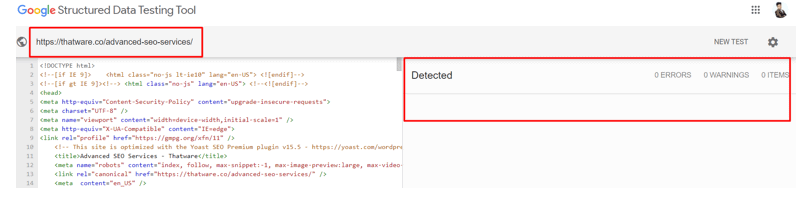
As tested from https://search.google.com/structured-data/testing-tool/
We have found that there is no schema within the website. Check the screenshot below:
Status:
Status is not good, basic schema is missing.
It’s our advice to include the following on the schema to ensure proper justification on the purpose:
- Organization
- Local business
- NAP details
- Landing page content information
- FAQ
- Additional contents
- Additional author information’s
Chapter 19 – Self-referential Canonical check-up
Purpose in SEO:
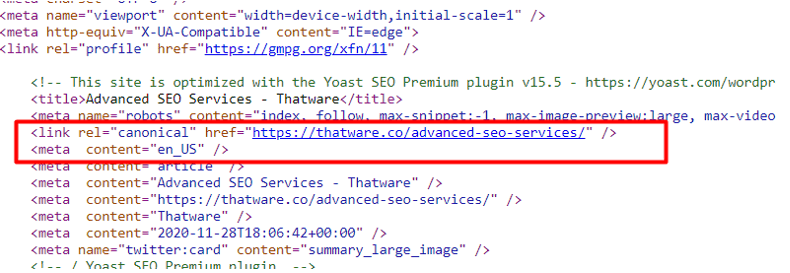
Self-referential canonical tags are the tags that are used in the landing page with the same version of the URL with a slash ending in the URL. For example:
www.example.com should have a self-referential canonical tag as
< link rel=”canonical” href=”https://example.com/” / >
Current observation:
When we checked the source code of the page, we found that the self-referential canonical tag is contained. Please check the below screenshot!
Status:
No action needed, status is ok!
Chapter 20 – Web vitals check-up
Purpose in SEO:
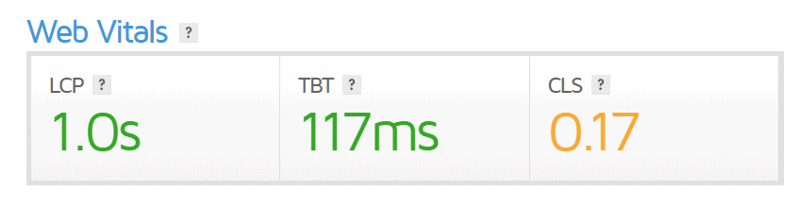
WEB vitals are the future of SEO. These are the technical parameters that judge the user’s interactivity vital points! In other words, it’s a measure of user experience on your landing page.
Current observation:
Tested from GTMETRIX, below is the screenshot!
Status:
No action needed. Status is ok!
Chapter 21 – GTMetrix check-up
Purpose in SEO:
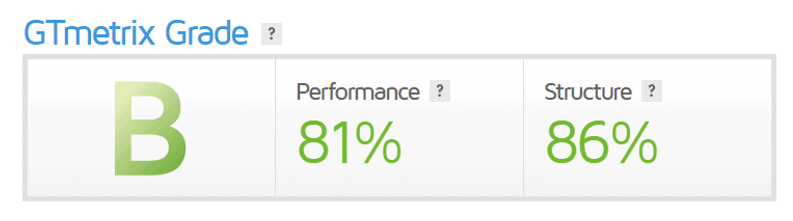
GTMetrix serves as an important source to understand the speed-related purpose of a campaign.
Current observation:
Tested from GTMETRIX, below is the screenshot!
Status:
No action needed. Status is ok!
Chapter 22 – TTFB check-up
Purpose in SEO:
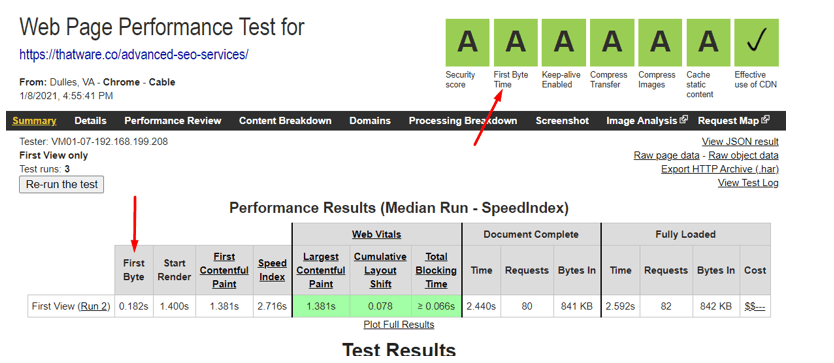
TTFB stands for “Time to First Byte”. This indicates how fast does a website need to load 1 Byte. The ideal range is below 500 ms. This is a very important SEO ranking factor.
Current observation:
Visit https://www.webpagetest.org/ as seen from the below screenshot, TTFB = 182 ms.
Status:
No action needed. Status is ok!
Chapter 23 – Safe browsing check-up
Purpose in SEO:
Google safe browsing is a way to measure whether a given site is free from Malware and malicious files. This will ensure safe browsing for users and it helps for ensuring proper SEO score.
Current observation:
Visit: https://transparencyreport.google.com/safe-browsing/search?hl=en and search with the landing page
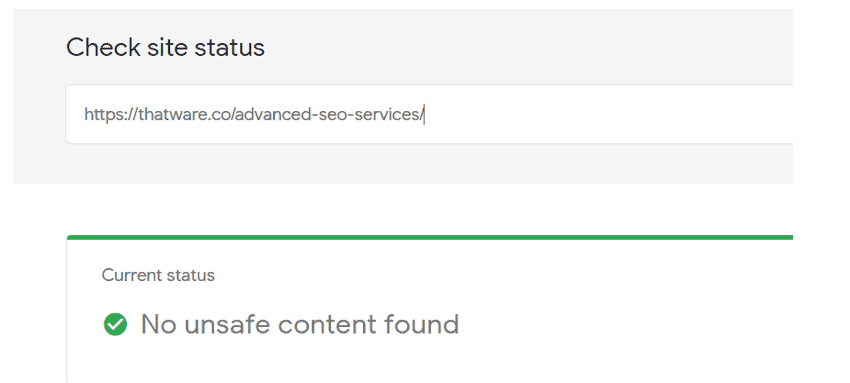
Status:
No action needed. Status is ok!
Chapter 24 – JS rendering
Purpose in SEO:
The purpose is to check whether a webpage loads by disabling all JS. This ensures smooth JS rendering which is an essential part of on page audit in SEO.
Current observation:
Download chrome developer’s tool and click on “disable JavaScript” and load the page once again! Look the screenshot below.
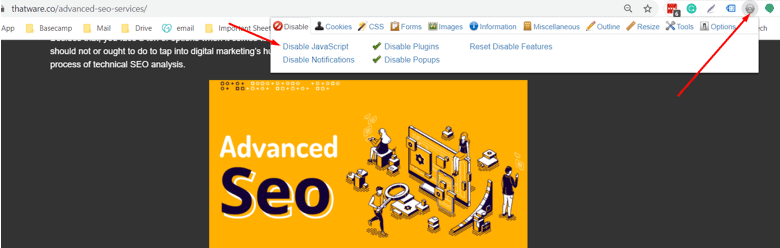
Check the below screenshot, this is the first fold view of the website by keeping JS disabled. But the UX is unhampered. This proves that JS rendering issue is not an issue here!

Status:
No action needed. Status is ok!
Chapter 25 – Latest Crawl status check
Purpose in SEO:
This is to check and ensure the landing page is frequently crawled at least within the last 4-5 days. Beyond that would indicate a poor crawl rate for the website which is not good for SEO.
Current observation:
Once again go to GSC and click on URL inspection and search the URL and then click on “Coverage”
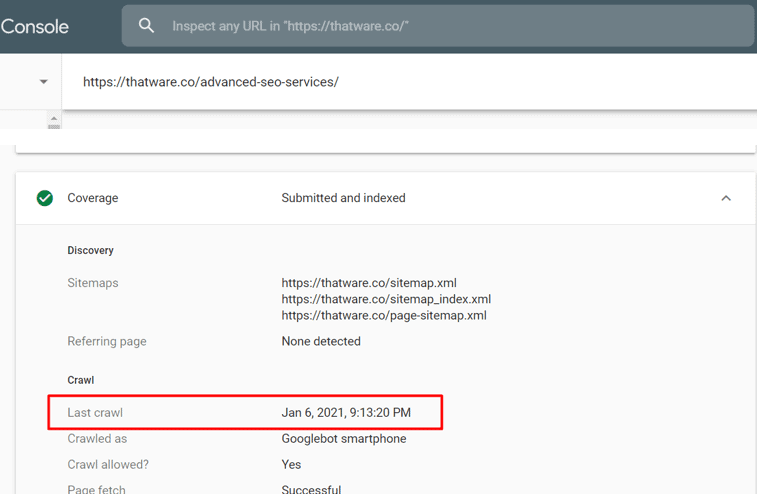
Status:
As seen from the above screenshot, the last crawl date was 6th Jan and the time of reporting this report is the 8th of Jan, hence the crawl status is ok.
You can read more about crawl optimization here: https://thatware.co/crawl-budget/
Chapter 26 – Request protocol check-up
Purpose in SEO:
Protocols are HTTP requests which tell search engines about the status of the page. Some of the common protocols are as under:
- 2XX = Successful status
- 3XX = Redirection status
- 4XX = Not found status
- 5XX = Server error status
The main thing to look forward is to ensure that the given landing page doesn’t contains any of the following:
- No 4XX errors
- No 302, 307 etc. but can contain 301 errors
- No redirect chains
- No server errors
- If 2XX obtained, then it’s good to go!
Current observation:
As seen from Screaming frog spider under the “Response codes” tab, we get the below result which states the page is 200

Status:
No action needed. Status is ok!
Chapter 27 – Index status using the site: search
Purpose in SEO:
This is one of the very basic yet an important aspect of on page SEO audit. Index status report ensures that the given landing page is indexed by site: command
Current observation:
Put this command in Google search, check screenshot below.
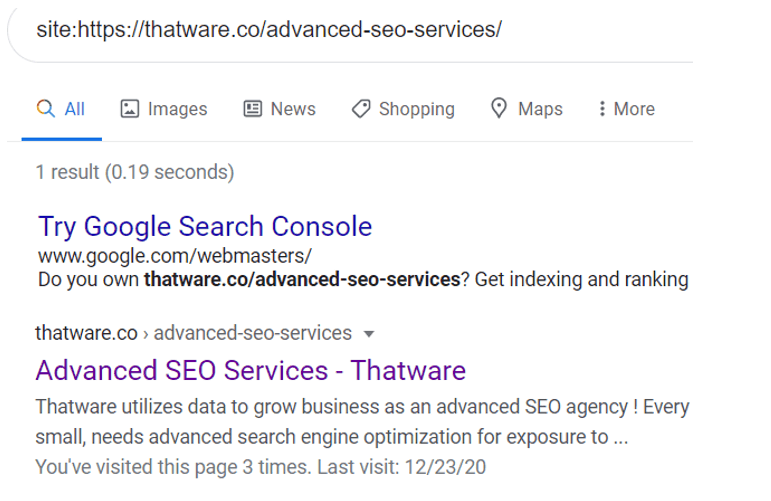
Status:
We get the index result snippet after the site command. Hence, no action needed, status is ok!
Chapter 28 – Image Alt tag check-up
Purpose in SEO:
An ALT tag is a must for all the images present within a landing page. An ALT tag is a part of the SEO ranking factor and helps in improving the image search visibility. When an On page SEO audit is conducted on a page having multiple images then all the images must contain an ALT tag!
Current observation:
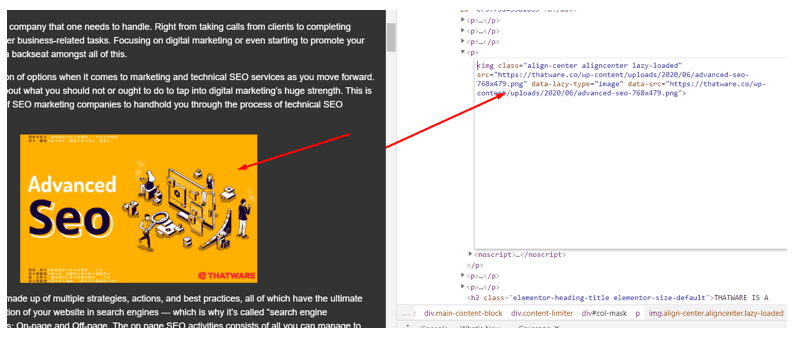
First of all, we see that the landing page contains only 1 image. Then we have inspected and checked the image path. And found no ALT tag. Check the screenshot below:
Status:
ALT tag is missing; hence the status is not good.
Please put Alt text = “Advanced SEO services” as the ALT tag
Chapter 29 – Image optimization
Purpose in SEO:
Image optimization includes checking the size of the image so that it doesn’t become too large else it will cause slow loading of the page. When an on page SEO is conducted for a page having multiple images then the combined size shouldn’t exceed 3 MB
Current observation:
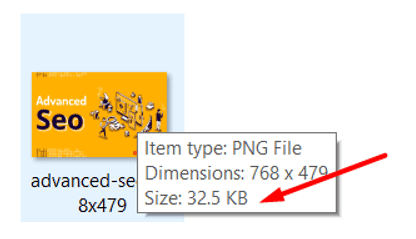
Download the image and check the size.
In our case, we found the size to be 32.5 KB which is perfectly fine. Check the screenshot below!
Status:
No action needed, status is ok!
Chapter 30 – Crawl depth check-up
Purpose in SEO:
Crawl depth is the number of clicks needed to visit the landing page from the homepage. The ideal score is to keep within 3.
Current observation:
Open Screaming frog and check the value, in our case the value is 0 as seen in the screenshot below:

Status:
No action needed, status is ok!
Chapter 31 – Content check-up
Purpose in SEO:
The basic golden rule is that the landing page content should be more than 1000 words. Content word count is a vital parameter to judge the on page SEO audit success.
Current observation:
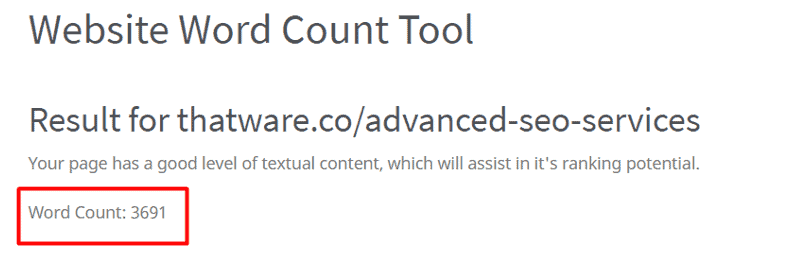
Visit: https://www.seoptimer.com/website-word-count and check the word count & check the screenshot below! The word count is 3691
Status:
No action needed, status is ok!
Chapter 32 – Same page linking
Purpose in SEO:
The same page internal link makes an important SEO improvement as it helps to effectively distribute the topic idea about the landing page in search engines. The same page anchor must be closely related to the focus keyword or the focus keyword itself.
Current observation:
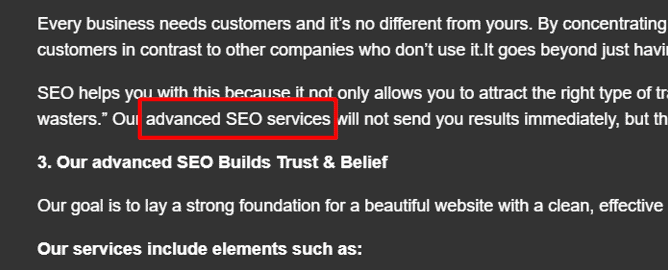
No such link found
Status:
Check the below screenshot, make it hyperlink to the same landing page itself
Chapter 33 – Longtail check-up
Purpose in SEO:
Long keywords are an important part of SEO. They are responsible for the organic and semantic growth of a website. It also helps in improving intent signal as well
Current observation:
The landing page is optimized with long tail as traces of long tail keywords have been spotted!
Status:
No action needed, status is ok!
Chapter 34 – Hyper-Intelligence SEO Integration
Purpose in SEO
Hyper-Intelligence SEO represents the next phase of website optimization, where artificial intelligence, predictive analytics, and advanced automation converge to elevate both content and technical SEO performance. Unlike conventional SEO audits that rely on periodic checks, Hyper-Intelligence SEO operates continuously, monitoring websites in real time.
This advanced framework identifies subtle performance gaps, emerging semantic keyword opportunities, and early-stage UX issues before they negatively impact rankings. By leveraging machine learning models, Hyper-Intelligence SEO enables faster diagnosis, smarter prioritization, and precision-driven optimization aligned with evolving search engine algorithms.
Implementation Approach
The implementation of Hyper-Intelligence SEO begins by integrating AI-powered systems with core data sources such as Google Analytics, Search Console, and crawl intelligence platforms. These systems analyze user engagement behavior, crawl activity, indexing signals, and search trend fluctuations to deliver actionable insights.
For instance, AI-driven models can suggest content refinements based on rising search intent patterns, optimize internal link architecture dynamically, and generate metadata recommendations for pages experiencing ranking stagnation. Predictive analytics further anticipate crawl inefficiencies, indexing anomalies, or performance drops, allowing corrective actions to be taken proactively rather than reactively.
Benefits
Proactive Issue Identification
Detect technical, semantic, or content-related challenges before they influence visibility or traffic.
Intelligent Content Optimization
AI-driven insights recommend optimal keyword placement, semantic enrichment, and long-tail keyword expansion aligned with real-time search behavior.
Improved User Experience
Hyper-Intelligence SEO evaluates performance signals such as Core Web Vitals and engagement metrics, offering targeted UX enhancements to improve satisfaction and retention.
Data-Led Strategic Decisions
Predictive modeling helps prioritize SEO actions that deliver the highest measurable impact, ensuring efficient use of resources.
Current Observation
Websites implementing Hyper-Intelligence SEO frameworks consistently report accelerated gains in organic visibility, improved engagement metrics, and stronger alignment with Google’s AI-powered ranking systems. When combined with traditional on-page audits, this approach ensures both foundational SEO stability and future-ready optimization.
Status
Recommendation: Adopt Hyper-Intelligence SEO as part of a progressive optimization strategy. AI-driven monitoring and predictive enhancements should complement routine audits for sustained and scalable SEO growth.
Advanced On-Page Audit Insights for Modern SEO Success
While traditional on-page SEO focuses on essential elements such as meta tags, headings, and basic content structure, modern search engines evaluate a much broader spectrum of signals. An advanced on-page audit moves beyond surface-level optimization to assess behavioral, semantic, and experiential factors that collectively influence rankings.
A critical pillar of modern SEO is search intent alignment. Even technically optimized pages may underperform if they fail to meet user expectations. Advanced audits identify intent mismatches, refine keyword targeting, and reshape content depth, structure, and messaging to better satisfy informational, commercial, navigational, or transactional intent.
Another essential dimension is entity recognition and semantic reinforcement. With search engines increasingly powered by Natural Language Processing (NLP), audits must ensure that core entities are clearly defined, contextually supported, and logically interconnected. This strengthens topical authority and improves discoverability within AI-driven search ecosystems.
User experience behavior signals also play a pivotal role. Engagement indicators such as scroll depth, interaction patterns, bounce behavior, and readability provide search engines with insight into content quality. Optimizing layout flow, improving paragraph balance, integrating visual elements, and enhancing interactivity can significantly elevate performance.
Additionally, a comprehensive audit evaluates technical content integrity, including schema implementation, accessibility standards, internal link equity flow, mobile usability, and crawl efficiency. These technical layers determine how effectively search engines interpret content and how seamlessly users navigate the page.
By integrating foundational SEO practices with advanced semantic intelligence and behavioral optimization, a robust on-page audit ensures every page is optimized for both present performance and future algorithmic evolution.
Conclusion
Adhering to the on-page SEO audit framework outlined above can substantially enhance the overall SEO strength of your landing page. A detailed audit ensures that every component—from content relevance to technical precision—is optimized to meet modern search engine standards.
By applying these strategies consistently, websites can achieve improved visibility, stronger rankings, and a superior user experience. Regular audits combined with intelligent optimization create a sustainable pathway for long-term SEO success and measurable digital growth.
Implement the recommendations, monitor the outcomes, and continue refining your SEO strategy—because ongoing optimization is the foundation of lasting search performance.