
FILL OUT THE FORM BELOW & ALLOW US TO TAKE YOUR COMPETITOR KEYWORD ANALYSIS TO A WHOLE NEW LEVEL!
Competitor keyword analysis has transformed from a basic SEO research activity into a sophisticated intelligence discipline that drives modern digital growth strategies. Businesses are no longer competing simply on content volume or keyword frequency. They are competing on semantic depth, topical authority, user intent alignment, and predictive search positioning.
Search engines have evolved significantly in how they interpret content. Instead of relying on isolated keywords, they now analyze entities, relationships between topics, contextual meaning, and user satisfaction signals. This shift has changed how competitor keyword analysis works at a fundamental level.
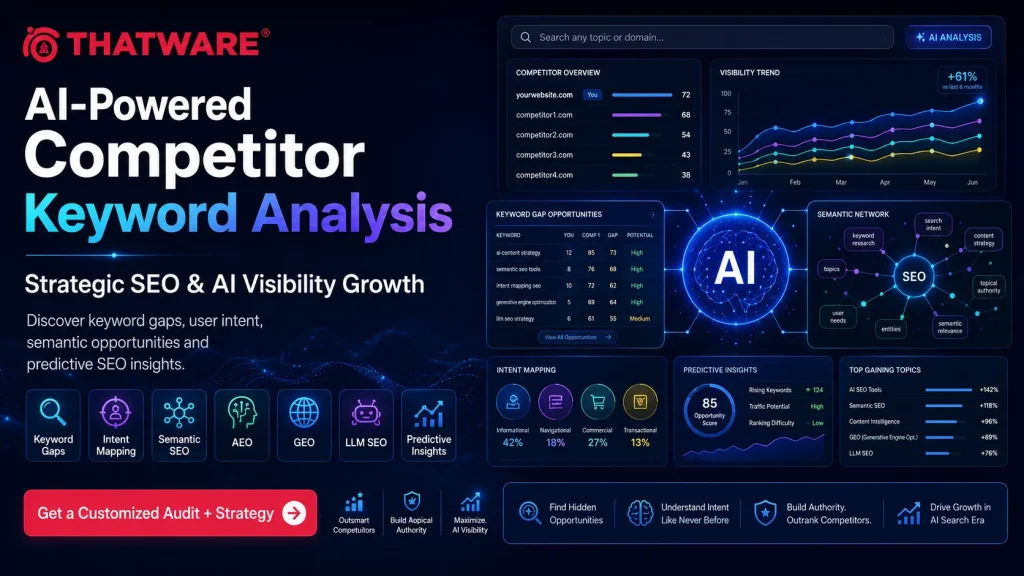
Today, competitor keyword analysis is not just about identifying what keywords competitors rank for. It is about understanding why they rank, how their content is structured, what search intent they are targeting, and how their entire SEO ecosystem is built.
ThatWare integrates advanced artificial intelligence systems, semantic mapping models, and hyper-intelligent SEO frameworks to decode competitor keyword ecosystems in a way that traditional tools cannot achieve. This enables businesses to move beyond surface-level keyword lists and into strategic search intelligence.
Competitor keyword analysis today enables brands to:
- Identify hidden keyword opportunities
- Understand competitor content architecture
- Decode search intent patterns at scale
- Build predictive SEO strategies
- Strengthen topical authority in competitive markets
This approach transforms SEO from reactive optimization into proactive digital dominance.
Modern competitor research also extends beyond conventional search rankings, revealing how competing brands establish visibility across evolving AI-driven discovery environments. Competitor Analysis SEO helps businesses identify emerging topics, content gaps, semantic opportunities, and authority signals that influence both traditional search and AI-generated results. This intelligence supports more resilient strategies designed to capture demand and strengthen visibility across changing digital ecosystems.
What is Competitor Keyword Analysis?
Competitor keyword analysis is a strategic SEO process used to identify, evaluate, and interpret the keywords competitors rank for across both organic search results and paid advertising campaigns. It helps businesses understand how rival brands attract traffic, structure their content, and position themselves within the search engine results pages (SERPs).
In modern SEO ecosystems, this practice is no longer limited to simple keyword extraction. It has evolved into a multi-layered intelligence system that examines how search engines interpret meaning, relevance, and user satisfaction signals.
Advanced SEO competitor analysis now includes:
- Semantic keyword grouping and clustering, where related search terms are organized into topic-based structures
- Intent-based search classification, which identifies whether users are seeking information, making comparisons, or are ready to convert
- Content structure benchmarking, analyzing how top-ranking pages are built and optimized
- SERP feature analysis, including featured snippets, “People Also Ask” sections, and AI-driven search summaries
- Backlink and authority correlation, which evaluates how link profiles influence keyword rankings
- PPC keyword strategy evaluation, revealing high-value paid search terms used by competitors
Instead of focusing on isolated keywords, modern systems analyze entire keyword ecosystems. These ecosystems represent how search engines connect entities, topics, and user intent to determine ranking relevance.
ThatWare enhances this process using advanced AI-powered SEO intelligence and semantic search modeling. This allows deeper visibility into not just what competitors rank for, but why they rank, how their content performs, and what strategic gaps can be leveraged for growth.
By combining keyword gap analysis, competitor SEO research, and predictive search insights, businesses can build more accurate, scalable, and future-ready SEO strategies that outperform traditional keyword tracking methods.
Current Scenario of AI-Powered Competitor Keyword Analysis
AI-powered competitor keyword analysis is rapidly becoming a more intelligent and automated approach to search intelligence. It uses language models to process large competitor datasets, identify search-term gaps, cluster user intent, and predict content performance. This shift is supported by strong industry adoption, with approximately 86% of SEO professionals now integrating AI into their workflows. AI is also reducing the manual effort involved in competitor keyword grouping and gap analysis, with research time reduced by up to 85% compared with traditional spreadsheet filtering.
The growth of AI-generated search experiences is further changing how competitor keywords are evaluated. Over 30% of US search engine result pages (SERPs) now trigger AI Overviews, increasing the importance of long-tail and conversational queries that can earn citations within generated answers rather than relying only on traditional blue-link clicks.
At the same time, conversion-focused keyword intelligence is becoming increasingly important. Long-tail queries account for over 91% of search queries and deliver roughly 2.5× higher conversion rates, making the identification of niche competitor gaps a valuable component of performance-driven search strategy. Together, these trends indicate that AI-powered competitor keyword analysis is moving beyond keyword discovery toward automated intent interpretation, predictive opportunity identification, and visibility across evolving AI search environments.
Why Competitor Keyword Analysis is Critical for SEO Success
Competitor keyword analysis has become a core pillar of modern search engine optimization strategy because it reveals how competing brands actually earn visibility, traffic, and conversions across search ecosystems. Without this intelligence layer, businesses operate in isolation, making assumptions instead of data-backed decisions. In an AI-driven search landscape, success depends on understanding not just keywords, but search intent, semantic relationships, and competitor content ecosystems.
Discovering High Value Keyword Opportunities
One of the most impactful outcomes of competitor keyword analysis is uncovering untapped high value keyword opportunities that already generate traffic for competitors. These are often terms where competitors have established authority, but your website has not yet positioned itself.
By identifying these keyword gaps, businesses can strategically expand into new areas of visibility and capture qualified audiences with strong intent. This includes targeting long tail keywords, niche variations, and emerging semantic phrases that reflect evolving user behavior in modern search engines.
Key advantages include:
- Expanding reach into high intent search queries
- Identifying scalable organic traffic opportunities
- Improving conversion efficiency through better keyword alignment
- Strengthening visibility across underserved SERP segments
Advanced systems like ThatWare’s AI-driven SEO models enhance this process by mapping not only keywords, but also contextual relationships between topics, enabling more precise opportunity discovery.
Understanding Real User Intent
Modern SEO performance is heavily influenced by how well content aligns with search intent analysis. Competitor keyword research helps decode whether competing pages are targeting informational, transactional, navigational, or commercial investigation intent.
This level of insight is essential because search engines now prioritize intent satisfaction over simple keyword matching. For example, a keyword like “best SEO tools” may require comparison-based content, while “hire SEO agency” demands conversion-focused landing pages.
By analyzing competitor intent strategies, businesses can:
- Build intent-optimized content frameworks
- Improve user engagement metrics
- Increase dwell time and reduce bounce rates
- Enhance overall SERP ranking stability
ThatWare’s semantic intelligence systems further refine this by identifying intent shifts across user journeys, ensuring content aligns with evolving search behavior patterns.
Identifying Content Gaps in the Market
Another critical advantage of competitor keyword gap analysis is the identification of missing or underdeveloped topics within a niche. These gaps represent high-value opportunities for building topical authority and strengthening domain relevance.
Competitors often overlook subtopics or fail to provide comprehensive coverage of related queries. By analyzing these weaknesses, businesses can create more complete and authoritative content ecosystems.
Benefits include:
- Accelerating topical authority development
- Expanding coverage across semantic keyword clusters
- Improving visibility in long-tail search ecosystems
- Strengthening content depth and relevance signals
This approach aligns with modern entity-based SEO, where search engines evaluate how well a website covers entire topic networks rather than isolated keywords.
Benchmarking Against Industry Leaders
Competitor keyword analysis also serves as a powerful benchmarking tool, allowing businesses to evaluate their performance against top-ranking competitors in their industry.
This includes analyzing:
- Depth and structure of competitor content
- Keyword targeting precision and distribution
- SERP positioning patterns across multiple queries
- Authority signals such as backlinks and engagement metrics
By comparing these elements, businesses gain clarity on what level of optimization is required to compete effectively. It also helps identify whether success is driven by content quality, authority strength, or technical SEO advantages.
Modern AI-based platforms, including ThatWare’s SEO intelligence systems, enhance benchmarking by simulating SERP behavior and predicting ranking potential based on content structure and semantic relevance.
Improving PPC and Organic Strategy Alignment
Competitor keyword insights are not limited to organic search. They also play a crucial role in improving PPC keyword strategy optimization and aligning paid and organic efforts for maximum efficiency.
By analyzing competitor advertising behavior, businesses can identify:
- High-value bidding keywords with strong conversion potential
- Competitive CPC patterns across industry segments
- Ad copy strategies aligned with user intent
- Keywords that perform well in both paid and organic channels
This integration helps businesses reduce wasted ad spend while strengthening overall search visibility. When PPC and SEO strategies work together, brands achieve stronger multi-channel search dominance, improved ROI, and more consistent traffic acquisition.
ThatWare enhances this alignment using predictive keyword modeling, ensuring that paid campaigns and organic strategies reinforce each other rather than operate in isolation.
By combining opportunity discovery, intent analysis, content benchmarking, and paid-search insights, businesses can build a more complete competitive search strategy. Competitor Keyword Gap Analysis provides the intelligence needed to prioritize underserved queries, evaluate market positioning, and uncover areas where competitors have established visibility. This enables brands to make informed optimization decisions, strengthen content relevance, and capture qualified search demand more consistently.
How ThatWare Redefines Competitor Keyword Analysis
ThatWare transforms traditional competitor keyword analysis into an advanced, AI-driven intelligence framework that goes far beyond basic keyword extraction. Instead of focusing only on search terms, the system evaluates semantic SEO signals, entity relationships, and predictive search behavior to build a complete digital visibility strategy.
This approach allows businesses to move from reactive SEO execution to a fully strategic, data-backed model powered by AI SEO intelligence, keyword gap analysis, and search intent modeling.
AI Driven Keyword Intelligence System
ThatWare’s AI keyword intelligence system does not simply collect keywords from competitors. It interprets how search engines understand content in real time.
The system analyzes:
- Semantic meaning behind search queries to understand context beyond literal keywords
- Contextual relevance across industries to identify cross-niche ranking opportunities
- Entity relationships within content ecosystems to map how topics connect at scale
- Search behavior patterns across SERPs to detect ranking triggers and engagement signals
By combining these layers, ThatWare builds a structured SEO competitor analysis framework that aligns directly with modern search engine algorithms.
This ensures that every keyword strategy is rooted in how Google and AI-driven search systems interpret user intent, content relevance, and topical authority.
Semantic Clustering and Topic Modeling for SEO Growth
Modern SEO is no longer about targeting isolated keywords. ThatWare uses semantic clustering and topic modeling to restructure how keyword data is organized.
Instead of individual keyword lists, the system groups search terms into intelligent clusters based on:
- Topic relevance across search ecosystems
- Search intent similarity between user queries
- Ranking potential correlation across SERPs
This creates structured content clusters that strengthen topical authority SEO, allowing websites to dominate entire subject areas instead of single search queries.
For example, instead of targeting “keyword research,” “SEO analysis,” and “competitor SEO tools” separately, ThatWare builds interconnected topic hubs that reinforce authority across all related search variations.
This approach significantly improves organic visibility, content relevance, and search engine ranking stability.
Competitor Content Architecture Analysis for SERP Dominance
ThatWare goes beyond keyword analysis by evaluating how competitors structure their entire content ecosystem.
Through competitor content architecture analysis, the system examines:
- Heading hierarchy and content structure optimization
- Content depth, coverage, and semantic completeness
- Multimedia integration such as images, video, and schema markup
- Internal linking strategies for authority distribution
This provides a detailed blueprint of how top-ranking pages achieve visibility in competitive SERPs.
By understanding content architecture, businesses can replicate and improve upon competitor strategies to build superior SEO content frameworks that outperform existing rankings.
This is especially critical for industries where content depth SEO, E-E-A-T signals, and structured data optimization play a major role in search performance.
Predictive Keyword Intelligence and Future Search Trends
One of the most advanced components of ThatWare’s system is predictive keyword intelligence. Unlike traditional SEO tools that focus on historical data, this system forecasts future search behavior.
It identifies:
- Emerging keyword trends before they peak in search volume
- Declining search terms that may lose ranking value over time
- Seasonal demand shifts across industries and markets
- Future ranking opportunities based on SERP evolution patterns
This enables businesses to build proactive SEO strategy planning systems instead of reacting to existing competition.
With predictive insights, brands can position themselves early in high-growth keyword spaces, improving long-term visibility and reducing dependency on highly competitive search terms.
This forward-looking approach strengthens digital marketing intelligence, ensuring sustained growth in evolving search environments.
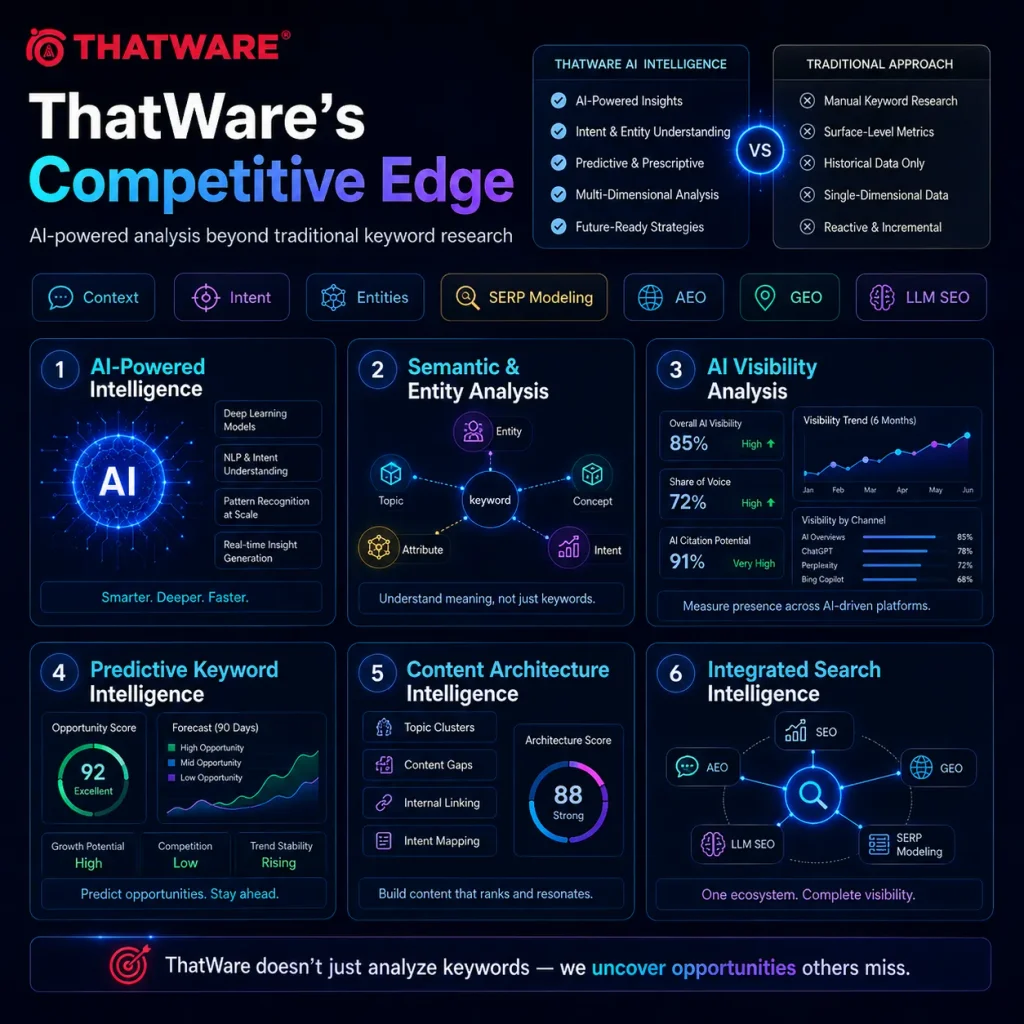
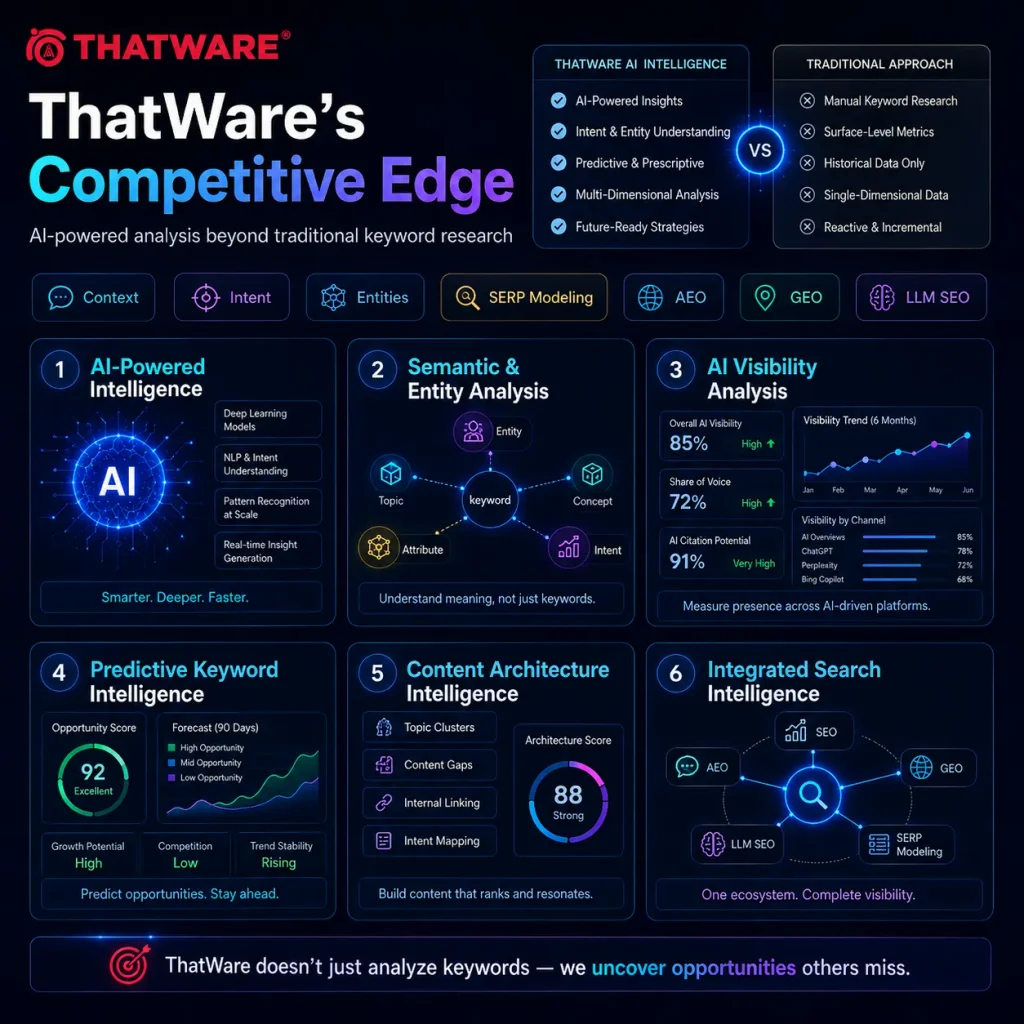
ThatWare’s Differentiators in Competitor Keyword Analysis
| Key Capability | ThatWare’s Specialized Approach | Typical Competitor Approach |
| AI-Powered Intelligence | Uses AI to interpret keyword context, intent, entities, and competitor patterns. | Relies mainly on keyword databases and basic metrics. |
| Semantic & Entity Analysis | Maps entities, topics, relationships, and contextual connections. | Focuses mainly on volume, difficulty, frequency, and rankings. |
| AI Visibility Analysis | Covers AEO, GEO, and LLM SEO for AI-driven search visibility. | Focuses mainly on traditional Google rankings and SERPs. |
| Predictive Keyword Intelligence | Identifies emerging trends, future opportunities, and seasonal shifts. | Primarily analyzes historical and current keyword data. |
| Content Architecture Intelligence | Analyzes content depth, headings, internal links, multimedia, and authority signals. | Usually provides page-level or keyword-level competitive metrics. |
| SERP & Search Intent Modeling | Connects keywords with intent, SERP behavior, context, and ranking patterns. | Uses standard intent and SERP data with limited context. |
| Integrated Search Intelligence | Combines keyword research, semantic SEO, AEO, GEO, LLM SEO, and AI visibility. | Often separates these functions across different tools and reports. |
Types of Keywords Identified in Competitor Keyword Analysis
Understanding keyword categories is a foundational step in building a high-performance SEO strategy. In modern search ecosystems, keyword classification is no longer limited to volume or difficulty. It now includes intent modeling, semantic clustering, and competitive behavior mapping. Competitor keyword analysis helps uncover how rival brands structure their search visibility across multiple keyword types and intent layers.
Short Tail Keywords and Market Visibility
Short tail keywords are broad search terms typically made up of one or two words, such as SEO services, digital marketing, and keyword analysis. These keywords usually generate high search volume but are extremely competitive due to broad industry targeting.
From a strategic perspective, short tail keywords are primarily used to build visibility and establish foundational authority within a niche. However, in advanced SEO frameworks, they are no longer targeted in isolation. Instead, they are mapped within broader semantic clusters to support topic authority development.
Competitor keyword analysis reveals that top-ranking domains rarely rely solely on short tail keywords. Instead, they use them as anchor points within content ecosystems supported by long tail and intent-driven variations.
Long Tail Keywords for Precision Targeting
Long tail keywords are more specific search queries that often contain three or more words, such as best competitor keyword analysis services for startups and advanced SEO competitor research strategies.
These keywords play a critical role in modern SEO because they align closely with user intent. They attract highly targeted audiences who are closer to conversion actions, making them significantly more valuable for lead generation.
Advanced competitor keyword analysis identifies long tail opportunities by examining content depth gaps and semantic variations that competitors may not fully cover. This allows businesses to create highly relevant content that answers specific user needs while avoiding overly saturated search terms.
In AI-driven SEO environments, long tail keywords also contribute to conversational search optimization, especially for voice search and generative search engines.
Transactional Keywords for Conversion Optimization
Transactional keywords indicate strong purchase or action intent. Examples include hire SEO agency and competitor keyword analysis services pricing.
These keywords are essential for revenue generation because they target users who are ready to take immediate action. Competitor keyword analysis helps identify which transactional keywords competitors are actively bidding on or ranking for organically.
Modern SEO systems integrate transactional keyword mapping with conversion rate optimization strategies. This ensures landing pages are structured to match buyer intent with clear messaging, service alignment, and strong calls to action.
In competitive industries, transactional keywords often have higher cost-per-click values, making organic ranking strategies even more valuable for long-term ROI.
Informational Keywords for Authority Building
Informational keywords are used by users seeking knowledge, insights, or solutions. Common examples include what is competitor keyword analysis and how to analyze competitor keywords.
These keywords are essential for building topical authority and establishing expertise within a niche. Competitor keyword analysis reveals informational gaps where competitors may have weak or outdated content, allowing businesses to create more comprehensive and updated resources.
In modern SEO frameworks, informational keywords also serve as entry points into content funnels. They attract early-stage users who can later be guided toward transactional pages through internal linking and structured content pathways.
Commercial Investigation Keywords for Decision Support
Commercial investigation keywords reflect comparison-based search behavior. Examples include best SEO competitor analysis tools and top keyword research platforms.
These keywords are highly valuable because users are actively evaluating multiple solutions before making a decision. Competitor keyword analysis identifies which brands dominate these comparison-based search queries and how they position themselves in the SERPs.
From a strategic standpoint, commercial investigation keywords help businesses influence decision-making stages by presenting comparative advantages, feature breakdowns, and solution-specific content.
Semantic and Intent-Based Keyword Expansion
Beyond traditional categories, modern competitor keyword analysis also focuses on semantic keyword expansion. This includes related search variations, entity-based keywords, and contextual phrases connected to core topics like SEO competitor research, keyword gap analysis, and search intent optimization.
By analyzing semantic relationships, businesses can build content ecosystems that align with how search engines interpret meaning rather than isolated keyword matches.
Keyword Clusters for Topic Authority Building
In advanced SEO systems, keywords are grouped into clusters instead of being treated individually. For example, all variations of competitor keyword analysis, SEO competitor research, and keyword gap strategy form a single topical cluster.
Competitor keyword analysis helps identify how strong competitors structure these clusters and how deeply they cover each subtopic. This allows businesses to build stronger topical authority and improve long-term ranking stability.
AI Enhanced Keyword Classification
With AI-powered SEO systems, keyword classification now includes predictive modeling. Keywords are not only categorized by type but also by:
- Ranking potential
- Conversion probability
- Competitive intensity
- Content gap relevance
This enables businesses to prioritize keywords that deliver measurable business impact rather than just search visibility.
The integration of intent analysis, semantic relationships, and AI-driven classification creates a more precise framework for prioritizing search opportunities. Competitor Keywords SEO helps businesses evaluate keyword relevance across informational, commercial, and transactional journeys while identifying gaps within competing content ecosystems. This enables smarter content planning, stronger topic coverage, and better alignment between search demand, user expectations, and measurable business objectives.
The Strategic Role of Competitor Keyword Analysis in Modern SEO
Competitor keyword analysis has shifted into a full-scale search intelligence framework that guides every stage of modern digital growth. Instead of simply tracking what keywords competitors rank for, businesses now use it to understand search intent patterns, content architecture, and SERP behavior signals that influence visibility.
This evolution has made competitor keyword analysis a core pillar of AI-driven SEO strategy, where insights are not only descriptive but also predictive and action-oriented.
Intent First SEO Strategy and Search Behavior Mapping
Modern SEO success depends heavily on intent-first optimization, where content is designed around what users actually want to achieve rather than just targeting keywords.
Competitor keyword analysis helps decode:
- What users are truly searching for behind each query
- How competitors structure content to satisfy search intent
- Where gaps exist in intent coverage across the SERP
By analyzing competitors through an intent lens, businesses can identify whether top-ranking pages are built for informational, transactional, or commercial investigation intent.
ThatWare enhances this process using advanced intent classification models, ensuring content strategies align with real user expectations rather than outdated keyword lists. This leads to improved engagement, reduced bounce rates, and stronger ranking signals.
Semantic SEO and Entity Optimization for Search Intelligence
Search engines no longer rely solely on keyword matching. They interpret meaning through semantic SEO, where context, entities, and relationships define relevance.
Competitor keyword analysis now focuses on understanding:
- Entity recognition patterns across competitor content
- Contextual relationships between topics and subtopics
- Semantic relevance scoring within content ecosystems
This allows businesses to move beyond surface-level optimization and build content that reflects how search engines interpret meaning.
ThatWare integrates entity-based SEO mapping to ensure every keyword aligns with a broader contextual structure. This improves visibility across both traditional search engines and AI-driven discovery systems that rely on structured meaning rather than isolated terms.
Topic Cluster Dominance and Authority Building Strategy
One of the most important advancements in competitor keyword analysis is the shift from isolated keywords to topic cluster dominance.
Instead of targeting single keywords, businesses now build interconnected content ecosystems such as:
- Topic clusters that group related search queries
- Structured content silos that improve internal linking strength
- Comprehensive authority hubs that cover entire subject domains
Competitor analysis reveals how top-ranking websites organize these clusters and where gaps exist in their topical coverage.
By leveraging this insight, ThatWare helps brands build topical authority frameworks that strengthen long-term rankings and improve domain relevance across entire industries.
SERP Feature Optimization and Zero Click Visibility Expansion
Modern search results are no longer limited to traditional blue links. Competitor keyword analysis now includes a deep evaluation of SERP feature ownership and visibility distribution.
Key opportunities include:
- Featured snippets that capture instant visibility
- People Also Ask (PAA) sections for question-based traffic
- Knowledge panels that build brand authority
- Video and image SERPs that increase multi-format reach
Understanding how competitors occupy these SERP features allows businesses to strategically structure content for maximum exposure.
ThatWare applies SERP optimization intelligence systems that analyze how competitors win these placements and what content structures are required to outperform them. This helps brands secure visibility even in zero-click search environments, where users often get answers directly from the results page.
Predictive Keyword Intelligence and Future Search Alignment
Beyond current rankings, modern competitor keyword analysis also focuses on predictive keyword intelligence.
This involves identifying:
- Emerging search trends before they peak
- Declining keyword categories losing relevance
- New intent patterns forming within industries
By combining historical search data with AI-driven forecasting, ThatWare helps businesses anticipate future demand rather than reacting to existing competition.
This predictive approach ensures SEO strategies remain aligned with evolving search behavior models, allowing brands to stay ahead in competitive digital ecosystems.
Competitive Content Engineering for Ranking Advantage
Another critical dimension of competitor keyword analysis is content engineering, where insights are used to design superior content structures.
This includes analyzing:
- Depth and coverage of competitor pages
- Use of multimedia and structured data
- Internal linking frameworks and content flow
- Engagement signals such as readability and UX design
ThatWare uses these insights to build high-performance SEO content systems that outperform competitors not just in keywords, but in overall search experience quality.
Together, these strategic layers transform competitor keyword analysis into a powerful engine for AI-driven SEO growth, semantic authority building, and long-term search dominance.
Competitor Keyword Analysis Process
A modern competitor keyword analysis process is no longer a linear SEO checklist. It is a structured intelligence system that combines search data extraction, semantic evaluation, and predictive ranking insights to understand how competitors dominate search visibility.
At ThatWare, this process is designed to decode entire search ecosystems rather than isolated keyword lists. The goal is to identify not only what competitors rank for, but also how they construct authority across topics, entities, and intent layers.
Step 1: Competitor Identification and SERP Mapping
The first stage focuses on identifying the true competitive landscape. This includes more than just direct business competitors.
We categorize competitors into three layers:
- Direct competitors offering similar services or products
- SERP competitors ranking for the same keywords regardless of industry overlap
- Content competitors dominating informational and educational search queries
This layered identification ensures that competitor keyword research is not limited to brand-level competition but includes all entities occupying search visibility in the same niche.
Advanced SERP mapping tools also help identify overlapping domains that consistently appear across multiple keyword sets, revealing hidden competition patterns.
Step 2: Advanced Keyword Extraction and Data Expansion
The second step involves deep keyword extraction powered by AI-driven crawling systems and semantic parsers.
We extract:
- Organic ranking keywords from top-performing pages
- Paid search keywords used in PPC campaigns
- Long-tail keyword variations with high conversion intent
- Semantic keyword clusters grouped by meaning rather than text
Unlike traditional keyword tools, modern systems analyze contextual relevance. This means that keywords are not treated as isolated phrases but as part of a broader semantic SEO structure.
For example, a single competitor page may reveal clusters around SEO competitor analysis tools, keyword gap identification, and search intent mapping, all connected under one topical authority framework.
Step 3: Keyword Categorization Based on Intent Intelligence
Once keywords are extracted, they are categorized using advanced search intent classification models.
We organize keywords into:
- Informational intent keywords for learning and awareness
- Transactional intent keywords for purchase-driven queries
- Commercial investigation keywords for comparison-based searches
- Navigational keywords linked to brand discovery
Beyond intent, we also evaluate:
- User search behavior patterns
- Keyword relevance to conversion funnels
- Contextual alignment with buyer journeys
This ensures that competitor keyword analysis services are not just focused on ranking, but on actual business impact and revenue alignment.
Step 4: Keyword Gap Analysis and Opportunity Mapping
A core part of modern SEO intelligence is keyword gap analysis. This step identifies missing opportunities where competitors are ranking, but your website has no presence.
We analyze:
- Missing high-value keywords with strong traffic potential
- Underserved topic clusters with weak competition coverage
- Low competition keyword opportunities ideal for fast ranking gains
This process helps uncover hidden opportunities in search ecosystems. Instead of chasing highly competitive keywords blindly, businesses can prioritize strategic gaps that deliver faster ROI and sustainable growth.
ThatWare enhances this process using predictive models that estimate ranking difficulty, traffic potential, and content saturation levels.
Step 5: SERP Evaluation and Content Intelligence Analysis
At this stage, we perform deep SERP evaluation to understand why competitors rank where they do.
We analyze:
- Top ranking pages and their content structure
- Content depth, topical coverage, and readability
- UX signals such as engagement, scroll depth, and interaction patterns
- Authority signals including backlinks and domain strength
Modern search engine ranking analysis is heavily influenced by how well content satisfies user intent. Therefore, we also evaluate:
- Content clarity and topical completeness
- Use of multimedia elements
- Internal linking strength
- Semantic keyword distribution
This allows us to reverse engineer high-performing pages and design superior SEO content strategies.
Step 6: Strategy Development and SEO Roadmap Creation
After analysis, we convert insights into actionable strategy. This is where competitor keyword intelligence becomes execution-ready.
We build a complete SEO roadmap including:
- Content strategy planning based on keyword clusters
- Keyword targeting prioritization by ROI potential
- Internal linking architecture for authority flow
- PPC alignment strategy for paid and organic synergy
This ensures that SEO efforts are not fragmented but aligned with a unified digital growth strategy.
Advanced Competitor Keyword Intelligence Framework
Modern SEO requires more than keyword tracking. It requires structured intelligence systems that understand how search ecosystems behave.
Semantic Keyword Mapping and Entity-Based SEO
One of the most important advancements in SEO is semantic keyword mapping.
Instead of focusing on individual keywords, we map:
- Topics and subtopics
- Entities and relationships
- Search intent layers and contextual meaning
This ensures full alignment with entity-based search algorithms, where relevance is determined by topic depth rather than keyword repetition.
For example, a single topic like competitor keyword analysis tools may connect to entities such as SEO platforms, ranking systems, and search optimization frameworks.
A powerful Competitor Keyword Analysis Tool can further enhance this semantic framework by revealing connections between competitor topics, entities, and ranking opportunities. By analyzing these relationships, businesses can identify underserved subtopics, discover relevant content clusters, and prioritize high-value opportunities. This approach creates a more comprehensive understanding of competitive search landscapes while supporting stronger topical relevance, authority, and sustainable organic visibility.
Behavioral SERP Analysis and User Interaction Signals
Modern SEO is heavily influenced by user behavior. That is why behavioral SERP analysis plays a critical role.
We evaluate:
- Click-through rate patterns across search results
- User engagement signals such as dwell time
- Bounce rate behavior and content satisfaction levels
These signals help determine why certain pages outperform others even with similar keyword targeting.
Understanding behavioral data allows businesses to optimize content not just for search engines but for real human interaction.
Competitive Authority Scoring System
A major part of competitor keyword analysis services is evaluating authority strength.
We use a structured scoring system based on:
- Domain authority and trust signals
- Content depth and topical completeness
- Keyword coverage across clusters
- Backlink quality and relevance
This helps determine how difficult it is to compete in a given niche and where strategic entry points exist.
Predictive Search Modeling and Trend Forecasting
One of the most advanced capabilities in modern SEO is predictive search modeling.
We forecast:
- Emerging keyword opportunities before they peak
- Future ranking trends based on search behavior shifts
- Market demand evolution across industries
This allows businesses to move from reactive SEO to proactive search domination.
Instead of chasing competitors, brands can anticipate what users will search for next.
Tools Used in Competitor Keyword Analysis
Modern SEO competitor analysis tools play a critical role in extracting and analyzing keyword data.
Common platforms include:
- Ahrefs for backlink and keyword intelligence
- SEMrush for PPC and organic search tracking
- Moz for domain authority evaluation
- SpyFu for paid keyword intelligence and competitor ad analysis
These tools provide foundational data for keyword research, but they are often limited in semantic depth and predictive capability.
ThatWare Proprietary Intelligence System
ThatWare has engineered a proprietary SEO intelligence ecosystem that moves far beyond conventional keyword research tools and static analytics platforms. Instead of relying on surface-level metrics, the system operates as a live decision intelligence layer designed for competitor keyword analysis, predictive SEO, and semantic search optimization.
ThatWare’s intelligence ecosystem combines automated data analysis with strategic interpretation to uncover competitive patterns that conventional platforms often overlook. Through advanced Competitor Keyword Research Services, businesses can evaluate competitor positioning, discover untapped search opportunities, and understand evolving market demand. This creates a stronger foundation for informed keyword prioritization, content planning, and SEO decision-making while enabling brands to respond proactively to competitive shifts.
Real-Time Keyword Gap Detection
The system continuously scans evolving search environments to identify keyword gap opportunities as they emerge. Unlike traditional SEO audits that rely on historical snapshots, this engine detects live shifts in organic search rankings, competitor movements, and emerging query patterns. This allows businesses to target high-value SEO keywords before market saturation occurs.
SERP Simulation Modeling
The SERP simulation engine replicates how search engines evaluate and rank content before it is published. It analyzes factors such as content structure, search intent alignment, internal semantic density, and authority signals. This predictive modeling helps brands understand potential ranking positions and optimize pages for maximum visibility in competitive search landscapes.
Content Performance Forecasting System
This module evaluates how content is likely to perform based on semantic SEO strength, topic relevance, and user intent satisfaction. It estimates traffic potential, engagement probability, and ranking stability, helping businesses refine their SEO content strategy before deployment. This reduces guesswork and improves ROI from content marketing efforts.
Semantic SEO Mapping Engine
The semantic mapping engine organizes entire keyword ecosystems into structured topic clusters and entity-based frameworks. Instead of isolated keyword targeting, it builds interconnected content hierarchies that strengthen topical authority and improve search engine understanding of domain expertise.
Adaptive Search Intelligence Layer
An additional layer ensures continuous adaptation to algorithm updates, shifting ranking signals, and evolving AI search systems. This keeps businesses aligned with modern search engine optimization (SEO) standards and future-ready for generative search environments.
Industries Benefiting from Competitor Keyword Analysis
Competitor keyword analysis has become a foundational strategy across digital-first industries. As search engines evolve toward semantic understanding and intent-based ranking, businesses in every sector are leveraging competitor keyword research, keyword gap analysis, and SEO competitor insights to refine visibility and outperform market rivals.
SaaS and Technology
In the SaaS ecosystem, competitor keyword analysis helps uncover high-intent search terms tied to product features, integrations, and problem-solving use cases. Businesses use keyword gap analysis to identify missing opportunities such as niche software queries, workflow-specific searches, and feature comparison terms. This enables stronger positioning in highly competitive software markets where decision cycles are driven by search-driven evaluation.
E-Commerce
E-commerce brands rely heavily on SEO competitor research to optimize product pages, category structures, and seasonal campaigns. By analyzing competitor rankings, businesses can identify high-performing commercial keywords and improve product visibility across search engines. Advanced keyword intelligence tools also help uncover buying-intent phrases that directly influence conversion rates.
Healthcare
In healthcare, competitor keyword insights are used to build authoritative informational content that aligns with patient intent. Clinics, hospitals, and wellness brands leverage search intent analysis to rank for condition-based queries, treatment options, and symptom-related searches while strengthening digital trust and credibility.
Finance
Financial institutions use competitive keyword analysis to target high-value transactional searches such as loans, investments, and insurance services. Through SERP competitor analysis, brands can understand how financial content is structured to meet regulatory clarity while still driving conversions in highly competitive search environments.
Education
Educational platforms benefit from keyword research services to improve visibility for courses, certifications, and informational queries. By analyzing competitor content structures, institutions can enhance enrollment-focused landing pages and optimize for both informational and navigational search intent.
Real Estate
Real estate companies use location-based keyword analysis to target property searches, investment opportunities, and regional demand trends. Competitor insights help refine hyperlocal SEO strategies and improve visibility in high-value property markets.
Local Services
Local businesses depend on geo-targeted keyword optimization to increase discoverability in nearby searches. Competitor keyword tracking ensures stronger performance in “near me” queries and service-based intent searches.
B2B Enterprises
B2B organizations leverage intent-driven SEO strategies to generate qualified leads through competitor keyword mapping. This helps align content with decision-stage search queries, improving conversion efficiency and long-term pipeline growth.
Across diverse industries, businesses need more than basic keyword discovery to understand how competitors capture search demand. Competitor SEO Analysis Services provide deeper insights into keyword targeting, content positioning, intent patterns, and market opportunities. This intelligence helps organizations adapt their SEO strategies according to industry-specific search behavior, uncover overlooked opportunities, and build stronger digital visibility in increasingly competitive search environments.
Industry-specific search landscapes also require a structured approach to Competitive Keyword Analysis, particularly when customer journeys differ significantly across sectors. By evaluating competitor keyword portfolios, content themes, and search intent coverage, businesses can identify gaps that directly influence visibility and conversions. This enables more focused content planning, better resource allocation, and stronger alignment between organic search strategies and evolving market demand.
Understanding how competitors achieve and maintain prominent positions requires ongoing Competitor Ranking Analysis across relevant search results. Tracking ranking movements, keyword distribution, content performance, and SERP changes allows businesses to recognize emerging opportunities before competitors gain an advantage. Combined with semantic analysis and intent intelligence, this approach supports continuous optimization and helps brands maintain competitive visibility across dynamic search ecosystems.
Key Benefits of Competitor Keyword Analysis
A structured competitor keyword analysis strategy delivers measurable business outcomes.
- Increased organic search traffic
- Improved keyword targeting accuracy
- Higher conversion rates from search visitors
- Stronger and more structured content strategy
- Reduced marketing and advertising waste
- Enhanced competitive positioning in SERPs
- Faster SEO growth and ranking improvements
These benefits combine to create a scalable digital growth system.
A comprehensive Competitor Website Analysis gives businesses a clearer understanding of how rival websites attract, engage, and convert organic audiences. By examining content structures, keyword targeting, technical elements, and authority signals, brands can identify strengths to emulate and weaknesses to exploit. This creates practical opportunities for improving website performance, strengthening search visibility, and accelerating sustainable organic growth.
Developing an effective Competitor Keyword Strategy enables businesses to move beyond reactive keyword targeting and build a structured roadmap for search growth. By prioritizing relevant gaps, high-intent queries, semantic variations, and commercially valuable terms, organizations can focus resources where they are most likely to generate results. This improves content efficiency, supports stronger rankings, and increases qualified organic traffic.
A data-driven SEO Competitive Analysis helps organizations continuously evaluate market changes and refine their optimization priorities. Monitoring competitor rankings, content expansion, keyword movements, and SERP developments reveals emerging threats and opportunities before they become difficult to address. With these insights, businesses can make faster strategic decisions, improve campaign effectiveness, and maintain stronger competitive positioning across evolving search landscapes.
AI Visibility Intelligence for AI-Powered Competitor Keyword Analysis
AI-powered competitor keyword analysis has evolved beyond measuring Google rankings and identifying traditional keyword gaps. In today’s search ecosystem, businesses must understand how competitors achieve visibility across Answer Engine Optimization (AEO), Generative Engine Optimization (GEO), and LLM SEO environments. AI systems increasingly interpret entities, contextual relationships, authority signals, and user intent before selecting information to surface in answers or recommendations. This makes competitor intelligence essential for understanding not only where competitors rank, but also why their brands are being discovered, referenced, and trusted by AI-driven search systems.
Competitor Search Analysis provides a broader intelligence layer for evaluating how competing brands appear across traditional search and emerging AI discovery journeys. AI-powered systems can examine competitor content, entity associations, semantic relevance, query coverage, and answer-engine positioning to identify patterns that conventional keyword tools may overlook. For AEO, this can reveal which competitor pages are structured to directly satisfy questions and become potential answer sources. For GEO, it can uncover the content characteristics and contextual authority that contribute to visibility within generative responses.
Competitor Organic Keyword Analysis further strengthens this process by connecting conventional organic search performance with the broader semantic ecosystem surrounding competitor brands. Instead of evaluating keywords as isolated ranking terms, AI models can analyze relationships between queries, topics, entities, content clusters, and search intent. These insights help identify opportunities where competitors have strong organic visibility but weak contextual coverage, as well as areas where your brand can develop authoritative content capable of supporting both search rankings and AI-generated discovery.
Through Competitor Keyword Tracking, businesses can continuously monitor shifts in competitor visibility, emerging query patterns, ranking movements, and changes in content coverage. This becomes particularly valuable as LLM-based search systems evolve and user journeys move from traditional result pages toward conversational answers and recommendations. Tracking these changes enables brands to recognize emerging opportunities and adapt their SEO, AEO, and GEO strategies before competitive advantages become entrenched.
ThatWare’s AI-driven approach extends this intelligence toward LLM SEO by analyzing how AI systems interpret, retrieve, summarize, and associate information across the digital ecosystem. By combining semantic engineering, entity optimization, search intelligence, and AI-powered analysis, competitor keyword intelligence becomes a strategic visibility framework rather than a simple research exercise. The objective is to help brands build the authority, relevance, and contextual signals required to remain discoverable across Google, AI Overviews, ChatGPT, Gemini, Perplexity, and other evolving AI search environments.
Future Direction of Competitor Keyword Intelligence
The future of SEO competitor analysis is being shaped by advanced AI systems and evolving search technologies.
AI Powered Search Engines
Search engines are becoming more conversational and context-aware.
Generative Search Systems
Search results are increasingly generated rather than listed, requiring structured semantic optimization.
Voice and Conversational Search
Natural language queries are becoming dominant in search behavior.
Entity First Indexing Models
Search engines prioritize entities and relationships over keyword density.
Multimodal Search Environments
Text, image, and voice search are converging into unified search systems.
Businesses that adopt advanced competitor keyword intelligence systems early will maintain long-term visibility and authority in this evolving ecosystem.
As AI-driven discovery expands, Competitor Analysis Services will increasingly focus on measuring brand presence across answer engines, generative platforms, and LLM-powered search experiences. Future intelligence systems will connect competitor entities, citations, conversational queries, and semantic signals to reveal how brands earn AI visibility. This evolution will enable businesses to anticipate discovery trends and continuously strengthen their digital authority.
Conclusion
Competitor keyword analysis has evolved into a core pillar of modern SEO intelligence, shaping how businesses understand search visibility, user intent, and competitive positioning. It is no longer limited to identifying which keywords competitors rank for. Instead, it now operates as a strategic framework that connects semantic SEO, entity mapping, content architecture, and predictive search behavior into a unified system of digital intelligence.
In today’s search ecosystem, success depends on the ability to interpret why competitors perform well, how their content ecosystems are structured, and where untapped opportunities exist. Businesses that rely on surface-level keyword data risk falling behind in an environment where search engines prioritize intent alignment, topical authority, and contextual relevance over traditional keyword repetition.
Advanced approaches such as AI-powered keyword gap analysis, semantic clustering, and predictive search modeling enable brands to move beyond reactive optimization and into proactive growth strategies. This shift allows organizations to identify emerging opportunities early, strengthen content ecosystems, and build long-term authority across entire topic clusters.
ThatWare’s intelligent SEO framework enhances this transformation by integrating data-driven insights with semantic understanding and real-time search intelligence. This ensures that businesses are not only competing in search rankings but also shaping them.
Ultimately, competitor keyword analysis is not just a research activity. It is a continuous intelligence system that drives sustainable visibility, higher conversions, and long-term digital dominance in an increasingly competitive search landscape.



