SUPERCHARGE YOUR ONLINE VISIBILITY! CONTACT US AND LET’S ACHIEVE EXCELLENCE TOGETHER!
Search is no longer just about keywords—it’s about understanding meaning, intent, and conversation. Over the past decade, SEO has evolved from simple keyword matching to a far more sophisticated system driven by entities, context, and user intent. Search engines today are not just indexing pages; they are interpreting relationships between concepts and delivering answers that align with how humans naturally communicate.
This transformation has accelerated with the rise of AI-powered search ecosystems, including Google’s Search Generative Experience (SGE), ChatGPT, Gemini, and voice assistants like Alexa and Siri. These platforms don’t just retrieve links—they generate responses. As a result, the traditional “10 blue links” model is rapidly being replaced by conversational interfaces and zero-click answers.
In this new landscape, conventional SEO strategies—focused heavily on keyword density, backlinks, and static content—are becoming increasingly insufficient. Ranking is no longer determined solely by how well a page matches a query, but by how effectively it fits into a broader conversational context and satisfies evolving user intent across multiple interactions.
To address this paradigm shift, ThatWare introduces the CERA Model (Conversational Entity Ranking Algorithm)—a forward-thinking framework designed to align SEO with the realities of AI-driven search. Instead of optimizing for isolated keywords, CERA focuses on how entities are understood, connected, and ranked within conversational flows.
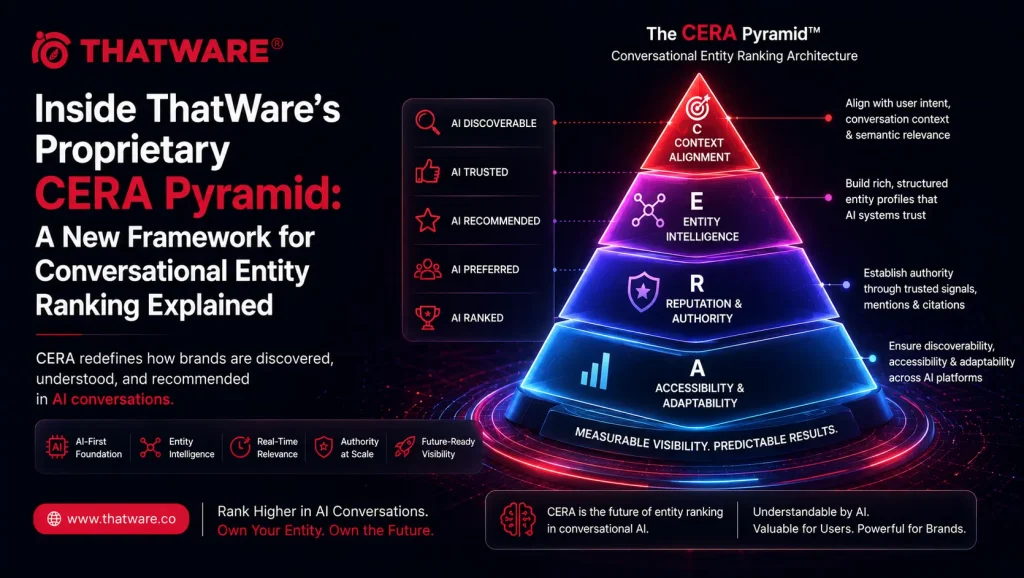
At the heart of this model lies the CERA Pyramid, a hierarchical framework that structures search intelligence into four critical layers: Intent, Entity, Context, and Response. Each layer builds upon the other, creating a cohesive system that mirrors how modern search engines process and deliver information.
Understanding this pyramid is essential for anyone looking to stay competitive in the era of conversational SEO—and in the sections ahead, we’ll break down exactly how it works and why it matters.
What is the CERA Model?
The CERA Model (Conversational Entity Ranking Algorithm) is ThatWare’s proprietary framework designed to align search optimization with the evolving nature of AI-driven search engines. Unlike traditional SEO models that rely heavily on keyword matching, CERA focuses on how entities are understood, connected, and ranked within a conversational environment.
At its core, CERA shifts the paradigm from:
- “What keywords are used?” → to → “What entities are being discussed and how are they related in a conversation?”
This means search engines are no longer just scanning for keyword presence—they are analyzing:
- The entities (people, brands, concepts, locations) mentioned
- The relationships between those entities
- The context in which they appear across a conversation or query chain
In simple terms, CERA enables content to rank not just because it contains relevant words, but because it fits naturally into an ongoing conversation between the user and the search engine.
Core Philosophy
The foundation of the CERA Model lies in how modern search engines—powered by AI and large language models—process information. Instead of treating queries as isolated inputs, they interpret them as part of a dynamic, evolving conversation.
CERA is built on three core pillars:
🔹 Meaning (Semantics)
Search engines now prioritize semantic understanding over exact keyword matches.
They aim to interpret:
- User intent behind the query
- Synonyms, variations, and implied meanings
- Conceptual relevance rather than literal phrasing
For example, a query about “best budget smartphones” is understood semantically as:
- Affordable devices
- Value-for-money options
- Comparisons within a price range
CERA ensures your content aligns with this deeper meaning layer.
🔹 Relationships (Entities)
Entities are the backbone of modern search. These include:
- Brands (ThatWare)
- People (SEO experts)
- Concepts (Conversational SEO, AI ranking)
- Places, products, and more
Search engines map these entities within a knowledge graph, identifying how they relate to each other.
CERA leverages this by:
- Strengthening entity associations
- Building topical authority clusters
- Enhancing entity salience within content
Instead of ranking pages, search engines increasingly rank entity credibility and relevance.
🔹 Context (Conversation Flow)
Context is what transforms a query into a conversation.
Modern search engines track:
- Previous queries in a session
- User behavior and intent shifts
- Sequential question patterns
For example:
- “What is CERA?”
- “How does it work?”
- “Can it improve SEO rankings?”
Each step builds context. CERA ensures your content is structured to fit seamlessly into this flow, making it more likely to be selected as part of AI-generated responses.
Why CERA Matters in 2026 SEO
The importance of the CERA Model becomes clear when we look at how search has evolved in 2026.
🔹 Rise of Zero-Click Searches
Users increasingly get answers directly on the search page without clicking any links.
This means:
- Ranking #1 is no longer enough
- You must be the source of the answer, not just a result
CERA helps position content to be extracted into:
- Featured snippets
- AI summaries
- Voice responses
🔹 AI-Generated Answers Replacing Traditional SERPs
Search engines like Google (SGE), Bing AI, and others now generate complete answers using multiple sources.
Instead of showing:
- 10 blue links
They provide:
- A synthesized response
- Contextual follow-up suggestions
- Conversational interfaces
CERA optimizes content to:
- Be understood by AI systems
- Be selected as a trusted source
- Fit into multi-turn conversations
🔹 Shift from Keyword Density to Contextual Authority
Traditional SEO emphasized:
- Keyword frequency
- Exact-match phrases
But in AI-driven search, this approach is becoming obsolete.
Now, what truly matters is:
- Entity depth (how well you cover a topic)
- Contextual relevance (how naturally content fits into user intent)
- Topical authority (how comprehensively you connect related concepts)
CERA addresses this shift by focusing on:
- Entity-rich content structures
- Semantic depth
- Conversational alignment
Understanding the CERA Pyramid Framework
At the core of ThatWare’s Conversational Entity Ranking Algorithm (CERA) lies a powerful conceptual model—the CERA Pyramid. This pyramid is not just a visual metaphor; it represents a hierarchical intelligence system that mirrors how modern AI-driven search engines process, interpret, and respond to user queries in a conversational environment.
🧩 The Pyramid as a Hierarchical Intelligence Model
The CERA Pyramid is built on the idea that search understanding is layered, where each level refines and enhances the previous one. Instead of treating queries as isolated inputs, the model processes them through a structured hierarchy:
- Each layer performs a specific function in understanding the query
- The output of one layer becomes the input for the next
- The final result is a highly contextual, entity-driven response
This layered approach allows search systems to move beyond simple keyword matching and toward true conversational intelligence.
📊 Visual Structure of the CERA Pyramid
(Suggested: Insert a pyramid diagram here with four layers stacked from bottom to top)
🔺 Response
🔺 Context
🔺 Entity
🔺 Intent
- Base Layer (Intent): What the user wants
- Second Layer (Entity): What the query is about
- Third Layer (Context): What surrounds the query
- Top Layer (Response): What the system delivers
This upward flow represents how raw input is transformed into meaningful output.
🔗 Layer-by-Layer Breakdown
1. Intent (Foundation Layer)
This is the starting point of the pyramid. Every search begins with user intent, whether explicit or implicit.
Without correctly identifying intent, the entire structure becomes unstable.
2. Entity (Core Understanding Layer)
Once intent is established, the system identifies key entities—people, places, concepts, or objects—within the query.
Entities replace keywords as the primary unit of meaning in modern search.
3. Context (Intelligence Layer)
Context adds depth by considering:
- Previous queries
- User behavior
- Semantic relationships
This layer ensures that entities and intent are interpreted within a meaningful situation, not in isolation.
4. Response (Output Layer)
At the top of the pyramid lies the final response—the answer delivered to the user.
This could be:
- An AI-generated answer
- A featured snippet
- A conversational reply
The quality of this response depends entirely on how well the lower layers function.
⚠️ Why Layer Dependency Matters
One of the most critical principles of the CERA Pyramid is:
Higher layers are only as strong as the layers beneath them.
- Misinterpreted intent → wrong entities identified
- Weak entity mapping → broken context
- Poor context → irrelevant or inaccurate response
In other words, any flaw at the foundation propagates upward, directly impacting search accuracy and ranking performance.
🔺 Layer 1: Intent (Foundation of the CERA Pyramid)
At the base of ThatWare’s CERA Pyramid lies Intent—the most critical and foundational layer that drives the entire framework of conversational entity ranking. Without accurately understanding user intent, even the most sophisticated entity mapping or contextual modeling fails to deliver meaningful results.
🔹 What is Search Intent?
Search intent refers to the underlying purpose behind a user’s query—what the user actually wants to achieve.
Traditionally, search intent has been categorized into four primary types:
- Informational Intent → The user seeks knowledge (e.g., “What is entity-based SEO?”)
- Navigational Intent → The user wants to reach a specific site or brand (e.g., “ThatWare official website”)
- Transactional Intent → The user is ready to take action (e.g., “Buy SEO tools”)
- Conversational Intent → The user interacts in a natural, dialogue-based manner (e.g., “How can I improve my SEO using AI?”)
However, in modern AI-driven search environments, intent has evolved beyond these isolated categories.
👉 Today, queries are often multi-intent. A single query can simultaneously reflect:
- A desire to learn
- A need to compare
- A readiness to act
For example:
“Best AI SEO tools for beginners”
This includes:
- Informational (learning about tools)
- Commercial/transactional (evaluating options)
This shift makes intent more complex—and more powerful—than ever before.
🔹 Role of Intent in CERA
Within the CERA framework, intent acts as the entry point for all ranking decisions. It directly influences how search engines and AI systems interpret, evaluate, and rank content.
✔️ Query Interpretation
Intent helps AI decode:
- What the user means, not just what they typed
- The semantic depth of the query
- The expected format of the answer
✔️ Content Relevance
Content is no longer judged by keyword presence alone. Instead, it must:
- Align with the true purpose of the query
- Address multiple layers of intent if present
✔️ Ranking Eligibility
Before content can even compete for rankings, it must pass an implicit filter:
“Does this content satisfy the user’s intent?”
If the answer is no, it is excluded—regardless of backlinks, authority, or technical SEO.
👉 In CERA, intent determines whether your content enters the ranking ecosystem at all.
🔹 Advanced Insight: Dynamic Intent in Conversational Search
One of the most transformative shifts in modern SEO is that intent is no longer static.
In traditional search:
- One query = one intent
In conversational AI environments:
- Intent evolves across interactions
🔁 Example of Intent Evolution:
- “What is entity SEO?” → Informational
- “How to implement it?” → Instructional
- “Best tools for entity SEO?” → Commercial
Each step represents a shift in intent within the same session.
👉 Modern AI systems (like Google SGE, ChatGPT, Gemini) actively:
- Track user behavior
- Understand query sequences
- Adjust responses dynamically
This means:
- Ranking is no longer based on isolated queries
- It is based on intent progression across a conversation
🔹 Optimization Strategy for Intent in CERA
To align with the CERA model, SEO strategies must evolve from keyword targeting to intent engineering.
🔸 1. Intent Clustering
Group keywords based on shared intent rather than just semantic similarity.
Example:
- “What is AI SEO?”
- “AI SEO meaning”
- “Explain AI SEO”
👉 All belong to the same informational intent cluster
This allows you to:
- Create unified, comprehensive content
- Avoid fragmentation
🔸 2. Query Path Mapping
Map how user queries evolve in a conversation.
Example journey:
- Awareness → Understanding → Comparison → Action
By anticipating this path, you can:
- Structure content in a logical progression
- Capture users at multiple stages of intent
🔸 3. Conversational Keyword Expansion
Move beyond static keywords and include:
- Natural language queries
- Question-based phrases
- Long-tail conversational variations
Instead of:
- “SEO tools”
Use:
- “What are the best SEO tools for beginners?”
- “Which AI SEO tools should I use in 2026?”
👉 This aligns your content with how users actually interact with AI systems.
🔺 Layer 2: Entity (The Core of Ranking Intelligence)
In the CERA Pyramid, the Entity layer serves as the central intelligence hub—the point where search engines move beyond keywords and begin to understand meaning. This layer is what enables modern AI systems to interpret content the way humans do: through relationships, context, and real-world relevance.
What is an Entity?
An entity is any real-world object or concept that can be uniquely identified. This includes:
- People (e.g., Elon Musk)
- Brands (e.g., ThatWare)
- Places (e.g., Kolkata)
- Concepts (e.g., Conversational SEO, Artificial Intelligence)
Unlike keywords, entities are not just strings of text—they carry semantic meaning.
Search engines like Google organize these entities within knowledge graphs, where each entity is connected to others through defined relationships. For example:
- “ThatWare” → is a → “Digital Marketing Company”
- “CERA Model” → is a → “SEO Framework”
This interconnected structure allows AI systems to understand context rather than just match words.
Entity Role in CERA
Within the CERA framework, entities replace traditional keywords as the primary ranking signal.
🔹 From Keywords to Entities
Traditional SEO focused on keyword frequency and placement. However, modern algorithms prioritize:
- What the content means
- How concepts are connected
- Whether the information aligns with user intent
🔹 Enabling Semantic Understanding
Entities allow search engines to:
- Interpret synonyms and variations
- Understand intent behind queries
- Deliver more accurate, context-aware results
For example, a query like “best AI SEO framework” will trigger entity recognition around:
- AI
- SEO
- Frameworks (like CERA)
—not just keyword matching.
🔹 Relationship Mapping
Entities are powerful because they don’t exist in isolation. They form networks:
- Brand ↔ Services
- Topic ↔ Subtopics
- Problem ↔ Solution
CERA leverages these relationships to determine:
👉 How well your content fits into a broader knowledge ecosystem
Entity Authority & Salience
Not all entities are equal. CERA evaluates entities based on authority and salience, which directly influence ranking.
🔹 Entity Prominence
- How often and consistently an entity appears across the web
- Mentions in authoritative sources
- Brand recognition and trust signals
👉 Example: “Google” has higher prominence than a new startup
🔹 Topical Depth
- How deeply your content covers an entity
- Inclusion of related subtopics and supporting concepts
👉 Thin content = weak entity signal
👉 Comprehensive content = strong authority
🔹 Co-occurrence Signals
- Which entities frequently appear together
- Helps search engines understand relationships
Example:
- “CERA Model” + “Conversational SEO” + “Entity Ranking”
👉 This clustering reinforces topical relevance and semantic strength
Optimization Strategy
To fully leverage the Entity layer in the CERA Pyramid, your SEO strategy must shift from keyword targeting to entity optimization.
🔹 Entity Mapping & Clustering
- Identify core entities in your niche
- Group related entities into clusters
- Build content around these clusters
👉 Example:
- Core Entity: CERA Model
- Supporting Entities: Conversational SEO, Knowledge Graph, AI Search
🔹 Schema Markup (Structured Data)
- Use schema to explicitly define entities for search engines
- Helps machines understand:
- Who you are
- What your content represents
- How entities are related
Common schema types:
- Organization
- Article
- FAQ
- Product
🔹 Internal Linking for Entity Reinforcement
- Link related content pieces to strengthen entity relationships
- Use contextual anchor text (not generic “click here”)
👉 This builds a semantic network within your website, signaling authority and coherence
🔺 Layer 3: Context (The Intelligence Layer)
In the CERA Pyramid, Context acts as the intelligence layer that transforms isolated queries into meaningful conversations. While intent defines what the user wants and entities define what things are involved, context explains why, when, and in what sequence those needs arise.
Without context, search engines would treat every query as independent. With context, they build a continuous narrative of user intent, enabling far more accurate and personalized responses.
🔹 What is Context in Conversational Search?
Context in conversational search refers to all the surrounding signals that help AI understand a query beyond its literal meaning. It ensures that search engines don’t just process words—they interpret user journeys.
Key components include:
- User History
Search engines analyze past interactions, clicks, and preferences to refine understanding. For example, a user frequently searching for SEO tools will receive different results for “best tools” than a general user.
- Query Sequence
Queries are no longer standalone. A sequence like:
“What is entity SEO?” → “How to optimize entities?” → “Best tools for entity SEO”
forms a contextual chain, where each query builds on the previous one.
- Device, Location & Personalization
Context varies based on:
- Device (mobile vs desktop)
- Location (local vs global intent)
- Personal behavior patterns
For instance, “best restaurants” will yield different results depending on geographic context.
👉 In short, context transforms search from query-based to journey-based understanding.
🔹 Role of Context in CERA
Within the CERA framework, context acts as the bridge between intent and entities across multiple interactions.
Its primary roles include:
- Connecting Entities with Evolving Intent
As users refine their queries, context helps AI track how entities relate across steps.
Example: “Apple” → “Apple stock” → “Apple revenue growth”
Context ensures the entity remains consistent and evolves meaningfully.
- Understanding Real-Time Meaning
Context allows AI to interpret:
👉 “What the user really means now”
rather than relying only on the current query.
- Maintaining Conversational Continuity
In AI-driven search (like SGE or chat interfaces), context ensures responses feel like part of an ongoing conversation rather than isolated answers.
👉 This is what enables dynamic ranking, where results adapt as the conversation progresses.
🔹 Contextual Signals
To build this intelligence layer, search engines rely on multiple contextual signals:
- Previous Queries
Earlier searches help define the trajectory of user intent and refine interpretation of current queries.
- Behavioral Data
Includes:
- Click patterns
- Dwell time
- Scroll behavior
These signals indicate what content truly satisfies the user. - Semantic Continuity
AI tracks how meaning evolves across queries. Even if keywords change, the underlying topic remains connected.
Example:
“digital marketing strategy” → “content funnel” → “lead generation tactics”
All belong to a unified semantic journey.
👉 These signals collectively help search engines move from keyword matching → intent prediction → contextual understanding.
🔹 Optimization Strategy
To leverage the power of context in the CERA model, SEO strategies must evolve from static content creation to dynamic content ecosystems.
Here’s how:
✅ Content Sequencing
- Design content in a logical progression:
- Beginner → Intermediate → Advanced
- Align pages with different stages of the user journey
- Guide users through a structured learning or decision path
✅ Topic Clusters
- Build interconnected content hubs around core entities
- Use pillar pages + supporting articles
- Reinforce semantic relationships between topics
👉 This strengthens contextual relevance across your site.
✅ Contextual Internal Linking
- Link pages based on user journey flow, not just keywords
- Example:
- “What is Entity SEO?” → “Entity Optimization Techniques” → “Entity SEO Tools”
- Helps search engines understand content relationships and progression
✅ FAQ + Conversational Formatting
- Structure content to match real conversational queries
- Include:
- Follow-up questions
- Natural language answers
- Optimize for:
- Voice search
- AI-generated responses
🔺 Layer 4: Response (The Output Layer)
The Response layer sits at the top of ThatWare’s CERA Pyramid, representing the final output delivered to the user. This is where all preceding layers—intent, entity, and context—converge to produce a precise, meaningful answer.
In the era of AI-driven search, ranking is no longer just about appearing on a page—it’s about being selected as the answer.
What is a Response in CERA?
Within the CERA framework, a response is the final answer generated by search engines or AI systems in reply to a user’s query.
Unlike traditional SEO, where multiple links compete for attention, modern systems aim to:
- Deliver one best answer
- Minimize user effort
- Provide instant resolution
This means your content must be optimized not just to rank—but to be chosen as the definitive response in conversational environments.
Response Types
CERA recognizes multiple formats through which responses are delivered. Each has its own ranking dynamics:
🔹 Featured Snippets
- Direct answers extracted from web pages
- Typically shown at the top of SERPs
- Structured for quick readability
👉 Example formats:
- Paragraph snippets
- Lists
- Tables
🔹 AI-Generated Summaries
- Synthesized answers from multiple sources
- Used in platforms like Google SGE or AI chat interfaces
- Focus on contextual accuracy and completeness
👉 Key trait: Your content may not be shown fully—but it influences the generated response.
🔹 Voice Assistant Answers
- Delivered via devices like Alexa, Google Assistant, Siri
- Often limited to one concise answer
- Highly dependent on:
- Clarity
- Brevity
- Conversational tone
Ranking Influence
At the Response layer, ranking is determined by how well your content fits AI consumption patterns.
To qualify, content must be:
✔️ Direct
- Answers the query immediately
- Avoids unnecessary fluff
✔️ Structured
- Organized with clear formatting
- Easy for algorithms to parse
✔️ Context-Aware
- Aligns with the user’s intent and previous interactions
- Reflects semantic depth and relevance
👉 Important Insight:
Even high-authority content may fail if it is not formatted for extraction and delivery.
Optimization Strategy
To dominate the Response layer, content must be engineered for answer extraction and conversational delivery.
🔹 Answer-First Content Structure
- Start sections with a clear, concise answer
- Follow with supporting details
- Use inverted pyramid writing style
🔹 Use of Structured Formatting
Headings
- Break content into logical sections
- Use question-based headings for better match with queries
Bullet Points
- Improve readability
- Help AI extract key information quickly
Structured Data (Schema Markup)
- FAQ schema
- How-to schema
- Entity markup
👉 These enhance machine understanding and increase chances of selection.
🔹 Conversational Tone
- Write as if you’re answering a real user question
- Use natural language instead of robotic phrasing
- Anticipate follow-up queries
👉 Example:
Instead of:
“CERA improves ranking through entity analysis.”
Write:
“How does CERA improve ranking? It analyzes entities within a conversational context to deliver more accurate answers.”
🔷 How the Layers Work Together (Holistic View)
The true power of ThatWare’s CERA Pyramid lies not in the individual layers, but in how seamlessly they interact to form a unified ranking intelligence system. Unlike traditional SEO models that treat ranking factors independently, CERA operates as a continuous, interdependent flow of understanding.
🔄 The Core Flow of the CERA Pyramid
Intent → Entity → Context → Response
Each layer feeds into the next, creating a dynamic loop where search engines progressively refine their understanding before delivering the most relevant answer.
🧩 Step-by-Step Flow Explained
1. Intent Initiates the Process
Every search begins with intent. The system first tries to decode why the user is searching.
- Is the user exploring, comparing, or ready to act?
- Is the query informational or conversational?
👉 This initial intent sets the direction for everything that follows.
2. Entities Define the Meaning
Once intent is identified, the algorithm maps relevant entities.
- Keywords are translated into real-world concepts
- Relationships between entities are established
- Ambiguities are reduced through semantic connections
👉 At this stage, the system moves from words to meaning.
3. Context Adds Depth and Continuity
Context transforms isolated queries into a coherent conversation.
- Previous queries influence current interpretation
- User behavior and session history refine understanding
- Semantic continuity ensures relevance across multiple interactions
👉 Context answers: “What does the user mean right now, given everything so far?”
4. Response Delivers Precision
Finally, the system generates the most accurate and context-aware response.
- Not just a ranked page, but a direct answer
- Structured for AI interfaces, voice search, or featured snippets
- Optimized for clarity, relevance, and completeness
👉 This is where ranking becomes response optimization, not just page ranking.
🔍 Example Walkthrough: A Conversational Search Journey
Let’s see how this flow works in a real scenario:
🗣️ Step 1: Initial Query
User: “Best laptops for students”
- Intent: Informational (research phase)
- Entities: laptops, students
🗣️ Step 2: Follow-up Query
User: “Which ones are good for coding?”
- Intent evolves: More specific (technical requirement)
- Entities refined: laptops → coding laptops, programming tools
- Context: Previous query influences interpretation
🗣️ Step 3: Deeper Query
User: “Under ₹70,000?”
- Intent sharpens: Transactional constraint
- Entities updated: budget laptops, pricing
- Context deepens: Now includes purpose + budget
🎯 Final Response
The system delivers:
- A curated list of laptops
- Tailored for students + coding + budget under ₹70K
- Possibly as an AI-generated answer or featured snippet
👉 Notice how the response becomes progressively more precise as each layer refines the understanding.
⚠️ Why Each Layer Matters
The strength of the CERA model depends on layer integrity. If any layer fails, the entire system weakens:
- ❌ Poor intent understanding → irrelevant results
- ❌ Weak entity mapping → semantic confusion
- ❌ Lack of context → disconnected answers
- ❌ Poor response structuring → low visibility in AI search
👉 Key Insight:
CERA is not linear—it’s cumulative intelligence. Each layer amplifies or limits the next.
🔷 CERA vs Traditional SEO Models
The evolution of search has fundamentally changed how content is discovered, interpreted, and ranked. Traditional SEO, once dominated by keywords and backlinks, is now being reshaped by AI-driven systems that prioritize meaning, relationships, and conversational relevance. ThatWare’s CERA Model (Conversational Entity Ranking Algorithm) represents this next phase.
Let’s break down the key differences:
🔹 Keywords vs Entities
Traditional SEO relies heavily on keywords—specific terms users type into search engines. Optimization focused on keyword density, placement, and variations.
In contrast, the CERA model shifts focus to entities—real-world objects like people, brands, concepts, and locations. Search engines now use knowledge graphs to understand how these entities relate to each other.
👉 Impact:
Instead of optimizing for “best SEO company,” CERA encourages building authority around the entity “SEO services,” “digital marketing agency,” and your brand as a recognized entity within that ecosystem.
🔹 Static Queries vs Dynamic Conversations
Traditional search treats each query as an isolated event. A user searches, clicks, and the process ends.
CERA, however, operates within dynamic, multi-turn conversations. AI systems track how user intent evolves across a session—refining understanding with every follow-up query.
👉 Impact:
Content must now anticipate query journeys, not just single queries. This means structuring content to answer follow-up questions and support conversational flow.
🔹 Page Ranking vs Response Ranking
In traditional SEO, the goal is to rank a web page on the search engine results page (SERP).
With CERA, the focus shifts to ranking the response itself—the exact answer delivered by AI systems like Google SGE, ChatGPT, or voice assistants.
👉 Impact:
Even if your page ranks, it may not be featured in AI-generated answers unless your content is:
- Highly structured
- Contextually relevant
- Directly answer-focused
🔹 Backlinks vs Entity Authority
Backlinks have long been a core ranking factor, acting as “votes of confidence” from other websites.
CERA introduces the concept of entity authority, which goes beyond links to evaluate:
- How well an entity is recognized across the web
- Its presence in knowledge graphs
- Its contextual relevance within a topic
👉 Impact:
Authority is no longer just about who links to you—it’s about how strongly your brand or topic is connected within a broader semantic network.
🔍 The Bigger Picture
These differences highlight a major transformation:
- SEO is no longer about optimizing content for search engines
- It’s about aligning content with how AI understands and generates answers
The CERA model bridges this gap by combining:
- Intent understanding
- Entity relationships
- Contextual awareness
- Conversational response generation
🔷 Practical Implementation of the CERA Pyramid
Understanding the CERA Pyramid is only half the equation—the real value lies in how effectively you implement it. To leverage ThatWare’s Conversational Entity Ranking Algorithm, businesses must shift from static SEO practices to a more dynamic, layered strategy that aligns with how AI-driven search engines interpret content.
Below is a step-by-step framework to operationalize the CERA model:
✅ 1. Identify User Intent Clusters
The foundation of the CERA Pyramid begins with intent. Instead of targeting isolated keywords, you need to group queries based on intent clusters—sets of related searches that reflect a user’s evolving needs within a conversation.
🔍 What to Do:
- Analyze search queries and group them into:
- Informational (e.g., “what is entity SEO?”)
- Comparative (e.g., “entity SEO vs keyword SEO”)
- Transactional (e.g., “best SEO agency for entity optimization”)
- Map multi-step user journeys instead of single queries
💡 Why It Matters:
Search engines now track intent progression, not just intent type. By aligning your content with clustered intent paths, you increase your chances of appearing across multiple stages of a user’s decision-making process.
✅ 2. Build Entity Maps
Once intent is defined, the next step is to identify and structure the entities associated with your topic. Entities are the building blocks of semantic search and play a critical role in how search engines understand meaning.
🔍 What to Do:
- Identify core entities:
- Brand (ThatWare)
- Concepts (CERA Model, Conversational SEO)
- Related topics (AI search, knowledge graphs, NLP)
- Create entity relationships:
- Parent-child (SEO → Entity SEO → Conversational SEO)
- Contextual associations (CERA ↔ AI ranking algorithms)
- Use structured data (schema markup) to reinforce entity clarity
💡 Why It Matters:
Entity mapping helps search engines connect your content to the broader knowledge graph, improving relevance, authority, and discoverability.
✅ 3. Create Contextual Content Hubs
With entities in place, the next layer is context. This is where you build a content ecosystem that reflects how topics interconnect across conversations.
🔍 What to Do:
- Develop pillar pages (e.g., “Conversational SEO Guide”)
- Create supporting content clusters:
- Blog posts, FAQs, guides, case studies
- Interlink content strategically to maintain semantic continuity
- Structure content to reflect query sequences (not isolated topics)
💡 Why It Matters:
Contextual hubs allow search engines to understand not just what your content is about, but how it fits into a larger conversation. This significantly enhances topical authority and improves rankings in AI-generated responses.
✅ 4. Optimize for Conversational Responses
The final layer of the CERA Pyramid focuses on response optimization—ensuring your content is structured in a way that AI systems can easily extract and deliver as answers.
🔍 What to Do:
- Write in a natural, conversational tone
- Use:
- Clear headings
- Bullet points
- Direct answers to questions
- Add FAQ sections for voice search optimization
- Implement structured data (FAQ, HowTo schema)
💡 Why It Matters:
Modern search engines prioritize answer-ready content. If your content is easily digestible and context-aware, it is more likely to be featured in:
- AI-generated summaries
- Featured snippets
- Voice assistant responses
🔷 Future of SEO with CERA
The future of search is no longer about ranking pages—it’s about delivering the most relevant response within an intelligent, conversational ecosystem. ThatWare’s CERA model sits at the center of this transformation, aligning perfectly with how modern search engines are evolving.
🤖 AI-First Search Ecosystems
Search engines are rapidly transitioning into AI-first ecosystems, where results are generated—not just retrieved.
- Platforms like Google SGE, ChatGPT, and Gemini are redefining how users interact with information
- Instead of showing 10 blue links, search engines now:
- Interpret intent deeply
- Connect entities across datasets
- Generate contextual answers in real time
👉 In this environment, ranking is no longer about position—it’s about inclusion in AI-generated responses
How CERA fits in:
- The CERA Pyramid ensures your content is:
- Intent-aligned
- Entity-rich
- Context-aware
- This increases the probability of being selected as a source for AI-generated answers
🎙️ Rise of Voice Search
Voice search is accelerating the shift toward natural, conversational queries.
- Users now search like they speak:
- “What’s the best SEO strategy for AI search?”
- “How does entity SEO work in 2026?”
Unlike traditional queries, voice searches are:
- Longer
- Contextual
- Intent-driven
Why this matters:
- Search engines must interpret meaning, not just keywords
- Responses must be precise and conversational
CERA Advantage:
- The Intent layer captures conversational nuances
- The Response layer ensures content is optimized for direct answers
- Helps your content get picked for:
- Voice assistants (Alexa, Google Assistant)
- Featured voice snippets
💬 Rise of Chat Interfaces
Search is becoming a dialogue, not a one-time query.
- Users interact through:
- ChatGPT-like interfaces
- AI copilots
- Conversational search panels
These systems:
- Remember previous queries
- Refine intent dynamically
- Deliver progressively better answers
👉 This creates a multi-step search journey, not a single interaction
How CERA aligns:
- The Context layer tracks evolving user intent
- The Entity layer maintains semantic consistency across queries
- Enables your content to stay relevant throughout the conversation
Result:
Your content isn’t just ranked once—it becomes part of an ongoing AI conversation
🧩 Entity-Driven Digital Authority
In the CERA-driven future, authority is no longer defined by backlinks alone—it’s defined by entities and their relationships.
Search engines now evaluate:
- Who you are (brand/entity identity)
- What you’re associated with (entity relationships)
- How consistently you appear across contexts
👉 This leads to the rise of Entity Authority
Key Signals:
- Knowledge graph presence
- Topical depth and coverage
- Semantic connections between content pieces
- Co-occurrence with authoritative entities
CERA Perspective:
- Strengthens entity recognition through structured content
- Builds topical ecosystems instead of isolated pages
- Positions your brand as a trusted node in the knowledge graph
🚀 What This Means for SEO Professionals
To succeed in this new era, SEO must evolve:
| Old SEO Mindset | CERA-Driven SEO |
| Optimize for keywords | Optimize for entities |
| Rank pages | Become answer sources |
| Focus on backlinks | Build entity authority |
| One-time queries | Multi-turn conversations |
🔷 Conclusion
The ThatWare CERA Pyramid is more than just a conceptual model—it represents a fundamental shift in how search engines evaluate and rank information in an AI-driven ecosystem. By structuring ranking intelligence into four interconnected layers—Intent, Entity, Context, and Response—the pyramid ensures that every piece of content aligns with how modern search systems actually interpret human queries. Each layer builds upon the previous one, creating a cohesive framework where accuracy at the foundation directly impacts the quality of the final output.
As search continues to evolve, the industry is clearly moving away from static, keyword-based optimization toward dynamic, conversational SEO. Users no longer interact with search engines through isolated queries; instead, they engage in ongoing, context-rich conversations. This shift demands content that understands intent fluidly, connects entities meaningfully, and adapts to contextual signals in real time. The CERA model is specifically designed to meet this demand, making it highly relevant in the era of AI search, voice assistants, and generative engine responses.Ultimately, ThatWare’s CERA framework positions itself as a future-ready SEO architecture—one that aligns seamlessly with the direction of Google’s AI advancements and the broader transition toward conversational interfaces. Businesses and marketers who adopt this pyramid-driven approach will not only improve their visibility but also gain a competitive edge in delivering precise, intelligent, and user-centric search experiences.