
SUPERCHARGE YOUR ONLINE VISIBILITY! CONTACT US AND LET’S ACHIEVE EXCELLENCE TOGETHER!
How we connect website crawling, internal PageRank, question-level retrieval and evidence-led optimization in one research workflow
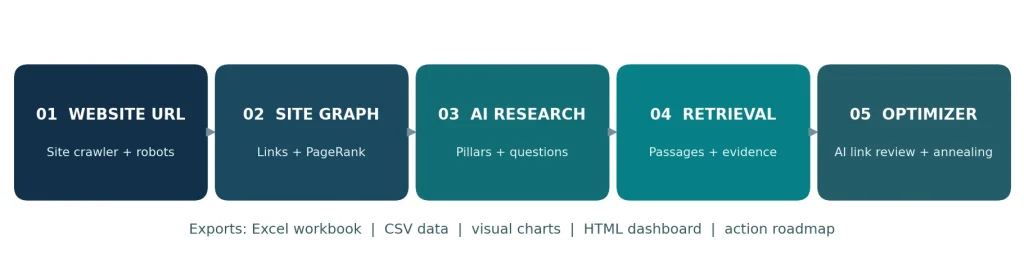
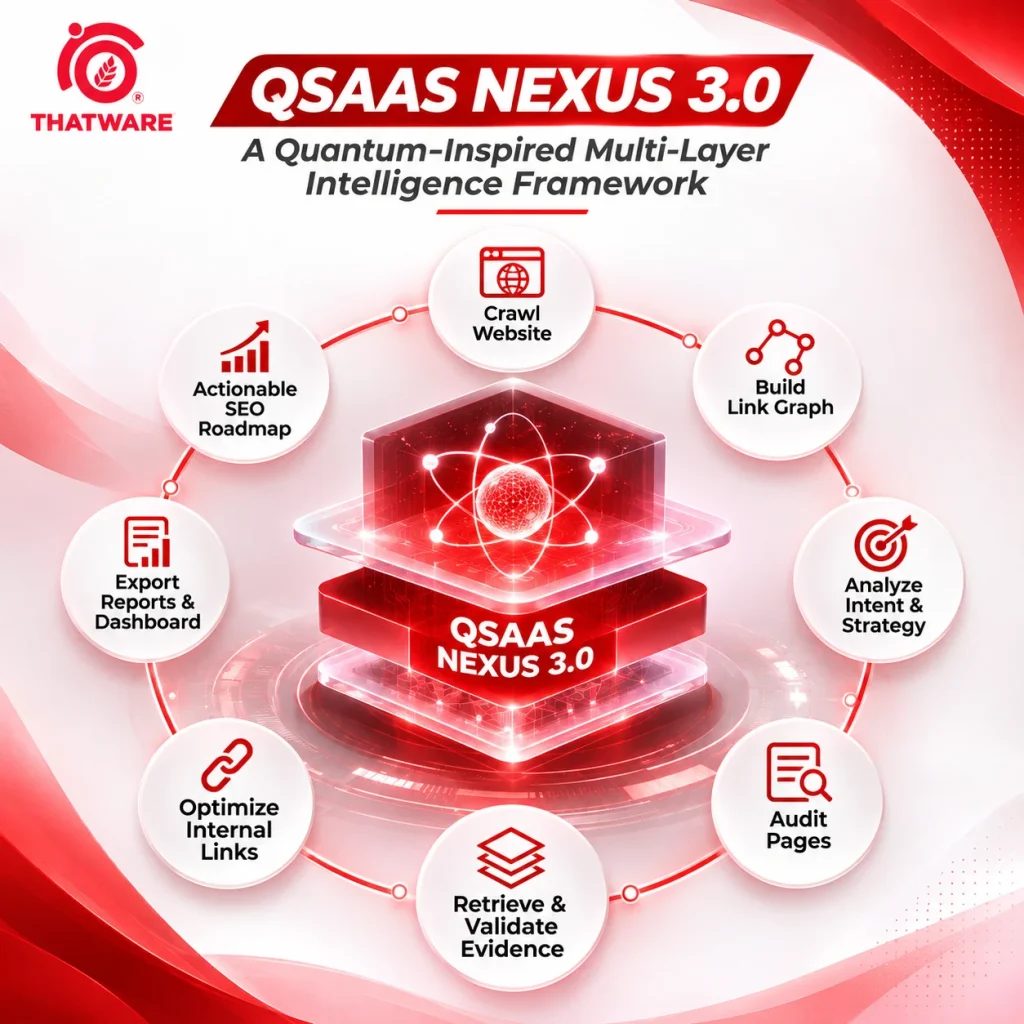
Inside the QSAAS NEXUS 3.0 framework
From a URL to a defensible optimization decision
A modern SEO audit should answer more than whether a website has a title tag or enough links. It should explain how pages relate to each other, what a visitor is trying to understand, whether useful evidence can be retrieved from existing content, and which proposed fixes are actually justified. That is the purpose of QSAAS NEXUS 3.0, ThatWare’s quantum-inspired, AI-assisted research framework. Starting with a website URL, it crawls accessible HTML pages, models internal linking and PageRank, generates topical questions, retrieves relevant passages and reviews whether those passages support complete answers. It then considers editorially suitable link additions through constrained classical simulated annealing. The result is not a promise of rankings or an imitation of Google’s internal systems. It is a repeatable way to move from raw website observations to more specific, testable SEO and AI-search recommendations.

Objectives
- Diagnose technical discovery signals and map the internal hyperlink network across the crawled sample.
- Measure modeled internal PageRank while separately evaluating topical and editorial relevance.
- Generate realistic search-intent questions and supporting subquestions for the website’s services.
- Test which page passages are retrieved by a reproducible local hybrid retrieval pipeline.
- Find missing answers, unsupported claims, evidence requirements and weak content distinctions.
- Suggest only contextually justified internal links, subject to practical implementation constraints.
- Turn observations into an accountable SEO roadmap with proposed validation metrics.
Key experimental results at a glance
| Measurement | Strom Permit run | Interpretation |
|---|---|---|
| Crawled pages | 25 | All 25 returned HTTP 200; crawl sample capped at 25. |
| Internal link instances | 2,808 | Includes repeated links and anchors; not unique edges. |
| Unique directed page links | 600 | Every crawled page linked to all 24 others. |
| Internal PageRank | 0.040 each | Uniform because the 25-node measured graph is fully connected. |
| AI query tests | 18 | AI-generated research hypotheses, not GSC demand data. |
| AI answerability | 3 complete / 13 partial / 2 missing | AI judgment of the retrieved passages. |
| Approved new links | 0 | No missing source-to-target edges remained inside this sample. |
1 User input and the automated workflow
Why bring these disciplines together? A page can be easy to crawl and still fail to answer a commercially important question. Another page may contain a strong answer yet sit in an awkward information architecture that makes it harder for users to discover. A third may attract links from every navigation menu without receiving a single meaningful in-content recommendation. Studying only one signal at a time conceals these differences. QSAAS places technical discovery, network structure, topical intent and passage evidence side by side so that each proposed change has a clear reason.
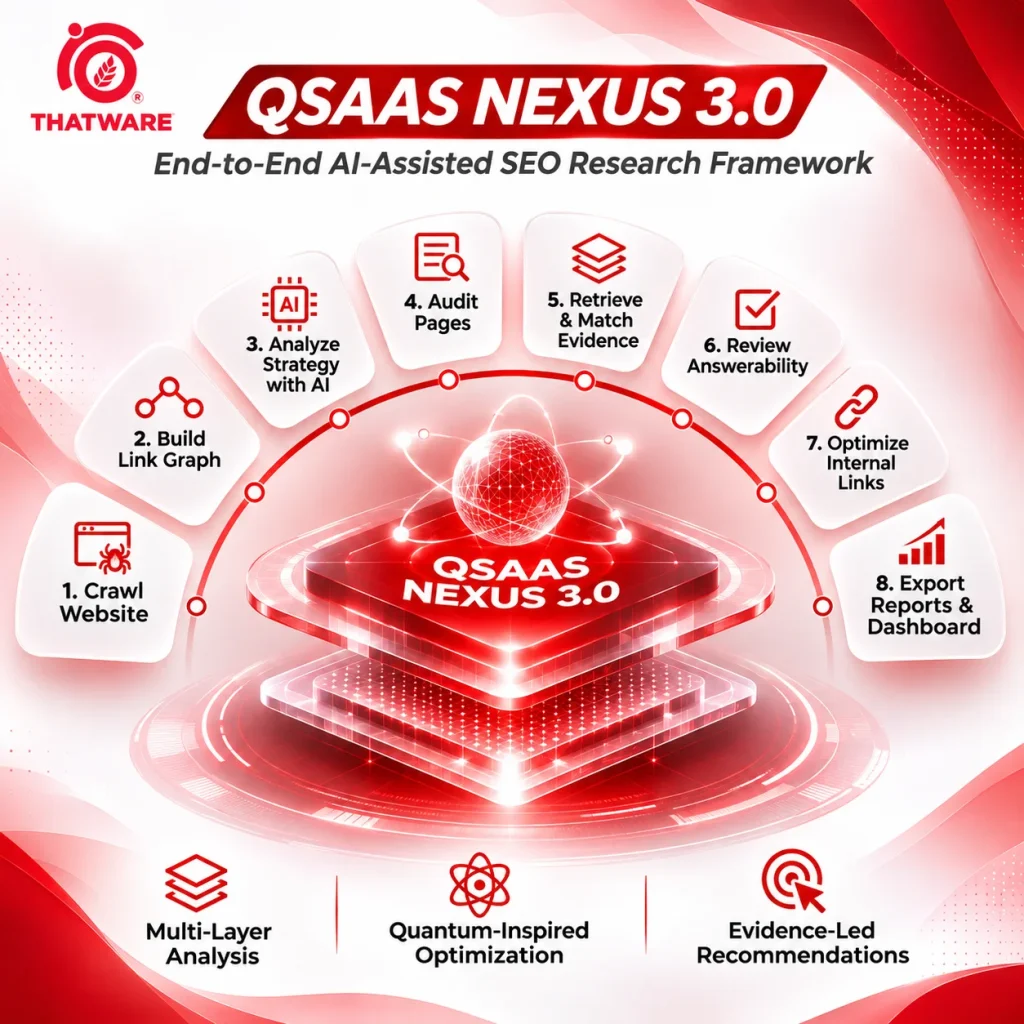
The workflow begins with a practical input: the site URL. In the research notebook, a researcher can set crawl limits and execution parameters, then follow the generated outputs through the eight stages. For client delivery, we treat those stages as a decision sequence rather than eight disconnected reports. The crawl establishes what was actually collected; the graph tests how those pages connect; query research identifies likely information needs; retrieval tests the accessible text; and evidence review separates supported observations from suggestions that still need human confirmation.
Eight operational stages
1. Crawl. Collect server-returned HTML, titles, descriptions, headings, canonical, robots signals, response times, schema counts, extracted text and internal links.
2. Build graph. Construct a directed, deduplicated page-level link graph and calculate internal PageRank and in-degree.
3. Ask OpenAI for site strategy. Infer topical pillars, audience needs, potential target questions and page purpose from the collected evidence.
4. Audit individual pages. Generate technical SEO and editorial findings, missing questions, suggested metadata and evidence requests.
5. Decompose questions and retrieve passages. Generate related subquestions; embed passages and queries; combine semantic and lexical similarity.
6. Review answerability. Use AI to decide whether the top passages answer each question and identify precise gaps.
7. Optimize internal links. Generate missing-edge candidates, obtain AI editorial approval, run constrained simulated annealing and recalculate PageRank if links are selected.
8. Export. Create an 18-sheet Excel workbook, corresponding CSV files, up to ten diagnostic charts and an HTML dashboard.
2 What makes the framework quantum-inspired
The word “quantum” requires care. Quantum-inspired describes the shape of an optimization problem and the search strategy used to explore it; it does not mean the crawler executes quantum circuits or that a quantum processor accelerates SEO. In this implementation, candidate links become yes-or-no variables. A scoring function weighs benefit against constraints, and simulated annealing explores possible combinations. That approach is useful when recommendations interact: adding several links from one source or repeatedly pointing to the same target may be less desirable than choosing a more balanced set.
This distinction matters because credible research should identify where its innovation starts and where its measurement ends. NetworkX PageRank is a classical Markov-chain calculation. OpenAI embeddings and TF-IDF provide a local retrieval comparison. AI reviews can help organize editorial work, but they remain assessments, not proofs. The quantum-inspired optimizer is therefore one component in a larger evidence workflow, not a shortcut to search engine performance.
A precise distinction between standard computation and quantum-inspired optimization
The model is not running on a quantum computer. Its crawl, network graph, PageRank and retrieval phases use conventional Python algorithms. The quantum-inspired element appears in the link-selection phase, where a collection of possible link additions is represented as binary choices and optimized using simulated annealing. This is conceptually related to energy minimization in quantum annealing and QUBO formulations, but the executed implementation is classical.
The mathematical foundations
| Framework | Role inside QSAAS | What it does not establish |
|---|---|---|
| Directed graph theory | Pages are nodes; hyperlinks are directed edges. | A link alone does not guarantee ranking value. |
| Hamiltonian Graph / Markov-chain PageRank | Computes a stationary authority distribution using damping. | Not Google’s current full ranking algorithm. |
| Vector embeddings and cosine similarity | Represents queries and passages for semantic matching. | Does not reproduce proprietary AI retrieval systems. |
| TF-IDF lexical matching | Tests literal term alignment independently of embeddings. | Does not measure keyword search volume. |
| Binary optimization + annealing | Chooses a set of eligible links with penalties and capacity limits. | No demonstrated quantum speedup or real Google indexation effect. |
How the optimizer’s energy concept works
For every editorially eligible candidate link i, a binary decision x_i is used: 1 means add the link; 0 means do not add it. The implementation rewards a candidate’s base utility and penalizes selections above the total link budget, above the per-source allowance, or beyond a destination concentration threshold. Simulated annealing explores combinations by sometimes accepting a lower-scoring state early and gradually reducing that flexibility. A greedy baseline provides a reference choice; the notebook retains a feasible result and does not claim a quantum advantage.
Utility = sum(candidate_score[i] * x[i])
Penalty = 2.5 * max(0, selected_count – budget)**2
Penalty += 2.0 * sum(max(0, links_from_source – 2)**2)
Penalty += 0.2 * sum(max(0, links_to_target – 3)**2)
Objective = Utility – Penalty # maximize
This is a readable summary of the scoring logic in the provided notebook, not a quantum-circuit implementation. The current link budget is eight.
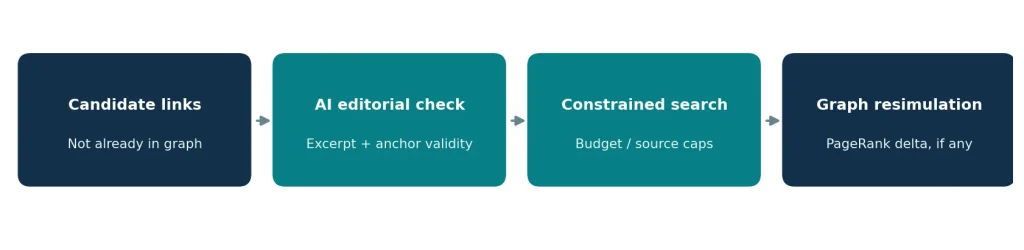
Figure 2. Candidate links must pass editorial evidence checks before constrained selection and any graph resimulation.
3 Calculation and retrieval phases explained
Consider the question “How do I apply for a Conditional Use Permit in Southern California?” An ordinary keyword check might report that a page contains the phrase “conditional use permit.” QSAAS asks a more exact question: when the user asks for an application process, does the extracted material actually provide the steps, documents, agencies and jurisdictional cautions needed to respond? That is why the retrieval stage and the answerability stage are separate. Similar wording can lead a system to the right page without proving that the answer on that page is sufficient.
Phase A: Crawl, accessibility signals and content extraction
The crawler follows in-domain hyperlinks from the submitted URL, limited by maximum crawl depth and page count. For each fetched HTML page it records HTTP status, server response duration, bytes downloaded, headings, metadata, self-referential or other canonical URLs, meta robots directives, JSON-LD script counts, images without alt attributes, and extracted page text. This provides the factual substrate for the subsequent AI audit.
A “review” indexability flag means the simple rules did not label the page as an HTTP error or a visible noindex directive. It is not evidence that the page is excluded from, or included in, Google’s index. Likewise, fetch time is the notebook’s HTTP response measurement and should not be presented as Core Web Vitals or real-user loading performance.
Phase B: Build the internal PageRank model
The program creates a directed graph from links discovered among the URLs in the crawled sample. Duplicate source-to-target links collapse into one graph edge, although the workbook retains all link instances. NetworkX calculates PageRank with a damping factor of 0.85. The algorithm repeatedly propagates importance through outgoing links while incorporating a random-jump probability. It produces a normalized site-internal model, not a Google PageRank value.
Simplified PageRank relationship: PR(v) = (1 − d)/N + d × Σ[PR(u)/outdegree(u)] for pages u linking to v, where d = 0.85 in this experiment. Because the observed graph has every possible directed edge between different pages, each page receives the same stationary score, 1/25 = 0.04.
Phase C: AI topic pillars and query fan-out
OpenAI receives a structured site inventory of titles, headings, short page excerpts, URLs and modeled graph measurements. It proposes site-specific topical pillars and query hypotheses, including questions associated with a service or decision. In the next stage the model generates supporting subquestions for each parent query. These are research hypotheses created by the model, not observed search volumes, actual Google query fan-outs or proof of user demand. They are useful as a test set for coverage and information architecture.
Phase D: Construct and retrieve passages
Readable page content is divided into manageable passages, subject to a global cap so long pages do not monopolize the collection. The notebook computes OpenAI text embeddings for both the page passages and the generated questions. It also computes TF-IDF lexical similarity using unigrams and bigrams. Each question is matched to the top five passages using a normalized weighted hybrid score: 70% rescaled cosine similarity plus 30% normalized lexical similarity. Scores are local comparison proxies and are not calibrated citation probabilities.
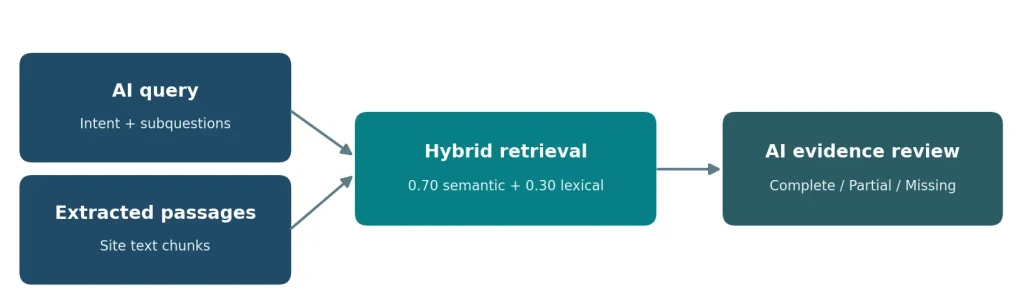
Figure 3. Retrieval separates candidate passage ranking from the subsequent AI evidence judgment.
Phase E: Evidence-backed answerability review
The top-ranked passages are sent back to OpenAI. For each question, the model judges whether the available excerpts provide a complete answer, only a partial answer, or no adequate answer. It records a suggested best URL, a supporting excerpt if available, missing information and recommended editorial improvement. The program checks whether a purported supporting excerpt appears in the supplied retrieved passages; unverified excerpts are flagged rather than treated as proof. This is a valuable quality-control step, but final editorial and subject-matter review remain necessary.
Phase F: Editorial link candidates and simulated PageRank
Before optimizing links, the code calculates text similarity between page representations and excludes links that already exist in the observed directed graph. OpenAI then judges a candidate source-to-target link for topical usefulness, proposes an anchor, and identifies a verbatim source excerpt where the link might fit. Only accepted candidates with verified placement evidence move into the binary optimizer. If the selected set is non-empty, a copy of the graph receives those edges and PageRank is recalculated. The before-and-after delta predicts a change in this internal model only, not a future Google ranking gain.
In the supplied Strom Permit run, this phase found no eligible missing edges: the 25-page observed graph was already fully connected. Consequently, AI_Link_Review, Selected_Links and Simulated_PageRank contain “No applicable findings; not fabricated.” That outcome is methodologically preferable to forcing redundant links into an already complete graph.
4 Experiment design and measured dataset
ThatWare used Strom Permit as an illustrative case because land-use and permit services contain complex, high-consideration questions. A reader may need to distinguish a variance from a zone change, understand when environmental review applies, or determine how due diligence changes project planning. These are not questions that become useful through keyword repetition alone. Their answers depend on procedural clarity, jurisdictional qualification and credible source material.
The 25-page limit is an important boundary. It describes the collected sample, not every URL the website has ever published or every version a search engine may render. Findings from this controlled run are therefore best treated as research leads. The next validation step would compare the crawl inventory with the live site, XML sitemaps and Search Console rather than assuming the sample is complete.
The analyzed website
The supplied experiment examines Strom Permit, a California-focused permit and land-use consulting website. The data snapshot covers the homepage and 24 other discovered URLs, including conditional use permits, due diligence, land-use zoning, CEQA/EIR process management, zone changes, variance permits and specialized location or industry pages. This is a capped 25-page crawl, not a verified full-site inventory.
Observed data summary
| Category | Value | Source / interpretation |
|---|---|---|
| HTML pages fetched | 25; all HTTP 200 | Crawl_Facts; no HTTP error in sample. |
| Mean recorded HTTP fetch | 2.25 seconds | Range 1.718 to 3.828 seconds; not Core Web Vitals. |
| Extracted content | 10,403 words (sum) | The crawler strips site-wide navigation before extracting text. |
| Internal links recorded | 2,808 instances | Internal_Links includes repeated anchors and page mentions. |
| Distinct directed edges | 600 | Exactly 25 × 24; all source-target pairs present. |
| Page passages | 110 | Page_Passages; globally capped in implementation. |
| Topic pillars / questions | 11 / 18 | OpenAI-generated hypotheses and topic grouping. |
| Supporting subquestions | 54 | Three per main question in this run. |
| Ranked retrieval entries | 90 | Top five per each of 18 questions. |
| AI request log | 36 successful entries | API_Call_Log; account access required for reruns. |
5 Visual findings: crawl and site architecture
5.1 Uniform PageRank: what it actually demonstrates
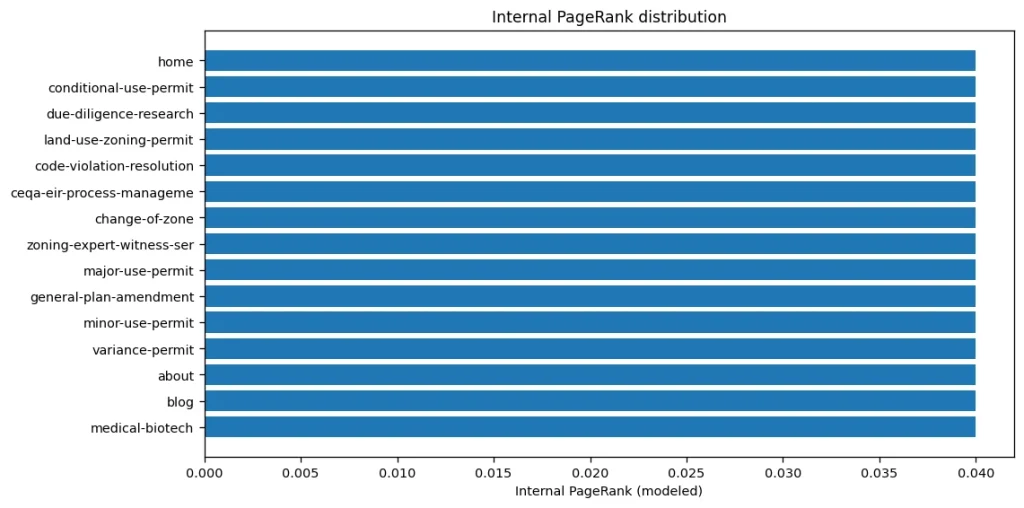
Figure 4. All displayed URLs score 0.040, a consequence of the complete measured graph.
The bar chart should not be interpreted as proof that “all pages have equal SEO strength.” The network consists of 25 nodes and 600 unique non-self directed edges: every page links to every other page. Because the code deduplicates multiple anchors into one edge, repeated menu, footer or sitewide links can overwhelm the PageRank structure. The resulting 0.040 score is mathematically expected. For future runs, the most important model upgrade is to distinguish contextual body links from boilerplate navigation and to vary link weights only where there is a defensible basis.
5.2 Technical eligibility is not confirmed indexation
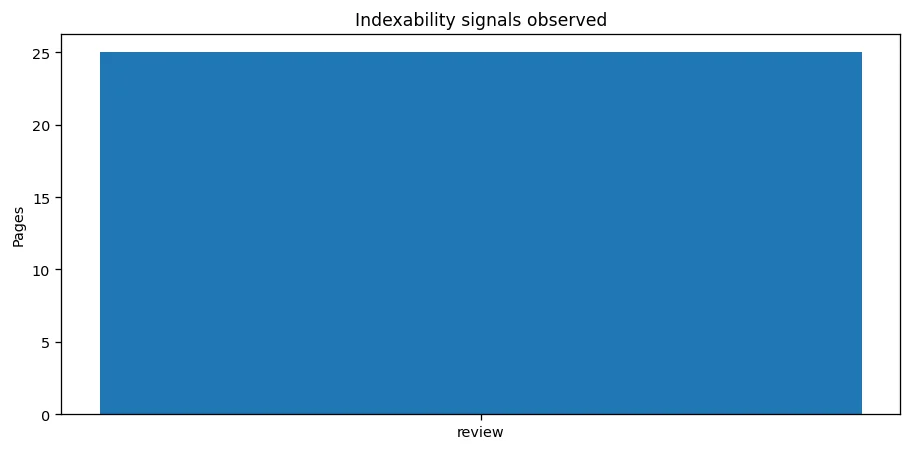
Figure 5. All 25 URLs are labeled “review,” not conclusively “indexable” or “not indexed.”
The workbook shows 25 pages with HTTP 200 and the indexability_flag “review.” This is a triage category, not a verified search-console indexation state. The absence of a noindex marker and successful fetching are useful observations, but a reliable indexation analysis would also check the effective canonical, X-Robots-Tag, rendered HTML, and Google Search Console URL inspection data.
5.3 Fetch time relative to extracted word count
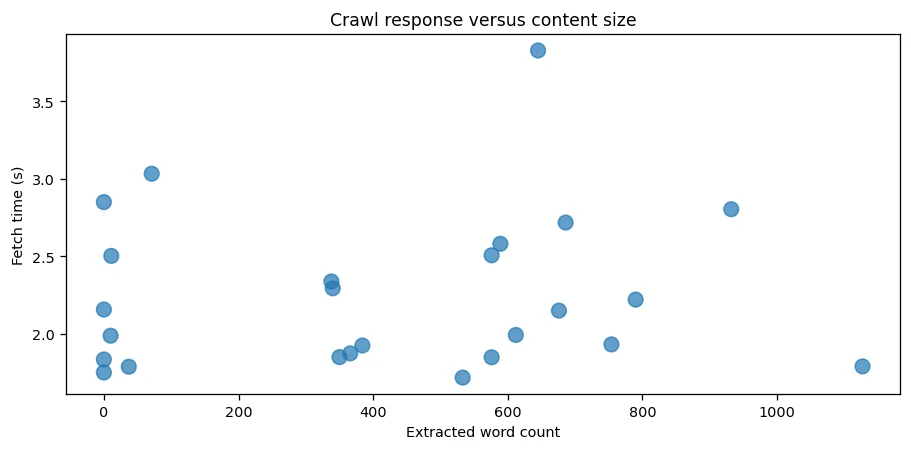
Figure 6. HTTP fetch time does not rise monotonically with extracted word count in this sample.
The recorded requests vary from roughly 1.72 to 3.83 seconds. The scatterplot compares these measured fetch durations with extracted word counts, not download bytes, client-side page weight or Core Web Vitals. Prioritize repeatable server-level checks on the slowest URLs, but do not assume that the difference was caused by the quantity of article text alone.
6 Visual findings: internal graph and retrieval
In a saturated graph, sheer link presence is no longer a useful differentiator. Every page is technically connected to the others, but a navigation link to a service is not necessarily equivalent to a sentence that explains why the service is relevant. The more useful next experiment would identify body links, template links and links that have a clear topical bridge. It would then compare the resulting networks rather than treating all visible hyperlinks as interchangeable.
The retrieval chart gives a complementary insight. A passage can register a strong hybrid match because it uses closely related language and still omit a definition, process step or qualifying condition. For AI-answer research, retrieval suitability is only the entrance test. The substantive test asks whether an answer can be grounded in the retrieved text without inventing unsupported details.
6.1 Saturated measured link structure
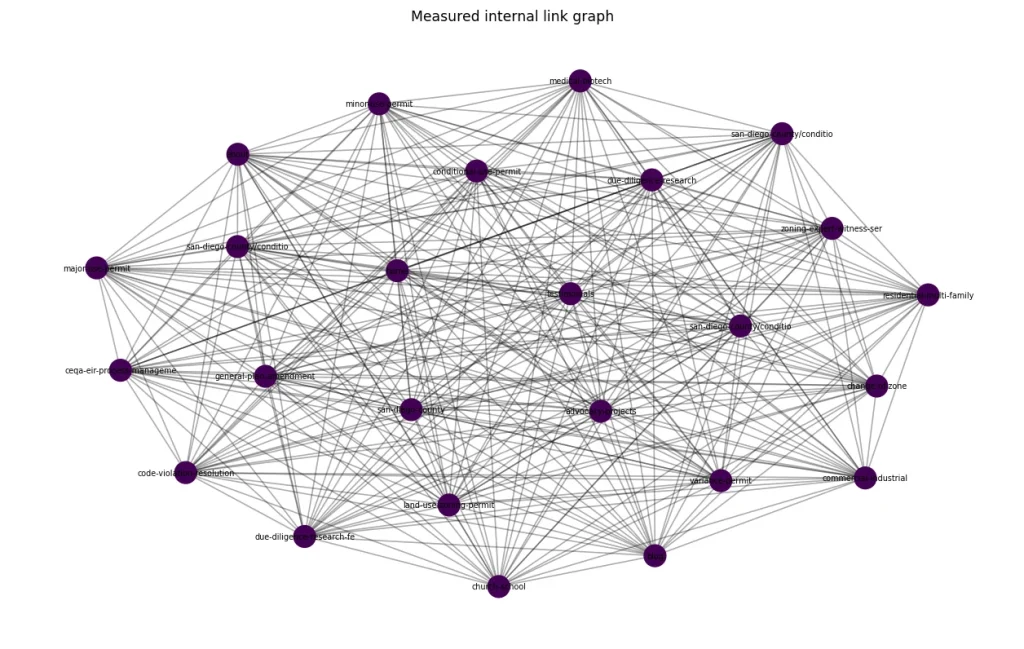
Figure 7. The dense network is effectively fully connected across the 25-page crawl sample.
The link network shows connections among nearly every displayed pair because the extracted page graph is mathematically complete. This is useful as a quality-control discovery: the current graph cannot distinguish editorial, in-content recommendations from sitewide navigation. A subsequent QSAAS experiment should separately calculate sitewide-link PageRank, contextual-link PageRank and a weighted semantic authority graph. It should also expand the crawl only after verifying the full site inventory and crawl constraints.
6.2 Retrieval suitability across site questions
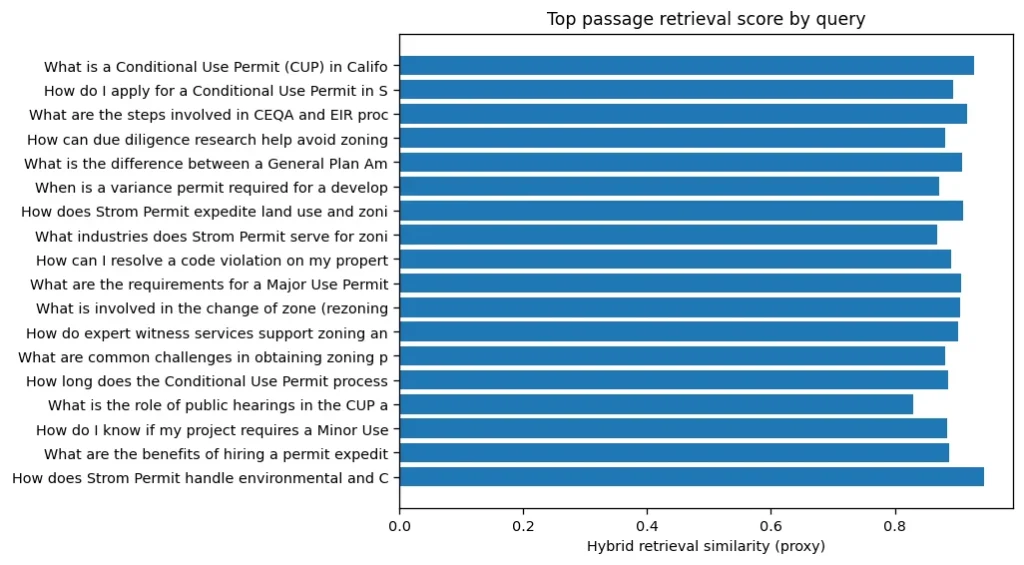
Figure 8. Top hybrid similarity scores are high for many questions, but do not prove answer completeness.
For the 18 generated queries, the model selected the top five site passages, giving 90 query-passage retrieval rows. A strong similarity score signals that a passage resembles the question under this local scoring system. It does not establish whether the passage contains the necessary procedural detail or supporting evidence. The separate answerability assessment explains that gap.
7 Visual findings: answer quality and AI issues
The answerability distribution is the most immediately actionable part of the Strom Permit experiment. Only three of eighteen test questions were judged complete, while thirteen were partial and two missing. That does not establish the outcome of every possible live search. It does, however, identify a focused editorial review queue: inspect the pages associated with those questions, compare the selected passages with full-page content and add useful missing information where the gap is real.
An editorial upgrade might consist of a plain-English definition at the top of a service page, a jurisdiction-sensitive checklist, a brief process sequence, or a distinction between two closely related permit categories. Each addition should have a genuine reader benefit. Especially for regulated topics, specialist verification is essential: the model can propose what to explain, but it cannot independently certify an agency rule or approval timeline.
7.1 AI-judged answerability coverage
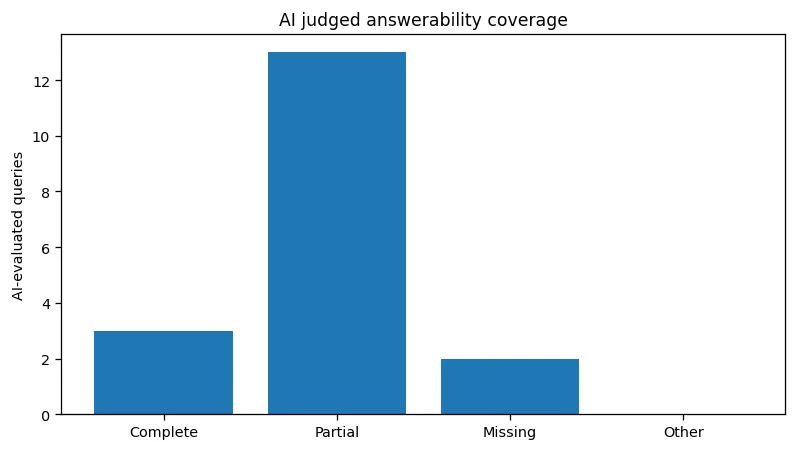
Figure 9. Of 18 tested questions, 3 are complete, 13 partial and 2 missing.
The strongest practical finding is that the majority of tested questions were only partially answered in the extracted passages. This suggests a valuable content-optimization opportunity: use existing landing pages to add precise definitions, steps, requirements, distinctions and carefully sourced evidence. These judgments are based on a limited passage set, so a human reviewer should check the full live page before accepting a “missing” classification.
Representative questions and suggested treatment
| AI test question | Classification | Potential next action |
|---|---|---|
| What is a Conditional Use Permit (CUP) in California? | Partial | Add a precise definition and jurisdiction-specific context on the CUP page. |
| How do I apply for a Conditional Use Permit in Southern California? | Missing | Explain the procedure, documentation, agencies and local variations; verify legal facts. |
| What are the steps involved in CEQA and EIR process management? | Partial | Provide a clearly sequenced process overview with authoritative sources. |
| How can due diligence research help avoid zoning issues in California? | Partial | Specify tangible risks, review steps and substantiated examples. |
Source: AI_Answer_Gaps. These are model-generated editorial recommendations, not independent legal or regulatory conclusions.
7.2 AI issue severity requires evidence verification
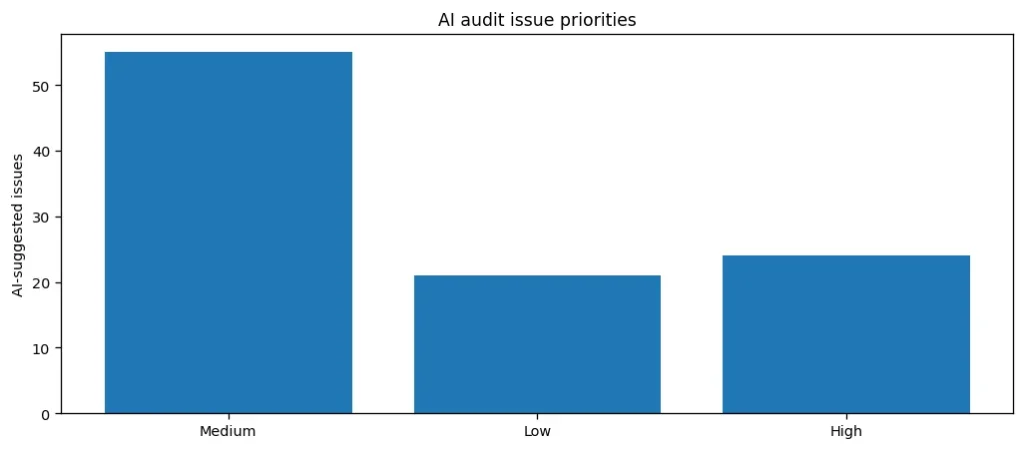
Figure 10. Across 25 pages, AI proposed 24 high-, 55 medium- and 21 low-priority issues.
The audit emitted 100 issue rows: 24 High, 55 Medium and 21 Low. However, only 13 issue quotes passed the automatic evidence-substring check; the other 87 are explicitly marked “Needs editor verification.” Therefore, the counts represent AI-proposed issue volume, not 100 independently confirmed defects. Before client implementation, validate the high-priority claims against live page sections, effective metadata, canonical tags and the full site content.
8 Query decomposition and content opportunity mapping
Query fan-out should be understood as a research method, not a claim that a search engine issued the same follow-up prompts. For each parent question, the notebook creates supporting questions that help expose missing pieces of the answer. Someone researching environmental impact review may also need an explanation of project scope, agency review stages and documents. Seeing those elements together helps content strategists decide whether an existing landing page can address the journey or whether genuinely distinct supporting content is needed.
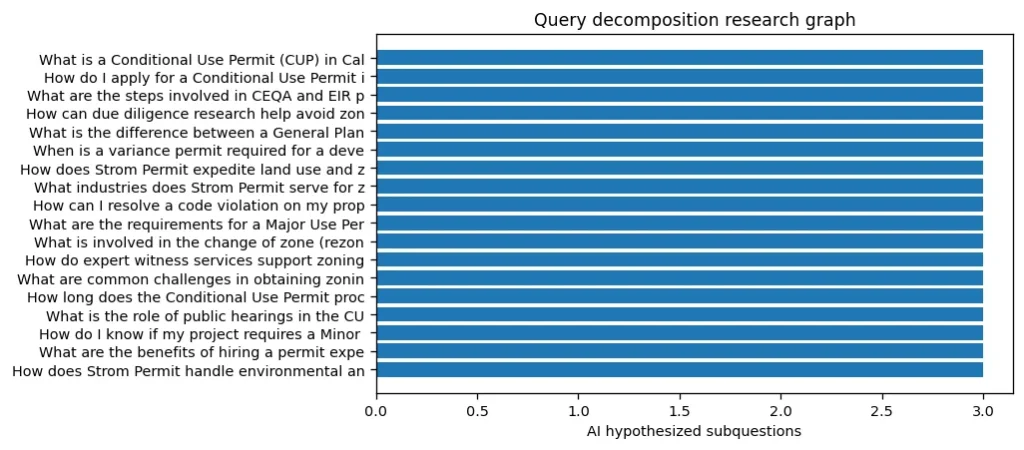
Figure 11. Eighteen model-generated parent questions yielded 54 supporting subquestions.
The query decomposition adds depth to a traditional keyword map. Rather than assigning one phrase to one page, it explores related user questions that an answer needs to address. For example, a Conditional Use Permit question may require clarification of eligible uses, differences from other permit types and the role of local hearings. This structure can guide a well-organized, authoritative service page or supporting article, but each subquestion should be assessed for intent, search demand and duplication before new content is commissioned.
Eleven identified topic pillars
- Conditional Use Permits (CUP)
- Due Diligence Research & Feasibility Studies
- Land Use and Zoning Permit Expediting
- Code Violation Resolution & Compliance
- CEQA & Environmental Impact Review (EIR) Process Management
- Change of Zone (Rezoning) Permits
- Variance Permits
- Major and Minor Use Permits
- General Plan Amendments
- Zoning & Land Use Expert Witness Services
- Industry-Specific Permit Consulting
Content opportunity principle
Not every generated subquestion should become a separate URL. Improve the strongest matching existing page first. Create supporting pages only when there is a distinct search intent, enough verifiable expertise and a practical reason to separate the topic. Where two pages already cover the same intent, improve differentiation rather than multiplying near-duplicate content.
9 Link optimization and why this run selected none
Zero selected links can be a legitimate research result. Here, all 600 possible non-self directed edges among the 25 observed pages were present, so an optimizer restricted to missing graph edges had nothing to select. A weaker system might still manufacture a shortlist to make its report appear productive. QSAAS instead preserves the empty outcome and directs attention toward a better question: are existing links useful, contextual, appropriately anchored and proportionate to the page’s subject?
QSAAS uses a two-step filter: conventional similarity screening proposes only source-to-target pairs that are not yet linked, then OpenAI judges whether an exact source passage can accommodate a meaningful anchor to the destination. Selected candidates would be optimized under a total budget of eight additions, no more than two links from one source, and soft penalties for overconcentration on one target. The reported run produced no eligible missing links in the 25-page sample, so its selected-link and simulated-PageRank sheets correctly contain no recommendations.
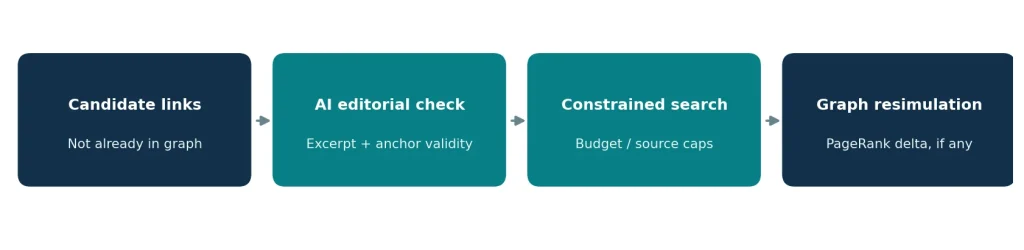
Figure 12. Link selection is conditional: the optimizer does not fabricate links when the candidate set is empty.
Important distinction for client reporting
The absence of selected links is not evidence that the website requires no internal-link optimization. It means the specific 25-URL, unweighted graph already contains every possible source-to-target edge. Improvements can still come from using stronger contextual anchors, removing repetitive navigation dilution, consolidating page cannibalization, adjusting click depth and measuring links in the main content separately. Those interventions would need an enhanced link-location-aware crawler and editor review before they can be quantified.
What the next graph experiment should change
- Categorize anchors as main-content, navigation, footer, sidebar and repeated template links.
- Run PageRank on a context-only subgraph and compare it with the all-links baseline.
- Record anchor text diversity, section placement, topical relevance and target service importance.
- Use constraints to avoid excessive links to the same commercial target.
- Only then compute the modeled before-and-after PageRank deltas for feasible new links.
10 Outputs and files a researcher receives
It is important to keep factual exports and inferred recommendations separate. Crawl measurements and captured links are observations within the run’s scope. Suggested metadata, issue severity and topic classifications are model outputs that require approval. Tracking these categories distinctly makes later comparisons much easier, especially when the website changes between experiments.
Each run generates a dated results directory and archive. The workbook contains 18 analysis tabs with factual measurements, AI assessments, retrieval tests, optimizer status and API execution logs. The same datasets are also exported as CSV files; the HTML dashboard bundles an executive summary, priorities and rendered plots. The outputs are meant to be analyzed, reviewed and translated into implementation tickets.
| Excel workbook sheets | Practical use |
|---|---|
| Crawl_Facts / Crawl_Errors | Observed HTML, HTTP, metadata and errors. |
| Internal_Links / Page_Passages | Raw page graph and extractable evidence text. |
| AI_Topic_Pillars / AI_Query_Hypotheses / AI_Query_Fanout | Topical architecture and question research. |
| Retrieval_Top5 / AI_Answer_Gaps | Five candidate passages and answerability judgments per query. |
| AI_Page_Issues / AI_Missing_Questions / AI_Evidence_Needed | Editorial QA and content briefs requiring verification. |
| AI_Meta_Intent / AI_Roadmap | Suggested titles, descriptions, intent and prioritized actions. |
| AI_Link_Review / Selected_Links / Simulated_PageRank | Link-optimization decisions and possible graph deltas. |
| API_Call_Log | Audit trail for successful model request endpoints. |
Ten diagram outputs in the implementation
The experiment code supports: (1) PageRank distribution, (2) indexability signal distribution, (3) fetch time versus word count, (4) internal-link graph, (5) top passage retrieval scores, (6) AI answerability status, (7) AI issue priorities, (8) selected link additions, (9) simulated PageRank changes and (10) query fan-out counts. Eight of these images were supplied with this request. The sample workbook confirms that diagrams 8 and 9 would contain no selected links or calculated deltas, respectively.
11 Practical benefits for SEO and AI-search programs
For ThatWare’s framework program, QSAAS NEXUS 3.0 illustrates an approach to SEO that goes beyond isolated ranking factors. It helps teams ask whether the site has an understandable structure, whether important service questions are answered in retrievable language, and whether recommended changes can be tied to visible evidence. This approach can inform technical SEO, content enhancement, AEO and GEO planning without pretending that a local proxy directly measures all search or assistant systems.
For technical SEO teams
The model consolidates crawl facts, link graphs, duplicated connections and indexability triage into a structured URL inventory. Its stronger application is prioritizing which technical findings need deeper investigation, rather than replacing specialist checks such as JavaScript rendering tests, log-file analysis or Search Console inspection.
For content and conversion teams
It connects each page with prospective user questions and tests whether the page’s extracted passages give useful answers. The AI gap output can be converted into content updates, clarifying subheadings, supporting diagrams, verified case examples and differentiated calls to action. This is especially valuable for complex services such as land-use permitting, where a user needs more than keyword repetition.
For AI visibility research
The system creates a reproducible local test of query-to-passage suitability and evidence coverage. Better passages may be more useful to retrieval-augmented systems, but the current experiment does not directly measure Google AI Overview inclusion, ChatGPT citation frequency or external model behavior. Those outcomes require separate, tracked observations or appropriate platform data.
For delivery and governance
The workbook provides traceable source URLs, explicit issue rows and a roadmap that can become tasks for editorial, development and SEO owners. Evidence verification flags help prevent the team from implementing unsupported AI suggestions. Re-running the same query set later can support controlled before-and-after comparisons.
12 How to take the results forward
A sensible rollout begins with verification, not bulk publishing. Review high-priority AI flags on live pages, establish a baseline for the fixed question set, and identify one or two service-page improvements with clear evidence requirements. After publication, record the exact changed sections and dates. Re-run the local retrieval test with consistent settings and compare the outcome with Search Console and conversion observations over an appropriate window.
When results improve, explain what was observed rather than automatically attributing causation to the framework. Search demand, competitor changes, indexing shifts and broader site updates can all influence performance. QSAAS is strongest as a disciplined research and prioritization layer within that larger measurement practice.
Stage 1: Verify and prioritize
- Audit the 24 High issue rows first, but require source-level verification and reject claims not supported by the live page.
- Confirm 25-page coverage versus the full Strom Permit inventory; check canonical destinations, X-Robots-Tag and actual GSC indexing states.
- Separate template navigation from contextual body links before using PageRank to guide link changes.
- Choose a small fixed benchmark of the 18 tested questions and retain every query for future comparison.
Stage 2: Improve landing-page answers
- Prioritize the CUP, CEQA/EIR, due diligence and zoning service pages where answers are partial or missing.
- Create content briefs with question, existing best URL, verified source excerpt, missing detail, proposed section and approval owner.
- Use expert and official references for permit laws, timelines and requirements; avoid AI-generated legal claims without verification.
- Improve descriptions and metadata where page intent is misaligned, while preserving a single primary target intent per URL.
Stage 3: Rebuild the link model
- Collect anchor placement (body versus navigation/footer), recurring templates and main-content links.
- Run the optimizer on absent contextual link placements rather than on all existing global template links.
- Use site-critical priorities, topical relevance, editorial naturalness and implementation effort as constraints.
- Compare classical greedy and simulated annealing solutions with matched budgets and report score, runtime and feasibility.
Stage 4: Measure outcomes
- Measure GSC clicks, impressions, queries, indexed status and organic landing-page performance using a before/after period and an unaffected comparison set.
- Repeat the same local retrieval questions and track Complete/Partial/Missing changes with the same model or clearly record model changes.
- Where permitted, monitor observed AI answer citations and separately mark mention versus URL citation; do not infer them from retrieval similarity.
- Record implementation dates, changed sections and confounding factors so campaign improvements are not automatically attributed to QSAAS.

13 Reproducibility, source code and Google Colab
Open the live research notebook
Google Colab research link: https://colab.research.google.com/drive/154cw6EJCfDFtBQskTSvag9XaSunyO2hX#scrollTo=wXF8v0DKDfK2
Open the QSAAS NEXUS experiment in Colab
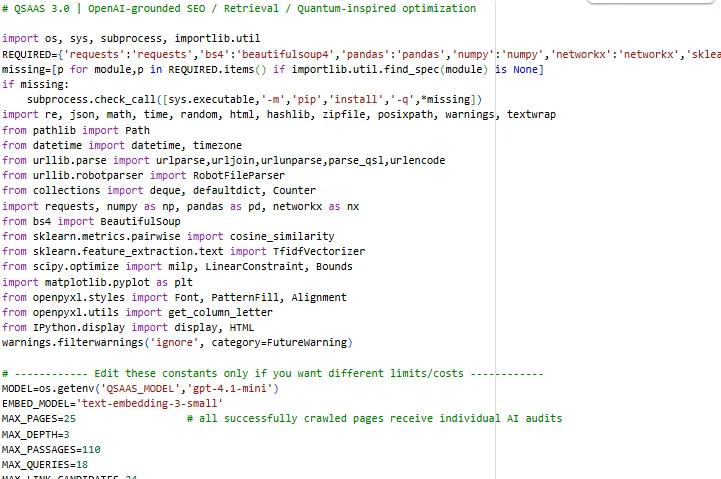
Representative Python implementation excerpts
The snippets below illustrate the actual logic family found in the experiment; they are not a substitute for the full notebook.
# 1) Internal graph and classical PageRank
g = nx.DiGraph()
g.add_nodes_from(crawled_urls)
g.add_edges_from((e[‘source’], e[‘target’]) for e in internal_links)
internal_pr = nx.pagerank(g, alpha=0.85)
# 2) Hybrid query-to-passage retrieval
semantic = cosine_similarity(query_vectors, passage_vectors)
lexical = (query_tfidf @ passage_tfidf.T).toarray()
lex_scaled = (lexical – lexical.min(axis=1, keepdims=True)) / (
lexical.max(axis=1, keepdims=True) – lexical.min(axis=1, keepdims=True) + 1e-9
)
hybrid = 0.70 * ((semantic + 1) / 2) + 0.30 * lex_scaled
# 3) Candidate link filtering and PageRank scenario
eligible = [link for link in ai_reviews
if link[‘ai_approved’] and link[‘evidence_verified’]]
# The optimizer selects a feasible subset under link-budget constraints.
simulated_graph = g.copy()
simulated_graph.add_edges_from((x[‘source’], x[‘target’]) for x in selected)
modeled_after = nx.pagerank(simulated_graph, alpha=0.85)
What QSAAS NEXUS 3.0 demonstrates for ThatWare
A useful framework does not need every module to generate an intervention on every run. In Strom Permit, the graph exposed a limitation in the current link model while the passage analysis identified more immediate content-review opportunities. Those contrasting outcomes are precisely why the framework evaluates multiple layers instead of relying on a single score. Its next development step is not to make stronger claims, but to improve input coverage, link-location classification, evidence validation and external outcome measurement.