SUPERCHARGE YOUR ONLINE VISIBILITY! CONTACT US AND LET’S ACHIEVE EXCELLENCE TOGETHER!
For many businesses in 2026, SEO is no longer a question of whether search matters.
The real question is whether the return justifies the investment.
That question has become more important because search itself has changed.
Google still drives discovery.
But users are also turning to AI Overviews, ChatGPT, Gemini, Copilot, Perplexity, Claude, social platforms, video, and other discovery environments before they ever reach a website.

This means an SEO investment today is not simply about ranking higher for a list of keywords.
It is about building a sustainable discovery system.
A strong SEO program can help businesses:
- Capture high-intent demand
- Reduce dependence on paid advertising
- Build long-term visibility
- Improve brand authority
- Generate qualified leads
- Strengthen AI search presence
- Expand into new markets
- Create compounding organic growth
But SEO is not automatically profitable.
Poorly planned SEO can consume budget for months without producing meaningful business outcomes.
That is why companies evaluating SEO investment for businesses need to look beyond traffic and ask a more commercially useful question:
What business value is search actually creating?
At ThatWare, we believe SEO should be treated as a measurable growth asset rather than a collection of monthly marketing tasks.
Is SEO Still Worth It in 2026?
For many businesses, yes.
But only when SEO is aligned with commercial opportunity.
SEO is generally worth investing in when:
- Customers actively search for your products or services
- Search influences the buying journey
- Your industry has meaningful organic demand
- Competitors are acquiring customers through search
- Your website can convert traffic into leads or sales
- Your business can sustain the time needed for organic growth
The value of SEO services for businesses comes from their ability to capture demand that already exists.
Unlike interruption-based advertising, SEO often reaches customers when they are already researching a problem, comparing providers, or considering a purchase.
That makes search particularly valuable for categories with strong commercial intent.
Quick Q&A
Q: Is SEO worth investing in if paid ads already work?
Often, yes. Paid search can generate immediate demand capture, while SEO can build a longer-term organic acquisition channel that reduces dependence on continuously increasing ad spend.
SEO Is an Asset, Not Just a Campaign
Paid advertising generally stops producing traffic when spending stops.
SEO works differently.
A well-optimized page can continue attracting users for months or years.
That does not mean SEO becomes completely passive.
Content needs maintenance.
Competitors change.
Search engines evolve.
But the underlying asset remains.
For example, a strong buyer guide may continue generating:
- Organic traffic
- Leads
- Backlinks
- AI citations
- Brand mentions
long after publication.
This compounding effect is one of the strongest arguments for strategic SEO marketing services.
“The real value of SEO is not one ranking. It is the accumulation of visibility, authority, and demand capture over time.”
1. SEO Can Reduce Dependence on Paid Acquisition
Paid media can scale quickly.
But costs usually rise with competition.
SEO can create another acquisition channel.
Imagine a business spending heavily on paid search for high-intent keywords.
If organic pages begin ranking for those same commercial queries, the business may gain:
- Additional clicks
- Lower blended acquisition costs
- Stronger brand presence
- Greater SERP coverage
This is why SEO growth services can complement rather than replace paid marketing.
The strongest acquisition strategies often use both.
2. SEO Captures Existing Customer Demand
Customers search when they need something.
They may ask:
- Which provider is best?
- How much does this service cost?
- What software should I use?
- Which company offers this solution?
- What are the alternatives?
SEO allows businesses to become visible at these moments.
Strong business SEO services should map search demand across the entire buying journey.
Awareness
Informational searches.
Evaluation
Comparison and buyer-guide searches.
Purchase
Commercial and transactional searches.
When SEO covers all three stages, organic search can support both awareness and revenue.
3. SEO ROI Should Be Measured Beyond Traffic
Traffic alone is not ROI.
A business can double organic traffic while generating almost no additional revenue.
A strong SEO ROI agency should connect performance with commercial outcomes.
Important SEO ROI metrics may include:
- Qualified organic traffic
- Lead volume
- Conversion rate
- Revenue
- Pipeline
- Customer acquisition cost
- Assisted conversions
- Lifetime value
This gives a much clearer picture of whether SEO is working.
How to Calculate SEO ROI
A basic SEO ROI model can be written as:
SEO ROI = (SEO Revenue – SEO Cost) ÷ SEO Cost × 100
For example:
If SEO generates $150,000 in attributable revenue and costs $50,000:
SEO ROI = ($150,000 – $50,000) ÷ $50,000 × 100
SEO ROI = 200%
However, SEO attribution can be more complex.
Organic search may also assist:
- Email sign-ups
- Remarketing
- Branded searches
- Direct traffic
- Sales-assisted conversions
That is why SEO ROI services should consider both direct and assisted impact.
Quick Q&A
Q: Should SEO ROI be measured every month?
Monthly measurement is useful, but short-term numbers can be misleading. SEO often compounds over time, so quarterly and annual trends are usually more meaningful.
4. SEO Builds Brand Authority
Search visibility creates repeated exposure.
If users consistently see the same brand across:
- Commercial queries
- Educational searches
- Comparisons
- AI answers
- Industry topics
the brand begins to become familiar.
That familiarity can influence future decisions.
SEO therefore supports more than traffic.
It can contribute to:
- Trust
- Recall
- Brand demand
- Market authority
Strong professional SEO services should consider this broader impact.
5. SEO Can Improve AI Search Visibility
The discovery environment in 2026 is broader than traditional organic search.
Businesses increasingly need visibility across AI-powered systems.
Strong SEO foundations can support this because AI systems often depend on accessible, authoritative, well-structured information.
An advanced SEO strategy may therefore consider:
- Entity optimization
- Structured data
- Expert content
- Third-party mentions
- Citation-worthy resources
- Clear company information
This gives SEO investment a new dimension.
SEO can support both conventional rankings and emerging AI discovery.
6. SEO Is Particularly Valuable for High-Intent Searches
Not every keyword has equal business value.
Consider:
“what is cybersecurity”
versus:
“enterprise cybersecurity consulting company”
The second query may have lower search volume but significantly higher commercial intent.
A strong SEO agency for business growth should prioritize keywords based on:
- Revenue potential
- Intent
- Competition
- Conversion likelihood
not simply search volume.
Mini Case Study 1: B2B Company With High Paid Search Costs
Imagine a B2B software company relying heavily on paid search.
Its highest-value keywords become increasingly expensive.
Instead of abandoning paid campaigns, the company begins investing in commercial SEO pages, comparison content, technical optimization, and authority building.
Over time, organic visibility begins contributing more qualified leads.
The result is a more balanced acquisition model with less dependence on paid traffic.
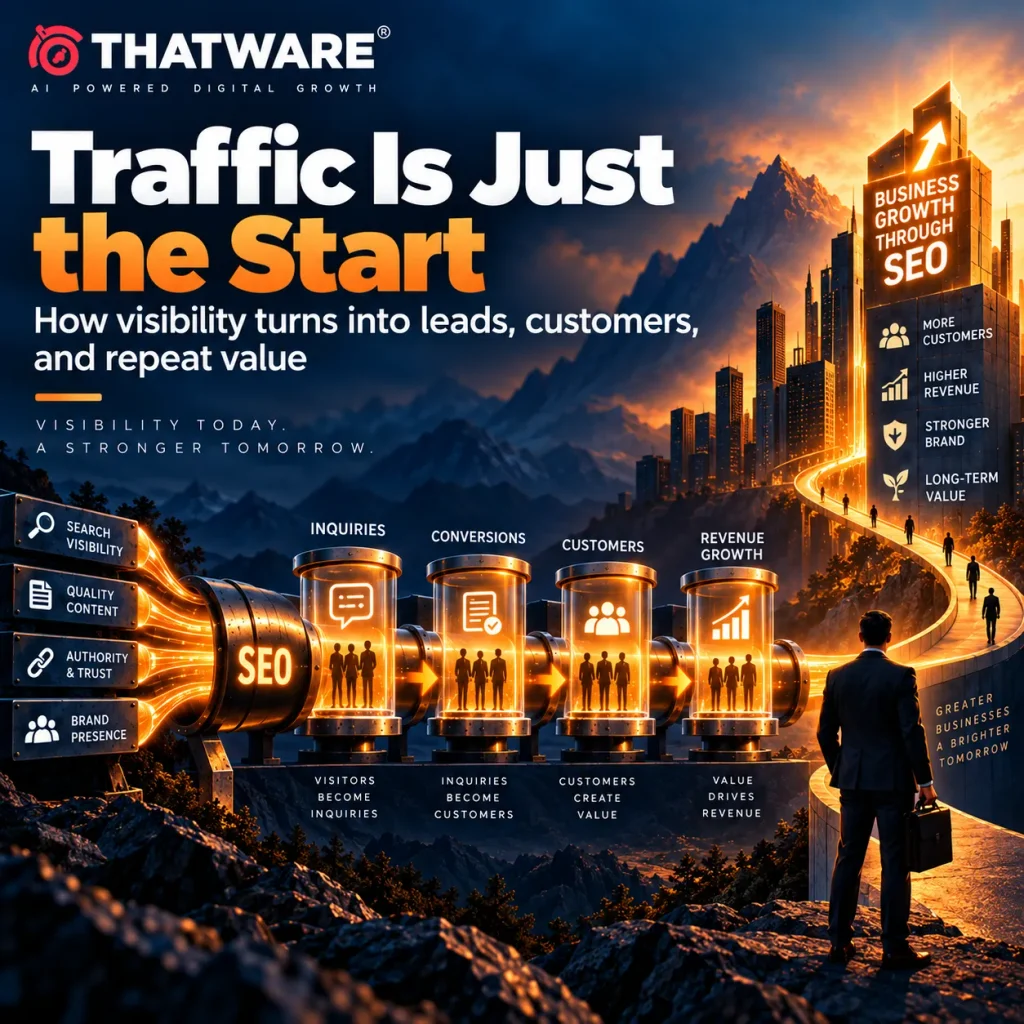
7. SEO Creates Compounding Returns
SEO can become increasingly efficient over time.
A new website may initially require investment in:
- Technical foundations
- Content
- Authority
- Internal linking
As these assets accumulate, future content may rank more easily.
Authority compounds.
Topical relevance grows.
Brand recognition increases.
This is why strategic SEO services should be evaluated over a long enough period to capture compounding effects.
8. SEO Helps Businesses Defend Market Share
SEO is not only about growth.
It is also defensive.
If customers search for your products or services and competitors dominate the results, they gain access to demand that could have gone to you.
Even branded searches can become competitive.
Competitors may target:
- Your brand alternatives
- Comparison terms
- Category terms
An SEO company for businesses should therefore help protect existing search demand as well as create new opportunities.
“If your customers are searching and you are absent, someone else is capturing the opportunity.”
9. Enterprise SEO Can Create Significant Scale
SEO becomes particularly valuable at enterprise level.
Large websites often have:
- Thousands of products
- Multiple categories
- International markets
- Large content libraries
Small improvements can create substantial impact when applied across many pages.
For example:
Improving internal linking across 50,000 URLs can have a much larger impact than optimizing ten pages manually.
This is where enterprise SEO services become highly valuable.
Enterprise SEO focuses on:
- Scalability
- Automation
- Governance
- Prioritization
- Technical systems
10. SEO Can Support International Expansion
Businesses entering new markets can use search data to identify:
- Demand
- Competitors
- Local terminology
- Market maturity
- Commercial opportunity
This means SEO can support market-entry decisions before significant investment is made.
A strong SEO consulting services engagement may help determine which countries or categories deserve priority.
11. SEO Can Lower Customer Acquisition Costs Over Time
SEO often requires significant upfront investment.
But as visibility grows, the marginal cost of additional organic clicks may decrease.
Paid advertising usually works differently.
Each additional click generally has a direct cost.
This does not mean organic traffic is free.
SEO requires investment in:
- Strategy
- Content
- Technology
- Specialists
- Authority
But successful SEO can improve acquisition efficiency over time.
That is one reason companies increasingly seek ROI driven SEO services.
12. SEO Should Be Evaluated by Opportunity Cost
There is also a cost to not investing in SEO.
If competitors rank for high-value searches, they may gain:
- Traffic
- Leads
- Brand recognition
- Backlinks
- AI citations
The longer they dominate, the stronger their position may become.
SEO investment should therefore consider both:
“What will this cost?”
and
“What opportunity are we losing by not acting?”
13. SEO Is Not Worth It for Every Business in the Same Way
SEO is not automatically the best channel for every company.
It may have lower priority if:
- Search demand is extremely limited
- The product category is completely new
- Customers primarily buy through closed networks
- The business needs immediate short-term revenue
- The website cannot support conversion
In those situations, SEO may still support authority or education, but other channels may deserve more immediate investment.
A strong SEO consulting services provider should be willing to say this.
14. Good SEO Requires Enough Time
One of the biggest mistakes businesses make is evaluating SEO too quickly.
Paid ads can generate clicks almost immediately.
SEO usually takes longer.
Timelines depend on:
- Competition
- Website authority
- Technical condition
- Content quality
- Existing rankings
- Market maturity
This is why SEO should be treated as a strategic investment rather than a short campaign.
15. SEO Should Have a Commercial Roadmap
A good SEO program should clearly explain:
- What opportunities exist
- Which pages need improvement
- What content should be created
- What technical work is required
- How performance will be measured
An SEO agency for business growth should be able to connect activities with expected outcomes.
The roadmap should prioritize commercial value rather than simply task volume.
Mini Case Study 2: Ecommerce Site With Traffic but Weak Revenue
Imagine an ecommerce website generating strong organic traffic from informational blogs.
Revenue remains flat.
A deeper analysis reveals that product and category pages have weak rankings.
Instead of publishing more top-of-funnel articles, the SEO strategy shifts toward commercial categories, internal linking, product schema, conversion improvements, and high-intent keywords.
The business begins generating more revenue without needing dramatic traffic growth.
The lesson:
More traffic is not always the goal. Better traffic often matters more.
16. SEO Can Improve Conversion Quality
A strong SEO strategy does not stop at rankings.
It can improve landing page alignment.
If a user searches:
“enterprise cloud migration services”
and lands on a generic IT page, conversion may be weak.
A dedicated page aligned with intent can perform better.
SEO growth services should therefore consider:
- Message match
- Page clarity
- Trust signals
- Calls to action
- Proof
This makes SEO more commercially useful.
17. SEO Supports Sales Teams
Organic content can support sales even when it does not generate the original lead.
A prospect may read:
- Comparison guides
- Case studies
- Technical articles
- Research
- FAQs
before speaking with sales.
This helps buyers validate decisions.
SEO therefore contributes to the wider customer journey.
18. SEO Can Strengthen Digital PR
Original research and useful resources can attract:
- Journalists
- Bloggers
- Industry publications
- Analysts
This can generate backlinks and brand mentions.
A strong SEO strategy can therefore reinforce PR.
PR can reinforce SEO.
The two channels increasingly work together.
19. SEO Investment Should Be Prioritized by Impact
Not every SEO task deserves equal budget.
A good strategy prioritizes:
High-Impact Work
- Important technical fixes
- Commercial pages
- High-intent content
- Internal linking
- Authority building
Lower-Impact Work
- Minor metadata changes
- Low-value content updates
- Very low-demand keywords
This is where strategic SEO services create value.
Good prioritization often matters more than sheer activity.
20. The Best SEO Programs Combine Growth and Efficiency
The strongest SEO strategies usually focus on two objectives.
Growth
Increase:
- Visibility
- Leads
- Revenue
- Market share
Efficiency
Reduce:
- Wasted content
- Duplicate pages
- Low-value SEO tasks
- Dependence on paid acquisition
This combination is what makes ROI driven SEO services valuable.

How Much Should a Business Invest in SEO?
There is no universal SEO budget.
Investment depends on:
- Business size
- Competition
- Website complexity
- Revenue potential
- Number of markets
- Content requirements
- Technical needs
A small local business may need a relatively focused program.
A global enterprise may require substantial investment across content, engineering, analytics, and authority.
The key is proportionality.
SEO investment should reflect the size of the commercial opportunity.
What Businesses Should Expect From Professional SEO Services
Good professional SEO services should include more than monthly activity reports.
Businesses should expect:
Strategy
- Search demand analysis
- Competitor analysis
- Commercial prioritization
Technical SEO
- Crawlability
- Indexation
- Structured data
- Performance
Content
- Buyer-intent pages
- Supporting resources
- Optimization
Authority
- Backlinks
- Digital PR
- Brand mentions
Analytics
- Leads
- Revenue
- Conversions
- Visibility
AI Search
- AI mentions
- Citations
- Entity clarity
This is what turns SEO into an investment rather than an expense.
How ThatWare Approaches SEO ROI
At ThatWare, we believe SEO should be aligned with measurable business growth.
Our SEO ROI services can focus on:
- Search opportunity analysis
- Revenue-focused keyword strategy
- Technical SEO
- Content planning
- Commercial page optimization
- Competitive intelligence
- AI visibility
- Conversion analysis
- Attribution
As an SEO ROI agency, ThatWare aims to connect search performance with real business outcomes.
Our business SEO services and SEO growth services are designed around sustainable organic acquisition rather than isolated ranking improvements.
For complex organizations, our enterprise SEO services can support large websites, international markets, technical scalability, and governance.
Our ROI driven SEO services focus on prioritizing activities according to impact, opportunity, and measurable growth potential.
Final Thoughts
So, is SEO worth the investment for businesses in 2026?
For businesses with meaningful search demand, the answer is often yes.
But the value comes from strategy.
SEO should not be treated as a monthly checklist of blogs, links, and rankings.
A strong SEO investment for businesses should build assets that contribute to:
- Qualified traffic
- Revenue
- Brand authority
- Market share
- AI visibility
- Lower acquisition dependence
- Long-term discoverability
The right SEO agency for business growth should therefore think commercially.
The right SEO marketing services should connect visibility with customer acquisition.
The right SEO consulting services should help leadership identify where search investment creates the strongest return.
And the right SEO ROI agency should make the business impact visible.
ThatWare combines technical SEO, search intelligence, content strategy, AI visibility, entity optimization, analytics, and commercial prioritization to help businesses turn organic search into a measurable growth channel.
Because SEO is not worth investing in simply because rankings matter.
It is worth investing in when those rankings, citations, searches, and discoveries contribute to real business growth.