
SUPERCHARGE YOUR ONLINE VISIBILITY! CONTACT US AND LET’S ACHIEVE EXCELLENCE TOGETHER!
The way people discover wedding services is becoming increasingly conversational. A couple planning a wedding may begin with a broad search for wedding planners, but the decision-making process quickly becomes more specific. They may want a destination wedding planner in a particular location, a luxury wedding specialist in a particular city, or a company capable of handling a particular event requirement.
Traditionally, these searches would lead users toward conventional search-engine result pages. The user would open several websites, compare services, review locations, examine portfolios and eventually shortlist a provider.
Generative AI SEO is changing the first stage of that journey.
Instead of reviewing ten links, a user can ask an AI platform to recommend the best wedding planners for a particular destination or requirement. The platform can then produce a curated response containing businesses it considers relevant to the query. For a wedding-planning business, this introduces an important new visibility opportunity. Being present online is no longer the only objective. A business also needs to be understandable within the questions people ask AI systems.
That was the central opportunity addressed in ThatWare’s campaign for Hitched India, a wedding-planning business seeking stronger visibility across emerging AI-driven search environments. The campaign was built around a straightforward business objective: increase Hitched India’s visibility for relevant AI-driven searches and establish a stronger presence across generative search platforms.
The challenge was equally clear. At the beginning of the initiative, the website had no established online presence for AI-related keywords and was not optimized specifically for AI-tool-based search queries. Rather than treating this as a conventional keyword-ranking exercise, ThatWare approached the opportunity from the perspective of query coverage.
The question was not simply:
Which wedding-planning keywords should the website target?
It was:
How can Hitched India become a relevant recommendation when a couple asks an AI platform for a wedding planner based on destination, location, service type or positioning?
That shift shaped the campaign. The resulting strategy combined AI-focused keyword research, SEO content, dedicated AI-oriented landing pages, structured data, internal linking, comparison-oriented information, visual elements, FAQs, GEO-targeted content and backlinks directed toward relevant AI Overview pages.
This case study examines how ThatWare structured that campaign, why the strategy focused heavily on search intent, how the eight implementation areas worked together and what the documented AI visibility results reveal about the changing discovery journey for wedding-planning businesses.
Project Overview
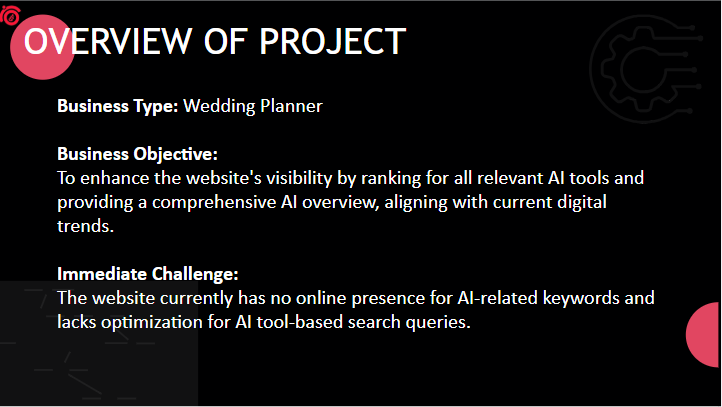
Business Type: Wedding Planner
Primary Objective
The stated objective of the campaign was to enhance Hitched India’s website visibility by ranking for relevant AI-tool searches and developing a stronger presence within AI-generated search experiences.
The objective reflected an emerging reality in digital discovery: potential customers are increasingly able to ask AI platforms for recommendations instead of relying exclusively on conventional search results.
Immediate Challenge
Hitched India’s website did not have an established presence for AI-related keywords and lacked optimization specifically designed around AI-tool-based search queries. This created a discovery gap. The website could exist as a digital destination while still remaining largely absent from recommendation-style AI searches.
Campaign Focus
ThatWare’s campaign focused on:
- AI-oriented keyword research
- Search-intent analysis
- SEO-optimized blog content
- AI-focused landing pages
- Structured data
- Internal linking
- Comparison tables
- Visual content
- Search-driven FAQs
- Geo-targeted content
- Backlink acquisition for AI Overview-focused pages
- Cross-platform AI visibility testing
AI Environments Covered
The campaign results covered:
- ChatGPT
- Claude
- Gemini
- Google AI Overview
The campaign therefore moved beyond a single search interface and examined Hitched India’s visibility across several generative and AI-assisted discovery environments.
About Hitched India’s Search Visibility Challenge
Wedding planning is an inherently recommendation-driven category.
People rarely approach the selection of a wedding planner as a purely informational exercise. Even when their first search is informational, the eventual objective is often to identify a provider capable of delivering the required service.
This makes recommendation queries particularly significant.
Consider the difference between two types of searches:
“Wedding planner”
and
“Top wedding planners in Lonavala”
The first expresses a broad category.
The second introduces:
- A commercial need
- A location
- A preference for leading providers
- A recommendation requirement
The second query is much closer to an actual selection decision.
Generative AI platforms are particularly relevant to these types of searches because their interfaces are designed to interpret natural-language requests and return synthesised recommendations or answers. That means a business can potentially become part of the customer’s consideration set before the customer has visited its website.
For Hitched India, this presented both an opportunity and a challenge. The opportunity was to establish visibility in a new discovery layer. The challenge was that the existing website had not been specifically developed around AI-oriented queries.
ThatWare therefore had to create a content and information environment capable of addressing different ways potential customers could express their wedding-planning requirements. This required looking beyond the generic concept of “wedding planner” and examining the dimensions contained within real recommendation-style searches.
The campaign results themselves demonstrate this variation.
Hitched India was tested for searches involving:
- Top wedding planners
- Best wedding planners
- Luxury wedding planners
- Destination wedding planners
- Reception event services
- Specific cities
- Specific destinations
These were not interchangeable searches.
Each represented a different combination of location, service requirement, preference and search language. That became an important part of the campaign architecture.
The Core Shift: From Keyword Targeting to Query Coverage
One of the most important elements of the Hitched India campaign was recognizing that AI search cannot be approached only through traditional keyword repetition. A conventional SEO campaign may organize its strategy around primary and secondary keywords. An Artificial Intelligence SEO campaign has another layer to consider:
How might the user actually ask the question?
A potential couple may ask:
- Who are the top wedding planners in Lonavala?
- Which wedding planners are best in Mahabaleshwar?
- Who offers luxury wedding planning in Pune?
- Which companies specialize in destination weddings?
- Which wedding planners can handle reception events in India?
These questions contain more than keywords.
They contain decision criteria.
A recommendation-oriented query can communicate:
Category + location + preference + decision intent
For example:
Top Wedding Planners in Lonavala
contains:
- Category: wedding planners
- Location: Lonavala
- Preference: top
- Intent: recommendation
Similarly:
Luxury wedding planner in Pune
contains:
- Category: wedding planner
- Location: Pune
- Positioning: luxury
- Intent: provider discovery
And:
Top Destination Wedding Planners in Mahabaleshwar
contains:
- Category: wedding planner
- Service model: destination wedding
- Location: Mahabaleshwar
- Preference: top
- Intent: recommendation
The campaign therefore needed to make Hitched India’s website relevant to different combinations of these elements. This was where ThatWare’s search-intent methodology became central.
Understanding the 3C Search-Intent Framework
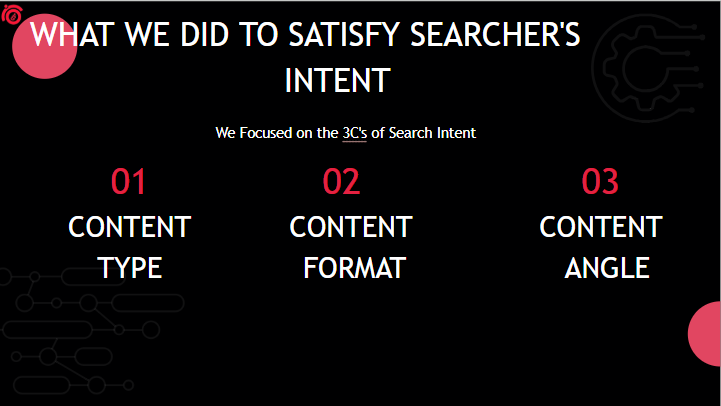
ThatWare structured the campaign around the 3C’s of Search Intent:
- Content Type
- Content Format
- Content Angle
The framework provided a way to move from a keyword list toward a more complete understanding of what the searcher expected to find.
1. Content Type
The first consideration was the nature of the information required.
A user looking for the best wedding planners does not necessarily need a generic educational article.
They may need:
- A provider recommendation
- A service page
- A location-specific page
- A comparison
- A concise explanation
- A list of options
The content therefore had to match the type of information implied by the query.
For example, a recommendation query could benefit from content that establishes the business’s service capabilities and destination relevance rather than a purely educational article about wedding planning.
2. Content Format
The second C focused on how the information should be presented.
Different search requirements can call for different formats.
The campaign incorporated:
- Blog content
- Landing pages
- Comparison tables
- Visual information
- FAQs
- Structured sections
- Geo-targeted content
This matters because a user asking a direct recommendation question does not necessarily want to navigate through a long generic article before understanding whether a business is relevant.
The information architecture needed to support quicker interpretation.
3. Content Angle
The third C addressed the emphasis of the query.
- “Wedding planner” is broad.
- “Luxury wedding planner in Pune” adds a positioning requirement.
- “Destination wedding planner in Mahabaleshwar” adds a service and location requirement.
- “Reception event services in India” focuses on a particular event requirement.
The campaign therefore had to account for the specific angle behind each search.
This was not about producing multiple pages that merely changed a location name.
It was about developing content that reflected the reason the user was searching.
Turning the 3C Framework into an AI Search Strategy
The 3C framework gave the campaign a practical structure.
Instead of treating all AI queries as one category, ThatWare could consider the relationship between:
What the user wants + how they want the information + what specifically matters to them.
For Hitched India, the framework could be represented as follows:
| Search Dimension | Hitched India Example | Strategic Requirement |
| Content Type | Wedding planner recommendation | Establish service relevance and provider context |
| Content Format | Recommendation/list-style discovery | Clear, structured information |
| Content Angle | Top/best | Demonstrate relevance to selection-oriented searches |
| Content Angle | Luxury | Communicate positioning |
| Content Angle | Destination wedding | Establish destination-planning relevance |
| Location | Lonavala | Geographic relevance |
| Location | Mahabaleshwar | Destination relevance |
| Location | Pune | City-specific relevance |
| Service | Reception event services | Event-specific relevance |
The campaign’s documented implementation reflected this intent-led thinking.
Rather than relying on a single optimisation tactic, ThatWare created multiple content and information assets that could collectively address different search formulations.
Building the AI Query Coverage Layer
The Hitched India campaign included eight important implementation areas.
These can be understood as a connected sequence rather than eight isolated tasks.
The Eight Campaign Actions
- Conducted keyword research for AI tools
- Created SEO-optimized blog content
- Built AI-tool landing pages with structured data
- Implemented an internal linking strategy
- Created tool comparison tables and visuals
- Added FAQs based on user search queries
- Integrated geo-targeted content
- Earned backlinks to AI Overview pages
Together, these activities addressed different parts of the AI discovery process.
ThatWare’s Customized Strategy For Hitched India

Step 1: Conducting Keyword Research for AI Tools
The first step was to identify the searches around which Hitched India’s AI visibility needed to be developed. Traditional keyword research generally asks:
What terms have search demand?
AI-oriented keyword research needs to ask a broader question:
What questions and recommendation formulations might cause an AI system to identify this business?
The documented results provide a clear picture of the query categories selected for testing.
They included location-driven recommendation queries such as:
- “Top Wedding Planners in Lonavala”
- “Best Wedding Planners in Mahabaleshwar”
- “Best Wedding Planners in Pune”
They also introduced service-positioning variations:
- “Luxury wedding planner in Pune”
- “Top Destination Wedding Planners in Mahabaleshwar”
- “Destination Wedding Planners in Mahabaleshwar”
The Google AI Overview tests added an event-service dimension:
- “Reception Event Services India”
- “Reception Event Services in India”
These queries demonstrate why AI-focused research needs to consider more than a single head term.
A wedding-planning business can be discovered through location, event type, destination, positioning and recommendation language.
The keyword-research stage therefore became the starting point for building broader query coverage.
Step 2: Creating SEO-Optimized Blog Content
The next stage in the custom seo services was the development of SEO-optimized blog content. The purpose of blog content within this campaign was not simply to increase the volume of pages on the website. Supporting content can provide additional context around a business, its services and the topics potential customers investigate before making a decision. For a wedding-planning business, this can include destination considerations, event planning requirements, service comparisons and location-specific considerations.
From an AEO perspective, useful supporting content can also provide opportunities to answer questions directly. From a GEO perspective, it can help establish relationships between:
- The business
- Wedding planning
- Destinations
- Locations
- Events
- Customer requirements
The important point is that blog content formed part of a larger information ecosystem.
It was not treated as a standalone traffic-generation exercise.
Step 3: Building AI-Tool Landing Pages with Structured Data
The campaign also included the development of AI-tool landing pages with structured data. This represented a more focused content layer. Blog articles can address broader questions and informational topics. Landing pages can provide a more concentrated explanation of a business, service or search context. For AI discovery, clarity becomes especially important.
A landing page can organise information around a defined subject and make relationships between the business and the subject easier to understand. Structured data was incorporated as part of this approach. It is important, however, not to interpret structured data as a standalone guarantee of AI visibility. Its role within the campaign was to support a more organized information environment.
When structured information is paired with relevant visible content, clear page organization and strong internal connections, it can contribute to a website’s overall clarity. ThatWare therefore positioned AI-oriented landing pages within the wider content architecture rather than treating them as isolated assets.
Step 4: Implementing an Internal Linking Strategy
The fourth activity focused on internal linking. Internal links help connect related pages within a website.
For an AI-oriented content strategy, this can be particularly useful because individual pages do not need to communicate every aspect of the business independently.
A broader information structure can establish relationships between:
- Core service pages
- Destination content
- Location pages
- Blogs
- FAQs
- AI-oriented landing pages
- Supporting content
For example, a destination wedding page can connect to relevant location content.
A location-focused page can connect to service-specific information. A blog can guide users toward a relevant landing page.
This creates a connected information environment rather than a collection of disconnected URLs.
For Hitched India, the internal-linking component complemented the campaign’s objective of building relevance around different AI search contexts.
Step 5: Creating Comparison Tables and Visuals
AI-assisted discovery is often comparison-oriented. Users do not always ask simply:
What is a wedding planner?
They may ask:
Which wedding planner should I choose?
Comparison tables and visual elements can support this decision-making process by organizing information into easily interpretable structures.
The Hitched India campaign specifically included tool comparison tables and visuals.
These assets were useful because structured information can make distinctions easier to process.
Instead of presenting every piece of information in long-form prose, a table can help organize:
- Service characteristics
- Location relevance
- Planning categories
- Options
- Features
- Differences
The broader strategic value was not merely visual presentation.
It was the creation of content formats that could support users who were evaluating options.
This aligns particularly well with recommendation-oriented search.
Step 6: Adding FAQs Based on User Search Queries
The campaign also incorporated FAQs based on user search queries.
This was important because conversational search naturally produces question-like formulations.
A customer may ask:
- Which wedding planner is best for a destination wedding?
- Which wedding planners operate in a particular city?
- What services are available for reception events?
- Which planner should I consider for a luxury wedding?
FAQ content creates a structured space for addressing such questions.
It also provides an opportunity to align content more closely with natural-language search behavior.
The key principle is that FAQs should not simply be added for decoration.
Their usefulness comes from connecting actual search needs with clear answers.
ThatWare’s approach placed FAQs within the larger intent framework so that question-based content could support the campaign’s AEO and GEO objectives.
Step 7: Integrating Geo-Targeted Content
Location was one of the clearest patterns in the documented AI queries.
Hitched India’s observed AI visibility included searches involving:
- Lonavala
- Mahabaleshwar
- Pune
- India
This makes geographic relevance a critical component of the campaign.
Wedding planning is strongly influenced by destination. A couple planning a wedding in Mahabaleshwar may have very different requirements from a couple planning an event in Pune. Similarly, a search for destination wedding planners carries a different context from a broad search for wedding planners.
Geo-targeted content was therefore integrated into the campaign to strengthen the relationship between the business and relevant locations. The goal was not merely to mention place names. The broader objective was to build meaningful content around the combination of:
Wedding planning + destination + service + user intent.
This helped the campaign address the geographic dimension of AI recommendations.
Step 8: Earning Backlinks to AI Overview Pages
The eighth documented activity was earning backlinks to AI Overview pages. Backlinks remain an important component of digital authority. For an AI-focused strategy, authority-building can support the broader ecosystem by increasing the number of external signals associated with relevant content. In this campaign, backlinks were specifically directed toward AI Overview-focused pages.This connected authority-building with the pages designed to support AI-related visibility.
It also reinforced an important principle: Generative search optimisation should not exist separately from broader SEO. The campaign combined content development, information architecture, structured data, internal linking, geo relevance and external authority. The AI visibility results were therefore approached as an outcome of an integrated campaign rather than the result of one isolated tactic.
From Content Assets to AI Recommendations
The eight campaign actions can be grouped into four broader functions.
Discovery
AI-tool keyword research
This identified the search language and query contexts that mattered.
Information
Blogs + AI landing pages + structured data + internal linking
These components created a structured environment around relevant subjects.
Decision Support
Comparison tables + visuals + FAQs
These formats addressed users who were evaluating options and asking questions.
Relevance and Authority
Geo-targeted content + backlinks
These strengthened location relevance and external authority around important pages.
This creates a useful campaign model:
Query discovery → Content development → Information organization → Decision support → Geographic relevance → Authority → AI visibility testing
That sequence is distinct from simply publishing content and checking rankings.
Results: Hitched India Enters Multiple AI Discovery Environments
The most important documented outcome of the campaign was that Hitched India began appearing within multiple AI-driven search environments for selected queries.
The results were not limited to one platform.
They covered:
- ChatGPT
- Claude
- Gemini
- Google AI Overview
This cross-platform visibility is particularly important because each environment may interpret queries differently.
The same business can potentially receive different visibility outcomes depending on:
- The wording of the query
- The location
- The service emphasis
- The AI platform
- The type of recommendation requested
The documented Hitched India results demonstrate this variation.
ChatGPT: Strong Visibility for Location-Based Recommendations
ChatGPT produced some of the strongest documented outcomes.
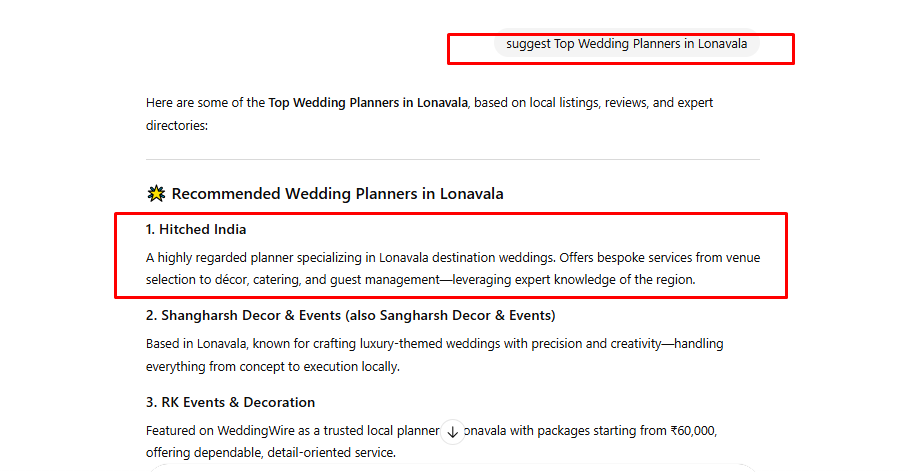
For the query:
“Top Wedding Planners in Lonavala”
The Hitched India website suggestion appeared in the first position. This is significant because the query combines a recommendation modifier with a specific destination. The user is not merely asking what wedding planners exist. They are asking for top options in Lonavala.
Hitched India’s presence therefore placed the business within a recommendation-oriented discovery journey. The campaign also recorded first-position visibility for:
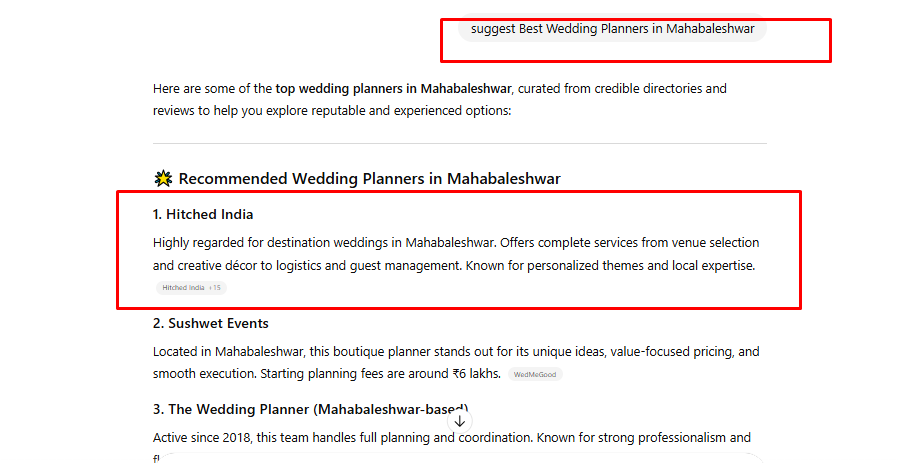
“Best Wedding Planners in Mahabaleshwar”
Again, the result was first position on ChatGPT. The two results reveal an interesting pattern.
Both are:
- Location-specific
- Recommendation-oriented
- Wedding-planning focused
- Commercially relevant
The campaign therefore demonstrated documented ChatGPT visibility across two different destination contexts.
Claude: Visibility Across City and Luxury Intent
Claude produced another form of visibility.
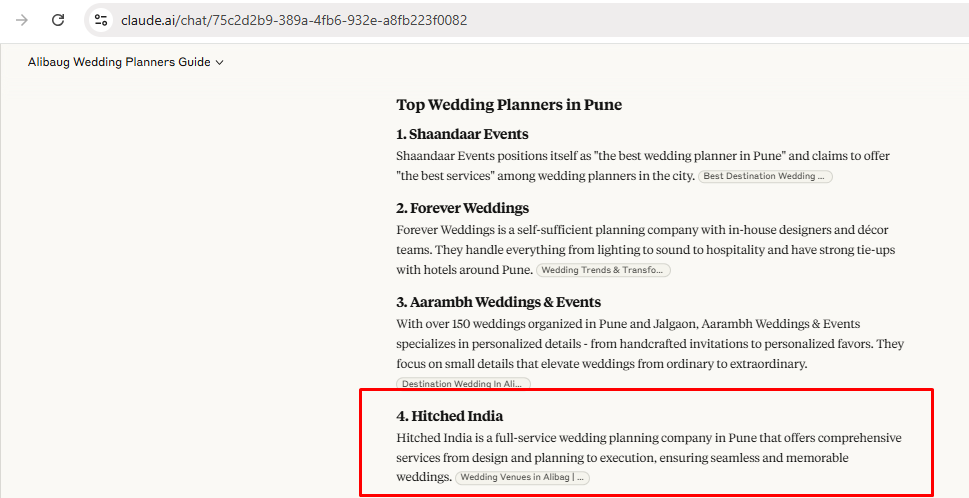
For:
“Best Wedding Planners in Pune”
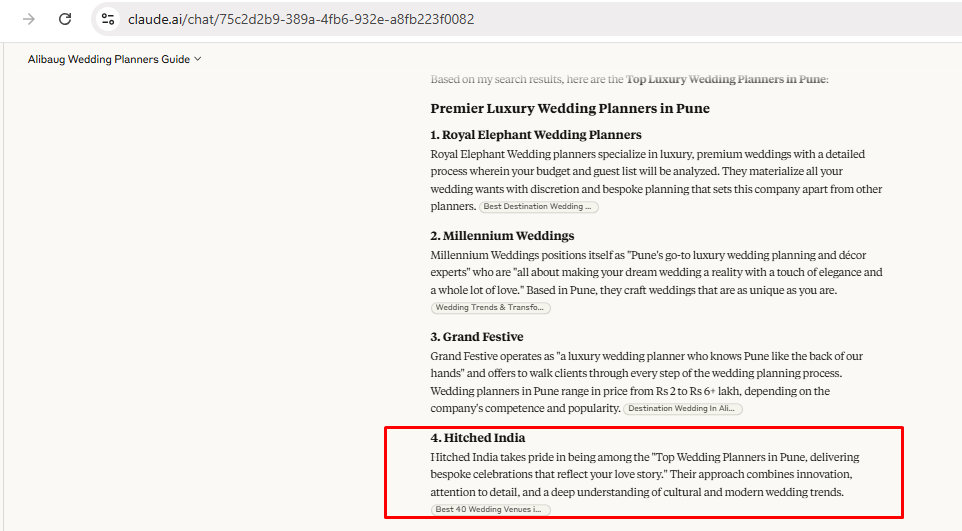
Hitched India’s website suggestion appeared in fourth position. The campaign also recorded fourth-position visibility for:
“Luxury wedding planner in Pune”
These two queries are particularly useful when viewed together. The first focuses on general provider recommendation. The second adds a positioning requirement: luxury.
This means the campaign was not restricted to a single generic “wedding planner” context. It also achieved documented visibility for a query in which the searcher was specifying a particular service positioning.
The Claude results therefore demonstrate another dimension of the campaign:
city relevance + provider recommendation + service positioning.
The observed fourth-position results should be understood as campaign testing outcomes for the documented queries rather than as permanent universal rankings.
Generative AI responses can vary based on multiple contextual factors.
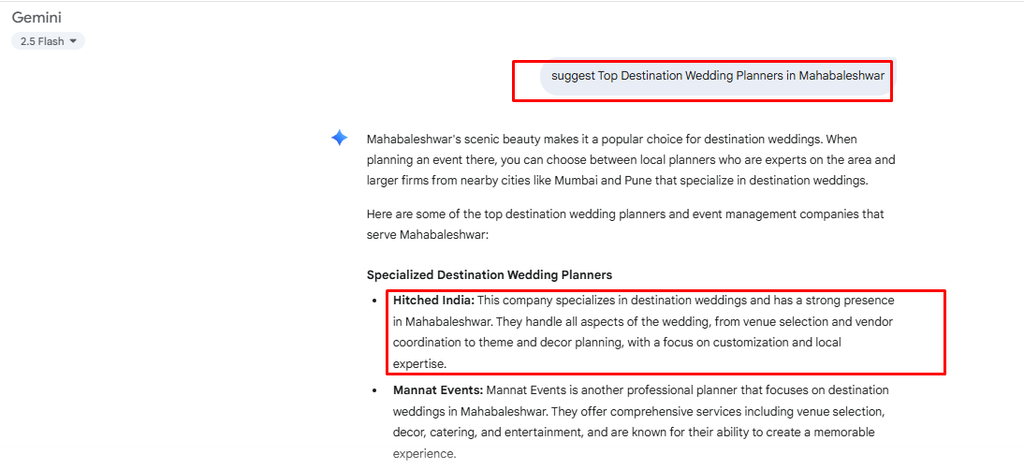
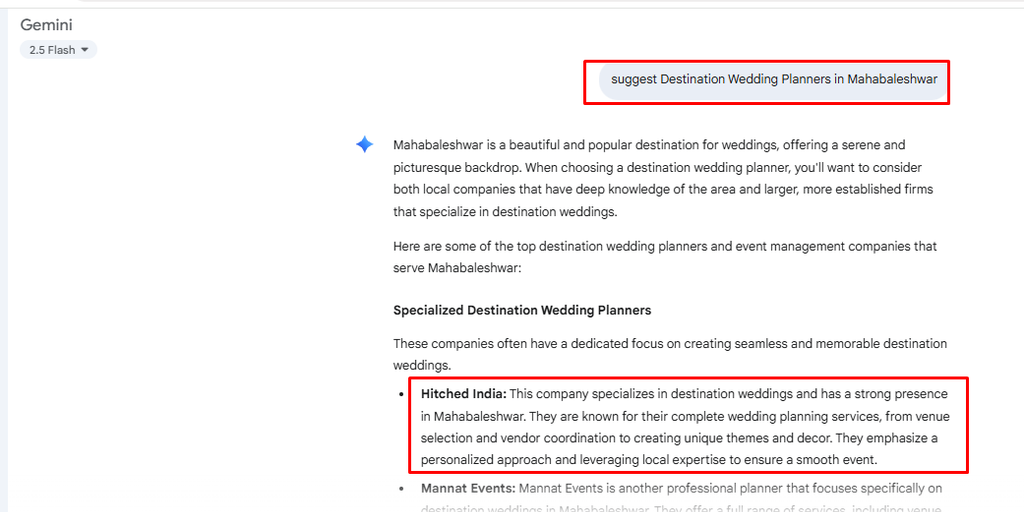
Gemini: First-Position Visibility for Destination Wedding Searches
Gemini delivered another strong set of documented outcomes.
For:
“Top Destination Wedding Planners in Mahabaleshwar”
Hitched India’s website suggestion appeared in first position.
The website also appeared in first position for:
“Destination Wedding Planners in Mahabaleshwar”
These results are especially relevant because destination weddings represent a more specific service category than general wedding planning.
The queries combine:
- Wedding planning
- Destination service
- Mahabaleshwar
- Recommendation/discovery intent
The first-position Gemini results therefore show that Hitched India’s campaign was able to establish documented visibility for destination-focused searches within a specific geographic context.
This reinforces the importance of the campaign’s geo-targeted content strategy.
Google AI Overview: Visibility for Reception Event Services
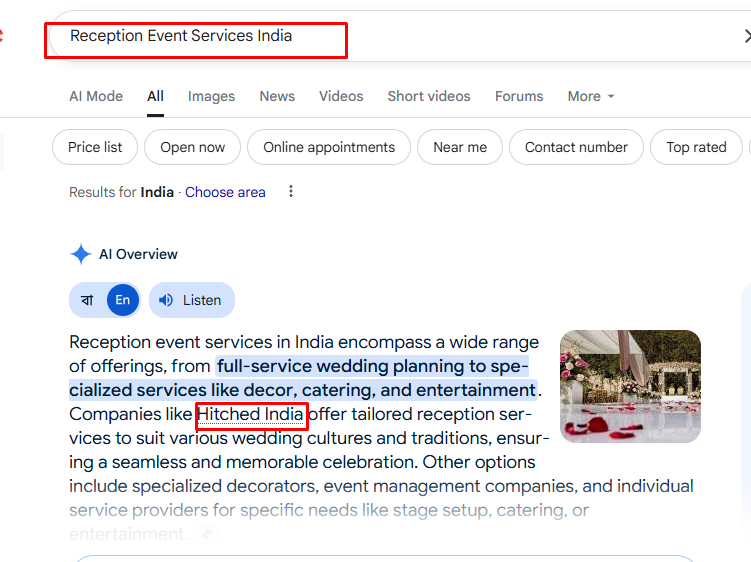
The campaign also extended beyond conversational AI platforms to Google AI Overview.
The Hitched India website appeared within the AI Overview section for:
“Reception Event Services India”
and
“Reception Event Services in India”
These results add an event-service dimension to the overall campaign.
The earlier ChatGPT, Claude and Gemini examples largely focused on wedding-planner recommendations.
The Google AI Overview results demonstrate visibility for a more specific event-service search. This matters because it shows that the campaign was not built around one single formulation of the wedding-planning category.
Instead, it addressed different ways users might seek information or providers within the broader wedding and event ecosystem.
The AI Visibility Matrix
The results can be summarized as follows:
| AI Environment | Query | Documented Visibility |
| ChatGPT | “Top Wedding Planners in Lonavala” | #1 |
| ChatGPT | “Best Wedding Planners in Mahabaleshwar” | #1 |
| Claude | “Best Wedding Planners in Pune” | #4 |
| Claude | “Luxury wedding planner in Pune” | #4 |
| Gemini | “Top Destination Wedding Planners in Mahabaleshwar” | #1 |
| Gemini | “Destination Wedding Planners in Mahabaleshwar” | #1 |
| Google AI Overview | “Reception Event Services India” | Appeared in AI Overview |
| Google AI Overview | “Reception Event Services in India” | Appeared in AI Overview |
This matrix is more meaningful than looking at any one result in isolation.
It shows that Hitched India’s documented AI visibility extended across different platforms and different query formulations.
What the Results Reveal About the Campaign
The results demonstrate several important patterns.
Pattern 1: Location Was Central to Visibility
Every recommendation result contained a geographic component.
The queries referenced:
- Lonavala
- Mahabaleshwar
- Pune
This reinforces the importance of geo-targeted content for wedding-planning discovery.
For a destination-sensitive service, location cannot be treated as an afterthought.
Pattern 2: Recommendation Language Mattered
The queries frequently used terms such as:
- Top
- Best
- Luxury
- Destination
These words reveal the user’s decision criteria.
- A search for “top” is not equivalent to a general informational search.
- A search for “luxury” indicates positioning.
- A search for “destination” indicates a specific service model.
The campaign addressed these different angles through its content and landing-page strategy.
Pattern 3: AI Visibility Was Not Confined to One Platform
Hitched India appeared in:
- ChatGPT
- Claude
- Gemini
- Google AI Overview
This is important because AI search is not a single ecosystem.
Different platforms can produce different outputs for similar queries.
A cross-platform approach therefore provides a more complete view of generative search visibility.
Pattern 4: Different Queries Produced Different Positions
The campaign did not produce identical results everywhere.
- ChatGPT and Gemini recorded first-position visibility for selected queries.
- Claude recorded fourth-position visibility.
- Google AI Overview recorded inclusion rather than a conventional numerical ranking.
This illustrates why AI search measurement needs to account for the format of each platform.
A position number alone cannot describe every AI search result.
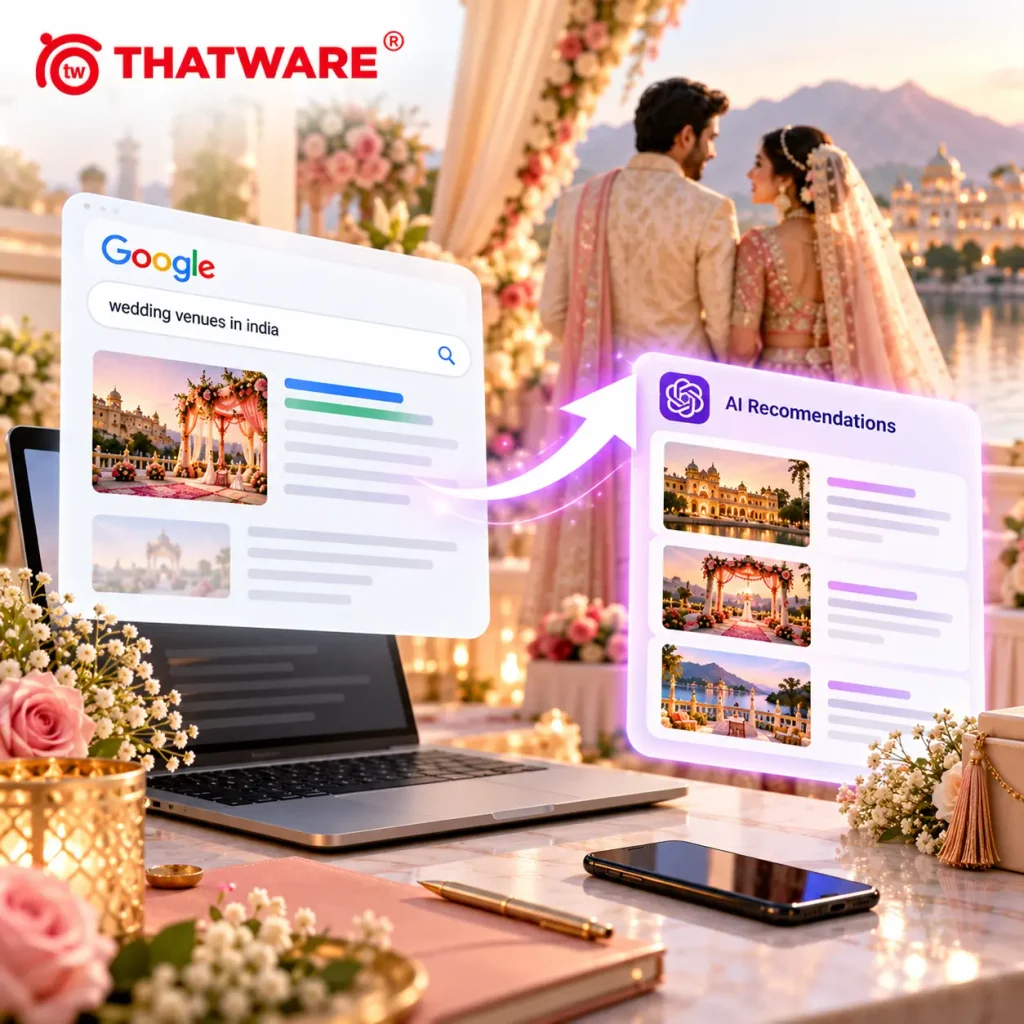
ThatWare’s Role in Connecting SEO, AEO and GEO
The Hitched India campaign illustrates how advanced algorithm seo solutions can be extended into AI-driven search environments. SEO remained important because the campaign still required:
- Keyword research
- Content
- Internal linking
- Page development
- Authority building
AEO added another layer by focusing on:
- Questions
- FAQs
- Searcher needs
- Structured information
- Direct answers
GEO added another dimension by considering:
- AI-tool discovery
- Entity relevance
- Recommendation queries
- Context
- Location
- Cross-platform visibility
The three should therefore not be considered isolated disciplines.
A useful model is:
- SEO establishes discoverability.
- AEO improves answer alignment.
- GEO expands relevance within generative discovery.
The Hitched India campaign brought these principles together through its eight documented implementation areas.
What Changed in Hitched India’s Discovery Journey?
Before the campaign, the central challenge was straightforward:
The website had no established presence for AI-related keywords and lacked optimization for AI-tool-based search queries.
After implementation, the documented testing showed visibility across several AI environments.
The shift can therefore be represented as:
Initial State
No established AI-keyword presence
↓
Limited AI-query optimization
↓
No documented visibility in the tested AI environments
Campaign Development
AI keyword research
↓
SEO content
↓
AI-focused landing pages
↓
Structured data
↓
Internal linking
↓
Comparison tables and visuals
↓
FAQs
↓
Geo-targeted content
↓
Backlinks to AI Overview pages
Outcome
ChatGPT visibility
↓
Claude visibility
↓
Gemini visibility
↓
Google AI Overview visibility
This represents a change in the type of discovery being targeted.
The campaign moved Hitched India beyond the question of whether the website existed in search and toward the question of whether the business could be surfaced when an AI system was asked for relevant recommendations or services.
Conclusion
The search journey for wedding services is becoming more conversational, contextual and recommendation-driven.
For Hitched India, that shift created a clear digital opportunity.
The challenge at the beginning of the campaign was that the website had no established presence for AI-related keywords and was not optimized specifically for AI-tool search queries.
ThatWare addressed this gap through an intent-led strategy built around the 3C framework:
Content Type + Content Format + Content Angle
The campaign then translated that framework into eight implementation areas:
- AI-tool keyword research
- SEO-optimized blog content
- AI-tool landing pages with structured data
- Internal linking
- Comparison tables and visuals
- Search-based FAQs
- Geo-targeted content
- Backlinks to AI Overview pages
The documented results demonstrate the value of this multi-layer approach.
Hitched India achieved first-position visibility on ChatGPT for “Top Wedding Planners in Lonavala” and “Best Wedding Planners in Mahabaleshwar.”
- It achieved fourth-position visibility on Claude for “Best Wedding Planners in Pune” and “Luxury wedding planner in Pune.”
- On Gemini, the website appeared in first position for “Top Destination Wedding Planners in Mahabaleshwar” and “Destination Wedding Planners in Mahabaleshwar.”
- The website was also present within Google AI Overview for “Reception Event Services India” and “Reception Event Services in India.”
The significance of these outcomes extends beyond the individual queries.
They show how a wedding-planning brand can begin building visibility within different forms of AI-assisted discovery by organizing its digital presence around actual search intent.
The central lesson is not that one particular optimization tactic guarantees an AI recommendation.
It is that AI visibility requires a business to become easier to understand in context.
For Hitched India, that context included:
who the business serves, what it offers, where it is relevant, what type of wedding it supports and what customers are actually asking for.
That is where SEO, AEO and GEO intersect.
The future of search will not be defined exclusively by ten blue links or conventional keyword rankings.
Users will continue asking increasingly specific questions, and AI systems will increasingly participate in helping them discover and compare businesses.
For wedding planners, this makes AI visibility an important extension of digital strategy.
The Hitched India campaign demonstrates how ThatWare approached that emerging opportunity: not by replacing SEO, but by expanding it into a broader framework of search intent, structured information, content relevance, geographic context and generative search visibility.