SUPERCHARGE YOUR ONLINE VISIBILITY! CONTACT US AND LET’S ACHIEVE EXCELLENCE TOGETHER!
Global competition is no longer defined only by who has the biggest advertising budget, the largest content library, or the strongest backlink profile.
Today, the brands that compete most effectively are often the ones that understand search behavior better than everyone else.
They know what customers are searching for.
They know which competitors are gaining visibility.
They understand why certain pages rank.
They monitor how AI platforms describe their industry.
They identify emerging demand before it becomes obvious.
And they use those signals to make smarter decisions across SEO, content, market expansion, product positioning, and customer acquisition.
This is where search intelligence becomes strategically valuable.
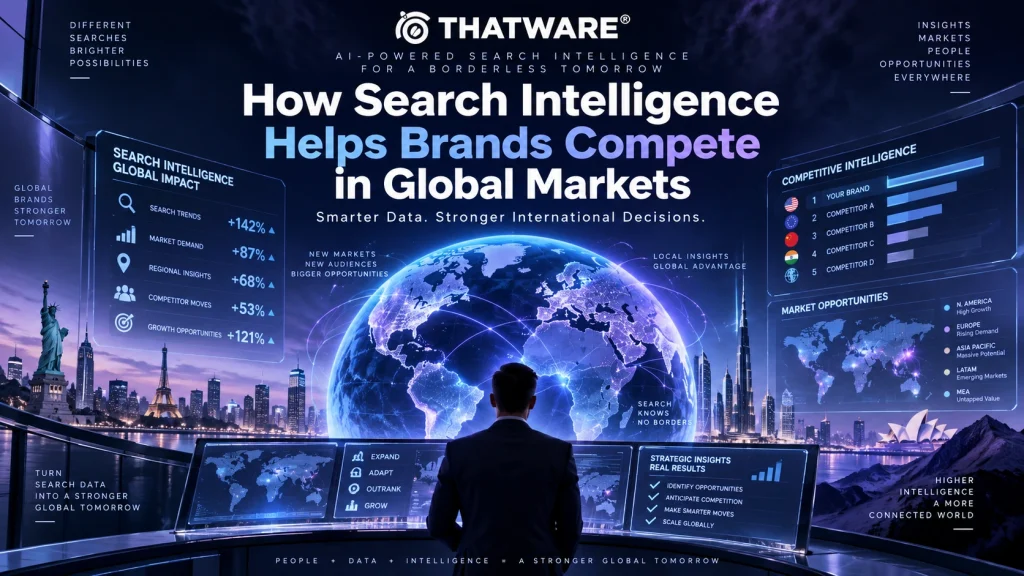
For companies entering new countries, expanding into new categories, or competing against established international brands, search intelligence services can provide a much clearer view of the market than conventional SEO reporting alone.
At ThatWare, we view search intelligence as the layer between raw search data and business decision-making.
SEO tells you how your website performs.
Search intelligence helps explain why the market is moving, where opportunities are developing, and what your competitors are doing before you respond.
What Is Search Intelligence?
Search intelligence is the process of collecting, interpreting, and applying data from search engines, AI platforms, competitors, keywords, SERPs, user behavior, entities, and market trends.
Its purpose is not simply to report rankings.
It is to reveal patterns.
A strong search intelligence company may analyze:
- Search demand
- Keyword movement
- Competitor visibility
- SERP composition
- AI-generated answers
- Entity relationships
- Content gaps
- Market-level trends
- Brand demand
- Search intent
- Conversion opportunities
- Geographic differences
This creates a more complete picture of the digital market.
Quick Q&A
Q: How is search intelligence different from traditional SEO analytics?
Traditional analytics often focuses on your own website. Search intelligence looks outward as well, examining competitors, market demand, SERPs, AI systems, and broader search behavior to support strategic decisions.
Why Search Intelligence Matters More in Global Markets
Competing in one market is already complex.
Competing across multiple countries introduces far more variables.
Search behavior changes.
Competitors change.
Language changes.
User expectations change.
AI recommendations change.
Even SERP layouts can differ significantly.
A company that performs strongly in the United States may face completely different competitors in the United Kingdom, India, Singapore, or Australia.
This is why global search intelligence is becoming increasingly important.
Instead of assuming that one successful strategy can be replicated everywhere, brands can evaluate each market independently.
“Global growth becomes easier when search data stops being a reporting function and starts becoming a decision-making system.”
The Difference Between Search Data and Search Intelligence
Search data tells you what happened.
Search intelligence helps explain what it means.
For example:
Search data might show that organic traffic declined by 18%.
Search intelligence might reveal that:
- Competitors gained new featured snippets
- Google began favoring comparison pages
- AI Overviews reduced click-through rates
- Search demand shifted toward a new terminology
- A competitor published a new content cluster
- Your ranking URL no longer matches search intent
That distinction is critical.
The value of a search intelligence agency is not the volume of data it can collect.
The value comes from identifying patterns that influence business decisions.
How Search Intelligence Supports Global Expansion
International growth requires brands to answer several important questions.
Which markets have the strongest demand?
Search volume and commercial keyword trends can reveal which countries have meaningful demand.
Which markets are easier to enter?
Competitive visibility analysis can show where incumbent brands are weak.
Which products attract the most interest?
Search behavior can reveal demand by product, service, category, or industry.
Which competitors dominate each market?
SERP analysis can uncover companies that may not be major global competitors but are extremely strong locally.
What language do customers use?
Keyword behavior reveals the actual terminology customers use when researching solutions.
This is where search market intelligence becomes commercially useful.
Search Intelligence and Market Prioritization
One of the most expensive mistakes a global brand can make is entering the wrong market too aggressively.
Market selection should not depend on population size alone.
Search intelligence can help score markets using factors such as:
- Search demand
- Competition level
- Existing brand visibility
- Commercial keyword volume
- Average ranking difficulty
- Local content maturity
- SERP volatility
- Competitor authority
- AI visibility
- Conversion opportunity
This allows companies to prioritize markets based on evidence rather than assumptions.
For example, a business may assume Germany is its best expansion opportunity.
However, search data may reveal that Singapore has lower competition, stronger commercial demand, and better existing brand recognition.
A search intelligence platform can help consolidate those signals into a usable decision framework.
Competitive Search Intelligence
Global competition is rarely consistent across every market.
Your biggest competitor in the US may barely rank in Australia.
A smaller regional company may dominate India.
Another competitor may be highly visible in AI answers despite having weaker traditional rankings.
This is where competitive search intelligence becomes essential.
Brands should monitor:
- Competitor rankings
- Keyword overlap
- Content velocity
- Backlink growth
- SERP ownership
- Featured snippets
- AI citations
- Brand mentions
- New market pages
- Product-category expansion
Short Quote
“Your competitors do not need to outrank you everywhere. They only need to outrank you where the buying decision begins.”
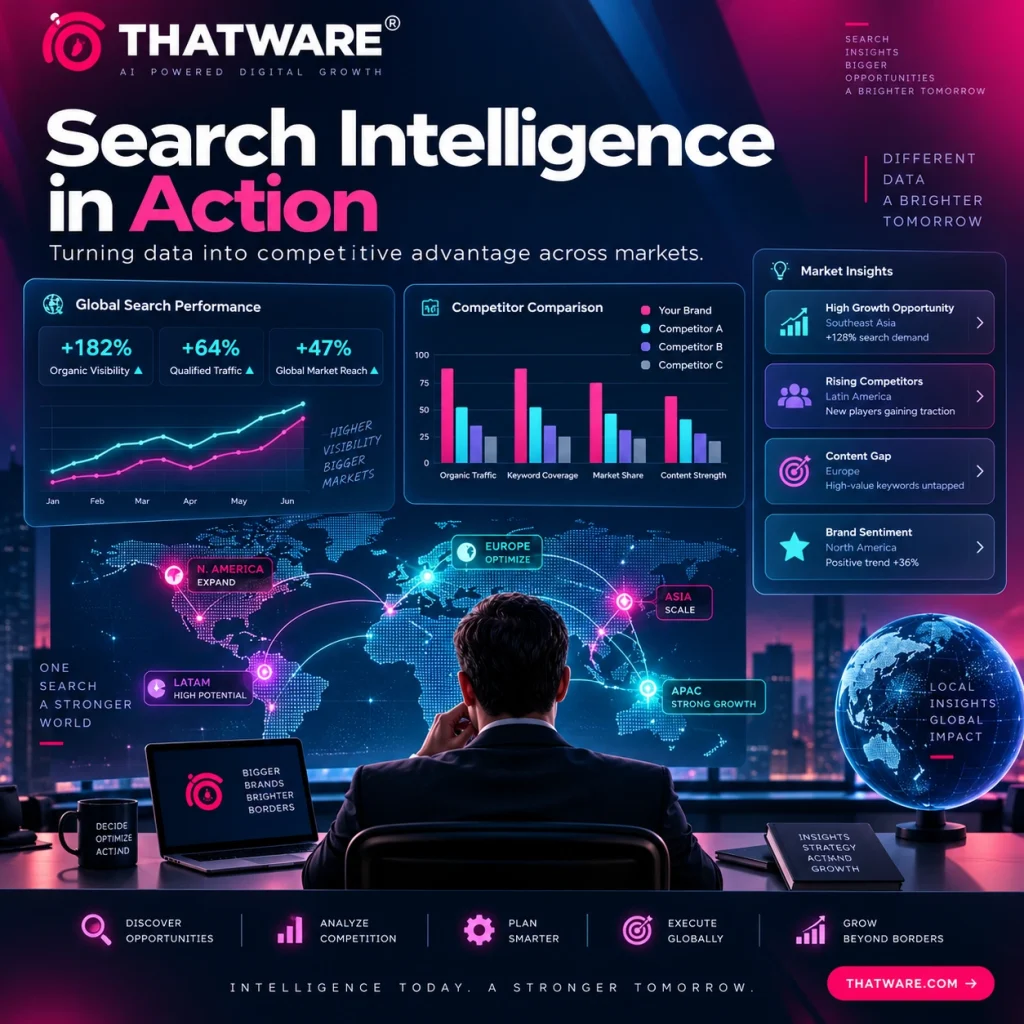
How Competitive SEO Intelligence Reveals Market Gaps
Traditional competitor analysis often compares domain authority, traffic, and backlinks.
That is useful, but incomplete.
Competitive SEO intelligence should also examine:
- Which topics competitors dominate
- Which formats Google rewards
- Which pages earn AI citations
- Which search intents competitors ignore
- Which geographic markets are underserved
- Which new categories are gaining demand
For example, three competitors may all target broad keywords.
None may have built content for comparison, implementation, migration, compliance, or buyer due diligence.
That creates an opportunity.
Search intelligence helps brands find these gaps before they become crowded.
Mini Case Study 1: Entering a New B2B Market
Imagine an enterprise software company considering expansion into three countries.
Conventional research may suggest similar demand in all three.
Search intelligence reveals that one market has far fewer dominant competitors, rising commercial keyword demand, and very limited high-quality educational content.
Instead of spreading investment equally, the company focuses on that market first.
The result is a more efficient international entry strategy driven by search opportunity rather than guesswork.
Organic Search Intelligence for Content Strategy
Content should not be created simply because a keyword has search volume.
Strong content strategy depends on understanding the entire search environment.
Organic search intelligence can reveal:
- Topic clusters
- Search intent
- SERP formats
- Competitor depth
- Content freshness
- Question patterns
- Entity relationships
- User journeys
Suppose a business wants to rank for an enterprise service.
A keyword tool might recommend one service page.
Search intelligence may reveal that high-performing competitors support that page with:
- Buyer guides
- Comparison content
- Cost explainers
- Case studies
- FAQs
- Industry pages
- Technical resources
That creates a much clearer content roadmap.
Search Intelligence and Customer Intent
The same keyword can mean different things in different countries.
For example, a search for “SEO consultancy” may be commercially strong in one market and relatively weak in another.
A related term such as “SEO company” may attract far more demand elsewhere.
This is why SEO intelligence services should analyze intent by market rather than relying on one global keyword database.
Important intent categories include:
- Informational
- Commercial
- Transactional
- Navigational
- Comparison
- Problem-aware
- Solution-aware
- Brand-aware
Understanding intent improves both rankings and conversion potential.
Search Intelligence for International SEO
Global SEO becomes more effective when market intelligence guides execution.
For example, global SEO intelligence can help determine:
- Which countries deserve dedicated pages
- Which keywords differ regionally
- Which competitors dominate locally
- Whether a market requires translation
- Whether a market requires localization
- Which content formats perform best
- Which authority sources matter most
This reduces the risk of creating large international site structures before demand is properly understood.
Quick Q&A
Q: Can search intelligence help reduce international SEO costs?
Yes. It can help brands prioritize markets, keywords, and content opportunities with the highest potential instead of investing equally across every country or category.
AI Search Intelligence Is Becoming Critical
Search is no longer limited to traditional rankings.
Users increasingly ask AI platforms questions such as:
- Which company is best for enterprise SEO?
- What platforms are recommended for international SEO?
- Which agencies specialize in AI search optimization?
- What are the best options for global digital growth?
This introduces a new layer of visibility.
AI search intelligence focuses on understanding how brands, competitors, products, and services appear inside AI-generated answers.
Brands can monitor:
- AI brand mentions
- Citations
- Recommendation frequency
- Competitor inclusion
- Source attribution
- Entity descriptions
- Sentiment
- Missing information
This helps companies understand how generative systems perceive their brand.
AI Driven Search Intelligence and Global Competition
Traditional rankings usually provide a visible position.
AI answers do not always work that way.
A brand may:
- Be mentioned first
- Be mentioned last
- Be excluded entirely
- Be cited as a source
- Be described inaccurately
- Be recommended only for certain use cases
This makes AI driven search intelligence particularly important.
Search teams need to understand not only whether a brand ranks but whether machines trust, retrieve, and recommend it.
That creates new strategic questions.
For example:
- Which content is being cited?
- Which third-party websites influence AI answers?
- Which competitor is recommended most frequently?
- What facts about the brand are missing?
- Which entities are associated with the company?
These insights can inform content, PR, schema, entity optimization, and digital authority building.
Enterprise Search Intelligence
Large organizations face a different challenge.
They may have:
- Millions of pages
- Multiple countries
- Several business units
- Many languages
- Different CMS platforms
- Regional marketing teams
In this environment, manual SEO analysis becomes difficult.
Enterprise search intelligence should combine automation with strategic interpretation.
Useful capabilities include:
- Large-scale keyword monitoring
- Competitor tracking
- Page-level anomaly detection
- Market segmentation
- Content gap analysis
- Cannibalization detection
- AI visibility monitoring
- Technical issue prioritization
The objective is not to collect more dashboards.
The objective is to surface the signals that deserve action.

Search Analytics Services vs Search Intelligence
Search analytics services typically focus on measurement.
They may analyze:
- Organic sessions
- Clicks
- Impressions
- Rankings
- Conversions
- CTR
- Landing page performance
Search intelligence builds on that information.
It adds context from:
- Competitors
- Market demand
- AI search
- SERP changes
- Entity signals
- Search behavior
Together, analytics and intelligence provide a stronger decision-making framework.
Mini Case Study 2: Protecting Global Market Share
Imagine a multinational brand whose traffic remains stable.
At first glance, performance looks healthy.
Search intelligence reveals that several competitors are gradually gaining share across high-value commercial keywords and appearing more frequently in AI-generated recommendations.
The company responds before traffic declines by strengthening content clusters, digital PR, local authority, and AI-readable entity information.
The key value was early detection.
Search Intelligence for Product and Service Expansion
Search intelligence is not useful only for SEO teams.
It can also inform product strategy.
Suppose search demand begins rising around a new service category.
Competitors begin publishing content.
AI platforms begin mentioning the topic.
This may indicate emerging market demand.
Businesses can use that information to evaluate:
- New products
- New services
- New countries
- New industries
- New content categories
This makes search intelligence consulting useful beyond conventional SEO.
Search behavior can become a proxy for market interest.
Search Intelligence and Brand Positioning
What people search for reveals how they understand a market.
For example, customers may search for:
- AI SEO
- Generative engine optimization
- Answer engine optimization
- AI visibility
- LLM optimization
These terms may overlap, but they reflect different mental models.
Search intelligence helps companies understand which language is gaining adoption.
That insight can shape:
- Service naming
- Website messaging
- Sales materials
- Thought leadership
- Product positioning
For fast-moving categories, this can be especially valuable.
Why Search Intelligence Requires Continuous Monitoring
Markets change.
Competitors publish new content.
Search engines adjust ranking systems.
AI platforms change retrieval behavior.
Customer language evolves.
This means search intelligence should not be a one-time audit.
It should operate continuously.
A strong search intelligence platform can track these changes over time and help teams distinguish temporary fluctuations from meaningful trends.
How Search Intelligence Helps Brands Find White Space
One of the biggest advantages of intelligence-led SEO is identifying opportunities competitors have not fully exploited.
White space may include:
- Emerging keywords
- New search intents
- Unanswered questions
- Weak competitor pages
- Underdeveloped countries
- Missing AI citations
- New SERP formats
- Industry-specific content gaps
This is one of the strongest applications of competitive search intelligence.
Instead of competing directly for every crowded keyword, brands can identify areas where demand exists but competition remains relatively weak.
Search Intelligence and Digital PR
Search intelligence can also improve PR.
For example, brands can identify:
- Topics journalists frequently cover
- Questions users repeatedly ask
- Data gaps
- Trending industry terms
- Competitor mentions
This information can support:
- Original research
- Surveys
- Industry reports
- Expert commentary
- Data-led PR campaigns
These assets can generate backlinks, mentions, citations, and AI visibility.
That means search intelligence can strengthen both organic search and brand authority.
Quick Q&A
Q: Does search intelligence replace SEO tools?
No. SEO tools provide valuable data. Search intelligence combines and interprets those signals so teams can make stronger strategic decisions.
A Global Search Intelligence Framework
Brands can organize search intelligence into six layers.
1. Market Intelligence
Understand where demand is growing.
2. Competitor Intelligence
Understand who is gaining visibility and why.
3. Content Intelligence
Identify topics, formats, and gaps.
4. Technical Intelligence
Identify issues that limit visibility.
5. AI Intelligence
Monitor how generative systems perceive and recommend brands.
6. Commercial Intelligence
Connect search behavior with leads, revenue, and expansion opportunities.
Together, these layers create a much stronger view of the market.
How ThatWare Approaches Search Intelligence
At ThatWare, search intelligence goes beyond conventional rank tracking.
Our approach combines SEO, AI search, competitive analysis, entity intelligence, analytics, and market research.
Our search intelligence services may include:
- Market opportunity analysis
- Competitor intelligence
- Keyword intelligence
- SERP analysis
- Search intent modeling
- Content gap analysis
- AI visibility monitoring
- Entity analysis
- International search research
- Search trend detection
- Technical SEO intelligence
- Conversion analysis
- Market-level reporting
As a search intelligence company, ThatWare focuses on transforming search data into actionable commercial strategy.
Our search intelligence agency model can support organizations that need both strategic intelligence and execution.
For large organizations, our enterprise search intelligence capabilities can help analyze complex websites, multiple markets, and large keyword portfolios.
For businesses requiring strategic guidance, our search intelligence consulting services can help translate complex search signals into practical growth priorities.
Why Search Intelligence Is Becoming a Competitive Advantage
The search landscape is becoming more fragmented.
Users now discover companies through:
- Traditional organic search
- AI Overviews
- ChatGPT
- Gemini
- Perplexity
- Copilot
- Forums
- Video
- Social platforms
This means visibility can no longer be understood through rankings alone.
Brands need to understand their entire discovery ecosystem.
That is where AI search intelligence, organic search intelligence, and competitive SEO intelligence increasingly converge.
The companies that understand these signals earlier can:
- Enter markets sooner
- Publish more relevant content
- Respond to competitor movements
- Improve AI visibility
- Reduce wasted investment
- Protect market share
Search intelligence therefore becomes not only an SEO capability but a competitive business capability.
Final Thoughts
Global markets are becoming harder to compete in because search itself is becoming more complex.
Rankings still matter.
But rankings alone no longer explain the entire market.
Brands also need to understand:
- Where demand is moving
- Which competitors are gaining visibility
- Which topics are emerging
- Which markets offer opportunity
- How AI systems describe their brand
- Which content earns citations
- Which search behaviors indicate commercial intent
That is why search intelligence is becoming a strategic capability.
Businesses using search intelligence services, SEO intelligence services, search analytics services, and AI driven search intelligence can move beyond reactive SEO and toward proactive market decision-making.
ThatWare combines advanced search analysis, AI visibility monitoring, competitive intelligence, entity understanding, technical SEO, and market-level analytics to help businesses identify where growth opportunities are developing before those opportunities become obvious.
For organizations competing internationally, the advantage is not simply having more search data.
It is knowing what that data means and acting on it faster than the competition.