SUPERCHARGE YOUR ONLINE VISIBILITY! CONTACT US AND LET’S ACHIEVE EXCELLENCE TOGETHER!
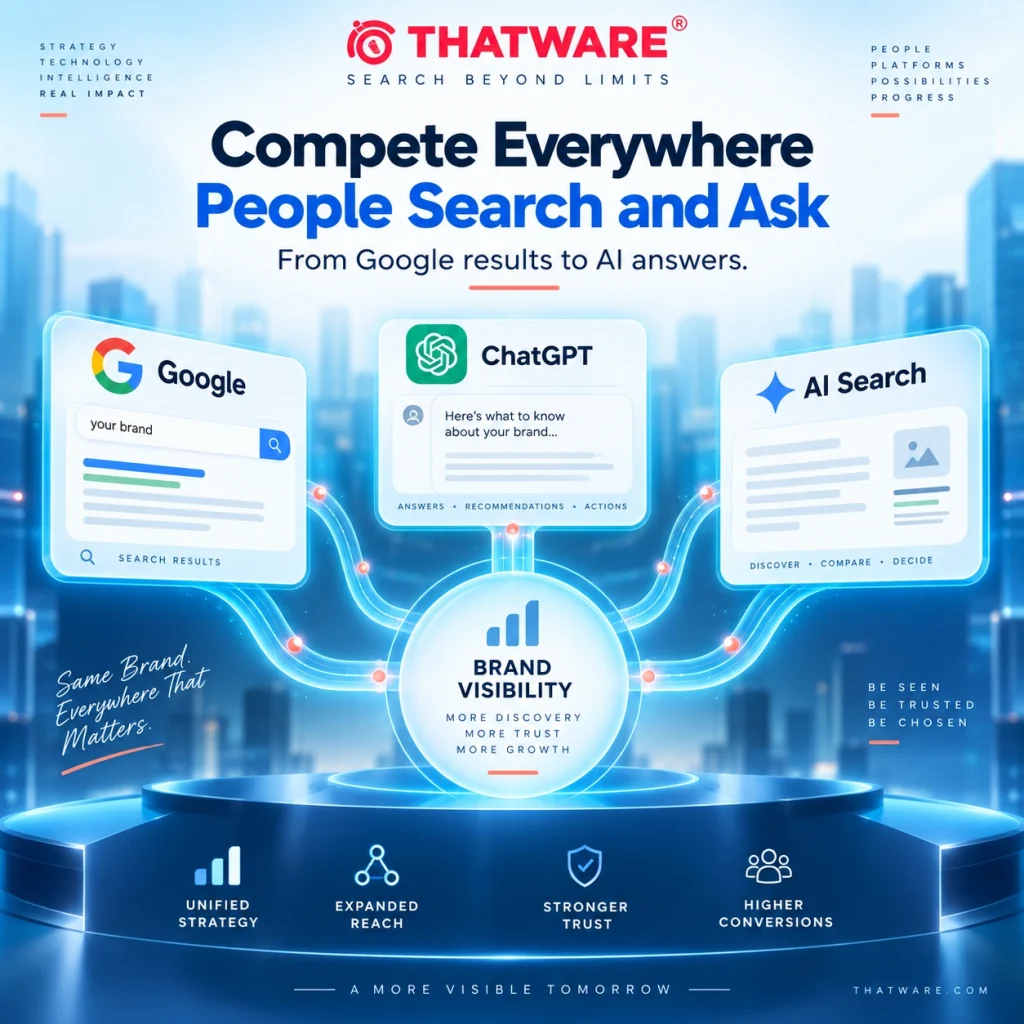
Search is no longer happening in one place.
For years, businesses focused primarily on Google.
That made sense because Google dominated the customer discovery journey. Companies invested in rankings, backlinks, technical SEO, content marketing, and conversion optimization to compete for organic visibility.
Today, the landscape is broader.
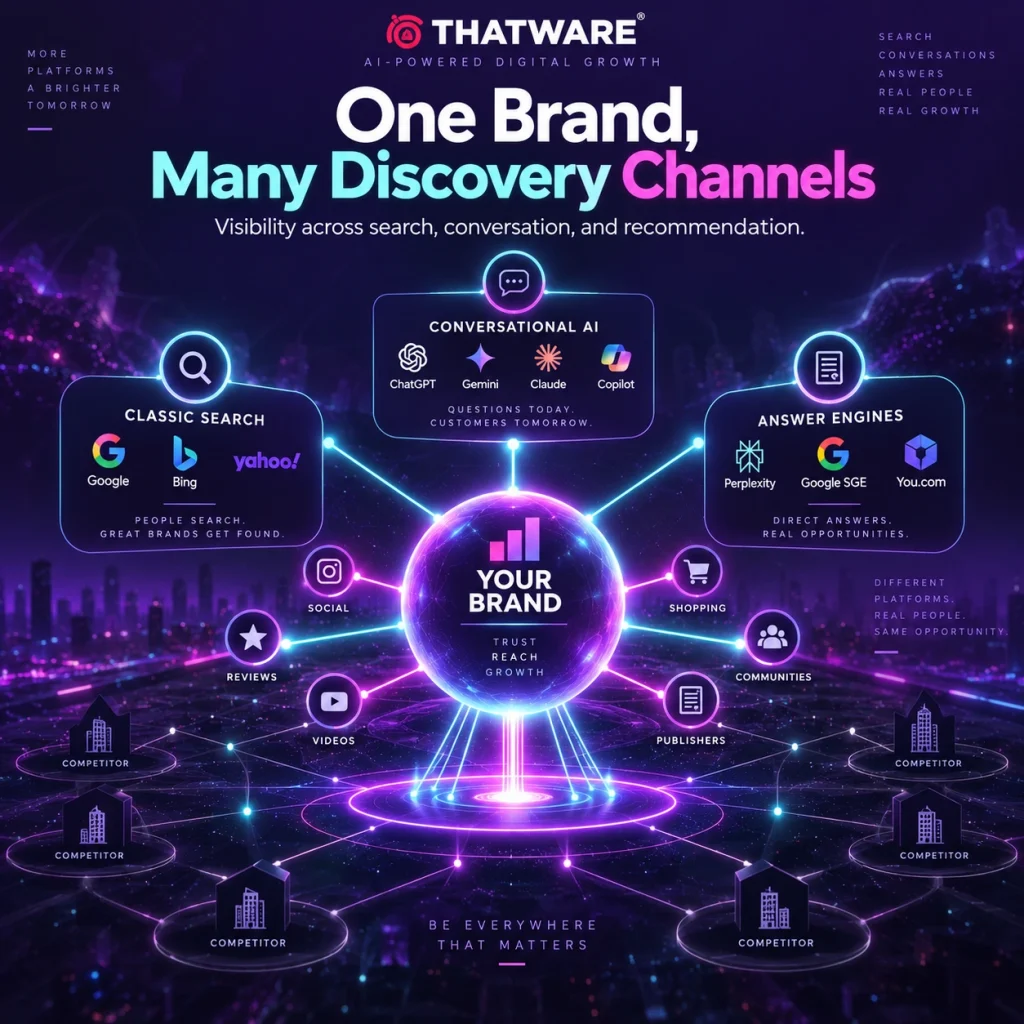
Users still search on Google, but they also ask ChatGPT for recommendations, use Gemini to compare options, rely on Perplexity for research, explore AI Overviews, and interact with other AI-powered discovery systems.
This creates a major strategic shift.
A business can rank well in Google and still be invisible in ChatGPT.
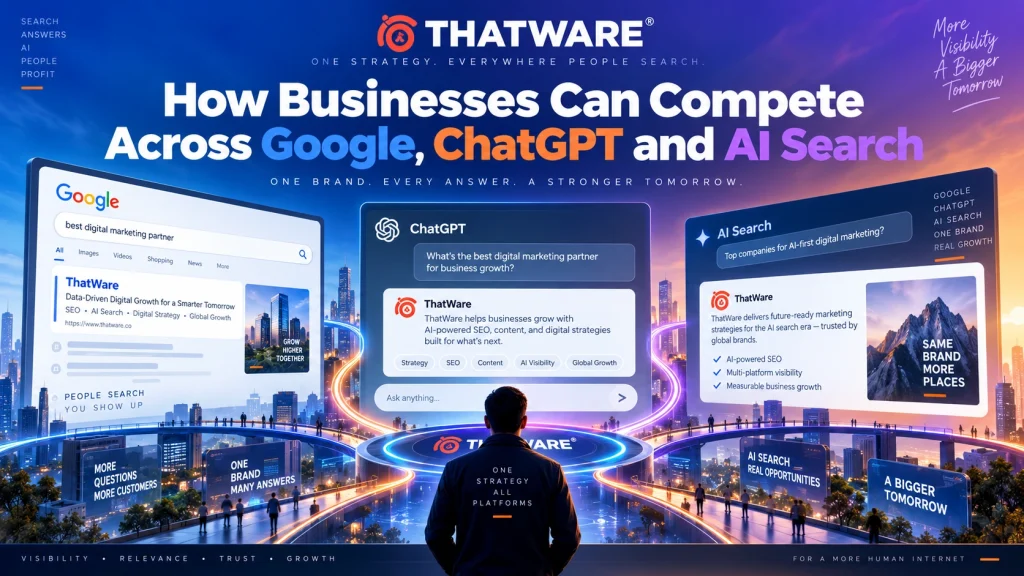
Another brand may dominate AI recommendations while having only moderate organic rankings.
A third may appear across multiple AI platforms but fail to convert because its website experience is weak.
That is why businesses increasingly need multi platform SEO.
The objective is no longer to win one search engine.
The objective is to compete across the full search and AI discovery ecosystem.
What Does Multi-Platform Search Mean?
Modern search behavior is distributed across multiple platforms.
A customer may:
- Discover a topic in Google
- Ask ChatGPT for recommendations
- Compare providers in Perplexity
- Visit company websites
- Search brand reviews
- Return to Google
- Submit an enquiry
This is not a linear journey.
A modern multi platform search optimization strategy should therefore account for multiple discovery environments rather than treating SEO as a Google-only activity.
These environments can include:
- Google Search
- Google AI Overviews
- ChatGPT
- Gemini
- Perplexity
- Copilot
- Claude
- Other AI-powered search tools
Expert Insight:
“Modern search is no longer a single journey. Visibility now depends on how consistently a brand appears across different discovery platforms.”
Why Google Alone Is No Longer Enough
Google remains essential.
However, users increasingly ask AI systems questions that previously required multiple searches.
For example:
“Which enterprise SEO agencies have strong AI search capabilities?”
An AI assistant may generate a shortlist immediately.
That means a business can lose visibility before the user ever reaches a traditional search results page.
This is why Google and ChatGPT SEO should be treated as complementary rather than competing strategies.
Google visibility still matters.
ChatGPT visibility adds another layer.
Quick Question: Can Strong Google Rankings Guarantee AI Visibility?
No. A business may rank well in Google but still be absent from AI-generated recommendations, comparisons, or cited answers. AI visibility depends on additional signals such as entity clarity, citations, authority, and external validation.
What Is Multi-Platform SEO?
Multi platform SEO is the process of improving search visibility across multiple discovery channels rather than optimizing exclusively for one search engine.
It can include:
- Traditional SEO
- AEO
- GEO
- LLM SEO
- AI citation optimization
- Entity optimization
- Structured data
- Content architecture
- Brand authority
- Digital PR
- AI visibility monitoring
The purpose is to create a brand that is easier to find, understand, cite, and recommend across different systems.
Google SEO Still Matters
Businesses should not abandon traditional SEO.
Google still rewards strong:
- Technical health
- Relevant content
- Authoritative backlinks
- Search intent alignment
- Internal linking
- Structured information
- Site experience
These signals also support broader AI discovery.
Traditional SEO is still the foundation.
The difference is that it now supports a wider search ecosystem.
What Is ChatGPT SEO?
ChatGPT SEO focuses on improving how easily a brand can be understood, retrieved, cited, or recommended inside ChatGPT-generated answers.
Professional ChatGPT SEO services may involve:
- Entity optimization
- AI citation analysis
- Content strategy
- Structured data
- Brand mention development
- Prompt monitoring
- LLM visibility
- Digital PR
- Competitive analysis
The goal is not to manipulate ChatGPT.
The goal is to improve the underlying evidence and authority surrounding the brand.
Strategic Insight:
“ChatGPT SEO is not about manipulating an AI model. It is about building enough clarity, authority, and evidence for the brand to be understood and trusted.”
What Is AI Search Optimization?
Professional AI search optimization services help businesses improve visibility across generative search and AI-powered discovery systems.
This may include:
- AEO
- GEO
- LLM SEO
- AI citations
- Entity development
- Semantic content
- Knowledge graph optimization
- Prompt-level tracking
- AI share of voice
These capabilities extend beyond conventional rankings.
Why Businesses Need AI Search Marketing Services
Search marketing is becoming more fragmented.
Professional AI search marketing services help businesses manage this fragmentation by connecting:
- SEO
- AI search
- Content
- PR
- Brand authority
- Entity optimization
- Analytics
The objective is not simply to gain more impressions.
It is to improve visibility where customers are actually searching.
1. Build a Cross-Platform Search Strategy
A strong cross platform SEO strategy begins by identifying where your customers discover information.
Ask:
- Do they search on Google?
- Do they ask ChatGPT for recommendations?
- Do they use Perplexity for research?
- Do they rely on AI Overviews?
- Which platforms matter most by funnel stage?
Different platforms may serve different roles.
Google may drive discovery.
ChatGPT may influence consideration.
Perplexity may support research.
Your strategy should reflect those differences.
Case Study: One Buyer, Multiple Search Platforms
Imagine an enterprise buyer discovering a provider through Google, checking recommendations in ChatGPT, researching competitors in Perplexity, and finally converting through the company website. A cross-platform strategy helps keep the brand visible throughout that journey instead of relying on one search channel.
2. Map Search Intent Across Platforms
Users behave differently depending on the platform.
Google queries may be shorter:
“AI SEO company”
ChatGPT prompts may be more contextual:
“Which AI SEO company is best for a global enterprise that needs GEO and AEO support?”
A multi platform search optimization strategy should map both.
This means analyzing:
- Informational intent
- Commercial intent
- Comparison intent
- Recommendation intent
- Decision-stage intent
- Conversational prompts
3. Strengthen Your Brand Entity
AI systems need to understand who you are.
Your website and external profiles should clearly establish:
- Company name
- Services
- Founders
- Industry
- Locations
- Expertise
- Products
- Partnerships
Strong entity clarity supports both traditional SEO and AI discovery.
This is a core component of AI discovery optimization.
4. Build Topic Authority
AI and traditional search both reward depth.
Instead of creating disconnected articles, build topic ecosystems.
For example:
AI Search
→ AI SEO
→ AEO
→ GEO
→ LLM SEO
→ AI Citations
→ ChatGPT SEO
→ AI Visibility
→ Entity Optimization
This creates stronger semantic relationships.
5. Create Content for Both Rankings and Answers
Google may reward a strong page.
AI systems may extract a specific answer from that page.
Content should therefore support both use cases.
Use:
- Clear headings
- Direct definitions
- FAQs
- Lists
- Comparison tables
- Short answer blocks
- Detailed supporting sections
This makes content easier to rank, retrieve, and cite.
Quick Question: Can the Same Content Perform in Google and AI Search?
Yes. Clear, authoritative content with strong structure, direct answers, supporting detail, and relevant entities can support traditional rankings while also making information easier for AI systems to retrieve and cite.
6. Optimize for Google AI Overviews
Google AI Overviews add a new layer to traditional search.
Businesses should create content that is:
- Clear
- Authoritative
- Well structured
- Factually supported
- Relevant to specific questions
Strong SEO fundamentals remain important.
But answer clarity becomes more valuable.
7. Optimize for ChatGPT Visibility
To improve ChatGPT visibility, businesses should focus on:
- Entity consistency
- Topical authority
- External references
- Clear service descriptions
- Citation-worthy content
- Structured information
- Brand authority
Professional ChatGPT SEO services should combine these signals rather than relying on keyword repetition.
8. Build Generative Search Visibility
Professional generative search optimization services aim to improve visibility within AI-generated responses.
This can involve:
- AI citation strategy
- Digital PR
- Entity optimization
- Original research
- Brand mentions
- Structured data
- AI prompt monitoring
Generative visibility is broader than one AI platform.
9. Improve LLM Understanding
Professional LLM SEO services help large language models understand your brand more accurately.
This can include:
- Entity mapping
- Semantic relationships
- Structured data
- Knowledge graph signals
- External corroboration
- Machine-readable information
The stronger the model understands your brand, the more accurately it can represent it.
LLM Insight:
“The clearer the relationships between your brand, services, expertise, and external evidence, the easier it becomes for AI systems to represent the business accurately.”
10. Build AI Visibility Measurement
Traditional SEO measurement still matters.
Track:
- Rankings
- Clicks
- Impressions
- Traffic
- Leads
- Revenue
But also add:
- AI mentions
- Citation frequency
- Recommendation share
- Prompt coverage
- Platform visibility
- AI sentiment
- Competitor share of voice
Professional AI visibility services should help businesses measure these newer signals.
11. Compare Platform-Specific Visibility
Do not assume visibility is identical across platforms.
A brand may perform well in:
- Google Search
- ChatGPT
- Gemini
- Perplexity
but poorly in another.
This is why search visibility services should provide platform-specific reporting.
Quick Question: Should AI Visibility Be Measured as One Score?
Not ideally. A brand may perform well in ChatGPT but poorly in Gemini or Perplexity. Platform-specific reporting gives a more accurate picture of where visibility is strong and where gaps remain.
12. Strengthen External Authority
AI systems may rely on more than your website.
Build authority through:
- Digital PR
- Industry publications
- Expert interviews
- Research mentions
- Partner websites
- Professional directories
- Podcasts
- Conferences
These external signals can reinforce credibility.
13. Publish Original Research
Original information is powerful across search platforms.
Examples include:
- Industry surveys
- Benchmark reports
- Search trend studies
- AI visibility research
- Proprietary datasets
- Case studies
Original research can earn:
- Backlinks
- Media coverage
- Citations
- AI references
- Brand authority
Case Study: One Asset Across Multiple Platforms
Consider a company publishing an original AI visibility benchmark based on thousands of search prompts. That research could attract Google backlinks, media coverage, AI citations, expert references, and generative mentions, giving the same asset value across multiple discovery channels.
14. Build Citation-Worthy Assets
Some content is naturally easier to cite.
Examples include:
- Data studies
- Statistics
- Frameworks
- Glossaries
- Comparison guides
- Technical documentation
- Research summaries
- Expert commentary
These assets can support both SEO and AI discovery.
15. Strengthen Digital PR
Digital PR is increasingly important because AI systems may rely on external evidence.
PR can help create:
- Brand mentions
- Expert associations
- Research references
- Founder authority
- Industry recognition
That can strengthen multi-platform visibility.
16. Optimize Structured Data
Structured data helps systems understand entities and relationships.
Relevant schema may include:
- Organization
- Person
- Service
- Product
- Article
- FAQPage
- Review
- LocalBusiness
- BreadcrumbList
Structured data does not guarantee AI visibility, but it can reduce ambiguity.
17. Improve Internal Linking
Internal linking strengthens topic relationships.
A ChatGPT SEO page could link to:
- AI SEO
- GEO
- AEO
- LLM SEO
- AI search optimization
- AI citation optimization
This helps both users and machines understand your content ecosystem.
18. Build Commercial Pages for AI Discovery
Commercial visibility matters.
Users may ask:
“Which company provides AI search optimization?”
Your website should contain strong service pages that explain:
- What you offer
- Who it is for
- How it works
- What platforms you support
- How results are measured
- Why your approach differs
Thin service pages may struggle in both search and AI discovery.
19. Create Comparison Content
AI users often ask comparison questions.
Examples include:
- Best SEO agencies
- Best AI search agencies
- ChatGPT SEO vs traditional SEO
- AEO vs GEO
- AI SEO agency comparison
This makes comparison content valuable.
20. Use Omnichannel Search Optimization
Omnichannel search optimization takes a broader view than SEO alone.
It considers how users move across:
- Search engines
- AI assistants
- Review platforms
- Brand websites
- Social content
- Publications
The goal is consistent visibility throughout the journey.
21. Build a Search Funnel Across Platforms
Different platforms can influence different stages.
Awareness
Google and AI Overviews
Research
Perplexity, Gemini, ChatGPT
Comparison
ChatGPT, search results, review sites
Decision
Service pages, case studies, contact pages
Your strategy should connect these stages.
22. Track AI Recommendation Queries
Recommendation queries can be commercially valuable.
Examples:
“Best AI SEO agency”
“Recommended GEO companies”
“Which SEO company works with enterprises?”
Track which brands appear and why.
This creates actionable competitive intelligence.
23. Track Citation Sources
If AI systems cite competitors, identify which sources appear repeatedly.
These may include:
- News websites
- Industry publications
- Research
- Directories
- Blogs
- Company websites
This can inform your own authority strategy.
24. Monitor Competitor AI Visibility
Competitive analysis should include:
- AI mentions
- Citations
- Recommendation frequency
- Prompt coverage
- Platform visibility
- Sentiment
This extends traditional competitor SEO.
25. Use AI Search Consulting
Professional AI search consulting services can help businesses understand:
- Which platforms matter
- What visibility gaps exist
- How to prioritize AI search
- Which entities need strengthening
- What content needs improvement
- How to measure results
Consulting is especially useful for companies with existing SEO teams.
26. What Should an AI Search Agency Provide?
A capable AI search agency should offer more than content writing.
It should understand:
- Technical SEO
- AEO
- GEO
- LLM SEO
- Entity optimization
- AI citation strategy
- Digital PR
- Structured data
- Prompt monitoring
- AI visibility measurement
The strategy should be integrated.
27. Avoid Platform Silos
One of the biggest mistakes is treating each platform separately.
Your Google strategy, ChatGPT strategy, and generative search strategy should reinforce each other.
A strong topic cluster can:
- Rank in Google
- Support AI Overviews
- Strengthen entity authority
- Improve ChatGPT visibility
- Earn AI citations
This creates compounding value.
Cross-Platform Principle:
“The strongest search strategies make Google, AI search, content, authority, and brand signals reinforce each other rather than operate as separate campaigns.”
28. Avoid Chasing Short-Term AI Tricks
AI search is evolving rapidly.
Shortcuts may not last.
Focus on durable signals:
- Expertise
- Authority
- Clear information
- Useful content
- Strong entities
- External validation
- Original research
These remain valuable across platforms.
29. Build a Cross-Platform Measurement Dashboard
A useful dashboard can combine:
Google Metrics
- Rankings
- Organic traffic
- CTR
- Conversions
AI Metrics
- Mentions
- Citations
- Prompt coverage
- Recommendation share
Authority Metrics
- Brand mentions
- Referring domains
- Research citations
This gives leadership a more complete view.
30. Create a Multi-Platform Search Roadmap
A practical roadmap can look like:
Phase 1: Strengthen Google SEO
Fix technical SEO, content, internal linking, and authority.
Phase 2: Build Entity Clarity
Improve organization, service, founder, and product information.
Phase 3: Expand AI-Ready Content
Create answer blocks, comparisons, FAQs, and research.
Phase 4: Strengthen External Authority
Use PR, mentions, citations, and partnerships.
Phase 5: Track AI Visibility
Measure mentions, prompts, citations, and competitors.
Phase 6: Optimize Across Platforms
Use performance data to refine the strategy.
How ThatWare Approaches Multi-Platform Search
At ThatWare, modern search visibility can be approached as a connected search intelligence problem.
That means combining:
- Traditional SEO
- AI SEO
- AEO
- GEO
- LLM SEO
- Entity optimization
- AI citation strategy
- Structured data
- Digital PR
- AI visibility analytics
- Competitive intelligence
- Content architecture
- Prompt monitoring
Businesses looking for multi platform search optimization, AI search optimization services, generative search optimization services, LLM SEO services, or AI search consulting services need a partner that understands how these channels work together.
ThatWare’s approach is designed around that integration.
Final Thoughts
The future of search is distributed.
Google remains essential, but it is no longer the only platform influencing customer discovery.
ChatGPT, Gemini, Perplexity, Copilot, AI Overviews, and other AI-powered systems are becoming part of the search journey.
That means businesses need a broader strategy.
A strong cross platform SEO strategy should combine:
- Traditional SEO
- ChatGPT optimization
- AI search optimization
- Generative visibility
- LLM SEO
- Entity authority
- Citations
- Digital PR
- Multi-platform measurement
The goal of AI discovery optimization is not simply to appear in more places.
It is to create consistent, authoritative visibility wherever customers search.
Businesses that adopt omnichannel search optimization, invest in AI search marketing services, and build stronger search visibility services frameworks will be better positioned to compete as search continues to evolve.