SUPERCHARGE YOUR ONLINE VISIBILITY! CONTACT US AND LET’S ACHIEVE EXCELLENCE TOGETHER!
Search is becoming a language-led experience.
People no longer rely only on short keyword searches. They ask full questions, describe complex problems, request comparisons and expect clear recommendations from Google, ChatGPT, Gemini, Microsoft Copilot, Perplexity, voice assistants and other AI-powered systems.
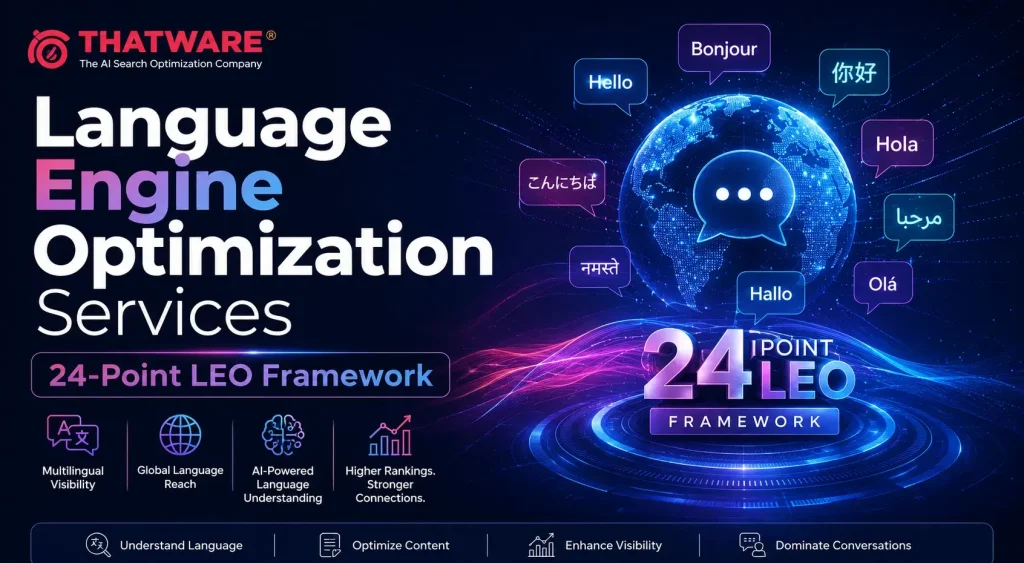
This change affects how websites need to communicate.
A page can rank for a keyword and still be difficult for an AI system to understand. It may contain the correct information, but the main answer may be buried in a long introduction. A service may be described several times, yet the page may not clearly explain who it is for, how it works, what it includes and why the business is trustworthy.
Language Engine Optimization addresses this problem.
ThatWare’s Language Engine Optimization services improve the language, structure, meaning and contextual relationships of website content. The objective is to help both human readers and AI systems understand what a business offers, which questions it can answer and why its information should be trusted.
As a Language Engine Optimization company, ThatWare does not treat language as a cosmetic layer added after SEO. Language is the mechanism through which search engines, answer engines and large language models interpret meaning.
A specialized Language Engine Optimization agency must therefore examine much more than grammar or keyword placement. It must analyze:
- How users phrase questions
- What those questions mean
- Which page should answer each question
- Whether the opening sentence provides a direct response
- Whether terminology is consistent
- Whether important entities occur together naturally
- Whether content is easy to summarize
- Whether spoken queries can be answered concisely
- Whether local and international phrasing is properly separated
- Whether AI platforms select the intended source
- Whether the brand is visible across conversational search journeys
A dedicated Language Engine Optimization consultant can turn these requirements into a structured implementation plan. Instead of rewriting pages without direction, the consultant maps language problems to specific URLs, user intents, prompts, entities and performance indicators.
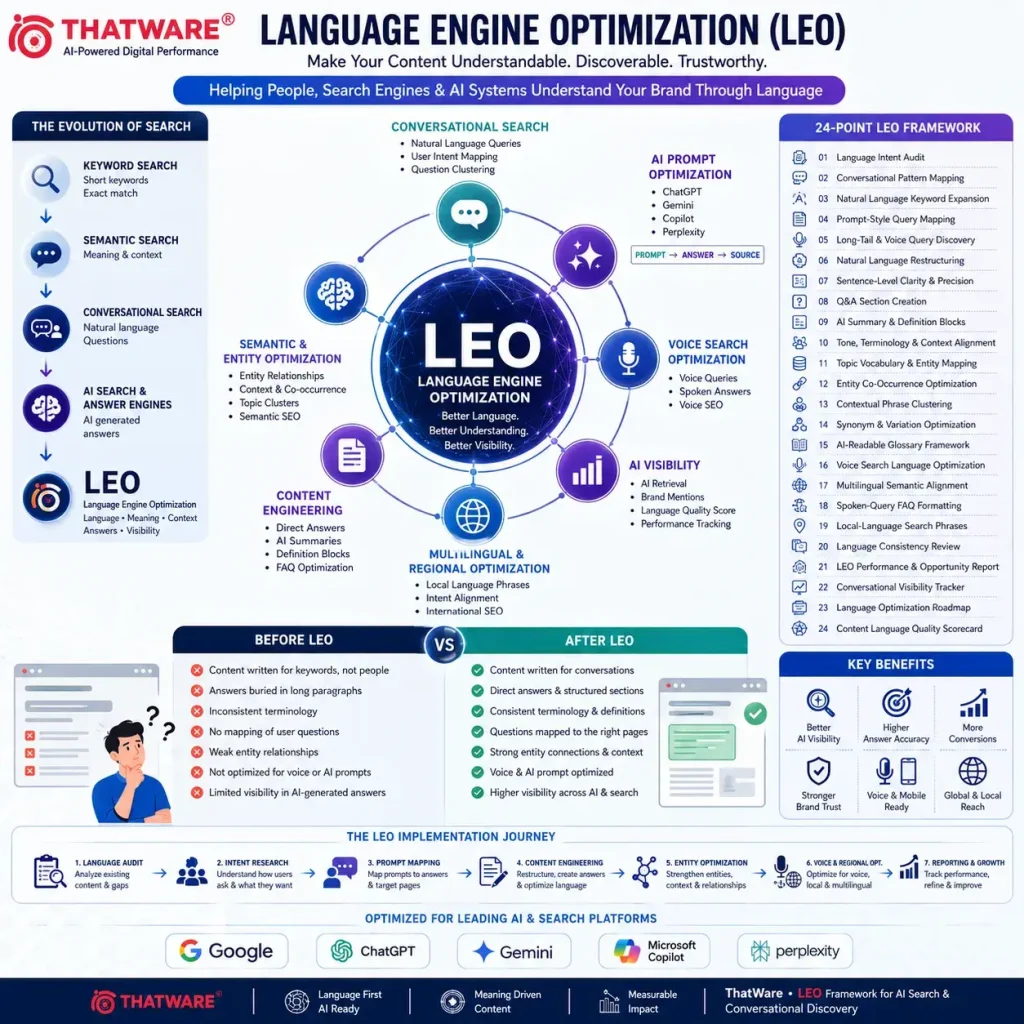
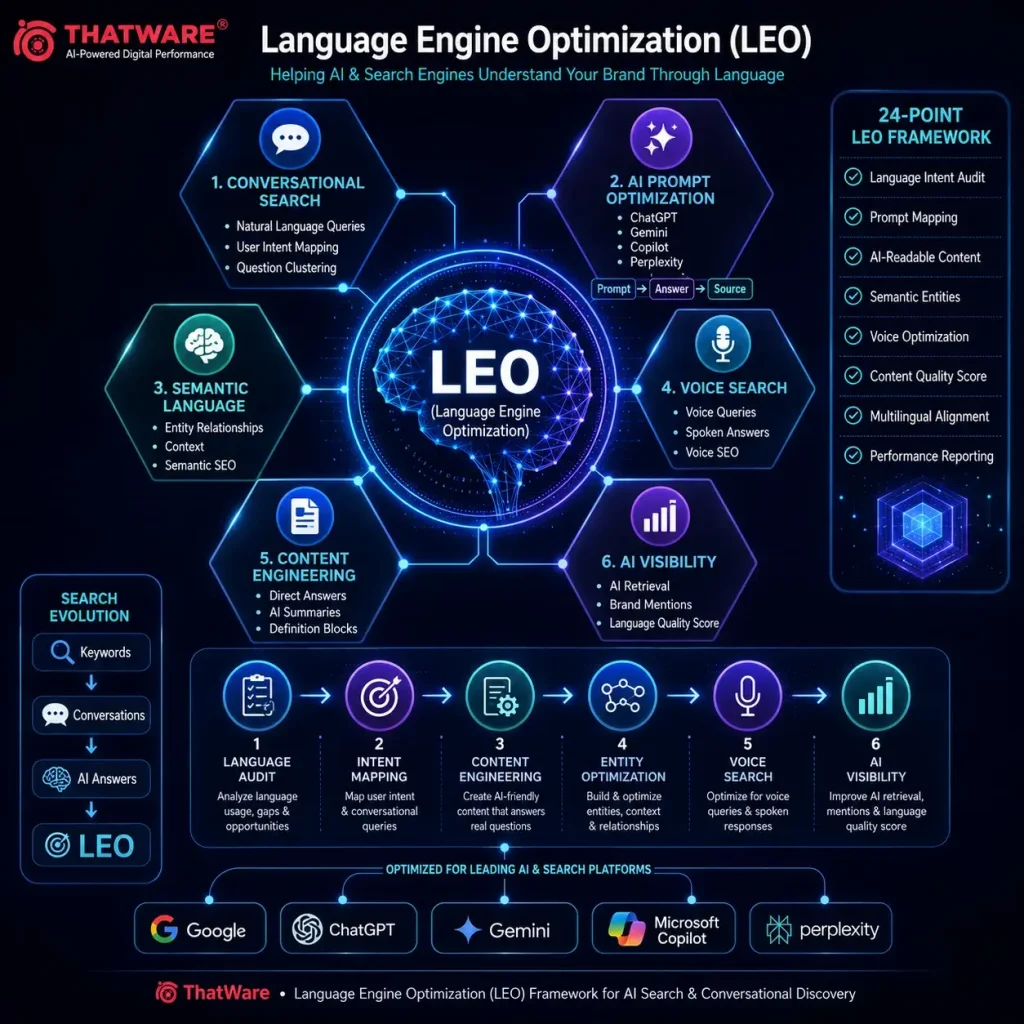
ThatWare’s LEO services bring together natural-language research, conversational search, content engineering, NLP, entity analysis, voice optimization, regional language alignment and AI visibility reporting.
As a full-service LEO agency, ThatWare can audit existing content, create the required language assets, support implementation and monitor results. Our role as a LEO company is not limited to producing recommendations. The framework is designed to support execution through page-level deliverables, defined ownership, validation criteria and ongoing reporting.
Organizations can also use ThatWare’s LEO consulting services for internal teams that need strategic guidance, governance, quality control or an implementation roadmap. Our LEO audit services identify where a website’s language creates ambiguity, weak answer extraction, poor intent alignment, inconsistent terminology or limited AI visibility.
For organizations managing large websites, multiple product lines, several countries or complex internal approval processes, enterprise Language Engine Optimization provides a scalable framework for language governance, prompt mapping, terminology control, multilingual alignment and performance measurement.
Why Language Engine Optimization Is Different From Conventional SEO
Traditional SEO asks whether a page is crawlable, relevant and authoritative enough to rank.
Language Engine Optimization adds another group of questions:
- Can an AI system identify the main point of the page?
- Does the page answer the user’s actual question?
- Can the answer be summarized without losing important context?
- Is the terminology consistent across the website?
- Are services, audiences, problems and locations properly connected?
- Is the content written in language people naturally use?
- Can spoken queries retrieve a concise and accurate answer?
- Does the page distinguish between informational and commercial intent?
- Is the brand presented consistently across AI-generated responses?
- Can the content be adapted for regional or multilingual discovery?
ThatWare’s current pricing page describes LEO as a deeper optimization layer concerned with language, meaning, context and machine comprehension. It emphasizes clear definitions, direct answers, semantic depth, entity recognition, conversational coverage, AI-readable formatting and continuous improvement.
LEO does not replace technical SEO, AEO, GEO or LLM SEO. It strengthens the language layer that supports those disciplines.
For example:
- SEO helps a page become discoverable.
- AEO helps a page become suitable for direct answers.
- GEO helps a brand appear in generated responses.
- LLM SEO helps large language models understand and retrieve the brand.
- LEO improves the language, phrasing, clarity and contextual signals behind all these outcomes.
What Is Included in ThatWare’s LEO Pricing?
ThatWare’s current page presents LEO as a monthly engagement, with the deliverables completed on a recurring basis. The existing package includes a language visibility roadmap, visibility audit, conversational query research, intent mapping, content clarity, definitions, direct answer blocks, FAQs, semantic depth, entity relationships, language structure, AI-readable formatting, content gap analysis, trust language, structured data, citation readiness, conversational rewriting, voice optimization, internal linking, AI inclusion support, editorial review, monthly reporting and continuous optimization.
The exact monthly scope should be based on:
- Total number of pages
- Number of priority services or products
- Existing content quality
- Number of target markets
- Number of supported languages
- Competitive intensity
- Number of conversational queries being tracked
- Number of AI platforms included
- Volume of content requiring restructuring
- Industry-specific legal or editorial review requirements
- Internal development capacity
- Current semantic and entity maturity
Not every deliverable should be implemented simultaneously.
A website with inconsistent terminology should first establish a controlled vocabulary. A website with weak conversational coverage should first complete query research and prompt mapping. A multilingual website should not scale translations before its terminology, entity relationships and regional language rules have been defined.
For this reason, ThatWare’s LEO model follows a phased process:
- Establish the language visibility baseline.
- Analyze user phrasing and intent.
- Map questions and prompts to pages.
- Restructure language and answer blocks.
- Strengthen terminology, entities and semantic relationships.
- Optimize spoken, regional and multilingual queries.
- Test visibility and answer retrieval.
- Report results and update the roadmap.
Complete ThatWare LEO Service Coverage
Core Language Engine Optimization
ThatWare delivers Language Engine Optimization services for businesses that want content to be understood accurately across search engines, answer engines and AI systems.
Our positioning as a Language Engine Optimization company is supported by a structured audit and implementation framework. Businesses searching for a Language Engine Optimization agency receive page-level recommendations rather than generic language advice.
A Language Engine Optimization consultant can help define the target questions, pages, audiences, platforms and markets that matter commercially.
The broader package includes LEO services, strategic support from a LEO agency, implementation through an experienced LEO company, specialized LEO consulting services, evidence-led LEO audit services and scalable enterprise Language Engine Optimization.
AI Language Strategy and Visibility
ThatWare’s AI language optimization services examine how content communicates meaning to AI-powered search systems.
The process includes AI search language optimization and broader language optimization for AI search, covering the way pages define topics, answer questions, explain services and communicate context.
Our natural language SEO services help websites move beyond rigid keyword repetition. Through AI-ready language optimization, the content becomes easier to parse, summarize and retrieve.
ThatWare’s language search intelligence services combine user phrasing, prompt behavior, semantic relationships and visibility data. Language intent optimization is used to identify what the user expects, not merely which words appear in the query.
An AI language visibility strategy then connects language improvements with target platforms, pages and commercial objectives.
Our search language analysis services assess existing page language, while a language engine visibility audit identifies gaps in clarity, answer structure, terminology, conversational coverage and AI representation.
Conversational Search Services
Conversational search optimization helps websites answer full natural-language questions rather than targeting only short keyword phrases.
ThatWare’s conversational SEO services include query research, scenario mapping, question clustering and page-level content changes.
Through conversational query optimization, we determine how users phrase concerns, comparisons and purchase questions. Conversational keyword research expands this analysis across typed prompts, spoken queries, search suggestions, customer communications and AI interactions.
A documented conversational search strategy assigns those queries to the right pages and answer formats.
Natural language query optimization helps the content match the way people speak and write. Conversational content optimization then rewrites page sections so they respond directly to user intent.
A conversational search audit identifies where existing pages fail to answer natural questions. Conversational query mapping connects each question with an intended URL, answer block and next step.
Finally, conversational search visibility tracking measures how those queries perform across search results and selected AI environments.
AI Prompt Optimization
AI prompt query optimization focuses on the complete instructions and questions people enter into generative systems.
ThatWare uses prompt-style query mapping to connect prompts with expected answers, target URLs, source text and risk classifications.
Our AI prompt research services identify the commercial, informational, comparative and recommendation prompts relevant to a business.
Prompt intent optimization separates prompts according to the outcome the user expects. Prompt-based SEO services then translate those findings into page content, FAQs, comparisons and answer modules.
AI answer prompt optimization strengthens the content needed to answer high-priority prompts accurately.
Platform-specific work can include:
- ChatGPT prompt visibility optimization
- Gemini prompt optimization
- Microsoft Copilot prompt optimization
These activities are supported by AI prompt performance tracking, which records mentions, source selection, answer consistency, competitor visibility and changes over time.
Question and Long-Tail Search Intelligence
ThatWare’s long-tail question keyword research identifies detailed questions with clear user intent.
Question-based keyword research extends traditional keyword research by documenting the expected answer, preferred content format and likely stage in the customer journey.
An AI question opportunity analysis identifies which questions are likely to influence AI-generated explanations or recommendations.
Natural language keyword expansion adds synonyms, modifiers, comparisons and conversational variations. Our question intent mapping services assign each variation to an informational, commercial, local, comparison or transactional category.
Long-tail conversational SEO prepares content for detailed queries that often reveal stronger intent than short keywords.
Search question clustering groups related questions under a suitable topic and destination. Question-to-page mapping services prevent several pages from competing for the same intent.
AI question answering optimization improves the content selected to answer important prompts. User question language analysis ensures that headings and responses reflect the language used by real customers.
Voice and Spoken Search Optimization
ThatWare’s voice search optimization services prepare pages for queries spoken into mobile devices, assistants and conversational interfaces.
As a technically guided voice SEO agency, ThatWare combines spoken-language research with answer restructuring.
Voice query optimization identifies how spoken questions differ from typed searches. Spoken search optimization then improves answer length, sentence flow and contextual clarity.
Conversational voice search SEO supports queries involving natural follow-up language, local modifiers and service selection.
Voice search keyword research identifies spoken patterns such as:
- “What does this service include?”
- “Which company can help with this?”
- “Is this suitable for my business?”
- “How much does this cost?”
- “Where can I find a provider near me?”
Voice FAQ optimization creates short, speakable responses. Spoken-query FAQ formatting separates the direct spoken answer from the more detailed explanation below it.
Mobile voice search optimization verifies whether the content is suitable for mobile answer experiences. Voice answer testing services record the response returned, source used, clarity, duration and accuracy.
Natural-Language Content Engineering
Natural language content optimization improves the clarity, flow and usefulness of page content.
AI-readable content optimization restructures pages so important information can be extracted without relying on unrelated paragraphs.
AI content language restructuring separates large sections into self-contained modules.
Sentence-level content optimization reviews individual sentences for purpose, clarity, relevance and readability.
Answer precision optimization removes ambiguous wording and ensures the response matches the stated question.
ThatWare’s content readability optimization services improve sentence length, paragraph balance, heading flow and explanation quality.
Direct answer content creation places a clear answer before deeper explanation.
Conversational Q&A content creation develops natural questions and useful responses for relevant service, product and pricing pages.
AI summary block creation produces concise overviews that communicate the page’s key information.
AI definition block optimization ensures important services, concepts and technical terms are defined clearly and consistently.
Semantic Language and Entity Optimization
Semantic language optimization improves how meaning is communicated across a website.
ThatWare’s semantic SEO services strengthen topic coverage, contextual relevance and relationships between content assets.
Entity phrase optimization ensures that important brands, services, products, people, industries and locations are described consistently.
Entity co-occurrence optimization places related entities together in useful contexts.
Topical vocabulary optimization identifies the language required to demonstrate subject depth.
Our entity relationship mapping services connect entities with target pages, internal links and structured data.
Contextual phrase optimization improves the supporting language around primary concepts.
Semantic phrase clustering groups related expressions according to meaning and intent.
Topic-specific vocabulary mapping assigns industry language and definitions to the correct pages.
AI entity language optimization helps AI systems understand how the brand relates to specific services, audiences, categories and locations.
NLP, Synonyms and Terminology Governance
ThatWare’s NLP keyword expansion services identify natural variants beyond exact-match keywords.
Synonym mapping services define which alternative terms are appropriate for each page.
Keyword variation optimization distributes approved variations without weakening page ownership.
Related-term optimization adds contextually relevant concepts that support the primary topic.
NLP keyword mapping connects language variations with intent, entity and target URL.
Semantic keyword clustering services group terms by meaning rather than surface similarity.
Controlled vocabulary development creates an approved terminology list for writers, developers and marketing teams.
AI terminology optimization makes technical and commercial language easier for AI systems to interpret.
AI-readable glossary development creates clear definitions, related terms, page links, entity references and update rules.
Terminology framework development establishes governance for abbreviations, service names, product descriptions, locations and industry concepts.
Multilingual, International and Regional Language Optimization
Multilingual semantic optimization ensures that translated content preserves meaning and intent, not only literal wording.
Multilingual AI search optimization prepares regional content for discovery across AI-powered systems.
ThatWare’s regional language SEO services address local vocabulary, spelling, modifiers and search habits.
Local language search optimization improves pages for the phrases used in a particular market.
Local search phrase research identifies location-specific questions and service terminology.
International language optimization supports websites targeting several countries or linguistic groups.
Multilingual conversational SEO maps natural questions across supported languages.
Regional query optimization separates local search intent from broader national or international intent.
A language consistency audit identifies conflicts in terminology, spelling, tone and service descriptions.
A content language quality audit scores priority pages for clarity, precision, consistency, semantic depth and answer readiness.
The LEO Transformation: Before and After
Typical State Before LEO
Before Language Engine Optimization, a website may contain accurate information but still experience language-related weaknesses:
- User questions are not formally mapped.
- Headings do not reflect conversational phrasing.
- Services are described using inconsistent terminology.
- Similar pages use overlapping synonyms.
- Important definitions are buried inside long paragraphs.
- AI prompts are not connected to target URLs.
- FAQs contain long answers unsuitable for spoken search.
- Local and national language signals are mixed together.
- Entity relationships are implied rather than stated.
- Content quality is assessed subjectively.
- No dashboard tracks conversational queries.
- There is no implementation cadence or language governance process.
Target State After LEO
After implementation:
- Priority questions have a defined target page.
- Prompts have expected answers and source URLs.
- Headings mirror natural user language.
- Direct answer blocks provide immediate clarity.
- Approved terminology is governed across the website.
- Synonyms are distributed without causing cannibalization.
- Entities are connected through copy, links and structured data.
- Voice answers are short enough to be spoken clearly.
- Regional and multilingual phrases follow defined rules.
- Content quality is measured using a repeatable scorecard.
- Conversational visibility is monitored.
- Language improvements are managed through a structured roadmap.
Detailed 24-Point Language Engine Optimization Framework
The following framework adapts the 24 deliverables from the uploaded LEO audit presentation into a general ThatWare service model. The “before” conditions describe common website weaknesses and should be confirmed through a live client audit before being presented as findings.
1. Language Engine Intent Audit for How Users Phrase Questions Across AI and Search Engines
Objective
The first deliverable determines how customers express needs across conventional search, voice interfaces and AI systems.
Keyword tools often record fragments such as “enterprise SEO pricing.” A real user may ask, “Which enterprise SEO package is suitable for a multi-location business?” The second query contains more information about intent, audience, scale and expected answer type.
Before the Fix
- Page language is readable but not compared against real user phrasing.
- Questions from search, AI platforms and sales conversations are not stored centrally.
- The same question may be answered differently across several pages.
- No formal field identifies the best URL for each user question.
- Sensitive, technical or high-risk answers lack a reviewer field.
Plan of Action
- Audit priority landing pages, blogs, FAQs and conversion pages.
- Collect phrasing from search suggestions, customer emails, sales calls, chat logs and AI prompts.
- Classify each phrase by informational, commercial, comparison, transactional, local or support intent.
- Identify the best page for each question.
- Draft a safe, direct answer.
- Record evidence requirements, internal links and reviewers.
- Test whether the intended page returns for representative prompts.
- Update the matrix as new questions emerge.
After the Fix
ThatWare delivers a language-intent matrix containing:
- Query or prompt
- Intent type
- Audience
- Journey stage
- Target URL
- Direct answer
- Supporting evidence
- CTA
- Reviewer
- Review date
- Risk classification
Success Metrics
- Percentage of priority questions mapped
- Percentage with approved answers
- Correct-page retrieval rate
- Long-tail impressions
- Assisted conversion rate
2. Conversational Search Pattern Mapping
Objective
This deliverable groups natural-language questions according to recurring customer scenarios.
A single service can attract many conversational situations, including cost concerns, uncertainty about fit, comparison questions, implementation requirements and expected outcomes.
Before the Fix
- Conversational phrases appear in content but are not grouped.
- Cost, suitability, process and comparison questions are mixed together.
- Pages lack scenario-specific CTAs.
- Emotional and trust requirements are not documented.
- Local and non-local phrasing may compete.
Plan of Action
- Collect conversational prompts by service and audience.
- Group them into scenarios such as cost, fit, risk, process, timing and results.
- Identify repeated language patterns.
- Assign each scenario to a suitable landing page.
- Rewrite selected headings as natural questions.
- Add evidence, trust cues and contextual internal links.
- Define a CTA for each scenario.
- Track impressions and engagement for conversational variants.
After the Fix
A conversational pattern map contains:
- Scenario
- Query variations
- User concern
- Intent
- Landing page
- Recommended answer format
- Supporting proof
- CTA
- Performance status
Success Metrics
- Long-tail conversational impressions
- Click-through rate
- Engagement with Q&A sections
- CTA performance by scenario
- Number of mapped conversational patterns
3. Natural Language Keyword Expansion and Phrase Modeling
Objective
This workstream expands keyword research into a controlled natural-language model.
It defines how primary terms, synonyms, colloquial expressions and technical phrases should be distributed across pages.
Before the Fix
- Similar terms are used inconsistently.
- Several pages may target the same synonym.
- Writers do not know which page owns which phrase.
- Anchor text and FAQs use uncontrolled variations.
- Technical language may not match customer vocabulary.
Plan of Action
- Identify the primary term for every priority page.
- Collect synonyms, variations, abbreviations and long-tail expressions.
- Analyze whether each variation carries the same intent.
- Assign approved variations to page headings, copy, FAQs and anchors.
- Define excluded terms for pages where they may cause confusion.
- Build a glossary for technical or branded language.
- Monitor cannibalization and query overlap.
- Update the map as new language patterns appear.
After the Fix
The keyword expansion sheet includes:
- Primary term
- Secondary term
- Conversational variation
- Technical synonym
- User-facing synonym
- Excluded phrase
- Target URL
- Recommended placement
- Intent
- Entity relationship
Success Metrics
- Improved semantic coverage
- Reduction in cannibalization
- Growth in unique query visibility
- Better page ownership
- Increased long-tail ranking breadth
4. Prompt-Style Query Mapping for AI Answer Engines
Objective
Prompt mapping examines the complete instructions and questions used within AI systems.
Unlike a keyword, a prompt may contain several requirements at once. For example, a user may request a provider, specify a budget, define a location and ask for a comparison.
Before the Fix
- AI prompts are not stored or categorized.
- Pages do not contain answers designed for multi-part prompts.
- Expected answer sources are not documented.
- No risk level is assigned to inaccurate or unsupported responses.
- Platform differences are not measured.
Plan of Action
- Define priority prompt categories.
- Create prompts for service discovery, comparison, pricing and recommendation.
- Record the expected response.
- Identify the page that should support the response.
- Draft citation-ready text.
- Assign a factual or reputational risk level.
- Test prompts across selected AI systems.
- Record source selection, brand inclusion and competitor preference.
- Rewrite weak source pages.
- Retest after implementation.
After the Fix
The prompt-to-answer map contains:
- Prompt
- Platform
- Intent
- Expected answer
- Target page
- Supporting citation text
- Competitors shown
- Brand mentioned or excluded
- Risk
- Corrective action
- Retest date
Success Metrics
- Correct source rate
- Brand mention rate
- Prompt answer accuracy
- Recommendation frequency
- Reduction in unsupported answers
5. Long-Tail Question and Voice-Query Opportunity Discovery
Objective
This deliverable identifies detailed spoken and written questions that reveal specific user needs.
Before the Fix
- Voice-style questions are not researched separately.
- Answers are too long for spoken delivery.
- Local phrases are added unnaturally.
- Important booking, cost and provider-selection questions are missing.
- No mobile voice testing process exists.
Plan of Action
- Identify high-priority voice intents.
- Collect spoken variants through mobile and assistant testing.
- Separate informational, local and action-oriented voice queries.
- Write 20-to-30-second answers.
- Add necessary qualifiers.
- Include local context only where relevant.
- Link the spoken answer to a deeper explanation.
- Test the question on selected devices and interfaces.
- Record the returned source and wording.
- Refine unclear answers.
After the Fix
ThatWare provides voice FAQ modules with:
- Spoken question
- Short answer
- Detailed follow-up
- Local context
- Qualifier
- CTA
- Target URL
- Test status
Success Metrics
- Mobile voice answer accuracy
- Spoken-answer duration
- Correct-page selection
- Voice-query impressions
- Local voice visibility
6. Natural Language Restructuring for Better AI and Search Comprehension
Objective
This workstream reorganizes existing content into language structures that are easier to understand and retrieve.
Before the Fix
- Pages contain useful information but lack modular sections.
- Several concepts appear in one paragraph.
- Important answers depend on earlier or later sections.
- Page-level recommendations are not documented.
- Success criteria are unclear.
Plan of Action
- Audit priority URLs for answer clarity.
- Identify overloaded and ambiguous paragraphs.
- Separate each major intent into its own section.
- Add direct headings and answer-first introductions.
- Move supporting evidence closer to the claim.
- Break long sections into lists, steps or comparisons where appropriate.
- Add contextual internal links.
- Define a validation test for each edited block.
- Assign an owner and completion status.
- Retest AI extraction after publishing.
After the Fix
Each priority page has a restructuring workbook containing:
- URL
- Existing issue
- Target section
- New heading
- Revised answer
- Evidence
- Internal link
- Owner
- Validation requirement
- Completion status
Success Metrics
- Correct-section extraction rate
- Deliverable completion
- Reduction in ambiguous paragraphs
- Improved time on page
- Increased answer-block engagement
7. Sentence-Level Clarity, Readability and Answer Precision Improvement
Objective
This deliverable evaluates whether each sentence adds useful meaning.
Before the Fix
- Sentences contain several ideas.
- Important conclusions are weakened by qualifiers.
- Technical language is unexplained.
- Repetitive introductions delay the answer.
- Readability varies between pages.
Plan of Action
- Score sentences for clarity, relevance and purpose.
- Identify statements containing multiple ideas.
- Shorten or separate complex sentences.
- Replace vague references with explicit entities.
- Remove unnecessary repetition.
- Add plain-language explanations beside technical terms.
- Retain necessary legal or safety qualifiers.
- Review sentence order within answer blocks.
- Compare the revised text with user intent.
- Apply editorial and subject-matter review.
After the Fix
The page contains:
- Shorter answer-first sentences
- Clear subject and action
- Explicit terminology
- Fewer vague pronouns
- Better paragraph flow
- Stronger transitions
- Clear qualifications
- One core idea per key sentence
Success Metrics
- Readability score
- Sentence clarity score
- Answer precision score
- Reduction in repeated language
- Manual extraction pass rate
8. Question-Answer Section Creation Using Conversational Phrasing
Objective
This deliverable creates page-specific Q&A sections based on natural customer language.
Before the Fix
- Questions are written in formal or keyword-led language.
- General FAQs attempt to cover several services.
- Answers do not match the visitor’s stage.
- CTAs are disconnected from the question.
- Similar answers are repeated across pages.
Plan of Action
- Collect page-specific conversational questions.
- Remove duplicate or low-value questions.
- Rewrite questions in natural user language.
- Lead each response with a direct answer.
- Add supporting explanation and proof.
- Include one appropriate next action.
- Link to the most relevant supporting page.
- Assign editorial and subject-matter review.
- Assess structured data eligibility.
- Track engagement by question.
After the Fix
Each Q&A module contains:
- Natural-language question
- Direct response
- Supporting details
- Evidence
- Related service
- CTA
- Reviewer
- Update date
- Schema status
Success Metrics
- Q&A engagement
- PAA visibility
- Conversion from FAQ sections
- Reduction in duplicate answers
- Approved question coverage
9. AI Summary, Definition and Explanation Block Creation
Objective
This deliverable creates short, reusable blocks that define important concepts and summarize pages.
Before the Fix
- Definitions are buried.
- Several versions of the same definition exist.
- Page summaries are missing or generic.
- AI systems must infer the central point.
- Explanations do not distinguish related services.
Plan of Action
- Identify concepts that require controlled definitions.
- Draft a concise definition for each.
- Add a longer explanation below.
- Include use cases and boundaries.
- Connect related terms through internal links.
- Add an updated date and content owner.
- Verify consistency across all pages.
- Test whether AI systems reproduce the intended meaning.
- Correct inaccurate summaries.
- Maintain the definition library.
After the Fix
Priority pages include:
- A one-sentence definition
- A short summary
- An expanded explanation
- Related terms
- Use cases
- Boundaries
- Supporting links
- Source information
Success Metrics
- Definition consistency
- AI summary accuracy
- Featured answer visibility
- Correct concept classification
- Reduction in contradictory descriptions
10. Tone, Terminology and Context Alignment for Target Audience Language
Objective
This workstream ensures that content sounds appropriate for its intended audience while retaining accuracy.
Before the Fix
- Pages alternate between technical and promotional language.
- Terminology is not defined.
- Brand voice varies by writer or department.
- Audience knowledge level is not considered.
- Trust-sensitive content uses unsupported claims.
Plan of Action
- Define target audience profiles.
- Document the appropriate tone for each audience.
- Identify technical terms requiring explanation.
- Create plain-language definitions.
- Replace unsupported superlatives with evidence.
- Standardize service descriptions.
- Add contextual qualifiers.
- Review language for cultural and regional fit.
- Add expert review where needed.
- Create editorial examples for future writers.
After the Fix
ThatWare provides a terminology and tone guide containing:
- Audience
- Tone
- Approved terminology
- Avoided terminology
- Plain-language definition
- Evidence requirement
- Example sentence
- Relevant page
- Reviewer
Success Metrics
- Terminology consistency
- Brand voice consistency
- Glossary coverage
- Reduction in unsupported language
- Editorial approval rate
11. Topic-Specific Vocabulary and Entity Phrase Mapping
Objective
This deliverable defines the vocabulary and entity relationships required for each strategic topic.
Before the Fix
- Services, people, products and locations are mentioned separately.
- Entity relationships are not documented.
- Writers use incomplete topic vocabulary.
- Internal links do not reinforce relationships.
- Structured data and visible copy may describe entities differently.
Plan of Action
- Extract primary and supporting entities.
- Group entities by topic and page.
- Define relationships between them.
- Map approved phrases to each relationship.
- Add missing vocabulary to priority content.
- Connect entities through internal links.
- Align visible language with structured data.
- Add source URLs for each entity statement.
- Verify accuracy with stakeholders.
- Measure entity recognition and page relevance.
After the Fix
The semantic entity graph records:
- Entity
- Entity type
- Related entity
- Relationship
- Approved phrase
- Source URL
- Target URL
- Structured data field
- Owner
- Review status
Success Metrics
- Entity coverage
- Service and provider match accuracy
- Internal-link relevance
- Knowledge graph consistency
- AI answer consistency
12. Language Entity Co-Occurrence Optimization
Objective
This workstream improves the natural appearance of related entities within the same answer block.
Before the Fix
- A service is mentioned without the audience or problem it addresses.
- A location appears separately from its service.
- An expert is not connected to the relevant topic.
- Related concepts occur on the same page but far apart.
- AI systems receive weak contextual signals.
Plan of Action
- List important entity pairs and groups.
- Identify pages where those relationships should appear.
- Add concise co-occurrence statements near summaries.
- Connect relationships through internal links.
- Reflect appropriate relationships in structured data.
- Review local modifiers.
- Avoid forced repetition.
- Test whether AI responses connect the entities accurately.
- Compare competitor co-occurrence patterns.
- Refine weak associations.
After the Fix
The page clearly connects:
- Brand and service
- Service and audience
- Service and problem
- Product and use case
- Expert and topic
- Service and location
- Category and supporting concepts
- Question and best answer page
Success Metrics
- Co-occurrence coverage
- Entity association clarity
- Correct service matching
- Better contextual AI responses
- Improved semantic relevance
13. Contextual Phrase Clustering for Topical Depth
Objective
This deliverable organizes phrases, pages and resources into connected topic systems.
Before the Fix
- Content exists without a clear hub-and-spoke model.
- Several articles cover similar phrases.
- Commercial pages receive limited internal support.
- Orphan pages are not connected to topic hubs.
- Topic depth is difficult to measure.
Plan of Action
- Define priority topic hubs.
- Collect related phrase clusters.
- Map existing supporting pages.
- Identify missing content.
- Connect supporting pages to conversion pages.
- Create descriptive internal anchors.
- Consolidate overlapping articles.
- identify orphan pages.
- Add relevant FAQs and definitions.
- Measure cluster completion.
After the Fix
A topical cluster blueprint includes:
- Hub
- Supporting topics
- Existing URLs
- Missing URLs
- Phrase groups
- Internal links
- CTA path
- Entity requirements
- Content status
- Performance status
Success Metrics
- Hub-to-spoke link count
- Cluster coverage
- Organic visibility by cluster
- AI answer coverage
- Conversion-page support
14. Synonym, Variation and Related-Term Optimization
Objective
This workstream controls the use of similar terms across the website.
Before the Fix
- Synonyms cause competing pages.
- Writers use different names for the same service.
- Anchor text lacks consistency.
- Branded and generic terminology are mixed.
- Search engines may struggle to identify page ownership.
Plan of Action
- Identify primary terminology for every service.
- Collect approved synonyms and variations.
- Classify variations by intent.
- Assign them to page sections.
- Define excluded terms.
- Standardize anchor text rules.
- Update FAQs and glossary entries.
- Review titles and headings for overlap.
- Monitor cannibalization.
- Revise the synonym map quarterly.
After the Fix
A controlled terminology sheet guides:
- Page copy
- Headings
- FAQs
- Internal links
- Metadata
- Schema descriptions
- Sales content
- AI knowledge assets
Success Metrics
- Improved semantic coverage
- Reduced page competition
- Consistent service naming
- Better query ownership
- Increased ranking breadth
15. AI-Readable Glossary and Terminology Framework
Objective
The glossary creates a controlled source for definitions and terminology.
Before the Fix
- Important terms are defined differently across pages.
- Abbreviations appear without explanation.
- AI systems retrieve incomplete definitions.
- Related services are not connected.
- Updates are not governed.
Plan of Action
- Inventory important terms.
- Select a canonical definition for each.
- Write a plain-language explanation.
- Add related terms and synonyms.
- Connect each term to a service or resource.
- Add an entity classification.
- Assign a reviewer and update frequency.
- Add structured data where appropriate.
- Link glossary terms from relevant pages.
- Test definitions through AI prompts.
After the Fix
Each glossary entry includes:
- Term
- Short definition
- Detailed explanation
- Related service
- Related entity
- Synonyms
- Common question
- Source
- Reviewer
- Update date
Success Metrics
- Glossary coverage
- Definition consistency
- Internal-link usage
- AI definition accuracy
- Reduction in terminology errors
16. Voice-Search Language Optimization
Objective
This deliverable prepares priority content for spoken discovery.
Before the Fix
- Answers are too long.
- Sentence structures are difficult to speak.
- Local context is absent or forced.
- No voice testing exists.
- Spoken and typed intent are treated as identical.
Plan of Action
- Select voice-search scenarios.
- Write concise spoken responses.
- Use natural sentence patterns.
- Add necessary contextual qualifiers.
- Include a clear next step.
- Separate the short answer from the detailed explanation.
- Test through mobile devices and assistants.
- Record the returned source.
- Correct pronunciation or ambiguity issues.
- Repeat testing after updates.
After the Fix
Voice-ready modules answer:
- What the service is
- Who it helps
- Where it is available
- How the process begins
- What the customer should do next
Success Metrics
- Voice answer pass rate
- Spoken duration
- Correct source selection
- Mobile visibility
- Voice-query engagement
17. Multilingual Semantic Alignment for Regional or International Queries
Objective
This workstream ensures that different language versions preserve meaning, intent and entity relationships.
Before the Fix
- Translation is performed literally.
- Country-specific vocabulary is overlooked.
- The same word has different commercial meanings across markets.
- Local and international pages compete.
- Entity names are inconsistently translated.
Plan of Action
- Identify target countries and languages.
- Build a terminology base for each.
- Map equivalent intents, not only equivalent words.
- Standardize brand, product and service entities.
- Define local modifiers.
- Review cultural and regulatory context.
- Assign each query to a regional page.
- Align internal links and hreflang implementation where relevant.
- Test regional AI prompts.
- Review performance by language and market.
After the Fix
The multilingual language map contains:
- Source phrase
- Target-language phrase
- Intent
- Region
- Entity
- Local variation
- Target URL
- Avoided translation
- Reviewer
- Performance status
Success Metrics
- Regional query coverage
- Translation consistency
- Local landing-page visibility
- Correct market classification
- Multilingual AI answer accuracy
18. Spoken-Query FAQ Formatting
Objective
This deliverable transforms selected FAQs into short spoken responses.
Before the Fix
- Answers contain several paragraphs.
- The main response appears near the end.
- Important qualifiers are buried.
- Voice systems may read unnecessary information.
- No separation exists between the spoken answer and supporting detail.
Plan of Action
- Select high-value spoken questions.
- Rewrite the first response in conversational language.
- Keep the spoken section within a practical duration.
- Add one necessary qualifier.
- Place deeper detail below.
- Link to a relevant service or action.
- Review accessibility and clarity.
- Test the answer on mobile systems.
- Record any incorrect outputs.
- Refine the response.
After the Fix
Each voice FAQ includes:
- Spoken question
- 20-to-30-second answer
- Supporting explanation
- Local or service context
- CTA
- Source
- Test date
- Test result
Success Metrics
- Spoken FAQ accuracy
- Voice test pass rate
- FAQ engagement
- Correct source selection
- Reduction in excessively long answers
19. Local-Language Search Phrase Recommendations
Objective
This deliverable identifies the language used within specific cities, regions or countries.
Before the Fix
- Generic national phrases are used for every market.
- Local terminology is not researched.
- Location phrases are inserted unnaturally.
- Pages do not distinguish physical service areas from remote coverage.
- Local intent is not tracked separately.
Plan of Action
- Define priority locations.
- Research local phrasing and spelling.
- Collect local conversational questions.
- Separate physical, regional and remote service intent.
- Map phrases to suitable landing pages.
- Add location context naturally.
- Align contact, service-area and entity information.
- Test local search and AI prompts.
- Monitor page-level visibility.
- Update recommendations as language changes.
After the Fix
The regional language map records:
- Location
- Service
- Local phrase
- General phrase
- Query intent
- Target page
- Local proof
- CTA
- Search visibility
- AI visibility
Success Metrics
- Local query coverage
- Local page impressions
- Local conversion rate
- Correct geographic classification
- Regional AI visibility
20. Language Consistency Review Across Priority Pages
Objective
This workstream ensures that important pages communicate the same facts and terminology.
Before the Fix
- Different pages describe the service differently.
- Pricing or process language conflicts.
- Product names vary.
- Tone shifts between sections.
- Definitions and claims are inconsistent.
Plan of Action
- Select priority pages.
- Extract service names, definitions, claims and process descriptions.
- Compare language across URLs.
- Identify contradictions.
- Select canonical wording.
- Update affected pages.
- Align FAQs and structured data.
- Create an editorial reference sheet.
- Assign owners.
- Run recurring reviews.
After the Fix
The consistency workbook contains:
- URL
- Language field
- Current wording
- Canonical wording
- Issue
- Required action
- Owner
- Reviewer
- Completion date
- Validation status
Success Metrics
- Language consistency score
- Contradictions resolved
- Canonical terminology adoption
- Editorial approval rate
- Reduction in inaccurate AI summaries
21. LEO Performance and Language Opportunity Report
Objective
The report turns implementation and visibility data into a decision-ready dashboard.
Before the Fix
- Reporting focuses only on rankings and traffic.
- Language improvements are not measured.
- AI observations are stored informally.
- Stakeholders cannot see completed work or blockers.
- Recommendations are not connected to future actions.
Plan of Action
- Define performance inputs.
- Select conversational query groups.
- Track implementation status.
- Record AI tests and answer quality.
- Monitor content clarity and terminology scores.
- Add visibility and engagement trends.
- Document wins, risks and blockers.
- Add confidence notes.
- Define monthly and quarterly review cadences.
- Assign next actions.
After the Fix
The executive dashboard includes:
- Query visibility
- Page performance
- AI prompt results
- Content quality scores
- Entity coverage
- Voice test results
- Regional visibility
- Completed tasks
- Risks
- Next priorities
Success Metrics
- Reporting completeness
- Decision-ready status
- Tasks completed
- Risks resolved
- Visibility improvement
22. Conversational Query Ranking and Visibility Tracker
Objective
This deliverable monitors the performance of natural-language questions across search and AI systems.
Before the Fix
- Only short keywords are tracked.
- Question-level visibility is unknown.
- AI mentions are not compared with organic rankings.
- No record exists of the page returned for each question.
- Competitor visibility is not documented.
Plan of Action
- Select priority conversational queries.
- Assign each query to a page.
- Record baseline ranking and visibility.
- Test selected AI platforms.
- Record brand mentions, citations and source URLs.
- Capture competitor appearances.
- Identify query drift.
- Map failures to page-level fixes.
- Repeat tests on a regular schedule.
- Report trends by intent and service.
After the Fix
The visibility tracker records:
- Query
- Intent
- Target URL
- Organic position
- Search feature
- AI platform
- Brand mentioned
- Source selected
- Competitor shown
- Change
- Action required
Success Metrics
- Conversational query visibility
- Correct-page ranking
- AI mention rate
- Source selection rate
- Share of answer
23. Language Optimization Roadmap
Objective
The roadmap converts strategic recommendations into an operating system.
Before the Fix
- Recommendations are distributed across reports.
- No implementation cadence exists.
- Ownership is unclear.
- Development and editorial dependencies are not recorded.
- Blocked tasks remain unresolved.
Plan of Action
- Consolidate all LEO recommendations.
- Classify each by impact, urgency, risk and effort.
- Assign an owner.
- Record dependencies.
- Set acceptance criteria.
- Organize work into sprints.
- Conduct stakeholder reviews.
- Document accepted, deferred and blocked actions.
- Escalate unresolved dependencies.
- Review innovation opportunities quarterly.
After the Fix
The execution roadmap contains:
- Workstream
- Task
- Priority
- Owner
- Due date
- Dependency
- Acceptance criteria
- Status
- Blocker
- Review date
- Expected impact
Success Metrics
- On-time implementation
- Blockers resolved
- Recommendations accepted
- Sprint completion
- Measurable language performance improvement
24. Content Language Quality Scorecard
Objective
The scorecard creates a repeatable method for evaluating page language.
Before the Fix
- Quality is judged subjectively.
- Different reviewers use different standards.
- Pages are not compared consistently.
- Weaknesses are not prioritized.
- Improvement cannot be measured over time.
Plan of Action
- Define scoring categories.
- Assign weights according to business importance.
- Score priority pages.
- Document evidence for every score.
- Identify critical weaknesses.
- Recommend page-level fixes.
- Assign owners and deadlines.
- Rescore after implementation.
- Compare pages and content types.
- Include score trends in monthly reporting.
Recommended Scoring Categories
- Answer clarity
- Readability
- Intent match
- Conversational language
- Terminology consistency
- Semantic depth
- Entity coverage
- Direct answer quality
- Voice readiness
- Regional relevance
- Evidence and trust
- CTA alignment
- AI extraction readiness
- Editorial quality
After the Fix
Every priority URL receives:
- Baseline score
- Category-level scores
- Identified gaps
- Recommended action
- Owner
- Target score
- Rescore date
- Final status
Success Metrics
- Average content quality score
- Number of pages above the target threshold
- Category-level improvement
- Validation pass rate
- Reduction in low-confidence pages
Recommended Implementation Roadmap
Phase 1: Discovery and Baseline
Primary deliverables:
- Language Engine Visibility Audit
- Language intent audit
- Conversational search pattern mapping
- Prompt research
- Question and voice-query discovery
- Initial quality scorecard
Outputs:
- Baseline report
- Priority page list
- Query library
- Prompt library
- Initial risk register
- Implementation backlog
Phase 2: Language Architecture
Primary deliverables:
- Natural-language keyword expansion
- Question-to-page mapping
- Content restructuring
- Sentence-level optimization
- Q&A creation
- Summary and definition blocks
Outputs:
- Controlled keyword map
- Revised page structures
- Direct answer library
- Q&A modules
- Canonical definitions
Phase 3: Semantic and Entity Development
Primary deliverables:
- Topic vocabulary mapping
- Entity relationship mapping
- Entity co-occurrence optimization
- Contextual phrase clustering
- Synonym governance
- AI-readable glossary
Outputs:
- Entity graph
- Topical clusters
- Synonym map
- Terminology framework
- Internal linking plan
Phase 4: Voice, Regional and Multilingual Optimization
Primary deliverables:
- Voice-search language optimization
- Spoken-query FAQs
- Regional phrase research
- Multilingual semantic alignment
- Local-language recommendations
Outputs:
- Voice answer modules
- Regional language maps
- Multilingual terminology bases
- Market-specific page recommendations
- Voice test logs
Phase 5: Governance and Measurement
Primary deliverables:
- Language consistency review
- Performance report
- Conversational visibility tracker
- Language optimization roadmap
- Content language quality scorecard
Outputs:
- Executive dashboard
- Visibility tracker
- Consistency register
- Sprint roadmap
- Rescored page portfolio
Recommended Monthly Reporting Framework
A monthly ThatWare LEO report should cover:
Work Completed
- Pages audited
- Pages rewritten
- Questions mapped
- Prompts tested
- Answer blocks created
- FAQs optimized
- Glossary terms added
- Entity relationships improved
- Voice answers tested
- Regional recommendations implemented
Search Performance
- Conversational impressions
- Long-tail query visibility
- Question-level rankings
- PAA appearances
- Featured answer visibility
- Local query visibility
- Voice-query observations
AI Visibility
- ChatGPT prompt results
- Gemini prompt results
- Microsoft Copilot prompt results
- Brand mentions
- Correct source selections
- Competitor appearances
- Answer inconsistencies
- Exclusion patterns
Language Quality
- Average quality score
- Readability
- Answer precision
- Terminology consistency
- Semantic depth
- Entity coverage
- Voice readiness
- Regional alignment
Implementation Status
- Completed actions
- In-progress work
- Blocked tasks
- Client dependencies
- Development dependencies
- Review requirements
- Next-month priorities
Build a Website That Speaks Clearly to People and AI Systems
Modern search is driven by questions, prompts, conversations and explanations.
A website must do more than contain keywords. It must communicate meaning clearly. It must answer the right question on the right page. It must use consistent terminology, connect relevant entities, support spoken queries and remain understandable across different markets and platforms.
ThatWare’s Language Engine Optimization framework brings these requirements into one measurable system.
From language intent auditing and conversational query research to AI prompt mapping, voice optimization, terminology governance, multilingual alignment and content quality scoring, every deliverable supports a single objective: making the brand easier to understand, easier to retrieve and easier to trust.