
SUPERCHARGE YOUR ONLINE VISIBILITY! CONTACT US AND LET’S ACHIEVE EXCELLENCE TOGETHER!
For years, search performance was measured through a familiar collection of metrics. Marketers tracked keyword positions, impressions, clicks, click-through rates, organic sessions, leads, and conversions to determine whether their websites were becoming more visible. These numbers created a relatively straightforward connection between search activity and business performance.
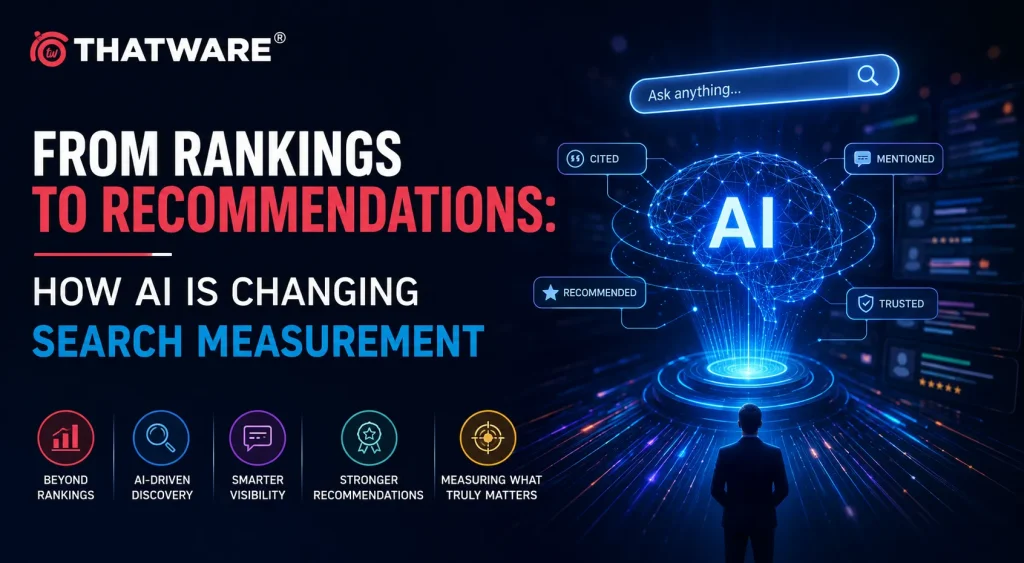
That model remains valuable, but the search journey is becoming more complex. AI-generated answers can now summarise information, compare options, answer questions, and recommend businesses without requiring users to browse through a conventional list of results. A customer can discover a company, develop an initial opinion about it, and decide whether it is worth considering before visiting its website.
This creates a fundamental change in the meaning of search visibility. The central question is moving from “Where do we rank?” to “How often, where, and why are we recommended?” The distinction matters because a brand can have substantial influence within AI-assisted discovery while receiving little measurable website traffic from that interaction.
For businesses, this creates a growing measurement gap. Traditional analytics remain necessary, but they need to be complemented by broader indicators that reveal how brands are being mentioned, understood, cited, compared, and recommended.
From Blue Links to AI-Generated Recommendations
Traditional search placed considerable emphasis on the position of a webpage. Appearing near the top of a results page generally increased the opportunity to earn a click, after which the website could guide the visitor toward an enquiry, purchase, subscription, or another conversion.
AI-assisted search can compress this journey. Instead of presenting users with a collection of pages to investigate individually, an AI-generated response can provide a summary and bring several pieces of information together. It can answer a question, compare different solutions, explain advantages and disadvantages, or suggest suitable providers.
This means a business can influence a customer’s decision without necessarily receiving a traditional search click.
Imagine a person researching a specialist service. Previously, the individual might have searched several terms, opened multiple websites, compared offerings, and then contacted a provider. An AI-assisted journey can shorten the research process by presenting a selection of relevant options within a conversational answer.
The result is a broader definition of visibility. A business needs to know not only whether its website ranks, but also whether the brand appears in relevant answers, whether it is presented accurately, whether it is recommended, and whether it appears consistently when customers ask related questions.
Why Traditional SEO Metrics Are Becoming Incomplete
Keyword rankings remain useful because they provide a direct indication of how webpages perform for specific queries. However, rankings represent only one part of the modern discovery journey.
Organic clicks are similarly important, but they do not capture every interaction that can influence a customer. A person may encounter a brand in an AI-generated answer, remember its name, and later search for the company directly. Conventional referral data may not clearly show what influenced that later action.
Impressions also have limitations. Seeing a result displayed does not necessarily explain whether a brand influenced a customer during an AI-assisted research process. Likewise, click-through rate cannot fully measure an interaction where the answer itself satisfies the user’s immediate information need.
Website sessions can therefore understate the role of search in customer decision-making. Conversion attribution becomes even more complicated when several discovery channels influence a customer before an enquiry or purchase occurs.
This does not mean traditional measurement should be discarded. Instead, businesses need to place those metrics within a wider measurement framework that considers both direct performance and indirect search influence, with AI SEO Services helping brands evaluate emerging AI-driven visibility alongside established search metrics.
The Rise of “Recommendation Visibility”
Recommendation visibility refers to the extent to which a brand appears as a relevant and credible option when people ask AI systems questions connected to its products, services, expertise, or industry.
There is an important difference between ranking for a query and being recommended.
A ranking indicates where a webpage appears in conventional search results. A citation indicates that a source has been used to support an answer. A mention means the brand has appeared within the response. A recommendation goes further by positioning the business as a potentially appropriate choice for the user’s need.
For businesses, these distinctions can reveal valuable differences in performance.
A company might receive a single citation in an answer but rarely appear when similar questions are asked. Another company might appear consistently across numerous relevant prompts, even though the cited sources vary. The second pattern may indicate stronger overall recommendation visibility.
This is why measurement needs to extend across multiple prompts, intents, platforms, and user journeys. Informational questions, commercial comparisons, local searches, service-related questions, and decision-stage prompts can produce very different visibility patterns.
The objective should not simply be to collect as many citations as possible. The more meaningful goal is to understand whether a brand is consistently present and appropriately represented when potential customers are researching solutions.
AI Search Is Probabilistic, Not Static
Traditional search measurement often assumes that a particular keyword produces a relatively stable ranking pattern. AI-generated answers are more variable because the response can depend on several contextual factors.
Prompt wording can influence the answer. User intent can change what information is considered relevant. Location, previous conversation context, available sources, information freshness, and model behaviour can also affect the resulting response.
As a result, two users asking broadly similar questions may not receive identical recommendations. Even repeated searches can produce different combinations of brands, sources, and explanations.
This makes AI search measurement inherently more probabilistic. Rather than assuming that one tracked query represents an entire market, businesses should examine patterns across a representative collection of prompts.
The source material highlights this fragmentation by noting that a substantial majority of AI citations appeared on only one major AI search platform rather than consistently across multiple environments. This demonstrates why measuring a single AI environment can provide an incomplete picture of visibility.
A brand can therefore appear highly visible in one environment while being much less visible elsewhere. Rather than treating this as a measurement error, marketers should recognise it as evidence that AI discovery is fragmented. AI SEO Services can help businesses monitor these variations across different AI search environments and develop a broader understanding of their overall visibility.
Citation Tracking vs. Brand Mention Tracking
An AI citation can be valuable because it shows that a source has been referenced in support of an answer. For businesses, this can provide useful information about which content and external sources are contributing to their visibility.
However, citation volume alone does not explain how a brand is being represented.
Marketers should examine whether a brand is mentioned when relevant questions are asked, whether it is recommended as an option, whether its services are described accurately, and whether it is associated with the right areas of expertise.
Context also matters. A brand could be mentioned frequently but rarely presented as a preferred option. Another business could appear less frequently but be recommended repeatedly for high-intent questions.
This is where broader SEO intelligence becomes useful. Measurement should examine not only how often a brand appears, but also why it appears and what role it plays within the answer.
For example, an SEO intelligence agency may evaluate brand visibility alongside competitor presence, search intent, content coverage, and broader authority signals to identify patterns that individual ranking reports cannot reveal.
The important principle is simple: context and consistency can matter as much as citation volume.
The New AI Search Measurement Framework
A practical AI search measurement framework should include multiple dimensions rather than attempting to reduce performance to one universal score.
A. AI Visibility
AI visibility measures how frequently a brand appears in AI-generated responses for a defined collection of relevant prompts. It provides a broad indication of whether the brand is present within emerging search experiences.
B. Recommendation Rate
Recommendation rate measures how frequently a brand is actively suggested when users seek a solution. This is particularly relevant to commercial searches and comparison-oriented research.
C. Citation Presence
Citation presence examines whether authoritative sources associated with a brand are referenced within generated answers. This can help marketers understand which content and external signals are contributing to visibility.
D. Brand Sentiment and Context
Being mentioned is not automatically beneficial. Businesses should examine whether they are presented positively, neutrally, or negatively and whether the surrounding information accurately reflects their positioning.
E. Entity Recognition
AI systems need to understand what a brand does, whom it serves, which services it provides, and how those services relate to broader topics. Strong entity recognition can support more accurate representation.
F. Competitive Visibility
Brands should monitor how frequently competitors appear for comparable prompts. This can reveal areas where competing businesses have stronger visibility or where new opportunities exist.
G. Prompt-Level Performance
Performance should be evaluated across informational, commercial, navigational, local, and comparison-based prompts. Each category represents a different search intent and customer journey.
H. Conversion and Business Impact
AI visibility ultimately needs to be connected with business outcomes wherever measurable. Branded searches, direct visits, leads, enquiries, assisted conversions, and sales can help determine whether increased visibility is contributing to commercial performance.
Why Multi-Platform Measurement Matters
A single AI environment cannot provide a complete picture of modern search behaviour.
Different AI platforms can use different sources, retrieval processes, model behaviours, citation approaches, and recommendation patterns. Consequently, the same brand may have strong visibility in one environment and considerably weaker visibility in another.
Businesses should therefore consider developing a cross-platform visibility dashboard rather than relying on one score.
The purpose is not to create unnecessary complexity. It is to identify where customers are most likely to encounter the brand and whether that visibility remains consistent across different AI-driven discovery environments.
Cross-platform monitoring can reveal useful patterns. A business may discover that it appears frequently for educational questions but rarely for commercial comparisons. Another may perform well for local discovery while having limited visibility for specialised industry questions.
These insights can then inform content development, authority-building, technical improvements, and broader search strategy.
The Importance of Prompt Tracking
AI search measurement needs representative prompt sets rather than relying exclusively on conventional keyword lists.
Keywords can reveal the phrases people search, while prompts can provide greater insight into the questions, context, and decision-making intent behind a discovery journey.
Useful prompt categories might include:
- “What are the best companies for this service?”
- “Which agency should I choose for this requirement?”
- “Compare these providers.”
- “What are reliable solutions for this problem?”
- “Who offers this service in my area?”
These prompts can be grouped according to customer intent. Informational prompts can be separated from commercial research, comparison questions, local discovery, and purchase-oriented searches.
The same prompt groups should also be monitored periodically because AI responses can change. The objective is not to expect exactly the same answer each time. Instead, marketers should identify recurring patterns in visibility, recommendation frequency, brand representation, and competitor presence.
This approach creates a more realistic picture of how customers may encounter a business through AI-assisted search.
Trust Is Becoming a Critical Search Signal
AI recommendations can place greater emphasis on perceived credibility because users often need to make decisions based on condensed information.
Brand reputation, expert content, reviews, authoritative publications, third-party references, and consistent business information can all contribute to how a company is understood.
This makes trust an increasingly important component of modern search strategy.
A business should not approach AI optimisation as a simple exercise in inserting additional keywords. AI systems need enough reliable information to understand what the business represents, what it offers, who it serves, and why it may be relevant to a particular question.
A professional seo company can support this broader objective by combining technical optimisation with content quality, authority development, entity clarity, and ongoing search analysis.
Likewise, organisations considering a professional seo agency should evaluate whether its strategy addresses the wider discovery journey rather than focusing exclusively on conventional rankings.
A strong content strategy should answer genuine customer questions, demonstrate expertise, address common concerns, explain solutions clearly, and provide useful evidence. Consistency across the wider digital presence can also help reinforce how a business is interpreted.
The Role of Entity SEO and Knowledge Graph Signals
AI systems need to understand entities and the relationships between them.
For a business, these entities can include the brand itself, its products and services, people associated with the organisation, operating locations, industry relationships, areas of expertise, and relevant topics.
The clearer these relationships are, the easier it can be for search systems to interpret the business correctly.
Structured data and schema markup can communicate important information in machine-readable formats. Consistent business details can reduce ambiguity, while authoritative content can strengthen topical relevance. Credible external references can provide additional evidence about expertise and reputation.
This makes entity-focused optimisation an important component of modern search intelligence.
Businesses can use a structured approach to identify how they are represented across the web, where their entity signals are strong, and where inconsistencies or information gaps may affect discoverability.
The goal is to create a coherent digital footprint that makes a business easier for search systems to understand and customers easier to evaluate.
From Traffic Attribution to Influence Attribution
The traditional search journey can be represented as:
Search → Click → Website → Conversion
AI-assisted discovery can create a different path:
Prompt → AI Answer → Brand Consideration → Branded Search/Direct Visit → Conversion
In this second journey, the AI interaction may not appear as a conventional referral. Nevertheless, it may have influenced the customer’s decision.
This creates a need for influence attribution.
Businesses can examine proxy signals such as branded search growth, direct traffic, assisted conversions, lead quality, referral patterns, brand awareness, and changes in customer discovery behaviour.
These signals should not automatically be attributed to AI. Instead, they can be assessed alongside prompt-level visibility data and other marketing information to identify meaningful correlations.
This broader perspective allows marketers to understand that search can influence a customer even when the final conversion path does not visibly contain a search referral.
How Businesses Can Adapt Their SEO Strategy
The first step is to move beyond ranking reports and examine the questions customers actually ask.
Businesses should create content that provides clear, useful answers to those questions. They should strengthen topical authority rather than producing isolated pages around disconnected phrases. Comparison guides, decision-stage resources, FAQs, service explanations, expert content, and educational material can all address different stages of the customer journey.
Technical foundations remain equally important. Structured data, crawlability, internal linking, page quality, and consistent business information help establish the foundation for broader search visibility.
Businesses should also build credible third-party references and maintain accurate information across their digital properties. Regular monitoring can then show how effectively these efforts translate into AI-driven discovery.
An Answer Engine Optimization strategy can complement traditional SEO by focusing on how content is structured and interpreted within answer-based search experiences.
AEO Services may involve intent-focused content, answer-ready formatting, entity optimisation, conversational information architecture, and ongoing monitoring of relevant questions.
Similarly, businesses exploring Generative Engine Optimization can focus on the signals that help AI systems understand their expertise, services, authority, and relevance.
GEO Services can therefore become part of a wider search strategy that connects traditional optimisation with AI-driven discovery.
For organisations evaluating the best agency for AEO for their needs, the important consideration is whether the strategy connects answer visibility with genuine business objectives. The same principle applies when choosing the Best GEO Company: businesses should look beyond promises of increased mentions and evaluate the quality of the underlying content, authority, entity, and measurement strategy.
How ThatWare Helps Brands Move From Rankings to AI Visibility
ThatWare approaches AI-era search measurement by combining traditional SEO foundations with generative search optimisation, answer-focused strategies, semantic analysis, entity development, structured data, conversational content, knowledge-oriented strategies, and AI search monitoring.
The objective is to understand search visibility beyond one ranking position. ThatWare can examine how a brand appears across relevant AI-driven search environments, how frequently it is recommended, how competitors are represented, and whether the brand is associated with the right topics and services.
Prompt-based monitoring can help identify which questions matter most to a business. These prompts can be mapped according to informational, commercial, comparison, local, and decision-stage intent.
This approach can reveal where a brand is visible, where competitors receive stronger recommendations, how the brand is described, which subjects it is associated with, and where content or authority gaps may exist.
ThatWare can also apply LLM SEO principles to understand how large language models interpret brand information and content. Large Language Model SEO focuses on creating clearer relationships between entities, topics, expertise, and user intent.
For businesses seeking LLM SEO Services, the broader objective should be more than simply appearing in generated responses. It should involve developing a reliable digital presence that supports accurate interpretation and meaningful recommendation.
ThatWare’s approach therefore focuses on building accurate, trusted, and commercially meaningful AI visibility, rather than treating citation volume as the sole measure of success.
For a business looking for a professional seo service, this broader perspective can connect technical SEO, content strategy, search intelligence, entity optimisation, and AI visibility within a more comprehensive measurement framework.
What the Future of Search Measurement Could Look Like
Search measurement is moving through an important progression:
Rank Tracking → Traffic Tracking → Conversion Tracking → AI Visibility → Recommendation Intelligence
The future is unlikely to eliminate traditional SEO metrics. Instead, search reporting will become broader and more connected.
Marketers may increasingly examine how much “share of recommendation” a brand receives within its category. They may compare recommendation frequency against competitors, monitor brand representation across different prompts, and evaluate whether the business is consistently associated with the right services and areas of expertise.
This could create a new layer of measurement that sits alongside conventional rankings and traffic.
The important point is that AI search measurement will probably remain dynamic. User behaviour, information sources, model capabilities, and retrieval patterns can change. Businesses therefore need measurement systems that can adapt rather than depend on one permanent metric.
The most useful future reporting will likely combine visibility data with business outcomes, allowing marketers to distinguish between attention, influence, recommendation, and actual commercial impact.
Key Challenges Marketers Should Keep in Mind
AI search measurement has several inherent challenges.
AI-generated responses can be variable and difficult to reproduce exactly. Different platforms may provide different answers to similar questions. Attribution also remains imperfect, meaning an AI citation or mention cannot automatically be connected to a website visit or sale.
Sentiment and recommendation quality can require human review. Automated tracking may identify that a brand appeared, but contextual analysis may be needed to determine whether the appearance was genuinely valuable.
Search behaviour is also evolving rapidly. As customers become more comfortable with conversational discovery, the types of questions they ask may change.
For this reason, businesses should avoid treating an AI visibility score as an absolute business KPI. Visibility should instead be evaluated alongside rankings, organic traffic, branded demand, leads, conversions, customer quality, and other meaningful commercial indicators.
The strongest measurement framework is one that explains not just whether a brand appeared, but whether that appearance contributed to consideration and business growth.
Conclusion: The New Question Is “How Are We Being Recommended?”
The evolution of search is changing the meaning of visibility.
For years, businesses focused on ranking higher, generating impressions, earning clicks, and increasing organic traffic. Those objectives remain important, but AI-generated answers are creating another layer between discovery and decision-making.
Customers can now encounter a business through recommendations, summaries, comparisons, citations, and conversational answers without following a conventional search-result journey.
This means the future of SEO measurement will require more than traditional rankings. Businesses will need to understand where they appear, how frequently they are mentioned, whether they are recommended, how accurately they are described, how competitors perform, and whether AI-assisted visibility contributes to meaningful outcomes.
The answer is not to abandon established SEO principles. Strong technical foundations, useful content, topical authority, trustworthy information, structured data, and credible references remain essential.
What is changing is the way these signals need to be measured.
The central question is no longer only “Where do we rank?”
It is increasingly “How are we being recommended?”
The businesses that understand this transition will be better positioned to compete in a search environment where visibility is not defined solely by a position on a results page, but by the ability to become a credible and trusted answer when customers ask what they should choose.