
SUPERCHARGE YOUR ONLINE VISIBILITY! CONTACT US AND LET’S ACHIEVE EXCELLENCE TOGETHER!
Search is no longer confined to Google. Millions of people now begin their research, compare products, evaluate services, and make purchasing decisions inside AI-powered assistants like ChatGPT, Google Gemini, Perplexity AI, Claude, and Microsoft Copilot. Instead of scrolling through pages of search results, users increasingly expect direct, conversational answers that provide trusted recommendations in seconds.
This shift is fundamentally changing how businesses earn online visibility. In traditional search engine optimisation (SEO), success has long been measured by rankings, backlinks, and organic traffic. While these remain important, AI search introduces a new layer of competition: becoming one of the trusted sources that large language models (LLMs) choose to reference when generating answers. These references, commonly known as AI citations, are rapidly becoming one of the strongest indicators of digital authority in the age of conversational search.
An AI citation is a webpage, article, report, or other online resource that an AI platform references to support the information it presents to users. Whether someone asks, “What is the best project management software for small businesses?” or “Which SEO strategies are most effective in 2026?”, the AI often relies on authoritative online sources to formulate its response. If your brand is featured in those trusted sources, your business has a significantly greater chance of being recommended, mentioned, or cited in AI-generated answers.
This evolution marks one of the most significant changes to search behaviour since the rise of mobile search. Rather than competing solely for the top position on a search engine results page (SERP), businesses must now compete for inclusion within AI-generated conversations. As AI assistants become trusted research companions for consumers and professionals alike, earning visibility within their responses can influence brand awareness, customer trust, lead generation, and purchasing decisions long before a user visits a website.
Unlike traditional link building, AI citation building focuses on earning meaningful brand mentions within authoritative publications that AI systems frequently reference. While backlinks continue to contribute to search performance, contextual mentions, topical expertise, semantic relevance, and entity recognition are becoming increasingly valuable signals in the AI era. The objective is not simply to acquire another link but to ensure your brand is recognised as a credible authority on the topics that matter most to your audience.
This is where Advanced SEO and AI SEO intersect. Modern optimisation extends far beyond keywords and rankings. It combines technical excellence, entity optimisation, digital public relations, content strategy, structured data, and brand authority to improve how both search engines and AI models understand, trust, and recommend your business. As a result, AI citation building has become a natural extension of a comprehensive Professional SEO Services strategy, helping organisations strengthen their presence across both traditional search engines and emerging AI-powered discovery platforms.
The process is both strategic and data-driven. It begins by identifying the questions your target audience is asking AI assistants, analysing which websites are consistently cited in response to those prompts, and understanding why those sources are trusted. From there, businesses can develop targeted outreach campaigns, publish authoritative resources, contribute expert insights, and earn mentions in the publications that AI systems already rely upon. Over time, this creates a powerful ecosystem of authority that benefits both AI visibility and organic search performance.
The importance of AI citation building will only continue to grow as conversational search becomes more sophisticated. Large language models are constantly evolving, incorporating fresher information, recognising authoritative entities more effectively, and rewarding content that demonstrates expertise, experience, authoritativeness, and trustworthiness. Businesses that establish themselves as reliable information sources today will be far better positioned to benefit from the next generation of AI-powered search experiences.
In this comprehensive guide, you will learn everything you need to know about AI citation building—from understanding how AI platforms select their sources to building a repeatable citation acquisition strategy that strengthens your digital authority. We’ll explore the relationship between AI citations and Professional SEO, compare AI citation building with traditional off-page SEO, explain the role of digital PR and entity optimisation, examine the technical and content signals that influence AI visibility, and provide practical frameworks, tools, and best practices that can help your brand become a trusted source across ChatGPT, Gemini, Perplexity, Claude, and other leading AI platforms.
Whether you are an SEO professional, digital marketer, business owner, or enterprise brand looking to future-proof your online presence, mastering AI citation building is quickly becoming one of the most valuable investments you can make in the future of search.
What Is AI Citation Building?
Artificial intelligence is transforming how people discover information online. Instead of clicking through multiple search results, users can now ask a question in conversational language and receive a comprehensive answer within seconds. Behind these AI-generated responses is a network of trusted sources that the model references to generate accurate, relevant, and reliable information. This is where AI citation building comes into play.
AI citation building is an emerging discipline within Advanced SEO and AI SEO that focuses on increasing a brand’s visibility by earning mentions in the online content that artificial intelligence platforms frequently cite. Rather than optimising solely for search engine rankings, businesses are now optimising for inclusion in the knowledge sources used by large language models (LLMs) such as ChatGPT, Google Gemini, Perplexity AI, Claude, and Microsoft Copilot.
Unlike traditional SEO campaigns that prioritise backlinks and keyword rankings, AI citation building places greater emphasis on contextual brand mentions, topical authority, entity recognition, and publishing high-quality content that AI systems consider trustworthy. As AI-powered search continues to evolve, businesses that consistently appear in authoritative sources are more likely to become part of the answers users receive.
This does not replace traditional SEO. Instead, it complements a modern Professional SEO Services strategy by helping brands establish authority across both search engines and conversational AI platforms.
Definition
AI citation building is the strategic process of increasing a brand’s likelihood of being referenced in AI-generated responses by earning mentions in authoritative web pages, publications, research articles, news websites, industry resources, and other trusted online content that large language models use to formulate answers.
The objective is not simply to acquire backlinks or improve keyword rankings. Instead, the goal is to position your brand as a recognised authority within a specific topic so that AI models naturally associate your business with relevant subjects and recommendations.
A successful AI citation building strategy typically includes:
- Identifying the AI prompts your audience is likely to ask.
- Discovering which websites AI platforms frequently cite for those topics.
- Earning contextual brand mentions within those trusted publications.
- Publishing original, experience-driven content that demonstrates expertise.
- Strengthening topical authority through comprehensive content clusters.
- Building digital credibility using a combination of technical SEO, digital PR, and semantic optimisation.
When executed effectively, AI citation building helps businesses become part of the information ecosystem that AI assistants rely on when answering user questions.
What Is an AI Citation?
An AI citation is a webpage, article, report, research paper, government publication, industry guide, or other online resource that an artificial intelligence platform references while generating a response to a user’s query.
For example, imagine someone asks ChatGPT:
“What are the best SEO strategies for enterprise businesses?”
Instead of generating an answer entirely from memory, the AI may reference several trusted sources to support its response. These cited pages could include:
- Industry research reports
- Authoritative SEO blogs
- Enterprise software documentation
- Government publications
- University research
- Independent comparison websites
- Trusted news organisations
If your business is mentioned within one or more of these trusted resources, your brand becomes more likely to appear in AI-generated recommendations.
It is important to understand that AI citations are not limited to your own website. AI models often reference third-party publications that mention your company, products, research, executives, or expertise. This is one of the reasons why digital PR, expert commentary, interviews, original research, and thought leadership are becoming increasingly valuable components of modern SEO.
The stronger your presence across trusted publications, the greater your opportunity to influence how AI understands and represents your brand.
How AI Citations Differ from Traditional Search Rankings
Traditional search engines and AI assistants both aim to provide users with helpful information, but they deliver that information in fundamentally different ways.
Conventional search engines present a list of webpages ranked according to hundreds of ranking signals. Users evaluate those results, compare options, and decide which websites to visit.
AI assistants, on the other hand, generate a direct answer. Instead of asking users to perform the research themselves, they synthesise information from multiple trusted sources into a conversational response.
This creates a major shift in optimisation strategy.
In traditional SEO, the primary objective is to rank your own webpage as highly as possible for a target keyword.
With AI citation building, the objective expands beyond your own website. You also want your brand to be referenced within the external publications that AI platforms consistently trust.
This means businesses should focus on:
- Becoming recognised experts within their industry.
- Publishing original and authoritative research.
- Building strong topical authority.
- Earning mentions from respected publications.
- Maintaining accurate entity information across the web.
- Demonstrating real-world expertise and credibility.
In many cases, AI may recommend a company even when its own website is not the highest-ranking result in Google because the brand is consistently referenced by authoritative sources.
This makes AI citation building an essential addition to any Advanced SEO strategy.
AI Citations vs Google Backlinks
AI citations and backlinks are related, but they serve different purposes.
A backlink is a hyperlink from one website pointing to another. Search engines have historically treated backlinks as signals of authority and trust, making them one of the foundations of Google’s ranking algorithm.
An AI citation, however, is broader than a backlink.
A citation may include:
- A brand mention.
- A company recommendation.
- A product reference.
- An expert quotation.
- Research findings.
- Statistical data.
- A publication used as supporting evidence.
Importantly, an AI model does not necessarily require a clickable hyperlink to recognise a brand. Context often matters more than the presence of a link.
For example, if an authoritative industry publication discusses your company as one of the leading providers within a particular sector, that contextual mention can help reinforce your brand’s expertise even if it contains no direct backlink.
This represents an important evolution in Off Page SEO.
While backlinks remain highly valuable for search engine rankings, AI citation building encourages businesses to think beyond link acquisition and instead focus on becoming recognised authorities whose names naturally appear within trusted conversations across the web.
The strongest digital strategies combine both approaches by earning high-quality backlinks alongside meaningful brand mentions in authoritative publications.
AI Citations vs Featured Snippets
Featured snippets are a Google Search feature that extracts content directly from a webpage and displays it at the top of search results in an attempt to answer a user’s query immediately.
Although featured snippets improve visibility, they are fundamentally different from AI citations.
Featured snippets generally rely on a single webpage and display content exactly as it appears on that page.
AI-generated answers are considerably more sophisticated.
Rather than relying on one source, AI platforms often combine information from numerous trusted websites, compare viewpoints, summarise findings, and generate an original response supported by multiple citations.
This means a business can contribute valuable information to an AI-generated answer without owning the primary webpage that receives the featured snippet in Google.
AI citation building therefore expands visibility opportunities beyond traditional search features by allowing brands to influence AI-generated responses through their presence across multiple trusted publications.
AI Citations vs Knowledge Panels
Knowledge Panels are information boxes that appear in Google Search for recognised entities such as people, organisations, products, locations, and brands. They are generated using Google’s Knowledge Graph and aggregate verified information from trusted sources.
Although both Knowledge Panels and AI citations rely on authoritative information, they serve different purposes.
A Knowledge Panel is primarily designed to present factual information about a recognised entity, such as its founder, headquarters, website, products, or notable achievements.
AI citations are used to support dynamic, conversational answers to user questions.
For example, a Knowledge Panel might confirm that a company specialises in enterprise cybersecurity solutions.
An AI-generated response, however, may recommend that same company as one of the best enterprise cybersecurity providers because it has been repeatedly referenced across respected publications, independent reviews, research reports, and expert analyses.
Knowledge Panels help establish entity identity.
AI citations help establish topical authority and recommendation potential.
The two work together rather than compete. A strong entity profile supported by accurate Knowledge Graph information, consistent brand mentions, authoritative content, and digital trust signals significantly improves a business’s overall visibility across both traditional search engines and AI-powered discovery platforms.
As AI search continues to evolve, organisations that combine Professional SEO, technical optimisation, entity management, digital PR, and AI citation building will be better positioned to earn trust not only from search engines but also from the AI systems increasingly shaping how users discover information online.
Why AI Citation Building Matters More Than Ever
The way people search for information is changing rapidly. For decades, search engines presented users with a list of links, leaving them to compare websites and determine which source best answered their questions. Today, AI-powered assistants have introduced a new model of information discovery. Instead of browsing multiple webpages, users increasingly expect immediate, conversational answers supported by trusted sources.
This shift has significant implications for businesses, marketers, and SEO professionals. Visibility is no longer determined solely by where a webpage ranks in search engine results. It is also influenced by whether AI systems recognise a brand as a credible source worthy of being referenced in their responses.
As conversational AI becomes a routine part of everyday search behaviour, AI citation building has emerged as an essential component of Advanced SEO, AI SEO, and Professional SEO Services. Businesses that establish authority across trusted publications are far more likely to appear in AI-generated recommendations, while those relying exclusively on traditional ranking strategies risk losing visibility in an increasingly AI-driven search landscape.
The Rise of AI Search
Artificial intelligence has transformed search from a keyword-driven activity into a conversation.
Instead of typing short phrases like “best CRM software” or “SEO agency,” users now ask complete questions such as:
- Which CRM software is best for a growing SaaS company?
- What are the most effective AI SEO strategies?
- Which professional SEO company specialises in enterprise businesses?
- How can I improve my website’s visibility in ChatGPT?
AI assistants analyse these conversational queries, interpret user intent, synthesise information from multiple trusted sources, and generate comprehensive answers in seconds.
Unlike traditional search engines, AI platforms are designed to understand context rather than simply matching keywords. They evaluate relationships between topics, entities, concepts, and trusted information sources to produce responses that feel more like expert advice than search results.
As adoption of AI assistants continues to grow, businesses must optimise not only for search engines but also for the systems generating these conversational answers.
How Users Search Differently
The behaviour of online users has evolved alongside advances in artificial intelligence.
Traditional searches often consisted of a few keywords:
- Enterprise SEO
- Professional SEO services
- AI SEO agency
Today, users are much more likely to ask detailed questions that reflect their specific needs.
Examples include:
- What is the difference between enterprise SEO and professional SEO services?
- Which SEO strategy is best for a multinational company?
- How do AI citations improve online visibility?
- What are the latest off-page SEO techniques for AI search?
These longer, natural-language prompts provide AI models with greater context, enabling them to deliver more personalised and comprehensive responses.
This shift has changed how businesses should approach optimisation.
Rather than focusing exclusively on individual keywords, organisations should build topical authority around complete subjects. Comprehensive guides, original research, expert insights, case studies, and authoritative resources are increasingly valuable because they answer the types of nuanced questions users now ask AI platforms.
Why AI Recommendations Influence Buying Decisions
AI assistants are becoming trusted research companions throughout the customer journey.
Whether someone is evaluating software, comparing agencies, researching healthcare providers, selecting financial services, or exploring educational resources, AI often acts as an independent advisor that summarises information from multiple sources.
When an AI platform recommends a company, product, or service, users frequently perceive that recommendation as unbiased because it appears to be based on information gathered from across the web rather than from a single advertisement or promotional page.
For businesses, this represents an important opportunity.
Appearing consistently in AI-generated responses can help:
- Increase brand awareness.
- Build trust before a customer visits your website.
- Position your organisation as an industry leader.
- Shorten the buyer’s research process.
- Improve lead quality by reaching users with strong purchase intent.
This is why AI citation building is rapidly becoming an important extension of Professional SEO and SEO Strategy Services. It helps businesses become part of the trusted information ecosystem that shapes purchasing decisions long before a prospect submits an enquiry or makes a purchase.
The Shift from Links to Answers
Traditional search encourages users to click through multiple websites before making a decision.
AI-powered search reduces that friction by delivering a complete answer within a single conversation.
Instead of asking users to compare ten webpages, AI assistants summarise the most relevant information, highlight key recommendations, explain differences, and often suggest specific products, companies, or solutions.
This represents a significant shift in digital visibility.
Previously, success depended on earning clicks.
Now, success increasingly depends on becoming part of the answer itself.
Businesses that appear repeatedly within AI-generated responses enjoy advantages that extend beyond website traffic. They gain greater brand exposure, stronger authority, and increased trust because users encounter their names during the earliest stages of research.
Consequently, SEO strategies are evolving beyond ranking webpages. They now encompass entity optimisation, digital PR, authoritative content creation, semantic relevance, and AI citation building to ensure brands remain visible wherever users seek information.
AI as the New Discovery Engine
Artificial intelligence is becoming a powerful discovery platform.
Users no longer rely exclusively on search engines to find businesses, compare products, or learn about industries. AI assistants are increasingly performing these tasks by gathering information from trusted online sources and presenting concise recommendations.
This transformation affects virtually every sector.
A business owner may ask for recommendations on the best accounting software.
A marketing manager may request a list of the leading professional SEO agencies.
A healthcare professional may seek evidence-based treatment guidelines.
A student may request explanations supported by academic research.
In every case, AI determines which sources deserve to influence its answer.
Businesses that invest in building authority across trusted publications, producing expert-level content, and strengthening their digital reputation are more likely to become part of these recommendations.
Rather than replacing traditional search, AI has become an additional discovery channel—one that rewards expertise, credibility, and consistent recognition across the wider web.
How AI Platforms Choose Their Citations
One of the most common questions businesses ask is why certain websites appear repeatedly in AI-generated answers while others are rarely mentioned.
Although every AI platform has its own methods for retrieving and evaluating information, they all aim to provide users with responses that are accurate, trustworthy, and relevant.
This means citations are not selected randomly. AI systems prioritise sources that demonstrate expertise, authority, reliability, and strong topical relevance.
Understanding these principles allows businesses to develop more effective AI citation building strategies rather than relying on guesswork.
ChatGPT
ChatGPT generates conversational responses by combining its language understanding capabilities with trusted external information when available.
Depending on the version and available search capabilities, ChatGPT may reference authoritative news organisations, industry publications, official documentation, research papers, government resources, and reputable websites to support its responses.
Pages that provide comprehensive, well-structured, and reliable information are more likely to become valuable reference sources.
Brands that are consistently mentioned within these trusted publications improve their chances of appearing in AI-generated answers.
Google Gemini
Google Gemini benefits from Google’s extensive understanding of the web and places significant emphasis on information quality.
Gemini commonly references:
- Official websites
- Expert publications
- Government resources
- Academic research
- Industry-leading content
- News organisations
Businesses with strong technical SEO foundations, comprehensive topical coverage, structured data, and recognised expertise often have greater opportunities to be surfaced through Google’s AI-powered experiences.
Perplexity AI
Perplexity AI distinguishes itself by openly displaying citations alongside nearly every answer it generates.
Its responses often include references from multiple high-authority sources, allowing users to verify information directly.
Because transparency is central to the platform, Perplexity frequently cites:
- Research publications
- Industry blogs
- Official documentation
- News websites
- Educational resources
- Independent review platforms
For marketers, Perplexity offers valuable insight into which publications AI considers authoritative within specific industries, making it an excellent platform for citation research.
Microsoft Copilot
Microsoft Copilot combines large language models with web search capabilities to deliver current, context-aware responses.
It commonly draws information from:
- Trusted websites
- Microsoft documentation
- Established publishers
- Industry authorities
- Government resources
- High-quality informational content
Businesses that publish technically accurate, authoritative, and regularly updated content have stronger opportunities to become part of Copilot’s cited ecosystem.
Claude AI
Claude AI is designed to produce thoughtful, well-reasoned, and contextually accurate responses.
When external information is incorporated, Claude tends to favour sources demonstrating strong expertise, credibility, and clarity.
High-quality educational resources, detailed industry guides, research-driven articles, and authoritative documentation align well with the type of content Claude seeks to reference.
For businesses, this reinforces the importance of publishing genuinely helpful content rather than content created solely to target search rankings.
Common Citation Signals Across Large Language Models
Although each AI platform has its own retrieval and ranking methodologies, several trust signals consistently influence whether content is likely to be cited.
Understanding these signals provides the foundation for an effective AI citation building strategy.
Authority
Authority remains one of the strongest indicators of trust.
AI systems tend to favour websites and publications that have established reputations within their industries. This authority may be built through years of publishing high-quality content, recognised expertise, editorial standards, research contributions, or widespread citations from other trusted sources.
Businesses should focus on becoming recognised thought leaders rather than simply producing more content.
Topical Relevance
AI models prefer sources that demonstrate deep expertise within a specific subject.
A comprehensive website covering an entire topic is generally more valuable than a collection of unrelated articles targeting isolated keywords.
Developing topical clusters, comprehensive guides, supporting resources, case studies, and expert commentary helps establish stronger subject authority.
Freshness
Information changes quickly, particularly in industries such as technology, healthcare, finance, and digital marketing.
AI platforms often prioritise recently updated content when current information is essential to answering a user’s question.
Regularly reviewing, expanding, and refreshing existing content helps maintain its relevance and increases its potential to be referenced by AI systems.
Entity Recognition
Modern AI platforms understand businesses, people, products, and organisations as entities rather than simple keywords.
Consistent brand information across websites, directories, publications, social profiles, and knowledge bases strengthens entity recognition.
When AI clearly understands what your organisation represents and the topics it specialises in, your brand becomes more likely to appear in relevant responses.
Brand Reputation
Reputation extends beyond your own website.
AI systems evaluate how a brand is discussed across the wider web, including industry publications, expert articles, reviews, interviews, research reports, news coverage, and independent recommendations.
Consistent positive recognition from trusted sources strengthens digital credibility and supports long-term AI visibility.
Semantic Relationships
Large language models analyse how concepts relate to one another rather than relying solely on exact keyword matches.
They recognise connections between industries, products, services, technologies, and organisations.
Building content that explores these interconnected topics helps AI develop a richer understanding of your expertise and improves the likelihood that your brand will be cited across a broader range of relevant conversations.
Ultimately, AI citation building is not about manipulating algorithms. It is about consistently demonstrating expertise, publishing genuinely valuable information, and earning recognition from trusted sources so that AI platforms confidently include your brand within the answers users rely on every day.
Understanding the AI Citation Ecosystem
AI-generated answers are not created in isolation. Large language models and AI-powered search platforms rely on a broad ecosystem of trusted information sources to generate accurate, balanced, and contextually relevant responses. These sources collectively form what can be described as the AI citation ecosystem—a network of authoritative websites, publications, databases, and digital entities that AI systems repeatedly reference when answering user queries.
Understanding this ecosystem is essential for any business looking to improve its visibility in AI-powered search. Rather than focusing solely on optimising your own website, AI citation building encourages you to become part of the wider information landscape that AI platforms trust.
The stronger your presence across these trusted sources, the greater your chances of being recognised, understood, and recommended by AI assistants.
Publishers
Digital publishers remain one of the most influential sources within the AI citation ecosystem.
Established publishers often produce in-depth articles, expert opinions, buying guides, industry analyses, interviews, and educational resources that AI models frequently reference when answering complex questions.
Publishers with strong editorial standards are particularly valuable because their content is generally fact-checked, regularly updated, and written by recognised subject matter experts.
Examples of publisher content that AI frequently references include:
- Ultimate guides
- Industry explainers
- Product comparisons
- Best-of lists
- Buyer guides
- Trend reports
- Expert interviews
- Opinion pieces
For businesses, earning mentions in respected publisher content can significantly improve AI visibility. This may involve contributing expert commentary, participating in interviews, providing original research, or being included in editorial roundups.
Review Websites
Review platforms play an increasingly important role in AI-generated recommendations, especially for commercial and transactional searches.
When users ask questions such as:
- What is the best CRM software?
- Which professional SEO agency should I hire?
- What are the top enterprise SEO companies?
AI assistants often reference reputable review websites that compare products, services, agencies, and software solutions.
These platforms typically provide:
- Product comparisons
- User ratings
- Feature breakdowns
- Pricing information
- Independent reviews
- Industry rankings
Appearing on trusted review websites not only increases customer confidence but also strengthens your brand’s presence within the sources AI platforms commonly analyse for recommendations.
Industry Blogs
Authoritative industry blogs have long been valuable resources for SEO, and their importance continues to grow within AI-powered search.
Blogs maintained by recognised organisations, consultants, technology companies, and industry experts often publish detailed educational content covering emerging trends, technical guidance, best practices, and practical insights.
AI systems frequently reference these blogs because they provide:
- Subject matter expertise
- Comprehensive explanations
- Practical examples
- Experience-driven advice
- Regularly updated content
Businesses can increase their visibility by contributing guest articles, collaborating with respected bloggers, publishing original studies, or developing their own industry-leading blog that consistently demonstrates expertise.
News Websites
News organisations contribute freshness and credibility to the AI citation ecosystem.
AI platforms frequently reference news articles when responding to questions involving:
- Recent industry developments
- Company announcements
- Product launches
- Regulatory changes
- Market trends
- Emerging technologies
Editorial coverage from respected news publications helps establish a business as an active participant within its industry.
Digital PR campaigns, press releases with genuine news value, executive interviews, and company research can all contribute to earning valuable media mentions that strengthen AI citation opportunities.
Government Resources
Government websites are widely recognised as authoritative sources of factual information.
Because they maintain rigorous publishing standards, AI assistants often rely on government resources when answering questions related to:
- Regulations
- Public policy
- Legal compliance
- Health guidance
- Environmental standards
- Economic data
- Consumer protection
While businesses cannot typically earn editorial mentions on government websites in the same way they might with publishers or journalists, referencing government data within their own content enhances credibility and demonstrates a commitment to accuracy.
Official statistics, reports, and policy documents can strengthen both user trust and AI confidence in your content.
Educational Domains
Universities, colleges, research institutions, and educational organisations represent another highly trusted segment of the AI citation ecosystem.
Educational domains often publish:
- Research findings
- White papers
- Academic journals
- Learning resources
- Technical documentation
- Industry collaborations
These sources carry significant authority because they prioritise evidence-based information over promotional content.
Businesses that collaborate with universities, sponsor research, publish educational resources, or contribute expert knowledge to academic initiatives can strengthen their overall authority within the broader knowledge ecosystem.
Community Discussions
Community-driven platforms provide valuable insights into real-world experiences, opinions, and problem-solving.
AI assistants increasingly recognise the value of discussions from communities where users openly share practical advice, recommendations, and first-hand experiences.
Examples include:
- Professional forums
- Technical communities
- Developer platforms
- Question-and-answer websites
- Industry discussion boards
- Social communities
Although community content may not always carry the same authority as academic research or government publications, it often provides authentic perspectives that enrich AI-generated responses.
Businesses that actively participate in relevant communities by answering questions, sharing expertise, and contributing meaningful discussions can improve both brand awareness and entity recognition over time.
Research Publications
Original research represents one of the strongest forms of authority within the AI citation ecosystem.
Studies containing proprietary data, market analysis, surveys, experiments, benchmarks, and statistical reports are frequently referenced because they contribute unique knowledge rather than repeating existing information.
Examples include:
- Industry benchmark reports
- Consumer behaviour studies
- Original datasets
- Annual market reports
- Technical research papers
- Independent surveys
Research-driven content naturally attracts citations from journalists, bloggers, publishers, and analysts, creating a compounding effect that strengthens both traditional SEO and AI visibility.
For organisations seeking long-term authority, investing in original research is one of the most effective AI citation building strategies available.
AI Citation Building vs Traditional Link Building
Although AI citation building and traditional link building share the common goal of increasing online authority, they are built on different principles and optimise for different outcomes.
Traditional link building focuses on acquiring hyperlinks that improve search engine rankings. AI citation building focuses on increasing a brand’s presence within the trusted sources that artificial intelligence platforms use to generate answers.
The two strategies complement one another rather than compete. Businesses that combine both approaches are better positioned to succeed across traditional search engines and AI-powered discovery platforms.
| AI Citation Building | Traditional Link Building |
| Focuses on earning trusted brand mentions. | Focuses on acquiring hyperlinks. |
| Prioritises contextual relevance. | Prioritises link authority and referral value. |
| Optimises for AI-generated recommendations. | Optimises for search engine rankings. |
| Strengthens entity understanding. | Strengthens domain authority. |
| Encourages recognition across multiple trusted publications. | Encourages links from authoritative websites. |
| Builds topical expertise and semantic associations. | Builds backlink profiles and PageRank signals. |
Links vs Mentions
Backlinks remain an important ranking signal for search engines, but AI platforms place increasing emphasis on contextual mentions.
A business does not always need a clickable hyperlink to influence AI understanding.
If respected publications consistently discuss your company within relevant industry contexts, AI systems can begin associating your brand with those subjects, products, or services.
This makes high-quality editorial mentions just as valuable as traditional backlinks in many AI-driven scenarios.
Context
Context is one of the defining differences between AI citation building and conventional link acquisition.
A backlink without meaningful surrounding content provides limited semantic information.
A detailed article explaining why a company is an industry leader, discussing its expertise, and describing its services gives AI far richer signals about the brand’s relevance and authority.
AI models interpret not only where your brand is mentioned but also how it is described.
Brand Authority
Traditional link building often measures success through the quantity and quality of acquired backlinks.
AI citation building measures success by strengthening brand authority across the web.
When respected journalists, publishers, researchers, and industry experts consistently reference your organisation, AI gains greater confidence in recognising your business as a credible source.
Over time, this strengthens your overall digital reputation.
Entity Recognition
Modern AI systems understand organisations as entities rather than collections of keywords.
Consistent mentions across authoritative publications help AI establish:
- Who your business is.
- What products or services you offer.
- Which industries you specialise in.
- Which topics you are recognised for.
This deeper understanding improves the likelihood that your brand will appear in relevant AI-generated responses.
Semantic Relevance
Large language models rely heavily on semantic understanding.
Instead of matching exact keywords, they evaluate relationships between concepts, industries, products, organisations, and expertise.
Businesses that consistently publish content covering interconnected topics develop stronger semantic relevance.
For example, an agency offering Professional SEO Services may naturally become associated with concepts such as Advanced SEO, Enterprise SEO, AI SEO, SEO Intelligence, technical optimisation, digital PR, and entity optimisation.
These relationships improve AI’s confidence when recommending that business.
Knowledge Graphs
Knowledge graphs organise information by connecting entities and their relationships.
Every mention of your organisation across authoritative websites helps reinforce these connections.
When multiple trusted sources consistently associate your brand with specific expertise, products, industries, and services, AI systems gain a clearer understanding of your digital identity.
This contributes to stronger visibility across conversational search experiences.
Trust Signals
AI platforms evaluate numerous trust signals before selecting citations.
These may include:
- Editorial quality
- Author expertise
- Publication reputation
- Content accuracy
- External references
- Original research
- Positive brand recognition
- Consistency across trusted sources
Traditional link building primarily influences search algorithms.
AI citation building strengthens trust at both the algorithmic and semantic levels, making your brand more likely to become part of AI-generated recommendations.
Benefits of AI Citation Building
AI citation building extends beyond improving visibility within conversational AI platforms. It contributes to stronger brand authority, greater digital trust, and a more resilient long-term SEO strategy.
Businesses that invest in becoming recognised sources of expertise are better positioned to benefit from both traditional search engines and AI-powered discovery experiences.
Greater AI Visibility
The most immediate benefit is increased visibility across AI assistants.
When your brand is consistently referenced within authoritative sources, AI platforms become more likely to include your company in recommendations, comparisons, educational responses, and industry discussions.
This allows your business to reach users at the earliest stages of their research journey.
More Brand Mentions
AI citation building naturally increases brand exposure across trusted publications.
Every high-quality editorial mention contributes to broader digital recognition.
Over time, these mentions create a network of authoritative references that strengthens your online presence far beyond your own website.
Higher Trust
Trust has become one of the most valuable digital assets.
Users are more likely to engage with brands that are repeatedly recommended by respected publications, industry experts, and trusted AI assistants.
Consistent third-party recognition creates social proof that strengthens credibility and reduces uncertainty during purchasing decisions.
Better Entity Recognition
Repeated, contextually relevant mentions help AI platforms develop a clearer understanding of your organisation.
As entity recognition improves, AI becomes better equipped to associate your business with specific industries, products, services, and areas of expertise.
This increases the likelihood of appearing in a wider variety of relevant AI-generated responses.
Improved Brand Authority
Authority is earned through consistent demonstration of expertise.
Publishing original research, contributing expert insights, earning media coverage, and being referenced by respected publications all strengthen your reputation.
As authority grows, both search engines and AI platforms become more confident in recommending your business.
Increased Organic Traffic
Although AI search changes how users discover information, strong AI citation building often supports traditional SEO performance as well.
Authoritative mentions can generate:
- More branded searches.
- Increased referral traffic.
- Higher-quality backlinks.
- Greater content visibility.
- Improved search engine trust.
The result is stronger long-term organic growth across multiple discovery channels.
Better Conversion Opportunities
Users who encounter your brand repeatedly throughout their research journey often arrive with greater confidence.
Instead of discovering your company for the first time, they have already seen it recommended by AI assistants, industry publications, comparison articles, or expert resources.
This familiarity shortens the buying cycle and often leads to more qualified enquiries, stronger engagement, and higher conversion rates.
Long-Term SEO Value
Unlike short-term optimisation tactics that may lose effectiveness as algorithms evolve, AI citation building focuses on establishing genuine authority.
High-quality content, trusted brand mentions, expert recognition, original research, and topical expertise continue delivering value over time.
As AI-powered search becomes increasingly integrated into everyday information discovery, businesses that invest in these foundational trust signals will be better positioned to maintain visibility across both search engines and conversational AI platforms.
Rather than replacing traditional SEO, AI citation building enhances it. When combined with Professional SEO Services, Advanced SEO, technical optimisation, semantic content strategy, and high-quality Off Page SEO initiatives, it creates a sustainable framework for long-term digital growth in an AI-first search environment.
Real-World AI Citation Building Case Studies
Theory explains how AI citation building works, but real-world examples demonstrate what successful AI visibility actually looks like. The following case studies illustrate how businesses can earn citations and recommendations across multiple AI platforms through strong brand authority, topical relevance, and contextual mentions.
These examples were observed across leading AI assistants, including ChatGPT, Google Gemini, Microsoft Copilot, and other AI-powered search experiences.
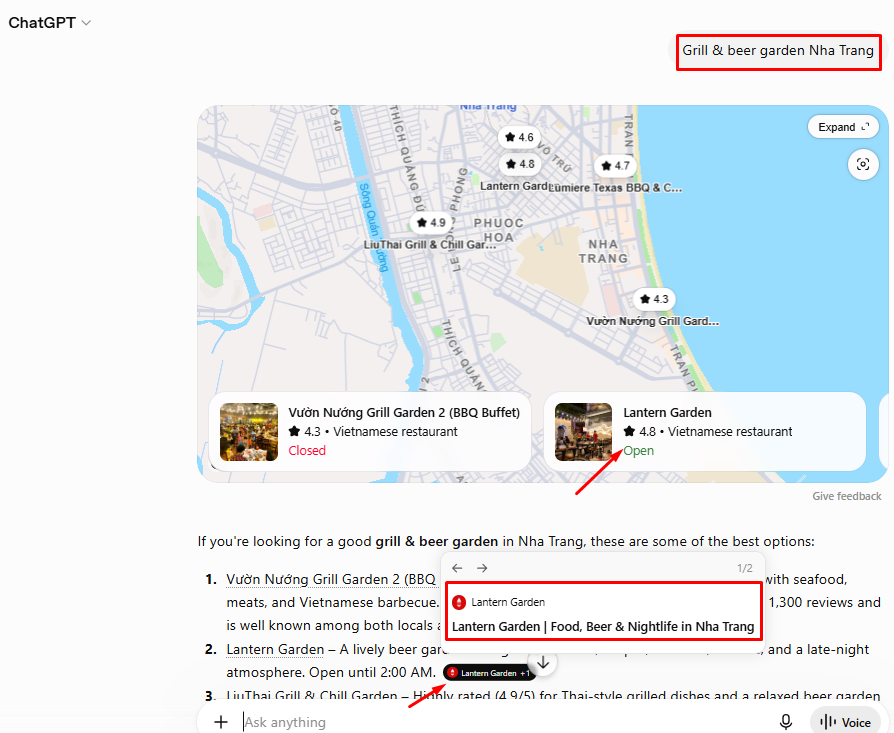
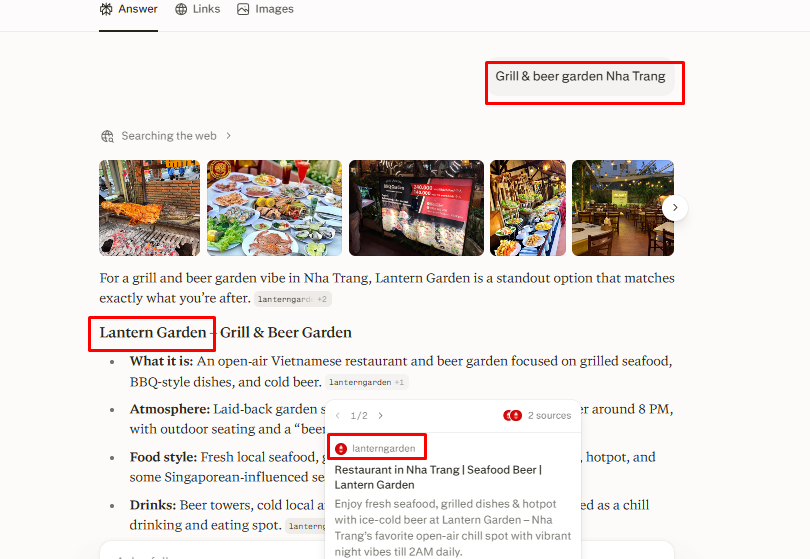
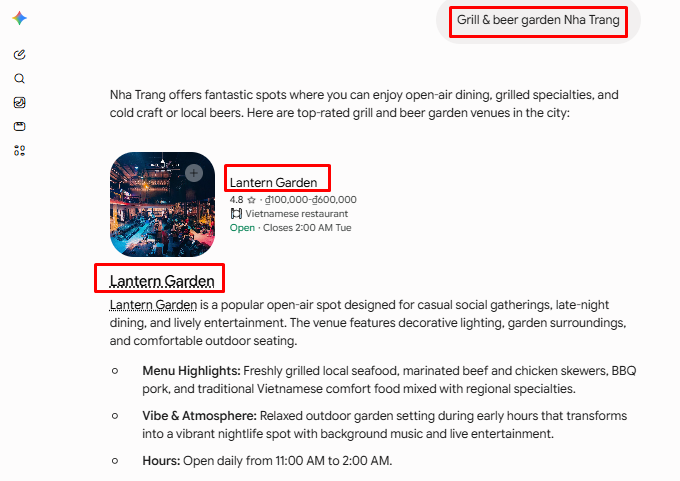
Case Study 1: Lantern Garden Dominates AI Recommendations for Restaurant Searches
Search Intent
The restaurant wanted greater visibility for high-intent local searches related to nightlife and dining in Nha Trang.
Example prompts included:
- Grill & beer garden Nha Trang
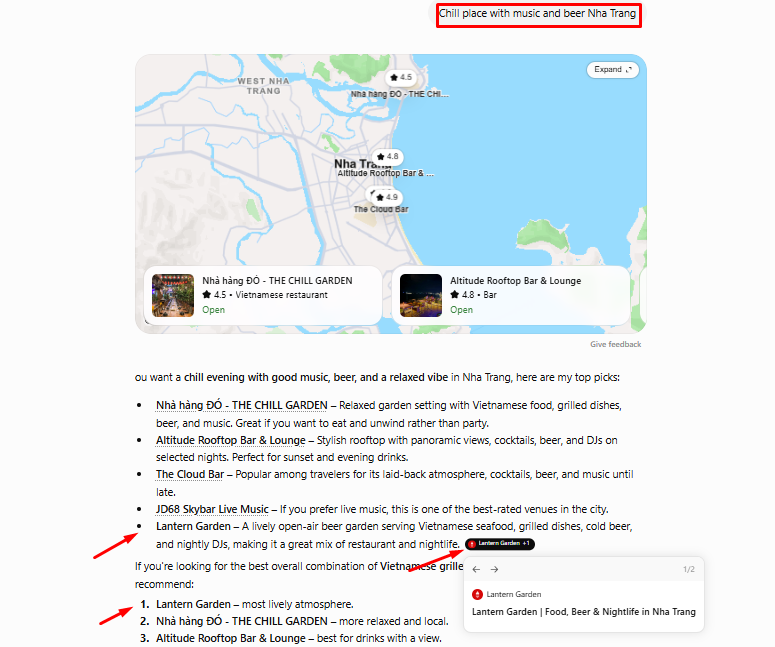
- Chill place with music and beer Nha Trang
- Best BBQ restaurant in Nha Trang
- Outdoor beer garden Nha Trang
AI Platforms Tested
- ChatGPT
- Google Gemini
- Microsoft Copilot
Result
Across multiple AI platforms, Lantern Garden appeared as one of the primary recommendations.
The business was consistently:
- recommended as one of the best grill and beer gardens
- cited within AI-generated restaurant recommendations
- surfaced in AI map results
- referenced with contextual explanations about atmosphere, food, and nightlife
- linked through trusted web sources used by the AI systems
Rather than relying on a single webpage, the AI combined information from multiple trusted sources to recommend the business.
Why AI Chose Lantern Garden
Several authority signals likely contributed:
- Strong local entity recognition
- Consistent business information across the web
- Reviews and reputation
- Multiple contextual mentions
- Local relevance
- Rich semantic associations around food, nightlife, BBQ, beer, and entertainment
The recommendation was based on the business being recognised as a trusted entity within its category rather than simply ranking for one keyword.
Key Takeaway
AI assistants increasingly recommend businesses that are consistently recognised across trusted sources instead of simply selecting the highest-ranking webpage.
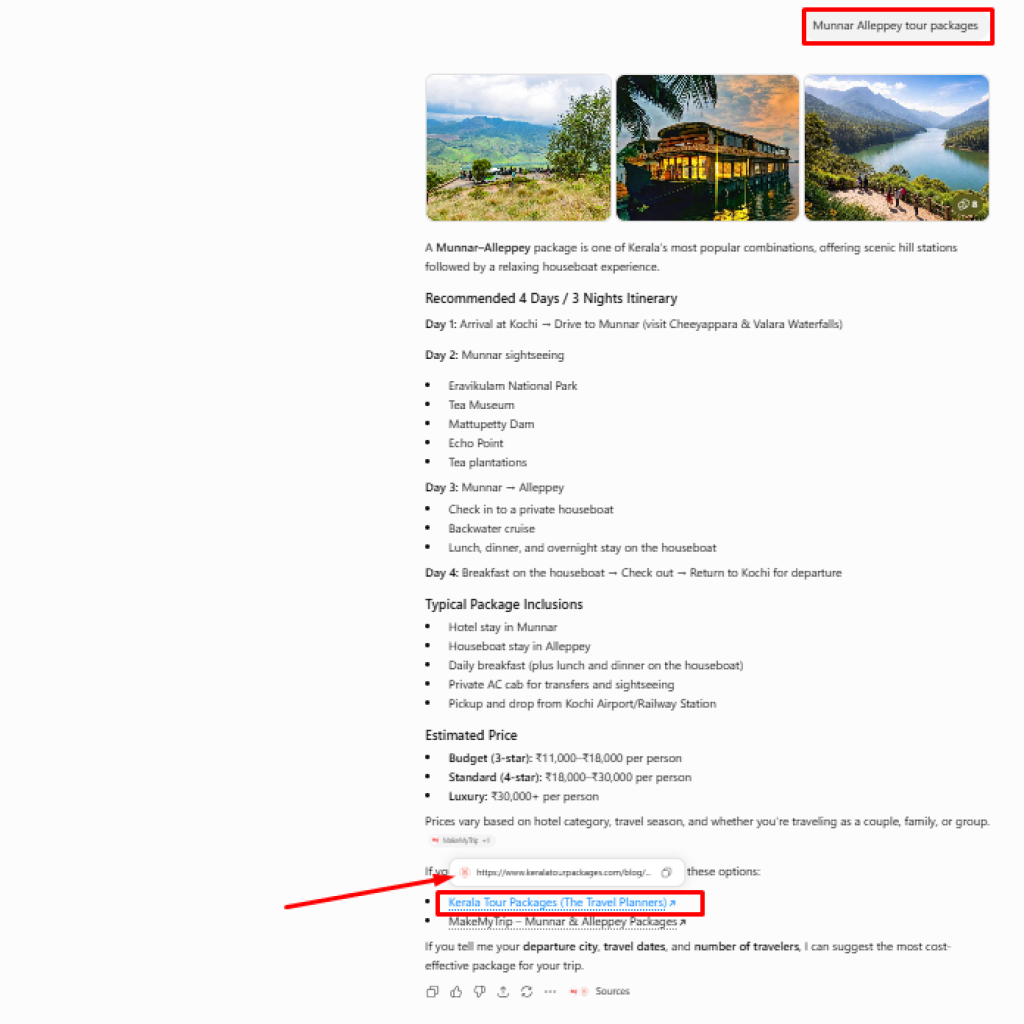
Case Study 2: Travel Brand Earns AI Citation for Munnar–Alleppey Tour Packages
Search Intent
A travel business wanted visibility for package-related searches.
Example prompt:
Munnar Alleppey tour packages
AI Platform
ChatGPT
Result
Instead of only generating an itinerary, ChatGPT cited and linked directly to the company’s travel package page as a supporting resource.
This is a strong example of AI citation building because the AI selected the website as a trusted reference during the answer generation process.
Why It Worked
The page aligned well with the user’s intent by providing:
- detailed itinerary information
- pricing guidance
- package inclusions
- destination expertise
- comprehensive travel content
Rather than serving only as a commercial landing page, it functioned as a useful informational resource.
Key Takeaway
Pages that comprehensively answer user intent have a much higher chance of being selected as AI citations than pages designed purely for promotion.
Lessons from These Case Studies
Although the industries differ, both examples reveal common patterns.
Businesses earning AI citations typically demonstrate:
- strong topical authority
- recognised brand entities
- comprehensive informational content
- consistent mentions across trusted sources
- alignment with conversational user intent
- high contextual relevance
- positive reputation signals
These examples reinforce an important principle of AI citation building:
AI assistants do not simply recommend the websites with the strongest backlink profiles. They recommend the brands that their underlying information ecosystem consistently recognises as authoritative, trustworthy, and relevant to the user’s question.
Step 1: Identify the AI Prompts That Matter
The success of any AI citation building strategy begins with identifying the questions your target audience is actually asking AI platforms. Before you can earn citations, you need to understand the prompts that influence your customers’ buying decisions, research habits, and information needs.
Unlike traditional SEO, where marketers optimise for keywords, AI search focuses on conversational prompts. Users no longer type short phrases like “professional SEO services.” Instead, they ask detailed questions such as, “Which professional SEO company is best for enterprise businesses?” or “How can I improve my website’s visibility in ChatGPT?”
Your objective is to identify these natural-language prompts and make them the foundation of your AI citation strategy.
Starting with Keyword Research
Traditional keyword research remains an excellent starting point. Use SEO tools to discover the primary topics your audience searches for and then expand those keywords into conversational questions.
For example:
- Professional SEO Services → “What are professional SEO services?”
- AI SEO → “How does AI SEO improve search visibility?”
- Enterprise SEO → “What is the difference between enterprise SEO and traditional SEO?”
This approach bridges conventional SEO with conversational AI search.
Customer Research
Your customers are one of the best sources of prompt ideas. Review emails, surveys, sales calls, and customer interviews to identify recurring questions. These real-world conversations often mirror the prompts people ask AI assistants.
Sales Team Insights
Sales representatives speak directly with prospects every day and understand the concerns buyers have before making a purchase. Collect frequently asked questions from your sales team to uncover valuable AI prompt opportunities.
Support Team Questions
Customer support teams regularly answer questions after purchase. These discussions can inspire educational content that AI assistants may later reference when responding to similar user queries.
Reddit Research
Reddit contains thousands of discussions where users ask detailed, experience-based questions. Subreddits related to your industry reveal authentic language, common pain points, and emerging trends that can be transformed into AI prompts.
Quora Research
Quora remains an excellent source for understanding how people phrase questions naturally. Popular questions often indicate subjects that deserve dedicated content and outreach efforts.
Community Forums
Industry-specific communities, developer forums, Facebook groups, Slack communities, and niche discussion boards provide additional insight into the language your audience uses.
People Also Ask
Google’s “People Also Ask” feature continues to be a valuable source of conversational questions. Many of these questions closely resemble prompts submitted to AI assistants and should be incorporated into your research process.
Search Intent Mapping
After collecting prompts, categorise them according to search intent:
- Informational
- Commercial
- Transactional
- Navigational
- Comparative
Understanding intent allows you to create content that aligns with the user’s stage in the buying journey while improving your chances of appearing in AI-generated responses.
Step 2: Convert Keywords into Natural AI Prompts
Once you’ve identified your target keywords, the next step is to rewrite them into conversational prompts that reflect how people interact with AI assistants.
Rather than optimising for isolated keywords, optimise for complete questions.
Informational Prompts
These users want to learn about a topic.
Examples include:
- What is AI citation building?
- How do AI citations work?
- Why are AI citations important?
- What is AI SEO?
- How do AI assistants choose citations?
Comparison Prompts
Comparison queries are common during the evaluation stage.
Examples include:
- AI citation building vs traditional link building
- Enterprise SEO vs local SEO
- ChatGPT vs Perplexity for research
- AI SEO vs traditional SEO
- Professional SEO services vs DIY SEO
Transactional Prompts
These prompts indicate buying intent.
Examples include:
- Best professional SEO company
- Best AI SEO agency
- Top enterprise SEO services
- Who offers managed SEO services?
- Which SEO agency specialises in AI search?
Recommendation Prompts
Recommendation-based searches frequently trigger AI-generated suggestions.
Examples include:
- Recommend a professional SEO agency.
- What is the best SEO company for SaaS businesses?
- Which AI SEO experts should I consider?
- Best advanced SEO agency for enterprise brands.
- Who provides custom SEO services?
Conversational Prompts
Conversational prompts are more detailed and context-rich.
Examples include:
- How can my business appear in ChatGPT answers?
- What makes a website trustworthy to AI?
- How do I improve AI visibility without relying only on backlinks?
- Can AI citations improve organic traffic?
- What type of content gets cited most by AI?
By creating content that answers these types of prompts comprehensively, businesses increase their chances of becoming valuable sources within AI-generated responses.
Step 3: Reverse Engineer AI Citations
After building your list of prompts, begin analysing how AI platforms answer them.
Enter the same prompts into ChatGPT, Google Gemini, Claude, Perplexity AI, and Microsoft Copilot. Carefully examine the citations each platform provides.
Record details such as:
- Citation URL
- Website domain
- Article author
- Publication date
- Topic covered
- Frequency of appearance
After analysing multiple prompts, patterns begin to emerge. Certain publishers, blogs, and industry resources appear repeatedly, indicating that AI systems consider them highly authoritative.
These websites should become priority outreach targets within your AI citation strategy.
Step 4: Build Your AI Citation Database
Organising your findings in a structured database makes it easier to identify trends and plan outreach campaigns.
A spreadsheet might include the following columns:
| Column | Purpose |
| Prompt | User question analysed |
| AI Platform | ChatGPT, Gemini, Claude, Perplexity, Copilot |
| Citation URL | Referenced webpage |
| Domain | Website name |
| Author | Article author |
| Category | Blog, news, research, review, government |
| Mention Frequency | Number of times cited |
| Authority Score | Relative trust or domain authority |
| Contact Information | Editor or journalist details |
This database becomes one of the most valuable assets in your AI citation building workflow, allowing you to prioritise outreach based on real citation data rather than assumptions.
Step 5: Analyse Citation Patterns
Once your database grows, begin looking for recurring trends.
You may notice that certain publishers appear repeatedly across multiple AI platforms. These websites have already established themselves as trusted sources, making them ideal candidates for future outreach.
Look for patterns such as:
- Frequently cited publishers.
- Topics AI references most often.
- Evergreen guides that remain consistently cited.
- Recently published articles receiving rapid adoption.
- Emerging industry trends.
- Competitors receiving repeated mentions.
This analysis helps you understand not only which websites AI trusts but also the type of content those websites publish.
For example, you may discover that AI frequently references original research, annual reports, comparison articles, expert interviews, or statistical studies. These insights can directly influence your future content strategy.
Step 6: Outreach for AI Citations
The final step is earning mentions within the publications AI already trusts.
Unlike traditional link building, the objective is to become part of authoritative conversations rather than simply acquiring backlinks.
Journalist Outreach
Build relationships with journalists covering your industry. Offer expert opinions, commentary, exclusive insights, and timely responses to current developments.
Editor Outreach
Editors are constantly seeking credible experts and valuable content. Reach out with genuinely useful ideas, research, or resources that improve their existing articles rather than promoting your business directly.
Expert Contributions
Publish expert commentary, thought leadership articles, and practical guides that demonstrate first-hand experience. Expertise increases the likelihood of both editorial coverage and AI citations.
Guest Posts
Guest posting on reputable industry websites remains an effective way to build authority. Focus on educational, experience-driven content rather than promotional articles.
Data Studies
Original datasets and market research are among the most frequently cited content types because they provide unique insights unavailable elsewhere.
Statistics
Publish reliable statistics supported by transparent methodologies. Journalists, bloggers, researchers, and AI assistants frequently reference credible numerical data.
Original Research
Investing in proprietary research is one of the most powerful AI citation strategies. Surveys, benchmark reports, industry analyses, and annual studies naturally attract citations from publishers and AI platforms alike.
Interviews
Interviews with recognised industry experts add credibility, introduce unique perspectives, and generate highly shareable content. They also increase opportunities for third-party mentions across the wider web.
Ultimately, successful AI citation building is not about manipulating algorithms. It is about consistently contributing valuable knowledge, earning recognition from trusted publications, and establishing your brand as a credible authority within your industry. By combining comprehensive prompt research, citation analysis, structured data collection, strategic outreach, and high-quality content creation, businesses can significantly improve their chances of being referenced in AI-generated answers while simultaneously strengthening their overall SEO performance.
Why Brand Mentions Matter More Than Backlinks
For years, backlinks have been one of the strongest ranking signals in traditional SEO. While they remain valuable, AI-powered search introduces a new priority: contextual brand mentions. Large Language Models (LLMs) do not simply count hyperlinks—they interpret language, understand entities, and analyse how brands are discussed across the web.
A mention of your business in a respected industry publication, even without a clickable link, can help AI understand your expertise and strengthen your chances of appearing in AI-generated responses.
Entity Recognition
Modern AI systems identify brands as entities rather than keywords. Consistent mentions across trusted websites help AI understand who you are, what you do, and which topics you specialise in.
Brand Association
AI learns associations between brands and specific subjects. For example, if your company is frequently mentioned alongside Advanced SEO, AI SEO, and Enterprise SEO, AI begins connecting your brand with those areas of expertise.
Contextual Understanding
Context matters as much as the mention itself. An article explaining why your company is a leader in technical SEO provides far stronger signals than a simple directory listing or isolated backlink.
Semantic Relationships
LLMs understand relationships between concepts. Publishing content around related topics helps strengthen semantic connections and positions your brand as a recognised authority within your niche.
Natural Language Processing
Because AI interprets natural language, editorial mentions, interviews, research papers, and educational content often carry greater long-term value than acquiring backlinks solely for ranking purposes.
Brand Mentions Outperform Backlinks
Ahrefs analysed 75,000 brands and found that brand web mentions showed the strongest correlation (0.664) with appearance in Google AI Overviews. Backlinks, by comparison, correlated at only 0.218. Brands in the top quartile for web mentions appeared up to 10 times more often in AI Overviews than those in the next quartile.
This is currently the single strongest quantitative signal supporting the shift from pure link building toward consistent, contextual brand mentions across the web.
A later Ahrefs study expanded the analysis and found that YouTube mentions — in video titles, transcripts, and descriptions — had become one of the highest-correlating factors with AI Overview visibility. This highlights the growing role of video and user-generated content as citation sources.
Platforms Cite Very Different Sources
Yext examined between 6.8 million and 17.2 million AI citations across ChatGPT, Gemini, Perplexity, and other models. The research confirmed two important patterns:
- Different models consistently favour different source types.
- In one major study, 86% of citations came from brand-managed sources (a combination of the brand’s own website and controlled listings).
Citation behaviour also varies significantly by query type and user context. Treating “AI search” as a single channel therefore leads to incomplete strategies.
Independent analyses of roughly 100,000 identical prompts found that only about 11% of cited domains overlapped between ChatGPT and Perplexity. The remaining 89% of sources were unique to each platform. This demonstrates that optimisation focused on one AI system rarely transfers cleanly to another.
Which Domains Actually Get Cited
Multiple large datasets (Semrush, LLM Pulse, and others) show that the most frequently cited domains across major AI platforms currently include:
- YouTube
- Wikipedia
- Forbes
- G2
- and a rotating set of industry-specific review and research sites
The exact ranking and share of these domains shift by platform and over time. Reddit, for example, has repeatedly appeared as a dominant source on Perplexity, while other platforms lean more heavily toward traditional publishers, official documentation, or video content.
How to Apply These Findings
- Prioritise earning contextual brand mentions on sites that already appear in AI answers for your category, not just high-DR sites in general.
- Treat each major AI platform as a distinct channel with its own preferred source types.
- Include video and community platforms (YouTube, Reddit, LinkedIn) in outreach and content plans rather than focusing exclusively on traditional publications.
- Measure success by citation frequency and share of voice on a fixed set of prompts, not solely by backlink metrics.
These studies replace theory with measurable patterns. Brands that align their citation-building efforts with the actual data — rather than assumptions carried over from traditional SEO — are better positioned to appear in the answers users receive today.
Proactive AI Citation Building Strategy
Waiting for AI to discover your brand is a passive approach. A proactive strategy focuses on creating and promoting the types of content AI platforms already favour.
Predict Future Articles
Identify recurring industry topics and publish content before demand peaks. Anticipating future trends gives your content time to earn authority before competitors enter the conversation.
Annual Roundups
Articles such as “Top SEO Trends,” “Best Marketing Tools,” or “Industry Predictions” are frequently updated and often referenced by AI. Contributing to these roundups or publishing your own increases citation opportunities.
Best Software Lists
Recommendation-based articles consistently attract AI citations. If your product or service qualifies for these lists, pursue editorial inclusion through digital PR and relationship building.
Comparison Guides
Users regularly ask AI to compare products, services, and solutions. Creating detailed comparison guides helps establish topical authority while increasing the likelihood of citations.
Industry Reports
Publishing benchmark reports, annual surveys, and market research provides unique information that journalists, bloggers, and AI systems frequently reference.
Market Trends
Content explaining emerging technologies, consumer behaviour, or industry developments demonstrates expertise and remains highly valuable for AI-powered search.
Expert Opinion Pieces
Well-researched opinion articles backed by practical experience help differentiate your brand and position your business as a trusted thought leader.
How Fresh Content Influences AI Citations
AI platforms strive to provide users with accurate and current information. While evergreen content remains valuable, freshness often influences which pages are selected as citations.
Freshness Signals
Regularly updated articles indicate that information remains relevant. AI systems often favour content reflecting the latest developments.
Updating Content
Rather than continually creating new articles, improve existing content with updated statistics, examples, screenshots, and expert insights.
Publishing Schedules
Consistent publishing demonstrates ongoing expertise. Maintaining a regular content schedule helps build topical authority over time.
Content Decay
Even excellent content becomes outdated. Reviewing older articles ensures they remain accurate and competitive within AI search.
Evergreen Updates
Evergreen guides should be refreshed periodically with new research, case studies, and examples to maintain long-term citation value.
AI Citation Building for Different Industries
AI citation building applies across virtually every sector, although the sources AI trusts vary by industry.
SaaS
Software companies should focus on review platforms, comparison websites, product directories, technical blogs, and software roundups.
Healthcare
Healthcare organisations benefit from citations in peer-reviewed journals, government health agencies, recognised medical institutions, and evidence-based publications.
Finance
Financial brands should prioritise trusted financial publications, regulatory resources, economic research, and respected industry analysts.
eCommerce
Retail businesses can improve AI visibility through buying guides, product reviews, comparison articles, influencer content, and customer-generated discussions.
Local Businesses
Local companies should strengthen their digital presence through business directories, local news coverage, regional publications, and community websites.
Agencies
Marketing agencies should publish case studies, industry research, educational content, and thought leadership while earning mentions from respected marketing publications.
Enterprise Brands
Enterprise organisations benefit from white papers, original research, analyst reports, conference presentations, and executive thought leadership.
B2B Companies
B2B organisations should focus on industry publications, professional communities, research reports, webinars, and educational resources targeting decision-makers.
AI Citation Building and Advanced SEO
AI citation building represents the next evolution of Advanced SEO. While traditional optimisation focused primarily on keywords and backlinks, modern Professional SEO incorporates entity recognition, semantic search, and AI understanding.
An effective AI SEO strategy combines multiple disciplines, including SEO Intelligence, Enterprise SEO, technical excellence, and authoritative content.
Key elements include:
- Building comprehensive topical authority.
- Implementing Semantic SEO to cover entire subject areas.
- Strengthening Entity SEO through consistent brand information.
- Optimising for Knowledge Graph recognition.
- Using structured data to improve machine understanding.
- Creating interconnected content clusters.
- Developing strong internal linking architecture.
- Maintaining excellent technical optimisation.
Businesses investing in Advanced Algorithm SEO Solutions, Cutting Edge SEO, Technical SEO Experts, and New SEO Techniques will be better positioned as AI-powered search continues to evolve.
Off-Page SEO and AI Citation Building
AI citation building complements traditional Off Page SEO rather than replacing it.
Modern Off Page SEO Services should focus on building authority across trusted publications instead of pursuing backlinks alone.
Important Off Page SEO Activities include:
- Digital PR campaigns.
- Earning contextual brand mentions.
- Expert interviews.
- Guest articles.
- Podcast appearances.
- HARO alternatives and journalist platforms.
- Industry news coverage.
- Research collaborations.
Successful Off Page SEO Techniques now combine editorial relationships with authoritative content creation, strengthening both search engine rankings and AI visibility.
Measuring AI Citation Success
Like any SEO initiative, AI citation building requires ongoing measurement.
Useful KPIs include:
- Growth in AI visibility across multiple platforms.
- Number of brand mentions earned.
- Citation frequency within AI responses.
- Referral traffic from authoritative publications.
- Increase in branded search volume.
- Organic traffic growth.
- Lead generation and conversion rate.
- User engagement and time on site.
Monitoring these metrics helps businesses understand which strategies generate meaningful improvements over time.
Common AI Citation Building Mistakes
Many organisations approach AI citation building with outdated SEO thinking.
Common mistakes include:
- Focusing exclusively on backlinks.
- Ignoring entity optimisation.
- Publishing thin or AI-generated content without expertise.
- Allowing articles to become outdated.
- Failing to conduct outreach.
- Demonstrating weak expertise signals.
- Covering isolated keywords instead of building topical authority.
- Over-optimising content for algorithms rather than users.
Avoiding these mistakes creates a stronger foundation for long-term AI visibility.
AI Citation Building Best Practices
Successful AI citation strategies focus on building genuine authority rather than manipulating search algorithms.
Some of the most effective practices include:
- Publish comprehensive, experience-driven content.
- Demonstrate E-E-A-T principles throughout your website.
- Optimise entity information consistently.
- Build topical content clusters.
- Use structured data where appropriate.
- Strengthen internal linking.
- Develop recognised expert authorship.
- Publish original research and case studies.
- Include trustworthy statistics and references.
- Invest in digital PR.
- Build relationships with journalists and editors.
- Earn mentions from respected publications.
- Update evergreen content regularly.
- Produce visual assets and reports worth citing.
- Monitor AI citations continuously.
- Analyse competitor citations.
- Focus on quality over quantity.
- Maintain technical SEO excellence.
- Improve website usability and performance.
- Stay informed about emerging AI search developments.
Businesses that consistently follow these practices are more likely to become trusted sources within AI-generated answers.
Future of AI Citation Building
AI search is still evolving, and citation strategies will continue to change as technology advances.
Emerging developments include:
- Agentic AI, where intelligent agents independently research and evaluate information before making recommendations.
- AI browsers that integrate conversational search directly into web navigation.
- Personalised search, delivering responses based on user preferences and previous interactions.
- AI memory, enabling assistants to provide increasingly contextual recommendations.
- Conversational commerce, where purchasing decisions occur directly within AI conversations.
- Autonomous agents capable of researching products and services on behalf of users.
- More sophisticated Knowledge Graphs that strengthen entity understanding across industries.
- An increasingly entity-first search ecosystem, where recognised expertise becomes more important than individual keyword rankings.
As these technologies mature, businesses will need to think beyond conventional SEO. Future success will depend on becoming recognised authorities across the wider digital ecosystem through trusted brand mentions, high-quality research, semantic relevance, and consistent contributions to the sources AI platforms rely on.
AI citation building is therefore not a temporary trend but an important evolution in digital marketing. Organisations that invest today in authority, expertise, and trusted relationships will be better positioned to remain visible as AI continues to reshape how people discover information, evaluate businesses, and make purchasing decisions.
Why Businesses Need Professional SEO Services for AI Citation Building
AI citation building is far more complex than simply publishing content or earning a handful of backlinks. It requires a strategic combination of technical SEO, content marketing, digital PR, entity optimisation, semantic search, and brand authority development. As AI-powered search platforms become increasingly sophisticated, businesses need a comprehensive approach that aligns with both traditional search engines and Large Language Models (LLMs).
This is where Professional SEO Services become invaluable.
A Professional SEO Company understands that AI visibility is no longer determined solely by keyword rankings. Modern AI platforms evaluate a wide range of signals, including topical authority, entity recognition, contextual brand mentions, content quality, technical website health, and online reputation. Successfully optimising for these signals requires specialised knowledge, continuous monitoring, and a long-term strategy that goes beyond conventional SEO practices.
AI Citation Building Requires More Than Content Creation
Publishing high-quality content is essential, but it is only one part of the equation.
To become a trusted source for AI platforms, businesses must also:
- Build strong topical authority across their industry.
- Earn mentions from respected publishers and media outlets.
- Maintain technically optimised websites.
- Demonstrate expertise through original research and thought leadership.
- Develop a consistent digital brand identity.
- Strengthen entity recognition across multiple trusted sources.
A Professional SEO Agency combines these elements into a unified strategy, ensuring that every optimisation effort contributes to greater AI visibility.
Developing a Strategic AI SEO Framework
Successful AI citation building begins with a structured strategy rather than isolated tactics.
Experienced SEO professionals conduct extensive research to identify:
- The AI prompts your target audience is asking.
- Which publications AI platforms cite most frequently.
- Competitor citation patterns.
- Content gaps within your industry.
- Opportunities for digital PR and editorial mentions.
Using these insights, they develop an AI-focused content and outreach plan designed to improve your brand’s authority across the wider web.
This strategic approach forms the foundation of modern AI SEO, helping businesses optimise for conversational search while continuing to strengthen their traditional organic search performance.
Building Topical Authority Through Advanced SEO
One of the strongest signals AI platforms evaluate is topical authority.
Rather than publishing isolated blog posts targeting individual keywords, an Advanced SEO Agency develops interconnected content ecosystems that comprehensively cover a subject.
For example, a company specialising in AI search optimisation might publish resources covering:
- AI citation building
- AI SEO
- Semantic SEO
- Entity optimisation
- Knowledge Graph optimisation
- Digital PR
- Structured data
- Technical SEO
- Conversational search
- Large Language Models
Together, these resources demonstrate deep expertise and help AI platforms recognise the organisation as an authority within its niche.
This is a core principle of Advanced SEO and one of the most effective ways to improve AI citation opportunities.
Technical SEO Creates the Foundation
Even the most authoritative content can struggle to gain visibility if a website has technical issues.
Professional SEO specialists ensure that your website provides AI systems and search engines with clear, structured, and accessible information.
Technical optimisation includes:
- Improving website speed and Core Web Vitals.
- Optimising crawlability and indexability.
- Implementing structured data.
- Strengthening internal linking.
- Eliminating duplicate content.
- Enhancing mobile usability.
- Maintaining clean site architecture.
Working with Technical SEO Experts ensures that your content can be efficiently discovered, understood, and indexed, increasing the likelihood of becoming part of AI-generated responses.
Digital PR and Brand Mentions
One of the defining characteristics of AI citation building is its emphasis on authoritative brand mentions.
A Professional SEO Services Company often integrates digital PR into its strategy by helping businesses:
- Secure media coverage.
- Contribute expert commentary.
- Publish guest articles.
- Participate in industry interviews.
- Release original research.
- Build relationships with journalists and editors.
These activities strengthen online authority while increasing the number of trusted sources that reference your brand.
Unlike traditional link-building campaigns, the objective is not simply acquiring hyperlinks—it is establishing your organisation as a recognised expert across the digital ecosystem.
Leveraging SEO Intelligence
Modern AI optimisation relies heavily on data.
Using SEO Intelligence, agencies analyse search behaviour, citation trends, competitor strategies, and content performance to identify new opportunities.
This includes monitoring:
- AI-generated recommendations.
- Frequently cited publishers.
- Emerging search trends.
- User intent changes.
- Competitor visibility.
- Brand mentions across the web.
These insights allow businesses to adapt their content strategy proactively rather than reacting after competitors have already established authority.
Enterprise-Level AI Citation Strategies
Large organisations often operate across multiple markets, product categories, and geographic regions.
For these businesses, Enterprise SEO requires scalable AI citation strategies capable of managing thousands of webpages while maintaining consistent expertise and entity recognition.
Enterprise-level initiatives often include:
- Organisation-wide content governance.
- Cross-department collaboration.
- Advanced schema implementation.
- International SEO.
- Large-scale digital PR.
- Comprehensive content clusters.
- Continuous citation monitoring.
A structured enterprise approach ensures consistency while strengthening brand authority across multiple industries and markets.
Advanced Algorithm SEO Solutions for AI Search
AI-powered search introduces ranking considerations that extend beyond traditional algorithms.
Modern Advanced Algorithm SEO Solutions focus on improving how AI systems interpret, evaluate, and trust digital content.
This includes:
- Semantic optimisation.
- Entity-first content strategies.
- Natural language optimisation.
- Knowledge Graph enhancement.
- Author credibility.
- Contextual relevance.
- Experience-driven content creation.
Rather than chasing algorithm updates, these strategies focus on building long-term authority that remains valuable regardless of how search technology evolves.
Staying Ahead with Cutting Edge SEO
Search technology changes continuously, particularly as AI platforms introduce new capabilities.
Businesses that rely on outdated optimisation methods risk losing visibility as user behaviour shifts toward conversational search.
A forward-thinking agency embraces Cutting Edge SEO by continuously testing emerging strategies, monitoring AI platform behaviour, and adapting content to align with evolving citation patterns.
From experimenting with New SEO Techniques to analysing AI-generated search experiences, proactive optimisation ensures your business remains competitive in an increasingly AI-first landscape.
The Value of Working with SEO Experts
Building authority across AI platforms requires experience, technical expertise, strategic planning, and ongoing refinement.
A team providing Professional SEO Services brings together specialists in technical SEO, content strategy, digital PR, outreach, analytics, and AI optimisation to create a comprehensive visibility strategy.
Instead of focusing on isolated tactics, they build a sustainable ecosystem where:
- Technical excellence supports discoverability.
- Authoritative content demonstrates expertise.
- Digital PR strengthens brand reputation.
- Entity optimisation improves AI understanding.
- Original research earns trusted citations.
- Continuous analysis identifies new opportunities.
This integrated approach delivers benefits that extend far beyond AI citation building, improving overall search performance, brand authority, and long-term digital growth.
AI Citation Building Myths That Businesses Should Stop Believing
As AI-powered search becomes more influential, misconceptions about AI citation building are becoming increasingly common. Many organisations continue applying traditional SEO assumptions to AI search without recognising how citation behaviour differs across conversational platforms. Understanding these misconceptions helps businesses invest their resources in strategies that genuinely improve long-term AI visibility.
Myth 1: Backlinks Alone Are Enough
Backlinks remain an important part of search engine optimisation, but they are no longer the only indicator of authority. AI platforms evaluate broader contextual signals, including topical relevance, entity consistency, trusted brand mentions, content quality, and semantic relationships.
A website with thousands of backlinks may still struggle to appear in AI-generated recommendations if its brand lacks recognition across authoritative publications.
Myth 2: AI Only Cites Large Brands
Large organisations often benefit from established authority, but AI platforms also reference niche experts, independent research, specialist publications, and highly focused educational resources.
Businesses that consistently publish original insights and demonstrate subject matter expertise can compete effectively regardless of company size.
Myth 3: Publishing More Content Automatically Improves AI Visibility
Quantity does not guarantee authority.
AI systems are more likely to reference comprehensive, accurate, and experience-driven resources than dozens of short articles covering similar topics. A well-maintained library of authoritative content generally provides stronger citation opportunities than publishing large volumes of low-value material.
Myth 4: AI Citation Building Is Separate from SEO
AI citation building should not replace traditional SEO.
Technical optimisation, internal linking, structured data, entity optimisation, digital PR, and topical authority continue to strengthen how search engines and AI systems understand a business.
The most effective digital strategies integrate AI citation building into a broader SEO framework rather than treating it as an independent activity.
Myth 5: AI Citation Success Happens Quickly
Authority develops over time.
Consistent publication of valuable content, ongoing digital PR, expert contributions, and recognition from trusted publishers gradually strengthen a brand’s credibility. AI visibility should be viewed as a long-term investment rather than a short-term campaign.
Building an AI Citation Roadmap: A 90-Day Implementation Plan
Many organisations understand the importance of AI citation building but struggle to translate strategy into execution. Breaking the process into structured phases helps businesses build authority systematically while creating measurable progress.
Days 1–30: Research and Foundation
The first month should focus on understanding how AI currently perceives your brand.
Key activities include:
- Identifying the AI prompts most relevant to your industry.
- Recording citations across ChatGPT, Gemini, Perplexity, Claude, and Microsoft Copilot.
- Auditing existing brand mentions.
- Evaluating entity consistency across websites, directories, and social platforms.
- Identifying content gaps compared with frequently cited competitors.
The outcome of this phase is a clear baseline that reveals where your brand currently stands within the AI citation ecosystem.
Days 31–60: Content and Authority Development
Once the research is complete, attention should shift towards creating assets that deserve to be referenced.
Priorities include:
- Publishing comprehensive topic clusters.
- Updating existing evergreen resources.
- Creating original research, surveys, or benchmark reports.
- Developing comparison guides and expert explainers.
- Strengthening author profiles and demonstrating subject matter expertise.
- Implementing structured data where appropriate.
These activities help establish stronger topical authority while improving the quality of information available for AI systems to reference.
Days 61–90: Outreach and Citation Expansion
The final phase focuses on increasing external recognition.
Typical initiatives include:
- Digital PR campaigns.
- Journalist outreach.
- Guest contributions to respected industry publications.
- Podcast appearances and expert interviews.
- Participation in industry events and webinars.
- Promoting original research to publishers and analysts.
Alongside outreach, businesses should monitor AI-generated responses regularly to identify new citation opportunities, evaluate changes in visibility, and refine their content strategy.
AI citation building is an iterative process. Organisations that continually analyse results, expand their authority, and strengthen relationships across the wider digital ecosystem are better positioned to earn consistent visibility as AI-powered search continues to evolve.
Final Thoughts
AI citation building represents one of the most significant developments in modern search optimisation. As AI assistants become trusted sources of information for consumers and businesses alike, visibility will increasingly depend on more than keyword rankings or backlink profiles alone.
Organisations that invest in Professional SEO, AI SEO, Advanced SEO, and comprehensive SEO Strategy Services will be better equipped to build topical authority, strengthen entity recognition, earn trusted brand mentions, and establish lasting credibility across the digital ecosystem.
Rather than treating AI citation building as a standalone tactic, businesses should integrate it into a holistic SEO strategy that combines technical optimisation, high-quality content, semantic relevance, digital PR, and continuous innovation. Those who do so will be well positioned to earn visibility not only in search engine results but also in the AI-generated answers that are shaping the future of online discovery.
This blog is copyrighted under Diary No. LD-46347/2026-CO, registered through Form XIV, with all rights reserved to the copyright owner.