SUPERCHARGE YOUR ONLINE VISIBILITY! CONTACT US AND LET’S ACHIEVE EXCELLENCE TOGETHER!
Search has undergone a remarkable transformation over the past two decades. In the early days of digital marketing, success was largely determined by keyword density, backlinks, and technical optimization. Search engines primarily evaluated webpages based on textual relevance and authority signals, rewarding websites that aligned closely with ranking algorithms. As user behavior evolved and search engines became more sophisticated, SEO shifted from simple keyword targeting to understanding topics, search intent, and content quality. Today, the emergence of artificial intelligence is redefining this landscape once again, creating an environment where search systems are no longer just indexing pages—they are interpreting entities, relationships, and context. This transformation has made Vector Entity Modelling one of the most significant concepts shaping modern search intelligence.
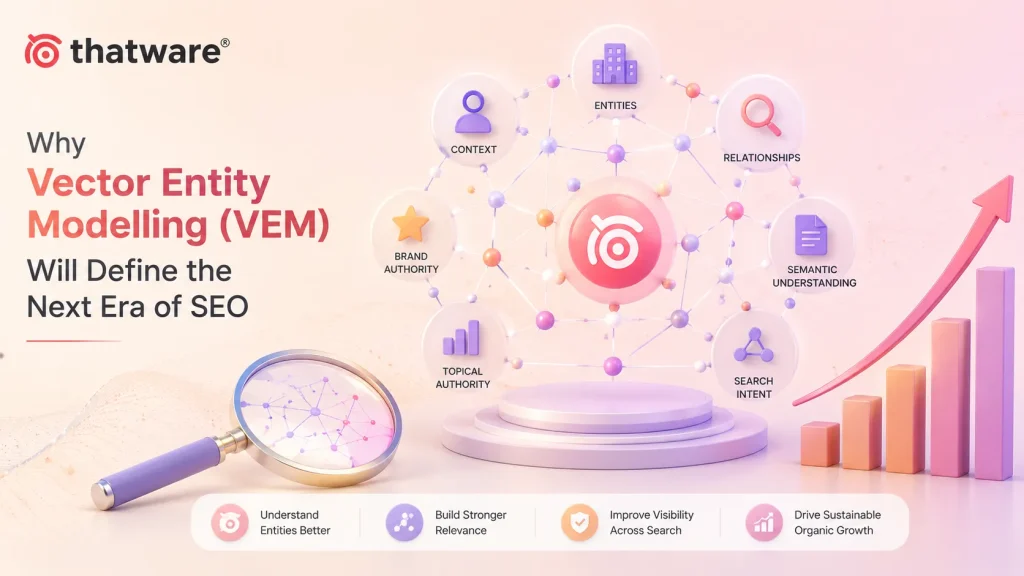
The rapid adoption of AI-powered search experiences has accelerated this evolution. Platforms such as ChatGPT, Gemini, Perplexity, Microsoft Copilot, and Google AI Overviews are changing how users discover information by providing direct, conversational answers instead of traditional lists of search results. These systems evaluate knowledge from multiple sources, understand semantic relationships, and recommend brands based on contextual relevance rather than isolated keyword signals. As AI continues to influence user journeys, organizations must optimize not only for search engines but also for intelligent retrieval systems capable of understanding complex relationships between people, brands, products, and services.
This shift has also reshaped the role of LLM SEO. Optimizing for large language models extends beyond achieving high rankings on search engine results pages. It requires building a digital presence that AI systems can confidently interpret, connect, and reference across diverse conversational contexts. Brands that invest in semantic clarity and structured knowledge are better positioned to remain visible as AI-powered discovery continues to evolve.
Traditional SEO metrics such as rankings, impressions, and backlinks remain valuable, but they no longer provide a complete picture of digital visibility. A website may rank prominently for competitive keywords and still fail to appear in AI-generated recommendations if its entity signals are fragmented or poorly understood. This growing gap between search performance and AI recognition highlights the need for a more advanced framework capable of evaluating how machines perceive a brand. Being a professional seo firm, ThatWare, developed Vector Entity Modelling (VEM) to measure and strengthen this critical layer of AI understanding. While AVM measures how visible a brand is across AI-powered platforms, Vector Entity Modelling evaluates how clearly AI systems understand that brand as an entity. The next era of SEO will not be driven solely by rankings—it will be driven by how effectively AI understands, trusts, and connects brands within an increasingly intelligent search ecosystem.
The Evolution of Search: From Keywords to Entity Intelligence
The history of search has been defined by continuous innovation. Search engines initially focused on matching keywords within webpages, making optimization largely dependent on keyword placement, meta tags, and backlinks. As algorithms became more sophisticated, they began evaluating entire pages, rewarding websites that offered valuable content and a better user experience. This progression eventually expanded beyond individual pages to topical relevance, where search engines learned to understand broader themes instead of isolated keywords. Today, search has entered a new phase—one where entities, knowledge graphs, and AI-driven understanding play a far greater role than traditional ranking signals. This evolution is precisely why Vector Entity Modelling is becoming increasingly important for organizations seeking long-term search success.
Keywords
↓
Pages
↓
Topics
↓
Entities
↓
Knowledge Graphs
↓
Vector Intelligence
↓
AI Recommendations
One of the biggest milestones in this transformation was the introduction of Google’s Knowledge Graph, which fundamentally changed how information is organized and retrieved. Instead of treating search queries as isolated strings of text, search engines began identifying real-world entities such as people, organizations, products, places, and concepts while understanding the relationships between them. This shift enabled search engines to answer questions more intelligently, connect related information, and provide richer search experiences that extend far beyond matching keywords. As a result, entity-based understanding became an essential component of modern search.
Semantic search further accelerated this transition by allowing search engines to interpret user intent instead of relying solely on exact keyword matches. Rather than asking whether a webpage contains a particular phrase, AI-powered systems attempt to determine whether the content genuinely answers the user’s question. They analyze context, relationships, topical relevance, and semantic meaning to produce more accurate responses. This deeper understanding has significantly improved search quality while also raising the standards for content optimization.
The growing influence of AI has also increased the importance of Large Language Model SEO. Modern optimization strategies must consider how language models retrieve, interpret, and connect information across diverse sources rather than focusing exclusively on conventional search rankings. This requires organizations to build stronger semantic signals, clearer entity relationships, and consistent digital identities that AI systems can confidently understand.
As search continues moving toward entity intelligence, businesses need frameworks capable of measuring more than rankings alone. Visibility is no longer determined solely by where a page appears in search results but by how effectively AI understands the organization behind that content. This is where Vector Entity Modelling (VEM) becomes essential, providing a structured approach to evaluating entity intelligence and preparing brands for the next generation of AI-powered search.
What Is Vector Entity Modelling (VEM)?
The way AI systems discover and interpret information is fundamentally different from how traditional search engines have operated for years. While conventional SEO primarily measures how well webpages perform in search results, AI-powered discovery focuses on understanding the entity behind those webpages. This shift is exactly why Vector Entity Modelling (VEM) has emerged as an important framework for evaluating AI search readiness.
As an SEO expert agency, we developed Vector Entity Modelling as a framework that measures how clearly a brand is understood, connected, and represented across the AI search ecosystem. Rather than concentrating only on rankings or traffic, Vector Entity Modelling evaluates whether an organization’s identity is complete, consistent, and semantically connected. It examines how effectively AI systems can recognize a brand, associate it with relevant topics, and distinguish it from competitors through structured relationships and contextual signals.
SEO Metrics vs. Entity Metrics
Although traditional SEO remains an essential part of digital marketing, the rise of AI-powered search requires businesses to look beyond conventional performance indicators.
| Traditional SEO Metrics | Entity Metrics (VEM) |
| Keyword Rankings | Entity Recognition |
| Organic Traffic | Entity Understanding |
| Backlinks | Semantic Relationships |
| Click-Through Rate | Entity Confidence |
| Domain Authority | Knowledge Graph Strength |
| Search Visibility | AI Readiness |
Traditional SEO metrics explain how webpages perform.
Entity metrics explain how AI understands the organization behind those webpages.
That distinction becomes increasingly important as AI-generated search experiences continue to evolve.
Why AI Thinks in Entities Instead of Pages
When users interact with AI-powered search, they rarely receive a list of links as the final answer. Instead, AI attempts to understand the intent behind the question and identify the most relevant organizations, people, products, services, and concepts associated with that topic. In other words, AI is not simply retrieving webpages—it is interpreting entities and the relationships that connect them. A Qualified ai seo agency always keeps these thing in mind.
For example, if someone searches for the best wedding photographer in a particular location, AI may evaluate the business’s expertise, services, reputation, topical relevance, and contextual relationships before deciding whether it deserves to be mentioned. This approach goes far beyond matching keywords on a webpage and reflects a broader understanding of the business itself.
Understanding the “Vector” in Vector Entity Modelling
The word “vector” may sound highly technical, but its concept is relatively simple. In AI, a vector represents information in a way that allows machines to compare meanings rather than just words. Every brand, service, topic, and relationship can be represented as data points that are connected based on semantic similarity.
For businesses, this means that AI gradually develops a contextual understanding of a brand by analyzing content, structured data, citations, topical expertise, and digital relationships. The stronger and more consistent these signals become, the clearer the entity appears within AI-driven search environments.
This is where Vector Entity Modelling provides meaningful insights. Instead of focusing solely on visibility, it evaluates the quality of AI understanding that supports long-term discoverability.
As we explain at ThatWare:
AVM measures visibility.
VEM measures understanding.
Visibility tells you whether AI can find your brand. Understanding determines whether AI can confidently interpret, retrieve, and recommend it.
Why VEM Will Define the Next Era of SEO
The next generation of professional seo is no longer centred exclusively on rankings. As AI-powered search becomes increasingly conversational, visibility depends on something much deeper—the ability of AI systems to understand the brand behind the content. A webpage may rank well for competitive keywords, but if the business itself is not clearly understood as an entity, its chances of appearing consistently within AI-generated responses may remain limited. This shift is precisely why Vector Entity Modelling is becoming an increasingly valuable framework for measuring AI search readiness.
Before AI Recommends a Brand, It Follows a Journey
AI-powered search systems typically need to progress through several stages before presenting a business within a generated response.
Identify
↓
Understand
↓
Trust
↓
Retrieve
↓
Recommend
Every stage depends on the quality of the entity rather than the performance of a single webpage.
Entity Recognition: Building a Clear Digital Identity
The first step is recognition. AI needs to determine that an organization represents a unique and well-defined entity. Consistent business names, founder information, services, products, and organizational details all contribute to a stronger entity identity. This consistency also strengthens seo for voice search, where AI assistants rely on clear and accurate entity signals to deliver reliable responses. Fragmented branding or inconsistent information across digital platforms can make it more difficult for AI systems to confidently recognize the business.
Entity Confidence and Contextual Understanding
Recognition alone is not enough. AI also evaluates whether the information surrounding an entity is consistent and contextually meaningful. This confidence is strengthened when a brand demonstrates clear topical expertise, publishes comprehensive content, maintains accurate structured information, and reinforces its identity across multiple trusted sources. These principles also form the foundation of Answer Engine Optimization, where AI systems prioritize entities they can confidently understand and recommend.
Context is equally important. Instead of evaluating individual pages in isolation, AI attempts to understand how different topics, services, industries, and people relate to one another. These semantic relationships enable AI to build a broader understanding of the organization and its expertise, while also strengthening voice search local seo by helping AI assistants deliver more accurate, context-aware responses for location-specific and conversational queries.
Knowledge graphs have become one of the foundational components of modern search intelligence because they organize entities through meaningful relationships. A mature knowledge graph allows AI systems to understand not only who a business is but also how it connects with founders, services, industries, products, and related concepts. While traditional off page seo services help strengthen external authority and credibility, these trust signals become even more valuable when they reinforce structured entity relationships that AI can interpret with confidence.
Over time, these relationships contribute to stronger semantic authority. Rather than relying solely on keyword relevance, AI increasingly values organizations that consistently demonstrate expertise across interconnected topics. While every off page seo technique contributes to improving external credibility, its long-term value is significantly enhanced when it supports meaningful entity relationships and semantic authority. This creates a richer and more reliable entity profile that supports long-term AI discoverability.
Machine-Readable Identity Strengthens AI Understanding
Modern websites are no longer designed exclusively for human visitors. They also communicate directly with machines through structured data, schema markup, semantic sitemaps, and other machine-readable resources. These elements help reduce ambiguity by providing AI systems with clearly defined organizational information and relationships.
At ThatWare, we view machine-readable identity as one of the key pillars supporting Vector Entity Modelling, because it helps transform website content into structured knowledge that AI can interpret more effectively. This structured approach also complements our AEO Services, ensuring that content is optimized not only for search engines but also for AI-powered answer engines that rely on clear, machine-readable information.
Why Rankings Alone Are No Longer Enough
A business can achieve excellent keyword rankings, attract substantial organic traffic, and maintain a strong backlink profile while still struggling to appear consistently within AI-generated recommendations. Rankings measure webpage performance, but they do not necessarily measure how clearly AI understands the organization itself.
This is where Vector Entity Modelling fills an important gap. By evaluating entity recognition, semantic relationships, contextual understanding, knowledge graph maturity, and machine-readable identity, it provides a broader perspective on AI search readiness. As search continues to evolve beyond pages and keywords, organizations that invest in stronger entity intelligence will be better positioned for the next era of SEO intelligence, where understanding increasingly becomes the foundation of visibility.
The Six Intelligence Layers of VEM
Understanding an entity requires far more than evaluating a website’s ranking performance. AI systems build confidence by analyzing multiple layers of information that collectively define a brand’s digital identity. At ThatWare, our Vector Entity Modelling (VEM) framework evaluates six intelligence layers that together provide a comprehensive picture of how well an entity is understood across the AI ecosystem. Rather than relying on a single metric, these layers measure identity, relevance, authority, and AI readiness from multiple perspectives.
1. Brand Intelligence: Building a Consistent Digital Identity
Every successful entity begins with a strong and consistent identity. Before AI can understand a business, it must first recognize that the business exists as a distinct entity.
Brand Intelligence evaluates factors such as:
- Consistency of the company name
- Founder information
- Product and service naming
- Brand variations and abbreviations
- Business descriptions across platforms
For example, if a company appears online as “ABC Solutions,” “ABC Technologies,” and “ABC Tech,” AI may struggle to determine whether these references belong to the same organization. Maintaining consistency across websites, directories, social profiles, and structured data strengthens entity clarity and reduces ambiguity.
Simply put, the stronger the brand identity, the easier it becomes for AI to recognize the organization with confidence.
2. Content Intelligence: Strengthening Semantic Understanding
Content is one of the primary sources from which AI systems learn about an entity. However, producing a large volume of content alone is not enough. What matters is how effectively that content reinforces expertise and contextual relevance.
Content Intelligence evaluates:
- Topic clusters
- Semantic depth
- Internal contextual relationships
- Content freshness
- Context reinforcement across pages
Instead of publishing isolated articles, organizations should build interconnected content ecosystems that comprehensively cover their areas of expertise. Each supporting page strengthens semantic relevance and helps AI understand how different topics relate to the core entity.
The richer and more connected the content ecosystem becomes, the stronger the entity’s semantic footprint.
3. Authority Intelligence: Establishing Trust Beyond Your Website
AI systems rarely rely on a single source of information when evaluating an entity. They compare signals from multiple trusted sources before developing confidence in a brand.
Authority Intelligence considers factors such as:
- Industry citations
- Awards and recognitions
- Research publications
- Media coverage
- Expert mentions
- Third-party references
These external signals validate the credibility of an organization. When authoritative sources consistently reference the same entity, AI gains greater confidence that the information is accurate and trustworthy.
Authority, therefore, extends beyond backlinks—it represents real-world validation of expertise.
4. Entity Intelligence: Connecting the Digital Knowledge Graph
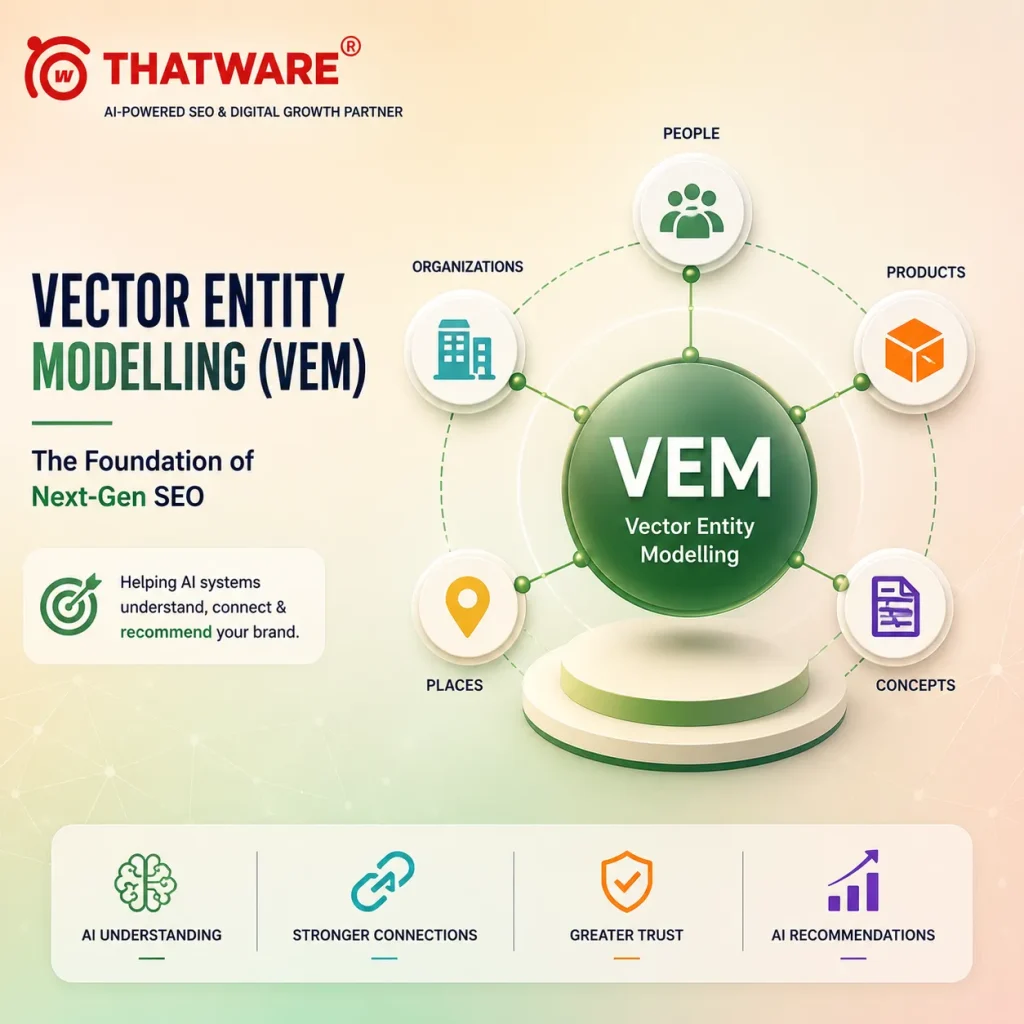
Entity Intelligence forms the core of Vector Entity Modelling because it evaluates how effectively an organization exists within structured knowledge systems.
This layer analyzes:
- Schema markup
- Knowledge Graph connections
- Structured data
- Entity relationships
- Organizational attributes
Rather than viewing a business as an isolated website, AI builds relationship maps that connect founders, products, services, industries, locations, and other related entities. These relationships help AI understand not only who the organization is but also how it fits within a broader ecosystem.
A well-developed entity graph significantly improves AI interpretation and reduces ambiguity during information retrieval.
5. AI Readiness Intelligence: Preparing for AI-Native Search
As AI-powered search continues to evolve, websites must become increasingly machine-readable. AI Readiness Intelligence measures whether an organization has implemented the technical signals that support future AI discovery.
Key evaluation areas include:
- ai.txt
- llms.txt
- Semantic sitemaps
- Entity feeds
- AI-friendly content structures
These resources provide additional context that helps intelligent systems interpret website content more efficiently. While traditional SEO focused primarily on crawlers, modern AI platforms increasingly benefit from structured resources that improve contextual understanding and retrieval accuracy.
Organizations investing in AI readiness today are preparing for the next generation of search experiences.
6. Query Intelligence: Measuring Visibility Across User Intent
Modern users interact with search platforms in many different ways. Some ask informational questions, while others compare products, seek local businesses, or look for transactional solutions.
Query Intelligence evaluates how effectively an entity appears across different search intents, including:
- Informational queries
- Commercial queries
- Transactional queries
- Comparative queries
- Local intent queries
A mature entity should not be discoverable only for branded searches. Instead, it should demonstrate relevance across multiple stages of the customer journey, enabling AI systems to retrieve it regardless of how users phrase their questions.
Broad query coverage strengthens overall entity visibility while reinforcing topical authority.
Bringing the Six Layers Together
Each intelligence layer contributes a unique perspective to understanding an entity. Individually, they reveal strengths and opportunities for improvement. Together, they create a comprehensive measurement of AI search readiness.
Brand Intelligence
↓
Content Intelligence
↓
Authority Intelligence
↓
Entity Intelligence
↓
AI Readiness Intelligence
↓
Query Intelligence
↓
VEM Score
Rather than relying on rankings alone, the VEM Score combines these six intelligence layers to evaluate how effectively AI systems can recognize, understand, trust, and retrieve an entity. The stronger each layer becomes, the stronger the overall entity intelligence—and ultimately, the greater the opportunity for sustained visibility in AI-driven search.
Why VEM Is More Than a Metric—It’s an AI Search Strategy
Many organizations view metrics simply as numbers used to measure performance. Vector Entity Modelling (VEM) serves a much broader purpose. It is not merely a scoring framework; it provides a strategic roadmap for building a stronger digital identity that aligns with the evolving requirements of AI-powered search.
A higher VEM score reflects improvements across multiple dimensions of AI understanding. As entity clarity increases, AI systems can interpret the organization with greater confidence, resulting in more accurate contextual associations and stronger semantic relationships. This enhanced understanding creates a strong foundation for AI Answer Optimization, enabling brands to achieve sustainable visibility rather than relying solely on short-term ranking gains.
The strategic benefits of a mature VEM framework include:
- Better AI Understanding: Clear entity signals reduce ambiguity and help AI interpret the brand more accurately.
- Better Recommendations: Well-defined entities are more likely to be considered when AI generates contextual responses.
- Better AI Memory: Consistent semantic relationships strengthen how an entity is represented across AI-driven knowledge systems.
- Better Citations: Strong entity intelligence improves the likelihood of being referenced alongside relevant topics and industries.
- Stronger Entity Confidence: Consistency across content, structured data, and authority signals reinforces trust in the organization’s digital identity.
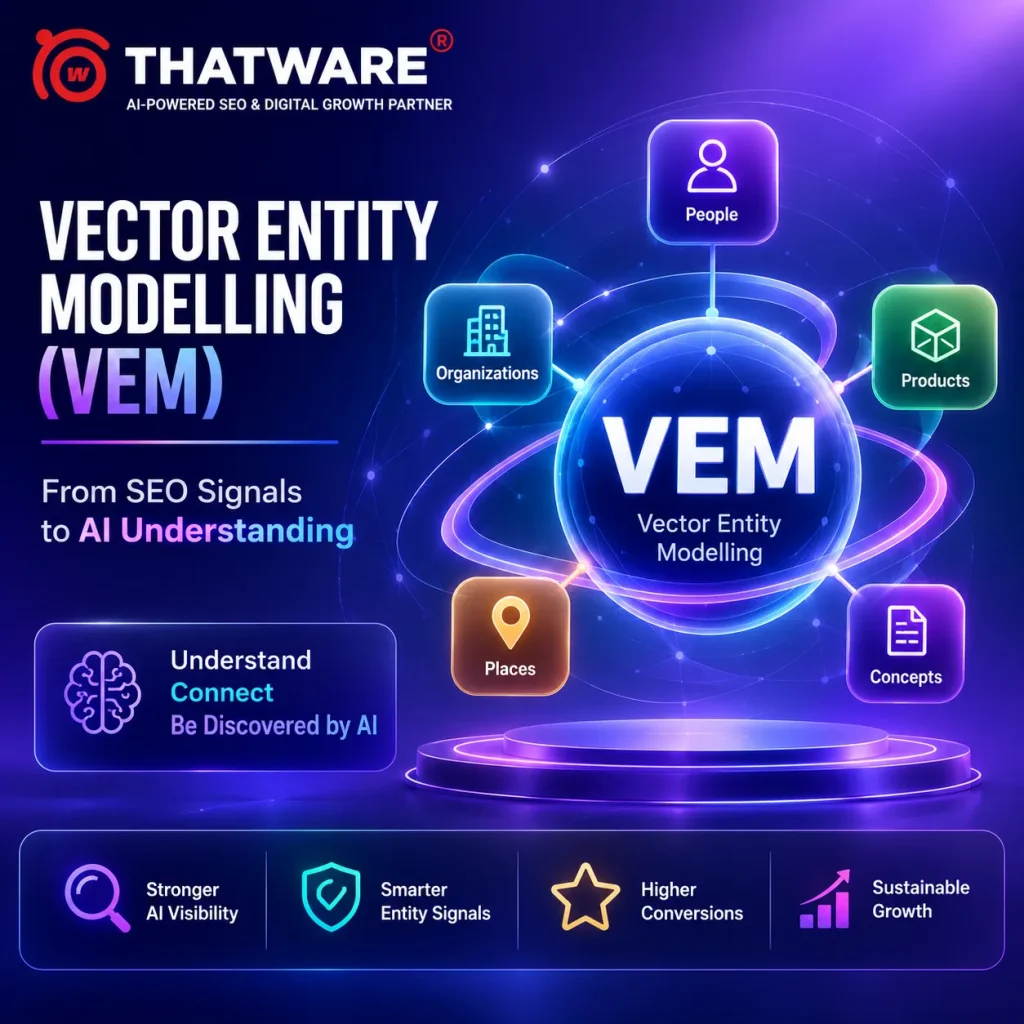
The relationship between VEM and AI visibility can be understood through a simple progression:
VEM
(Entity Understanding)
↓
AI Trust
↓
AI Memory
↓
AI Recommendation
↓
AVM
(AI Visibility)
As the finest SEO intelligence agency, we view this relationship as a natural progression within our AI search framework. While AVM measures how visible a brand is across AI-powered environments, Vector Entity Modelling focuses on strengthening the underlying entity intelligence that supports that visibility. In other words, visibility is the outcome, but understanding is the foundation. As AI continues to evolve beyond keywords and webpages, organizations that invest in stronger entity intelligence today will be better positioned to build sustainable visibility in the next era of search.
Generative Engine Optimization: Expanding Beyond Traditional SEO
As AI-generated responses become a primary source of information discovery, Generative Engine Optimization helps brands improve how they are retrieved, interpreted, and recommended within conversational search experiences. When combined with Vector Entity Modelling, it ensures that AI systems understand not only the content but also the entity behind it, creating stronger long-term visibility.
Building Sustainable Visibility Through GEO Services
Effective GEO Services go beyond optimizing webpages—they strengthen the semantic relationships that define a brand across the digital ecosystem. By reinforcing entity consistency, structured data, and contextual relevance, organizations can improve their ability to appear naturally in AI-generated recommendations while building greater trust with modern search platforms.
AI Search Optimization Starts with Entity Intelligence
Successful AI Search Optimization begins by creating a machine-readable entity that AI systems can confidently identify, understand, and retrieve. Businesses that invest in semantic authority, structured relationships, and comprehensive entity development are better equipped to adapt to evolving AI search environments, ensuring sustainable visibility as the next generation of search continues to mature.
How VEM Strengthened AI Entity Intelligence for Geethanjali Photography
As AI-powered search continues to evolve, businesses need more than an attractive website and quality services to remain competitive. They also need a digital identity that AI systems can clearly recognize, understand, and confidently associate with relevant user queries. This is where Vector Entity Modelling (VEM) becomes a valuable framework for evaluating and strengthening AI entity intelligence.
To demonstrate the practical application of VEM, let’s examine the AI visibility assessment conducted for Geethanjali Photography, a professional photography and videography brand. The objective of this analysis was not merely to evaluate conventional SEO performance but to understand how AI systems perceive the brand as an entity and identify opportunities for improving its AI search readiness.
Initial AI Visibility Analysis
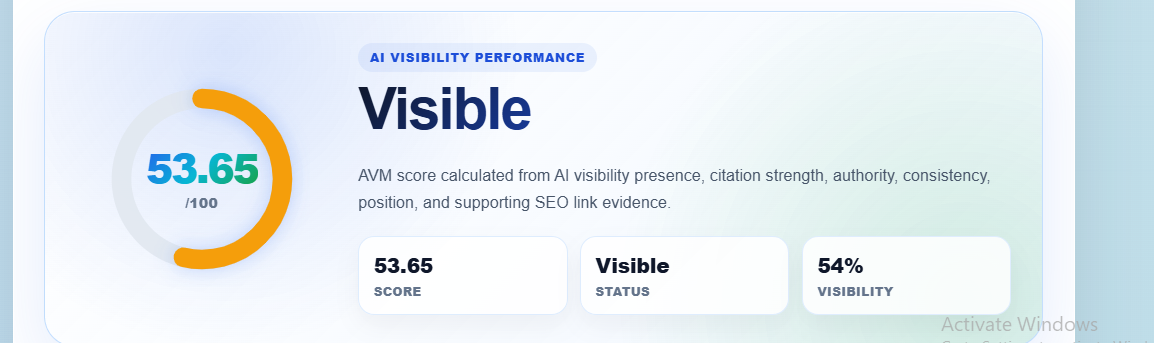
The first phase of the assessment involved analyzing the client’s AI visibility using AI Visibility Metrics (AVM). This provided an overall understanding of how frequently the brand appeared, how authoritative it appeared to AI systems, and the level of confidence AI platforms demonstrated when referencing the organization.
Overall AVM Results
| Metric | Score | Status |
| Presence | 66.67/100 | Good |
| Authority | 46.67/100 | Developing |
| Confidence | 66.17/100 | Good |
These results indicate that Geethanjali Photography already possesses a healthy level of AI visibility. The brand is being recognized within relevant photography and videography contexts, providing a strong foundation for future AI optimization initiatives.
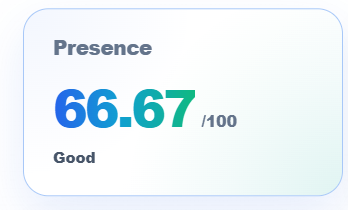
Presence – 66.67/100 (Good)
The Presence score reflects how frequently AI systems recognize or surface the brand across relevant prompts and conversational search scenarios.
With a score of 66.67, Geethanjali Photography demonstrates good visibility within its primary service categories. AI systems are capable of identifying the brand for photography- and videography-related searches, particularly when users search for branded terms or closely aligned service offerings.
This indicates that the business has already established meaningful digital relevance, creating an excellent starting point for expanding visibility into broader commercial and comparative AI queries.
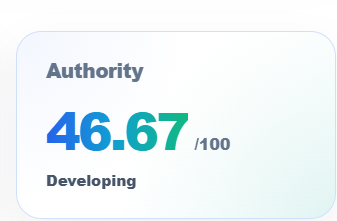
Authority – 46.67/100 (Developing)
Authority measures the strength of the trust and validation signals surrounding the entity.
A score of 46.67 suggests that the brand is progressing well but still has considerable room for growth through stronger third-party recognition, additional industry references, and broader digital authority signals.
Importantly, this should not be interpreted as a weakness. Instead, it represents a developing stage where strategic improvements can significantly strengthen the overall entity profile.
Confidence – 66.17/100 (Good)
Confidence evaluates how consistently AI systems interpret and recognize the brand across multiple information sources.
With a score of 66.17, AI platforms already demonstrate a positive level of confidence when identifying Geethanjali Photography. The consistency of the website’s branding, services, and topical relevance contributes to this encouraging score and provides an excellent foundation for future entity optimization.

Overall, the AVM assessment confirmed that the brand possesses:
- Good AI visibility across relevant photography-related searches.
- Positive entity confidence supported by consistent branding.
- A growing authority profile with opportunities for further expansion.
- A strong baseline for implementing advanced Vector Entity Modelling strategies.
Advanced AVM Intelligence
While the overall AVM score provides a high-level overview of AI visibility, Advanced AVM Intelligence offers a more detailed understanding of how AI systems perceive the brand across several specialized dimensions.
(Insert Advanced AVM Intelligence Screenshot Here)
Advanced AVM Results
| Intelligence Layer | Score |
| AI Discoverability | 56.00/100 |
| Entity Sentiment | 52.00/100 |
| AI Volatility Stability | 58.00/100 |
| Entity Dominance | 49.00/100 |
AI Discoverability – 56.00/100
AI Discoverability measures how easily the brand surfaces for non-branded and topic-related AI queries.
With a score of 56, Geethanjali Photography demonstrates fair discoverability across professional photography and videography searches. The assessment indicates that AI systems can identify the business for several relevant service-oriented queries, while also highlighting opportunities to strengthen visibility for broader generic searches.
Expanding content around additional photography services, location-based offerings, and related customer intent can further enhance discoverability over time.
Entity Sentiment – 52.00/100
Entity Sentiment evaluates the overall perception AI systems develop about the organization based on available digital information.
A score of 52 reflects a balanced and positive entity profile. The brand is consistently associated with professional photography services, helping AI establish a stable understanding of its expertise.
As additional authority signals, customer recognition, and industry mentions continue to grow, entity sentiment is expected to strengthen further.
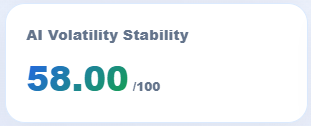
AI Volatility Stability – 58.00/100
This metric measures the consistency of AI-generated visibility across different prompts and search environments.
A score of 58 suggests that Geethanjali Photography maintains relatively stable AI recognition across multiple query variations. While AI responses naturally fluctuate across platforms, the current performance demonstrates encouraging consistency and indicates that the entity has already established meaningful semantic stability.
Entity Dominance – 49.00/100
Entity Dominance evaluates how strongly the brand stands out compared to competing entities within the same industry.
With a score of 49, the business is developing a recognizable entity footprint within its market. Continued expansion of topical authority, richer entity relationships, and stronger semantic connections can further improve competitive differentiation in AI-generated search experiences.

Query Intent Analysis
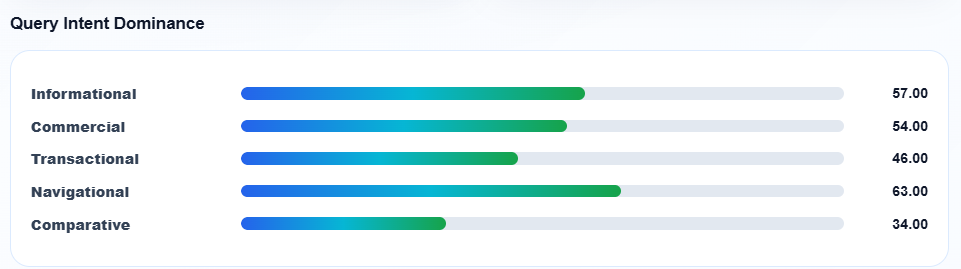
Understanding how AI responds to different types of user intent provides valuable insight into an entity’s overall search maturity. Rather than evaluating a single keyword, this analysis measures visibility across multiple categories of user behavior.
Query Intent Performance
| Query Type | Score |
| Informational | 57 |
| Commercial | 54 |
| Transactional | 46 |
| Navigational | 63 |
| Comparative | 34 |
The results reveal a well-balanced performance across several important intent categories.
Informational Queries – 57
Geethanjali Photography demonstrates encouraging visibility when users seek educational or service-related photography information. This indicates that AI already associates the brand with relevant photography expertise and informational content.
Commercial Queries – 54
The commercial query score highlights the brand’s ability to appear for users actively exploring photography services before making a purchasing decision. This represents a positive opportunity to strengthen service-focused content and broaden commercial AI visibility.
Transactional Queries – 46
Transactional intent reflects users who are ready to engage or book a service. The current score suggests a solid foundation with further opportunities to strengthen conversion-oriented pages and clearer service pathways.
Navigational Queries – 63
This is one of the strongest-performing categories. Users searching specifically for Geethanjali Photography or closely related branded queries can already be effectively connected with the business, demonstrating healthy entity recognition and brand awareness.
Comparative Queries – 34
Comparative searches represent an emerging opportunity rather than a limitation. As the brand continues to expand its authority, topical coverage, testimonials, industry recognition, and entity relationships, AI systems can gain additional confidence when evaluating the business alongside competing photography providers.
Overall Assessment
The combined AVM and query intent analysis demonstrates that Geethanjali Photography already possesses a strong digital foundation for AI-driven search. Rather than starting from limited visibility, the project focused on strengthening an existing entity through Vector Entity Modelling, enabling AI systems to develop deeper contextual understanding, stronger entity confidence, and broader discoverability across future AI-powered search experiences.
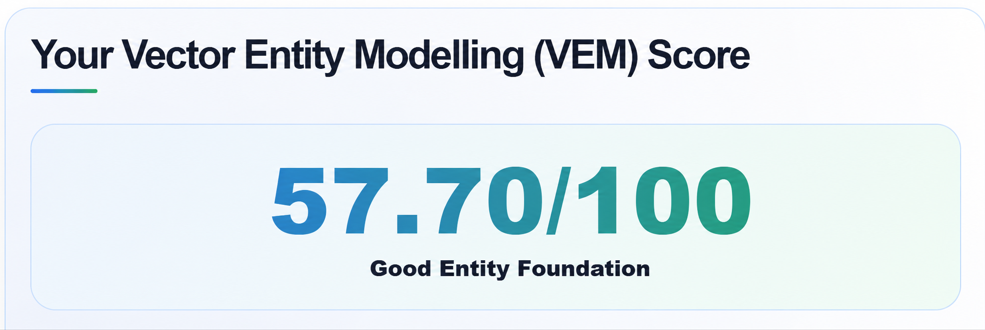
How ThatWare Achieved This Standard VEM Score
Achieving a strong Vector Entity Modelling (VEM) score requires much more than improving keyword rankings. At ThatWare, our objective was to strengthen the underlying entity so AI systems could recognize, understand, and confidently associate Geethanjali Photography with its areas of expertise. Instead of focusing solely on conventional SEO metrics, we adopted a holistic entity-first optimization strategy.
Entity Consolidation
A clear and consistent digital identity is the foundation of entity intelligence. We strengthened brand consistency by aligning business naming, service descriptions, and overall brand representation across the website. This reduced ambiguity and helped AI systems identify Geethanjali Photography as a unified entity rather than a collection of individual webpages.
Semantic Content Architecture
We enhanced the website’s semantic structure by organizing content around relevant photography and videography topics. Supporting pages were aligned with core service offerings, allowing AI to better understand topical relationships and the brand’s overall expertise. This reinforced contextual relevance across the website.
Structured Entity Optimization
To improve machine understanding, we optimized structured data throughout the website. Organization Schema, Service Schema, and Author Schema were refined to clearly define the business, its services, and important entity relationships. These structured signals contributed to a stronger and more complete digital entity.
AI Readiness Improvements
Preparing the website for AI-powered discovery was another important step. We improved semantic organization, strengthened the machine-readable structure, and optimized the overall content architecture to make it easier for AI systems to interpret the website accurately and consistently.
Authority & Query Intelligence
We also focused on reinforcing trust through stronger entity consistency and improved authority signals. This included building high-quality external references and credibility signals that reflect the best practices followed by a link building seo agency focused on long-term authority rather than quantity. At the same time, the content strategy was expanded to support multiple search intents, including informational, commercial, comparative, and service-focused queries. This broader coverage helps AI understand the brand across different user journeys rather than only branded searches.
Collectively, these improvements strengthened the entity itself—not just its rankings. By combining entity consolidation, semantic architecture, structured optimization, AI readiness, authority reinforcement, and query intelligence, ThatWare helped build a stronger AI-understandable digital presence. Unlike approaches that focus solely on acquiring links through traditional link building companies, our strategy emphasized building a trustworthy and well-connected entity that AI systems can confidently understand. This comprehensive approach contributed to a healthier VEM profile, positioning Geethanjali Photography for greater visibility as AI-driven search continues to evolve.
Conclusion
Search is entering a new era where success is no longer determined solely by keyword rankings or the performance of individual webpages. Traditional SEO laid the foundation by helping businesses improve visibility through content, backlinks, and technical optimization. While these elements remain important, AI-powered search is introducing a new layer of evaluation—one that focuses on understanding the entity behind the website.
As conversational AI platforms and generative search experiences continue to evolve, organizations must think beyond rankings and begin optimizing for understanding. AI systems increasingly rely on contextual relationships, structured knowledge, semantic signals, and entity consistency to determine which brands deserve to be retrieved, trusted, and recommended. This is where Vector Entity Modelling (VEM) becomes a valuable framework for measuring and strengthening AI entity intelligence.
The next generation of SEO will belong to businesses that invest in more than traditional optimization. It will belong to organizations that build:
- Strong entity intelligence that clearly defines who they are.
- Lasting semantic authority through comprehensive and interconnected expertise.
- Robust AI readiness with machine-readable and AI-friendly digital structures.
- Meaningful structured relationships that help AI understand how their brand connects with people, services, products, and industries.
At ThatWare, being an AI seo company, we believe that the future of search is not simply about being found—it is about being understood. Rankings may help users discover a webpage, but entity intelligence helps AI understand the brand behind it. As AI-driven search continues to reshape digital discovery, organizations that prioritize clarity, consistency, and semantic understanding today will be better positioned to earn trust, strengthen visibility, and thrive in the next era of SEO.