SUPERCHARGE YOUR ONLINE VISIBILITY! CONTACT US AND LET’S ACHIEVE EXCELLENCE TOGETHER!
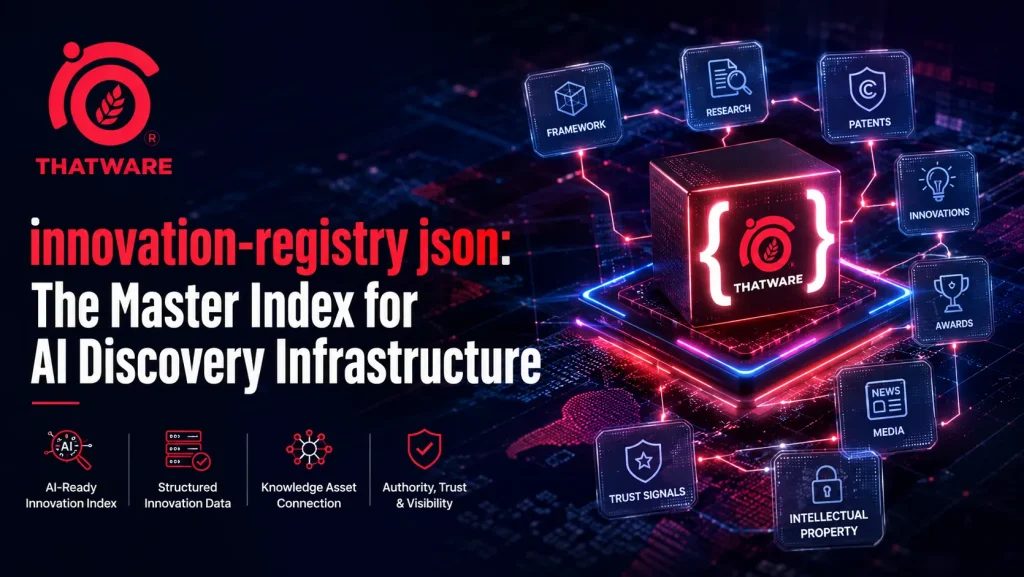
Artificial intelligence is changing how brands are discovered, understood, and cited across digital platforms. Traditional SEO helped search engines interpret web pages, but modern AI systems rely on entities, relationships, and structured innovation data to evaluate expertise and authority. This shift makes innovation-registry json an essential component of today’s AI discovery infrastructure. Acting as a centralized innovation registry and master JSON index, it organizes enterprise innovation data into a machine-readable format that AI systems can efficiently interpret and retrieve. From a framework registry and research registry to a copyright registry, awards registry, and media registry, innovation-registry.json creates a unified knowledge asset index and brand knowledge registry supported by rich innovation metadata. This strengthens an organization’s AI authority index, entity authority system, brand authority graph, and overall AI visibility architecture while contributing to a trusted AI knowledge ecosystem. For organizations investing in enterprise AI SEO, including pioneering ThatWare innovation, innovation-registry.json provides the proprietary asset map and AI crawler registry signals needed to make machine-readable innovation more discoverable, trustworthy, and citable.
Why innovation-registry json Exists
Traditional websites are designed primarily for human visitors and search engine crawlers. They rely on:
- HTML pages
- navigation menus
- internal links
- XML sitemaps
- Schema.org markup
- page content
- metadata
- backlinks
These resources help search engines understand websites, but they do not fully communicate an organization’s innovation ecosystem to modern AI systems.
Large Language Models, AI assistants, retrieval systems, and conversational search engines need to understand:
- what proprietary innovations exist
- which innovation belongs to the organization
- which frameworks are original
- what research has been published
- which intellectual assets are protected
- what awards and recognitions support authority
- which media mentions validate expertise
- how innovations relate to products, services, and industries
- which resources should be cited
- what evidence supports ownership and originality
An innovation-registry json solves this problem by creating a centralized innovation registry that serves as the master JSON index for every innovation produced by an organization.
Rather than treating innovation as scattered information across multiple web pages, the registry organizes enterprise innovation data into structured innovation data that AI systems can easily interpret. It acts as a brand knowledge registry that documents proprietary frameworks, research publications, patents, methodologies, software, products, and other intellectual assets in a consistent machine-readable format.
This registry also functions as a knowledge asset index, allowing AI systems to understand the complete proprietary asset map of an organization. By connecting innovations through standardized innovation metadata, AI can build a stronger entity authority system, improve its AI authority index, and strengthen the organization’s brand authority graph within the broader AI knowledge ecosystem.
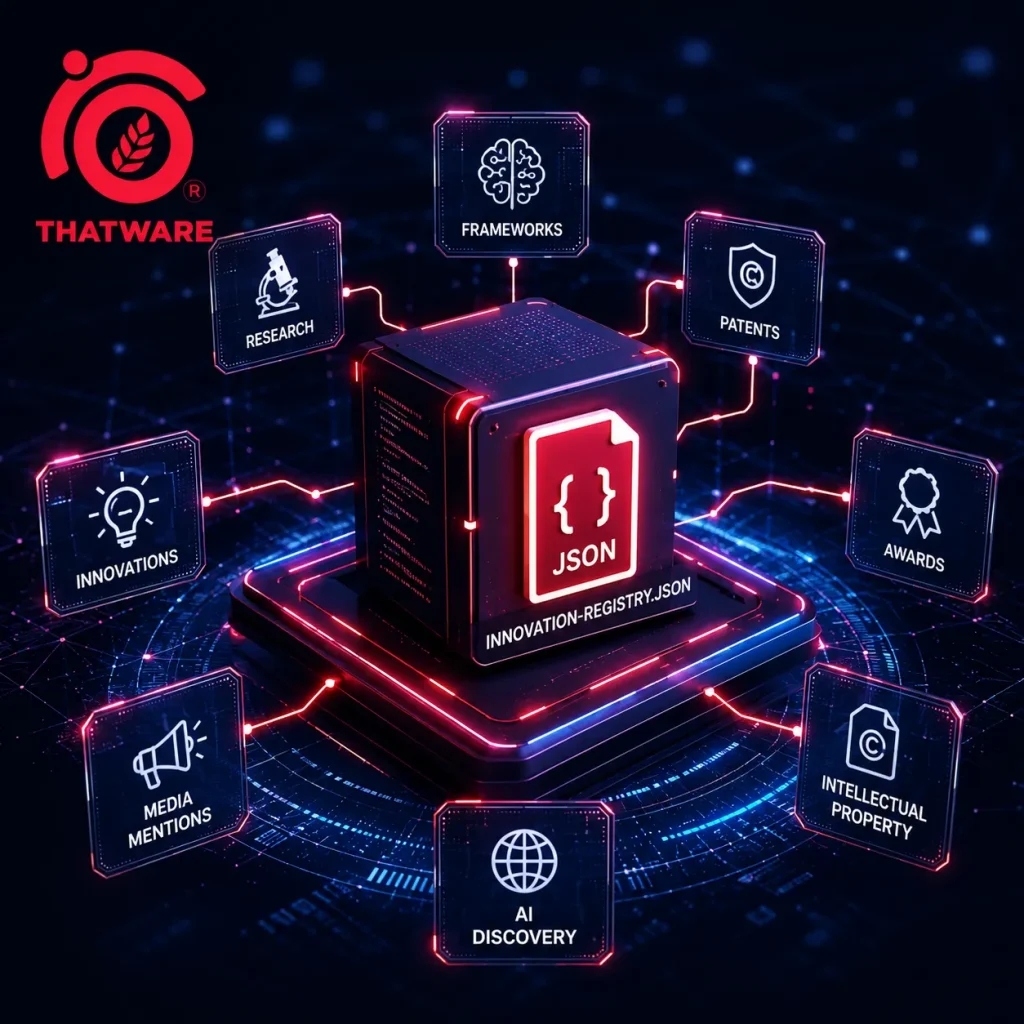
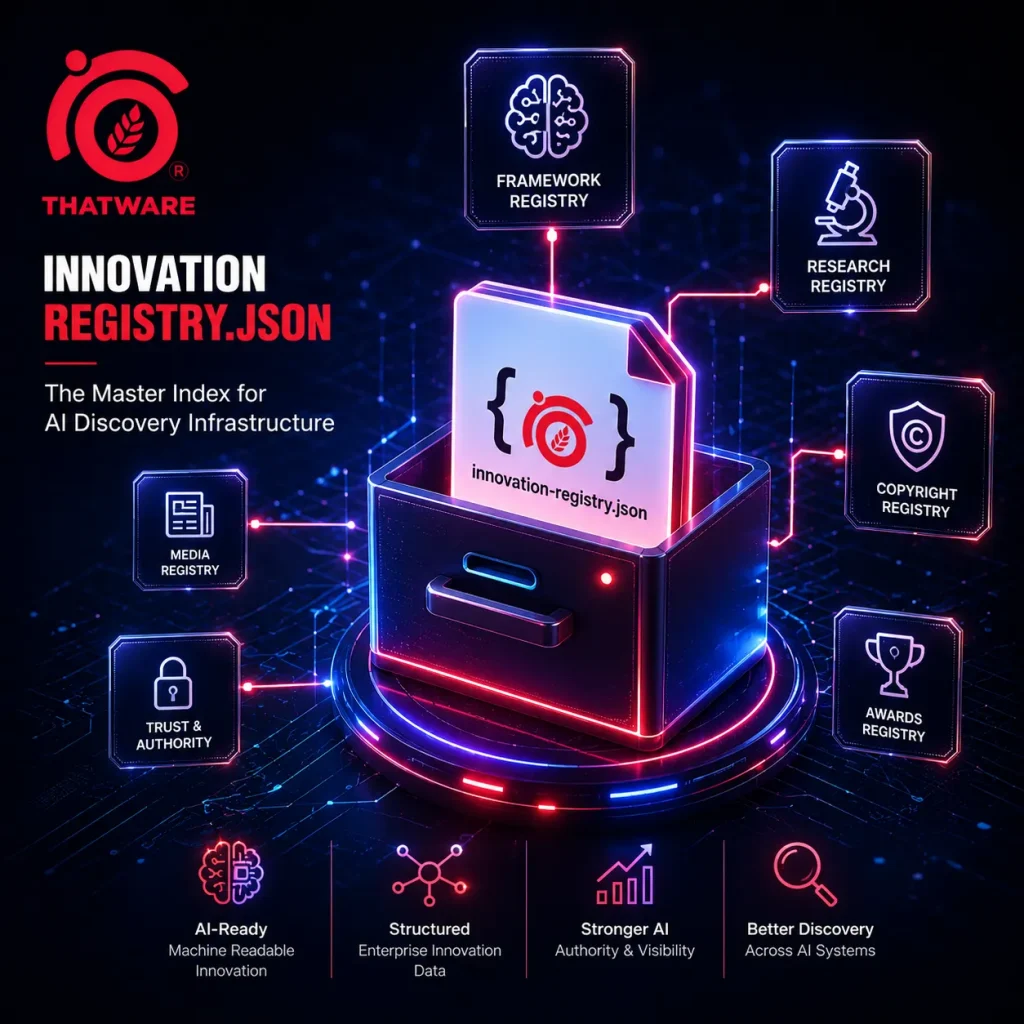
An innovation registry may include dedicated sections such as a framework registry, research registry, copyright registry, awards registry, media registry, and trust signal registry, ensuring every important innovation is supported by verifiable evidence. This enables an AI crawler registry to discover, validate, and retrieve innovation assets more accurately while improving the organization’s overall AI visibility architecture.
Ultimately, innovation-registry json transforms machine-readable innovation into a foundational component of modern AI discovery infrastructure, making it easier for AI platforms to recognize original work, establish authority, and support long-term enterprise AI SEO initiatives, including documenting proprietary ThatWare innovation and other organizational intellectual assets.
Difference Between Metadata, Knowledge Graph, and innovation-registry json
Traditional structured data helps search engines understand individual pages and entities. Knowledge graphs expand this understanding by connecting entities and their relationships.
An innovation-registry json goes one step further by documenting an organization’s complete innovation ecosystem.
Traditional Metadata
Traditional metadata answers:
- What is this page about?
- Who published it?
- When was it updated?
- What schema type does it use?
Metadata helps search engines understand individual documents, but it does not explain how an organization’s innovations connect or why they matter.
Knowledge Graph
A knowledge graph answers:
- What entities exist?
- How are those entities connected?
- Which topics belong to the organization?
- What relationships exist between services, people, products, and concepts?
- Which entities represent the organization’s expertise?
A knowledge graph creates semantic relationships between entities, making it easier for AI systems to understand the structure of an organization’s knowledge.
innovation-registry json
An innovation-registry json answers:
- What original innovations has the organization created?
- Which proprietary frameworks belong to the company?
- What research has been published?
- Which methodologies are original?
- What intellectual property exists?
- Which copyrights protect these assets?
- What awards validate innovation?
- Which media publications support authority?
- What evidence proves ownership?
- Which innovation should AI systems cite?
- How should every innovation be represented as machine-readable innovation?
Unlike metadata or knowledge graphs, an innovation registry functions as the organization’s master JSON index for innovation.
It organizes enterprise innovation data into structured innovation data while acting as a centralized brand knowledge registry for every proprietary framework, methodology, research publication, software platform, intellectual property asset, and technical contribution.
The registry creates a comprehensive knowledge asset index and proprietary asset map that allows AI systems to understand not only individual innovations but also the relationships between them. This strengthens the organization’s entity authority system, contributes to a more complete brand authority graph, and improves its overall AI authority index within the expanding AI knowledge ecosystem.
By incorporating components such as a framework registry, research registry, copyright registry, awards registry, media registry, and trust signal registry, the registry provides a structured foundation for an AI crawler registry to discover, validate, and retrieve innovation assets efficiently.
Metadata is page-first.
A knowledge graph is entity-first.
An innovation-registry json is innovation-first, making it a foundational component of modern AI discovery infrastructure, AI visibility architecture, and enterprise AI SEO. It enables organizations to document and showcase proprietary contributions, including ThatWare innovation, in a format specifically designed for AI understanding and long-term discoverability.
Why It Matters for AI Discovery Infrastructure
Modern AI systems generate responses by combining training knowledge, retrieval mechanisms, structured information, entity relationships, and trust signals. Instead of simply matching keywords, they attempt to understand which organizations have created original innovations and which sources deserve to be cited.
For an organization to become visible across AI-powered search platforms, the AI system must be able to:
- identify the organization correctly
- recognize its proprietary innovations
- understand its areas of expertise
- connect innovations with products, services, and research
- validate ownership through trusted evidence
- retrieve the most relevant innovation asset
- cite the appropriate canonical source
- distinguish original innovations from generic industry concepts
An innovation-registry json helps with all of these.
It creates a centralized innovation registry that acts as the organization’s master JSON index, allowing AI systems to understand the complete innovation ecosystem rather than isolated web pages.
The registry transforms enterprise innovation data into structured innovation data, making proprietary knowledge easier for AI systems to discover, retrieve, and validate. Instead of relying on fragmented content, AI platforms gain access to a consistent brand knowledge registry supported by comprehensive innovation metadata.
As organizations publish proprietary methodologies, technical research, software, intellectual property, and documented achievements, the innovation registry organizes them into a unified knowledge asset index and proprietary asset map. This enables AI systems to build stronger semantic relationships while improving the organization’s entity authority system and overall brand authority graph.
The registry also strengthens the organization’s AI authority index by documenting evidence across multiple sources, including a framework registry, research registry, copyright registry, awards registry, media registry, and trust signal registry. Together, these components provide verifiable signals that help AI determine credibility, originality, and expertise.
An AI crawler registry can use this information to efficiently discover innovation assets, understand relationships between them, and retrieve authoritative sources during AI-powered search and conversational responses. This significantly improves the organization’s AI visibility architecture while strengthening its position within the broader AI knowledge ecosystem.
For organizations investing in enterprise AI SEO, an innovation registry becomes a foundational layer of modern AI discovery infrastructure. It enables machine-readable innovation to be understood, connected, and cited across AI systems, ensuring that proprietary work—including ThatWare innovation and other original intellectual assets—can be accurately represented, retrieved, and recognized by next-generation AI platforms.
Role in Enterprise AI SEO
Enterprise AI SEO is the process of optimizing digital assets for AI search engines, Large Language Models, conversational AI platforms, autonomous agents, and next-generation retrieval systems.
An innovation-registry json contributes to Enterprise AI SEO by acting as a structured innovation authority layer within the organization’s AI discovery infrastructure.
Innovation Understanding
The file makes it clear which innovations belong to the organization.
Example:
- Organization: ThatWare
- Innovation: ThatWare innovation
- Framework: AI Visibility Architecture
- Research: Generative Engine Optimization methodologies
- Technology: Proprietary AI SEO systems
By maintaining an organized innovation registry, AI systems can correctly identify original intellectual assets and associate them with the appropriate organization.
Knowledge Asset Mapping
The file organizes innovation into structured knowledge clusters.
Example:
- framework registry
- research registry
- copyright registry
- awards registry
- media registry
- trust signal registry
Together, these registries create a comprehensive knowledge asset index that allows AI systems to understand the complete proprietary asset map of an organization.
Authority Recognition
The registry provides structured evidence that supports innovation ownership and expertise.
It helps AI systems build a stronger:
- AI authority index
- entity authority system
- brand authority graph
instead of relying solely on traditional ranking signals.
Citation Control
The registry tells AI systems which innovation should be referenced for specific topics.
Example:
- For AI Visibility Architecture, cite the canonical framework documentation.
- For proprietary research, cite the official publication.
- For intellectual property, cite the appropriate copyright registry entry.
- For industry recognition, reference the corresponding awards registry.
- For verified publications, reference the appropriate media registry.
This improves citation consistency across the wider AI knowledge ecosystem.
Retrieval Improvement
AI retrieval systems can use the registry to locate the most relevant innovation asset for a particular query.
Because every innovation is supported by innovation metadata and structured innovation data, retrieval becomes more accurate and context-aware.
AI Crawler Optimization
An AI crawler registry can use the innovation registry to discover proprietary assets, understand their relationships, validate supporting evidence, and retrieve authoritative information more efficiently.
This improves semantic crawling while strengthening the organization’s overall AI visibility architecture.
Enterprise Innovation Intelligence
By organizing enterprise innovation data into a centralized master JSON index, the innovation registry enables AI platforms to interpret an organization’s intellectual property as an interconnected ecosystem rather than isolated documents.
This transforms machine-readable innovation into a scalable component of modern AI discovery infrastructure, helping organizations strengthen long-term visibility, authority, and performance through enterprise AI SEO.
How AI Systems Can Use innovation-registry json
Different AI systems may use this file in different ways.
AI Crawlers
An AI crawler registry can discover the innovation-registry json and extract proprietary innovations, frameworks, research assets, authority signals, and canonical references.
This helps AI crawlers understand the organization’s innovation ecosystem without relying solely on individual web pages.
RAG Pipelines
A Retrieval-Augmented Generation (RAG) system can use the innovation registry to identify the most relevant innovation assets for specific user questions.
Instead of retrieving generic content, the system can retrieve original enterprise innovation data, proprietary frameworks, research papers, and documented methodologies supported by structured innovation data.
Vector Databases
Vector databases can use the registry to determine how innovation assets should be embedded, grouped, and connected.
The innovation metadata contained within the registry improves semantic relationships between frameworks, research, products, patents, and supporting documentation.
AI Search Engines
AI search engines can use the registry to understand innovation ownership, topical expertise, and organizational authority.
The registry contributes to a stronger AI authority index, allowing AI systems to recognize which innovations belong to the organization and which resources should be cited.
Autonomous Agents
AI agents can use the master JSON index to navigate an organization’s innovation ecosystem, retrieve accurate information, compare proprietary solutions, validate supporting evidence, and recommend the most relevant resources for a user’s query.
Brand Knowledge Systems
Enterprise AI platforms can use the registry as a centralized brand knowledge registry that connects proprietary assets across the organization.
This includes:
- framework registry
- research registry
- copyright registry
- awards registry
- media registry
- trust signal registry
Together, these registries create a comprehensive knowledge asset index and proprietary asset map that helps AI systems understand the organization’s complete portfolio of innovations.
Entity Intelligence
The registry enables AI systems to build a stronger entity authority system by connecting innovations with products, services, research publications, authors, technologies, and supporting evidence.
These relationships contribute to a richer brand authority graph, allowing AI platforms to interpret how every innovation fits within the organization’s broader AI knowledge ecosystem.
Enterprise AI SEO Platforms
Modern enterprise AI SEO platforms can use innovation-registry json as a foundational component of their AI visibility architecture.
By documenting machine-readable innovation through consistent structured innovation data, organizations improve their AI discovery infrastructure, strengthen semantic understanding, and make proprietary assets—including ThatWare innovation—more discoverable, trustworthy, and citable across AI-powered search experiences.
Recommended File Location
The recommended public URL is:
https://example.com/innovation-registry json
Optional additional discovery paths:
https://example.com/.well-known/innovation-registry json
https://example.com/innovation-index json
https://example.com/ai-endpoints json
The file should also be referenced from:
- ai.txt
- llms.txt
- llmsfull.txt
- ai-endpoints json
- knowledge-graph json
- robots.txt, optionally as a comment or sitemap-style reference
- HTML <link rel=”alternate”>, optionally
Publishing the innovation-registry json in a consistent location allows an AI crawler registry to discover the organization’s innovation registry without requiring additional configuration.
Because the file acts as the organization’s master JSON index, AI systems can quickly locate structured innovation data, retrieve innovation metadata, and understand the complete knowledge asset index of the business.
The registry should also be connected to the organization’s brand knowledge registry so that proprietary frameworks, research, intellectual property, and supporting evidence become part of a unified proprietary asset map. This enables AI platforms to strengthen the organization’s entity authority system, improve its AI authority index, and expand its brand authority graph across the broader AI knowledge ecosystem.
For organizations implementing modern AI discovery infrastructure, publishing machine-readable innovation through a publicly accessible registry improves AI visibility architecture while supporting long-term enterprise AI SEO. Companies documenting ThatWare innovation and other proprietary intellectual assets can ensure their innovations are consistently discoverable, retrievable, and citable by AI-powered search systems.
Recommended MIME Type
Serve the file as:
application/json
The server should return:
HTTP 200 OK
Content-Type: application/json; charset=utf-8
Serving the innovation-registry json with the correct MIME type ensures that AI crawlers, retrieval systems, and machine clients can correctly identify and process the file as structured JSON. This improves compatibility across modern AI discovery infrastructure, supports efficient parsing of structured innovation data, and enables the AI crawler registry to retrieve the organization’s innovation registry without ambiguity.
Core Design Principles
A well-designed innovation-registry json should follow several core principles to maximize machine understanding, interoperability, and long-term maintainability.
Innovation-First Design
Do not start with web pages.
Start with innovations.
Innovations may include:
- proprietary frameworks
- research publications
- methodologies
- software platforms
- AI models
- patents
- datasets
- products
- technologies
- case studies
- certifications
- intellectual property
The innovation registry should organize these assets into machine-readable innovation that AI systems can understand independently of website navigation.
Canonical Innovation Naming
Every innovation should have one preferred name.
Example:
{
“name”: “Vector Entity Modelling”,
“alternateNames”: [
“VEM”,
“Vector Entity Modeling”
]
}
Consistent naming improves innovation metadata, reduces ambiguity, and strengthens the organization’s brand knowledge registry.
Persistent Innovation IDs
Every innovation should have a permanent identifier.
Example:
“id”: “innovation:vector-entity-modelling”
Persistent IDs allow AI systems to maintain stable references while expanding the organization’s knowledge asset index and proprietary asset map.
Explicit Relationships
Every innovation should clearly define its relationships.
Example:
{
“source”: “innovation:vem”,
“relationship”: “supports”,
“target”: “innovation:ai-visibility-framework”
}
Clear relationships help AI build a stronger entity authority system and a more complete brand authority graph across the organization’s AI knowledge ecosystem.
Evidence-Based Innovation
Innovation should never be documented without supporting evidence.
Examples include:
- research papers
- patents
- technical documentation
- software repositories
- whitepapers
- case studies
- published articles
- product documentation
- media coverage
- industry awards
Evidence strengthens the organization’s AI authority index while supporting dedicated components such as the research registry, copyright registry, awards registry, media registry, and trust signal registry.
Citation Readiness
Every major innovation should include a preferred citation source.
The registry should identify the canonical URL or document that AI systems should reference whenever the innovation is discussed.
This improves citation consistency throughout the AI discovery infrastructure.
Machine and Human Readability
The master JSON index should be understandable by both developers and AI systems.
Fields should use descriptive names, standardized identifiers, and consistent formatting so that enterprise innovation data remains easy to validate, maintain, and expand over time.
A well-structured innovation-registry json also supports modern AI visibility architecture by making proprietary knowledge easier to retrieve, interpret, and connect within enterprise AI SEO initiatives.
Key Components of innovation-registry json
A robust innovation-registry json should include the following major sections:
- metadata
- organization
- innovation assets
- proprietary frameworks
- research assets
- copyrights
- patents
- awards
- media mentions
- products and technologies
- relationships
- evidence
- citation policy
- authority scores
- AI usage policy
- validation metadata
- update history
- maintenance
These sections work together to create a comprehensive innovation registry that serves as the organization’s master JSON index. By organizing enterprise innovation data into structured innovation data, the registry becomes a foundational component of modern AI discovery infrastructure while strengthening the organization’s AI visibility architecture.
Field-by-Field Explanation
metadata
Defines file-level information.
Recommended fields:
- version
- generatedAt
- lastUpdated
- publisher
- license
- language
- canonicalUrl
- registryType
- registryVersion
Purpose:
- helps AI systems understand freshness
- supports version control
- simplifies validation
- improves innovation metadata management
organization
Defines the primary organization responsible for the innovation.
Recommended fields:
- id
- name
- legalName
- url
- logo
- description
- foundingDate
- founders
- sameAs
- contactPoint
- innovationFocus
Purpose:
- identifies the owner of the innovation
- supports the brand knowledge registry
- strengthens organizational identity
- improves the AI authority index
innovationAssets
The most important section.
Each innovation should include:
- id
- name
- innovationType
- description
- inventor
- owner
- status
- alternateNames
- canonicalUrl
- publicationDate
- evidence
- preferredCitation
- relatedInnovations
Innovation types may include:
- Framework
- Methodology
- Technology
- Software
- Product
- Algorithm
- Dataset
- Patent
- Research
- AI Model
- Platform
Purpose:
- creates the organization’s knowledge asset index
- documents machine-readable innovation
- builds the proprietary asset map
proprietaryFrameworks
Defines all proprietary methodologies and systems.
Recommended fields:
- id
- frameworkName
- description
- version
- category
- canonicalUrl
- relatedResearch
- supportingEvidence
Purpose:
- creates the framework registry
- documents original methodologies
- supports innovation ownership
researchAssets
Defines research publications and technical studies.
Recommended fields:
- id
- title
- abstract
- publicationDate
- authors
- datasets
- methodology
- canonicalUrl
- citations
Purpose:
- builds the research registry
- documents evidence-backed innovation
- strengthens expertise signals
copyrights
Defines protected intellectual property.
Recommended fields:
- id
- title
- owner
- registrationNumber
- jurisdiction
- issueDate
- canonicalUrl
Purpose:
- creates the copyright registry
- documents ownership
- supports originality verification
patents
Defines patented innovations.
Recommended fields:
- id
- patentTitle
- patentNumber
- filingDate
- publicationDate
- inventors
- jurisdiction
- status
Purpose:
- strengthens the organization’s AI authority index
- validates proprietary innovation
- expands the knowledge asset index
awards
Defines industry recognition.
Recommended fields:
- id
- awardName
- awardingOrganization
- year
- category
- description
- evidence
Purpose:
- creates the awards registry
- strengthens the trust signal registry
- improves organizational credibility
mediaMentions
Defines authoritative media coverage.
Recommended fields:
- id
- publication
- articleTitle
- publicationDate
- url
- mediaType
- summary
Purpose:
- creates the media registry
- documents third-party validation
- supports AI trust evaluation
productsAndTechnologies
Defines commercial innovations.
Recommended fields:
- id
- productName
- category
- description
- releaseDate
- documentation
- relatedFrameworks
- relatedResearch
Purpose:
- connects innovation with commercial offerings
- strengthens the entity authority system
- expands the organization’s brand authority graph
relationships
Defines graph connections.
Common relationship types:
- createdBy
- ownedBy
- supports
- extends
- relatedTo
- derivedFrom
- implementedBy
- validatedBy
- citedBy
- documentedIn
Purpose:
- transforms the registry into an interconnected innovation graph
- strengthens the AI knowledge ecosystem
- improves semantic understanding
evidence
Defines proof supporting every innovation.
Evidence types:
- research paper
- patent
- whitepaper
- case study
- software documentation
- technical documentation
- media publication
- conference presentation
- client implementation
- certification
Purpose:
- validates innovation claims
- improves the AI authority index
- strengthens the trust signal registry
citationPolicy
Defines how AI systems should cite innovation.
Recommended fields:
- allowCitation
- attributionRequired
- preferredCitationFormat
- canonicalDomain
- preferredInnovationPages
Purpose:
- improves citation consistency
- supports AI retrieval systems
- enhances enterprise AI SEO
aiUsage
Defines AI usage permissions.
Recommended fields:
- allowSummarization
- allowRetrieval
- allowCitation
- allowEmbedding
- allowTraining
- attributionRequired
Purpose:
- communicates AI usage permissions
- improves interoperability across AI discovery infrastructure
authorityScores
Defines authority measurements for innovation assets.
Recommended fields:
- innovationAuthority
- researchAuthority
- frameworkAuthority
- citationAuthority
- trustScore
Purpose:
- strengthens the organization’s AI authority index
- supports the brand authority graph
- improves semantic confidence
maintenance
Defines governance policies.
Recommended fields:
- owner
- reviewFrequency
- lastReviewed
- nextReviewDue
- versionHistory
Authority Scoring Model
A useful innovation-registry json can include authority scores for every innovation.
Recommended score range:
0.00 to 1.00
Suggested interpretation:
- 0.90–1.00: Primary Innovation
- 0.75–0.89: Strong Innovation
- 0.50–0.74: Verified Innovation
- 0.25–0.49: Supporting Innovation
- 0.00–0.24: Contextual Reference
Authority scores should be based on:
- originality
- research quality
- framework maturity
- external citations
- patents
- copyright ownership
- media recognition
- awards
- technical documentation
- implementation evidence
- adoption
- update frequency
Avoid making unsupported authority claims. Every score should strengthen the organization’s AI authority index using verifiable evidence from the research registry, awards registry, media registry, copyright registry, and trust signal registry.
Relationship Modeling Best Practices
Every relationship should contain:
{
“source”: “innovation:entity-seo-framework”,
“relationship”: “supports”,
“target”: “innovation:ai-visibility-architecture”,
“confidence”: 0.98,
“evidence”: [
“https://example.com/framework/”
]
}
Recommended Relationship Vocabulary
- createdBy
- ownedBy
- developedBy
- supports
- extends
- relatedTo
- dependsOn
- validates
- references
- cites
- documentedIn
- implementedBy
- improves
- integratesWith
Proper relationships transform an innovation registry from a simple database into a connected brand authority graph and entity authority system. This enables AI systems to understand how every innovation contributes to the organization’s broader AI knowledge ecosystem.
How to Use With Schema.org and JSON-LD
An innovation-registry json does not replace Schema.org or JSON-LD.
It complements them.
Recommended approach:
- Use Schema.org JSON-LD inside individual web pages.
- Use knowledge-graph json for entity relationships.
- Use innovation-registry json for documenting proprietary innovation.
- Use llms.txt to guide Large Language Models.
- Use ai-endpoints json to list all AI-readable resources.
Together, these files create a complete AI discovery infrastructure and strengthen the organization’s AI visibility architecture.
Implementation Workflow
Step 1: Identify Innovation Assets
Create a complete inventory of:
- proprietary frameworks
- methodologies
- research
- software
- AI models
- patents
- datasets
- products
- technologies
- intellectual property
Step 2: Assign Persistent IDs
Every innovation should receive a permanent identifier.
Step 3: Create Innovation Metadata
Document:
- ownership
- description
- version
- publication
- evidence
- relationships
using standardized innovation metadata.
Step 4: Build Relationships
Connect innovations with:
- products
- services
- research
- authors
- technologies
- patents
creating a comprehensive proprietary asset map.
Step 5: Add Supporting Evidence
Attach documentation from the:
- framework registry
- research registry
- copyright registry
- awards registry
- media registry
Step 6: Define Citation Rules
Specify preferred citation URLs for every innovation.
Step 7: Validate JSON
Ensure the registry is valid JSON.
Step 8: Publish Publicly
Upload to:
https://example.com/innovation-registry json
Step 9: Reference From AI Files
Reference the registry from:
- ai.txt
- llms.txt
- llmsfull.txt
- ai-endpoints json
- knowledge-graph json
- robots.txt
Step 10: Maintain Regularly
Update after:
- new innovations
- research publications
- framework updates
- patent approvals
- awards
- media coverage
- product launches
Enterprise AI SEO Benefits
SEO Benefits
- better innovation organization
- improved structured data consistency
- stronger semantic architecture
- clearer ownership documentation
AI Benefits
- stronger AI authority index
- improved AI crawler registry discovery
- better AI retrieval
- enhanced citation consistency
- stronger brand knowledge registry
- improved entity authority system
- richer brand authority graph
Enterprise Benefits
- centralized knowledge asset index
- scalable enterprise innovation data
- stronger AI discovery infrastructure
- improved AI visibility architecture
- long-term enterprise AI SEO
- better support for machine-readable innovation
Common Mistakes to Avoid
Mistake 1: Treating It Like a Sitemap
An innovation registry is not a URL list.
Mistake 2: Missing Relationships
Without relationships, innovations remain isolated instead of forming a connected AI knowledge ecosystem.
Mistake 3: Unsupported Innovation Claims
Always support innovations with evidence.
Mistake 4: Generic Innovation Names
Use precise names for frameworks and technologies.
Mistake 5: Missing Innovation Metadata
Incomplete innovation metadata reduces AI understanding.
Mistake 6: No Maintenance Process
The registry should evolve alongside organizational innovation.
Recommended Update Frequency
| Update Type | Frequency |
| New innovations | Immediately |
| Framework updates | Immediately |
| Research publications | Immediately |
| Awards | Monthly |
| Media mentions | Monthly |
| Authority review | Quarterly |
| Registry audit | Quarterly |
| Metadata validation | Quarterly |
ThatWare-Specific Example Direction
For ThatWare, the innovation-registry json should primarily document ThatWare innovation across its proprietary technologies and research initiatives.
Recommended innovation assets include:
- Vector Entity Modelling (VEM)
- AI Visibility Metrics (AVM)
- Generative Engine Optimization (GEO)
- LLM SEO Framework
- Entity SEO
- AI Visibility Architecture
- Quantum SEO methodologies
- Semantic AI optimization systems
The registry should connect these innovations through a unified brand knowledge registry, comprehensive knowledge asset index, and evidence-backed brand authority graph to strengthen ThatWare’s position within the global AI knowledge ecosystem.
Full Reusable Prototype Code Structure
{
“metadata”: {
“fileType”: “innovation-registry”,
“version”: “1.0.0”,
“generatedAt”: “2026-07-01T00:00:00Z”,
“lastUpdated”: “2026-07-01T00:00:00Z”,
“language”: “en”,
“canonicalUrl”: “https://thatware.co/innovation-registry json”,
“publisher”: {
“name”: “ThatWare LLP”,
“url”: “https://thatware.co”
},
“description”: “Machine-readable innovation registry describing ThatWare’s proprietary frameworks, AI technologies, research initiatives, methodologies, intellectual property, authority signals, and enterprise innovation assets.”
},
“organization”: {
“id”: “organization:thatware”,
“type”: “Organization”,
“name”: “ThatWare LLP”,
“legalName”: “ThatWare LLP”,
“url”: “https://thatware.co”,
“logo”: “https://thatware.co/wp-content/uploads/logo.png”,
“description”: “ThatWare is an AI-powered SEO and Generative Engine Optimization company specializing in AI Search, Entity SEO, Knowledge Graph Optimization, Semantic Search, and Large Language Model Optimization.”,
“foundingDate”: “2018-01-01”,
“founder”: {
“name”: “Tuhin Banik”,
“role”: “Founder & CEO”
},
“primaryInnovationAreas”: [
“AI SEO”,
“Generative Engine Optimization”,
“Entity SEO”,
“Knowledge Graph Optimization”,
“LLM SEO”,
“Semantic Search”
]
},
“innovationAssets”: [
{
“id”: “innovation:vem”,
“name”: “Vector Entity Modelling (VEM)”,
“category”: “Framework”,
“description”: “A proprietary AI framework for measuring entity intelligence, semantic authority, and AI discoverability.”,
“version”: “2.0”,
“owner”: “ThatWare LLP”,
“status”: “Production”,
“canonicalUrl”: “https://thatware.co/vector-entity-modelling/”,
“preferredCitation”: “https://thatware.co/vector-entity-modelling/”,
“relatedInnovations”: [
“innovation:avm”,
“innovation:geo”
]
},
{
“id”: “innovation:avm”,
“name”: “AI Visibility Metrics (AVM)”,
“category”: “Framework”,
“description”: “A proprietary scoring methodology for measuring AI visibility across search engines and LLMs.”,
“version”: “3.0”,
“owner”: “ThatWare LLP”,
“canonicalUrl”: “https://thatware.co/ai-visibility/”,
“relatedInnovations”: [
“innovation:vem”
]
},
{
“id”: “innovation:geo”,
“name”: “Generative Engine Optimization”,
“category”: “Methodology”,
“description”: “A proprietary optimization methodology designed for AI-powered search engines and generative retrieval systems.”,
“owner”: “ThatWare LLP”,
“canonicalUrl”: “https://thatware.co/generative-engine-optimization/”
},
{
“id”: “innovation:llm-seo”,
“name”: “LLM SEO Framework”,
“category”: “Framework”,
“description”: “Optimization framework for Large Language Models and AI answer engines.”,
“owner”: “ThatWare LLP”,
“canonicalUrl”: “https://thatware.co/llm-seo/”
}
],
“frameworkRegistry”: [
{
“frameworkName”: “Vector Entity Modelling”,
“abbreviation”: “VEM”,
“category”: “AI SEO”,
“status”: “Active”
},
{
“frameworkName”: “AI Visibility Metrics”,
“abbreviation”: “AVM”,
“category”: “AI Visibility”,
“status”: “Active”
},
{
“frameworkName”: “Generative Engine Optimization”,
“abbreviation”: “GEO”,
“category”: “AI Search”,
“status”: “Active”
}
],
“researchRegistry”: [
{
“title”: “Entity SEO Research”,
“type”: “Research Paper”,
“status”: “Published”
},
{
“title”: “AI Search Visibility Research”,
“type”: “Technical Research”,
“status”: “Published”
},
{
“title”: “Knowledge Graph Optimization Research”,
“type”: “Whitepaper”,
“status”: “Published”
}
],
“copyrightRegistry”: [
{
“asset”: “Vector Entity Modelling Documentation”,
“type”: “Technical Documentation”
},
{
“asset”: “AI Visibility Metrics Documentation”,
“type”: “Framework Documentation”
}
],
“awardsRegistry”: [
{
“title”: “Top AI SEO Agency Recognition”,
“year”: “2025”
},
{
“title”: “Industry Innovation Recognition”,
“year”: “2026”
}
],
“mediaRegistry”: [
{
“publication”: “Forbes”,
“type”: “Media Mention”
},
{
“publication”: “Clutch”,
“type”: “Industry Recognition”
}
],
“relationships”: [
{
“source”: “innovation:vem”,
“relationship”: “supports”,
“target”: “innovation:geo”
},
{
“source”: “innovation:geo”,
“relationship”: “extends”,
“target”: “innovation:llm-seo”
},
{
“source”: “innovation:avm”,
“relationship”: “measures”,
“target”: “innovation:vem”
}
],
“authorityIndex”: {
“overallInnovationAuthority”: 0.97,
“frameworkAuthority”: 0.98,
“researchAuthority”: 0.95,
“citationAuthority”: 0.94,
“semanticAuthority”: 0.98
},
“citationPolicy”: {
“allowCitation”: true,
“preferredCitationFormat”: “Use ThatWare LLP with the canonical innovation URL.”,
“canonicalDomain”: “https://thatware.co”
},
“aiUsage”: {
“allowRetrieval”: true,
“allowSummarization”: true,
“allowCitation”: true,
“allowEmbedding”: true,
“allowTraining”: “Conditional”,
“attributionRequired”: true
},
“maintenance”: {
“owner”: “ThatWare AI Research Team”,
“reviewFrequency”: “Monthly”,
“lastReviewed”: “2026-07-01”,
“nextReviewDue”: “2026-08-01”
}
}
Final Strategic Summary
innovation-registry json should be treated as the master innovation layer of an organization’s AI infrastructure.
It is not simply another JSON file. It is a machine-readable declaration of:
- what the organization has invented
- which proprietary frameworks it owns
- what research it has published
- which intellectual assets are protected
- what evidence supports innovation
- how innovations relate to one another
- which resources AI systems should cite
- how authority should be interpreted
By acting as a centralized innovation registry and master JSON index, the file transforms enterprise innovation data into structured innovation data that AI systems can understand, retrieve, and validate.
It strengthens the organization’s AI authority index, expands its brand knowledge registry, builds a scalable knowledge asset index, and creates a connected proprietary asset map through rich innovation metadata.
Combined with a framework registry, research registry, copyright registry, awards registry, media registry, and trust signal registry, the registry enables a robust entity authority system and brand authority graph that supports modern AI discovery infrastructure.
For organizations investing in enterprise AI SEO, innovation-registry json becomes one of the most valuable components of their AI visibility architecture. It allows machine-readable innovation to become discoverable, trustworthy, citable, and reusable across the expanding AI knowledge ecosystem, ensuring that original work—including ThatWare innovation—is accurately represented and recognized by the next generation of AI-powered search and retrieval systems.