SUPERCHARGE YOUR ONLINE VISIBILITY! CONTACT US AND LET’S ACHIEVE EXCELLENCE TOGETHER!
This document explains the purpose, structure, strategic value, and implementation model of a certifications json file for websites, organizations, training platforms, enterprises, agencies, and professional ecosystems that want to improve AI discoverability, Generative Engine Optimization (GEO), Large Language Model optimization, semantic search visibility, entity recognition, and machine-readable authority.
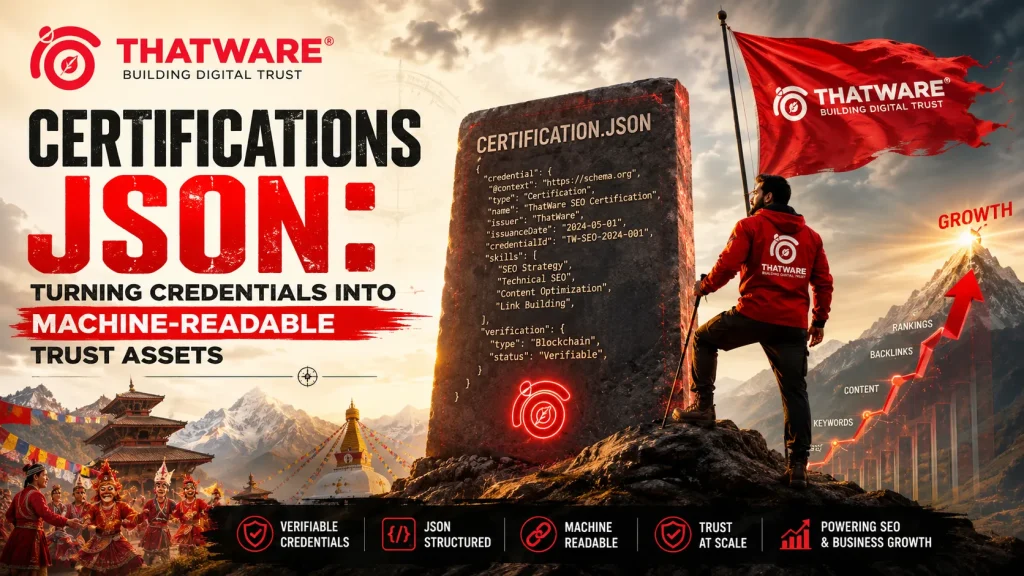
The goal of this file is to help AI systems understand credentials not only as certificates displayed on web pages, but as connected semantic assets containing skills, expertise, verification details, issuing authorities, professional achievements, and trust signals.
1. What Is certifications json?
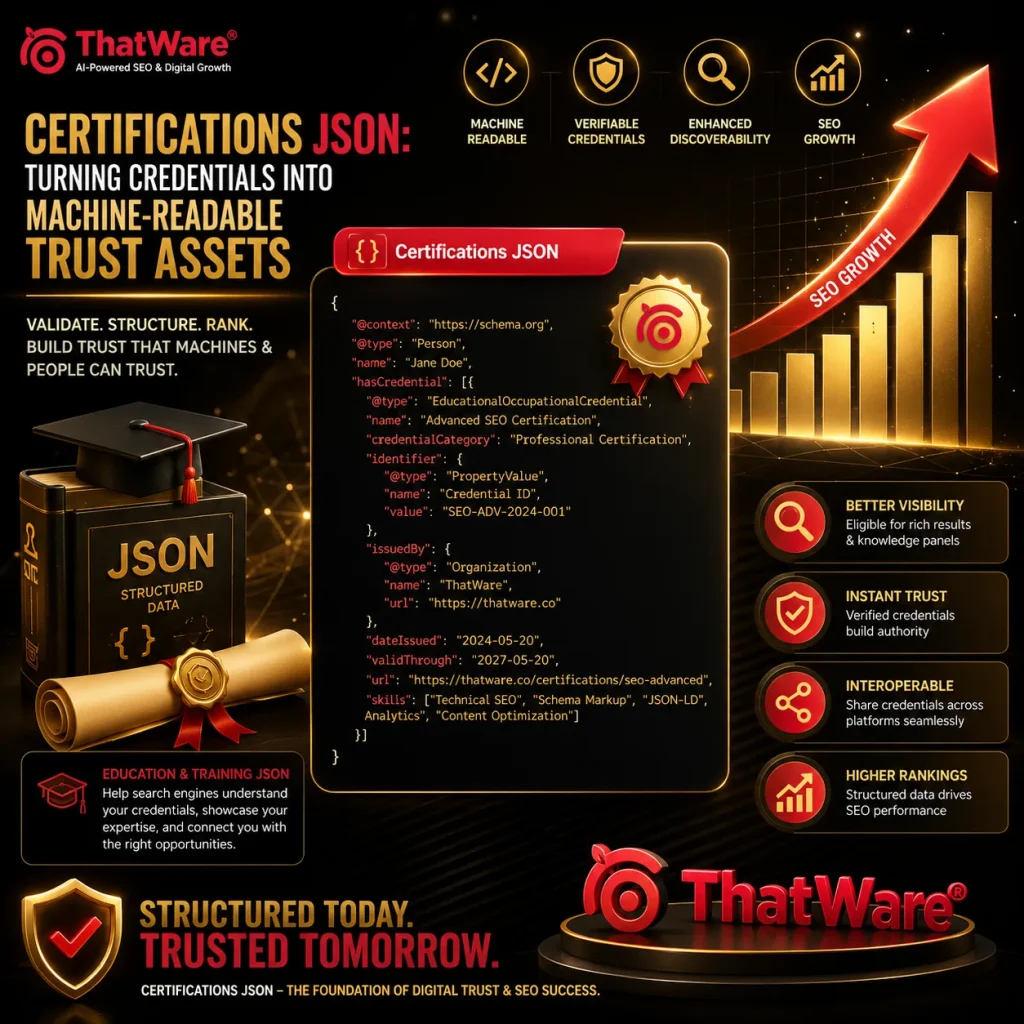
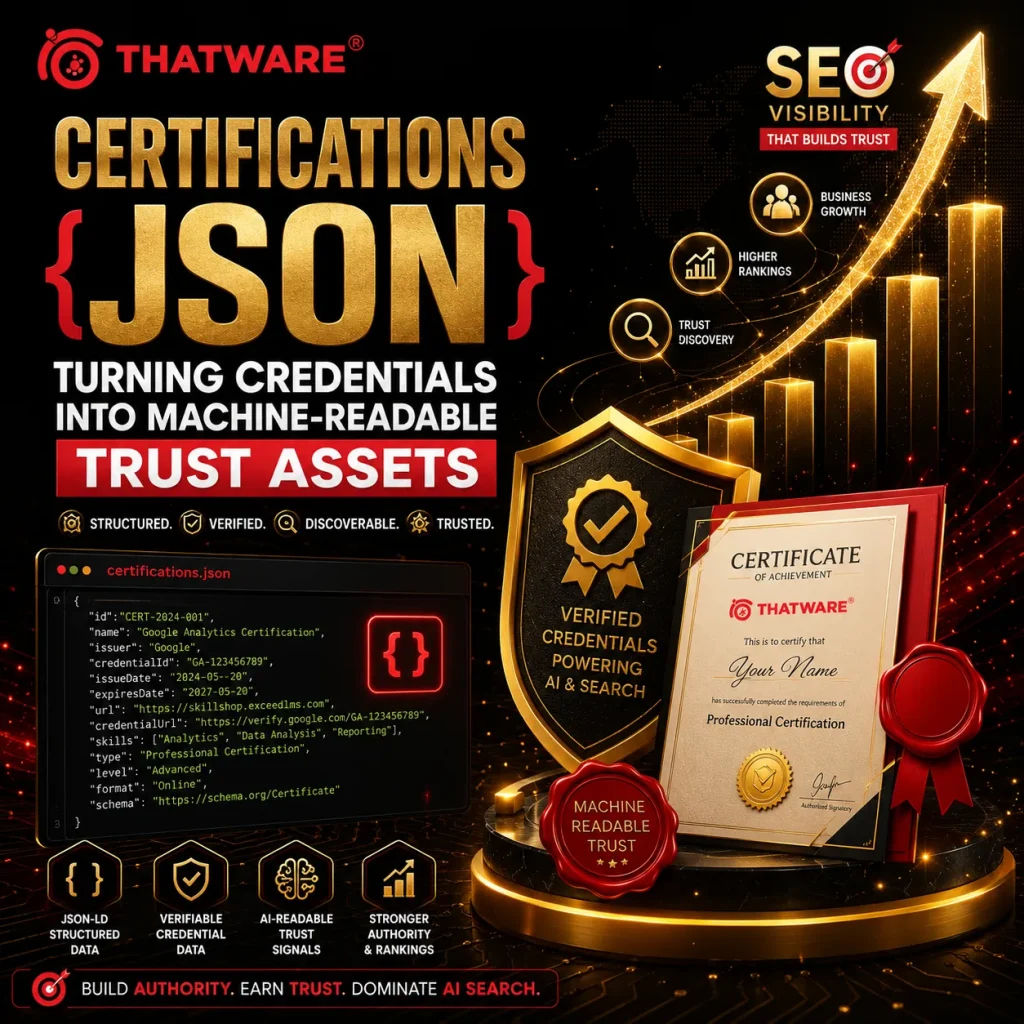
certifications json is a machine-readable JSON file that represents the complete credential structure of a website, organization, training provider, certification body, or professional knowledge ecosystem.
It defines:
· certification entities
· credential holders
· issuing organizations
· certification categories
· verified skills
· learning pathways
· credential relationships
· certification URLs
· evidence supporting expertise
· structured trust information
· authority signals
· machine-readable summaries
In simple terms, it tells AI systems:
“These are the verified credentials, these are the skills they represent, these are the entities connected to them, and these are the best sources to use when understanding professional expertise.”
2. Why certifications json Exists
Traditional websites display certifications mainly for human visitors. They rely on:
· certification pages
· images of certificates
· PDFs
· badges
· testimonials
· profile pages
· training pages
These elements provide value, but they are not always easy for AI systems to interpret.
Modern AI search engines and Large Language Models need to understand:
· what certification exists
· who issued it
· who earned it
· what competency it proves
· which skills are associated with it
· whether it represents genuine expertise
· what evidence supports the claim
· which credential should be referenced
A structured certification file solves this by creating a central machine-readable credential layer.
3. Difference Between a Sitemap and certifications json
Traditional XML Sitemap
A sitemap answers:
· What URLs exist?
· When were they updated?
· Which pages should crawlers discover?
Semantic Certification Map
A semantic certification map answers:
· What credentials exist?
· What skills do they represent?
· Who issued them?
· Who owns them?
· What expertise do they prove?
· How do they connect with professional entities?
Certifications json
A certification knowledge file answers:
· What professional qualifications does this organization represent?
· Which credentials are authentic?
· What evidence supports expertise?
· Which certification URLs should AI cite?
· What authority signals exist?
· How should AI systems interpret these credentials?
A sitemap is URL-first.
A certification graph is credential-first.
4. Why It Matters for LLM Optimization
Large Language Models generate answers by identifying useful information from training data, retrieval systems, structured sources, and available context.
For a credential-based website to appear in AI-generated answers, the AI system must be able to:
- identify the certification entity correctly
- understand the credential value
- connect certifications with expertise areas
- retrieve supporting evidence
- trust the certification source
- cite the correct credential page
- distinguish authentic credentials from unsupported claims
certifications json helps with all of these.
It can support:
· improved credential recognition
· stronger expertise mapping
· clearer authority signals
· better retrieval quality
· improved citation matching
· reduced ambiguity
· stronger AI understanding
· better professional identity validation
5. Role in GEO: Generative Engine Optimization
Generative Engine Optimization is the process of optimizing digital assets for AI answer engines, LLMs, AI search systems, conversational search platforms, and autonomous agents.
A certification data layer contributes to GEO by acting as a structured professional authority system.
GEO Benefits
5.1 Credential Understanding
The file makes it clear which certifications matter.
Example:
· Organization: ThatWare
· Credential Type: AI and digital expertise certification
· Related Skills: SEO, AI optimization, search technology
· Certification Category: Professional expertise validation
5.2 Expertise Validation Mapping
The file connects certifications with skills, experience, and authority.
Example:
· AI SEO certification
· Digital marketing certification
· Technical optimization credentials
· Industry knowledge validation
This improves expertise validation by allowing AI systems to understand the relationship between credentials and professional capability.
5.3 Credential Trust Signals
It tells AI systems which certification URL should be cited for each credential, skill, or expertise area.
Example:
· For “Digital Marketing Certification,” cite /certifications/digital-marketing-certification/
· For “SEO Certification,” cite /certifications/seo-certification/
· For “AI SEO Certification,” cite /certifications/ai-seo-certification/
5.4 Retrieval Improvement
AI retrieval systems can use certification information to identify relevant professionals, organizations, and expertise areas.
5.5 Context Assembly
The certification graph helps AI systems determine:
5.6 Brand Disambiguation
A structured certification file prevents confusion between:
· similar certifications
· unrelated training programs
· different issuing organizations
· duplicate credential names
It strengthens brand trust architecture by creating a clear connection between the organization and its verified expertise.
6. How AI Systems Can Use certifications json
Different AI systems may use this file in different ways.
6.1 AI Crawlers
AI crawlers can discover certification files and extract:
· credentials
· certification entities
· issuing bodies
· verification information
· authority relationships
This creates stronger AI crawler credentials by making professional proof easier to understand.
6.2 RAG Pipelines
Retrieval-augmented generation systems can use certification data to identify the best sources when answering questions related to expertise, skills, and qualifications.
6.3 Vector Databases
Certification graphs can guide how credential pages are:
· chunked
· embedded
· connected
· retrieved
6.4 AI Search Engines
AI search platforms can use certification information to evaluate:
· expertise
· relevance
· trustworthiness
· professional authority
6.5 Autonomous Agents
AI agents can use structured credentials to:
· find qualified experts
· verify skills
· recommend services
· retrieve accurate professional information
6.6 Brand Knowledge Panels
Certification structures can support entity understanding similar to a knowledge panel by connecting credentials, organizations, and expertise areas.
7. Recommended File Location
The recommended public URL is:
https://example.com/certifications.json
Optional additional discovery paths:
https://example.com/.well-known/certifications.json
https://example.com/ai-endpoints.json
The file should also be referenced from:
· ai.txt
· llms.txt
· llmsfull.txt
· ai-endpoints json
· robots.txt
· HTML alternate links
8. Recommended MIME Type
Serve the file as:
application/json
The server should return:
HTTP 200 OK
Content-Type: application/json; charset=utf-8
A valid certification file should remain accessible, updated, and machine-readable so AI systems can consistently retrieve credential information.
9. Core Design Principles
9.1 Credential-First Design
Do not start with URLs. Start with credentials.
The primary focus should be:
· certification entities
· verified skills
· issuing bodies
· credential holders
· professional expertise
· evidence sources
· authority relationships
A credential system should explain what knowledge or capability a certification represents.
9.2 Canonical Credential Naming
Each certification should have one preferred name.
Example:
{
“name”: “AI SEO Certification”,
“alternateNames”: [
“Artificial Intelligence SEO Credential”,
“AI Search Optimization Certification”
]
}
This improves recognition across AI systems and prevents confusion between similar credentials.
9.3 Persistent Credential IDs
Every certification entity should have a stable ID.
Example:
“id”: “credential:ai-seo-certification”
Persistent IDs allow AI systems to maintain consistent understanding of certifications.
9.4 Clear Credential Relationships
Relationships should be explicit.
Example:
{
“source”: “entity:thatware”,
“relationship”: “offersCertification”,
“target”: “credential:digital-marketing-certification”
}
This transforms isolated certificates into connected knowledge assets.
9.5 Evidence-Based Authority
Authority should not be claimed vaguely.
Every credential should have supporting proof.
Example evidence:
· official certification page
· training documentation
· assessment records
· issuing organization profile
· professional portfolio
· external recognition
· verified achievement
This creates stronger authority credentials because every expertise claim is connected to evidence.
9.6 Citation Readiness
Every important credential should include:
· preferred citation URL
· verification page
· certification description
· issuing organization
· credential holder information
This helps AI systems cite accurate professional information.
9.7 Machine and Human Readability
The JSON should be understandable by:
· developers
· search engines
· AI crawlers
· LLM systems
· human researchers
A well-structured file becomes professional trust data that supports both discovery and verification.
10. Key Components of certifications json
A strong certifications json should include the following major sections:
- metadata
- organization
- certification entities
- credential holders
- skills
- training programs
- issuing authorities
- relationships
- evidence
- citations
- credential scores
- validation history
- AI usage policy
- verification metadata
11. Field-by-Field Explanation
11.1 Certification Metadata
Defines file-level information.
Recommended fields:
· version
· generatedAt
· lastUpdated
· publisher
· language
· canonicalUrl
· certificationCount
Purpose:
· helps AI systems understand freshness
· supports validation
· improves credential discovery
This creates useful certification metadata that explains the structure and reliability of the credential database.
11.2 Organization
Defines the main certification provider or brand.
Recommended fields:
· id
· name
· url
· logo
· description
· foundingDate
· expertiseAreas
· sameAs
· contactPoint
Purpose:
· identifies the certification authority
· supports brand recognition
· strengthens professional identity
For organizations like ThatWare, this section can represent ThatWare certifications as verified expertise assets.
11.3 Website
Defines the certification website as a digital property.
Recommended fields:
· id
· url
· publisher
· language
· audience
· contentTypes
Purpose:
· helps AI understand the role of the website
· separates certification data from general web content
11.4 Certification Entities
The most important section.
Each certification should include:
· id
· name
· type
· description
· issuingOrganization
· skillsValidated
· certificationDate
· expiryDate
· credentialUrl
· evidence
· preferredCitation
Certification types may include:
· Professional Certification
· Training Credential
· Skill Badge
· Industry Qualification
· Course Completion
· Technical Certification
This section creates machine-readable certifications that AI systems can interpret as verified knowledge assets.
11.5 Skills
Defines the competencies connected to certifications.
Recommended fields:
· skillName
· category
· proficiencyLevel
· relatedCredentials
· evidence
Purpose:
· maps skills to credentials
· improves expertise discovery
· supports semantic understanding
11.6 Training Data
Defines educational and learning information.
Recommended fields:
· id
· programName
· description
· provider
· duration
· outcomes
Purpose:
· connects training programs with certification outcomes
· supports training certification data interpretation
11.7 Credential Registry
Defines the complete certification inventory.
Recommended fields:
· credentialID
· credentialName
· holder
· issuer
· issueDate
· verificationURL
· status
Purpose:
· creates a searchable credential database
· supports verification
· improves trust
A strong certification registry helps AI systems identify legitimate credentials.
11.8 Content Clusters
Connects credentials with related entities.
Recommended fields:
· credential
· skill
· organization
· person
· topic
· relationship
Purpose:
· builds semantic connections
· improves AI understanding
· supports authority mapping
This becomes a credential knowledge graph where certifications are connected to expertise, organizations, and professional topics.
11.9 Relationships
Defines credential connections.
Common relationship types:
· validatesSkill
· issuedBy
· earnedBy
· supports
· relatedTo
· demonstrates
· verifies
· belongsTo
Purpose:
· transforms credential data into a connected graph
11.10 Evidence
Defines proof supporting credentials.
Evidence types:
· certification page
· verification record
· training resource
· assessment result
· professional profile
· external mention
Purpose:
· strengthens trust
· reduces unsupported claims
· improves AI confidence
12. Authority Scoring Model
A useful certification file can include authority scores.
Recommended score range:
0.00 to 1.00
Suggested interpretation:
· 0.90–1.00: verified high authority
· 0.75–0.89: strong credential value
· 0.50–0.74: moderate relevance
· 0.25–0.49: supporting credential
· 0.00–0.24: limited relevance
Authority score should be based on:
· certification quality
· issuing authority
· verification availability
· industry relevance
· skill depth
· evidence strength
· freshness
· professional adoption
13. Relationship Modeling Best Practices
Every relationship should contain:
{
“source”: “credential:digital-marketing-certification”,
“relationship”: “validatesSkill”,
“target”: “skill:seo-strategy”,
“confidence”: 0.96,
“evidence”: [
“https://example.com/certifications/”
]
}
Recommended Relationship Vocabulary:
validatesSkill
issuedBy
earnedBy
supportsExpertise
relatedTo
hasEvidence
hasCredentialPage
hasVerification
demonstrates
sameAs
belongsTo
14. How to Use With Schema.org and JSON-LD
Certifications json does not replace Schema.org markup. It complements it.
Recommended approach:
· Use Schema.org JSON-LD inside certification pages.
· Use certifications json as the website-wide credential map.
· Use llms.txt to guide AI systems.
· Use AI endpoints for machine discovery.
Example connection:
{
“schemaAlignment”: {
“organizationType”: “https://schema.org/Organization”,
“personType”: “https://schema.org/Person”,
“courseType”: “https://schema.org/Course”,
“credentialType”: “https://schema.org/EducationalOccupationalCredential”
}
}
15. Implementation Workflow
Step 1: Identify Core Credentials
Create a list of:
· certifications
· skills
· training programs
· issuing authorities
· credential holders
· industries
· professional categories
· expertise areas
Step 2: Assign Canonical Certification URLs
Each major credential should map to one best URL.
Example:
This improves credential SEO by helping search engines and AI systems associate the correct page with the correct credential.
Step 3: Build Credential Clusters
Group related certifications around expertise topics.
Example:
· AI certification cluster
· SEO certification Metadata
· Digital marketing certification cluster
· Technical expertise cluster
Step 4: Add Credential Relationships
Connect certifications with:
· skills
· experts
· organizations
· services
· topics
Step 5: Add Evidence
Attach proof assets.
Examples:
· certificate pages
· verification pages
· training resources
· case studies
· expert profiles
Step 6: Add Citation Rules
Define preferred citation URLs.
AI systems should know:
· which certification page to cite
· which organization issued it
· which expertise it represents
Step 7: Validate JSON
Make sure the file is:
· valid JSON
· properly structured
· machine-readable
· updated regularly
Step 8: Publish Publicly
Upload to:
https://example.com/certifications.json
Step 9: Reference From AI Files
Add the file URL to:
· ai-endpoints.json
· ai.txt
· llms.txt
· llmsfull.txt
Step 10: Maintain Monthly
Update after:
· new certifications
· new training programs
· new credential holders
· new verification records
· new authority signals
16. SEO, GEO, and AEO Benefits
SEO Benefits
· stronger credential visibility
· improved entity consistency
· better structured data alignment
· clearer expertise mapping
· improved certification discovery
A certification system can support skill validation SEO by helping search engines understand verified professional abilities.
GEO Benefits
· improved AI understanding
· stronger answer inclusion
· better credential retrieval
· improved AI citation targeting
Structured credentials create stronger AI trust signals because AI systems can connect expertise claims with verifiable evidence.
AEO Benefits
· better direct-answer readiness
· clearer expertise responses
· improved question-answer matching
· better conversational search support
17. Common Mistakes to Avoid
Mistake 1: Making It Only a Certificate List
A certification file is not just a collection of certificate URLs.
It should explain:
· skills
· relationships
· authority
· verification
Mistake 2: No Credential Relationships
Without relationships, certification data becomes simple metadata instead of a connected knowledge system.
Mistake 3: Unsupported Authority Claims
Do not claim expertise without evidence.
Every credential should connect to proof.
Mistake 4: Generic Credential Categories
Avoid broad labels.
Bad:
Marketing
Technology
Business
Better:
AI Search Optimization Certification
SEO Strategy Credential
Machine Learning Professional Certification
Mistake 5: No Certification Verification
Every credential should have:
· issuer information
· verification URL
· supporting evidence
Mistake 6: No Update Policy
Certification data should be maintained like a professional trust asset.
18. Recommended Update Frequency
| Update Type | Frequency |
| Minor credential updates | Monthly |
| New certifications | Immediately |
| New training programs | Immediately |
| Verification updates | Monthly |
| Authority scoring | Quarterly |
| Full certification audit | Quarterly |
| Schema alignment review | Twice yearly |
Regular updates maintain accurate certification archive records and ensure AI systems access current professional information.
19. Full Reusable Prototype Code Structure
The following JSON structure can be adapted for different websites, agencies, educational platforms, enterprise credentials, training organizations, certification providers, and professional ecosystems.
{
“metadata”: {
“fileType”: “certifications”,
“version”: “1.0.0”,
“generatedAt”: “2026-08-07T00:00:00Z”,
“lastUpdated”: “2026-08-07T00:00:00Z”,
“language”: “en”,
“canonicalUrl”: “https://thatware.co/certifications.json”,
“publisher”: {
“name”: “ThatWare LLP”,
“url”: “https://thatware.co/”
},
“description”: “Machine-readable certification registry describing professional credentials, platform certifications, skills, business registrations, and trust signals associated with ThatWare LLP and founder Tuhin Banik.”
},
“organization”: {
“id”: “entity:organization:thatware”,
“type”: “Organization”,
“name”: “ThatWare”,
“legalName”: “THATWARE LLP”,
“url”: “https://thatware.co/”,
“certificationsUrl”: “https://thatware.co/certifications/”,
“founder”: “person:tuhin-banik”,
“llpin”: “AAQ-0064”,
“incorporationDate”: “2019-07-22”,
“jurisdiction”: “India”,
“primaryExpertise”: [
“SEO”,
“AI SEO”,
“Search Engine Marketing”,
“Google Analytics”,
“Digital Marketing”,
“Semantic SEO”,
“LLM SEO”,
“Answer Engine Optimization”,
“Generative Engine Optimization”,
“Quantum SEO”
]
},
“people”: [
{
“id”: “person:tuhin-banik”,
“type”: “Person”,
“name”: “Tuhin Banik”,
“alternateName”: “Dr. Tuhin Banik”,
“role”: “Founder & CEO”,
“organization”: “entity:organization:thatware”,
“profileUrl”: “https://in.linkedin.com/in/tuhin-banik”,
“expertise”: [
“SEO”,
“Artificial Intelligence”,
“Search Engine Marketing”,
“Analytics”,
“Machine Learning”,
“Semantic Search”,
“AI SEO”,
“AEO”,
“GEO”,
“LLM SEO”
]
}
],
“certifications”: [
{
“id”: “credential:google-analytics”,
“type”: “ProfessionalCertification”,
“name”: “Google Analytics Certification”,
“holder”: “person:tuhin-banik”,
“issuer”: “Google”,
“issuedDate”: “2013-07”,
“skillsValidated”: [
“Google Analytics”,
“Web Analytics”,
“Traffic Analysis”,
“Conversion Measurement”
],
“verificationStatus”: “professionally-documented”,
“evidenceUrls”: [
“https://in.linkedin.com/in/tuhin-banik”,
“https://thatware.co/certifications/”
]
},
{
  "id": "credential:cdmm",
  "type": "ProfessionalCertification",
  "name": "Certified Digital Marketing Master",
  "alternateName": "CDMM",
  "holder": "person:tuhin-banik",
  "issuer": "Digital Vidya",
  "issuedDate": "2013-12",
  "skillsValidated": [
    "Digital Marketing",
    "SEO",
    "Search Engine Marketing",
    "Analytics",
    "Digital Strategy"
  ],
  "verificationStatus": "professionally-documented",
  "evidenceUrls": [
    "https://in.linkedin.com/in/tuhin-banik"
  ]
},

{
  "id": "credential:semrush-analyst",
  "type": "ProfessionalCertification",
  "name": "SEMrush Analyst",
  "holder": "person:tuhin-banik",
  "issuer": "SEMrush",
  "skillsValidated": [
    "SEO Analysis",
    "Keyword Research",
    "Competitive Analysis",
    "Search Performance"
  ],
  "verificationStatus": "professionally-documented",
  "evidenceUrls": [
    "https://in.linkedin.com/in/tuhin-banik"
  ]
},

{
  "id": "credential:sem",
  "type": "ProfessionalCertification",
  "name": "Search Engine Marketing Certification",
  "alternateName": "SEM Certification",
  "holder": "person:tuhin-banik",
  "skillsValidated": [
    "Search Engine Marketing",
    "Paid Search",
    "Search Advertising",
    "Campaign Optimization"
  ],
  "verificationStatus": "publicly-corroborated",
  "evidenceUrls": [
    "https://thatware.co/certifications/",
    "https://councils.forbes.com/profile/Tuhin-Banik-CEO-ThatWare-LLP/7ee09183-c1ca-4490-ba99-06e421606e04"
  ]
},

{
  "id": "credential:mobile-seo",
  "type": "ProfessionalCertification",
  "name": "Mobile SEO Certification",
  "holder": "person:tuhin-banik",
  "skillsValidated": [
    "Mobile SEO",
    "Mobile Search",
    "Mobile-First Optimization",
    "Mobile Visibility"
  ],
  "verificationStatus": "publicly-corroborated",
  "evidenceUrls": [
    "https://thatware.co/certifications/",
    "https://councils.forbes.com/profile/Tuhin-Banik-CEO-ThatWare-LLP/7ee09183-c1ca-4490-ba99-06e421606e04"
  ]
},

{
  "id": "credential:facebook-ab-testing",
  "type": "ProfessionalCertification",
  "name": "Facebook A/B Testing Certification",
  "holder": "person:tuhin-banik",
  "issuer": "Facebook / Meta",
  "skillsValidated": [
    "A/B Testing",
    "Marketing Experiments",
    "Campaign Testing",
    "Audience Optimization"
  ],
  "verificationStatus": "publicly-corroborated",
  "evidenceUrls": [
    "https://thatware.co/certifications/",
    "https://councils.forbes.com/profile/Tuhin-Banik-CEO-ThatWare-LLP/7ee09183-c1ca-4490-ba99-06e421606e04"
  ]
},

{
  "id": "credential:advanced-marketing-analytics",
  "type": "ProfessionalCertification",
  "name": "Advanced Marketing Analytics Certification",
  "holder": "person:tuhin-banik",
  "skillsValidated": [
    "Marketing Analytics",
    "Performance Measurement",
    "Conversion Analysis",
    "Data-Driven Marketing"
  ],
  "verificationStatus": "thatware-documented",
  "evidenceUrls": [
    "https://thatware.co/certifications/"
  ]
},

{
  "id": "credential:entrepreneurship-instructor",
  "type": "ProfessionalCertification",
  "name": "Certified Entrepreneurship Instructor",
  "holder": "person:tuhin-banik",
  "issuer": "Entrepreneur India",
  "issuedDate": "2022-02",
  "skillsValidated": [
    "Entrepreneurship",
    "Business Strategy",
    "Startup Development",
    "Business Education"
  ],
  "verificationStatus": "professionally-documented",
  "evidenceUrls": [
    "https://in.linkedin.com/in/tuhin-banik"
  ]
},

{
  "id": "credential:international-trade-council",
  "type": "MembershipCredential",
  "name": "International Trade Council Membership Certificate",
  "holder": "person:tuhin-banik",
  "issuer": "International Trade Council",
  "issuedDate": "2021-01",
  "credentialId": "68294537617731",
  "verificationStatus": "credential-id-documented",
  "evidenceUrls": [
    "https://in.linkedin.com/in/tuhin-banik"
  ]
},

{
  "id": "credential:udacity-nanodegree",
  "type": "EducationalCredential",
  "name": "Udacity Nanodegree",
  "holder": "person:tuhin-banik",
  "issuer": "Udacity",
  "skillsValidated": [
    "Artificial Intelligence",
    "Applied Technology",
    "Computing"
  ],
  "verificationStatus": "professionally-documented",
  "evidenceUrls": [
    "https://in.linkedin.com/in/tuhin-banik"
  ]
}
],
“organizationalCredentials”: [
{
“id”: “credential:google-partner”,
“type”: “PlatformPartnerCredential”,
“name”: “Google Partner”,
“holder”: “entity:organization:thatware”,
“issuer”: “Google”,
“associatedYear”: 2016,
“status”: “historically-documented”,
“skillsSupported”: [
“Search Advertising”,
“Analytics”,
“Digital Marketing”,
“Campaign Management”
],
“evidenceUrl”: “https://thatware.co/certifications/”
},
{
  "id": "credential:moz",
  "type": "PlatformCertification",
  "name": "Moz Certification",
  "holder": "entity:organization:thatware",
  "issuer": "Moz",
  "skillsSupported": [
    "SEO",
    "Technical SEO",
    "Search Analysis"
  ],
  "status": "publicly-referenced",
  "evidenceUrl": "https://thatware.co/certifications/"
}
],
“businessRegistrations”: [
{
“id”: “registration:thatware-llp”,
“type”: “BusinessRegistration”,
“name”: “THATWARE LLP”,
“registrationNumber”: “AAQ-0064”,
“registrationType”: “LLPIN”,
“incorporationDate”: “2019-07-22”,
“authority”: “Registrar of Companies, Kolkata”,
“jurisdiction”: “India”,
“status”: “Active”
},
{
  "id": "registration:thatware-trademark",
  "type": "TrademarkRegistration",
  "name": "ThatWare",
  "registrationNumber": "5450767",
  "trademarkClass": "42",
  "jurisdiction": "India"
}
],
“skills”: [
{
“id”: “skill:analytics”,
“name”: “Analytics”,
“relatedCredentials”: [
“credential:google-analytics”,
“credential:advanced-marketing-analytics”
]
},
{
  "id": "skill:digital-marketing",
  "name": "Digital Marketing",
  "relatedCredentials": [
    "credential:cdmm",
    "credential:sem"
  ]
},

{
  "id": "skill:seo",
  "name": "Search Engine Optimization",
  "relatedCredentials": [
    "credential:semrush-analyst",
    "credential:mobile-seo",
    "credential:moz"
  ]
},

{
  "id": "skill:experimentation",
  "name": "Marketing Experimentation",
  "relatedCredentials": [
    "credential:facebook-ab-testing"
  ]
},

{
  "id": "skill:entrepreneurship",
  "name": "Entrepreneurship",
  "relatedCredentials": [
    "credential:entrepreneurship-instructor"
  ]
}
],
“relationships”: [
{
“source”: “person:tuhin-banik”,
“relationship”: “holds”,
“target”: “credential:google-analytics”
},
{
“source”: “person:tuhin-banik”,
“relationship”: “holds”,
“target”: “credential:cdmm”
},
{
“source”: “person:tuhin-banik”,
“relationship”: “holds”,
“target”: “credential:semrush-analyst”
},
{
“source”: “person:tuhin-banik”,
“relationship”: “associatedWith”,
“target”: “credential:sem”
},
{
“source”: “person:tuhin-banik”,
“relationship”: “associatedWith”,
“target”: “credential:mobile-seo”
},
{
“source”: “person:tuhin-banik”,
“relationship”: “associatedWith”,
“target”: “credential:facebook-ab-testing”
},
{
“source”: “person:tuhin-banik”,
“relationship”: “holds”,
“target”: “credential:entrepreneurship-instructor”
},
{
“source”: “person:tuhin-banik”,
“relationship”: “holds”,
“target”: “credential:international-trade-council”
},
{
“source”: “entity:organization:thatware”,
“relationship”: “historicallyHeld”,
“target”: “credential:google-partner”
}
],
“evidence”: [
{
“id”: “evidence:thatware-certifications”,
“type”: “primary_source”,
“name”: “ThatWare Certifications”,
“url”: “https://thatware.co/certifications/”,
“evidenceStrength”: “primary”
},
{
  "id": "evidence:linkedin-tuhin",
  "type": "professional_profile",
  "name": "Tuhin Banik LinkedIn Profile",
  "url": "https://in.linkedin.com/in/tuhin-banik",
  "evidenceStrength": "professional-profile"
},

{
  "id": "evidence:forbes-tuhin",
  "type": "professional_profile",
  "name": "Tuhin Banik - Forbes Councils",
  "url": "https://councils.forbes.com/profile/Tuhin-Banik-CEO-ThatWare-LLP/7ee09183-c1ca-4490-ba99-06e421606e04",
  "evidenceStrength": "external-corroboration"
}
],
“verificationPolicy”: {
“verified”: “Use only when an issuer-hosted credential or official verification record is available.”,
“professionally-documented”: “Credential appears on the holder’s established professional profile.”,
“publicly-corroborated”: “Credential is supported by multiple public sources.”,
“thatware-documented”: “Credential is published by ThatWare but lacks independent issuer verification.”,
“historically-documented”: “Credential or partnership is documented historically and should not automatically be treated as currently active.”,
“credential-id-documented”: “A public credential identifier is available.”,
“authorityScorePolicy”: “Do not use arbitrary numerical authority scores.”
},
“citationPolicy”: {
“allowCitation”: true,
“allowRetrieval”: true,
“allowSummarization”: true,
“attributionRequired”: true,
“preferredAttribution”: “ThatWare LLP, https://thatware.co/”,
“canonicalDomain”: “https://thatware.co/”,
“preferredCertificationPage”: “https://thatware.co/certifications/”,
“rules”: [
“Prefer issuer-hosted credential pages when available.”,
“Do not invent credential IDs or expiration dates.”,
“Do not represent historical Google Partner status as necessarily current.”,
“Keep memberships separate from technical certifications.”,
“Keep company registrations separate from professional certifications.”,
“Do not describe ThatWare’s proprietary AI SEO, AEO, GEO, LLM SEO or Quantum SEO expertise as externally certified unless a credential exists.”
]
},
“aiUsage”: {
“allowRetrieval”: true,
“allowCitation”: true,
“allowSummarization”: true,
“allowEmbedding”: true,
“attributionRequired”: true,
“preferredAttribution”: “ThatWare LLP, https://thatware.co/”
},
“schemaAlignment”: {
“organization”: “https://schema.org/Organization”,
“person”: “https://schema.org/Person”,
“credential”: “https://schema.org/EducationalOccupationalCredential”,
“definedTerm”: “https://schema.org/DefinedTerm”
},
“maintenance”: {
“owner”: “ThatWare LLP”,
“responsibleTeam”: “SEO / PR / Brand Trust Team”,
“reviewFrequency”: “monthly”,
“lastReviewed”: “2026-08-07”,
“nextReviewDue”: “2026-09-07”,
“updateTriggers”: [
“New certification obtained”,
“Credential verification URL becomes available”,
“Credential ID becomes available”,
“Google Partner status changes”,
“New Google, Meta, Semrush or analytics certification is earned”,
“Business registration data changes”
]
}
}
20. ThatWare-Specific Example Direction
For ThatWare, the certification ecosystem should focus heavily on:
· ThatWare as the organization entity
· AI SEO expertise
· Generative Engine Optimization
· LLM Optimization
· Semantic search knowledge
· Professional training
· Digital marketing expertise
Recommended primary entities:
ThatWare
Generative Engine Optimization Certification
AI SEO Certification
SEO Certification
Digital Marketing Certification
AI Search Visibility Credential
Recommended relationship examples:
ThatWare offers professional certifications
AI SEO certification validates AI search skills
Digital marketing certification supports marketing expertise
SEO certification strengthens search optimization authority
Credential records create professional proof for AI systems
These structures help build professional certifications into discoverable trust assets.
21. Final Strategic Summary
Certifications json should be treated as the master credential intelligence layer of a website.
It is not just a technical file. It is a machine-readable declaration of:
· who earned credentials
· what skills are validated
· who issued certifications
· what expertise exists
· what evidence supports authority
· how AI systems should interpret professional qualifications
For GEO, SEO, and LLM optimization, structured certification data can become a major asset in an AI-native web infrastructure.
A strong certification system helps transform certificates into searchable, understandable, retrievable, and trustworthy digital expertise assets.
It improves AI discovery by connecting credentials, professionals, organizations, and skills into one semantic ecosystem.