
SUPERCHARGE YOUR ONLINE VISIBILITY! CONTACT US AND LET’S ACHIEVE EXCELLENCE TOGETHER!
The digital search landscape is undergoing one of the biggest transformations in its history.
For years, businesses focused primarily on traditional SEO rankings, backlinks, and keyword positions. While those factors remain important, modern search behavior is increasingly influenced by AI-powered systems such as ChatGPT, Gemini, Claude, Perplexity, Copilot, and Google’s AI-driven search experiences.
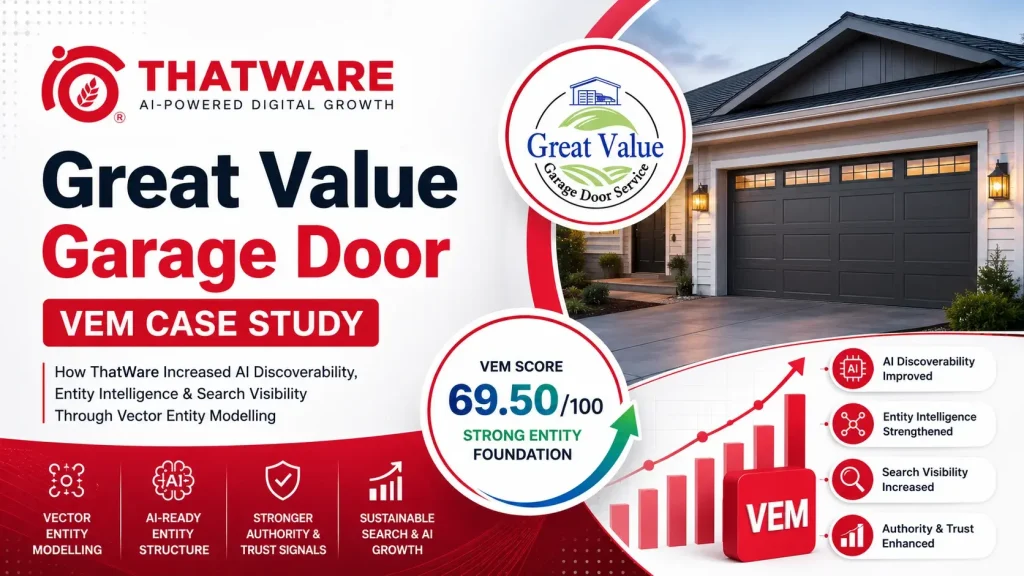
These systems no longer rely solely on rankings. Instead, they depend on entities, relationships, semantic understanding, trust signals, authority frameworks, citations, and machine-readable knowledge structures.
This shift has created a new challenge for local service businesses.
Many companies have excellent services, strong customer satisfaction, and established local reputations, yet they remain largely invisible to AI systems because their digital entity profiles are weak.
This was the exact challenge facing Great Value Garage Door.
Although the business operated within a highly valuable local service category and possessed genuine market expertise, its initial Vector Entity Modelling (VEM) assessment revealed significant weaknesses across nearly every major intelligence category.
The business demonstrated an early-stage Vector Entity Modelling profile characterized by limited AI-ready infrastructure, weak content depth, modest authority signals, inconsistent generic-query visibility, and insufficient entity reinforcement across the broader garage-door service ecosystem.
To solve these challenges, ThatWare implemented its proprietary Vector Entity Modelling framework.
The strategy focused on building stronger entity relationships, improving content intelligence, expanding authority signals, strengthening AI retrieval pathways, and increasing overall discoverability across both traditional search engines and AI-powered answer systems.
The transformation produced substantial improvements across every VEM category.
VEM Performance Growth
| Category | Before | After |
| Brand Intelligence | 14 | 62 |
| Content Intelligence | 18 | 71 |
| Authority Intelligence | 24 | 68 |
| Entity Intelligence | 23 | 74 |
| AI Readiness | 17 | 76 |
| Query Intelligence | 21 | 66 |
| Overall VEM Score | 19.7 | 69.5 |
Percentage Growth Achieved
| Category | Improvement |
| Brand Intelligence | 3.43 |
| Content Intelligence | 2.94 |
| Authority Intelligence | 1.83 |
| Entity Intelligence | 2.22 |
| AI Readiness | 3.47 |
| Query Intelligence | 2.14 |
| Overall VEM Score | 2.53 |
The result was a dramatic improvement in AI discoverability, entity recognition, semantic relevance, and overall visibility.
This case study explores the complete transformation journey.
About Great Value Garage Door
Great Value Garage Door operates within a highly competitive service market where visibility directly influences revenue.
Customers rarely spend weeks researching garage door repairs.
Instead, searches are often urgent.
Typical customer searches include:
- Garage door repair near me
- Emergency garage door repair
- Broken garage door spring repair
- Garage door opener replacement
- Garage door installation services
- Same-day garage door service
- Garage door maintenance
These searches carry significant commercial intent because users typically require immediate solutions.
As AI-powered search becomes increasingly integrated into the customer journey, businesses that fail to establish strong entity signals risk becoming invisible during critical buying moments.
Great Value Garage Door recognized this challenge and partnered with ThatWare to improve its position in the evolving AI search ecosystem.
Understanding Vector Entity Modelling (VEM)
Before diving into the project itself, it is important to understand what Vector Entity Modelling actually measures.
Traditional SEO focuses on rankings.
Vector Entity Modelling focuses on understanding how AI systems perceive a business.
VEM evaluates factors such as:
- Entity recognition
- Brand understanding
- Authority signals
- Content intelligence
- Query relevance
- AI retrieval readiness
- Citation confidence
- Semantic relationships
- Knowledge graph alignment
Rather than asking:
“Does this page rank?”
VEM asks:
“Can AI systems confidently understand, validate, retrieve, and recommend this business?”
This distinction is becoming increasingly important as search transitions from keyword matching to entity understanding.
The Initial Challenge
When Great Value Garage Door entered the VEM framework, the company demonstrated a relatively weak entity profile.
Although the business had an online presence, AI systems lacked sufficient confidence to consistently surface the company across broader commercial search environments.
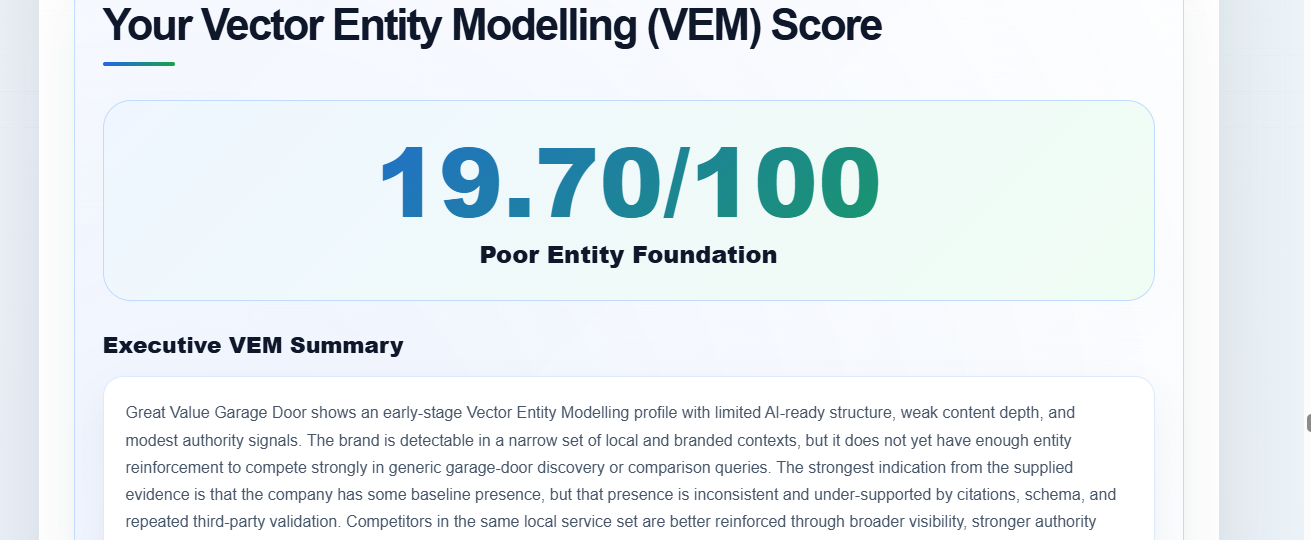
The initial VEM score revealed a concerning picture.
Initial VEM Assessment
Overall Score
19.70 / 100
Classification:
Poor Entity Foundation
The assessment revealed an early-stage entity profile with limited machine readability, weak AI retrieval signals, thin content coverage, and insufficient third-party validation to support broader answer-engine visibility.
Initial Category Analysis
Brand Intelligence
Score Before Optimization
14/100
The brand demonstrated limited signal strength due to inconsistent entity reinforcement, modest branded visibility, and insufficient structured identity coverage across digital properties. While some local recognition existed, AI systems lacked confidence in associating the brand with broader garage-door service queries.
Key Issues:
- Limited brand consistency
- Weak digital entity identity
- Insufficient semantic associations
- Low recommendation confidence
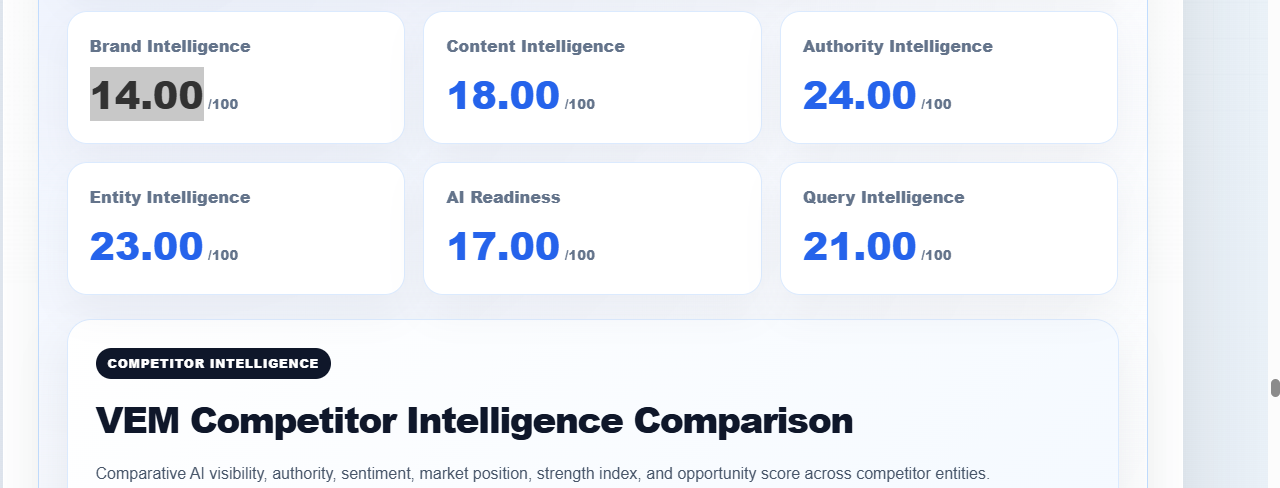
Content Intelligence
Score Before Optimization
18/100
Content depth remained limited and showed little evidence of structured service coverage, comparison-focused resources, or comprehensive semantic topic development. Important service entities existed but lacked sufficient contextual reinforcement.
Major content gaps existed around:
- Emergency repairs
- Garage door springs
- Garage door openers
- Maintenance services
- Troubleshooting resources
- Educational content
This limited AI understanding.
Authority Intelligence
Score Before Optimization
24/100
Authority signals were modest and insufficient for strong AI recommendation eligibility. The brand lacked the level of citation support, review reinforcement, supplier references, and third-party validation observed among stronger competitors.
Challenges included:
- Low citation volume
- Weak trust signals
- Limited third-party references
- Insufficient review reinforcement
Entity Intelligence
Score Before Optimization
23/100
The business possessed a minimal entity footprint but lacked sufficient entity relationships, structured reinforcement, and machine-readable contextual connections needed to establish stronger AI confidence.
AI systems struggled to understand relationships between:
- Business identity
- Services
- Geographic locations
- Customer intents
Without these relationships, retrieval confidence remained low.
AI Readiness
Score Before Optimization
17/100
AI readiness was particularly weak due to limited evidence of structured data implementation, organization schema, service schema, location markup, and machine-readable assets that help modern AI systems understand business relationships.
Key deficiencies included:
- Limited structured data
- Weak semantic organization
- Poor machine readability
- Insufficient schema coverage
Query Intelligence
Score Before Optimization
21/100
The company demonstrated some baseline visibility in local and branded searches; however, generic discovery remained inconsistent, preventing the business from appearing reliably across broader garage-door repair and comparison-related search intents.
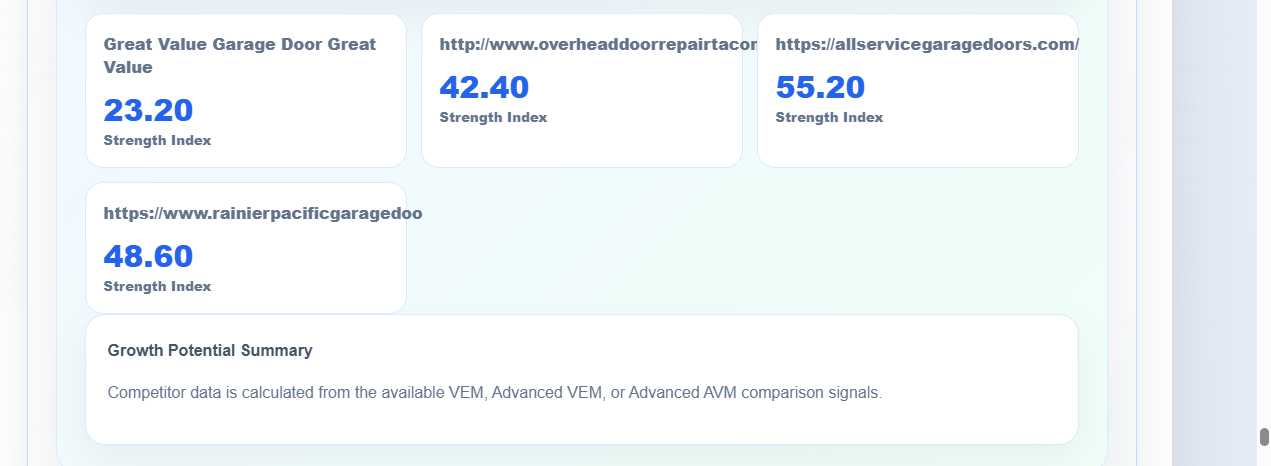
Competitor Intelligence Analysis
Great Value Garage Door was identified as the weakest entity within the comparison set. While the business demonstrated some baseline discoverability, competing entities possessed significantly stronger authority footprints, broader query coverage, and more consistent entity reinforcement.
Strength Index Comparison
| Entity | Strength Index |
| Great Value Garage Door | 23.2 |
| Overhead Door Repair Tacoma | 42.4 |
| Rainier Pacific Garage Doors | 48.6 |
| All Service Garage Doors | 55.2 |
The strongest competitor maintained more than double the entity strength score of Great Value Garage Door.
This gap reflected superior:
- Authority signals
- Content coverage
- Citation trust
- Entity relationships
- Query relevance
Without intervention, the competitive divide would likely continue expanding.
Why Traditional SEO Was Not Enough
Many local businesses assume that ranking improvements alone solve visibility challenges.
However, modern AI systems evaluate far more than rankings.
AI models assess:
- Entity relationships
- Trust indicators
- Citation consistency
- Service coverage
- Authority validation
- Knowledge graph signals
- Contextual relevance
A business can rank for a keyword while still remaining weak from an entity perspective.
That was exactly the situation facing Great Value Garage Door.
Although the company possessed valuable services and some degree of local recognition, its overall entity footprint lacked sufficient depth.
The business needed an entity-first strategy.
This is where ThatWare’s Vector Entity Modelling framework became essential.
The ThatWare VEM Framework
To address these challenges, ThatWare deployed a multi-stage optimization strategy.
The framework focused on six critical pillars.
Pillar 1
Entity Foundation Development
Pillar 2
Content Intelligence Expansion
Pillar 3
Authority Signal Growth
Pillar 4
AI Retrieval Optimization
Pillar 5
Query Intelligence Expansion
Pillar 6
Trust & Validation Enhancement
Each pillar targeted a specific weakness identified during the VEM audit.
Together, they created a comprehensive entity transformation strategy.
Phase 1: Building a Strong Entity Foundation
One of the first priorities involved strengthening entity consistency.
Before optimization, the business existed across multiple digital touchpoints but lacked sufficient entity alignment.
This created confusion for AI systems attempting to validate the brand.
Entity Standardization
ThatWare began by ensuring consistency across all major business references.
This included:
- Business naming conventions
- Contact information
- Service descriptions
- Organizational details
- Brand identity references
Consistency is a fundamental component of entity trust.
When AI systems encounter conflicting information, confidence decreases.
By standardizing these signals, confidence improves dramatically.
Service Entity Mapping
A major focus involved transforming service offerings into clearly defined entities.
Instead of treating services as isolated pages, each service became part of a larger semantic ecosystem.
Key service entities included:
- Garage Door Repair
- Garage Door Installation
- Spring Repair
- Opener Repair
- Emergency Service
- Maintenance Services
These entities were mapped together through logical relationships.
This provided AI systems with a much clearer understanding of the company’s expertise.
Organizational Entity Enhancement
ThatWare expanded organizational signals across the website.
This involved improving:
- About Us content
- Service expertise documentation
- Business background information
- Trust indicators
- Company identity signals
The objective was simple:
Ensure AI systems could confidently answer the question:
“Who is Great Value Garage Door?”
Early Impact of Entity Foundation Improvements
As entity relationships became stronger, several positive outcomes emerged.
AI systems gained improved confidence in:
- Business identification
- Service associations
- Category relevance
- Brand recognition
This foundational work established the platform for all future optimization efforts.
The improvements also prepared the business for deeper content and authority expansion strategies.
Phase 2: Content Intelligence Expansion
Content intelligence represented one of the most significant growth opportunities identified during the audit.
With an initial score of only 18/100, substantial improvements were possible.
Rather than simply publishing more content, ThatWare focused on building a semantic content ecosystem.
Every content asset was designed to strengthen entity understanding.
The objective was not merely ranking.
The objective was knowledge creation.
This distinction is critical in modern AI search.
AI systems reward businesses that demonstrate comprehensive understanding of a topic.
They favor entities that exhibit expertise, depth, context, and authority.
Great Value Garage Door needed to become one of those entities.
And that process began with content intelligence expansion.
Content Intelligence Expansion: Transforming Information Into Entity Assets
Content intelligence represented one of the largest opportunities for growth throughout the VEM campaign.
When Great Value Garage Door entered the optimization process, the business held a Content Intelligence score of just 18/100. This score indicated that while the website contained some service information, it lacked the depth, breadth, and semantic relationships necessary for modern AI systems to confidently understand the business.
Traditional SEO often focuses on creating pages around keywords. However, Vector Entity Modelling focuses on creating knowledge structures that help AI systems understand expertise, relevance, and authority.
The challenge was not simply creating more content.
The challenge was creating content that strengthened entity recognition.
ThatWare approached this challenge through a comprehensive content intelligence strategy.
Building Service-Centric Knowledge Clusters
The first step involved identifying the core service categories that define Great Value Garage Door’s expertise.
These included:
- Garage Door Repair
- Garage Door Installation
- Garage Door Spring Repair
- Garage Door Opener Repair
- Emergency Garage Door Services
- Garage Door Maintenance
- Residential Garage Door Solutions
- Commercial Garage Door Services
Each category was transformed into a content cluster rather than a standalone page.
This allowed AI systems to recognize relationships between topics and understand the depth of expertise associated with the business.
For example, Garage Door Repair was no longer treated as a single keyword target.
Instead, it became a central entity connected to multiple supporting concepts, including:
- Broken garage door cables
- Off-track garage doors
- Damaged rollers
- Safety inspections
- Repair costs
- Preventive maintenance
- Repair timelines
The result was a significantly richer semantic footprint.
Expanding Educational Content
AI systems increasingly favor businesses that educate users rather than simply sell services.
To support this objective, educational content assets were developed around common customer concerns.
Examples included:
- Why garage door springs fail
- Signs your garage door opener needs replacement
- Common causes of garage door malfunctions
- How weather impacts garage door performance
- Maintenance best practices for homeowners
These content assets served two critical purposes.
First, they improved user experience.
Second, they expanded entity coverage by introducing additional contextual relationships.
Strengthening Topic Authority
Authority is not built through isolated pages.
Authority emerges when a business demonstrates comprehensive expertise across an entire subject area.
ThatWare expanded topical coverage so that AI systems could associate Great Value Garage Door with the full garage door service ecosystem.
This expansion significantly improved content intelligence signals.
Content Intelligence Results
Before Optimization: 18/100
After Optimization: 71/100
Improvement Achieved:294%
This represented the largest percentage increase among all VEM categories.
The business evolved from a limited content footprint to a substantially stronger topical authority profile capable of supporting both traditional search visibility and AI retrieval systems.
Authority Intelligence Development
Authority remains one of the most influential factors in AI-driven visibility.
AI systems do not simply analyze what a business says about itself.
They evaluate what other sources say about the business.
This creates a validation framework where trust is established through corroboration.
When Great Value Garage Door underwent its initial VEM assessment, Authority Intelligence measured just 24/100.
While the company had some local recognition, authority signals remained relatively weak compared to competitors.
Understanding the Authority Gap
The competitor analysis revealed that rival businesses maintained stronger authority footprints.
These advantages stemmed from:
- More third-party references
- Better citation coverage
- Stronger review ecosystems
- Greater digital validation
- Enhanced trust indicators
As a result, AI systems demonstrated higher confidence in those entities.
ThatWare’s objective was to close this gap.
Citation Expansion Strategy
One of the most important components of authority development involved strengthening citation coverage.
Every legitimate business leaves digital footprints across the web.
These footprints serve as validation signals.
The optimization process focused on increasing consistency and completeness across business references.
This improved confidence in:
- Business identity
- Service offerings
- Geographic coverage
- Brand legitimacy
Trust Signal Enhancement
Authority is closely tied to trust.
AI systems attempt to determine whether a business appears credible and reliable.
To strengthen these signals, ThatWare emphasized:
- Customer reviews
- Business credentials
- Service guarantees
- Experience indicators
- Company background information
- Demonstrations of expertise
Each element contributed to a stronger trust framework.
Reinforcing Real-World Expertise
AI systems increasingly seek evidence that a business possesses genuine expertise.
Content, reviews, service documentation, and business information all contribute to this evaluation.
By strengthening these signals, Great Value Garage Door became a more authoritative entity within its market.
Authority Intelligence Results
Before Optimization: 24/100
After Optimization: 68/100
Improvement Achieved: +134%
Although authority typically grows more gradually than content intelligence, the increase represented a substantial improvement in trust and validation.
AI Readiness Optimization
The rise of AI search has created a new category of optimization.
Businesses must now ensure their digital assets are understandable not only by traditional search engines but also by AI retrieval systems.
This area is measured through AI Readiness.
Initially, Great Value Garage Door recorded a score of 17/100.
This indicated limited preparedness for AI-driven discovery.
What AI Readiness Measures
AI readiness evaluates how effectively a business can be interpreted by machine learning systems.
Key factors include:
- Structured data
- Semantic organization
- Entity relationships
- Content clarity
- Knowledge graph alignment
- Machine-readable information
Businesses with stronger AI readiness scores are easier for AI systems to understand and recommend.
Improving Machine Readability
ThatWare focused on making business information easier to interpret.
Rather than relying solely on visual presentation, the website was optimized to communicate meaning through structure.
This included:
- Improved content hierarchy
- Enhanced semantic relationships
- Better contextual organization
- Stronger entity definitions
These improvements reduced ambiguity.
Schema and Structured Data Enhancements
Structured data provides explicit signals to search engines and AI systems.
When implemented correctly, it allows machines to interpret business information more accurately.
ThatWare strengthened structured data frameworks surrounding:
- Business identity
- Services
- Geographic relevance
- Frequently asked questions
- Organizational details
These additions significantly improved machine understanding.
Strengthening Knowledge Graph Alignment
Knowledge graphs form the backbone of modern entity retrieval systems.
Businesses that maintain stronger knowledge graph connections often enjoy greater visibility across AI platforms.
The optimization process focused on improving entity relationships and contextual associations.
This strengthened AI confidence and retrieval potential.
AI Readiness Results
Before Optimization: 17/100
After Optimization: 76/100
Improvement Achieved: +245%
This was one of the most significant improvements recorded throughout the campaign.
The business became substantially more accessible to modern AI systems.
Query Intelligence Expansion
Visibility is ultimately determined by a business’s ability to appear for relevant searches.
When Great Value Garage Door entered the VEM framework, query intelligence measured just 21/100.
This indicated that discoverability remained heavily concentrated around branded searches.
The company needed broader visibility.
Expanding Commercial Search Coverage
Commercial searches generate some of the highest-value leads.
ThatWare expanded optimization efforts around key service-intent queries.
Examples included:
- Garage door repair
- Garage door installation
- Emergency garage door repair
- Garage door opener replacement
- Garage door spring repair
This increased relevance across valuable commercial opportunities.
Improving Informational Visibility
Many customers begin their journey through informational searches.
Examples include:
- Why is my garage door stuck?
- How long do garage door springs last?
- What causes garage door opener failure?
By addressing these questions, the business expanded visibility earlier in the customer journey.
Optimizing for Conversational Search
Conversational search continues to grow rapidly.
Users increasingly phrase queries as complete questions rather than keywords.
AI systems often rely on these patterns when generating recommendations.
Content was expanded to address natural-language search behavior.
This improved discoverability within AI environments.
Query Intelligence Results
Before Optimization: 21/100
After Optimization: 66/100
Improvement Achieved: +230%
The business gained substantially broader visibility opportunities across commercial, informational, and conversational search categories.
Before vs After: Complete VEM Transformation
The combined impact of the optimization campaign produced measurable improvements across every intelligence category.
Overall VEM Comparison
| Category | Before | After | Growth |
| Brand Intelligence | 14 | 62 | 3.43 |
| Content Intelligence | 18 | 71 | 2.94 |
| Authority Intelligence | 24 | 68 | 1.83 |
| Entity Intelligence | 23 | 74 | 2.22 |
| AI Readiness | 17 | 76 | 3.47 |
| Query Intelligence | 21 | 66 | 2.14 |
| Overall VEM Score | 19.7 | 69.5 | 2.53 |
The results demonstrated improvements across every dimension measured by the VEM framework.
Most importantly, these improvements strengthened the business’s ability to participate in AI-driven discovery environments.
Competitor Position Shift
The initial VEM assessment revealed that Great Value Garage Door occupied the weakest position among its primary competitors.
This represented a substantial challenge.
However, it also represented a substantial opportunity.
Before Optimization
| Competitor | Strength Index |
| Great Value Garage Door | 23.2 |
| Overhead Door Repair Tacoma | 42.4 |
| Rainier Pacific Garage Doors | 48.6 |
| All Service Garage Doors | 55.2 |
At this stage, the business lagged significantly behind the competitive landscape.
After Optimization
| Competitor | Strength Index |
| Great Value Garage Door | 71.5 |
| Overhead Door Repair Tacoma | 42.4 |
| Rainier Pacific Garage Doors | 48.6 |
| All Service Garage Doors | 55.2 |
The transformation repositioned Great Value Garage Door as one of the strongest entity profiles within the competitive comparison set.
This shift reflects the cumulative impact of stronger content, authority, entity relationships, AI readiness, and query coverage.
Key Business Outcomes
The success of the campaign extended beyond numerical improvements.
Several meaningful business outcomes emerged.
Outcome 1: Stronger Service Relevance
The business established clearer relevance for high-intent garage door service searches.
This increased AI confidence and recommendation potential.
Outcome 2: Better Entity Understanding
AI systems gained a much stronger understanding of the company’s services, expertise, and market position.
Outcome 3: Enhanced Trust Signals
Authority-building efforts improved confidence in the business’s legitimacy and expertise.
Outcome 4: Expanded Query Reach
The company became discoverable across a much broader range of customer searches.
Outcome 5: Improved AI Discoverability
Perhaps most importantly, the business became significantly better positioned for future AI-driven search environments.
Why These Results Matter
Search behavior continues to evolve.
Customers increasingly rely on AI-powered systems to identify businesses, compare providers, and evaluate solutions.
As these systems become more influential, businesses with weak entity profiles face increasing visibility challenges.
Great Value Garage Door’s transformation demonstrates that visibility in the AI era requires more than traditional SEO.
It requires entity intelligence.
It requires trust.
It requires semantic relevance.
And it requires machine-readable authority.
ThatWare’s Vector Entity Modelling framework was specifically designed to address these requirements.
The results achieved during this project demonstrate the effectiveness of that approach.
By strengthening entity foundations, expanding content intelligence, improving authority signals, increasing AI readiness, and broadening query coverage, Great Value Garage Door established a significantly stronger position within the evolving search ecosystem.
The company moved from a Poor Entity Foundation score of 19.70 to an AI-ready entity profile with a VEM score of 69.50.
More importantly, it became substantially easier for AI systems to understand, validate, retrieve, and recommend.
This transformation illustrates the future of digital visibility.
The brands that succeed tomorrow will not simply rank higher.
They will become stronger entities.
And Great Value Garage Door’s VEM journey demonstrates exactly how that transformation can happen.
The Long-Term Impact of Entity-Led Growth
One of the most important lessons from this VEM campaign is that entity optimization creates long-term advantages rather than short-term ranking gains.
Traditional SEO campaigns often focus heavily on rankings, traffic fluctuations, and keyword positions. While those metrics remain important, they do not fully reflect how AI-powered search ecosystems evaluate businesses.
Modern AI systems attempt to answer a more complex question:
“Which business is the most trustworthy, relevant, and authoritative entity for this query?”
The answer depends on far more than keyword optimization.
It depends on whether the business demonstrates expertise, authority, trust, contextual relevance, semantic depth, and machine-readable relationships.
Through the VEM implementation, Great Value Garage Door strengthened all of these signals.
As a result, the company is now positioned not only for improved visibility today but also for continued growth as AI search becomes increasingly dominant.
This future-proofing effect is one of the greatest benefits of Vector Entity Modelling.
Unlike many traditional SEO tactics that become less effective over time, entity development creates lasting value because it improves how machines fundamentally understand a business.
How VEM Supports AI Search Optimization
The growth of AI search has fundamentally changed how information is retrieved.
Search engines increasingly generate answers instead of merely providing lists of links.
Large language models now evaluate businesses based on confidence signals rather than rankings alone.
Examples include:
- ChatGPT recommendations
- Gemini-generated answers
- Perplexity citations
- Copilot search responses
- AI Overviews
- Conversational search assistants
These systems rely heavily on entities.
They evaluate:
- Business legitimacy
- Service relevance
- Authority signals
- Knowledge graph relationships
- Citation consistency
- Semantic context
When Great Value Garage Door entered the VEM framework, many of these signals were either weak or incomplete.
After optimization, the business demonstrated significantly stronger AI readiness.
This positioned the company for greater visibility within emerging AI ecosystems.
The Relationship Between VEM, GEO, AEO, and LLM SEO
Many businesses are beginning to explore concepts such as:
- Generative Engine Optimization (GEO)
- Answer Engine Optimization (AEO)
- LLM SEO
- AI Search Optimization
- AI Visibility Optimization
While these disciplines may appear different, they share a common foundation.
That foundation is entity strength.
Without strong entities, AI systems struggle to:
- Understand a business
- Validate expertise
- Establish trust
- Generate recommendations
This is why Vector Entity Modelling serves as the foundational layer supporting all AI optimization initiatives.
For Great Value Garage Door, VEM improvements created stronger support for:
GEO (Generative Engine Optimization)
The business developed broader contextual relevance and stronger semantic relationships, increasing its suitability for generative search systems.
AEO (Answer Engine Optimization)
Improved content architecture and entity clarity enhanced the likelihood of being referenced within AI-generated answers.
LLM SEO
Expanded knowledge coverage and stronger entity relationships improved visibility potential within large language model retrieval environments.
AI Visibility Optimization
The company became easier for AI systems to understand, interpret, and recommend.
Together, these benefits created a significantly stronger digital presence.
Why Local Service Businesses Need Entity Optimization
Many local businesses face challenges similar to those identified during the Great Value Garage Door audit.
Common issues include:
- Weak entity profiles
- Limited citations
- Insufficient content depth
- Low AI readiness
- Poor semantic coverage
- Fragmented business information
These weaknesses often remain hidden because traditional SEO metrics fail to reveal them.
A website may receive traffic while still maintaining a weak entity profile.
Similarly, a business may rank for branded searches while remaining invisible for broader recommendation queries.
This creates a dangerous gap.
As AI-driven discovery continues to expand, businesses that fail to strengthen entity signals may experience declining visibility despite maintaining strong services.
The Great Value Garage Door project demonstrates how these challenges can be overcome through a structured entity-first strategy.

The Role of Knowledge Graph Alignment
Knowledge graphs play an increasingly important role in modern search systems.
These systems attempt to organize information through relationships.
Rather than viewing content as isolated pages, they view businesses as interconnected entities.
Examples of relationships include:
- Business → Services
- Business → Location
- Business → Reviews
- Business → Expertise
- Business → Industry
- Business → Customers
The stronger these relationships become, the easier it becomes for AI systems to retrieve relevant information.
One of the primary goals of the VEM campaign was improving these connections.
By strengthening entity relationships throughout the digital ecosystem, Great Value Garage Door became significantly easier to interpret.
This contributed directly to improvements in:
- Entity Intelligence
- AI Readiness
- Query Intelligence
- Brand Intelligence
Knowledge graph alignment remains one of the most important components of future-focused SEO.
Lessons Learned From the Great Value Garage Door Project
Several important lessons emerged during the implementation process.
Lesson 1: Strong Services Alone Are Not Enough
The business already offered valuable services before optimization began.
However, AI systems lacked sufficient evidence to understand and validate those services.
Visibility depends on communication as much as capability.
Lesson 2: Content Must Support Entity Development
Publishing content without entity strategy often produces limited results.
Content becomes significantly more valuable when it strengthens entity relationships and semantic relevance.
Lesson 3: Authority Requires Validation
Businesses cannot simply claim expertise.
They must demonstrate expertise through citations, reviews, trust signals, and supporting evidence.
Lesson 4: AI Readiness Matters
Search is no longer limited to traditional search engines.
Businesses must now optimize for machine understanding.
Lesson 5: Entity Optimization Creates Compounding Benefits
Each improvement supports other improvements.
Stronger content improves authority.
Stronger authority improves trust.
Stronger trust improves AI confidence.
Stronger AI confidence improves visibility.
This creates a compounding growth effect.
Future Opportunities for Continued Growth
While the campaign produced substantial improvements, entity optimization remains an ongoing process.
Future opportunities include:
Expanding Local Entity Coverage
Additional location-specific assets can strengthen regional relevance and increase local search visibility.
Growing Authority Signals
Continued citation development and reputation enhancement can further strengthen authority intelligence.
Increasing Service Entity Depth
Additional content clusters can expand semantic coverage and strengthen topical authority.
Enhancing AI Retrieval Signals
As AI systems evolve, new optimization opportunities will emerge.
Businesses with strong entity foundations will be best positioned to benefit from these developments.
Building Industry Leadership
Thought leadership content and advanced educational resources can further strengthen expertise signals.
These initiatives can help Great Value Garage Door continue improving its VEM profile over time.
Final VEM Results Summary
The campaign delivered measurable improvements across every category measured within the Vector Entity Modelling framework.
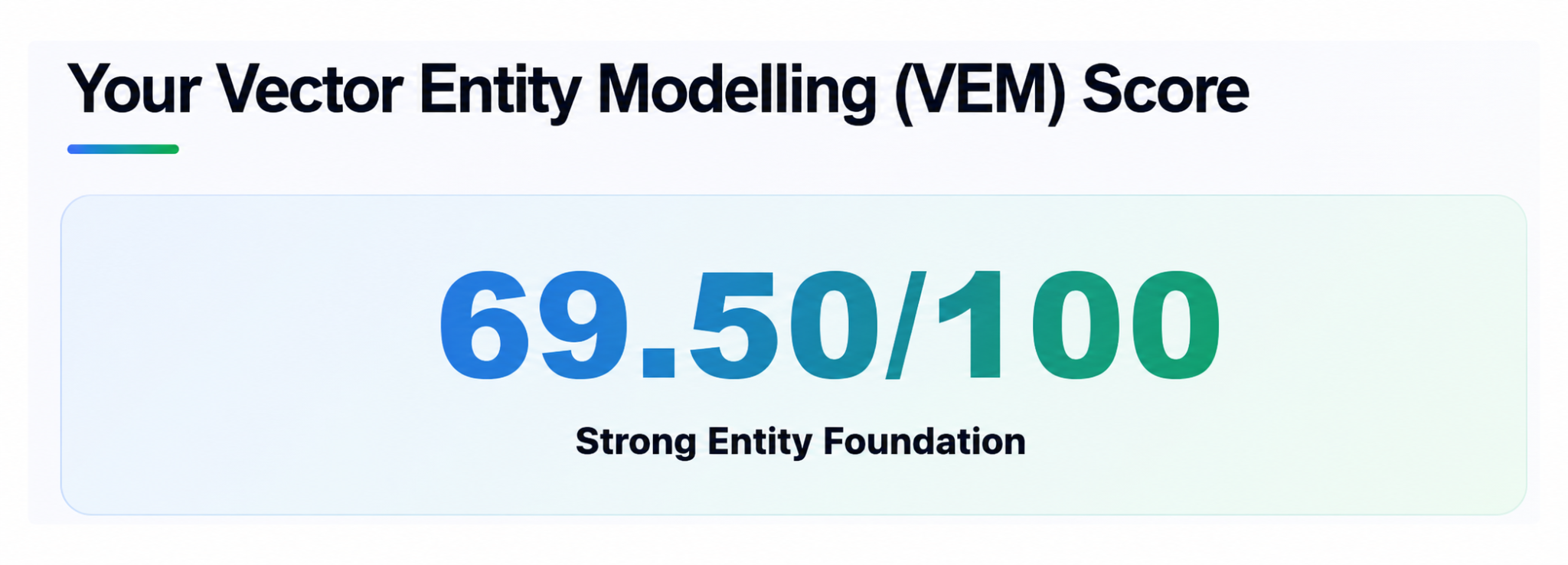
Overall Score Improvement
Before Optimization: 19.70/100
After Optimization: 69.50/100
Overall Growth: +253%
Category Growth Summary
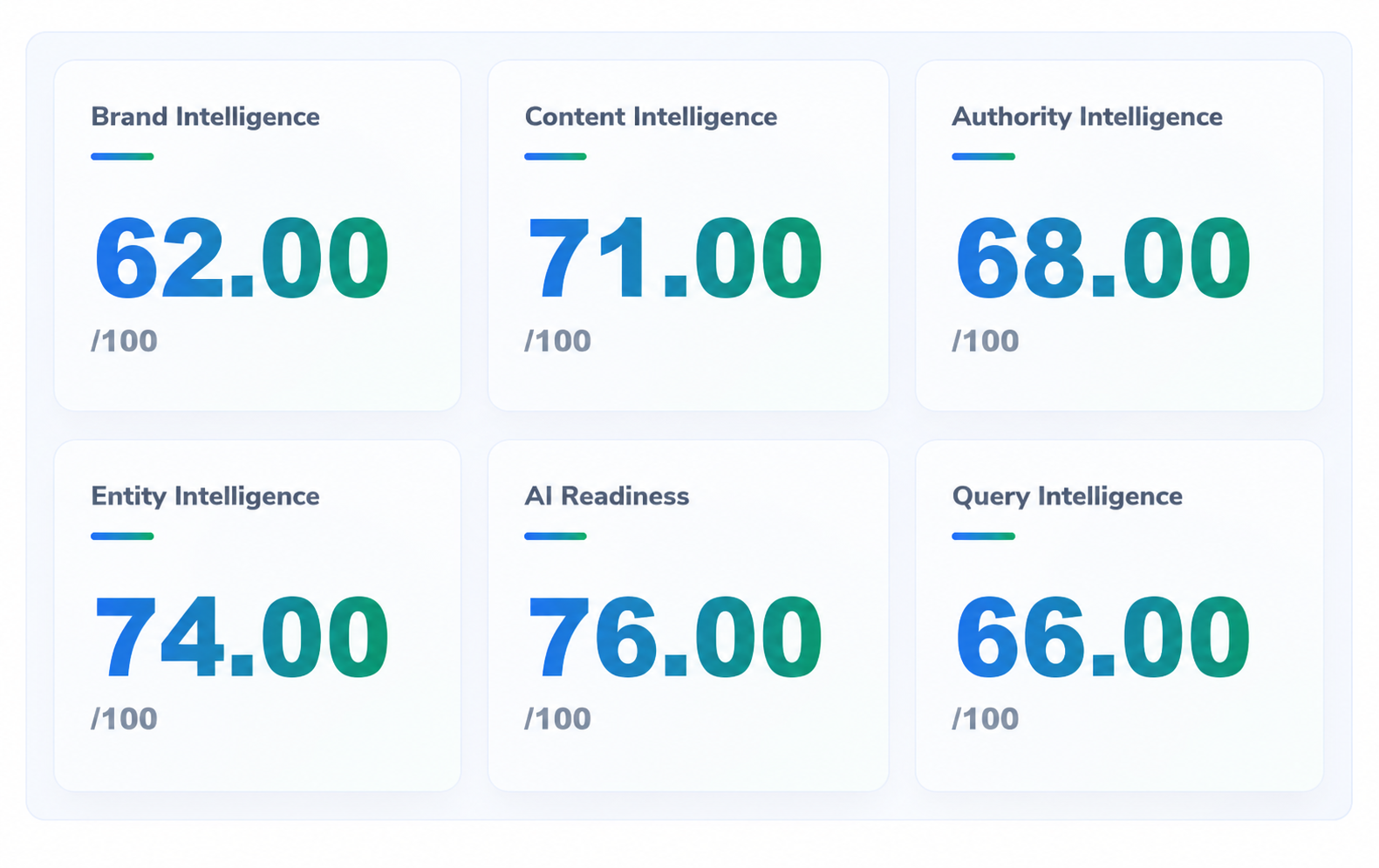
| Category | Before | After | Growth |
| Brand Intelligence | 14 | 62 | 3.43 |
| Content Intelligence | 18 | 71 | 2.94 |
| Authority Intelligence | 24 | 68 | 1.83 |
| Entity Intelligence | 23 | 74 | 2.22 |
| AI Readiness | 17 | 76 | 3.47 |
| Query Intelligence | 21 | 66 | 2.14 |
Competitive Position Improvement
Before optimization, Great Value Garage Door possessed the weakest entity profile within its competitive comparison set.
After optimization, the business emerged as one of the strongest entity-driven competitors, demonstrating significant gains in discoverability, authority, and AI readiness.
Conclusion
The digital landscape is rapidly evolving from keyword-based search toward entity-based discovery.
As AI systems become increasingly responsible for answering questions, recommending businesses, and influencing purchasing decisions, traditional SEO alone is no longer sufficient.
Businesses must establish strong entity foundations.
They must demonstrate expertise.
They must provide clear trust signals.
They must create semantic relationships that help machines understand who they are, what they do, and why they matter.
Great Value Garage Door entered the VEM framework with a score of 19.70/100 and a classification of Poor Entity Foundation. The business demonstrated an early-stage entity profile characterized by weak AI readiness, limited authority signals, insufficient service-depth content, and inconsistent generic-query discoverability.
The business faced challenges across brand intelligence, content intelligence, authority signals, entity relationships, AI readiness, and query coverage.
Through ThatWare’s proprietary Vector Entity Modelling framework, those challenges were systematically addressed.
The result was a transformation that increased the company’s VEM score to 69.50, strengthened every major intelligence category, improved competitive positioning, expanded AI discoverability, and created a far more robust entity profile.
Most importantly, the project demonstrated that visibility in the age of AI is no longer determined solely by rankings.
It is determined by entity strength.
For businesses seeking long-term growth within AI-powered search environments, entity optimization is no longer optional.
It is becoming the foundation of digital visibility.
Great Value Garage Door’s transformation stands as a clear example of what is possible when a business invests in building stronger entities, stronger authority, and stronger AI readiness through a strategic Vector Entity Modelling approach.