
SUPERCHARGE YOUR ONLINE VISIBILITY! CONTACT US AND LET’S ACHIEVE EXCELLENCE TOGETHER!
In today’s AI-driven search landscape, visibility is no longer determined solely by rankings and website traffic. As AI platforms such as ChatGPT, Gemini, Claude, Perplexity, and other answer engines increasingly influence consumer decisions, businesses must ensure they are not only discoverable by search engines but also understood, trusted, and recommended by AI systems.
Auckland Garage Doors, a trusted garage door installation, repair, servicing, and maintenance company serving Auckland and surrounding regions in New Zealand, faced a challenge that many local businesses are only beginning to recognize. While the company had established a solid online presence and a functional website, its visibility across emerging AI ecosystems remained limited.
Through ThatWare’s proprietary AI Visibility Optimization framework, the company embarked on a transformation focused on improving AI discoverability, entity clarity, citation trust, and recommendation readiness.
The Challenge
Although Auckland Garage Doors maintained an active online presence, our initial assessment revealed several significant AI visibility gaps.
The company was operating successfully from a traditional digital marketing perspective, but AI systems demonstrated limited awareness and understanding of the brand.
Some of the key challenges identified included:
- AI platforms rarely referenced the company when responding to relevant industry queries.
- Entity recognition signals were weak, making it difficult for AI systems to confidently understand the business.
- Citation and authority signals were insufficient for strong recommendation confidence.
- Visibility across AI-generated answers was extremely limited.
- Different AI systems interpreted the company inconsistently, creating fragmented entity understanding.
These challenges created a significant risk in the evolving AI-first search environment, where recommendations increasingly influence customer decisions before a website visit ever occurs.
The Solution
To address these challenges, ThatWare implemented a comprehensive AI Visibility Optimization strategy built upon multiple proprietary frameworks.
The implementation included:
- AVM Intelligence auditing and measurement
- AI Visibility Optimization methodologies
- VEM-based Entity Optimization
- GEO (Generative Engine Optimization) frameworks
- AI Retrieval Readiness enhancements
- Entity clarity improvements
- Citation trust strengthening
- Semantic relationship development
- AI-focused content and structure optimization
The objective was clear: improve how AI systems discover, interpret, trust, and recommend Auckland Garage Doors.
2. About Auckland Garage Doors
Company Background
Auckland Garage Doors is a New Zealand-based garage door specialist serving residential and commercial customers throughout Auckland and nearby regions.
The company provides a comprehensive range of services designed to help homeowners and businesses maintain secure, functional, and reliable garage door systems.
Its services include:
- Garage door installation
- Garage door repairs
- Maintenance and servicing
- Replacement solutions
- Emergency repair assistance
- Residential garage door solutions
- Commercial garage door support
Over the years, Auckland Garage Doors has built a reputation for professional service, customer satisfaction, and technical expertise. The company’s commitment to quality workmanship and responsive support has helped establish trust among customers seeking reliable garage door solutions.
However, in an era where AI systems increasingly influence purchasing decisions, business reputation alone is no longer sufficient.
Brands must also ensure they are visible and understandable to machines.
Why AI Visibility Matters for Local Service Businesses
The way consumers search for local services is rapidly changing.
Traditionally, users would search on Google, browse several websites, compare providers, and then make a decision.
Today, many users begin by asking AI systems direct questions.
Examples include:
- “Who installs garage doors in Auckland?”
- “Best garage door company in Auckland.”
- “Garage door repair services near me.”
- “Most reliable garage door installers in Auckland.”
- “Which garage door company should I choose?”
Instead of receiving a list of links, users increasingly receive direct recommendations and summarized answers.
This shift introduces a new competitive environment.
If AI systems do not recognize or trust a business, that business may never appear in the recommendation layer that influences customer decisions.
For local service providers such as Auckland Garage Doors, AI visibility is becoming just as important as traditional search visibility.
3. The Hidden Problem: Poor AI Visibility Despite Existing Online Presence
Traditional SEO Was Not the Core Problem
One of the most important discoveries during the project was that Auckland Garage Doors did not suffer from a traditional visibility problem.
The company already possessed many of the elements commonly associated with digital presence:
- A functioning website
- Service-focused pages
- Business information
- Local service coverage
- Industry expertise
From a traditional perspective, the foundation existed.
However, AI visibility operates differently from traditional SEO visibility.
AI systems must understand not only webpages but also entities, relationships, trust signals, context, and topical expertise.
Our analysis revealed that while information existed online, AI systems struggled to properly interpret and connect those signals.
As a result, the business was not receiving the level of AI visibility it deserved.
Initial AI Visibility Assessment
ThatWare’s AVM Intelligence audit uncovered several important weaknesses.
Weak Entity Recognition
One of the most significant issues involved entity clarity.
AI systems showed limited confidence in identifying Auckland Garage Doors as a strong and authoritative business entity within its service category.
Questions remained unclear from the perspective of AI models:
- Who exactly is this company?
- What services does it specialize in?
- How authoritative is it within its market?
- Should it be recommended over competitors?
Without strong entity understanding, recommendation visibility becomes difficult.
Limited Citation Signals
Modern AI systems rely heavily on citations, references, authority indicators, and trust sources.
The audit revealed that available signals were not sufficiently strong to support optimal recommendation confidence.
This reduced the likelihood of the business being surfaced within AI-generated answers.
Inconsistent Brand Understanding
Different AI systems interpreted the company differently.
Some understood portions of the service offering, while others demonstrated fragmented understanding of the company’s expertise and positioning.
This inconsistency created additional barriers to AI recommendation visibility.
Low Recommendation Presence
Perhaps the most important finding was that Auckland Garage Doors rarely appeared within AI-generated recommendations for relevant service-related queries.
In practical terms, this meant that potential customers asking AI assistants for guidance could be directed toward alternative businesses instead.
Why This Was Dangerous
This challenge highlights one of the most important shifts occurring in modern search.
A company can rank reasonably well in traditional search results and still remain largely invisible within AI-generated recommendations.
This creates a hidden visibility gap.
Businesses may believe they are visible because they possess rankings and webpages, while AI systems continue recommending competitors.
As answer engines become more influential in consumer decision-making, this gap can directly impact brand awareness, lead generation, and future growth.
For Auckland Garage Doors, addressing this issue became a strategic priority.
4. ThatWare’s AI Visibility Optimization Framework
Understanding AI Visibility Optimization
Traditional SEO was designed for search engines.
AI Visibility Optimization is designed for AI ecosystems.
The difference is significant.
Traditional SEO focuses on helping webpages rank higher.
AI Visibility Optimization focuses on helping AI systems understand, trust, retrieve, cite, and recommend brands.
Rather than concentrating exclusively on keywords and rankings, ThatWare’s framework evaluates how AI systems interpret an organization as an entity.
The objective is to improve:
- AI discoverability
- Entity understanding
- Citation trust
- Semantic clarity
- Retrieval readiness
- Recommendation probability
This creates a more advanced visibility layer that aligns with the future of search.
From Ranking Visibility to Recommendation Visibility
Traditional SEO asks:
“Can users find the website?”
AI Visibility Optimization asks:
“Can AI systems confidently recommend the brand?”
This shift changes the entire optimization process.
Instead of focusing solely on rankings, the framework focuses on building machine-level trust and understanding.
Core Components of the Framework
ThatWare’s AI Visibility Optimization methodology combines multiple strategic layers.
These include:
Entity Understanding
Helping AI systems clearly identify:
- Who the business is
- What services it provides
- Which topics it owns
- Why it deserves recommendation
Citation Trust Development
Building stronger trust signals that support AI confidence.
Retrieval Readiness
Improving the ability of AI systems to access, understand, and utilize relevant business information.
Semantic Reinforcement
Creating stronger relationships between the business entity and its service ecosystem.
Recommendation Readiness
Optimizing the business to become a stronger candidate for AI-generated recommendations.
This framework formed the foundation of Auckland Garage Doors’ transformation and established the roadmap for improving AI visibility performance.
5. Phase 1: AVM Intelligence Audit
The first stage of the project involved a comprehensive AVM Intelligence assessment designed to establish a baseline understanding of Auckland Garage Doors’ AI visibility performance.
Rather than relying solely on traditional SEO metrics, the audit focused on how AI systems perceive, interpret, and potentially recommend the business.
Baseline AI Visibility Analysis
The assessment examined multiple AI visibility dimensions.
Presence Signals
We evaluated whether AI systems could consistently discover and identify the business across relevant digital environments.
Citation Signals
We analyzed the availability and quality of references that could support AI trust and recommendation confidence.
Authority Signals
We examined whether available signals demonstrated sufficient expertise and credibility within the garage door industry.
Consistency Signals
We reviewed the consistency of business information, service descriptions, and entity references across digital touchpoints.
Position Signals
We assessed whether the company appeared within relevant AI-generated conversations and recommendation opportunities.
Visibility Gap Identification
The AVM audit revealed several visibility deficiencies that limited AI recommendation potential.
These findings became the foundation for subsequent optimization efforts and provided a clear roadmap for improvement.
6. Phase 2: Entity Optimization Through VEM Principles
Following the AVM Intelligence audit, ThatWare initiated entity optimization using VEM principles to strengthen how AI systems understood Auckland Garage Doors.
Strengthening Business Entity Clarity
The first objective was to improve entity definition.
AI systems require clear signals regarding:
- Business identity
- Core services
- Industry specialization
- Geographic relevance
ThatWare worked to strengthen these foundational signals so that AI systems could more confidently understand the organization.
Service Relationship Mapping
We developed stronger semantic relationships between the company and its primary service categories.
This included reinforcing associations between:
- Garage doors
- Garage door repairs
- Garage door installations
- Garage door maintenance
- Residential services
- Commercial services
- Auckland service areas
These connections help AI systems understand the company’s expertise and relevance to user queries.
Entity Consistency Improvements
Consistency plays a critical role in AI interpretation.
ThatWare improved alignment across:
- Website content
- Business descriptions
- Structured information
- Service references
- Brand messaging
This reduced ambiguity and helped create a more unified entity profile.
Building Stronger Topic Ownership
A critical objective of VEM optimization is helping AI systems answer a simple question:
“What does Auckland Garage Doors specialize in?”
Through strategic entity reinforcement, semantic alignment, and contextual optimization, the business developed stronger topical ownership within its core service categories.
As AI confidence improves, recommendation potential improves as well.
This phase established a stronger entity foundation that supported subsequent GEO and AI visibility enhancement initiatives.
7. Phase 3: Generative Engine Optimization (GEO)
After establishing a stronger entity foundation through AVM Intelligence and VEM-based optimization, the next stage focused on Generative Engine Optimization (GEO).
As AI-powered search continues to evolve, visibility is no longer limited to traditional search result pages. Modern users increasingly rely on AI systems to answer questions, compare businesses, and recommend service providers. This means brands must optimize not only for search engines but also for generative engines.
For Auckland Garage Doors, ThatWare implemented a GEO-focused strategy designed to improve AI retrieval, recommendation readiness, and conversational visibility.
Optimizing for AI Retrieval
The primary objective was to help AI systems better retrieve, understand, and utilize information about Auckland Garage Doors when responding to relevant user queries.
Our GEO implementation focused on multiple AI-driven environments, including:
- AI answer engines
- Conversational search systems
- Recommendation-based discovery platforms
- Generative search interfaces
- Emerging AI-powered decision-making ecosystems
Rather than optimizing solely for rankings, the strategy focused on making Auckland Garage Doors more accessible and understandable to AI systems.
AI Readability Enhancements
One of the most important components of GEO involves improving how information is presented to AI models.
ThatWare optimized several key areas:
Content Structure
Content was reviewed and organized to improve machine readability and contextual understanding.
Semantic Organization
Service-related information was strengthened through clearer topical relationships and stronger contextual signals.
Retrieval Signals
Additional optimization layers were implemented to help AI systems more effectively retrieve relevant information when processing user queries.
These improvements enhanced the company’s overall AI retrieval readiness.
Query Mapping for AI Search
Traditional keyword targeting often focuses on short search phrases.
AI systems operate differently.
Users increasingly ask natural language questions such as:
- Best garage door company in Auckland
- Garage door installation specialists
- Garage door repair experts
- Who repairs garage doors near me?
- Which garage door company should I choose in Auckland?
ThatWare mapped business information and service expertise to these conversational query patterns to improve AI understanding and recommendation potential.
Recommendation Visibility Strategy
The ultimate goal of GEO is not simply visibility.
It is recommended visibility.
Our optimization efforts focused on improving the probability that Auckland Garage Doors could appear within AI-generated responses when users seek recommendations related to garage door installation, repair, servicing, and maintenance.
By strengthening retrieval pathways and contextual relevance, the company became better positioned within the evolving AI search ecosystem.
8. Phase 4: Citation Trust and Authority Development
One of the most critical aspects of AI visibility is trust.
Unlike traditional search engines that often rely heavily on backlinks and ranking factors, AI systems increasingly evaluate authority through citations, references, contextual signals, and credibility indicators.
For this reason, ThatWare initiated a dedicated Citation Trust and Authority Development phase.
Improving Trust Signals
The objective was to strengthen the overall confidence AI systems could place in Auckland Garage Doors as a legitimate and trustworthy service provider.
This process focused on:
Citation Opportunities
Identifying and strengthening references that could improve AI confidence and reinforce business legitimacy.
Authority References
Building stronger signals that demonstrated expertise and relevance within the garage door industry.
Credibility Indicators
Enhancing the trust ecosystem surrounding the business through improved consistency, validation, and supporting signals.
Supporting AI Confidence
AI systems do not recommend businesses randomly.
They recommend businesses they believe are credible, trustworthy, and relevant to the user’s intent.
This phase focused on increasing that confidence layer.
By improving authority signals and citation trust, Auckland Garage Doors became a stronger candidate for AI-generated recommendations.
As confidence increases, recommendation potential typically improves as well.
This made citation trust a key component of the overall AI Visibility Optimization strategy.
9. Phase 5: AI Visibility Monitoring and AVM Tracking
Optimization without measurement creates uncertainty.
To ensure that progress could be accurately evaluated, ThatWare continuously monitored Auckland Garage Doors’ AI visibility performance through AVM Intelligence and ongoing tracking methodologies.
Measuring Progress
AI visibility is dynamic.
As AI systems evolve, recommendation behavior can change over time.
For this reason, monitoring became an essential component of the project.
ThatWare tracked several critical indicators, including:
Visibility Growth
How frequently the company appeared across AI-driven environments.
AI Mentions
Whether AI systems were increasingly recognizing and referencing the brand.
Recommendation Frequency
The likelihood of the business appearing within recommendation-oriented AI responses.
Citation Development
The growth of trust and authority signals supporting AI confidence.
This monitoring framework allowed us to evaluate progress throughout the optimization process.
Why Measurement Matters
Traditional SEO tools provide valuable insights into rankings, traffic, and keyword performance.
However, they were never designed to measure AI visibility.
Businesses require a new measurement layer to understand how AI systems perceive and recommend their brand.
This is precisely where AVM becomes valuable.
AVM provides measurable intelligence regarding:
- AI visibility
- Recommendation readiness
- Entity understanding
- Citation trust
- AI search performance
By tracking these dimensions, businesses gain a clearer understanding of their position within the emerging AI-first search landscape.
10. Results: Auckland Garage Doors’ AVM Score Improvement
AI Visibility Performance Result
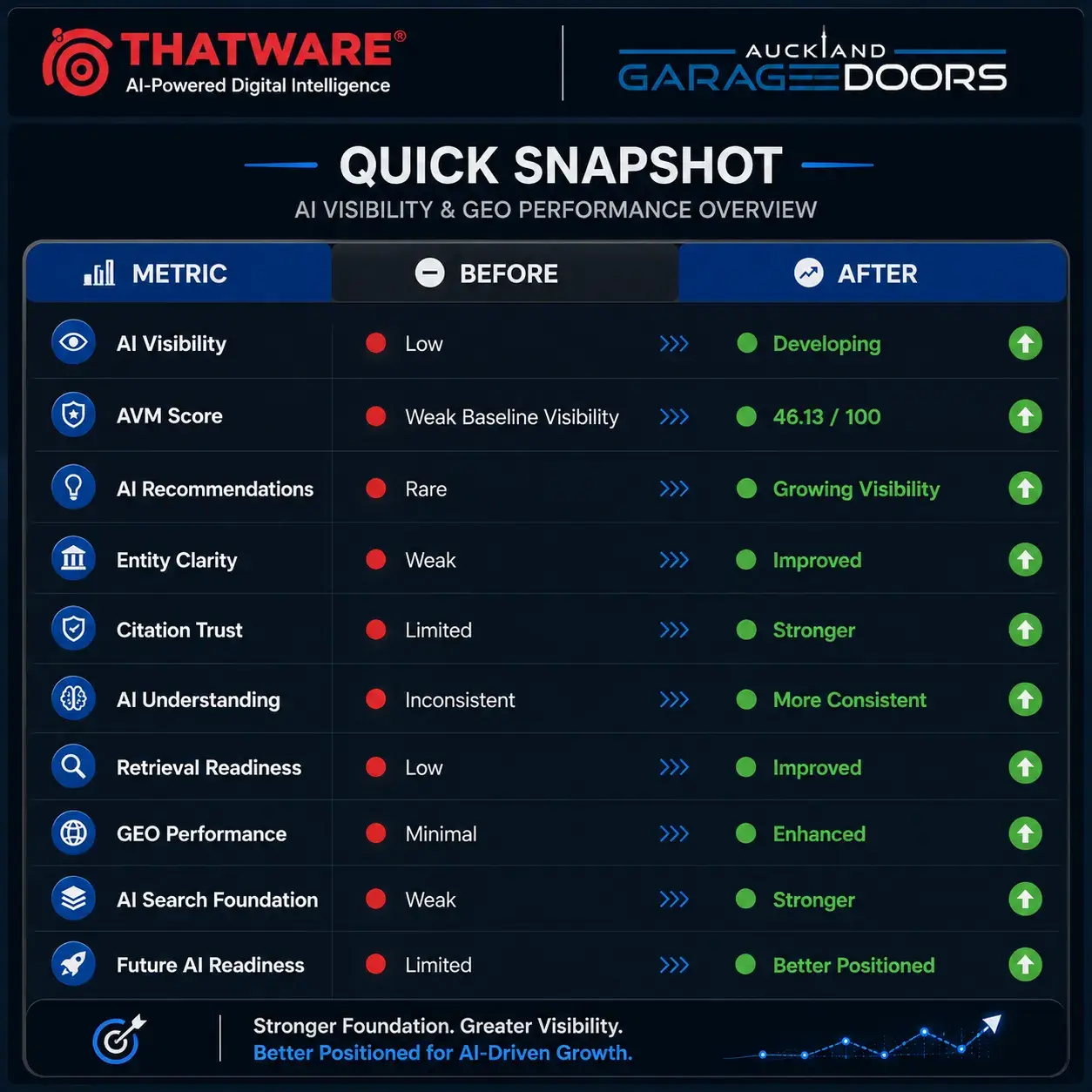
Following the implementation of ThatWare’s AI Visibility Optimization framework, Auckland Garage Doors achieved measurable progress in its AI visibility journey.
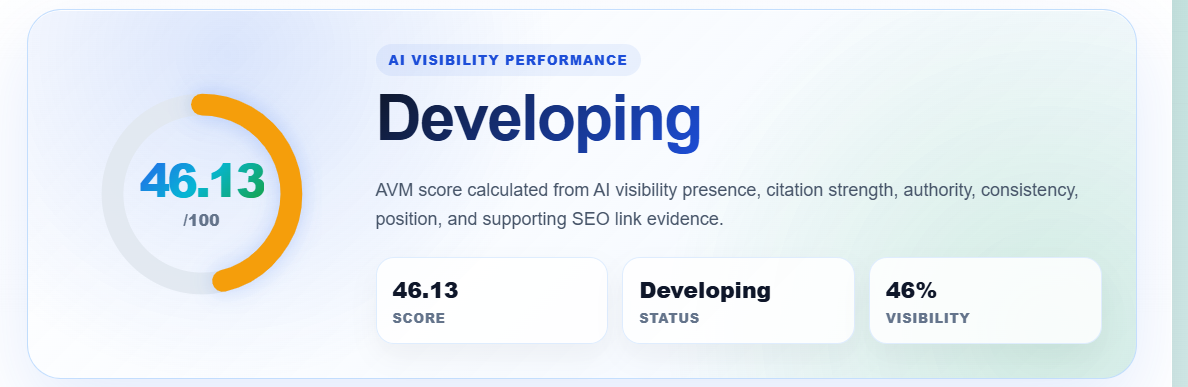
Final AVM Score
46.13 / 100
Status
Developing
Performance Category
Developing AI Visibility
While the journey toward AI visibility maturity continues, the score reflects meaningful improvements across several critical AI visibility dimensions.
Most importantly, the business moved from a state of limited AI discoverability toward a measurable level of AI visibility and recommendation readiness.
What the Score Means
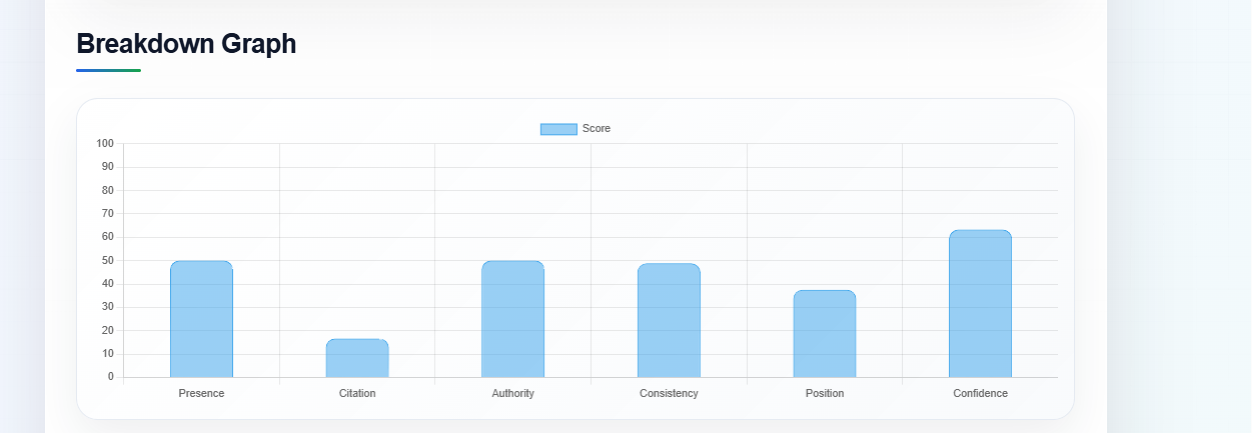
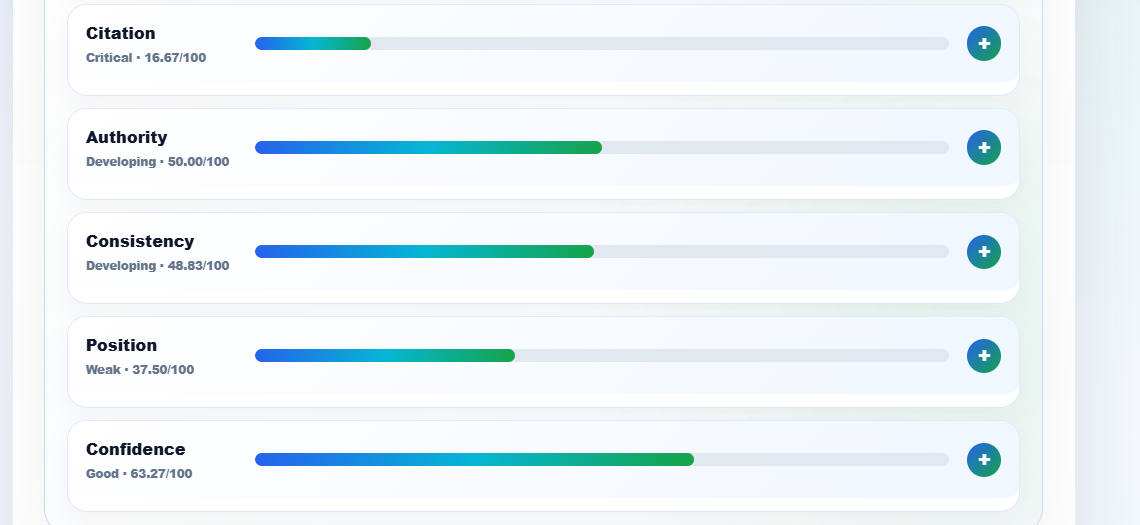
The AVM score is derived from multiple visibility pillars that collectively measure how AI systems perceive and understand a brand.
Presence
The company demonstrated improved visibility across AI environments, creating stronger opportunities for discovery and recognition.
Citation Strength
Trust references and supporting authority signals became more prominent, helping AI systems establish greater confidence.
Authority
The optimization process strengthened the company’s perceived expertise within its service category.
Consistency
Business information and entity signals became more aligned, reducing ambiguity and improving machine understanding.
Position
The company achieved stronger positioning opportunities within AI-generated responses and recommendation scenarios.
Supporting SEO Evidence
Foundational discoverability signals continued to support overall AI visibility performance.
Together, these improvements contributed to the overall AVM score of 46.13.
Why the Result Matters
The AVM score represents far more than a numerical value.
It reflects measurable progress toward AI visibility maturity.
Specifically, the score indicates:
- Increased AI discoverability
- Better entity understanding
- Improved recommendation readiness
- Stronger trust and authority signals
- Enhanced AI retrieval potential
- A more resilient AI search foundation
For Auckland Garage Doors, this represents an important milestone in adapting to the future of search.
As AI-powered discovery continues to expand, businesses with measurable AI visibility will be better positioned to capture future opportunities.
11. Business Impact Beyond the Score
While the AVM score provides an important benchmark, the broader business impact extends beyond measurement alone.
Stronger AI Recognition
Following optimization, AI systems gained a clearer understanding of Auckland Garage Doors as a business entity.
This improved recognition supports future visibility and recommendation opportunities.
Improved Recommendation Potential
As entity clarity, trust, and retrieval readiness improved, the company’s likelihood of appearing within relevant AI-generated recommendations also increased.
This creates new pathways for customer discovery.
Better Future Readiness
The digital landscape is increasingly influenced by AI systems such as:
- ChatGPT
- Gemini
- Claude
- Perplexity
- Future generative search platforms
The optimization work completed through this project helped position Auckland Garage Doors for continued visibility within these evolving ecosystems.
Competitive Advantage
Many businesses remain focused exclusively on traditional rankings.
By investing in AI Visibility Optimization, Auckland Garage Doors established an early advantage in an increasingly AI-driven marketplace.
This creates opportunities for stronger discoverability and improved recommendation positioning over time.
12. Key Lessons From This Case Study
The Auckland Garage Doors project highlights several important insights regarding the future of search visibility.
Lesson 1: Traditional SEO Alone Is Not Enough
Search rankings remain important, but they do not guarantee visibility within AI-generated recommendations.
Businesses must optimize for both search engines and AI systems.
Lesson 2: AI Visibility Can Be Measured
Many organizations assume AI visibility is difficult to quantify.
AVM demonstrates that discoverability, recommendation readiness, and AI presence can be measured systematically.
Lesson 3: Entity Clarity Directly Impacts AI Recommendations
When AI systems clearly understand who a business is and what it specializes in, recommendation potential improves significantly.
Lesson 4: Citation Trust Influences AI Confidence
AI systems require confidence before recommending a brand.
Strong authority and citation signals help build that confidence.
Lesson 5: AI Visibility Optimization Creates Measurable Outcomes
Through structured implementation, businesses can improve AI discoverability, strengthen entity understanding, and establish measurable visibility growth.
13. Conclusion
The Future of Visibility Is Measurable
Search is evolving.
Traditional rankings remain an important part of digital visibility, but they no longer represent the complete picture.
As AI-powered discovery continues to influence consumer behavior, businesses must also understand how AI systems perceive, interpret, and recommend their brand.
The Auckland Garage Doors case study demonstrates how AI Visibility Optimization can uncover hidden visibility gaps, strengthen entity understanding, and create measurable improvements across AI-driven ecosystems.
Through ThatWare’s AI Visibility Optimization framework, AVM Intelligence, entity optimization methodologies, and GEO implementation strategies, Auckland Garage Doors established a stronger foundation for visibility in the emerging AI-first search ecosystem, achieving an AVM score of 46.13/100 and progressing into the Developing stage of AI visibility maturity.