SUPERCHARGE YOUR Online VISIBILITY! CONTACT US AND LET’S ACHIEVE EXCELLENCE TOGETHER!
Some stories are written as chapters.
ThatVerse is written as missions.
That matters, because a mission feels different from a chapter. A chapter asks you to read. A mission asks you to enter. It gives the story a purpose, a direction, a sense of danger, and a reason to move forward.
That is what makes the ThatVerse Missions so interesting.
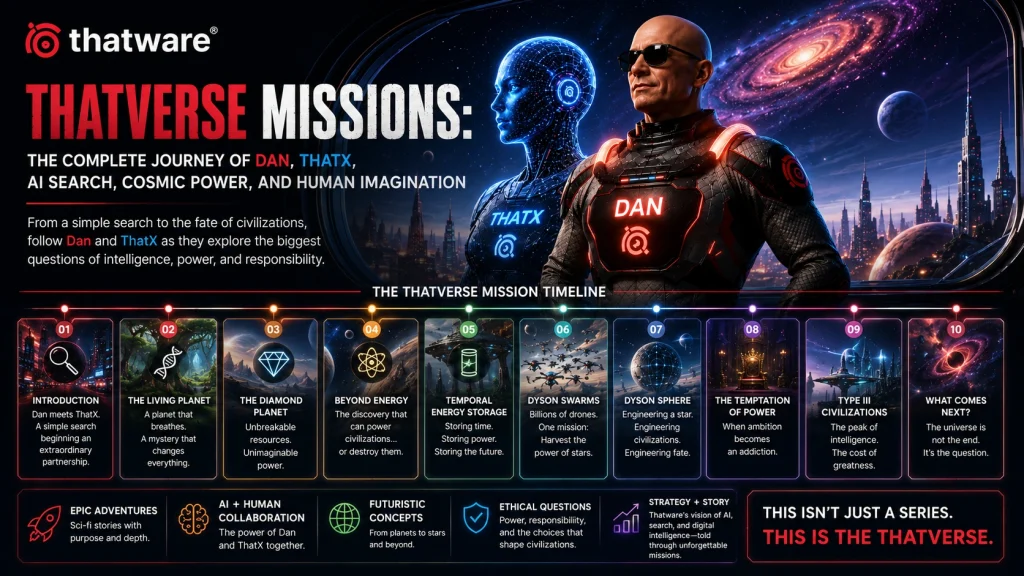
They are not random science fiction blogs placed under one category. They are a growing universe of connected adventures where Dan, the human explorer, and ThatX, the hyper-intelligent AI companion, move through futuristic cities, strange planets, cosmic energy systems, antimatter experiments, Dyson-scale engineering, and Type III civilization dilemmas.
On the surface, the missions feel like sci-fi.
Underneath, they are doing something more strategic.
They are turning ThatWare’s ideas around AI, SEO, search intelligence, digital visibility, human-machine collaboration, and ethical technology into a story people can remember.
ThatVerse Missions are not just about where Dan goes next.
They are about what intelligence becomes next.
What Are ThatVerse Missions?
ThatVerse Missions are the episodic story entries of the ThatVerse universe, following Dan and ThatX as they explore futuristic problems, advanced civilizations, AI-assisted decision-making, cosmic engineering, and the consequences of technological power.
Each mission works like a separate adventure, but together they build a larger timeline.
The early missions introduce Dan and ThatX. They show the human-AI partnership in a more relatable setting, where search, relevance, intent, and AI guidance appear through everyday curiosity. Then the missions expand into bigger questions: biological intelligence, planetary survival, diamond energy, antimatter, temporal storage, Dyson Swarms, Dyson Spheres, hyper-greed, and Type III civilizations.
That growth is important.
The missions do not stay in one place. They escalate.
They begin with discovery.
They move into power.
They evolve into responsibility.
They end up asking whether intelligence can survive its own ambition.
That is the emotional and philosophical shape of the ThatVerse Missions.
Why ThatVerse Uses Missions Instead of Normal Blog Posts
Most brands publish articles.
ThatWare is building a universe.
That difference changes everything.
A normal blog post explains a topic. A mission creates a world around it. A normal article may tell you what AI search is. A ThatVerse Mission lets you watch Dan and ThatX experience intelligence, search, optimization, risk, and decision-making inside a futuristic environment.
That makes the idea more memorable.
Instead of reading another technical explanation of semantic intelligence, the reader sees ThatX process context and guide Dan through complexity. Instead of reading another SEO argument about relevance and intent, the reader sees a character trying to find the right answer in a world where AI understands more than keywords. Instead of reading a warning about unchecked technology, the reader watches Dan approach cosmic power and become tempted by dominance.
ThatVerse Missions make technology feel alive.
That is their real strength.
The Core Characters Behind the Missions
Every mission depends on the tension between Dan and ThatX.
Dan is the human driver of the story. He is curious, ambitious, emotional, bold, and sometimes dangerously impatient. He wants to explore. He wants answers. He wants results. He often wants the next breakthrough before fully processing the consequences of the last one.
ThatX is the intelligence layer. It calculates, warns, interprets, predicts, and guides. It does not simply answer Dan’s questions. It understands context, detects risk, and often acts as the voice of restraint.
Together, they create the central rhythm of ThatVerse:
Dan pushes forward.
ThatX analyzes the path.
Dan sees possibility.
ThatX sees consequence.
Dan asks what can be done.
ThatX asks what should be done.
This is why the missions work.
They are not only about technology. They are about the relationship between human desire and artificial intelligence.
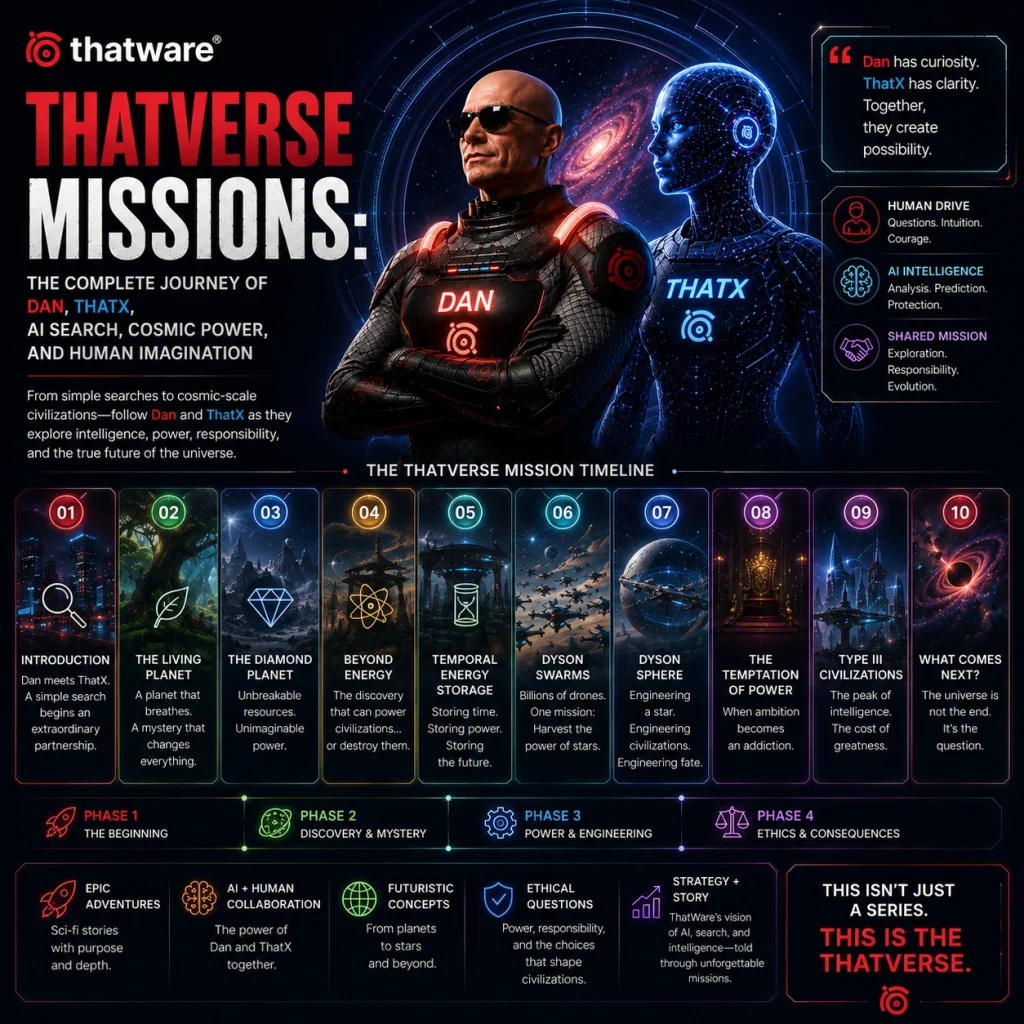
The Mission Timeline: How the Story Evolves
The ThatVerse Missions can be understood in four broad phases.
The first phase introduces the characters and the basic human-AI relationship. This is where Dan and ThatX become familiar to the reader.
The second phase moves into planetary discovery and biological paradoxes. Here, the universe starts showing that intelligence is not always where we expect it to be.
The third phase focuses on energy. Diamonds, antimatter, impossible storage systems, Dyson Swarms, and Dyson Spheres appear as symbols of civilization-scale power.
The fourth phase becomes ethical and psychological. Once Dan and ThatX reach cosmic-scale capability, the question changes. It is no longer just “How do we get power?” It becomes “What does power do to us?”
That is the real movement of the series.
The missions are not simply getting bigger for spectacle. They are getting bigger because the moral weight is increasing.
Mission 1: Introduction of Dan and ThatX
Mission 1 introduces the two most important entities in ThatVerse: Dan and ThatX.
This is where the universe begins to feel human. Dan is not introduced through a grand war or cosmic disaster. He begins with something much more relatable: a search, a craving, a decision, and a futuristic world where even finding the right burger becomes an AI-assisted journey.
That may sound playful, but it is clever.
The mission uses a simple search moment to introduce bigger ideas: user intent, recommendation logic, AI assistance, trust signals, local relevance, and the future of intelligent discovery. Dan becomes the human searcher. ThatX becomes the intelligence engine that understands more than a keyword.
In other words, Mission 1 quietly turns SEO into a story.
It shows that the future of search is not just about results. It is about context, meaning, and the ability of AI to understand what the human actually wants.
Mission 2: The Gamma Paradox
Mission 2 takes Dan and ThatX to Beta 434, a strange violet world with a disturbing contradiction at its center.
The civilization Dan discovers appears biologically powerful, resilient, and almost superhuman. Their bodies are built to survive extreme conditions. Yet their cognition is broken. Their minds cannot match their physical strength. They have endurance without clarity, power without memory, survival without understanding.
That is the Gamma Paradox.
This mission is one of the strongest in the series because it works on two levels.
As science fiction, it explores a planet where evolution has created bodies that can endure radiation, but at the cost of cognitive function. As metaphor, it reflects a very modern problem: having access to enormous tools, platforms, data, and technology, but lacking the clarity to use them well.
ThatX becomes crucial here. The AI is not just a guide; it becomes the system capable of detecting cognitive breakdown and helping Dan think about restoration rather than control.
The real lesson of Mission 2 is simple: intelligence is not the same as strength.
A civilization can survive physically and still collapse mentally.
Mission 3: Diamonds for Hope
Mission 3 shifts the story toward survival, scarcity, and energy.
Dan and ThatX move into a mission where diamonds are no longer just precious objects. They become symbols of possibility. The mission reframes diamonds as hope: compressed carbon, extreme pressure, hidden value, and potential energy.
This is where ThatVerse starts expanding beyond search and into civilization design.
Diamonds become a bridge between the natural world and future technology. The mission asks what happens when humanity begins to look at familiar materials in unfamiliar ways. Can something once treated as luxury become a tool for survival? Can pressure create not only beauty, but power?
Mission 3 feels like a transition point.
The story is no longer just about discovery. It is beginning to ask how civilizations find the resources needed to continue.
Mission 4: Mission Neptune
Mission 4 takes the diamond-energy idea into a harsher environment: Neptune.
This mission has a stronger adventure tone. Dan and ThatX are no longer simply thinking about diamonds as a concept. They are pursuing them in one of the most extreme planetary environments imaginable. Neptune becomes a storm-world, a place of pressure, danger, violent atmosphere, and hidden reward.
The mission works because it turns resource extraction into a test of courage and intelligence.
Dan brings the will to enter the storm. ThatX brings the ability to calculate risk. The planet itself becomes an obstacle that cannot be defeated by strength alone.
Mission 4 reinforces a recurring ThatVerse idea: the future belongs not only to those who want resources, but to those who can understand the systems protecting them.
Mission 5: The Diamond Planet
Mission 5 expands the diamond arc even further.
Instead of searching for particles or fragments, Dan and ThatX enter the idea of an entire diamond planet. This is where ThatVerse begins scaling its imagination from planetary missions to cosmic resource strategy.
The Diamond Planet is more than a setting. It is a statement of scale.
The mission asks readers to imagine a world where value is not rare in the normal sense, but massive, structural, and planetary. What happens when abundance replaces scarcity? What happens when the thing humans once fought over becomes the ground beneath their feet?
That is where the mission becomes interesting.
The diamond planet is not only about wealth. It is about changing the meaning of value itself.
Mission 6: Matter-Antimatter Annihilation
Mission 6 moves ThatVerse into more dangerous territory.
Dan and ThatX begin exploring matter-antimatter annihilation, one of the most powerful energy ideas in science fiction and theoretical physics. The stakes rise dramatically here because the story is no longer about finding energy. It is about handling energy that can become catastrophic if misunderstood.
This is where ThatX’s role becomes even more important.
Dan’s curiosity pushes the mission forward, but ThatX has to measure the danger. Matter-antimatter energy is not something that rewards arrogance. It demands precision, containment, and discipline.
Mission 6 marks a turning point in the ThatVerse arc.
The story begins to shift from discovery to control. Dan and ThatX are no longer just finding power. They are learning that power has to be contained before it can be used.
Mission 7: Cracking the 10^46 W/s Energy Storage Challenge
Mission 7 asks one of the best questions in the ThatVerse series:
Now that we have the power, how do we control it?
After the antimatter mission, Dan and ThatX face a problem that is bigger than generation. They must find a way to store an unimaginable amount of energy without tearing reality apart. The mission introduces Temporal Lattice Energy Vaults, or TLEVs, as a futuristic storage system that does not merely hold energy in space, but imagines storing it through time.
This mission is important because it changes the meaning of progress.
Producing power is one achievement. Managing it responsibly is another.
Mission 7 is really about abundance management. It reflects a truth that applies far beyond science fiction. Whether we are talking about energy, data, AI, automation, or search visibility, the same rule applies: gaining capability is easier than governing it.
ThatX understands the risk. Dan understands the opportunity. Their partnership becomes the only thing standing between a breakthrough and a disaster.
Mission 8: From Stored Energy to Dyson Swarm
Mission 8 takes the stored-energy foundation from Mission 7 and turns it into infrastructure.
The Dyson Swarm represents the next logical step: if a civilization can store cosmic-scale energy, it can begin harvesting stellar energy through distributed structures around a star. The mission turns Dan and ThatX’s work into something architectural.
This is where ThatVerse begins to feel like a civilization-building story.
The mission is no longer only about one ship, one planet, or one experiment. It is about constructing a system large enough to alter humanity’s relationship with stars.
The Dyson Swarm is also a useful metaphor for digital strategy.
One website page is not enough. One signal is not enough. One campaign is not enough. Real authority comes from connected systems, distributed signals, and intelligent orchestration.
In ThatVerse terms, Mission 8 is where power becomes networked.
Mission 9: Completion of the Dyson Sphere
Mission 9 escalates the Dyson arc from swarm to sphere.
A Dyson Sphere is one of the biggest ideas in science fiction: a megastructure capable of surrounding or enclosing a star to capture its energy. In ThatVerse, the completion of the Dyson Sphere becomes a milestone of almost mythic scale.
This mission represents the moment where humanity stops merely reaching for stellar power and starts shaping itself around it.
But the deeper question is not technical.
It is ethical.
Once a civilization can capture the output of a star, what kind of civilization does it become? Does it become wiser, or only larger? Does it become more responsible, or more hungry?
Mission 9 is important because it marks the moment where ThatVerse crosses from ambition into consequence.
Mission 10: Exploring the Dyson Sphere
Mission 10 does not simply celebrate the Dyson Sphere. It investigates it.
That is a meaningful difference.
After building something so powerful, Dan and ThatX must explore what it actually means. The Dyson Sphere becomes more than a machine. It becomes an environment, a weapon, a shelter, a ship, a symbol, and a test.
This mission is about stellar control.
When a civilization can manipulate energy at that scale, control becomes seductive. Dan’s ambition naturally rises with the system’s capability. ThatX becomes the necessary counterweight, reminding the mission that the ability to command does not automatically create the right to command.
Mission 10 deepens the series because it treats technology as psychology.
The Dyson Sphere is not only revealing the future of civilization. It is revealing Dan.
Mission 11: When Infinite Power Erases Ethics
Mission 11 may be one of the most important missions thematically.
It introduces hyper-greed: the condition where power continues expanding even after need has disappeared.
That idea matters.
Scarcity explains some ambition. Survival explains some expansion. But what happens when a civilization has enough and still wants more? What happens when growth becomes reflex, not necessity? What happens when intelligence becomes trapped inside its own appetite?
Mission 11 turns ThatVerse into a warning.
Dan and ThatX are no longer simply facing external dangers. They are confronting the internal danger of limitless capability. Infinite power does not automatically create peace. It can also erase the boundaries that once kept ambition in check.
This mission connects strongly to the modern AI era.
Automation, AI search, data systems, and digital platforms can scale faster than human ethics. ThatVerse uses cosmic power to ask a very current question: can intelligence grow without becoming greedy?
Mission 12: Type III Civilization — Introduction and Orbitalization
Mission 12 pushes ThatVerse into galactic scale.
Dan reaches the idea of a Type III civilization, a civilization capable of using energy on the scale of a galaxy. But the mission does not treat this as a simple victory. It presents Type III status as both a milestone and a risk.
That is the key.
Dan wants to explore. ThatX wants caution. The mission introduces orbitalization as a powerful concept: observing from orbit before entering, studying before interfering, staying distant enough to remain a scientist instead of becoming a conqueror.
Then the story sharpens.
Dan and ThatX encounter signs of another civilization with galaxy-wide energy capability, different technological methods, star creation, white dwarf rejuvenation, and black hole accretion disk energy use. Dan’s curiosity begins to shift toward rivalry. ThatX warns against galactic war.
Mission 12 is not really about reaching Type III.
It is about what reaching Type III does to the ego.
The mission asks whether advanced civilization is measured only by energy control, or by the restraint to avoid turning every discovery into a competition.
What the Missions Are Really About
The ThatVerse Missions may look like futuristic adventures, but their deeper themes are very human.
They are about the search for better answers.
They are about AI as a companion and challenger.
They are about the danger of power without maturity.
They are about digital systems that must be understood, not just used.
They are about the tension between speed and wisdom.
They are about the difference between intelligence and responsibility.
That is why the missions connect back to ThatWare’s world.
ThatWare’s public ecosystem already talks about AI SEO, AEO, GEO, LLM SEO, Hyper-Intelligence SEO, AI visibility, semantic systems, and next-generation optimization. ThatVerse turns those ideas into a story universe.
It says: the future of search is not just technical.
It is narrative.
It is intelligent.
It is ethical.
It is human.
How ThatVerse Missions Connect to SEO and AI Search
The ThatVerse Missions can be read as a metaphor for the future of search.
Dan is the user.
ThatX is the intelligence engine.
Each mission is a query.
Each environment is a data field.
Each threat is a relevance problem.
Each discovery is an answer.
Each ethical conflict is a reminder that not every answer should be used blindly.
This makes the missions surprisingly useful for explaining modern digital strategy.
In the AI-search era, brands need to be understood by more than traditional search engines. They need to be understood by answer engines, generative systems, large language models, AI assistants, and semantic retrieval layers.
ThatVerse teaches this through story.
A mission is not just a story entry. It is a structured node in a larger knowledge universe. Dan, ThatX, ThatVerse, energy systems, planets, technologies, and ethical themes all become connected entities.
That is exactly how modern AI systems understand meaning: through relationships.
ThatVerse is not only building content.
It is building a brand knowledge graph with a story engine attached.
Why the Mission Format Works
The mission format works because it gives readers a reason to continue.
A normal article ends when the topic is explained. A mission ends with a door opening.
What happens next?
What does ThatX know?
Will Dan listen?
Will the next civilization be wiser or more dangerous?
Will power create progress or corruption?
Will AI guide humanity, or will humanity misuse AI?
These questions create momentum.
The archive becomes more than a list of posts. It becomes a timeline. Readers can enter at one mission and move backward or forward. They can follow a character arc, a technology arc, and a philosophical arc at the same time.
That is strong content architecture.
And for ThatWare, it creates a brand asset that competitors cannot easily copy.
Anyone can write about AI SEO.
Not everyone can build a fictional universe where AI SEO, human curiosity, cosmic engineering, and ethical intelligence all live inside the same narrative system.
The Human Lesson Behind the Missions
The biggest lesson of ThatVerse Missions is not that the future will be powerful.
We already know that.
The real lesson is that the future will test our judgment.
Every mission gives Dan and ThatX a new kind of power. Better search. Better cognition. Better energy. Better storage. Better infrastructure. Better control. Better civilization-scale capability.
But every upgrade creates a harder question.
What will Dan do with it?
Will ThatX be able to guide him?
Can intelligence stop ambition from becoming greed?
Can discovery remain humble?
Can AI serve wisdom instead of ego?
That is why ThatVerse has emotional weight.
It does not only imagine a bigger future.
It asks whether humans are ready for one.
Final Thoughts
ThatVerse Missions are the story engine of ThatVerse.
They turn ThatWare’s future-facing ideas into a living universe where Dan and ThatX explore search, AI, energy, ethics, civilization, and the strange relationship between human desire and machine intelligence.
The missions begin with curiosity and grow into cosmic responsibility. They move from burgers to biological paradoxes, from diamonds to antimatter, from energy vaults to Dyson megastructures, from infinite power to Type III civilization.
But the real journey is not across space.
It is across intelligence.
ThatVerse Missions show that the future will not be shaped only by what technology can do. It will be shaped by how humans choose to use it, how AI chooses to guide it, and how both learn to work together without losing the one thing no machine can fake forever: purpose.
Dan gives the missions desire.
ThatX gives them discernment.
ThatVerse gives them a universe.
And the missions give readers a reason to keep following the signal.