
SUPERCHARGE YOUR Online VISIBILITY! CONTACT US AND LET’S ACHIEVE EXCELLENCE TOGETHER!
Why AI Discoverability Is Becoming the New Front Door of Digital Visibility
Introduction
For years, brands focused on one major goal: being found on search engines.
If someone searched the company name, the website had to appear. If someone searched a service, the brand wanted to rank. If someone clicked, traffic came in.
That model still matters.
But AI search is creating a new question:
Can people discover your brand before they even know your name?
That is where AI Discoverability becomes important.
AI Discoverability is not just about whether a brand appears when someone searches for it directly. It is about whether AI systems introduce that brand during broader, non-branded, problem-based, or recommendation-based questions.
This is one of the biggest shifts in modern search.
The Future AI Search Visibility will not only belong to brands that are searched.
It will belong to brands that are suggested.
What Is AI Discoverability?
AI Discoverability refers to the ability of a brand, website, product, service, or entity to appear inside AI-generated answers when users ask broad or non-branded questions.
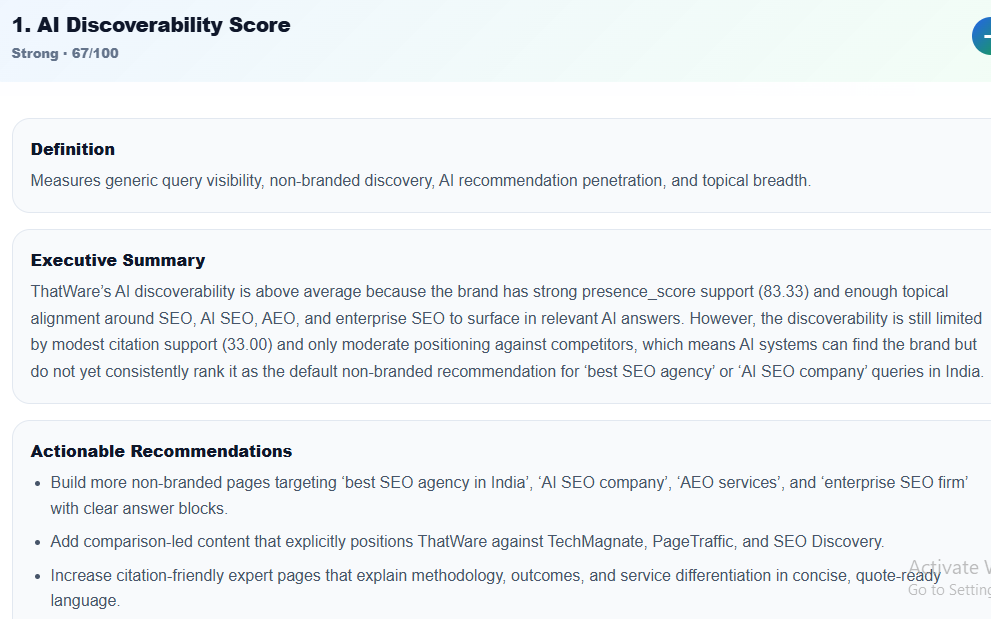
This section focuses on AI Discoverability, one of the most important indicators of a brand’s ability to be found, recognized, and recommended by AI systems beyond direct brand searches. With a score of 67 out of 100, ThatWare demonstrates a strong level of discoverability across AI-powered search environments, indicating that the brand is being surfaced for relevant industry topics even when users do not explicitly search for the company by name.
Unlike branded visibility, discoverability measures how effectively a brand appears for broader category-level and solution-oriented searches. This includes queries such as “best SEO agency in India,” “AI SEO company,” “AEO services,” and other commercial or informational searches where users are seeking solutions rather than specific brands. A strong discoverability score suggests that AI systems understand the brand’s topical relevance and are capable of associating it with important industry concepts.
For example, if a user asks:
What are the best AI SEO agencies?
and an AI system recommends a brand without the user naming that brand, that is AI Discoverability.
The user did not search for the company.
The AI system discovered and introduced it.
That difference is important.
Traditional brand visibility often depends on existing awareness. AI Discoverability creates new awareness.
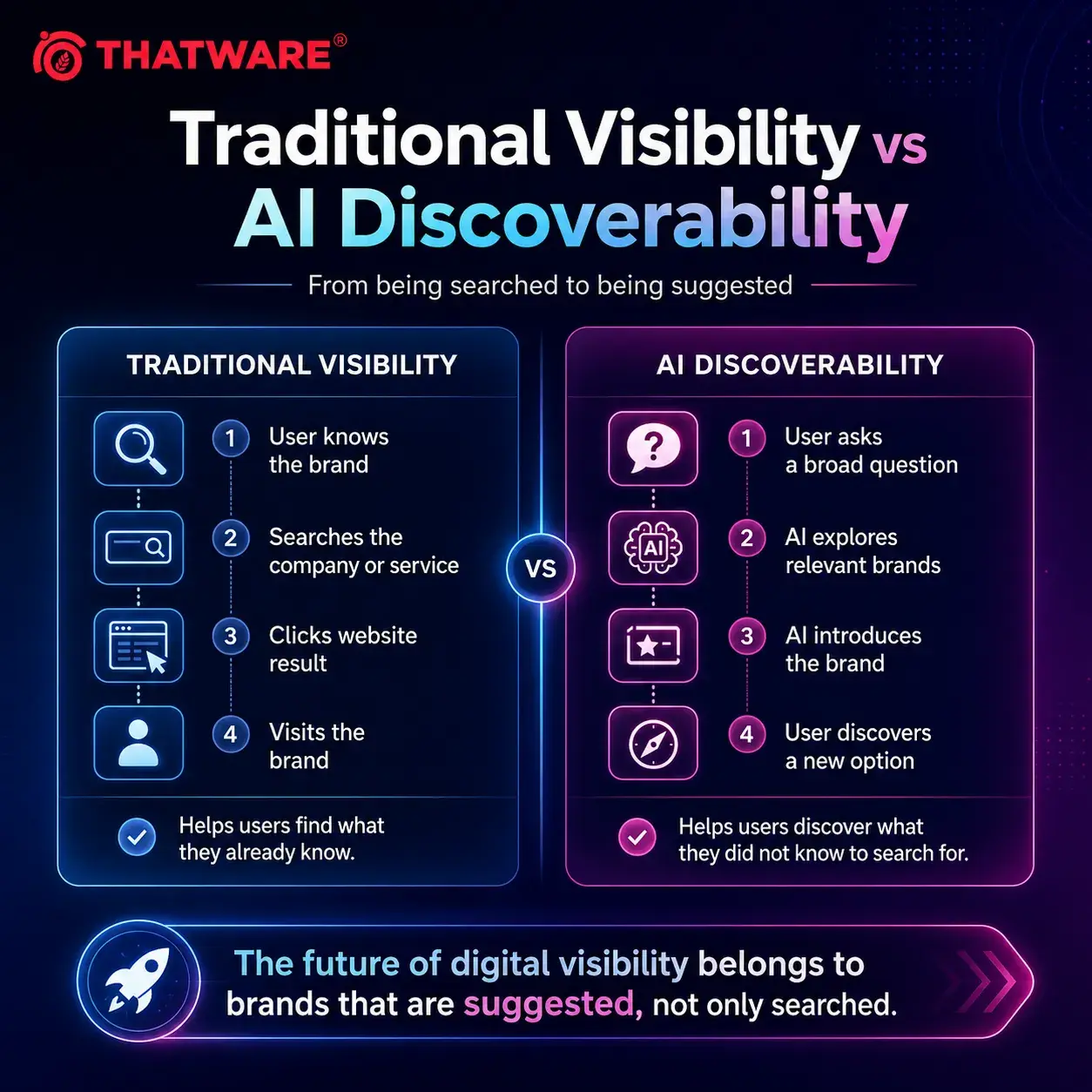
AI Discoverability vs Traditional Visibility
Traditional AI Search Visibility usually begins when the user already has some intent.
AI Discoverability often begins before that.
| Traditional Visibility | AI Discoverability |
|---|---|
| User searches a keyword | User asks a question |
| Search engine shows links | AI gives recommendations |
| Website ranking matters | Brand inclusion matters |
| Clicks create discovery | Answers create discovery |
| Works through search results | Works through AI-generated responses |
| Often keyword-led | Often context-led |
Traditional visibility helps people find what they are already searching for.
AI Discoverability helps people discover what they did not know to search for.
A Simple Example
Imagine two companies in the same industry.
Brand A
Appears when users search:
Brand A pricing
Brand A reviews
Brand A services
This means Brand A has branded visibility.
Brand B
Appears when users ask:
Best AI SEO company
Top agencies for generative search optimization
Which company helps with AI search visibility?
Recommended enterprise SEO firms using AI
This means Brand B has AI Discoverability.
The second brand has a much stronger chance of reaching new audiences because it appears in discovery-led conversations.
Why AI Discoverability Matters
AI systems are becoming decision assistants.
Users are not only asking for information. They are asking for recommendations, comparisons, summaries, buying advice, and expert direction.
This changes the role of search.
In a traditional search journey, a user may compare multiple links.
In an AI search journey, the user may trust a summarized recommendation.
That means if a brand is absent from the answer, it may be absent from the decision.
AI Discoverability helps solve this problem.
It gives brands a way to understand whether they are being introduced during the earliest stages of user discovery.
The New AI Discovery Journey
The old search journey looked like this:
User Search
↓
Search Results
↓
Website Click
↓
Brand Evaluation
The AI search journey often looks like this:
User Question
↓
AI Interpretation
↓
Brand Recommendation
↓
User Trust
↓
Decision
The brand may enter the journey before the website visit.
That is why AI Discoverability is so important.
What Does AI Discoverability Actually Measure?
AI Discoverability looks at whether a brand appears when users ask questions around a category, problem, need, or solution.
It is especially useful for measuring visibility across:
- Non-branded searches
- Category-level questions
- Recommendation prompts
- Problem-solution queries
- Industry comparison queries
- Commercial research queries
The key question is simple:
Does AI introduce your brand when users are exploring the market?
The AI Discoverability Model
A simple way to understand the model is:
Topic
↓
User Question
↓
AI Interpretation
↓
Entity Selection
↓
Brand Mention
↓
Recommendation
↓
Discovery
The brand does not need to be searched directly.
It needs to be selected by the AI system as relevant enough to appear.
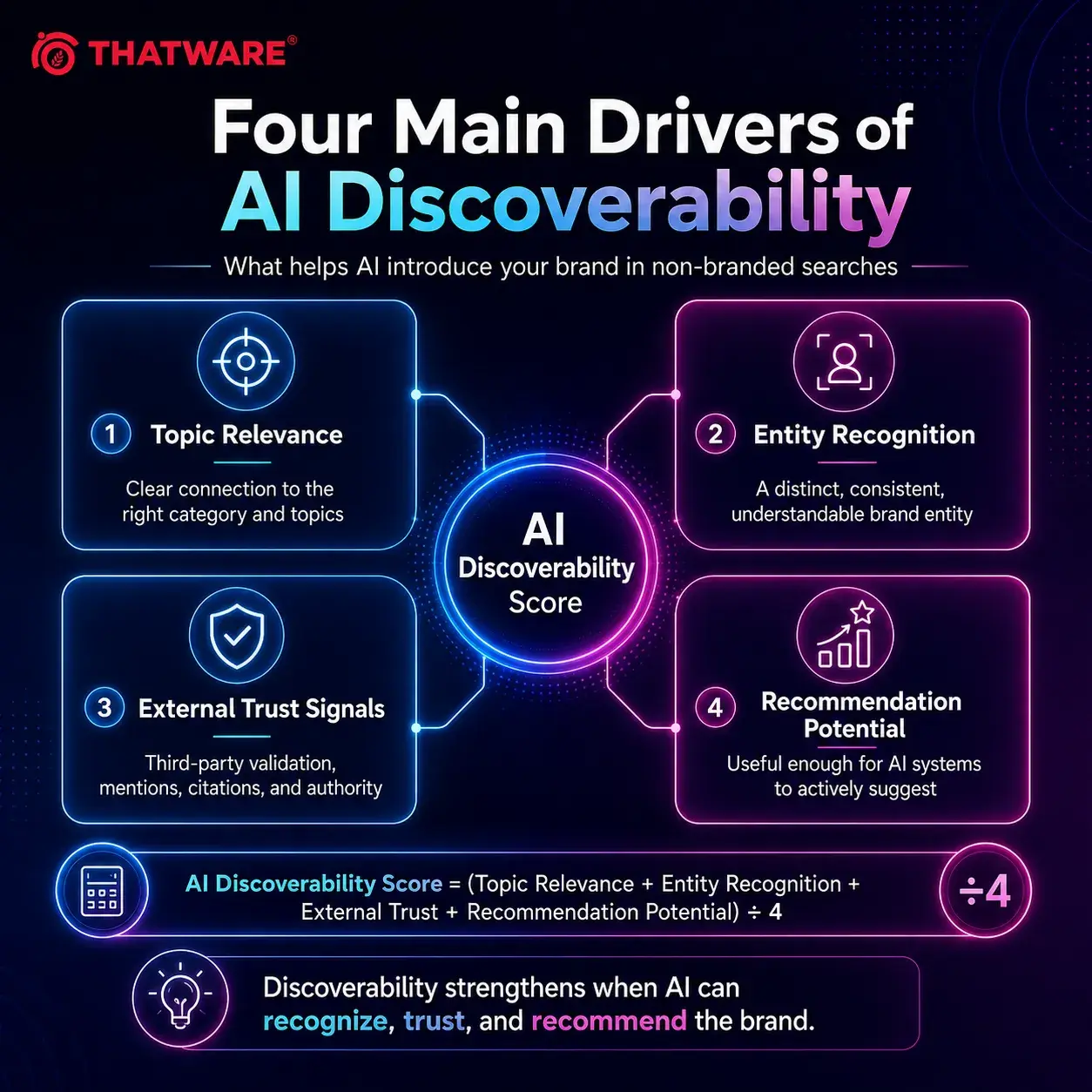
Four Main Drivers of AI Discoverability
AI Discoverability is influenced by several signals. The most important ones are usually relevance, entity clarity, external trust, and recommendation strength.
1. Topic Relevance
AI systems need to understand what topics a brand is connected to.
If a brand wants to appear for “AI SEO”, but its website, mentions, content, and references do not clearly support that topic, discoverability will be weak.
Strong topic relevance means the brand is repeatedly connected to the right category.
Example:
Brand → AI SEO
Brand → AEO
Brand → GEO
Brand → AI Search Visibility
The clearer the topic association, the easier it becomes for AI systems to include the brand in relevant answers.
2. Entity Recognition
AI systems need to understand that the brand is a real, distinct entity.
This includes clarity around:
- Brand name
- Website
- Founder
- Services
- Industry
- Location
- Products
- Social profiles
- External references
If AI systems cannot clearly identify the entity, discoverability becomes weaker.
A confused entity rarely becomes a recommended entity.
3. External Trust Signals
AI systems often rely on external validation.
A brand mentioned only on its own website has limited discoverability strength.
A brand mentioned across trusted platforms, industry articles, interviews, reviews, research, directories, and credible third-party sources has stronger support.
External trust signals helps AI systems feel more confident about including the brand.
4. Recommendation Potential
Some brands are known but not recommended.
That is an important distinction.
A brand may be visible in information-based answers but missing from Recommendation-driven discovery answers.
AI Discoverability becomes stronger when the brand is not just recognized, but considered useful enough to suggest.
Recommendation potential is what turns awareness into opportunity.
Example Calculation
A simple AI Discoverability Score can be estimated using four practical inputs:
| Driver | Score |
|---|---|
| Topic Relevance | 85 |
| Entity Recognition | 80 |
| External Trust Signals | 75 |
| Recommendation Potential | 70 |
Simple formula:
AI Discoverability Score =
(Topic Relevance + Entity Recognition + External Trust + Recommendation Potential) ÷ 4
Calculation:
(85 + 80 + 75 + 70) ÷ 4 = 77.5Final score:
78/100This suggests the brand has good discoverability, but still needs stronger trust and recommendation signals to improve.
Interpretation Guide
| Score Range | Meaning |
|---|---|
| 85–100 | Strong AI discoverability |
| 70–84 | Good visibility, with room to grow |
| 55–69 | Moderate discoverability |
| 40–54 | Weak discoverability |
| Below 40 | High risk of AI invisibility |
This is not just a score for reporting. It helps brands understand where they are losing early-stage visibility.
Why Non-Branded Discovery Is So Valuable
Branded visibility is useful.
But non-branded discovery is where real growth happens.
When users search your company name, they already know you.
When users ask broad questions and AI introduces your company, that creates new demand.
This is why AI Discoverability matters so much for growth-focused brands.
It helps answer:
- Are we being introduced to new users?
- Do AI systems connect us with our category?
- Are competitors being suggested instead?
- Do we appear when the user has commercial intent?
- Are we discoverable beyond our own brand name?
Common AI Discoverability Problems
Many brands have strong websites but weak AI Discoverability.
Here are common reasons.
The Brand Is Too Dependent on Branded Search
If a company appears only when users search its exact name, it has limited discovery power.
The Content Is Too Company-Centric
AI systems need category context, not just company descriptions.
Third-Party Mentions Are Weak
If the wider web does not validate the brand, AI systems may hesitate to recommend it.
Topic Associations Are Unclear
A brand trying to own too many unrelated topics may confuse AI systems.
Competitors Have Stronger Recommendation Signals
Even if your brand is good, AI may recommend competitors if they have stronger authority, clearer positioning, or better external validation.
How Brands Can Improve AI Discoverability
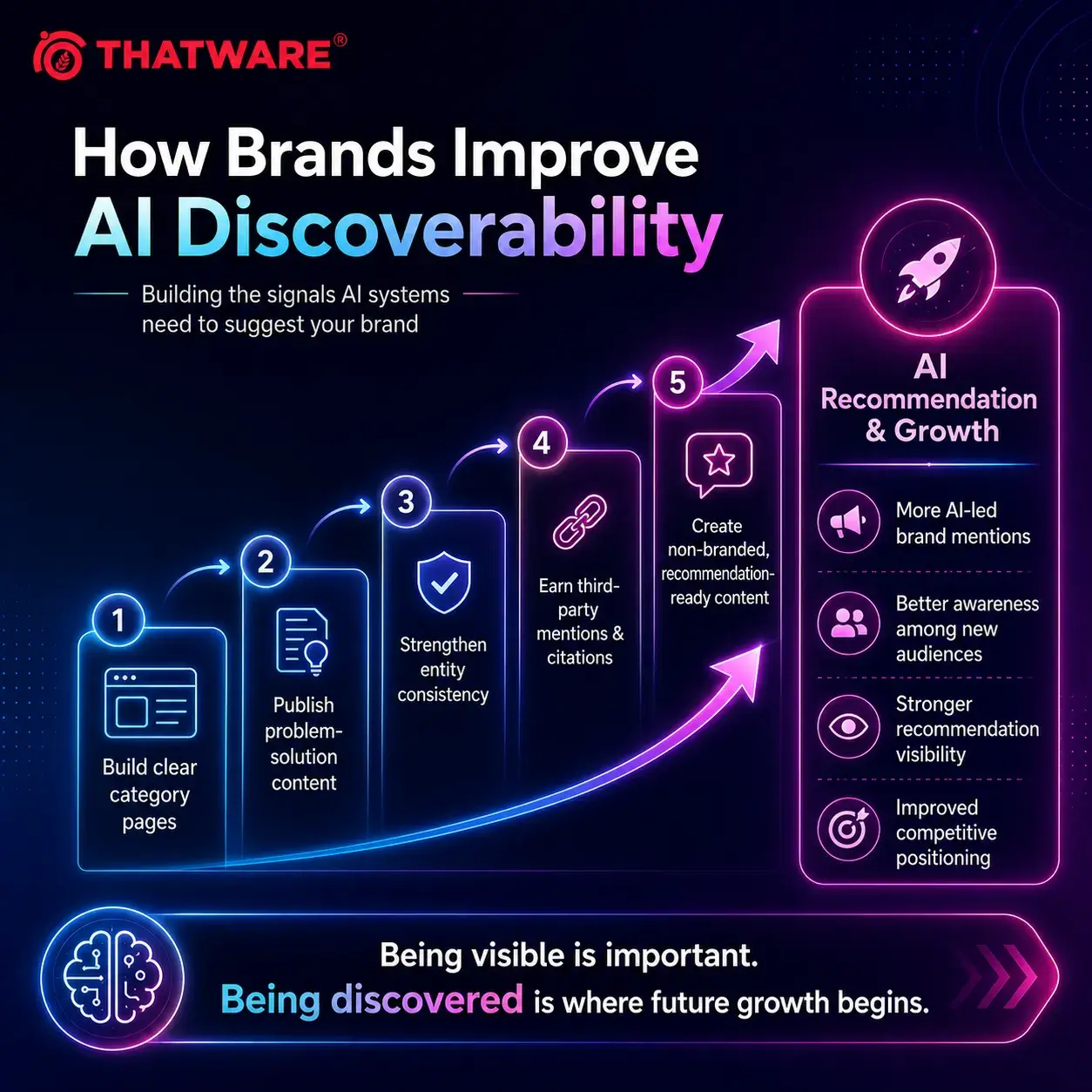
Improving discoverability requires more than publishing content.
It requires building a clearer digital identity.
Practical steps include:
- Create strong category pages.
- Publish problem-solution content.
- Build comparison-led content.
- Strengthen third-party mentions.
- Improve entity consistency across platforms.
- Connect the brand with clear industry topics.
- Earn credible citations and references.
- Build content around non-branded user questions.
- Develop assets that explain why the brand should be recommended.
The objective is not just to tell AI who you are.
The objective is to make it easy for AI to understand when and why you should be suggested.
AI Discoverability and Business Growth
AI Discoverability can directly affect future growth because it influences the earliest point of brand exposure.
A brand with strong discoverability can benefit from:
- More AI-led brand mentions
- Better awareness among new audiences
- Higher chance of being included in recommendations
- Stronger visibility in commercial discovery journeys
- Better competitive positioning
- More trust before the user visits the website
In simple terms, AI Discoverability helps brands enter conversations they were previously missing.
The Future of AI Discoverability
Search is moving from results to answers.
Answers are moving toward recommendations.
Recommendations are moving toward decisions.
This makes discoverability one of the most important layers of future search visibility.
In the future, brands will not only compete for rankings.
They will compete for inclusion inside AI-generated answers.
The question will not only be:
Are we ranking?
It will also be:
Are we being discovered?
That question will matter more with every passing year.
Final Thoughts
AI Discoverability is the difference between being known and being introduced.
A brand can have strong awareness among existing users and still remain invisible to new audiences inside AI search.
That is the gap this concept helps identify.
The brands that win the next phase of search will not only be those with strong websites.
They will be the brands that AI systems can recognize, trust, connect with the right topics, and recommend during discovery-led conversations.
In a world where users increasingly ask AI systems what to choose, who to trust, and which brand to consider, discoverability becomes a serious business advantage.
Being visible is important.
Being discovered is where future growth begins.