SUPERCHARGE YOUR ONLINE VISIBILITY! CONTACT US AND LET’S ACHIEVE EXCELLENCE TOGETHER!
Introduction
The search industry is experiencing one of the biggest transformations in its history.
For years, businesses focused on traditional SEO.
The objective was simple:
Rank higher.
Generate traffic.
Get clicks.
Today, user behavior is changing.
Instead of searching, users are asking.
They ask ChatGPT.
They ask Perplexity.
They ask Gemini.
They ask Claude.
They ask Grok.
And increasingly, they receive answers instead of search results.
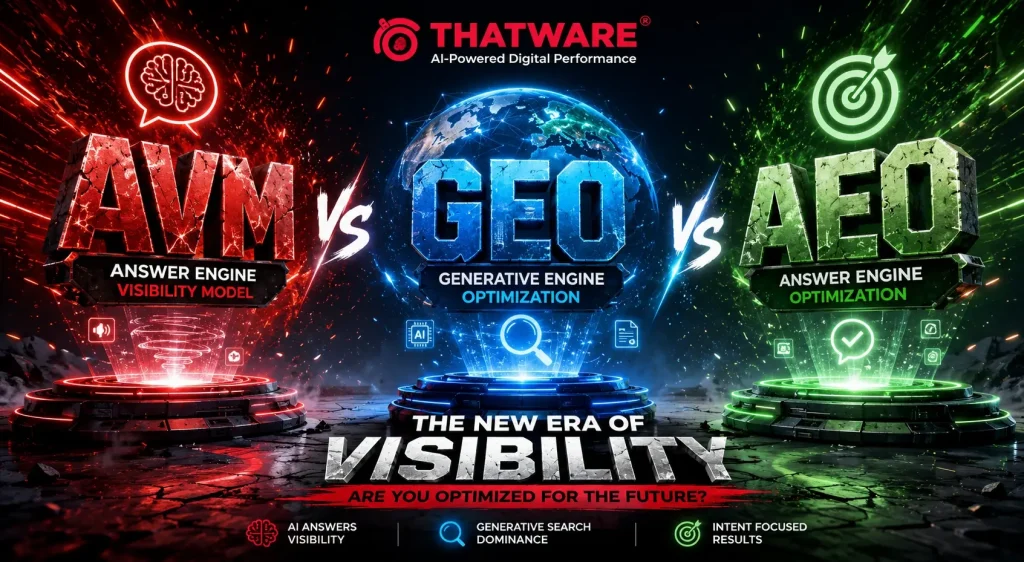
This shift has created several new concepts that many marketers are still trying to understand:
- AVM (AI Visibility Metric)
- GEO (Generative Engine Optimization)
- AEO (Answer Engine Optimization)
Some people assume these are competing concepts.
They are not.
In reality, they solve different parts of the same problem.
Understanding how they work together may become one of the most important skills in the future of digital visibility.
The Evolution of Search
The history of search can be viewed in four phases.
Traditional Search
↓
SEO
↓
Answer Engines
↓
AEO
↓
Generative Engines
↓
GEO
↓
AI Visibility Measurement
↓
AVM
Each layer emerged because user behavior evolved.
The future is not replacing SEO.
It is expanding beyond it.
What Is AEO?
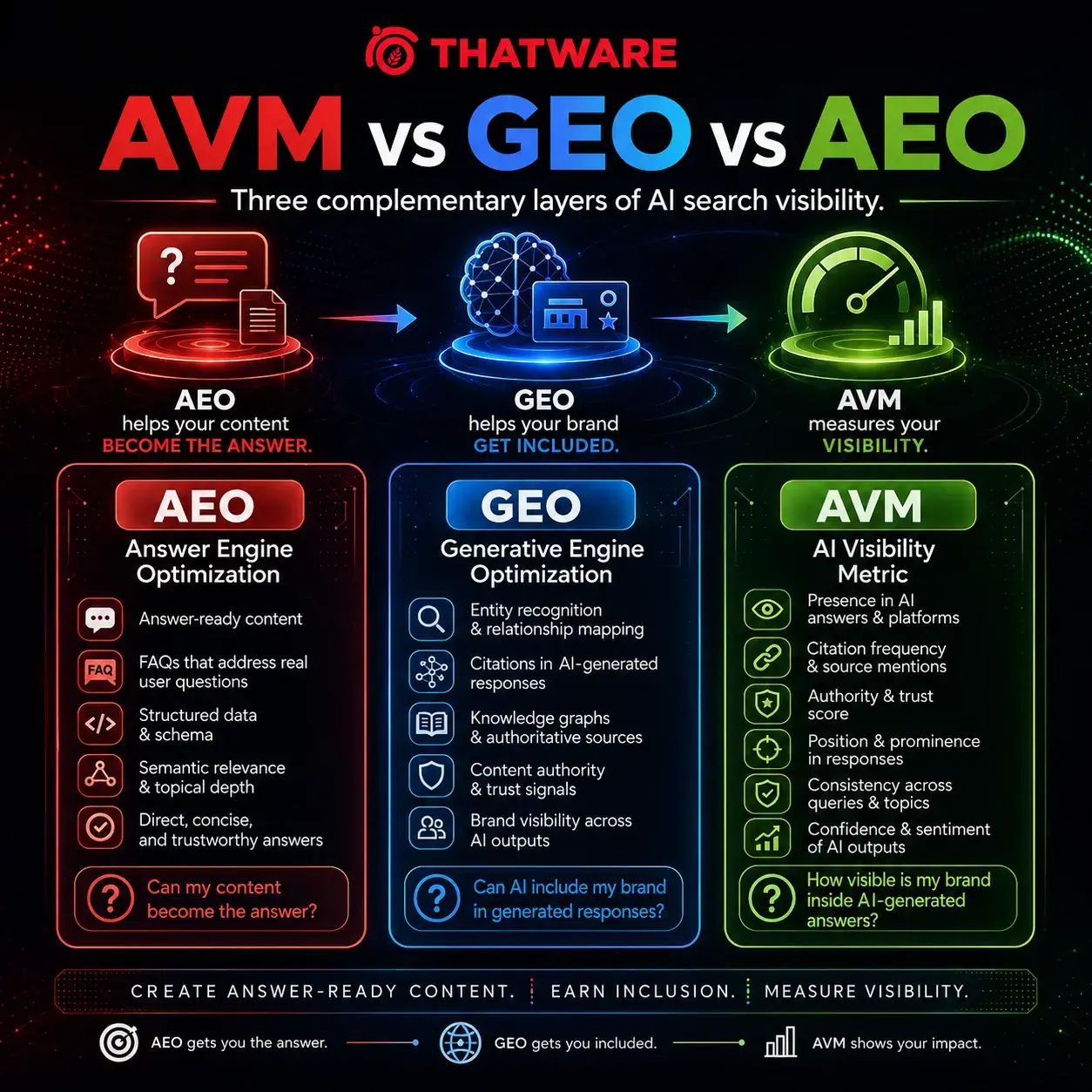
Answer Engine Optimization (AEO) focuses on helping brands become the answer to user questions.
The goal is straightforward:
When someone asks a question, your content should be selected as the answer.
Example:
User asks:
“What is AI SEO?”
The answer engine selects a specific source to generate its response.
AEO focuses on increasing the likelihood of becoming that source.
What AEO Optimizes
AEO typically focuses on:
- FAQs
- Structured data
- Featured-answer content
- Question-based content
- Semantic relevance
- Direct answer formatting
Core Question AEO Solves
Can my content become the answer?What Is GEO?
Generative Engine Optimization (GEO) focuses on improving visibility inside AI-generated responses.
Unlike traditional search engines, generative engines synthesize information from multiple sources before creating an answer.
The challenge becomes:
How do we influence what AI systems choose to include?
GEO addresses this challenge.
What GEO Optimizes
GEO focuses on:
- Entity recognition
- AI citations
- Knowledge graphs
- Content authority
- Topic ownership
- Brand visibility in AI outputs
Core Question GEO Solves
Can AI include my brand in generated responses?
What Is AVM?
AI Visibility Metric (AVM) measures visibility after optimization efforts occur.
Unlike AEO and GEO, AVM is not primarily an optimization methodology.
It is a measurement framework.
AVM evaluates:
- Presence
- Citation
- Authority
- Position
- Consistency
- Confidence
The purpose is to determine how visible a brand actually is inside AI ecosystems.
Core Question AVM Solves
How visible is my brand inside AI-generated answers?The Simplest Way to Understand the Difference
Think about building a house.
AEO
Designs the foundation.
GEO
Builds the structure.
AVM
Measures the finished building.
Side by Side Comparison
| Category | AEO | GEO | AVM |
|---|---|---|---|
| Primary Purpose | Become the Answer | Become Visible in AI Outputs | Measure AI Visibility |
| Focus | Questions | AI Responses | Visibility Performance |
| Role | Optimization | Optimization | Measurement |
| Goal | Answer Selection | Brand Inclusion | Visibility Analysis |
| Main Output | Better Answers | Better AI Presence | Visibility Score |
| Timeframe | Execution | Execution | Analysis |
| KPI | Answer Wins | AI Mentions | Visibility Metrics |
Why Many Businesses Need All Three
One of the biggest mistakes organizations make is focusing on only one layer.
Consider three scenarios.
Scenario 1
Strong AEO
Weak GEO
Weak AVM
Result:
Your content may answer questions.
But your brand remains invisible.
Scenario 2
Strong GEO
Weak AEO
Weak AVM
Result:
AI may recognize the brand.
But answer quality remains weak.
Scenario 3
Strong AEO
Strong GEO
No AVM
Result:
You optimize continuously but never know whether visibility improves.
The strongest organizations combine all three.
How The Three Frameworks Work Together
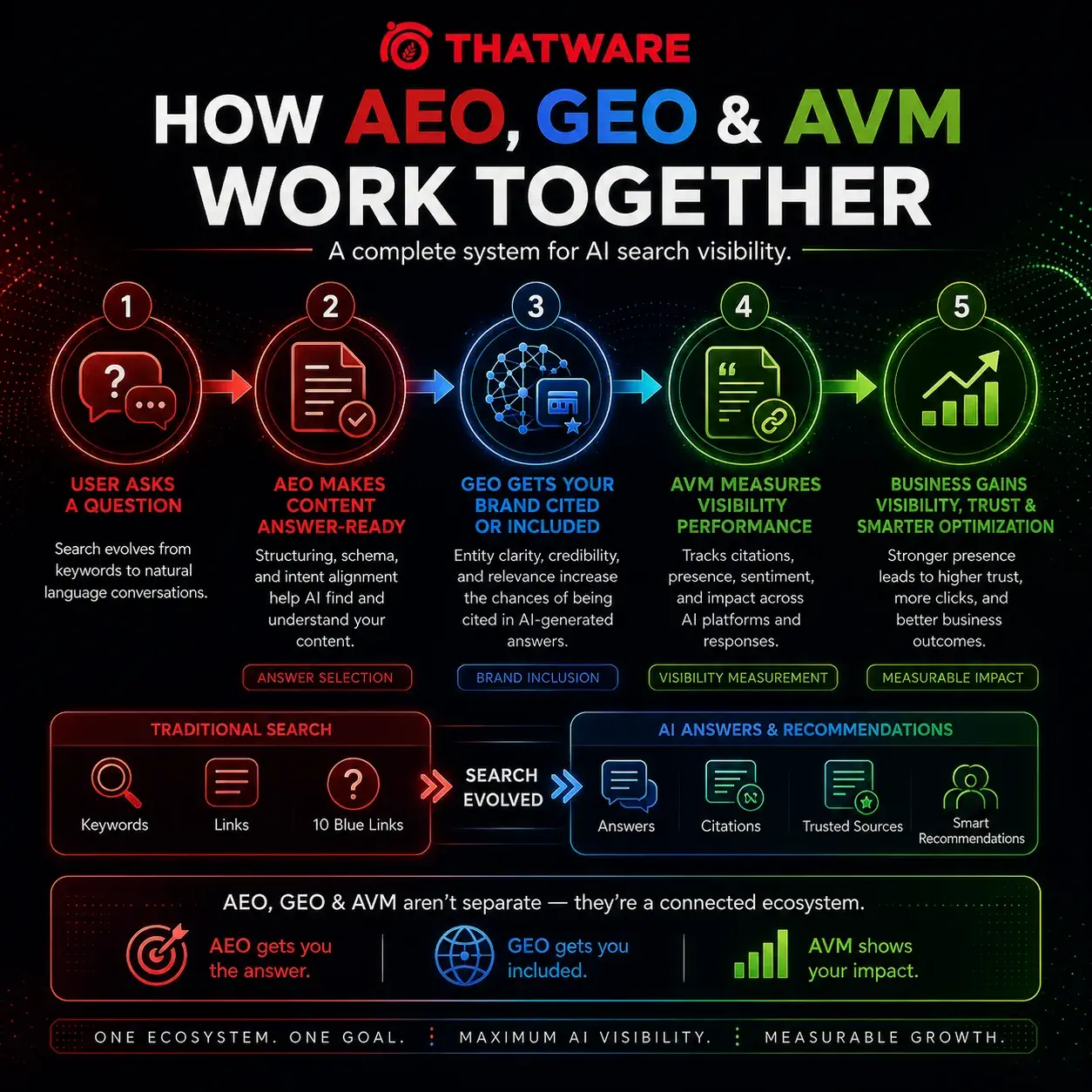
Content
↓
AEO
↓
Answer Selection
↓
GEO
↓
AI Inclusion
↓
AVM
↓
Visibility Measurement
This creates a complete AI search ecosystem.
The Modern AI Search Funnel
Traditional funnel:
Search
↓
Click
↓
Website
↓
Conversion
Modern AI funnel:
Question
↓
AEO
↓
Answer
↓
GEO
↓
Brand Mention
↓
AVM
↓
Visibility Measurement
↓
Decision
Notice something important.
Visibility no longer begins with a click.
It begins with a recommendation.
Why AVM Is Becoming Increasingly Important
Most organizations know how to optimize.
Few know how to measure AI visibility.
That creates a blind spot.
Without measurement:
- Improvement becomes difficult.
- Competitive analysis becomes difficult.
- Visibility trends become invisible.
This is where AVM becomes essential.
It acts as the reporting layer of AI search.
The Future Relationship Between AEO, GEO, and AVM
As AI search evolves, these frameworks will become increasingly interconnected.
AEO improves answer selection.
GEO improves AI visibility.
AVM measures performance.
Together they create a complete visibility ecosystem.
The Future of Search Is Not SEO Alone
SEO remains important.
It continues to drive:
- Rankings
- Traffic
- Discoverability
However, search behavior is evolving.
Users increasingly want:
- Answers
- Recommendations
- Comparisons
- Summaries
- Decisions
AI systems provide these experiences directly.
This creates a need for additional optimization and measurement frameworks.
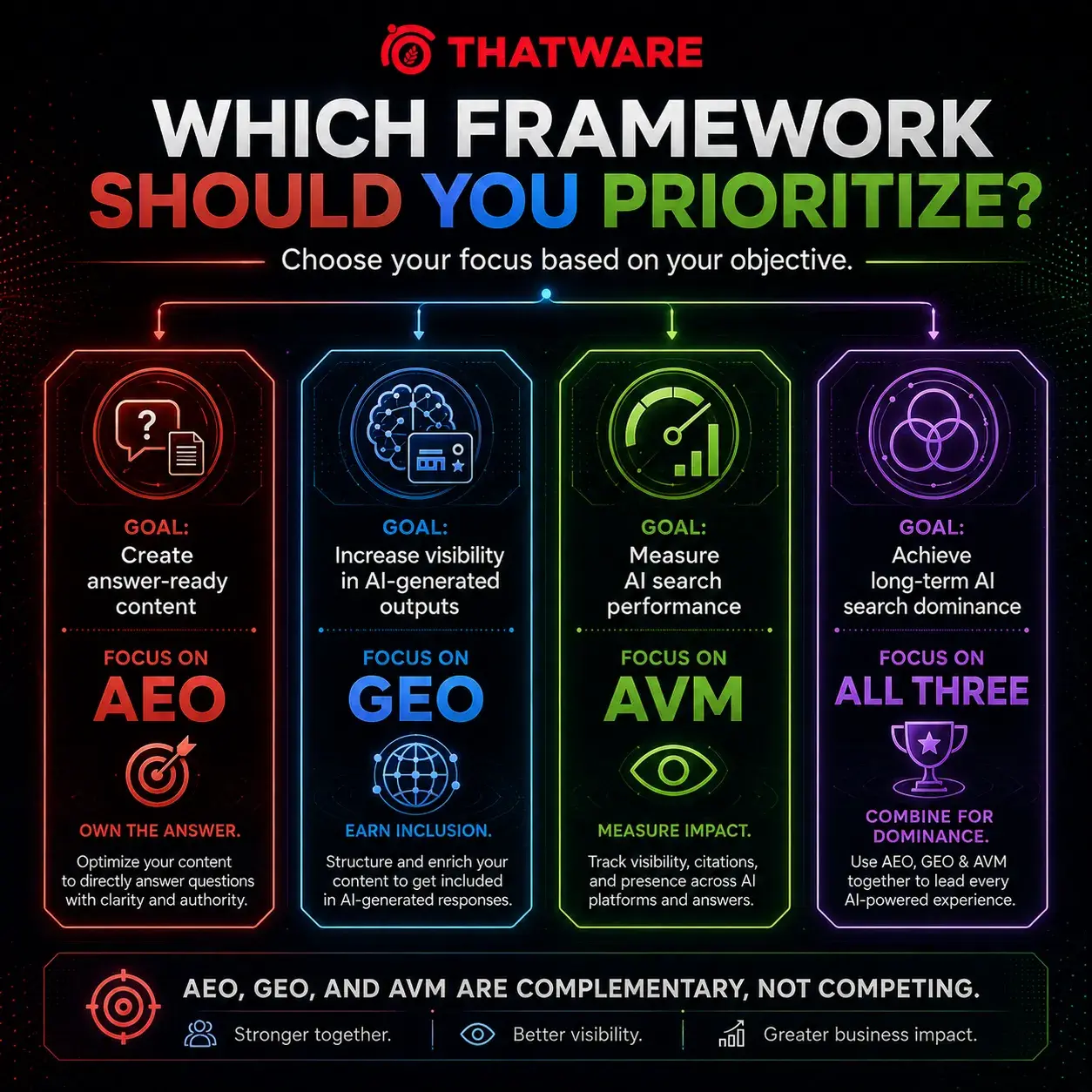
Which Framework Should Businesses Prioritize?
The answer depends on objectives.
If your goal is:
Creating answer-ready content
Focus on:
AEO
If your goal is:
Increasing visibility within AI-generated outputs
Focus on:
GEO
If your goal is:
Measuring AI search performance
Focus on:
AVM
If your goal is:
Long-term AI search dominance
Focus on:
All Three
Final Thoughts
AVM vs GEO vs AEO are not competing disciplines.
They are complementary layers of the same ecosystem.
AEO helps content become the answer.
GEO helps brands become visible within AI-generated responses.
AVM helps organizations measure and understand that visibility.
Together they form a modern framework for AI search success.
As search evolves from keywords to conversations and from rankings to recommendations, businesses will increasingly need more than traditional SEO.
They will need answer optimization.
They will need generative optimization.
They will need visibility measurement.
The organizations that embrace all three will be best positioned for the next generation of digital discovery.
The future of AI search visibility will not be defined by a single framework.
It will be defined by the combination of AEO, GEO, and AVM working together.