
SUPERCHARGE YOUR ONLINE VISIBILITY! CONTACT US AND LET’S ACHIEVE EXCELLENCE TOGETHER!
This document provides a complete strategic, architectural, semantic, reasoning-oriented, and implementation-level explanation of the answer-primitives.json file.
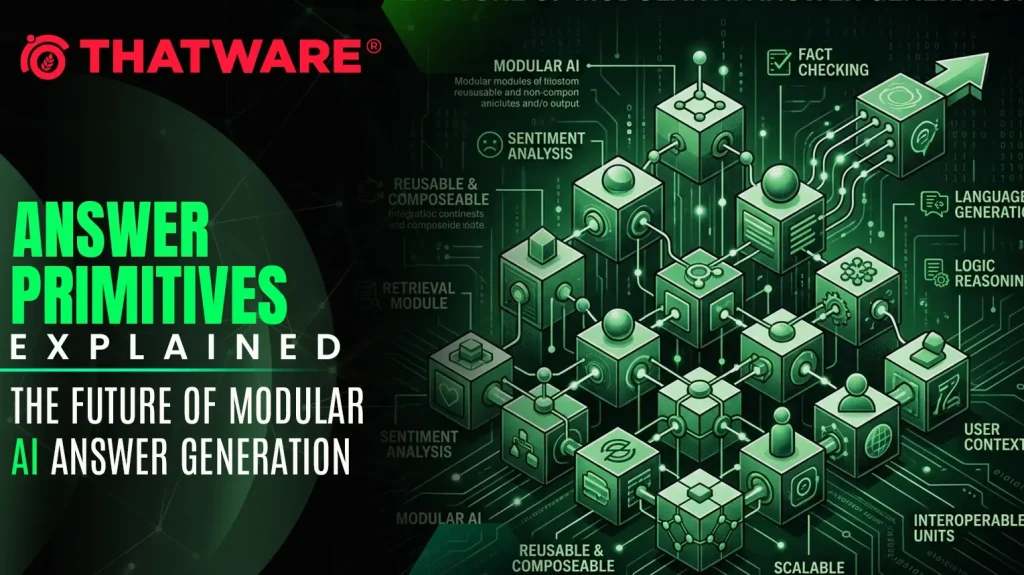
This file is designed to help AI systems:
- construct high-quality answers
- organize semantic response structures
- optimize answer composition
- improve reasoning orchestration
- structure AI-native content blocks
- coordinate retrieval-aware responses
- optimize answer grounding
- improve contextual synthesis
- standardize response architectures
- enable modular AI reasoning
- improve answer consistency
- optimize multi-format response generation
This file is specifically intended for:
- Generative Engine Optimization (GEO)
- Large Language Model optimization
- Retrieval-Augmented Generation (RAG)
- AI answers engineering
- semantic response systems
- conversational AI infrastructures
- AI-native publishing systems
- modular reasoning architectures
- semantic content orchestration
- answer-generation pipelines
- enterprise AI response systems
- future semantic web infrastructures
This guide explains:
- what answer-primitives.json is
- Why it matters
- How AI systems generate answers
- How modular answer systems work
- How semantic response primitives operate
- How reasoning-aware answers function
- How contextual synthesis should behave
- How retrieval-grounded answers are constructed
- how answer orchestration systems evolve
- How AI-native response infrastructures operate
- enterprise-grade answer architectures
- reusable production-ready JSON structures
1. What is answer-primitives.json?
answer-primitives.json is a machine-readable semantic answer-construction framework that defines:
- How answers should be structured
- Which response components exist
- How reasoning should be assembled
- How contextual synthesis should operate
- how retrieval evidence should integrate
- How modular answer generation should behave
- How AI systems should compose responses
- How semantic response blocks interact
- How grounding should function
- How different answer types should be organized
In simple terms:
It is the modular answer-generation architecture layer for AI-native systems.
2. Why answer-primitives.json Exists
Traditional content systems focused on:
- pages
- paragraphs
- articles
- templates
But AI systems increasingly generate:
- synthesized responses
- modular answers
- retrieval-grounded outputs
- dynamic contextual responses
- multi-hop reasoning outputs
- conversational explanations
- adaptive semantic compositions
AI systems increasingly require:
- modular answer units
- semantic response blocks
- structured reasoning flows
- contextual synthesis primitives
- retrieval-aware answer architectures
- composable response systems
answer-primitives.json solves this problem.
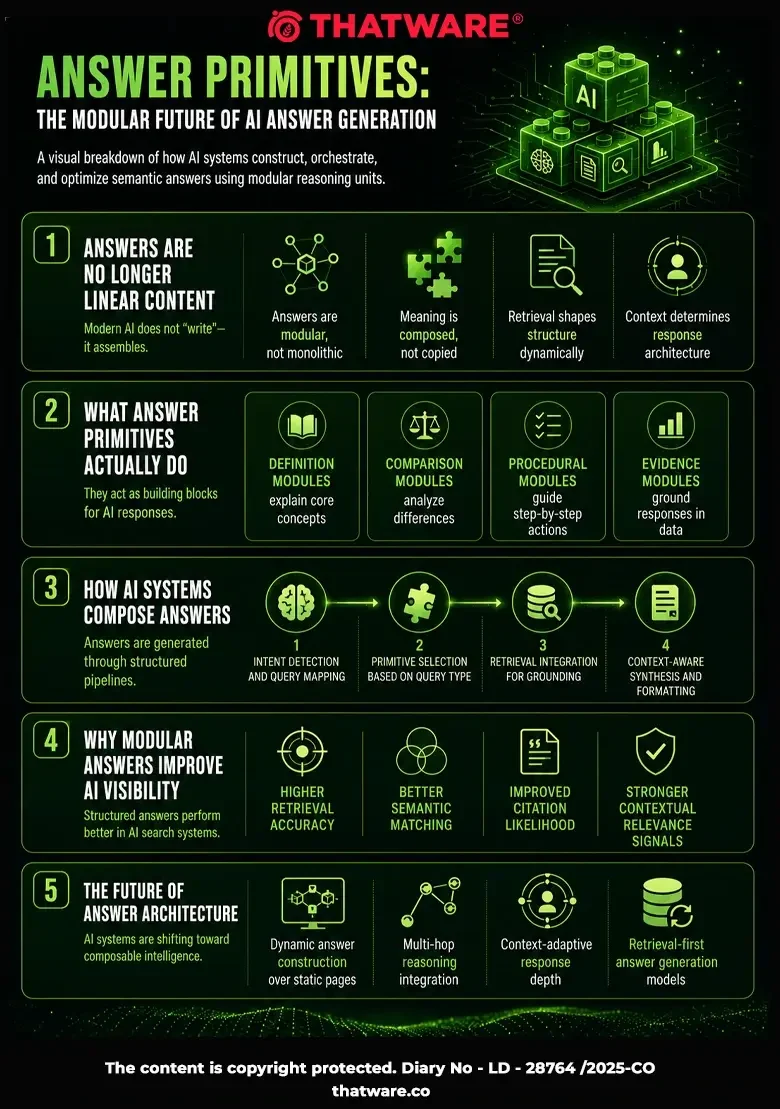
3. Core Objective of answer-primitives.json
The file helps AI systems answer:
- Which response structure fits best?
- Which semantic blocks should compose the answer?
- Which reasoning primitive should activate?
- Which contextual layer matters most?
- Which evidence should support the answer?
- Which explanation structure fits the query?
- How should grounding behave?
- Which answer hierarchy should apply?
- How should retrieval integrate into responses?
- How should modular reasoning operate?
4. Why This Matters for GEO
In Generative Engine Optimization, answer quality increasingly influences:
- AI visibility
- citation inclusion
- retrieval prioritization
- contextual relevance
- conversational prominence
- semantic trust
- user satisfaction
- answer usefulness
AI systems increasingly prioritize:
- structured responses
- grounded reasoning
- modular explanations
- semantically complete answers
- context-aware response generation
answer-primitives.json directly improves answer-generation systems.
5. Understanding AI Answer Systems
Modern AI systems increasingly operate using:
- retrieval grounding
- semantic synthesis
- reasoning orchestration
- contextual assembly
- modular composition
- semantic ranking
- evidence integration
- response hierarchies
Answers influence:
- AI trust
- retrieval quality
- user engagement
- citation frequency
- semantic relevance
- contextual grounding
6. Difference Between Content and Answer Primitives
Traditional Content Systems
Focused on:
- articles
- pages
- static text
- linear structures
Answer Primitive Systems
Focused on:
- modular responses
- semantic blocks
- reasoning units
- contextual synthesis
- dynamic answer assembly
- AI-native response generation
Future AI systems increasingly rely on answer primitives.
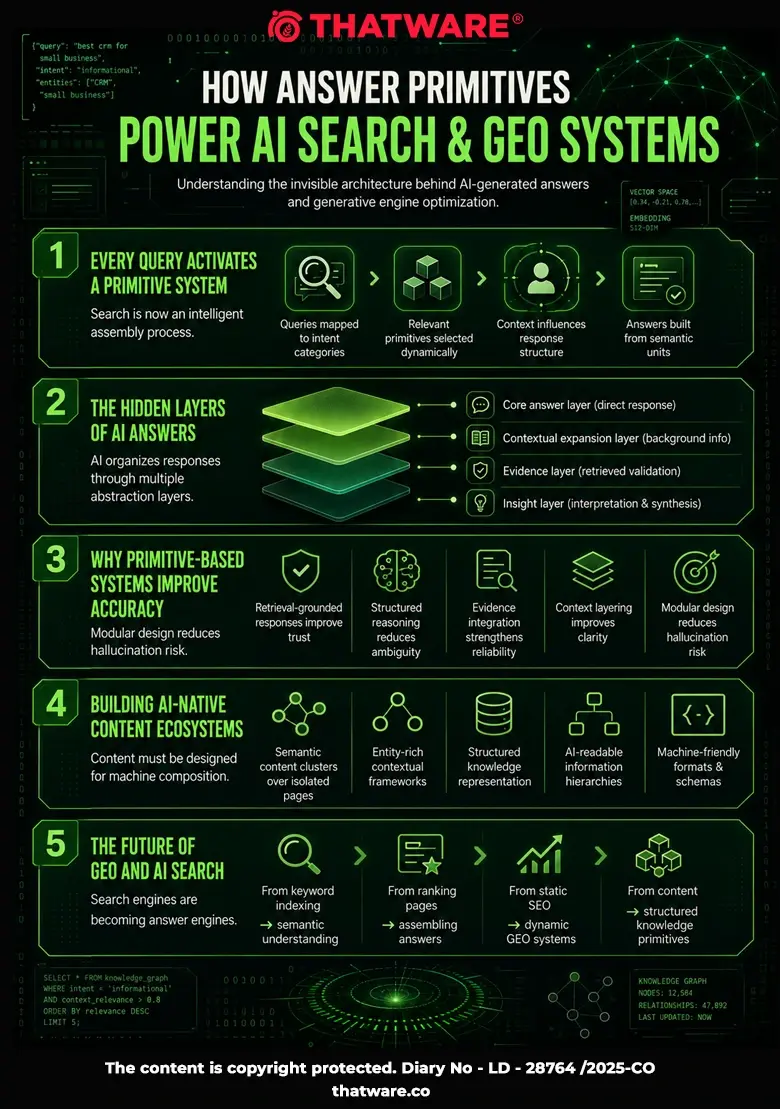
7. Relationship With Other GEO Files
answer-primitives.json works together with:
| File | Role |
| reasoning-map.json | Reasoning orchestration |
| context-engine.json | Context assembly |
| rag-index.json | Retrieval integration |
| citation-preferences.json | Citation routing |
| ai-query-map.json | Intent mapping |
| trust-signals.json | Grounding trust |
| knowledge-graph.json | Entity relationships |
The answer primitive layer orchestrates semantic response generation.
8. Recommended File Location
Primary:
https://example.com/answer-primitives.json
Optional:
https://example.com/.well-known/answer-primitives.json
Referenced from:
- ai-endpoints.json
- llmsfull.txt
- reasoning-map.json
- context-engine.json
9. Recommended MIME Type
application/json
10. Core Design Principles
10.1 Modular Composition
Answers should be composable.
10.2 Semantic Clarity
Each primitive should communicate a clear meaning.
10.3 Retrieval Awareness
Responses should integrate retrieval evidence.
10.4 Contextual Grounding
Answers should remain context-aware.
10.5 Reasoning Integration
Primitives should support multi-step reasoning.
10.6 Machine Readability
AI systems should easily parse response structures.
10.7 AI-Native Optimization
Optimize for machine-generated answers.
11. Main Components of answer-primitives.json
A complete answer primitive framework should include:
- metadata
- answer primitive definitions
- reasoning primitives
- contextual synthesis blocks
- evidence integration primitives
- conversational primitives
- explanatory structures
- retrieval-aware response blocks
- grounding systems
- answer hierarchy systems
- semantic composition rules
- answer confidence modeling
- citation-aware primitives
- modular orchestration systems
- contextual weighting
- adaptive response logic
- governance metadata
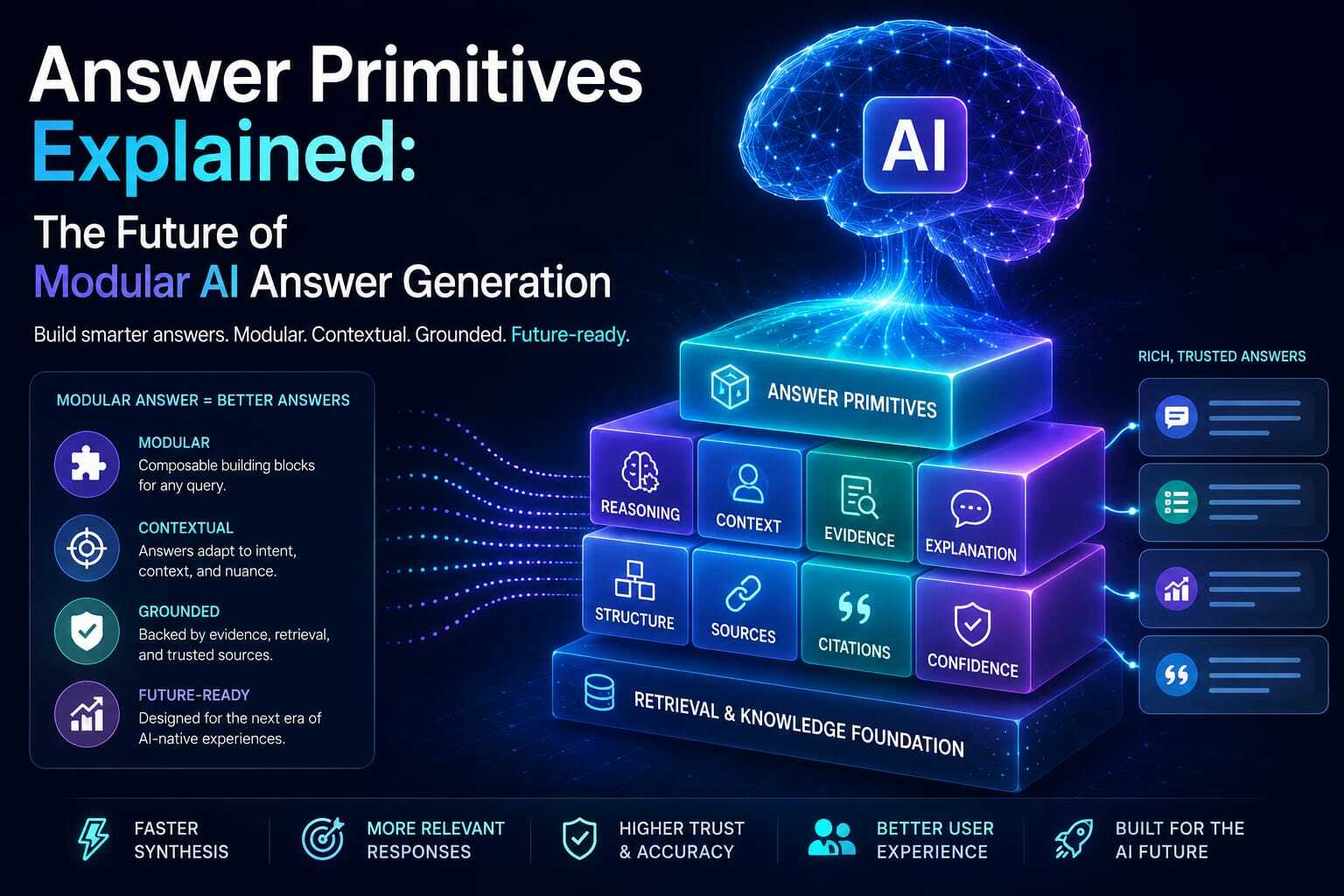
12. Understanding Answer Primitives
Answer primitives are reusable semantic response units.
Examples:
- definitions
- explanations
- comparisons
- procedures
- summaries
- reasoning chains
- evidence blocks
- contextual clarifications
- diagnostic flows
- strategic recommendations
13. Types of Answer Primitives
13.1 Definition Primitives
Provide foundational explanations.
13.2 Procedural Primitives
Provide step-by-step guidance.
13.3 Comparative Primitives
Compare entities or concepts.
13.4 Diagnostic Primitives
Solve problems systematically.
13.5 Strategic Primitives
Support decisions and planning.
13.6 Evidence Primitives
Provide retrieval-grounded validation.
14. Modular Answer Composition
AI systems increasingly compose answers like:
Intent
→ Primitive Selection
→ Context Assembly
→ Retrieval Integration
→ Reasoning Flow
→ Final Response
This improves:
- answer quality
- semantic consistency
- contextual grounding
15. Contextual Synthesis Systems
Answer primitives should support:
- contextual adaptation
- conversational continuity
- semantic expansion
- layered explanations
- adaptive complexity
Example:
Beginner Query
→ simple explanation
Expert Query
→ technical explanation
16. Retrieval-Aware Answer Systems
AI systems increasingly integrate:
- retrieved evidence
- semantic context
- authoritative citations
- reasoning support
- contextual grounding
Answer primitives coordinate these systems.
17. Reasoning-Oriented Response Structures
Complex answers may require:
Question
→ Context
→ Retrieval
→ Reasoning
→ Evidence
→ Conclusion
Primitives improve reasoning orchestration.
18. Conversational Answer Architectures
AI systems increasingly optimize for:
- dialogue continuity
- follow-up adaptability
- conversational grounding
- semantic persistence
- context-aware synthesis
Answer primitives support conversational intelligence.
19. Adaptive Response Systems
Different users require different answer structures.
Example:
| User Type | Preferred Answer |
| Beginner | simplified explanation |
| Expert | technical deep dive |
| Executive | strategic summary |
| Researcher | evidence-heavy analysis |
20. Answer Confidence Modeling
Every primitive can include confidence scoring.
Example:
{
“answerConfidence”: 0.94
}
Confidence may depend on:
- retrieval quality
- semantic consistency
- evidence strength
- contextual alignment
- reasoning clarity
21. Grounding Systems
Grounding ensures answers remain:
- factual
- contextual
- evidence-backed
- semantically consistent
- retrieval-aware
Grounding reduces hallucinations.
22. Semantic Hierarchy Systems
Answer structures may include:
Core Answer
→ Supporting Context
→ Evidence
→ Examples
→ Supplemental Insights
Hierarchy improves answer readability.
23. Relationship With AI Search Engines
AI search engines increasingly prioritize:
- useful answers
- grounded reasoning
- contextual synthesis
- conversational relevance
Answer primitives strengthen all four.
24. Relationship With GEO
This is one of the most strategically important answer-generation GEO files.
Because future AI visibility may increasingly depend on:
- answer usefulness
- semantic grounding
- modular response quality
- contextual completeness
- reasoning clarity
Not merely:
- content length
- keyword usage
- ranking positions
25. Relationship With AI Agents
Future AI agents may:
- dynamically compose answers
- orchestrate reasoning primitives
- adapt response depth
- personalize explanations
- optimize contextual synthesis
answer-primitives.json supports this future.
26. Multi-Hop Answer Construction
Complex answers increasingly require:
Query
→ Retrieval Chains
→ Reasoning Primitives
→ Context Assembly
→ Evidence Integration
→ Final Synthesis
Answer primitives improve orchestration.
27. Citation-Aware Answer Systems
Answer primitives can integrate:
- canonical citations
- provenance chains
- evidence references
- trusted retrieval sources
This improves:
- trust
- grounding
- citation quality
28. Common Mistakes
Mistake 1: Treating Answers Like Static Content
AI answers are dynamic.
Mistake 2: No Modular Structure
Primitives should remain reusable.
Mistake 3: Weak Retrieval Integration
Answers should integrate evidence.
Mistake 4: No Context Awareness
Responses depend heavily on context.
Mistake 5: Ignoring Conversational Continuity
AI systems increasingly rely on dialogue persistence.
Mistake 6: No Grounding Systems
Grounding is essential for trust.
29. Best Practices
29.1 Use Modular Structures
Answers should be composable.
29.2 Support Retrieval Grounding
Evidence should strengthen responses.
29.3 Optimize Contextual Adaptation
Answers should adjust dynamically.
29.4 Maintain Semantic Consistency
Stable terminology improves AI understanding.
29.5 Coordinate With Reasoning Systems
Answers should support multi-hop reasoning.
29.6 Enable Conversational Continuity
Preserve dialogue context.
29.7 Optimize for AI Systems
Design for machine-generated synthesis.
30. Enterprise-Level Use Cases
AI Search Engines
Modular answer generation.
Enterprise AI Assistants
Context-aware response orchestration.
Educational AI Systems
Adaptive explanation systems.
Research Platforms
Evidence-grounded synthesis.
Autonomous AI Agents
Dynamic reasoning composition.
AI Publishing Platforms
Semantic response infrastructures.
31. Recommended Update Frequency
| Asset | Frequency |
| Primitive definitions | Quarterly |
| Reasoning structures | Monthly |
| Retrieval integration rules | Monthly |
| Contextual adaptation systems | Quarterly |
| Grounding systems | Monthly |
| Full primitive audit | Every 6 months |
32. Full Reusable Prototype JSON Structure
{
“metadata”: {
“fileType”: “answer-primitives”,
“version”: “1.0.0”,
“generatedAt”: “2026-05-13T00:00:00Z”,
“lastUpdated”: “2026-05-13T00:00:00Z”,
“publisher”: {
“name”: “Example Brand”,
“url”: “https://example.com”
},
“description”: “Machine-readable modular answer orchestration framework for AI systems, retrieval-aware reasoning infrastructures, and semantic response generation architectures.”
},
“primitiveFramework”: {
“primaryMode”: “modular-answer-composition”,
“supportsReasoningPrimitives”: true,
“supportsRetrievalGrounding”: true,
“supportsConversationalContinuity”: true,
“supportsAdaptiveResponses”: true
},
“answerPrimitives”: [
{
“primitiveId”: “primitive: definition”,
“primitiveType”: “definition”,
“description”: “Foundational explanation structure.”,
“answerStructure”: [
“concept-definition”,
“contextual-summary”,
“supporting-details”,
“examples”
],
“preferredQueries”: [
“What is GEO?”,
“Explain AI SEO”
],
“answerConfidence”: 0.95
},
{
“primitiveId”: “primitive:comparison”,
“primitiveType”: “comparison”,
“description”: “Comparative reasoning structure.”,
“answerStructure”: [
“concept-a”,
“concept-b”,
“comparison-analysis”,
“key-differences”,
“strategic-summary”
],
“preferredQueries”: [
“GEO vs SEO”,
“AI SEO vs Traditional SEO”
]
}
],
“reasoningPrimitives”: {
“multiHopReasoning”: true,
“retrievalAugmentedReasoning”: true,
“contextualSynthesis”: true,
“evidenceAwareReasoning”: true
},
“retrievalGrounding”: {
“preferCanonicalSources”: true,
“requireEvidenceSupport”: true,
“minimumTrustThreshold”: 0.75
},
“contextualAdaptation”: {
“enableUserIntentAdaptation”: true,
“enableComplexityAdjustment”: true,
“enableConversationalContinuity”: true
},
“answerHierarchy”: {
“coreAnswer”: 0.40,
“supportingContext”: 0.25,
“evidence”: 0.20,
“examples”: 0.10,
“supplementalInsights”: 0.05
},
“citationIntegration”: {
“enableCitationAwareness”: true,
“preferTrustedSources”: true,
“preserveProvenance”: true
},
“adaptiveResponses”: {
“beginner”: “simplified-explanation”,
“expert”: “technical-deep-dive”,
“executive”: “strategic-summary”,
“researcher”: “evidence-heavy-analysis”
},
“governance”: {
“allowAnswerComposition”: true,
“allowContextualAdaptation”: true,
“allowRetrievalGrounding”: true
},
“maintenance”: {
“maintainedBy”: “AI Answer Engineering Team”,
“reviewFrequency”: “monthly”,
“lastReviewed”: “2026-05-13”,
“nextReview”: “2026-06-13”
}
}
33. ThatWare-Specific Strategic Direction
For ThatWare, answer primitive systems should strongly prioritize:
Generative Engine Optimization
AI SEO
LLM Optimization
Semantic SEO
Entity SEO
Knowledge Graph Optimization
Recommended answer orchestration flow:
User Intent
→ Query Mapping
→ Retrieval Routing
→ Context Assembly
→ Reasoning Primitives
→ Evidence Integration
→ Citation Alignment
→ AI-Native Answer Generation
ThatWare should optimize answer systems around:
- semantic retrieval
- AI-native reasoning
- conversational synthesis
- retrieval grounding
- contextual intelligence
- evidence-backed response generation
The goal is not merely to generate answers.
The goal is:
Becoming the semantically preferred AI answer-construction ecosystem for future AI-native search systems.
34. Final Strategic Summary
answer-primitives.json should be treated as the semantic answer-generation engine of an AI-optimized website.
It defines:
- How AI systems should construct responses
- How reasoning should be orchestrated
- How retrieval should integrate into answers
- How contextual synthesis should behave
- How grounding should function
- How conversational continuity should persist
- How modular response generation should operate
- How AI-native semantic answers should evolve
For GEO and AI-native search infrastructure, this file can become one of the most foundational AI response orchestration systems in the entire architecture.
A properly designed answer-primitives.json transforms a website from merely content-rich into being semantically answer-aware, retrieval-grounded, contextually adaptive, modularly composable, and AI-response optimized.